Art and the ecosystem at Nitroglobus in Second Life

Nitroglobus Roof Gallery: Animals on Earth

The start of October brings with it the opening – on Monday October 5th at 12:30 SLT – another provocative exhibition at Nitroglobus Roof Gallery, curated by Dido Haas.

Nitroglobus remains one of my most-visited (and most written about!) galleries because month in and mouth out, Dido encourages some of the most engaging artists to display their work there, and to do so within the frame of a theme she – or more usually the artist – has set. The result is that each most, Nitroglobus plays host to art that can provoke, evoke, emote, and engage on a level that I personally cannot help but find magnetic.

For October, the gallery is playing host to an installation put together by two artists working together under the banner of Dreamers & Co. They are Nette Reinoir (Jeanette Reinoir) – who is exhibiting her work within a gallery for the first time – and Livio Korobase, and they are  supported in part by drawings from the portfolio of physical world Dutch artist, Redmer Hoekstra.

Entitled Animals on Earth, the installation is designed to encourage us to use this time of enforced pause in our lives courtesy of the SRS-COV-2 pandemic to consider what is happening to the world’s ecosystem – its flora and fauna – directly as a result of mankind’s impact on the planet.

Modern societies have been treating Mother Earth as if it was their property; extracting resources, polluting constantly, changing the landscape, killing the animals and destroying its natural balance.
Since the Industrial Revolution, humanity has killed 83% of all wild mammals and half of all the plants on Earth. Two hundred species of living beings are extincted every single day. We collectively need to change so many things in areas such as the use of plastic, meat consumption, contaminating energies, day-to-day overconsumption and more.

– Statement by the artists

Nitroglobus Roof Gallery: Animals on Earth

Now to be sure, statistics and figures need context, and those relating to “daily” extinction rates can be called into question, as they tend to be inconsistent. For example, in 2015 the Millennium Ecosystem Assessment concluded that perhaps some 24 species of plant, insect and animal became extinct either regionally or globally every day – but the U.N. Convention on Biological Diversity put the figure at “up to 150”, a far larger number, even allowing for the “up to”. Other models present further differing rates, and all appear to be distanced from the fact that historically, we have “only” seen around 800 global extinctions of animals (land, air and marine), during the last 400 years.

However, this does not negate Animals on Earth‘s thematic message. The current epoch – the Holocene – is regarded as encompassing the sixth mass extinction level event (ELE) this planet has seen, the Anthropocene extinction; and event that is still very much on-going, and potentially accelerating. It has its roots in natural climate change as the Pleistocene period, with its rolling waves of ice ages, gave way to the warmer, wetter Holocene period, leading to the extinction of many of the large mammalian species that had acclimatised to the cold, dry ice ages, and an a matching marine megafungal extinction event that brought an end to many marine reptiles and fish due to changing sea temperatures.

But this period of extinctions was influenced by another factor: the rise of humans as organised hunter-gatherers, which gave rise to the first wave of over-hunting, accelerating the demise of many species. It was the start of a trend of human intervention and meddling in Earth’s ecosystem that has continued throughout the Holocene period such that within a few thousands of years, humankind has had one of the most dramatic impacts the Earth’s biomass has witnessed.

Nitroglobus Roof Gallery: Animals on Earth

From over-hunting, to disrupting natural environment as a result of increasing agricultural needs (notably livestock rearing) through to large-scale urban and other development and its associated infrastructure and waste, humans have significantly altered the world’s biomass in multiple ways,  own of the biggest being the distribution of mammalian life on Earth, which in 2018 was shown to be 36% humans, 60% livestock (notably cattle and pigs) and just 4% wild animals (source: The biomass distribution on Earth, Proceedings of the National Academy of Sciences). Nor does it end there; as the pre-eminent apex predator, human kind is regarded as a megahunter due to our predisposition to hunt and kill creatures pure for “sport” – an act that significantly increases the risk of regional (and even global) extinction of multiple species.

Thus, through our actions, we are directly responsible for continuing the Anthropocene extinction, and thanks to our broader impact on the climate, we are pretty much its primary driver. Our actions are bringing multiple species of fauna and flora and biota dangerous close to the edge of global extinction, we have irrefutably been responsible for many regional extinctions (rendering portions of the world and its oceans no longer habitable by species that once occupied them, even if those species survive to some degree elsewhere) over the last several decades.

It is all of this that Animals on Earth tries to encompass, and it tries to do so not by brow-beating with facts and figures or by doing so by being unduly heavy in its imagery, but by presenting us with images and models and interactive elements that in places fun (do make sure you kiss the frog) and which also serve to get the grey matter working, even if subconsciously.

Nitroglobus Roof Gallery: Animals on Earth
Flow with the thoughts and you’ll discover nature illustrates the Creator’s powers, whoever he/she is. Most of us, however, fail to appreciate nature because we’re entangled in our fast-paced lives, and life’s problems cloud our minds from grasping its beauty and lessons. Climate change, overpopulation, pollution, unfettered urbanization, and wars cause disasters to the natural environment. Little wonder we see less of nature and more of guns, nukes, and bloodshed in our cities.

Statement by the artists

Rich in colour thanks to Nette’s images, and very interactive thanks to Livio’s models and scenery (be sure to mouse-over things carefully – even  Redmer Hoekstra’s drawing are more than they seem – Animals on Earth encourages the visitor to consider Earth’s biodiversity as represented by the creatures with who we share the world, and presses us to imagine what life would be like in general terms were we to lose them.

With much to see and do – and to mull over / research – Animals on Earth officially opens to music by DJ Gorilla on Monday, October 5th,  appropriately enough, and will remain open through the rest of October.

SLurl Details

Space Sunday: supernovas, weird planets and warnings

The crab nebula: the remnants of a supernova that occurred some 6,500 light years from Earth, and was first recorded by Chinese astronomer in 1054. This is a composite picture made up of 24 images captured by the Hubble Space Telescope in December 1999 and early 2000. Credit: NASA / ESA

Life on our planet faces many threats. Cosmically speaking, the three biggest threats life on Earth faces, are solar flares an coronal mass ejections, Earth-crossing asteroids, and locate supernova events – the violent explosions of stars as they die.

Of these three, Earth-crossing asteroids tend to get the most attention, as they are regarded as the most immediate n terms of potential threat and what we can actually do to actually mitigate that threat if we’re given enough warning. Solar activity is a risk, but fortunately, when even at the peak of its cycle, our middle-aged Sun is rarely viciously violent, and when it does get angry, it’s rare that Earth is directly in the path of an lash-out – although as I noted in my previous Space Sunday article, we have recently come close.

Supernovas are also a mixed bag – we certainly can’t stop them, and if one occurs that is sufficiently violent and close enough to us, then we could be in a spot of bother no matter where we are in our orbit around the Sun. If close enough, supernovas of Type 1a or Type II could go so far as to be extinction level events (ELEs). Fortunately, in order to do so, such a supernova would have to occur in a fairly massive star that’s within a few hundred light years of us – and there are precious few of those. And if if one did explode as a supernova, that are all so far away, we’d see them long before we’d feel the effects.

Take Betelgeuse for example, a star that has caused much speculation among some due to its recent behaviour. Even if we witness the light of its supernova explosion tomorrow, it would be another 100,000 years for the “hard” radiation of the explosion’s cosmic rays to reach us.

But what of smaller stars – white dwarfs – that are also given to going out with a supernova bang? There are a couple on our neighbourhood, but they are nowhere near that stage in their lives, nd by the time they are, we’ll pretty much be beyond the distance from them at which they could do us a mischief.

While supernovae – the violent explosions of certain types of large star at the end of their lives – can leave richly colours clouds of gas and material, like the Veil Nebula seen here, some 2,400 light years away (and some of the earliest of which go on to be the birthplaces of new stars), this is not always the case. Some can leave “bubbles” in interstellar space, regions with very little material in them at all. Credit: NASA / ESA

So, does that mean supernova are not a threat? No; leaving ELEs aside, a local supernova could still trigger long-term havoc with things like the Earth’s climate. In  fact, a new study indirectly points to this possibly being the case around 2-3 million years ago, when the Earth was subjected to the effects of a nearby supernova.

The basic evidence for this comes from concentrations of 60Fe, an iron isotope, found in deep ocean sedimentary rock layers called the ferromanganese crusts. What is significant about this is that 60Fe doesn’t naturally occur here, but is a by-product of supernova events, thus leading some to conclude the remnants of such an explosion once washed over us. However, it has also been pointed out that 60Fe can also be synthesised by AGB stars as they approach the end of their lives without ever going supernova, so it is possible the deposits found on the ocean beds were purely the result of distant interaction with one or more AGB stars far back in the time of Earth’s youth.

Because of this ambiguity, a team from the Technical University of Munich gathered several dozen ferromanganese crust samples from four widely separated  locations on the floor of the Pacific ocean and at depths of between 1.6 km and 5.1 km beneath the ocean surface. They subjected all of these samples to extensive analysis to see if they could find traces of other elements that could be tied to either  a supernova or the output of an AGB star. And they were successful, finding concentrations of the manganese isotope 53Mn. This is significant as this isotope doesn’t naturally occur on Earth, nor is it a product of AGB stars – but it is a product of supernova explosions.

Not a slice of chocolate cake but a slice of a sample of the ferromanganese crust layers drawn from the floor of the Pacific Ocean and shown to contain isotopes that were most likely created by a supernova event.Credit: Dominik Koll / Technical University of Munich

Further, the team’s analysis of both the 53Mn and 60Fe concentrations revealed that both are present in similar amounts and the same ratios throughout all of the samples studied. This suggests that both were present in the Earth’s biosphere at the same time, and were deposited on the ocean floor in  similar quantities over the same period of time, again pointing to them having a common origin in a supernova event. What’s more, because 60Fe has a half-live of 2.6 million years before it decays into nickel, said supernova  could not have occurred more than about 2.5 million years ago.

In addition, the concentrations of both isotopes proved sufficient for the team to estimate the like size of the star the caused the supernova: between 11 and 25 times the size of our Sun. That’s of a sufficient size for the supernova to create what’s as called a “bubble” or “cavity” in space:  a  region that appears to be almost completely  devoid of matter. Interestingly, for the last 7-10 million years, our solar system has been travelling through just such a “bubble”, called the Local Cavity. It is believed to have formed as a result of number of supernova events that occurred between 20 and 10 million years ago – which creates an interesting overlap with the idea of a supernova affecting Earth some 2.5 million years ago.

2.5 million years ago also marks the start of the of Pleistocene period, a time of considerable climate change that saw repeated cycle of ice ages that in turn saw dramatic shifts in the flora and fauna, with multiple mini extinction events, This cycle then repeated in the late Pleistocene through early Holocene (11,700 years ago), and the planet started to warm up again, leading to further cycles of extinction (notably those mammals that had developed to level in the cold, like the woolly mammoth).

What triggered that sudden cooling is unknown, but while the Munich study doesn’t point it it directly, it has been shown that severe interference by cosmic rays can cause dramatic shifts in climate, particularly towards the colder extremes. So again, the time link between that ancient supernova evidenced in the ferromanganese crusts of the seabed  and rise of the ice ages of the Pleistocene is interesting.

Climate change during the early Pleistocene period – possibly the result of atmospheric interference by the supernova – may have given rise to the glaciation periods that occurred throughout that time. These in turn spurred the evolution of species such as the woolly mammoth, the European  Cave Lion and woolly rhino (both to the right of the painting above), all of which became extinction as Earth’s climate once ago changed over the late Pleistocene  and into the Holocene, with some extinctions (such as the mammoth) likely accelerated by over-hunting by primitive humans. Image: painting by Mauricio Antón, “What Killed the Woolly Mammoth?”

Starship SN8 Set for Pressure Tests

The core hull of the SpaceX Starship prototype SN8 was moved to the test stand during the pas week to undergo tank pressure tests. Fitted with the aft aerodynamic flaps that will help the vehicle “skydive” through the atmosphere, but sans the upper section, nose cone and forward aerodynamic surfaces, and currently without motors, the core section was due to undergo a pressure test as this article was being written.

Starship prototype SN8 with aft aerodynamic surfaces in their folded configuration sitting on the test stand at the SpaceX Boca Chica facilities. Its flight to 15 km altitude should take place in the next couple of weeks. Credit: RGV Aerial Photography

This test involves the tanks within the section being filled to operating pressures with inert liquid nitrogen. A hydraulic ram under the stand the exerts pressure on the base of the structure to simulate the stresses the three Raptor engines that power the vehicle will place on the structure in order to verify its fitness for flight.

Should this test be successful, SN8 will have the upper sections added, and its engines mounted. It will then go through further tests, including actual fuelling and a static firing of it motors. Once all these tests have been completed, the vehicle will be ready for its 15 km high “hop”, which is likely to take place before the end of the month.

At the same time as SN8 is undergoing its tests, prototype SN9 is also being readied for its first flight.

Continue reading “Space Sunday: supernovas, weird planets and warnings”

Rock Your Rack 2020 in Second Life

via Rock Your Rack

Rock Your Rack is the annual fund-raiser for the National Breast Cancer Foundation (NBCF) opened its doors on Saturday, October 3rd, and remains in full swing through until Sunday, October 18th, 2020, offering shopping, music, fashion shows, entertainment and art.

Some 1.7 million women – and men – were diagnosed with breast cancer in 2012, the year in which Rock Your Rack was founded by Jamee Sandalwood and the team at Models Giving Back. Today, the figure still stands at around 1.6 million world-wide. NBCF’s mission is to help women in the United States by providing help and inspiring hope to those affected by breast cancer through early detection, education and support services. NBCF is also joining hands with organisations around the globe to provide breast cancer education, and Rock Your Rack aims to raise funds to support all of these activities.

Located on a single region, the event this year has a distinctly tropical theme, and is sponsored by Digital Farm System, Dark Betty, Darkstar’s Speakeasy, Designs By Soosy, NY NY Piano Lounge, Rapture, and Swank Events. and has more than 60 designers and merchants taking part.

As with previous years, supporting designers have been asked to provide a limited edition item, of which 100% of all proceeds of sales go towards Rock Your Rack. In addition, and to encourage visits to the event, designers have been asked to offer an exclusive item their customers can only purchase via Rock Your Rack.  You can find out more about the limited edition and exclusive offers at the event here.

Rock your Rack 2020: art show

Entertainment will be on offer each weekend of the event and features bot DJs and live singers. Special performances by Terpsicorps Artwerks are also a feature of this year’s event. Just under 40 artists are participating in the Rock your Rack art show this year, presenting a rich mix of art covering SL avatar studies and landscape and physical world art created by the the artists involved. And, of course there will be the event fashion shows.

The complete event schedule can be found in the calendar below – all times SL. However, be sure to check the Rock Your Rack website for concise schedules for things like the weekend entertainment schedules.

Those so minded can also take part in the Rock Your Rack hunt. Many of the designer and other booths at the event  have a L$10 item available as part of the Rock Your Rack Hunt – look for the heart-in-a-clothes hanger objects. Then can be found all over the event region – including the art show!

Rack Your Rack 2020: fashion show stage

About Rock Your Rack

Rock Your Rack is the annual fund-raiser for, and officially endorsed by, the National Breast Cancer Foundation in the United States. launched in 2012, the event has been held every year since then, operating on the basis of complete transparency. All documentation relating to the funds raised at each event from screenshots of totals raised, through the Lindex credit processing of US dollar amounts out of Second Life to donation receipts from the MBCF, are posted each year directly to the Rock Your Rack website.

SLurl and URL Details

Stopping by a Paradise on Sea in Second Life

Paradise on Sea, October 2020 – click any image for full size

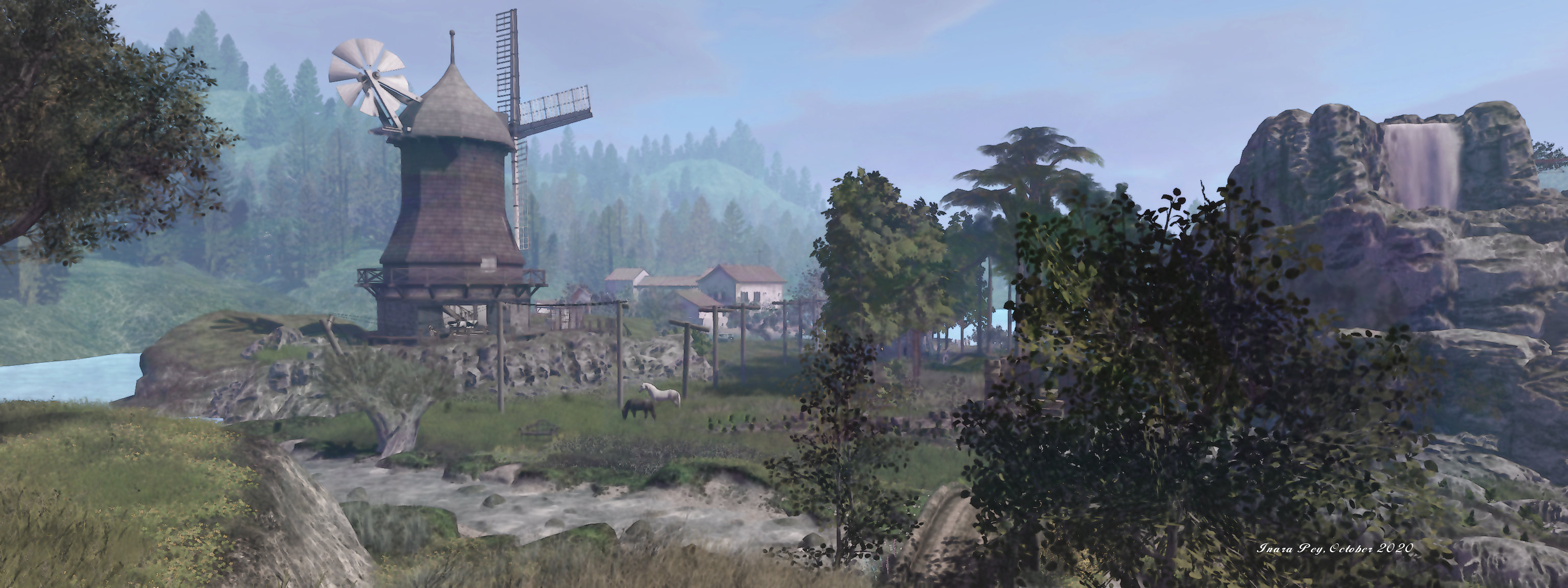
Paradise on Sea came to our attention via Shawn Shakespeare (who has perhaps the most unique talent for finding regions that are open to photographing / writing about). A Full region held by Bellita (Belle Onedin), it offers a home for her SL business, Heart Poses located on a sky platform high above the region, and a ground level that is open for visitors to explore and appreciate.

Set in summertime, the region offers a warming visit for those of us sitting in the northern hemisphere, where the weather seems to have decided to skip autumn entirely, and settled on scowling, rainy, winter-like days. Given this lean towards summer, Paradise on Sea is a bright, lush setting, full of greenery and with flowers – wild or potted – in full bloom to offer bright splashes of colour against the rich greens.

Paradise on Sea, October 2020

Although offering the “on Sea” in its title, the region has the appearance of being located within a landlocked lake, verdant hills cut by a single  serpentine river surrounding its three islands. The largest of these, forming the bulk of the region, is home to the landing point – which is not enforced (in fact the coordinates found in About Land’s Options tab are actually off, and will drop you into the waters of the region’s east side) – is located in an old stone ruin that offers a teleport disk up to the Heart Poses store.

The landing point sits at the feet of a tall, blunt-topped peak of rock that rises from a broad base that mixes grassy slopes with pools of clear water fed from numerous falls that tumble from multiple points in its sheer faces. It’s a distinctive rocky mass, vying with the huge form of a wooden windmill sitting on its own rocky upland to the south, and a nearby cedar of Lebanon for recognition as the tallest object on the island.

Paradise on Sea, October 2020

From the landing point, a cobbled path points both north and south – the former direction leading to the open fields that wash tall grass around the base of the windmill’s rocky foundation, while the latter direction winds its way to the north side of the region and the shallow cove of a beach.

Here wooden platforms rise in individual tiers from the narrow lip of grass between the beach the the walls of the high peak, ladders linking them to provide the means to scale the heights, passing water that drops to feed the beach-side pools that don’t reach the lake but instead offer places for birds and ducks to take a drink. Climb the ladders and platforms, and they’ll take you to a point just below the summit where a hot spring resides – or for the daring, a hang glider can be launched for an aerial view of the region and its surrounds.

Paradise on Sea, October 2020

The windmill is not the sole building within the region: four houses await discovery by explorers, with three of distinctly Tuscan design, suggesting the region might be somewhere inland in central / northern Italy. Two of these are to be found on the smaller islands that lie to the north-west and on the east side of the main land mass. Both are furnished and offer much to see both indoors and in the grounds around them The third and largest a villa occupies a south-west headland that is just a jumble of rocks away from becoming separated from the rest of the landscape as it dominates the flat sandstone slab of rock on which it sits. Again furnished, and with an inviting courtyard within its walls, it calls to visitors to come and explore it.

A surfaced, single-tracked road curls outward from this villa’s humped bridge. Passing around the shoulder of the windmill’s table of rock, the road ends close by a gabled cottage with an air of rural France about, it neatly juxtaposed by the very British presence of an old red telephone booth facing it over a parked car. Sitting within its own gardens and grounds, this cottage lies just above the waters of the lake and shares its location with a charming little painter’s studio and a small houseboat linked to the land by a wooden pier and deck to offer something of a floating summer house.

Paradise on Sea, October 2020

This is a region packed throughout with detail and many, many opportunities to sit and relax as well as for taking photographs. As noted, all of the houses are furnished – as is the windmill, while the outdoor sitting spots can be found in their grounds or gardens, along the beach, up on the tall peak and elsewhere. Cars (roadworthy and not) add a further sense of human life to the setting, whilst the birds overhead and the horses in fields and close to houses add their mix of life and presence to the setting.

With so much going on within a region that uses the private region land capacity bonus, there is a lot for the eye – and the viewer – to take in, and it would be remiss of me not to note the fact that the volume of mesh and textures can take its toll on older systems, and disabling shadows for those that use them might be advisable when moving around. Nevertheless, Paradise on Sea is a rewarding and engaging visit, and photos taken within the region can be submitted to its associated Flickr stream.

Paradise on Sea, October 2020

SLurl Details

2020 TPVD meeting week #40: summary (more cloud uplift)

Eterea, August, 2020  – blog post

The following notes are taken from the TPV Developer meeting held on Friday, October 2nd, 2020. These meetings are generally held every other week, unless otherwise noted in any given summary. The embedded video is provided to Pantera – my thanks to her for recording and providing it. Time stamps are included with the notes will open the video at the point(s) where a specific topic is discussed. Note these summaries are not intended to be a full reporting on all topics discussed, but focus on those items that are more directly user-facing.

This was an exceptionally brief meeting, with some discussion in chat, so please refer to the video as well.

Cloud Uplift – Agni

[0:06-3:39]

In my CCUG meeting summary, I noted that regions running on AWS are starting to appear on the main grid (Agni).

Commenting on progress of the Uplift project at the start of the meeting, Oz Linden indicated the Testylvania region (a restricted access region intended for testing purposes) is also running via AWS. It is regarded as “feature complete”, and the region is specifically available to TPV viewer developer for compatibility testing.

Any TPV developers who cannot access the region should contact one of Mazidox, Maestro or Kyle Linden.

It addition, Oz noted:

We currently have several dozen regions [on Agni] running uplifted, some of them user-accessible and some not. We will be ramping that up over the next few weeks. … At some point we will be moving the regular RC [deployments]  there as well, but we’re not quite ready for that yet due to back-end considerations that shouldn’t affect users directly … But one of the ways you can ask for trouble when dealing with computer programmes is by saying it “shouldn’t” do something.  

Oz Linden, TPV Developer Meeting, October 2nd

There may be a issue with attachments ghosting more frequently when teleporting between two regions running on AWS, but this has yet to be confirmed / a bug report raised.

SL Viewer News

[2:45-6:08]

As per may SUG and CCUG meeting updates, the current official viewer pipelines are as follows:

  • Current release viewer :Love Me Render #4 (EEP fixes), version 6.4.9.549455, released September 24, promoted September 28th.
  • Release channel cohorts:
    • Cachaça Maintenance RC viewer, version 6.4.10.549752, issued October 1st.
    • Mesh uploader RC viewer, version 6.4.10.549686, October 1st.
  • Project viewers:
    • Project Jelly project viewer (Jellydoll updates), version 6.4.10.549690, October 1st.
    • Custom Key Mappings project viewer, version 6.4.5.544079, June 30th.
    • Copy / Paste viewer, version 6.3.5.533365, December 9th, 2019.
    • Project Muscadine (Animesh follow-on) project viewer, version 6.4.0.532999, November 22nd, 2019.
    • Legacy Profiles viewer, version 6.3.2.530836, September 17th, 2019. Covers the re-integration of Viewer Profiles.
    • 360 Snapshot project viewer, version 6.2.4.529111, July 16th, 2019.

General Viewer Notes

  • With the promotion of the LMR #4 viewer, the graphics team are turning to other graphics / rendering projects.
    • Note that LMR #4  appears to resolve the issue of the large performance hit linden Water has on EEP viewers.
  • The next viewer liable for promotion is likely to be the Mesh Uploader RC viewer, most likely in week #42 (commencing Monday, October 12th, 2020).
  • An upcoming series of viewers will be focused on UI improvements. /one of the aims of this work will be to overcome some of the long-standing viewer issues, as well as adding some new features.
  • For the project viewers:
    • The Legacy Profiles viewer is still awaiting the back-end changes.
    • The Custom Key Mapping viewer has not had a lot of feedback, and as a result is being considered for update to RC status.
    • The remaining project viewer are unlikely to change in the short-term.

In  Brief

  • [8:10-8:45] There are concerns among some Mac users on older hardware over their upgrade path with Apple’s announcement of a move to using ARM-based CPUs. LL is trying to get hold of an ARM-based test system directly from Apple to enable them to carry out in-depth investigation / testing.


JudiLynn’s Mindscapes in Second Life

Mindscapes: JudiLynn India at Janus Gallery II

I made my second visit of the week to Chuck Clip’s Sinful Retreat region in order to see Mindscapes, an exhibition by JudiLynn India, and which can be found within the region’s Janus Art Gallery II.

JudiLynn is a remarkable abstract artist who has been active in Second Life since 2009. Having studied graphics design at the Tyler School of art, at the opening of the new century she decided to focus her creativity on acrylic and digital painting, particularly exploring the opportunities for textured painting in the former and the ability to play with light and colour with the latter. When combined, these two approaches give her art a genuinely tactile dimension which in turn breathes a fascinating sense of life into them.

The title of this exhibition appears to be drawn from the fact that much of JudiLynn’s work originates within her mind’s eye, rather than being inspired by external sources. These are bold, vivid pieces, clearly drawn from her love of colour, their finish retaining the layered, tactile look that is so intrinsic to her art.

Mindscapes: JudiLynn India at Janus Gallery II
It is my goal to make charitable creation my life’s work. My intent is to share my craft and use it to raise much needed support for organizations that improve the quality of life for people at home and abroad.

– JudiLynn India, describing her art and her approach to life

Fourteen pieces are offered – twelve as conventional canvases, two as totems standing within shallow alcoves in the gallery’s curved wall. While all the pieces naturally draw and hold the eye, their mix of bright tones and more organic colours quite captivating, I confess that I found Mindscape 2 Totem particularly attractive; the colours within it richly organic, its form – a rectangular block – primal, its entire form exceptionally Earthly – by which I mean it has an element of having been drawn from the very crust of the planet, and raised up to offer a story of the ages that progresses down through its colours.

but each of these pieces that make up Mindscapes has something to say to those looking upon it; there are subtle narrative running through each, be it due the the shapes that are suggested within each or the manner in which colours ebb and flow with one another or intertwine gracefully, or the suggestion of things half-seen produced by the mix of line, colour and textural layering.

Mindscapes: JudiLynn India at Janus Gallery II

Captivating, entrancing, emotive and offering a combined journey into the art and imagination of their creator, the pieces presented through Mindscapes are not to be missed.

SLurl Details