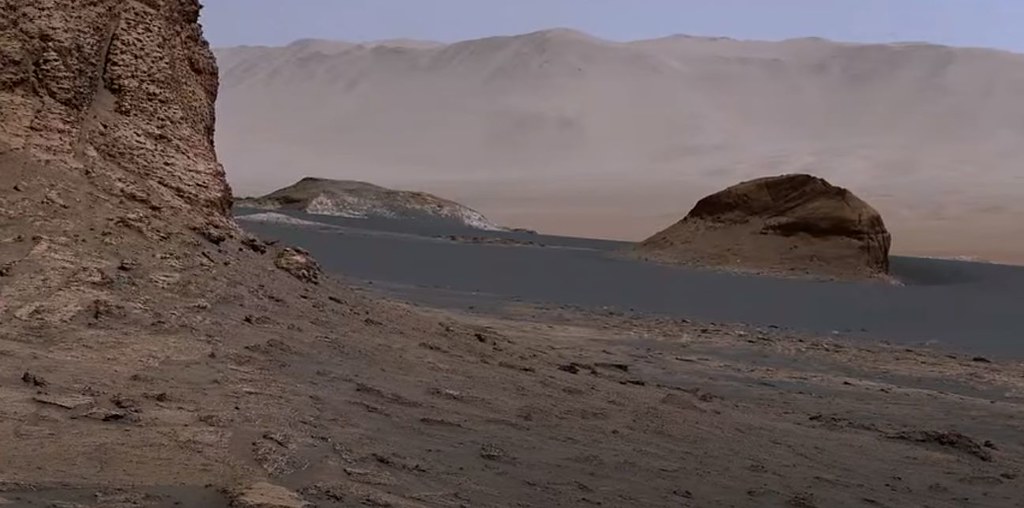
It’s now nine years since NASA’s Mars Science Laboratory rover Curiosity arrived on the Red Planet. To celebrate, the rover is about to enter a new phase of exploration as it continues to climb the slopes of “Mount Sharp” (more correctly, Aeolis Mons), the 5 km high mound that rises from the centre of Gale Crater.
Through July and August, the rover has been passing through a “transitional field” between a region on the mound that is dominated by the presence of clay minerals and one dominated by sulphates. While doubt has recently be cast on how large a role water has played in the crater’s (and particular “Mount Sharp’s”) formation, the change from clay minerals to sulphates is nevertheless important, as it marks a point where very different processes were at work on Mars as a result of the planet’s changing climate.
The rocks here will begin to tell us how this once-wet planet changed into the dry Mars of today, and how long habitable environments persisted even after that happened.
– Abigail Fraeman, MSL deputy project scientist
This is an area the MSL science team have been anxious to reach; roughly 460 metres above the crater floor where the rover landed in August 2012, it has been a target for Curiosity since before the rover arrived on Mars, as it could hold the key to the impact of climate change elsewhere on Mars where it is thought water may once have been present.
The transition between environments comes as Curiosity celebrates nine years of operations on Mars. To mark this NASA recently released a video of images captured by the rover during July, as it approached the transitional area. Because it is currently winter within Gale Crater, a time when the amount of dust in the tenuous Martian atmosphere is especially low, the images used in the video are exceptional clear and detailed images that even reveal the crater walls in detail, even though they are over 70 km away.
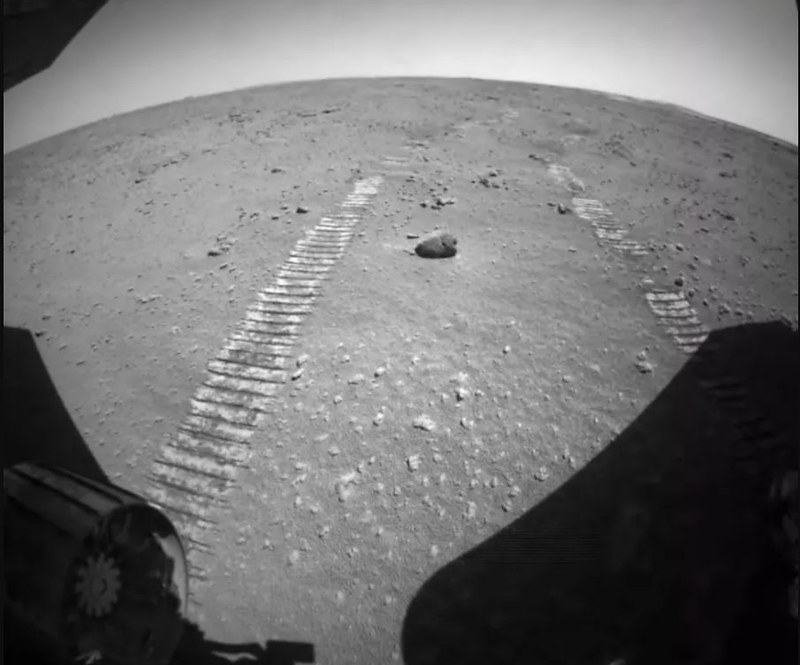
Another rover with cause to celebrate is China’s Zhurong rover, currently operating on Utopia Planitia. Somewhat smaller than the NASA rover, Zhurong arrived on Mars at the start of an initial 90-sol (92 day)mission are a part of China’s TIanwen 1 interplanetary mission. Since its arrival, the rover has been moving south from its lander vehicle, carrying out a range of science operations.
China has perhaps not been as pro-active as NASA in their social media output on the mission, but Zhurong has performed exceptional well, returning some 10 gigabytes of data to mission control on Earth whilst travelling almost a kilometre, visiting other elements of the mission along the way, such and the backshell and parachute that protected it through entry into the the Martian atmosphere and helped to decelerate in its descent ready for landing. So well, in fact that the China National Space Administration (CNSA) has announced the mission is to be extended through a second 90-sol period.
The rover has most recently reached an area believed to have once been the shoreline of ancient coastal waters in the region, marking it as a particular area of scientific interest. In particular, the rover is being directed to drive to a feature described as a “groove” just over 1.6 km from its current position.
Hopefully, by providing data on this area for our scientists, we can get a deeper understanding of the geology of Mars, and then even see if we can find evidence of the existence of an ancient ocean in Utopia Planitia. If it is possible for us to see from the top to the bottom [of the groove], or if there are disparities of rock types and compositions, we could learn about what has happened in its geological history. So, this is what we’re going to focus on in the near future
– Liu Jianjun, chief designer of the Tianwen 1 ground application system
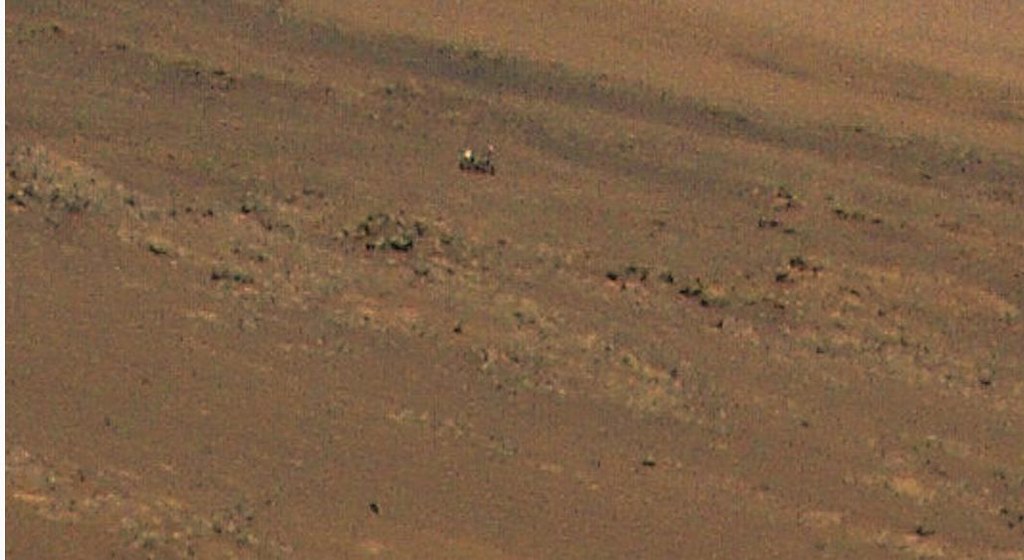
Meanwhile, in Jezero Crater, NASA’s ingenuity Mars helicopter drone has completed its 12th – and most challenging – flight.
On August 16th, 2021, the helicopter took off on a reconnaissance flight again in support of the Mars 2020 rover Perseverance. The flight was one of the longest to date, with Ingenuity covering over 450 metres and lasted 169 seconds over terrain, dubbed “Séítah South”, regarded as “risky” due to its varied nature.
Flying over Séítah South carries substantial risk because of the varied terrain. When we choose to accept the risks associated with such a flight, it is because of the correspondingly high rewards. Knowing that we have the opportunity to help the Perseverance team with science planning by providing unique aerial footage is all the motivation needed.
– From the Ingenuity flight log
The flight saw the helicopter return to the “round trip” approach seen in initial flights, travelling out over a region where, if it had been forced to make an emergency landing, could have resulted in it suffering damage or loss, and then back again. The route was selected so as to allow Ingenuity recorded the terrain in sufficient stereoscopic detail that mission planners might determine a route into the terrain for Perseverance. and have the rover drive itself safely to specific points of interest.
Taking the rover into “Séítah South” is regarded as riskier than flying Ingenuity over it, but the region is also full of intriguing rocks that the science team believe the risk is worth the potential returns.
Currently, Mars is approaching a period of solar conjunction – meaning it is on the far side of the Sun relative to Earth, and about to pass “behind” the Sun as seen from Earth, and event that happens once every two years. During this period, and the time leading up to it an immediately after it, ionized gas radiating out from the Sun’s corona can interfere with radio signals between Earth and vehicles operating on the surface of Mars or in orbit around it, increasing the risk of miscommunications and possible damage to, or loss off, those vehicles.
To avoid this, the fleet of spacecraft currently in orbit around Mars from the USA, UAE, Europe and China will be order to enter “safe” modes during the first two weeks of October, shutting down all major operations until such time as communications can be safely resumed. At the same time, the rovers active on the surface of Mars will switch to autonomous modes of operation, reducing their science operations until such time and full communication between them and the orbits spacecraft and the spacecraft and Earth can be re-established.
Continue reading “Space Sunday: roving on Mars, Starship flights, and suing NASA”









 Inara Pey: Living in a Modemworld