SL Project updates week 15/2: TPV Developer meeting

Tillicum Island; Inara Pey, March 2015, on FlickrTillicum Island (Flickr) – blog post

The following notes are primarily taken from the TPV Developer (TPVD) meeting held on Friday, April 10th, and from the Server Beta meeting held on Thursday, April 9th. A video of the TPVD meeting is included below, with any time stamps in the following text referring to the video. My thanks as always to North for the recording and providing it for embedding,

Server Deployments Week 15 – Recap

As always, please refer to the server deployment thread in the forums for the latest information and updates.

  • On Tuesday, April 7th the Main (SLS) channel received the server maintenance update previously deployed to the three RC channels, which sees UDP inventory messaging deprecated (HTTP Inventory in the viewer MUST be enabled for your inventory to fetch correctly / your avatar to render in your view –  details here and further notes below)
  • On Wednesday, April 8th all three RC channels received a new server maintenance package comprising a crash fix, minor CDN configuration updates and an internal server configuration update.

HTTP Inventory

[15:18] The Lab is still planning to remove the HTTP Inventory option and setting from their viewer “soon”. In addition, as a part of their overall work on improving inventory handling, the Lab is planning on removing the viewer-side code for UDP inventory fetching from their viewer, citing the time frame in which this is likely to happen as being “weeks or months, more likely months”.

Firestorm has already removed the option in preparation for their upcoming release, and has set that viewer so that if anyone currently has HTTP Inventory disabled, it will automatically be re-enabled in installing the new release over their older version.

Forthcoming Deployment

A new change destined for the RC channels is an update to llGetObjectDetails(), which adds new functions for avatar shape identification and hover height:

  • OBJECT_BODY_SHAPE_TYPE – returned list entry is a float between 0.0 and 1.0, -1.0 if the avatar is not found
  • OBJECT_HOVER_HEIGHT – returned list entry is a float, -1.0 if the avatar is not found.

SL Viewer

Avatar Layer Limits

[03:00] The Avatar Layer Limits viewer updated from project to RC status with the release of version 3.7.27.300567 on April 9th. This allows users to wear up to 60 wearable layers (jackets, shirts, tattoo, alpha, etc.) in any combination. Until these updates reach the main viewer (and all TPVs), those using it will find their layers will only adhere to the new global limit whilst using this RC viewer.

A update to the baking service which will enforce the new global limit  will be deployed once it has passed LL’s QA testing.

[05:23] Again, please note that this update only applies to avatar wearing (clothing) layers; it does not apply to attachments, which remain at the global limit of 38. The Lab currently has no plans to alter this, not only because they’re work to resolve a series of attachment issues, but also because large numbers of attachments on avatars can impact viewer performance due to the way in which they are handled.

[11:38] The above notwithstanding, a further update to the attachment fixes project viewer (currently at version 3.7.27.300377) is expected soon, possibly in week #16.

Maintenance Viewer

[06:36] The Maintenance RC viewer updated to version 7.27.300636 on April 9th. This viewer includes multiple fixes and improvements. It now appears that all of the issues reported against this viewer when first released have now been resolved, and subject to the performance of this new version as an RC, it looks set to be promoted as the next de facto release viewer.

Tools Update Viewer

[08:50] The “final” set of fixes and updates for the Tools Update RC viewer (currently version 3.7.27.300242) are with the Lab’s QA team. If all goes according to plan, these should be appearing shortly in an update to the RC viewer, which should then place it as the next-in-line for promotion to the de facto release viewer  after the Maintenance RC has been promoted.

Once this viewer does reach release status, it will mean the Lab will have switched to the new viewer build process. As a result, the official viewer will no longer install on Windows XP or versions of Mac OS X below 10.7. This will also be true of any TPVs which fully switch to the the new build process in the future.

Viewer-Managed Marketplace

[00:00] The first element of the server-side deployment occurred in week #15. However, there are two further elements awaiting deployment, which will roll-out to the servers over the next two weeks. So the Lab is hoping that things might be ready for wider beta testing to commence in the week #17 (commencing Monday, April 20th).

Continue reading “SL Project updates week 15/2: TPV Developer meeting” →

Could the Lab use Amazon AppStream to “replace” SL Go?

Sl Go proved itself very popular among SL users running low-end hardware
SL Go proved itself very popular among SL users running low-end hardware

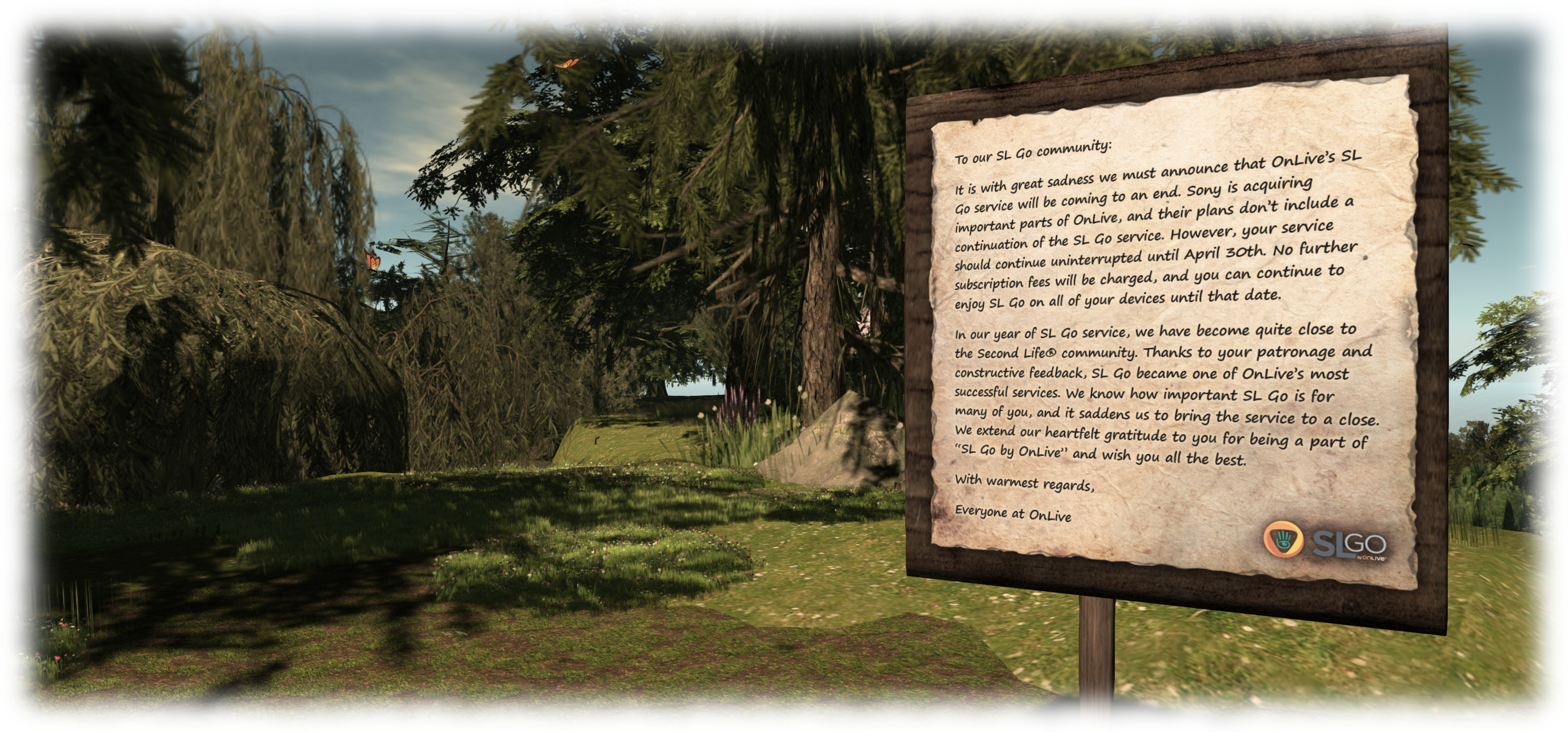
On Thursday, April 2nd, it was announced that SL Go, the streaming service for accessing SL  provided by OnLive, is to shut-down on April 30th alongside OnLive’s other consumer services. The reason for this is because OnLive has sold the IP and patents associated with the services to Sony Computer Entertainment.

Since the news broke, there have been numerous calls made for Sony to maintain SL Go as a service, including  an on-line petition. However, as painful as it is, all such calls and petitions to  Sony are unlikely to succeed, as I explained in a recent blog post.

In that article, I also considered whether or not the Lab might invest time and effort in offering something that might fill the void. At the time, I thought the answer to this would most likely be “no”, as the Lab seem to have enough on its plate already with Second Life and its next generation platform.

But the more I think about it, the more I feel that the Lab should endeavour to offer some kind of “SL Go replacement”.

One potential means by which they might do so could be via Amazon AppStream.

Obviously, there are issues involved in providing such a service beyond the physical provisioning. Anything which requires some form of external hosting is going to incur costs, for example. However, the flip side to this is it’s fair to say the SL Go has demonstrated that if users believe they are getting a beneficial service, they are willing to pay for it, providing the price is not prohibitively high.

Certainly, there are a wide range of potential benefits to be had from such an endeavour, particularly if implemented through something like Amazon AppStream:

  • It offers an easily scaled means by which the Lab could provide an “SL streaming service” to users on low-end hardware and those on mobile devices – something long demanded by SL users
  • It could provide the means by which SL could be accessed through web browsers – again, a long-desired means of attracting new users to the platform who might otherwise be put off by having to download and install the viewer
  • It obviously means that those SL users on low-end systems can enjoy the full graphical richness of SL in the manner LL would like to see all users experience it
  • It could help those preferring to run older operating systems – such as Windows XP – to continue accessing SL even after they might otherwise be unable to even install the viewer
  • It might even help the Lab map and test options which might be beneficial for their nascent next generation platform.

While developing such a service might not necessarily be easy, the Lab isn’t entirely without any experience in this area. As I and many others have pointed out, in 2010 they did experimenting with streaming the viewer, using the Japanese company Gaikai (coincidentally purchased by Sony Computer Entertainment in 2012), which delivered the viewer to web browsers, as shown in the video below. If there is anything remaining of this work at the Lab, it might possible to put it to work through something like Amazon AppStream.

That said, there is a lot for the Lab to consider in attempting to fill the forthcoming void that will be left by SL Go. And while I would not be at all surprised to learn they are already doing so, they might still require some encouragement to take things beyond just considering options. Something which might encourage them, or at least demonstrate to them that there really could be a worthwhile demand for such a service, could be for users to politely speak up.

One way to do this might be to add your name to the existing petition – I would hope someone at the Lab is keeping an eye on it.

Another could well be to leave a positive and polite comment on the subject following this article, as (and all ego aside) I do know eyes at the Lab pass over this blog (just as they do many others).

There is no guarantee that Lab will move to provide some kind of “SL Go replacement”, but on the other hand, as someone once said, nothing ventured, nothing gained.

SL project updates week 15/1: server, viewer, HTTP Inventory reminder

... and don't miss out on the merfolk's beach, complete with pier and fun fair!
Don#t forget you can plunge into learning about SL’s extensive merfolk and undersea community this week, thanks to the folk at Fanci’s Deep and the Safe Waters Foundation. There’s undersea tours, dances, dolphin rides, shopping opportunities, freebies and a whole lot more. You can even visit the mer beach and fun fair (above)! To find out more, read the blog post on the event, which runs through until April 11th

Server Deployments Week 15

As always, please refer to the server deployment thread in the forums for the latest information and updates.

  • On Tuesday, April 7th the Main (SLS) channel will receive the server maintenance update previously deployed to the three RC channels. This is primarily focused on trying to prevent  inventory loss issues, and sees UDP inventory messaging deprecated (see HTTP Inventory, below, for more important information)
  • On Wednesday, April 8th all three RC channels should receive a new server maintenance package comprising:
    • A fix for a server crash when rezzing an object
    • A minor change for CDN configuration
    • Adjusted internal server configuration.

SL Viewer Updates

A new release candidate viewer was released towards the end of last week. The HeatWave viewer, version 3.7.27.300424. This is essentially the maintenance RC viewer with an additional URI parser fix to prevent a viewer crash bug, but has retained a project name to differentiate the two RCs from one another.

 HTTP Inventory

With the Tuesday deployment (noted above), the main grid now only supports HTTP Inventory fetching. This means you must have the HTTP Inventory option enabled in the viewer (it can be found under the Develop(er) menu).

Should you disable it for any reason, you will encounter two issues:

  • Your avatar will not render, but will remain a cloud
  • Should you refresh your inventory for any reason (clear cache), your viewer will never complete the process of inventory fetching.

Unfortunately, and coincidentally, the Main channel deployment on Tuesday, April 7th came at a time when asset server / inventory issues were being experienced across the grid, and inventory database maintenance was carried out as a result.

Note that from Tuesday, April 6th, you must ensure HTTP Inventory is enabled in the Develop menu (sometimes called the Developer menu in TPVs) in order to help avoid inventory and / or avatar rendering problems

These issues and the maintenance may have masked any problems some people may have been having purely as a result of HTTP Inventory being disabled in their viewer.

Therefore, if you are encountering problems with your avatar remaining a cloud, or your inventory failing to load, please try the following steps to see if they resolve your situation:

  1. Make sure you have the Develop(er) menu enabled in your menu bar at the top of the viewer. Press CTRL-ALT-Q if you cannot see it.
  2. Click on Develop(er) to list the menu options.
  3. Make sure there is a tick in front of the HTTP Inventory option.
  4. If HTTP Inventory does not have a tick in front of it, then it is disabled. Click on it to enable it (and display the tick).
  5. Closed the Develop menu and re-log.
  6. Hopefully, following your re-log, your avatar will render / your inventory load properly.

UDP Inventory Messaging Deprecated

The reason for this is that the Lab has now deprecated the “old” method of inventory messaging (referred to as UDP messaging). However, if you disable the HTTP Inventory option in your viewer, the viewer will still attempt to use the “old” method, and thus you’ll have problems.

There are plans in hand for the Lab to remove the HTTP Inventory option from the viewer, and some TPVs may opt to remove it ahead of any update from the Lab. Until that time, it is essential you keep the option enabled to assist with the smooth functioning of your inventory.

Experience Keys / Tools

Not a lot to report on this project. Simon Linden has been working on the Key Value (KVP) database store used by Experiences. This work appears to be related to the Lab working to ensure the when deployed Experience Keys / Tools can be properly scaled to meet the anticipated demand for them. Commenting in general terms on the work, Oz Linden said during the Simulator User Group meeting on Tuesday, April 7th, “if we are as successful as we’d like to be with Experiences being adopted, it would run into problems. So we’re trying to solve them before we get to that point.”

2015 viewer release summaries: week 14

Updates for the week ending: Sunday, April 5th, 2015

This summary is published every Monday, and is a list of SL viewer / client releases (official and TPV) made during the previous week. When reading it, please note:

  • It is based on my Current Viewer Releases Page, a list of all Second Life viewers and clients that are in popular use (and of which I am aware), and which are recognised as adhering to the TPV Policy. This page includes comprehensive links to download pages, blog notes, release notes, etc., as well as links to any / all reviews of specific viewers / clients made within this blog
  • By its nature, this summary presented here will always be in arrears, please refer to the Current Viewer Release Page for more up-to-date information.

Official LL Viewers

  • Current Release version updated to version 3.7.26.299635 on March 24th (formerly the Avatar Hover Height viewer) download page, release notes, wiki page, AHH overview
  • Release channel cohorts (See my notes on manually installing RC viewer versions if you wish to install any release candidate(s) yourself):
    • HeatWave RC viewer version 3.7.27.300424, released on April 3rd – core updates: the same fixes and improvements as the Maintenance release, with an additional fix for a URI parsing issue (download and release notes)
    • Maintenance RC viewer updated to version .7.27.300323 on March 31 – core updates: multiple fixes and improvements (download and release notes)
    • Tools Update project viewer version 3.7.27.300242 updated on March 30th – core updates: builds Windows and Mac viewers using the new tool chain and autobuild process and also incorporates the revised viewer log-in screen (download and release notes)
  • Project viewers:
    • Attachment fixes project viewer (Project BigBird), version 3.7.27.300377, released on April 1 – core updates: a number of fixes for various attachment issues (download and release notes)
    • Avatar Layer limits project viewer updated to version 3.7.27.300098 – allows users towear up to 60 wearable layers (jackets, shirts, tattoo, alpha, etc.) in any combination  (download and release notes)

LL Viewer Resources

Third-party Viewers

V3-style

V1-style

  • Cool VL Viewer Stable branch updated to version 1.26.12.37, Experimental to version 1.26.13.6 and Legacy branch to 1.26.8.92, all on April 4th (release notes)

Mobile / Other Clients

  • No updates.

Additional TPV Resources

Related Links

Why SL Go won’t continue, and OnLive opted to sell

Farewell SL Go; one of OnLive's most successful services, but nevertheless one unlikely to be saved
Farewell SL Go; one of OnLive’s most successful services, but nevertheless one unlikely to be saved

Since the announcement that OnLive’s gaming services are to shut down at the end of April, there has been understandable upset from within the SL community (and from some OpenSim users as well, given Firestorm on SL Go can be used to access OpenSim grids).

Following the news, there were a plethora of requests made to Sony on social media that they continue to provision SL Go as a service and an on-line petition was started in the hope of achieving the same end. Unfortunately, these requests and the petition overlook one thing.

As OnLive made clear in their statements on the future of their gaming services, and as I attempted to point to in my original article on this news, Sony didn’t actually acquire OnLive’s services. They took the opportunity to purchase the IP and 140 patents the company held relating to cloud gaming and other “assets” (which would most likely appear to be the additional 135 patents related to cloud gaming  OnLive had pending), without actually buying OnLive’s services. So technically, there’s nothing for them to “continue” to offer SL Go users.

What’s more, as Dennis Harper, the SL Go Product Manager at OnLive, made clear in these pages, taking the IP and patents is akin to taking the heart and lungs of OnLive’s services; without them, a service like SL Go cannot easily be continued by someone else. At least, not without money changing hands and someone having the infrastructure by which they can deliver the service.

So, are Sony the Big Evil for doing this? did they gobble OnLive’s patents to stifle competition? Is this, as was dramatically stated in some quarters as the news broke, some kind of first shot in a forthcoming “VR battle” between corporations? Well …. No.

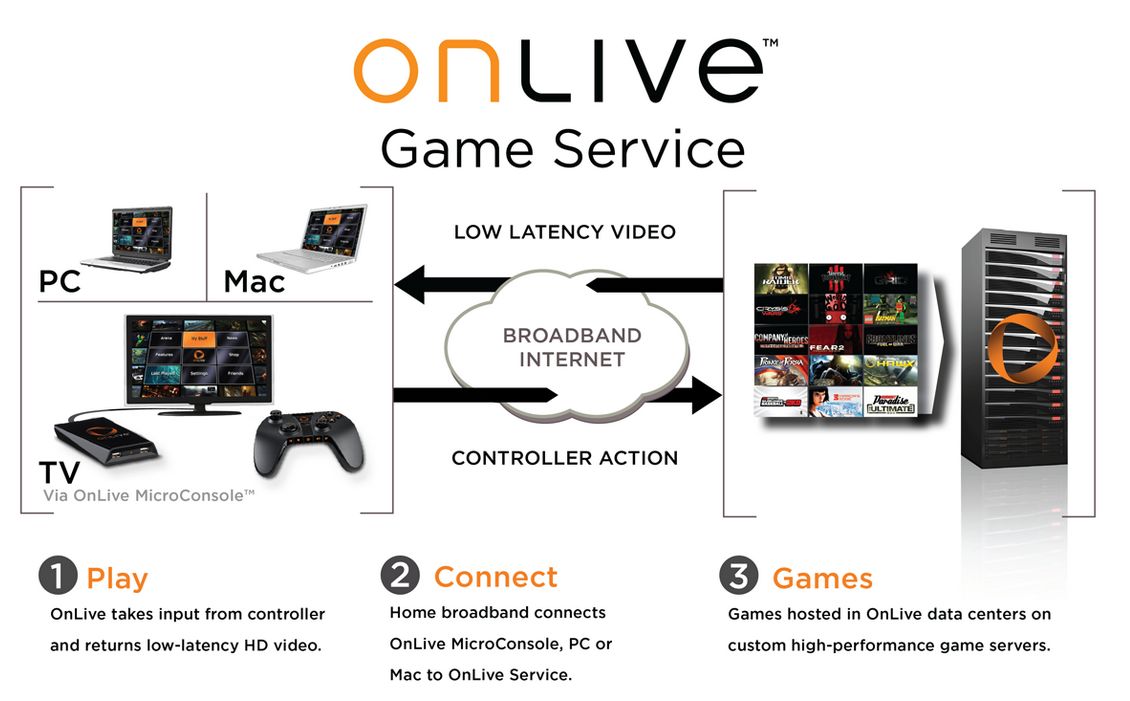
From the start, OnLive was well ahead of the curve, and even though we're reaching a point were the viability of cloud-based gaming can be demonstrated, it seems few are yet willing to take a gamble on taking-on the kind of services OnLive have offered
From the start, OnLive was well ahead of the curve, and even though we’re reaching a point were the viability of cloud-based gaming can be demonstrated, it seems few are yet willing to take a gamble on taking-on the kind of services OnLive have offered (image courtesy of OnLive)

The truth is that OnLive put itself on the market.

That this is the case can be found in another post on the company’s blog entitled, A Bright Future for Cloud Gaming At Sony. As well as containing useful historical information, the post underlines the specific issues the company’s management had been forced to face:

Since 2012, the company has dramatically improved its technology and business models such that all of its 5 services are gross margin positive, ranging from 43% to 86% margin … The company also was able to achieve conversion rates from free trial to paid of between 64-78% for its services. Despite these positive metrics, the lifetime value (TLV) of a subscriber was still less than the cost to acquire subscribers (CPA), but they were converging. While we knew we could not get to break-even on our own, we believed that there were many large companies who would be able to get there.

In other words, in order to get to a break-even point,  OnLive’s management felt the company needed to be offered-up for acquisition, albeit hopefully as a going concern.

Perhaps the first fully public hint that this was the case may have actually come in a blog post issued a couple of days ahead of Sony deal being announced. Of course, by the time the post appeared, the deal was undoubtedly cut and dried; nevertheless, The 2015 Case for Cloud Gaming and OnLive, could almost read as the company laying out its stall in order to attract a suitable investor / acquirer.

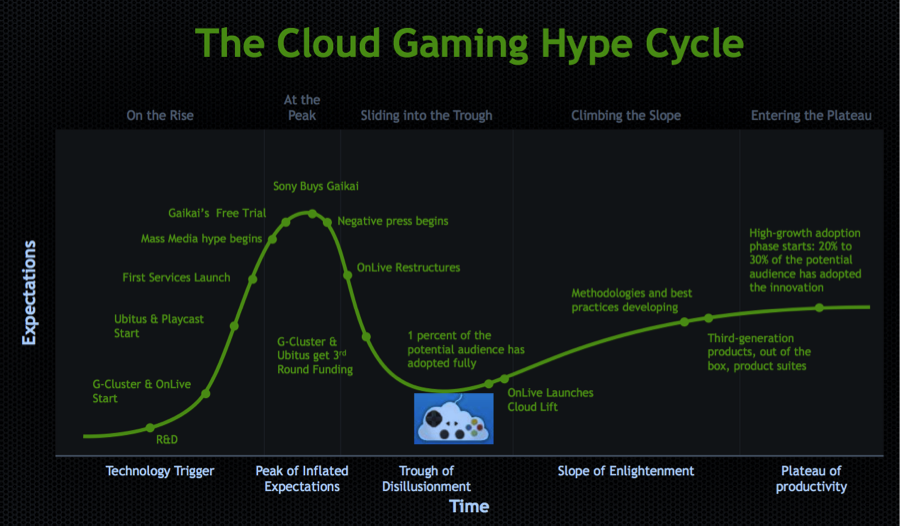
Despite the fact the Nvidia suggested OnLive themselves were helping to lift cloud gaming out of the Trough of Disillusionment towards its Plateau of Productivity, no-one was interested in acquiring the company as an operational concern when OnLive decided to seek outside assistance (image: Nvidia via OnLive)

Unfortunately, despite all the positive indicators they could show, the Cloud Gaming hype cycle had bitten hard; no-one OnLive approached was willing to take them on as a going concern. Not even the fact that Nvidia had indicated the worst was behind the sector, and that OnLive itself was helping to push the technology up the Slope of Enlightenment, could encourage anyone to acquire the company outright. Thus the deal with Sony for the IP and patents sale was agreed.

Why didn’t Sony acquire OnLive as a whole? Because they already have their own cloud gaming service, PlayStation Now, which came out of a 12-month beta programme in January 2015. The OnLive patents understandably offer more value when put to work within PlayStation Now than Sony would be liable to find in buying-out OnLive as a whole, so they didn’t bother.

Interestingly, and entirely coincidentally, PlayStation Now has its own link to Second Life. It is built on the back of Gaikai, a Japanese streaming game provider acquired by Sony in 2012. Gaikai is the company Linden Lab worked with in an attempt to provide the means of streaming Second Life to web browser, a service which underwent a limited beta run in 2010, as the video below demonstrates.

But to draw things to a close; however “unjust” it might appear, all of this means that SL Go cannot really be saved. The patents which enabled it to function are gone, and the services upon which it runs are closing down. The only real options are for someone else to come along and offer a similar service of their own, or for LL to work with a partner to provide such as services, as they once attempted with Gaikai.

Both would seem unlikely; in the case of the former, SL perhaps represents too small a community of users to be worth catering for (and remember, SL Go came about in part as a result of rather unique circumstances). And while I tend to lean towards LL having an interest in cloud-based streaming, I don’t think that interest is with regards to Second Life, so I can’t see them getting directly involved in trying to provide a streaming solution for SL access. If nothing else, they’ve likely got enough on their plate already.

SL Go was a great and brave experiment. It is a shame that its days are drawing to a close; but OnLive, through their services as a whole, have proven what might be achieved. In that respect, they are right when they proclaim that cloud gaming has a bright future.

SL project updates week 14/2: server, viewer, CDN

The Trace Too; Inara Pey, March 2015, on Flickr The Trace Too (Flickr) – blog post

Server Deployments Week 14 – Recap

As always, please refer to the server deployment thread in the forums for the latest information and updates.

  • There was no deployment to the Main SLS channel on Tuesday, March 31st, due to the inventory issues arising from the week #13 RC deployment – see my update here for details.
  • On Wednesday, April 1st, all three RCs received the same update to the current server maintenance package to fix the issues with Trash failing to purge in non-AIS v3 viewers (see BUG-8877. and my coverage of the recent issues here). Those suffering from inventory fetch failures on RC regions are advised to re-enable HTTP Inventory in their viewers, if disabled (found under the Develop menu).

SL Viewer

Wednesday, April 1st saw the release of the Project BigBird viewer (yes, seriously!), version 3.7.27.300377, which contains the various fixes for attachment issues which the Vir Linden has been working on. Specific fixes offered are listed as (note the MAINT designations are for the Lab’s internal JIRA, and thus non-viewable):

  • MAINT-4351 HUDs and attachments intermittently and randomly detach after teleports, sometimes reattaching on their own shortly after, sometimes staying detached completely, or showing as “worn on Invalid Attachment Point” while still detached
  • MAINT-4653 [Attachment-RC] When using “Add” or “Attach to” to attach multiple attachments at the same time, some attachments fall off and some get attached to the wrong attachment point
  • MAINT-4917 Attaching multiple objects generates multiple bake requests
  • MAINT-4918 Removing multiple attachments generates redundant detach requests
  • MAINT-4919 Attempting to wear an outfit with more than 40 attachments will fail

UDP Paths: HTTP Inventory, Textures and More

As noted at the top of this report, the week #13 RC deployments have been causing some inventory-related issues, one of which –  the Trash purging problem – has been fixed with this week’s RC RC deployment.

The second issue  – failures in inventory fetching following clearing cache on RCs regions – has been caused by a combination of the Lab deprecating the UDP message path for inventory updates and users having the HTTP Inventory option in the viewer (found under the Develop menu – CTRL-ALT-Q) disabled (unchecked).

Given this path has been deprecated, it is essential you keep HTTP Inventory enabled (the Lab will be removing the option from the Develop menu in the future to prevent it being unwittingly disabled).

Speaking at the Server Beta Meeting on Thursday, April 2nd, Oz Linden indicated that the Lab would be taking steps in the future to deprecate UDP messaging is “high on the list” for being deprecated in the future, given that textures have now moved to the CDN.

The CDN and Switching Further Services

While discussing the issue of UDP messaging, Oz again re-iterated the desire to pivot things like fetching animations and sounds away from UDP and onto HTTP, with the aim of provisioning them through the CDN, further lifting the load the simulators currently carry. However, he caveated this with two important points:

  • While this is something he’d like to see done, and is in the plans for SL’s future, the work hasn’t actually be scheduled yet, must less started; therefore it is not something that will be happening in the short-term (or perhaps even the medium term)
  • The Lab is working on a further round of CDN improvements – again, no time scale is available for their implementation – but there won’t be any additions to the data delivered via the CDN until after such improvements have been deployed.

One aspect here is that, in terms of the simulator load and in terms of the vast majority of users, the switch-over to avatar, mesh and texture data to CDN-based services has been a success for the Lab. However, as we’ve also seen, it has resulted in issues for some users, up to and including what is a degraded service due to the actions of at least one ISP.  While the latter is not something the Lab or their CDN provider can directly tackle, it does point to the fact that while off-loading the heavy lifting from the Lab’s servers can make for improvements, it can affect users in other ways.

Hence why the Lab is being cautious in approach, and is continuing to work with its CDN providers to try to improve the service as far as can be done, in the hope of reducing the number of ways in which users might find SL a poorer experience as a result of the CDN implementation. However, exactly what can be achieved and issues mitigated, remains to be seen.

In the meantime, as as per part 1 of this week’s update, if you do feel mesh and texture rendering isn’t what it once was, try following Monty Linden’s interim ideas  for easing things.