Welcome to the Hotel California in Second Life

Hotel California; Inara Pey, April 2019, on FlickrHotel California – click any image for full size

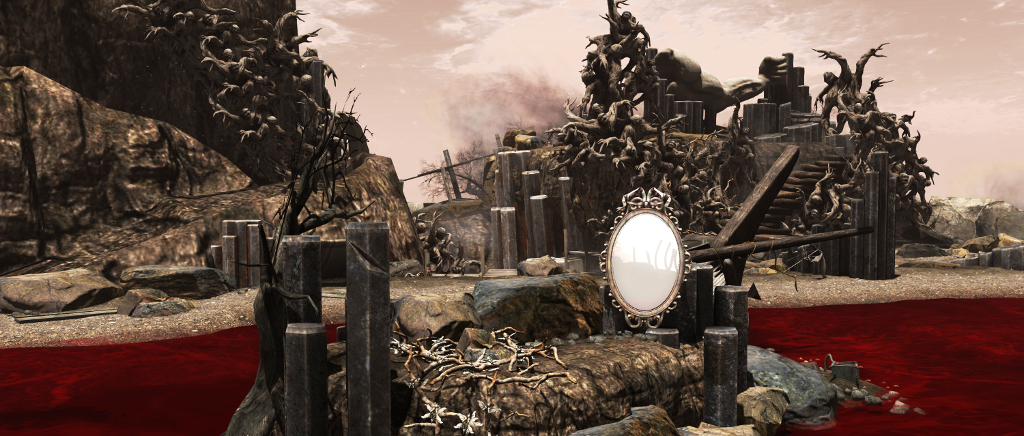
Hotel California is a Full region designed by Lex Machine (Schmexysbuddy) that we were made aware of by Miro Collas. It presents “A war torn land fighting its way back to beauty” where, “Life always finds a way”; and it makes for a curious visit with its mix of influences.

The landing point sits in the middle of a broken bridge that attempts to span the region, rooted in a high table of rock to the north, and pointing south towards a lower hill on the southern end of the region. However, before it reaches that point, it dissolves into ruin, the paved road vanishing, leaving just the piers on which the road once stood – and these are leaning haphazardly, a mature tree sitting between them, suggesting the bridge has been in a state of ruin for decades.

Hotel California; Inara Pey, April 2019, on FlickrHotel California

The table mountain with its small, rounded dome of a peak to one side, is home to the titular Hotel California – although unlike the song, it is probably not a place you can check-out of but never leave. Its dishevelled condition indicative that it hasn’t been in service for many years, the tree within its courtyard grown to a considerable size, the café within its shade suggestive wine hasn’t been served there for a long time.

Below the mountain, the region is primarily flat, sitting just above the surrounding water, the southern hills being the only other relief. This landscape is lush, with verdant grass and yellow rapeseed. deer roam here, although there are some signs of the war that apparently tore through the land at some point: the fuselage of a transport ‘plane, the shells of buildings, and the wreckage of vehicles, including a tank and a rather unusual flying … car.

Hotel California; Inara Pey, April 2019, on FlickrHotel California

A large house, sitting atop a hill, stands apart from the ruins in that it is intact, as if spared from whatever happened. Lightly furnished, it is too large to be a farm-house, its kitchen is well-stocked, its conservatory a place of well-tended plants. Hidden behind the house sits a survivalists bunker; suggesting the house is still in use.

A very localised storm is in full career atop the remaining hill, marked by a shattered lighthouse. Here the rain falls in sheets and the lightening is violent. It looks out over the western lowlands, offering a view of both a ruined rotunda and a passing Predator drone, its weapons pylons empty.

Hotel California; Inara Pey, April 2019, on FlickrHotel California

It is to the west that the region has – for me – its most interesting features. Just off the coast sits the ruin of a large, industrial-like building. It roof is gone, its walls and floors broken, the bare rusted metal of the smashed cement walls visible. A CND “shrine” sits within this broken building, but it is the scenes outside of it which hold the attention.

From the misted waters on one side of the building rise the great tentacles of what might be a Kraken, as if reaching to tear more of the structure down. Closer to shore, a group of statues are grouped, as if frozen in the act of fleeing to dry land. Or are they the petrified remains of people who once fled the now partially flooded building?

Hotel California; Inara Pey, April 2019, on FlickrHotel California

An unusual design for a region, one that is not at all the kind of apocalyptic setting one might expect from the About Land description, but which is photogenic and somewhat prone to fancy, as per the Kraken and water scene. Those wishing to obtain rezzing rights can do so by joining the Shutter Thugs group at the landing point. Photos taken at the region can also be submitted to the Shutter Thugs Flickr group.

Altogether a somewhat different and engaging visit.

Hotel California; Inara Pey, April 2019, on FlickrHotel California

SLurl Details

Celebrating van Gogh in Second Life

ArtCare Gallery: Vincent van Gogh

Currently open at the ArtCare Gallery, curated by Carelyna Resident, assisted by Kurk Mumfuzz and Yany O’Real, is a celebration of art marking the 166th anniversary of Vincent van Gogh’s birth.

This is at first appears to be a most unusual exhibition, in that the gallery space is given over to large cubes, on four faces of which are reproductions of many of van Gogh’s paintings, while the inner walls of the gallery space carry a repeated reproduction of his 1888 painting, Starry Night Over The Rhone.

The reason for presenting the paintings on large cubes is presented at the landing point by a cube bearing a quote from van Gogh, “I would rather paint on big cubes, but I can’t carry them”.  Also at the landing point is a brief biography of van Gogh, that provides a broad thumbnail of his artistic output and the tragedy of his life.

ArtCare Gallery: Vincent van Gogh

Some of the reproductions include The Church in Auvers-sur-Oise (1890), The Langlois Bridge at Arles with Women Washing (1888), Olive Grove (1889), The Cottage (1885),  Still Life with Lemons on a Plate (1887), Pietà (1889), several of his self-portraits, and a two-walled reproduction of The Starry Night (1889). Between the cubes and walls are several settings suggestive of café spaces, possibly a reference to van Gogh’s mixed view of such places, of which he once said, “I have tried to express the idea that the café is a place where one can ruin oneself, go mad, or commit a crime” whilst referencing his 1889 painting, The Night Café.

It is the range of paintings present here that makes this an interesting exhibition: while some of van Gogh’s more famous paintings are shown (notably, perhaps, the Starry Night paintings), so to are perhaps lesser-known studies, such as from several of his collections: shoes, flowers, people at work, and so on, while there is a balance between his oil and watercolour works. There are also possible references to some of the less considered aspect of van Gogh’s life, such as his relationship with religion, as seen through Pietà.

ArtCare Gallery: Vincent van Gogh

My only complaints are that the use of the cubes, coupled with their size means that viewing some of the works on offer can be difficult. my second is that the paintings are presented without any supporting information – and given the selection on offer, some additional note cards / panels offering insight into some of the themes of van Gogh’s work could encourage a greater appreciation of his work.

Nevertheless, this is still an exhibition worth seeing for anyone with a love of van Gogh’s work. And I confess that while visiting it, I was once again reminded of another tribute to van Gogh’s work, that of Robbie Dingo’s Watch the World. Made far back in 2008, it takes viewers of on a time-lapse journey through the in-world recreation of The Starry Night. The build itself has long gone, but is commemorated in a couple of videos from Robbie, and I’m embedding the 2008 version, presented to Don McLean’s 1972 hit, Vincent, here.

SLurl Details

ArtCare Gallery (Prychek, rated: Moderate)


Art as a landscape in Second Life

Grauland; Inara Pey, March 2019, on FlickrGrauland – click any image for full size

Grauland is a homestead region held by JimGarand and home (in the sky) to his M-1 Art Poses, is one of the more unusual locations I’ve visited recently.

Described simply as a “photogenic sim”, it is actually far more than this; I would describe it more as a setting that presents art as a landscape.

Grauland; Inara Pey, March 2019, on FlickrGrauland

The landing point looks out over a section of coastline mindful of the Giant’s Causeway in County Antrim on Northern Ireland’s northern coast: Cube Republic’s marvellous Basalt columns step down to the sea before stretching out over the water in a slender finger. Several more frame the landing point, which includes a teleport up to the M-1 store.

Grauland; Inara Pey, March 2019, on FlickrGrauland

Sitting above the basalt, and split into two plateau-like areas, the rest of the region offers an intriguing mix. Directly behind the landing point, and across a road apparently emerging from a tunnel beneath the taller plateau, sits a large concrete structure, the home to a striking concrete block maze forming a large, and striking statement of modern art which in some ways reflects the columnar basalt coastline.

Grauland; Inara Pey, March 2019, on FlickrGrauland

This block theme is continues on the upper plateau, reached via cement stairs built into a steel frame. These lead to a large courtyard area guarded by whitewashed walls and a large, modern hall-like building. More cement blocks sit within the courtyard, extending into a part of the building itself, which forms a gallery space.

At the time of my visit, the gallery was home to a minimal exhibition of striking photographs by Jim himself. However, the gallery is designed to be more than just a home to art; along with the courtyard, it is very much a part of the artistic sweep of the region.

Grauland; Inara Pey, March 2019, on FlickrGrauland

Overlooking the courtyard is an industrial-like tower topped by a cabin. The industrial nature of the tower reflects that of the steps leading up to the courtyard, providing a further sense of continuity in the setting. Apparently open to the public, the cabin offers a bird’s-eye view out over the region.

Nor is this all. Throughout the region are marvellous art-like installations: great concrete swirls surround oak and persimmon trees, while rusting metal shapes sit on a terrace looking out to sea, the ruins of an abandon shack on the coast below them as large spheres float over the water. Elsewhere are smaller artistic elements: a caravan of turtles, a sculpture by Silas Merlin, knots of rock also forming statements of their own, doors hovering above the water… A further concrete-walled maze sits in the lee of the courtyard’s plateau, the walls again offering an industrial feel, together with an expression of graffiti.

Grauland; Inara Pey, March 2019, on FlickrGrauland – click any image for full size

Simple yet elegant, minimalist yet rich in detail. Grauland is a fascinating and very photogenic region and a place where it is easy to spend a lot longer visiting than you might think would be the case on first arriving.

SLurl Details

Moon’s Likelihood of Nearness in Second Life

DiXmiX Gallery: Moon Edenbaum

Moon Edenbaum has a talent for taking avatar studies that provide a richness of possible narrative. I first encountered his work in a joint exhibition of art featuring Moon and Hillany Scofield back in 2017 (see Dathúil: Me_You – Moon Edenbaum), and have appreciated his work since then. So it was with a sense of anticipation that I jumped over to DiXmiX Gallery, curated by Dixmix Source, to view a new exhibition of Moon’s work entitled The Likelihood of n e a r e s s.

With its official opening held on Friday, March 29th, 2019, this is a series of some 17 images of Moon’s friends. However, rather than being a set of what might be called “traditional” avatar studies, these are quite marvellous studies taken from some unique perspectives, presented in fitting monochrome finishes.

DiXmiX Gallery: Moon Edenbaum

Each image offers a particular context on the individuals portrayed. They are by turns captures of intimacy, of candidness, of coyness and, throughout all of them, nearness. The suggestion is that the avatars are not so much facing the camera, but are spending time with a friend.

This gives all of them that narrative depth I do enjoy with Moon’s work. Each picture has a story to tell, both about the subject and about their relationship with the camera / the person behind the camera. Take Pai, for example; by avoiding any of her facial features, we are presented with an image of someone who could be shy, or at least self-conscious with the idea of a  camera pointing at her. But this is picture that also reveals she trusts the camera enough for it not to reveal her vulnerability in this regard, while the camera in turn understands her discomfort and respect it by turning its eye away from the potential to embarrass her.

DiXmiX Gallery: Moon Edenbaum

Coyness is perhaps best exemplified through Yul and Mic. Side-by-side, both offer playful views of their subjects that does much to suggest their nature and their relationship with the camera / photographer. Perhaps my favourite among this collection, however, is perhaps Cyn.

Once again a glorious close-up, there is a layered richness to this picture that is attention-holding. It is at once intimate, revealing and allows the imagination to take flight. From the collar around the subject’s through, through to her pose to  the selected angle of the shot itself, the picture offers a story of a woman both aware of – but not bothered by – the presence of the camera, as her attention is held elsewhere, through to a tale of her desires and preferences in relationships. It also raises intriguing questions that give the imagination flight on such matters of her desires and with whom and how they might be met, through to thoughts of exactly who holds her attention, and whether it is in fact the photographer.

DiXmiX Gallery: Moon Edenbaum

It is also, for me, the piece that reflects the title of this most fascinating exhibition, which I have no hesitation in recommending, each picture offering so much to those who view them.

SLurl Details

Paola’s Nudes: an homage to Helmut Newton at Nitroglobus

Nitroglobus Gallery: Nudes by Paola Mills

Now open through April and into May at Nitroglobus Roof Gallery, curated by Dido Haas, is Nudes, a themed series of images by Paola Mills, which stands as something of an homage to the late German-Australian photographer Helmut Newton.

For those unfamiliar with Newton, who is perhaps best remembered for his work from the 1970s through mid-1990s, I’ll let Brooke McCord provide an introduction:

Nobody has made quite the lasting impression on fashion imagery as Helmut Newton. Hired by French Vogue in the 1950s before being propelled to fame in the 1970s, Newton came to be renowned for his controversial scenarios, hypersexualised imagery and striking compositions. With elements of his work that linked to the themes of surrealism – an art movement dominant during his youth spent growing up in Berlin – Newton’s unadulterated love of beautiful and strong women saw him create images laden with heavy overtones of voyeurism, sadomasochism and fetishism.

Brooke McCord, Your ultimate guide to Helmut Newton, Dazed, 2016

Nitroglobus Gallery: Paola Mills

In particular, Newton is p[erhaps best known for two classical collections of photography, White Women (1976) and Big Nudes (1981), which together with 1978’s Sleepless Nights, often form a triptych of themes for retrospectives of his unique style of photography.

For Nudes, Paola states she draws inspiration from, and pays something of a tribute to, Big Nudes, although I would perhaps argue that some of the pieces here also reflect (and contrast with) Newton’s White Women as well. As noted, both have come to be regarded as classical works by Newton; White Women due to its mixture of aesthetics, technical perfection and bourgeois decadence laced with dark elegance and eerie abstract s/m trappings to present what was regarded as a pinnacle of erotic photography.

Big Nudes, however, eschewed all of the trappings found within White Women. Instead, for this series of black-and-white photos, produced between 1979 and 1981, Newton took a stylistic change, the elaborate layouts with their tones of decadence discarded in favour of a full-on unambiguously formulated approach that took pride in female nakedness, and its power therein.

Nitroglobus Gallery: Paola Mills

This latter aspect is very much in evidence within Paola’s images, which also offer a contrast to Big Nudes with their use of skin tone and backdrop; they thus present almost an inverse mirror to Newton’s originals. And like Newton’s Big Nudes, Paola’s images speak to both the vulnerability and strength of the female body. But within some of them as well are echoes of White Women: a delicate and nuanced sensuality which, when combined with camera angle and backdrop – the plainness of the latter notwithstanding – offer echo elements of Newton’s 1976 collection. Not that Paola is intending to titillate through these images, a point she makes in the notes accompanying the exhibition, after she gives credit to Newton for his work:

Much more modestly I wanted to represent the nakedness of an avatar in all its erotic charge. I don’t want to tickle the sexual instincts nor excite the minds, but only convey to my avatars the human sensitivity that guides them in the metaverse.

– Paola Mills, describing Nudes

Nitroglobus Gallery: Paola Mills

But just because there is something of a voyeuristic / erotic aspect to some, of the images in Nudes should not be seen in any way as a failure on Paola’s part to achieve her stated goal. Rather, it speaks to the success in presenting the full complexity of human sensitivity – both within the images themselves and our reaction to them.

Nudes officially opens on Sunday, March 31st, 2019 with a party at 12:00 noon SLT, and will run through the month and into May. However, those wishing to see the exhibition ahead of the launch can do so now.

SLurl Details

Spring at La Virevolte in Second Life

La Virevolte; Inara Pey, March 2019, on FlickrLa Virevolte – click any image for full size

Update: La Virevolte has closed, SLurls have therefore been removed from this article.

Iska (sablina) and ChimKama have returned La Virevolte (“the Twirl”) to the grid after the Homestead region on which it sits – Lemon Beach – spent time as Ponto Cabana (read here for more on that design), and are currently presenting it in a marvellous springtime rural design that carries hallmarks of central France in its look and feel.

To the east of the region sits a a rugged curtain of cliffs, a stream tumbling down the slope leading away from their feet to pass under a bridge that carries a narrow road away from a tunnel that appears to cut through them. Their presence suggests this is a headland somewhere, the tunnel cutting through their walls forming a link to the land beyond, while the water flanking the three remaining sides of the setting has the feel of being a great lake, the far shores of which are obscured by haze.

La Virevolte; Inara Pey, March 2019, on FlickrLa Virevolte

Buildings lie to either side of the road as it runs down from the tunnel. Some of these – most notably the church-like stone-built gatehouse – indicating this place has been inhabited a long time. Other buildings, such as the auto shop – are of far more recent architectural design, and pointing to the longevity of occupation in this part of the land.

The road splits at the old gatehouse, one arm continuing south onto the headland’s finger, passing a small café where tables are set outside on a cobbled terrace and a Pétanque boules game overlooks the calm waters. This arm of the road ends at a small, slightly run-down farm, where dairy cows quietly graze, and which also offers a view out over the water towards the small island on which a painter’s retreat sits.

La Virevolte; Inara Pey, March 2019, on FlickrLa Virevolte

The northern arm of the road crosses the little stream at a second bridge to form a relaxed loop around grassy tiers on which sit apple trees in their springtime blossom, and which are topped by a second farmhouse. Lantern-lit paths run along and around these tiers, while the road’s passage around them is marked by stone walls and wooden fencing.

A small shingle beach sits off the south side of this road, marked by the carcass of an old rowing boat that forlornly looks towards the little painter’s island. However, there is no water crossing to the latter – which doesn’t appear to be private – is provided; flying or wading seem to be the only way to reach its adobe walls with their Spanish looks.

La Virevolte; Inara Pey, March 2019, on FlickrLa Virevolte

It offers a cosy terrace and flat roof, each with places to sit and pass the time, paintings stacked against walls, a fresh canvas occupying an easel on the roof, perhaps waiting for inspiration to strike the artist who sometimes occupies this little getaway.

Other places to sit can be found scattered throughout the region, and there is a wonderful and quite natural sense of age to this little village – and not just as a result of the presence of the more medieval buildings to be found here.  There is the tired-looking farm mentioned above and, not far from it, the yard alongside the auto repair shop, that looks for all the world like an abandoned playground.

La Virevolte; Inara Pey, March 2019, on FlickrLa Virevolte

Which should not be taken to mean this is a place of ruin or decay; far from it. The beauty and appeal of La Virevolte is clear; what there is, is a perfect balance between natural beauty of setting and landscape and the careworn feel of places perhaps past their prime; a balance that can often be witnessed when passing through any town, village or hamlet.

Finished with a gentle and natural sound scape and framed under an ideal windlight complete with birds flying and wheeling overhead, this current iteration of La Virevolte makes for an engaging, photogenic springtime visit and is not to be missed.

La Virevolte; Inara Pey, March 2019, on FlickrLa Virevolte