Discussing myself is something that doesn’t come particularly easy, especially when it comes to anything like self-advertising or my photography – which I regard as passable for blog illustrations, little more.
However, Sorcha Tyles recently asked me to consider an exhibition of my work at her gallery of Artful Expressions, which I admit to finding incredibly flattering – if more than a little nerve-racking. However, in talking to Sorcha, I decided to take up her generous offer.
So, opening at Artful Expression on Friday, May 8th at 14:00 SLT is a small selection of my work entitled Impressions, which features images (some not previously seen) of my recent SL travels. Music is being provided by DJ Julz, and I hope you’ll join us for the opening – or hop along to the gallery and take a look while the exhibition is open through to the end of the month(ish).
Many, many thanks to Sorcha for the invite and encouragement, and for arranging the exhibition!
Currently open at Bryn Oh’s Immersiva is Social Distancing, a join installation by Bryn and Cica Ghost. The title should immediately give away the theme of the installation.
I confess that in its current application around the world, I find the term “social distancing” an odd choice. In an era when social media has all but taken over our lives and allow many to say in contact half-way across the globe whilst often remaining distanced from those immediately around them, the idea of “social distancing” is perhaps something of a non-sequitur; as the SARS-CoV-2 virus relies on close physical proximity one to another, it’s seemed to me a more apt term for the phenomena we’ve seen sine February (in the west – earlier in places like the far east) should perhaps be “physical distancing”.
Social Distancing
Anyway, semantics aside, this cosy – in terms of size – installation offers a broad take on social / physical distancing and its impact it has had on us. Within a watery, overgrown garden environment surrounded on three sides by great concrete walls (the state of the garden and the high walls themselves possible metaphors).
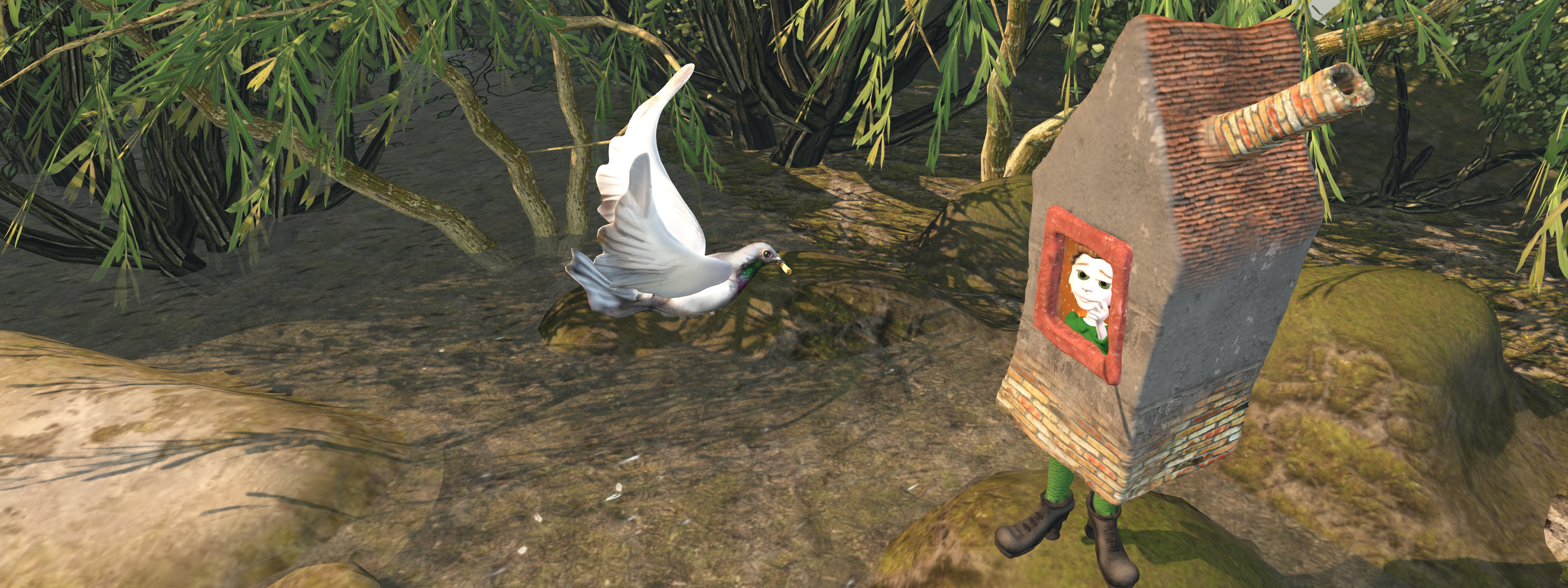
A rough path winds through the overgrown landscape, offering a path to various vignettes signifying the state and anxieties of people and society. A man sits at the window of his house, the room behind him stacked with toilet rolls and he has a pair of binoculars in hand as he looks towards his mailbox. The flag is up and letters lie within, but he appears too worried to make the trip out to collect them. Further along the zig-zagging path, a couple sit on a boat – but at opposite ends, unable to express themselves more intimately to one another by holding hands or simply sitting side-by side.
Social Distancing
Further still long the path is a little village scene where the occupants of the houses all express various reactions to having to remain isolated. Some, more able to adapt, perhaps, use carrier pigeons (an analogy for more modern means of connecting to others?) to pass letters back and forth. Others sit at their windows and worry. One simply hides behind his curtain, peeking in terror at the world from around the edge of it. Should you wish to be a part of this vignette, there are a couple of houses with single poses included.
There’s a certain poignancy to all of these little houses and their occupants that may perhaps touch us in different ways. For many of us, making the transition to the kind of lifestyle social / physical distancing has brought about hasn’t been dramatically hard in the scheme of things. We have our Facebook, our You Tube our WhatsApp – and yes, our Second Life – to maintain contact and engage with family and friends. But what about those who find being on their own hard – such as the elderly or those psychological issues? Seeing the face crammed into a corner of a house window and peering around the edge of the curtain, I was immediately reminded of an interview with a doctor who has been trying to help those whose psychosis requires physical proximity to others in order to help them avoid giving into their inner demons and voices.
Social Distancing
Another subtle element in the installation alludes to the risk countries and people face in pushing to get back to “business as usual” too soon. There is a real risk – as has been seen with past epidemics and pandemics – that trying to relax rules around social / physical distancing, etc., too soon could lead to a second or even third wave of the SARS-CoV-2 / Covid-19 situation striking the world. Within Social Distancing, this risk is seen by the presence of “Corona Monsters” among the bushing and floating in the water. they appear to lying in wait, ready to strike should those in the little houses all decide to come out and start mingling.
A timely and engaging installation, reached via the teleport board at the Immersiva landing point, and complete with gacha machines for those wishing to obtain some of the models used in the exhibit or to support Cica and Bryn.
Social Distancing
SLurl Details
Social Distancing – via the teleport board (Immersiva, rated Moderate)
Hotel Del Salto, May 2020 – click any image for full size
Recently opened in Second Life is a new Homestead region designed by Jade Koltai. An experienced region designer in her own right, Jade also used to work with Serene Footman in producing some of the most extraordinary builds in Second Life based on physical world locations. With this latest build, she further demonstrates her skill in bringing places from around the globe to life in the virtual.
Hotel De Salto is a region based on the hotel located in San Antonio del Tequendama, Colombia some 30 km south-west of Bogotá. It sits alongside the Salto del Tequendama (Tequendama Falls),a 157m high waterfall that drops into a deep gorge.
Hotel Del Salto, May 2020
According to a legend of the Muisca people of the Andean plateau, the waterfall was created by Bochica, who used his staff to break the rock and release the water that covered the Bogotá Savannah. In their language, Chibcha, the name means “he who precipitated downward”, and stems from a further legend in which the Muisca were said to escape subjugation by the Spanish conquistadors by jumping off the falls to become eagles, flying to their freedom.
The hotel actually started life in 1923 as a mansion built by architect Carlos Arturo Tapias along French lines and intended to celebrate the wealth and elegance of the country’s elite. It continued in the role for several years, undergoing expansion which also saw it converted into its luxury hotel, which opened to customers in 1928.
Hotel Del Salto, May 2020
The hotel operated for 50 years, drawing tourists from across the world to it. Some were attracted by its unique views, others by a darker desire. Drawn by the tale of the Muisca legend of people leaping from the falls to become eagles, the broken-hearted came to the hotel to leap to their deaths from the cliffs beside it.
However, by the 1970s, the hotel was facing issues. Bogotá had grown exponentially in the intervening years, and without all the necessary supporting infrastructure; the result was much of the city’s raw sewage entered local river to make its way down to the Tequendama Falls and the gorge below the hotel, contaminating it. At the same it, an upstream hydroelectric dam was built on the main Bogotá River, which often starved the impressive falls of water, reducing them to trickling dribbles dropping into the gorge from above.
Hotel Del Salto, May 2020
These factors saw trade at the hotel decline from the late 1970s through until its closure in the early 1990s. For a brief time during the hotel’s decline there was talk of renovating it, but for come 15 or so years it was left to moulder in the high Andean forests and weather – a forbidden place, rich in legend.
Then in 2011 the National University of Colombia’s Institute of Natural Sciences joined with the Ecological Farm Foundation of Porvenir to launch extensive renovations of the hotel, turning it into a cultural museum. The first exhibition at the new museum, Caverns, ecosystems of the subterranean world, opened in 2013.
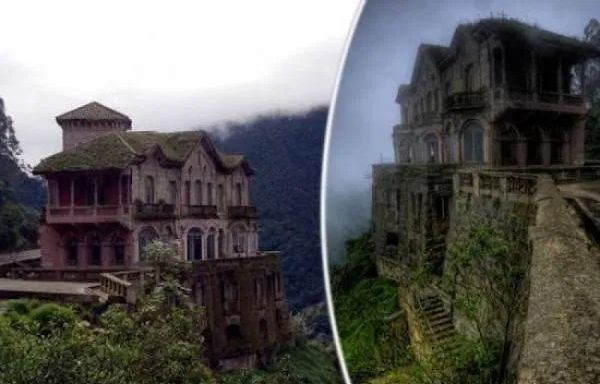
Two views of the Hotel Del Salto as it was while empty. Via moco-choco.com
For her build, Jade offers both a homage to, and interpretation of, the hotel during those years when it lay abandoned. As with the original, it sits atop a deep gorge, facing the Tequendama Falls on the region’s north side.
The shelf on which it sits is perhaps broader that that occupied by the actual Hotel Del Salto, which means some of the on-the-edge grandeur of the original is lost, but there is no mistaking the architectural style that has been captured by this interpretation.
Hotel Del Salto, May 2020
The building is overgrown, vines hanging within mouldy rooms like drapes, furnishings braking and rotting as a result of the humidity no doubt brought about by the heat and damp, the terrace around it broken and given over to weeds and 50’s style cars. Like the original, stairs descend the cliffs below the hotel, although these don’t pass any basement levels. Instead they provide access to a bridge spanning the gorge, and further stairs down to the floor of the gorge, where ancient ruins lay, offering the suggestion of a place perhaps once belonging to the Muisca.
Throughout the build can be found numerous platforms and seating points intended to provide places from which the hotel and the gorge with its falls – presented in full spate – can be appreciated. Adding to the setting are wheeling birds, a rich sense of forest, parrots and toucans, while the sound scape gives incredible depth to the region’s visual splendour.
Hotel Del Salto, May 2020
Completed by a region surround that strongly evokes the Andean uplands of Colombia to provide the perfect backdrop, this is a build fully deserving of a visit and in spending time exploring.
Officially open from Tuesday, May 5th at Nitroglobus Roof Gallery curated by Dido Haas, is Entropy, by EmberPolaris.
In terms of thermodynamics, entropy is defined as:
A measure of the unavailable energy in a closed thermodynamic system that is also usually considered to be a measure of the system’s disorder, that is a property of the system’s state, and that varies directly with any reversible change in heat in the system and inversely with the temperature of the system.
More informally, entropy is referred to as a general running down of the universe into a state of disorder. For her exhibition, Ember presents an almost Shakespearian view of modern life; one in which we might as a well be mannequins, we have so little little say in the fate of the universe as a whole; that all we say and do, all that we build, is merely a stage for the greater passage of life – ours and the universe’s.
Nitroglobus: Entropy, May 2020
It is a stark, but captivating view of things; one that might be referred to as emphasising the futility of life. But there is more here; through the use of mannequins in place of humans, Entropy folds within it question of identity – not only who we are or might be, but also a challenge as to what our role in life might be when framed against the bigger backdrop of the universe’s slow passing.
More then this, through the framing of each picture is a reminder that creation – and creativity – can offer a richness of beauty that far surpasses any darkness that might otherwise be inherent in these pictures: sunlight falling through the scaffolding of an advertising hoarding, Shadows falling across an alleyway or a sudden bright splash of colour amidst the grey; sunlight falling through clouds.
There is a stark beauty within these pieces that is astonishing; life is present in every image, the use of mannequins as models notwithstanding; a vitality that stands in contrast to the basic meaning of entropy. There is also, conversely, the suggestion of disorder that is entirely in keeping with the precepts of entropy; it surrounds and enfolds the sense of order also suggested elements present in these pictures and their sense of structure and order of life as can be witnessed in the settings for many of these images.
Nitroglobus: Entropy, May 2020
Those Entropy is a richly layered exhibit, offering multiple commentaries on life, the universe, and our place within it, as well as presenting rich images in and of themselves.An excellent first-time exhibition from an artist I hope we’ll see more of in the future.
The Beguiled Art Gallery and Studio, May 2020 – click any image for full size
Occupying a Full mainland region, The Beguiled Art Gallery and Studio has been designed by Jilla Lamar as a place for photography, art and romance for visitors. It’s a setting packed with detail – which can admittedly make it heavy going for a viewer with all the bells and whistles enabled, but providing care is taken, it is a place that offers a lot that really shouldn’t be missed.
From the gazebo landing point towards the south, a number of paths offers multiple routes through the region, which is set out as a garden in the rich colours of spring, summer and autumn. Pointing due west, one of these paths leads to The Beguiled Art Gallery, an imposing building with multiple levels that is home to 2D art by Jilla, together with (at the time of our visit) Skye Donardson and Fury Harbinger.
The Beguiled Art Gallery and Studio, May 2020
Split into multiple spaces both vertically and horizontally, the gallery also includes 3D works by Mistero Hifeng, SpotCat, St0rmyN1ght and others, together with spaces to sit and relax throughout. All of this makes the gallery a warm, cosy place in which to spend time and admire the art on display.
To the east, on the far side of the landing point sits the imposing form of a deco-styled building that is home to as series of photography sets available for use by anyone visiting them. Compact in size, these include indoor and outdoor settings, all individually lit. Rezzing is open, so visitors are welcome to rez their own props and pose systems – but are asked to make sure they clear their pieces up afterwards.
The Beguiled Art Gallery and Studio, May 2020
These opportunities extend to the gardens as a whole, which might best be described as a series of vignettes joined by a common landscape rich in flowers, trees in bloom or turning gold in readiness for autumn. A place through which paths curl and flow, and sheep and deer, and rabbits and butterflies, all roam or flutter while puppies play and windmills turn. Throughout are places to sit, places to discover – and plenty of 3D art to find.
Literally wherever you roam through these gardens there is something to surprise and engage, from the piano amidst those butterflies, to a “garden” of Cica Ghost’s Dreamers, to statues by the likes of Kadaj Yoshikawa, Zun Sahara, Mistero Hifeng, Lossip Delicioso and others. Outcrops provide raised areas of relief reached by ladders and on which yet more vignettes to be appreciated.
The Beguiled Art Gallery and Studio, May 2020
To the north, the land naturally rises to a hilltop overlooking the rest of the gardens. This is home to a crystal palace offering the opportunity for romance, dance and rest. It is watched over by an impressive water tower that has been converted into a table games room – just take the teleport up to the top. Circling the slopes leading up to this tower is a garden-backed blue whale swimming in small circles through the sky.
Follow the path along the front of the crystal palace, and there is more to be discovered: gardens with summer houses, havens of flowers and seats surrounded by arched walls, the paths lined by carefully planted crystals. Elsewhere across the region can be found caves, camp sites, a dance gazebo for, waterside rests and tree-lined avenues.
The Beguiled Art Gallery and Studio, May 2020
Lit by an windlight suggestive of a summer’s day,The Beguiled Art Gallery and Studio also works under a range of other settings to offer an environment ideal for photography as well as exploration. Separated from the surrounding regions on three sides by natural borders of tree images, and on the fourth by the rise in land, the Beguiled Art Gallery and Studio makes for an enchanted, calming haven of art and nature.
A recommended visit for patrons of art, photographers and SL travellers like.
The Raglan Shire Artwalk is one of the staples of the SL art calendar, and for 2020 the 15th Artwalk will take place between Sunday, May 17th and Sunday, June 21st, inclusive.
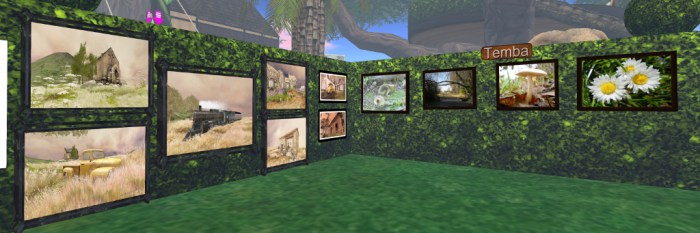
A popular event among artists and residents, the Artwalk can see over 150 artists displaying their work – 2D and 3D – across the regions of Raglan Shire. All the displays are open-air, with 2D art is displayed on hedgerows in and around the regions, offering visitors the chance to view pieces as they explore the Shire, while sculptures and 3D art is displayed in a number of designated areas across the regions.
Those wishing to exhibit their work at the 2020 Artwalk are invited to review the requirements for entry and follow the link from there to the registration form. Applications for participation must be received by the organisers no later than Sunday, May 10th, 21:00 SLT.
Key points about the exhibition are:
The event is a non-juried show.
Artists can display more than one piece if they wish.
2D (“flat” art pieces will be awarded a maximum of 15 LI, and individual pictures should be 1 prim, including the frame.
3D art (sculptures, etc.), will be awarded a maximum of 500 LI for up to three pieces of work. Artists are requested to state the LI per piece in their application.
Sales of art are allowed.
Types of art supported by the show are: representations of RL photography, painting, drawing, printmaking, collage, and digital fine art that can be displayed on a prim; and SL photography, manipulated SL photography and SL sculpture.
Pictures of RL crafts, such as beadwork, leatherwork, etc., are not part of the show’s definition
All the above art forms are welcome, but should be rated PG / G – so no nudity, please!
Group membership will be required in order to display work
Questions and enquiries should be forwarded via note card to Artwalk Director Karmagirl Avro, or Artwalk Assistants Kayak Kuu, Linn Darkwatch, maggi696 or RaglanShireArtwalk Resident.
Raglan Shire Artwalk 2019
Event Dates
Sunday, May 10th: applications close at 21:00 SLT.
Tuesday, May 12th: Notification of exhibit space location issued to 3D artists.
Friday, May 15th (after 09:00 SLT) and Saturday May 16th: Artist set-up days.
Sunday, May 17th: Artwalk Opens.
Sunday, June 21st: Artwalk closes.
Sunday, June 21st (after 18:00 SLT) through Tuesday, June 22nd: Takedown of works.