Crossing The Divide in Second Life

The Divide, March 2021

A tweet from Second Life blogger and photographer Rig Torok concerning one of his recent region outings set a bell clanging in the back of my head when it showed up in my time line. It featured an image of, and URL to, a place called The Divide,  was sure we’d visited in the not-to-distant past, but which which failed to show up on my listed of blogged destinations.

That prompted me to rifle through Windows Explorer, and sure enough, there was a folder from December 2019 with a couple of photos of the setting, some rough notes  – and nothing else; so we’d clearly visited, but for whatever reason, had either never fully explored or I’d simply forgotten to go back for photos and write-up thoughts for a post. Hopefully, this piece will therefore make up for things.

The Divide, March 2021

The work of Xen (Xenia Nordberg) and Coriel (Coriel7766), and sitting on a sky platform over a Full private region that leverages the Land Impact bonus, The Divide is described as a study of contrasts, an expression of duality inspired by the works of Hayao Miyazaki.

For those unfamiliar with Miyazaki, he is a Japanese Anime artist, writer, director and producer of animated films. He is internationally regarded as one of the accomplished film-makers and story tellers in the history of animation. His work is characterised by a range of recurrent themes, including humanity’s relationship with nature and technology, elements of which are evident within The Divide, both directly and indirectly.

The Divide, March 2021

Humanity’s relationship with nature is perhaps most clearly shown in the divide within the setting: to one side, and containing the landing point, sits a very Japanese theme town or village. To the other lies a sinuous, climbing valley, the separator between the two a narrow river channel spanned by bridges.

On the one hand, these two settings speak of both more prevalent aspect of our relationship with nature in our standing apart from it in our towns and cities of concrete and glass whilst constraining its presence to parks and gardens. On the other it represents our underlying need to embrace nature and the escape it can offer in its open spaces and amongst its flora and fauna.

The Divide, March 2021

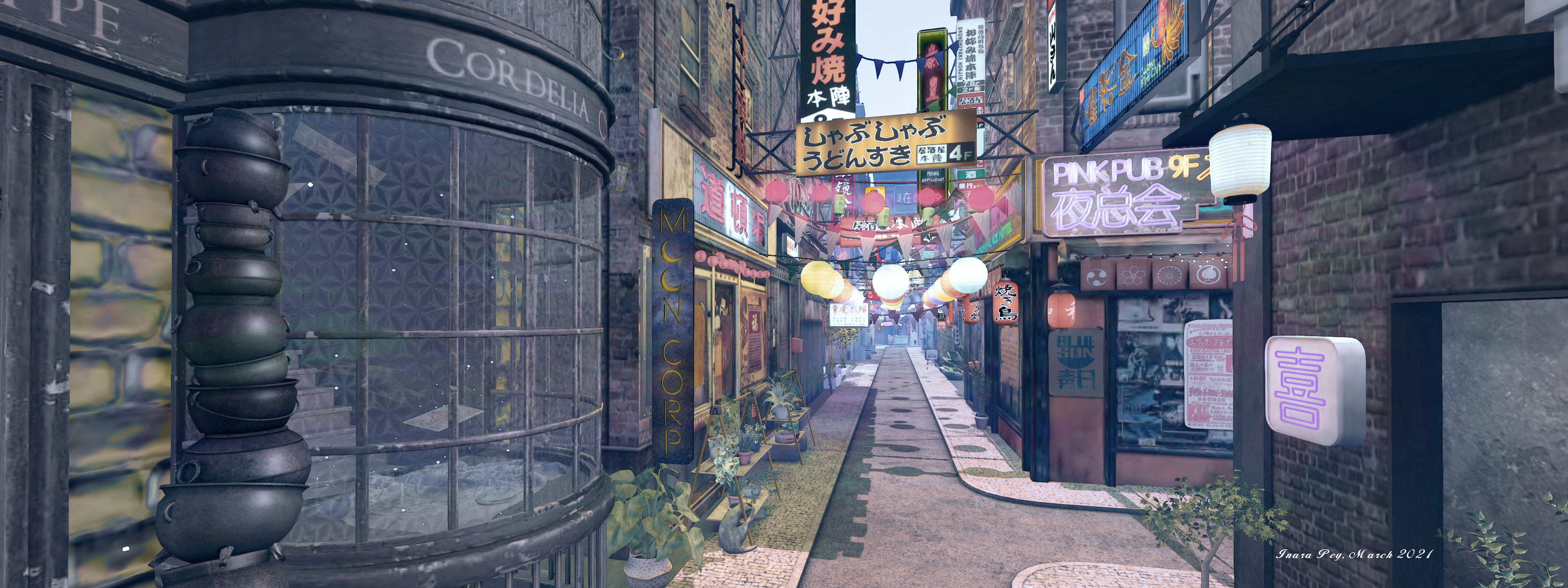
The town itself is a marvellously compact affair that packs a lot into it, which  admittedly can make moving through it a little heavy going thanks to things like texture loads; I found it easier to disable shadow rendering entirely other than when actually taking snapshots, just to get the textures to load in a little faster and to offer smoother walking / camming. Streets run between an assorted collection of buildings, bunting and lanterns stretched overhead as if for a festival, a subway station hinting at a connection with places further afield whilst hiding a surprise.

While a good number of the town’s buildings are simple façades, others offer interiors to be explored, adding depth to the setting’s sense of place. Little side gardens may also await discovery, again harking back to the idea of our relationship with nature in the manner they offer retreats from the hustle of the street life just a few metres away. An interesting curio sits on the west side of the town: a mushroom-like rock rising above the surrounding buildings, topped by an ancient ruin that is itself home to a able-top D&D style game.

The Divide, March 2021

The human / technology reference is also much in evidence throughout, from the very obvious – all the neon signage, the vehicles, and so on – to the more subtle (anyone spot the reference to a certain film franchise focused on technology?). There’s also the pointers to the speed of modern life such as the “fast food” kiosks for grabbing a bite while on the move, countered by little temple-like places where life can be put on pause and more spiritual matters addressed.

Across the water, the valley and parkland offers the means to escape and explore and presents an interesting mix of themes and ideas. There are Chinese elements such as the of pandas in their bamboo copse, for example, and more studies in our relationship with nature, notably typified by the little shrines along the path that climbs up into the hills.

The Divide, March 2021

To the south of the setting, beyond a bamboo curtain sits a ramshackle home. Reached via a concrete bridge, it again echoes the ideals of relationship: humans living within nature, with our relationship with technology represented through the use of a converted shipping container for the house – the same kind of contain that is used to transport all our little electronic and computerised gizmos around the globe aboard massive ships guided by satellites circling the world high overhead.

Some of the landscaping along the valley and its climbs could perhaps do with a little tidying up, but as long as you follow the paths and steps, you shouldn’t have too much of an issue in finding your way around. Make your way all the way to the top of the steps that wind up through the head of the valley, a zipline awaits to offer a faster way back down – just mind the trees on your way!

The Divide, March 2021

Rich in detail, expressive in design, The Divide presents a lot to be discovered and enjoyed. My thanks to Rig for the reminder.

Slurl Details

The art of Isabel Hermano in Second Life

Janus II Gallery: Isabel Hermano – Living in a Steampunk World

I did not intend to write about another exhibition at Chuck Clip’s Sinful Retreat so quickly after my last arts write-up (see: Sheba’s mystical art in Second Life). however, after witnessing Isabel Hermano’s exhibition at the Janus II Gallery in the region, I could not help but put fingers to keyboard.

Given the breadth of her work that is on display, I’m rather surprised to admit that’s I’ve not previously documented Isabel’s art, as her digital images are truly  captivating to the eye.

Janus II Gallery: Isabel Hermano – Living in a Steampunk World

Although entitled Living in a Steampunk World, the pieces offered through this exhibition feature much more than the style of retro-futuristic images we might normally associate with the idea of “steampunk”; while such elements  – the ideas of Victoriana, corsets, goggles, exotic mechanicals – present in several of the images, so to does the exhibition cast a wider net, capturing retro-modern elements, touches of Fritz Lang and Buck Rogers, hints of childhood, even a glimpse of contemporary science fiction.

This wider casting of the net doesn’t invalidate the title of the exhibition – rather, it enhances it, and offers a new twist.

Take Tinman, with its the image of C3-PO for example: whilst his appearance might bring to mind thoughts of a technologically advanced, spacefaring civilisation far beyond that of our own, his appearance as a “tin man” is not actually that far removed from the ideas of steampunk mechanoids.

Isabel notes that she likes to use bold colours  on account of the depth of passion they suggest, and that use of colour is clearly shown here – and I would argue that its presence in these pieces adds a further dimension to their narrative. And make no mistake, these are pieces rich in their ability frame moments and ideas that capture the eye and transport the imagination in the most marvellous of ways, whether or not the idea of steampunk are central to the journey.

For me, this sense of narrative is particularly strong with Radio City Music Hall, and The Sisters. These are also two pieces that may not immediately appear to be particularly “steampunk” in nature. The first brings to mind the era of Marlowe and hard-boiled detectives, whilst the latter richly mixes ideas. With the three female characters, there is a clear reference to Fritz Lang and Metropolis, whilst the airship above them both suggests steampunk airship – but set against a cosmic backdrop of a nebula cloud, it also carries that Buck Rogers vibe mentioned above.

Janus II Gallery: Isabel Hermano – Living in a Steampunk World

Theses are also pieces that are rich in motif and symbol – the use of animals in several of the more “steampunky” pictures, the juxtaposition of modern technology with suggestions of the Victorian era, mechanical octopuses, and so on that can lead the imagination onwards in it journey – and the eye to the richness of detail within each of these pieces.

Open through until early April, Living in a Steampunk World is a captivating exhibition of digital art.

SLurl Details

An Enchanting Small Town in Second Life

Enchanting Small town, March 2021

Enchanting Small Town is a homestead region design by Nataly Moonwall that opened earlier in the year, but which I’ve only recently managed to hop across to and see. For those seeking something of a urban setting for photography (albeit sans props, as there is no group available for rezzing rights), it could be a useful place to visit.

Step away from the stresses of life and chill in this realistic small town. A place to hang out & explore. Take great pictures. Beautiful, relaxing beach. Café, Playground, Jazz Club and more! Enjoy.

– Enchanting Small Town About Land description

Enchanting Small town, March 2021

Compact in size and easy to explore, the setting very much has a US West Coast vibe to it, set out as a waterfront location overlooking a sloping beach and backed by taller buildings and hills and suggest it could be part of a larger coastal setting.

The beach and the waterfront are the focal point, the latter comprising a main road that doubles as parking for the beach, being a dead end. Behind it sits a large, modern house that appears open to the public – although the sign on the main gates offers a stark warning to trespassers! The general design of the house, complete with infinity pool to the rear (which may have worked better facing the open sea), oozes wealth. But for me, it wasn’t the house – as excellently furnished as it is – that held my attention.

Enchanting Small town, March 2021

Bracketing it are two pedestrianised areas that caught my attention the most. One is fronted by what looks to be a recent development of boutique shops adjacent to a subway entrance and small newspaper kiosk. This area runs around to an older part of town with apartment houses and narrow streets that is fronted by a motel entrance.

The entire layout here suggests that at one time the waterfront road may have continued around to the motel, but the construction of the boutique shops prompted the broader pedestrianisation and the opening of the subway station entrance / exit.

Enchanting Small town, March 2021

The main entrance to the subway lies beyond the motel, where the West Coast feel starts to merge with a sense of the the other side of the United States: the signage for the station (and that over the smaller entrance / exit) would clearly be more at home in New York. While there may not be a station under the entrance, it points the way to the local jazz club, a cosy place that sits within a neighbourhood that again perhaps suggests New York than Santa Monica, further adding to the region’s mix of West Coast / East Coast vibe.

To the other side of the main house is a further pedestrian thoroughfare that leads to to a small recreational park. It is home to one of those small community supermarkets together with a bubble tea café for those needing some refreshment; it’s the kind of place someone might come to people watch, although it is currently more home to the local pigeons and doves.

Enchanting Small town, March 2021

Whilst most of the buildings in the region are façades, places like the café, the supermarket and jazz club, as well as the furnished house, add depth to the setting by providing places for people to go to and spend time within. Further depth is added by the inclusion of areas of the setting including props such as cars, etc., but which are not currently directly accessible, suggesting things could be moved around to present different areas to explore.

With the beach awaiting swimmers and sunbathers, a beach bar waiting to serve cocktails and opportunities for photography throughout, Enchanting Small Town makes for an easy, engaging visit.

Enchanting Small town, March 2021

SLurl Details

Sheba’s mystical art in Second Life

Janus III Gallery: Sheba Blitz – Into the Mystic

When Sheba Blitz first arrived in Second Life, it was without any preconceived ideas about displaying her work.  However, after encountering the vibrant arts communities that exist across the platform she decided to give exhibiting her work a try – and I, for one am glad that she did.

Hailing from Australia, Sheba has studied art in a variety of styles over the years, gaining several diplomas in the process. However, throughout her time as an artist, she has found focus in painting mandalas – which she does so quite exquisitely.

Janus III Gallery: Sheba Blitz – Into the Mystic

For those unfamiliar with it, the mandala (literally meaning “circle” in Sanskrit) is a symbol with very deep religious, spiritual and even political meaning. It may be employed in spiritual guidance, focusing the attention of practitioners and adepts, as a means of establishing a sacred space and as an aid to meditation and trance induction. Mandalas are particularly used in Hinduism, Buddhism, Jainism and Shintoism. They also have new age symbolism, and were regarded by Jung as a means to explore “the fourfold nature of the psyche”.

I first encountered Sheba’s work five years ago and was immediately captivated. Specialising in painting quarternity mandalas, she works with gouache, acrylics and metallic paints on either canvas or paper, drawing on sources such as music, books, astrology and tarot symbolism as her inspiration. The finished pieces are all intricately beautiful, endlessly geometric, generally perfectly symmetric, and rich in symbolism.

Janus III Gallery: Sheba Blitz – Into the Mystic

All of this creative, spiritual beauty can currently be seen at the Janus III Gallery on Chuck Clip’s Sinful Retreat, where Sheba is exhibiting a selection of her work entitled Into the Mystic.

Across the two floors of the gallery one can find the most meticulous pieces of art that are utterly captivating.

Whenever I witness Sheba’s art and and consider the work that went into each piece, I cannot help but be put in mind of dul-tson-kyil-khor (mandala of coloured powders) in Tibetan Vajrayana Buddhism. Like those painstakingly constructed sand paintings, there is an inherent balance within Sheba’s paintings in terms of symmetry and harmony that lifts the spirit whilst also speak to the depth of focus on the part of the artist.

Like the work of Tibetan monks, Sheba’s art is rich in iconography that combines geometric shapes and spiritual symbols.

However, unlike the Tibetan sand painting, which is intentionally impermanent, each piece ritualistically destroyed and used as an offering to water and life once the meditation of its creation is complete, Sheba’s art endures well beyond its creation. In this, while sand painting might speak to the impermanence of life and the cycle of creation, Sheba’s art reflects the enduring nature and balance of the cosmos around us.

Janus III Gallery: Sheba Blitz – Into the Mystic

This is art for which images on a page simply do not do justice. Each piece is so rich in form and intricate in detail, Sheba’s work deserves to be seen and appreciated first hand whether you are drawn to the spiritual symbolism of the mandala or simply drawn to art for its beauty and geometry So do take time to drop into the Janus III Gallery before this exhibition ends later in the month.

SLurl Details

Cherishville’s coastal spring in Second Life

Cherishville II, March 2021

We were drawn back to Lam Erin’s Cherishville on the advice of region super sleuth Shawn Shakespeare, who noted to me the region has relocated since our last visit in mid-2020, and has been redressed for the spring season.

The last time we visited, Cherishville has been given a look of tropical splendour that mixed a splash of the Caribbean with a twist of the Mediterranean, whilst also carrying a sense of timelessness. For the new setting, the region – now referred to as Cherishville II – has moved to a somewhat more temperate climate in terms of its setting. However, while sporting a new look, it retains that air of timelessness.

Cherishville II, March 2021

I say this because as you explore the region, elements pop-up that give cause to consider it to be in a certain period, but then others appear to suggest something else. For example, on arrival I felt I’d dropped into a coastal setting that is in the immediate post World War II era. A 1940s Citroen is parked at the roadside, whilst a worn-out 50’s style car is slowly being overtaken by grass and weeds. Similarly, a boat moored close by has that 40’s / 50’s styling about it, whilst across the water the ruins of a large house look as if they are the result of ordinance of some kind having struck it. But then, in looking around, other details surface that suggest the region is placed in a more recent period.

Take, for example, the ruined house; it sits on one arm of the local harbour’s cove, the east and west ends still standing, the middle long gone, the wreckage having been cleared so that the space created might be used as the outdoor forecourt to a café-bar. This sits slightly set back from the ruin as you look at it, and is of a distinctly modern architectural form – that of a giant coffee mug, complete with handle, its brickwork almost pristine – suggesting it belongs to more recent times then the post-war years. Similarly, the two motorbikes parked outside of the old walls to the property suggest they are far more recent than the 40s or 50s, particularly given the off-road looks of one of them.

Cherishville II, March 2021

These dichotomies extend to the overall design of the region, which tends to suggest it might lie somewhere along the Atlantic coast of France (allowing for the presence of the surrounding mountains, hardly a feature of the western coast of that country!), but which can also awaken thoughts of the more remote parts of the North American continent, or in my case (again allowing for the off-region mountains)  in places brought to mind thoughts of Cornwall or Ireland. Thus, a further layer of magic is added to the scene.

The bay mentioned above is home to both the landing point and a small hamlet that might have once seen fishing as a potential mainstay, although those times may well have passed. While there is a fishing boat present, it is out of the water and up on stocks; whether it is undergoing repairs or restoration is open to debate, but it’s ageing condition matches that of the buildings close by, suggesting that it and they no longer see regular working use.

Cherishville II, March 2021

The hamlet’s presence spreads beyond the curve of the region’s inlet, extending eastward from where the café bar sits on the northern coast. Here again, the buildings offer a sense of age as they huddle around the foot of a narrow hill to reach an old stone built farmhouse. The flank of the hill directly behind this farmhouse has neat rows of lavender marching up it, as if going to war against the remnants of an ancient fort the crowns the hill. With its circular walls standing without evidence of ever being part of a larger structure, this put me in mind of the promontory forts of Cornwall and Devon – although similar ruins may well be found elsewhere in Europe.

While the slope from farm house to fort can be climbed, the best way to reach the latter is via the road that points south from the harbour and the landing point before meandering its way around the landscape. This is ideal for exploration on foot or – if you have one – via a wearable horse.

Cherishville II, March 2021

Running under tree and beside more lavender neatly arrayed in a field, this is one of those roads that, while you know you are confined to a single region, has the feeling of genuinely going somewhere. As you follow it, the bay and the buildings around it are gradually and naturally obscured by the trees and the lie of the land, whilst what lies ahead is similarly gently revealed as you explore.

It’s possible that at one time the fort offered a commanding view over the bay and the surrounding landscape, but the passage of years have seen the slopes around it become the home of trees that now match and exceed it in height such that whatever command it once had has long since passed. Now it sits with stones worn by weather and moss, a memento of a bygone era and, perhaps, the setting for lover’s trysts.

Cherishville II, March 2021

Beautifully laid out and presented, this iteration of Cherishville ensures the region retains its reputation as a photogenic highlight of Second Life.

SLurl Details

Bamboo’s Blue Snow in Second Life

Kondor Art Centre: Bamboo Barnes – Blue Snow

Blue Snow is the title Bamboo Barnes has given to her most recent exhibition, which opened at the Kondor Centre Art Gallery (curated by Hermes Kondor) on February 27th. I’m not sure of the origins for the title, but that hardly matters given the theme of the exhibition and the nature of Bamboo’s art.

Bamboo is a self-taught digital artist who started producing her work using Second Life in the form of avatar studies and images of other people’s art installations. In 2013 she started producing original pieces, and in the eight years since, she has developed a unique and striking style that has not only been exhibited in virtual spaces but also in the physical world.

Kondor Art Centre: Bamboo Barnes – Blue Snow

For this exhibition, Bamboo plumbs personal depths, exploring her growing understanding of art as a means of expression and her development as an artist.

In her introduction to the exhibit she notes that “Art is never finished, just abandoned”, a statement that might at first seem a little confusing, as clearly, many pieces of art do stand as finished items – hence why we can see them in galleries and museums, reproduced, sold, hanging on our walls at home, and so on.

Kondor Art Centre: Bamboo Barnes – Blue Snow

However the capitalisation of “Art” is important: signifying that rather than referencing any singular piece of art, Bamboo is referring to the medium in all its forms, be it painting, photography, sculpture, models, the written and / or spoken word and so on; recognising that it is always evolving, and that artists can change genre, format and style, taking on some and abandoning others as they find new or different ways to express themselves.

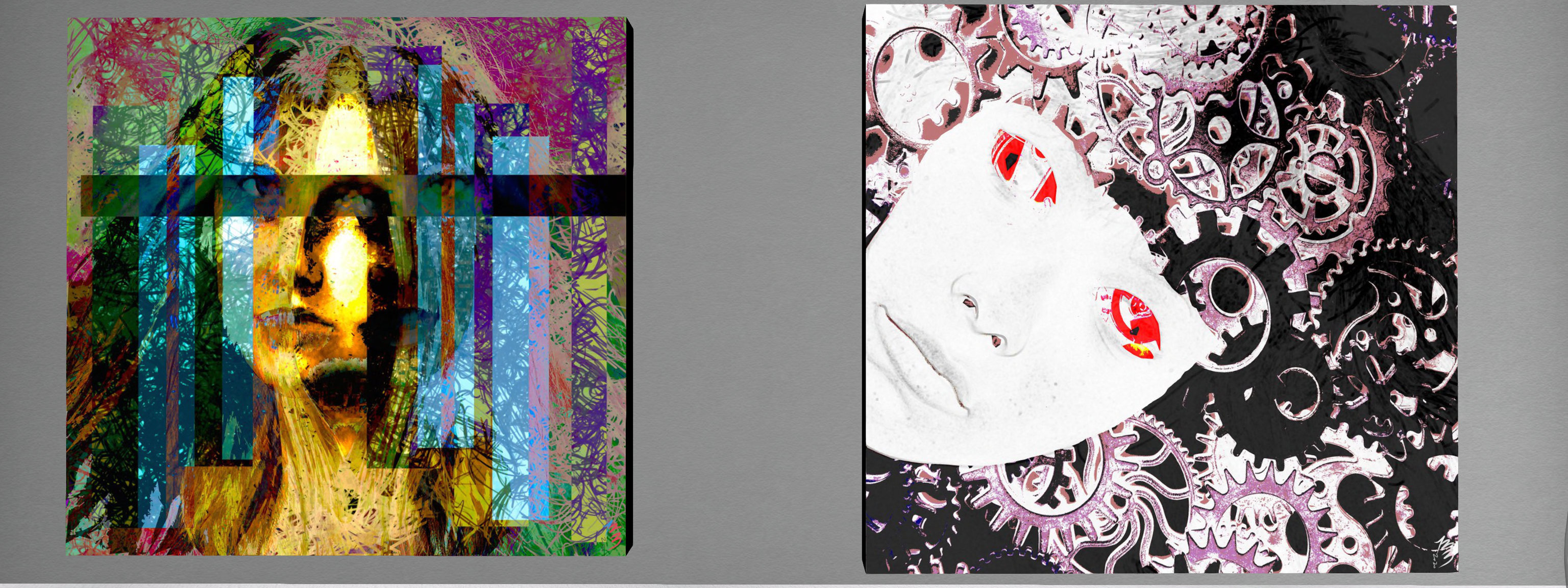
As is usual with Bamboo, all of the pieces offered within Blue Snow are endlessly vibrant, both in terms of the colours used and the degree of life they each exude. There is a strength about each one that captivates the eye and challenges the imagination, offering stories that might – when considering the central theme of the exhibition – enfold thoughts of the artist and her relationship with her work as well as revolving around our own perceptions of who we are and where we might be going.

Kondor Art Centre: Bamboo Barnes – Blue Snow

Richly engaging, Blue Snow is another superb exhibition from one of SL’s leading digital artists.

SLurl Details