Dementophilia in Second Life

The Vordun: Dementophilia

“We are chased by evil throughout our lives.” Federico Sosa (TheBDKX) states in introducing Dementophilia, his new exhibition at The Vordun Museum and Gallery. “Devils we try to hide, and slowly eat us up from inside, draining our strength. The worst of all evils. Ourselves.”

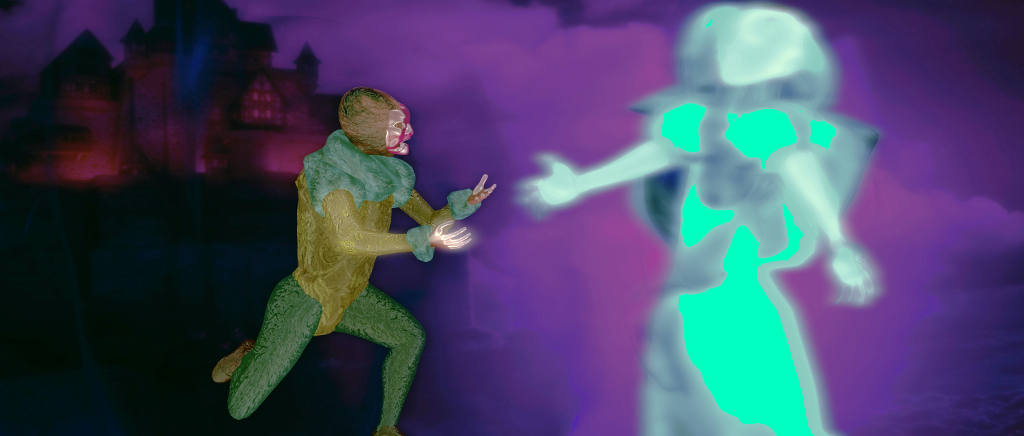
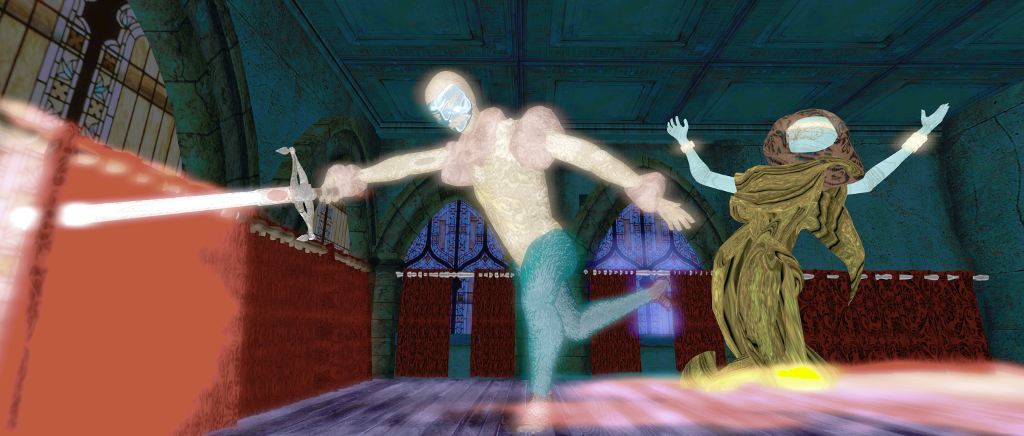
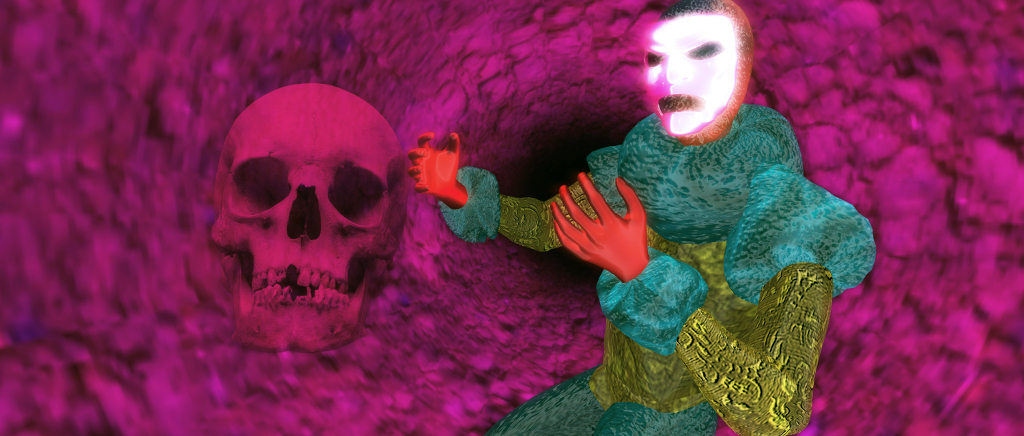
Dementophilia is described as “an abnormal, obsessive attraction towards insanity, and it is the perfect title for this exhibition. Located in the rear hall of The Vordun, it features eight paintings and eight sculptures, together with a large central mixed 2D and 3D element – the Vortex. Together they personify the darker imaginings from the depths of the mind

The Vordun: Dementophilia

The eight images and eight statues are paired, the statues physical manifestations of the paintings, brought forth by the vortex bursting forth from the rear wall of the hall. Each painting / statue represents a creature – or is that an elemental aspect, a beast if you will, of our psyche? In addition, each painting is partnered with a description of the demon it represents:  Enktrik, Zatrunnya, Beltaka, Fenniaq; Nelikaw, Trezykoy, Melkyze, Yiennak; each description reads as the writings of an unsettled mind – and what mind wouldn’t be unsettled seeing creatures such as these rising from the subconscious.

Thus, entering the hall is akin to entering those thoughts beneath our reasoned consciousness; a place where our personal devils reside; parts of our being alien and terrible – yet playing a vital role in forming our personality, again as Federico notes: “Locked inside, they can heal our wounds. Out in the open they reign. Beasts from within. Beasts of love and Pain. Beasts that are on the loose, fighting against the external consciousness.”

The Vordun: Dementophilia

Within this exhibition, these beasts have been named, their nature understood, suggesting their keeper is long familiar with them. Their presence speaks to that battle with an “external” consciousness, a mind acutely aware of their existence. A mind willing to make them manifest – or, perhaps, a mind succumbing to their dominance. It is down to us to decide which.

Dementophilia is intriguing in both its concept and interpretation. As manifestations of darker thoughts and desires, they capture the unreality of the subconscious. As pieces of art, they offer an abstract hint of demons from the realms of Hieronymous Bosch.

The Vordun: Dementophilia

I did find myself wondering how much deeper the impact of the exhibit might be if presented in a more tailored environment / setting and with an appropriate Windlight, but nevertheless, it still makes for a thought-provoking visit.

SLurl Details

Purple, Imani and Juris at DiXmiX in Second Life

DiXmiX Gallery – Purple Leonis ONeill

DixMix Gallery, curated by Dixmix Source, has another triple exhibition, this one featuring the work of Purple Leonis ONeill (Nel4481), Juris Bergmanis (JurisJo) and Imani Nayar. All three are very different in terms of their tone and style, making exhibition an interesting visit.

Purple’s work is located in the Grey hall of the gallery, just inside the main entrance. she presents thirteen images spilt between the gallery’s two levels. – two in a very large format, and all in rich, vibrant colours. Entitled Fantasme, there is a strong avian / fantasy theme running through the series, offering a unique set of avatar studies which are – in a word – entrancing.

DiXmiX Gallery – Imani Nayar

Within the Black hall, Imani Nayar also presents thirteen black and white images under the collective title Exposed. All are avatar studies, and as the title of the exhibit might suggest, some of them should be considered NSFW.

Above the Black hall is the White gallery space, where  Juris Bergmanis is displaying eleven quite stunning landscape images captured from around Second Life; and when I say stunning, I mean just that. They all share a common theme of sky and colour, suggesting they are intended to celebrate autumn.

DiXmiX Gallery – Juris Bergmanis

It’s a shame that, again, no biographical information is provided on the artists for those unfamiliar with them, as I’ve mentioned before. However, it is fair to say that such is the diversity of the three styles on display here, the lack of background information doesn’t detract from appreciating the pieces which are offered within each of the three exhibits.

SLurl Details

Elemental drawings in Second Life

Elemental – San (Santoshima)

“The exhibit is in celebratory recognition of the 9-year anniversary of Play as Being (PaB) in SL, and as such, is part of a year-long series of solo exhibits by PaB Guardians.” So reads – in part – the introduction to Elemental,  a set of photo drawings by San (Santoshima) on display at the Art of Being gallery through until the end of October, and to which I recently received a personal invitation to visit from the artist.

A total of 10 image boards are presented within the gallery space – six on the circular outer wall, four on the square central walls. Each panel contains multiple images, which can be viewed in turn by clicking on the panel (for the four images ranged on the sides of the central walls, click the left or right edges).

Elemental – San (Santoshima)

Thematically, the panels are similar in the images they present; the six outer panels focus on images of birds in flight and a figure with an umbrella. The colour wash in all of them suggest a breezy, perhaps rainy environment the birds and figure and flying / walking (drifting?) through each; thus we get – in part – the title for the exhibit: Elemental. The time of day which appears to suggest different times of day as well, perhaps adding to the title.

The inner four all share the same set of images showing a garden sitting with plants, rocks and trees, again taken at different times of the day. The natural setting for each image, combined with the watercolour-like tones, again suggests the images are Elemental in approach. As you click on the panels to page through the images, it is possible to By clicking on them to page through the images each holds, it is possible to form a story for each.

Elemental – San (Santoshima)

It’s important to note this is not just a visual exhibition. San has included a special sound scape to accompany the images, so it’s important to have local sounds enabled when visiting in order to enjoy the exhibition to the fullest. “[The] live sound recordings were made in a southern Gulf Island, British Columbia,” San explains. “Outside my cabin door; a raven pair conversing, raven parents with three fledglings, various small birds, and Pacific tree frogs.”

Also, as noted in the introduction to the exhibition, Elemental forms part of a celebration of Play as Being, an in-world group which describes itself as, “exploring reality by using our own life as a laboratory. A thought experiment to see what is left if we put down what we have, to see who we are.” More information on the group, together with a schedule of their events, can be found on their wiki page.

Elemental – San (Santoshima)

Elemental is a fascinating exhibition – and a peaceful one; a visit prior to closure is recommended.

SLurl Details

Myra’s Transitions in Second Life

Club LA and Gallery: Transitions

“My art primarily explores the freedom on-line communities, specifically Second Life, provide, allowing you to set aside your cultural roles and explore other roles.” Myra Wildmist in introducing her new exhibition Transitions, which opened at the Club LA and Gallery, curated by Fuyuko ‘冬子’ Amano (Wintergeist), on Sunday, October 22nd 2017.

She continues, “Real life cultural roles are necessary for a functioning society, but they are often extremely confining, almost forcing people into pigeon holes of expected behaviour. Second Life gives us all the opportunity to slip out of our pigeon holes and be almost anything we can imagine.”

Club LA and Gallery: Transitions

What follows is a selection of a dozen images offering some remarkable views of Second Life, each with a touch of the personal as then all include Myra herself in their frames – although it would be unfair to call all of them avatar studies; their compositions being such that the avatar forms a part of the overall scene rather than the focus of the image. Even those which do focus on the avatar do so in ways very different to more “traditional” avatar studies, allowing each one to tell its own story.

There are three pieces in the exhibit which might be considered NSFW, but all twelve are richly expressive, and demonstrate a broad range of approaches to photography which mark Myra as a true exponent of her art.

Club LA and Gallery: Transitions

Transistion shares the gallery space with Twain Orfan’s An Exhibition, which I reviewed in September, and a select of four images from John Brianna’s physical world photography.

SLurl Details

Floating in Second Life

Floating

Floating is an accident, pure and simple. It was never intended to be a collaboration between Bryn Oh and Cica Ghost – but that is what it is. Which is not to say that it is anything unfortunate – far from it; it’s an installation that mixes fun with something of a slight social message.

As Bryn explains, the installation was originally intended to be her design, but built to display the 2D art of another person. But for some reason (shyness?), having secured a grant to use the region, the other artist did not follow through on their commitment and no 2D art was supplied – leaving Bryn holding the lease on a region and in need of an idea. Enter Cica Ghost. She and Bryn put their heads together and in a week, Floating had emerged, with the assistance of Desdemona Enfield and Serenity Mercier.

Floating

The core of the build is a city hugging a shoreline; at one end are high-rise apartments overlooking a marina with motor cruisers and boats. The people in the apartments are clearly wealthy or well-off; through the windows of one we can see a family sitting down for a sumptuous meal, a butler in attendance, in another, a family sits in coloured warmth. With the marina and the high-rise buildings, the evidence of wealth, it is hard not to be put in mind of somewhere like Monaco.

At the other end of the curving shoreline it is a different story. Here there are no glittering high-rises, only older buildings, grubbier in appearance, which in turn give way to humble, racked living pods. The beach here is also far from the pristine marina, with piles of detritus, while the absence of colour underlines the lack of affluence. Thus, a comment on the divide between those who have, and those who have less (and who serve?), is made.

Floating

However, this isn’t just a build with a message on society’s disparities; there is also a sense of fun yo be found. At the arrival point, visitors can take an umbrella and float around the build, while free-floating balloons also offer a means to float through the air. But be warned – care needs to be taken as there are blocks that periodically fall from the sky.

Also to be found at the landing point is a zap gun. This can be purchased for L$0, and allows people to hunt and shoot one another. Just make sure you join the experience in the region if you intend to place – otherwise, should you be shot by someone else, you’ll be teleported home, rather than just back to the landing point.

Floating

Floating is a curious, electric mix of art, message and fun (if visiting with others and the guns are being used). Instructions on obtaining the zap gun and on getting around can be found at the landing point.

SLurl Details

Floating (LEA 13, rated: Moderate)

Melusina’s Mysteries in Second Life

Nitroglobus Roof Gallery: Mysteries

Melusina Parkin returns to the Nitroglobus Roof Gallery for October, with an exhibition called Mysteries, and it is a thought-provoking display of photography.

“Missing faces, veiled ones, obscure looks,” Melusina states in introducing the exhibition. “Statues and mannequins populate Second Life with their mysterious mood. Sometimes they are creepy, sometimes they are gentle, always they are silent.”

Nitroglobus Roof Gallery: Mysteries

Thus, Mysteries presents thirteen images of mannequins, figures and statues captured from around Second Life. Such figures, to be found all over the grid, whether in stores or art events, parks or role-play regions, homes or photography studios, all have some kind of story to tell – be it part of a larger setting or contained within the frame of their own display as a work of art or object of everyday use.

So to, through Melusina’s collection, do they tell a story or stories within this exhibition. The images have clearly been selected with care to project this, Mystery 10 through Mystery 13, for example, are displayed together on two walls, presenting an unfolding narrative – although what that narrative might be is up to each of us as we view the images. Others, such as Mystery 7 perhaps tell a story quite independently of the other pieces in the collection. But however one looks at them, the stories are there, individual or collected, waiting to be heard.

Nitroglobus Roof Gallery: Mysteries

But there is more here as well, if we’re willing to look a little deeper. Our avatars are, in a sense, our own mannequins. Through them, we get to decide not only how we interact with one another, but how we actually appear to one another. We can project – or inhabit – our avatars at will, using them to reveal or hide, project or protect, many different facets of who we are. They are both a window into who we are and a shield by which we can hide the things we do not wish to have seen. Mystery 2 and Mystery 3 perhaps embody this most specifically.

So as Melusina states, Mysteries may present an apparently lifeless population – but in doing so, it makes us wonder about human feelings and thoughts – and particularly, perhaps about our own feeling and thoughts, about our identity, relationship with others,  and our openness.

Nitroglobus Roof Gallery: Mysteries

Mysteries is another nuanced, fascinating exhibition from Melusina; and yet another not to be missed.

SLurl Details