MC Grafite is a relative newcomer to Second Life, having joined the platform just five months ago. However, at 13:00 SLT, on Tuesday 13th December, she is opening her new gallery featuring her work (and only the second time she has publicly exhibited her art!). I took the opportunity to drop in ahead of the opening, while MC was still setting up to gain something of a sneak peek.
Also known as Marisa Camelo, MC is an artist in the physical world focusing on pencil-based drawings. She notes she spends around nine or ten hours a day drawing, her work covering a range of topics, including portraiture, animals and wildlife, costumes, tattoo designs, cars, and more. And if I were to try to define her art in a single word or phrase, it would be: striking.
Within a simple, but effective gallery setting of stone pillars and plain white walls, MC presents a broad portfolio of her work, from simple-looking sketches, located outside of the main entrance in an enclosed courtyard, through to a series of exquisite set of white-on-black images of quite exceptional beauty and depth.
Her portraiture is also shown, within pictures of actors, celebrities and film and literature characters mounted on the rear walls of the gallery. I admit that her Baby Groot (Guardians of the Galaxy Volume 2) and her It immediately drew my eyes to them. Both capture the vitality and mischief inherent in the first, and the sheer malevolence of the second quite perfectly. I found Eye, located directly beneath It equally mesmerizing – although this should not be taken to mean there is anything lacking in the remaining portraits; quite the reverse in fact: each has its own unique attraction.
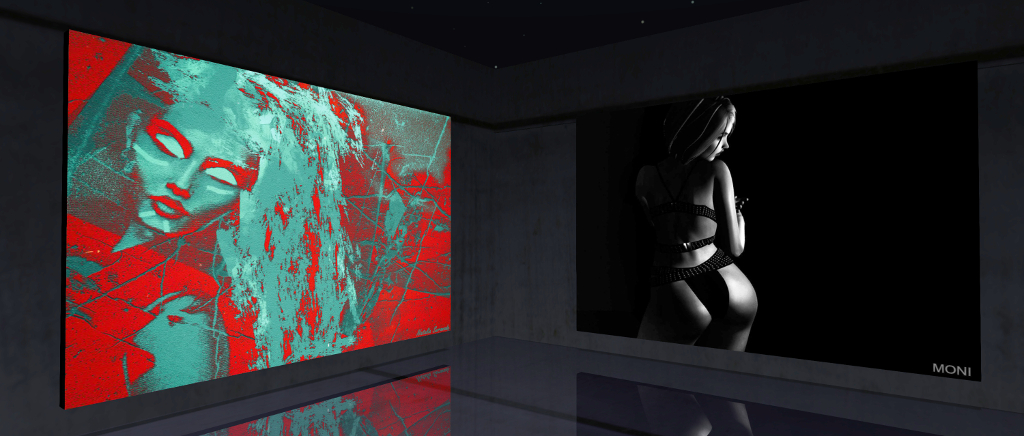
But I must admit to being completely captivated by the etching-like black-on white pieces she presents; there is something about this approach to art that I’ve always found enamouring, and the pieces MC offers are stunning in their presentation and beauty. As a cat lover, Cat Reflex and Cat in the Moonlight simply (both seen in the image at the top of this article) entranced me.
Further pieces are available on the upper mezzanine of the gallery, one or two of which might be considered NSFW. However, as MC was still setting-up on the upper floor when I visited, I only had a quick cam up to it, in order to avoid disturbing her too much.
As well as her own art, MC also offers a commissioned art service. Details of this can be found via the information givers located next to one of the stairways leading up to the Mezzanine level.
The gallery officially opens at 13:00 SLT on Tuesday, December 18th, 2018, as noted. But whether you can make the opening or not, I do recommend the MC Grafite Gallery as well worth a visit.
CybeleMoon (Hana Hoobinoo) is without doubt one of the most expressive fantasy artists in Second Life. Her art has a unique beauty that I consider to be unsurpassed in its depth and narrative; pieces that are hauntingly fascinating, encapsulating worlds of wonder and mystery or reflecting wonderment and innocence through portrait and study.
You can witness for yourself just how evocative and engaging her art is by visiting Tales of A Winter Sun, which officially opens at 12:00 noon SLT on Saturday, December 14th, 2018 at the Paris Metro Art Gallery. I was able to visit the exhibition ahead of the opening, and it truly is a delight.
Tales of a Winter Sun is actually something of a three-part exhibition. There is Cybele’s art, 20 images and a central mural type display; then there is a poem by Cybele, reflective of the art and of the season (available by clicking the information board at the lading point), and also a blog post she provides on her website.
There is a time in the hushed solitudes of falling winter, while the dreaming earth stirs softly beneath her frosted blanket, where for a moment, we remember innocence and magic, and the incredible awe of being, where hope is renewed in the lighting of candles and a star leads the way to Bethlehem, Where grievances are put aside as we open our wounded hearts to receive the seeds of rebirth Where my own dreams flow to the sacred music of haunted woodlands and enchanted children. and old tales are retold with feasting and friends where the lost are found and the poor are blessed and where angels walk among us
– CybeleMoon
Reflective of the theme and the season, the 20 images offer us 20 twenty stories – some quite literally so, should you touch them – each beautifully encapsulated in a single moment.
It is this feeling of capturing a moment that is particularly attractive about Cybele’s work. Her pieces are incredibly intricate in form and construction, the balance of light, colour, focus and theme utterly sublime; where looking at her art, I cannot help but see them in terms of an orchestra, different elements and layers, skilfully woven into a whole under the guiding hands of the conductor – or in this case the artist.
Yet, at the same time, there is a marvellous sense that each piece, far from being composed, has been captured in a fleeing moment, as if the mind has taken a snapshot of a dream or the eye a single moment of time played out before us in a world where wonder, innocence and beauty define all we see, and perhaps say and do.
Some might accuse me of waxing lyrical or of using hyperbole in writing like this – but unless you’ve seen Cybele’s work first-hand, it is hard to grasp just how rich, resonant and alive her art really is. As such, I urge you to go and witness Tales of a Winter Sun for yourself – you will not be disappointed.
In the meantime, and as she references it in her own blog post, I’ll leave you with an astonishing rendition of Leonard Cohen’s Hallelujah by Rhema Marvanne, and recorded when she was just eight years old, and which sits as a perfect companion to the art Cybele presents in both the exhibition and her blog post.
For those unfamiliar with Moya (Patrick Moya in the physical world), he has been a part of the artistic movement Ecole de Nice, and throughout his career has been as the forefront of artistic expression through all forms of media and technology, including virtual spaces. He is an early pioneer of video art, and was quickly drawn to the potential of virtual spaces like Second Life, in which he has been involved since 2007 and where he continues to maintain his Moya estate of four regions. He was also one of the first artists to actively promote Second Life in the physical world, with Rinascimento Virtuale, hosted by the museum of Anthropology of Florence, in 2009.
Entitled Carnaval et fêtes populaires (literally “Carnival and popular festivals”, but given the English title “Carnival and popular traditions” in English), it is a typical piece from Moya, full of vitality, reflecting elements of his physical world art. Within it is – as one would expect – his alter-ego of Moya, familiar by his Pinocchio-like nose, and little Dolly, inspired by the cloned sheep of the same name. Frivolous, engaging, with some subtle motifs, Carnaval et fêtes populaires is a colourful piece, well in keeping with the time of the year.
Below it, on the lower floor of the gallery are three exhibition spaces presenting the physical world art of three very different artists: Renoir Adder, Layachi Ihnen and Bump Squeegee.
I confess to being unfamiliar with Layachi’s art, which is offered here as the largest of the three displays. A profession of mathematics, Layachi started painting in 1969, and since 1999 has focused on mixed media, combining digital painting on computer with traditional techniques. For this exhibition, he presents pieces that reflect this mixing – notes the faces in many of the paintings -, all offered in a unique and distinctive style.
As an artist, Renoir Adder straddles genres. Within his pieces can be found elements of post-impressionism, potentially influenced by the like of Van Gogh; suggestions of Picasso; and impressionist leanings.
Much of this is in evidence in the 15 pieces displayed at La Maison d’Aneli, in the midst of which are, to my eyes, three absorbing painting of Geishas which exhibit a unique and eye-catching style that focuses the attention marvellously, encouraging the observer to work outwards from them and take in the rest of the paintings in turn.
Bump Squeegee’s collage art is, for those familiar with it, instantly recognisable. Rich in colour and style, the dozen pieces here are a marvellous selection of Bump’s work. By their very nature, these are pieces for which description is meaningless; they deserve to be seen first-hand in order to appreciate them fully.
Back on the upper level of the gallery is a selection of physical world photography by Chapichapo Delvalle. Another artists with whom I was unfamiliar, Chapichao’s work focuses on nature and natural settings, varying from full landscape pieces to focusing down to things like a small branch of pine cones set on the stonework of a footpath, offered as a series of studies in colour and style.
Colour is a major element in these images, and might be said to be a physical reflection of Chapichao’s vibrant view of Second Life.
Lam Erin, in providing full disclosure, is one of my favourite Second Life landscape artists, although I only discovered his work less than two years ago. As a virtual artist, Lam takes images captured within Second Life and transforms them into the most fantastic digital works of art, so rich in detail, you feel as if you can see the individual brush strokes in an original piece of art.
One of the hallmarks of Lam’s work is his presentation of cloudscapes. These cast a dramatic, even foreboding, look to the skies of his art that brings an added depth of realism and narrative to his paintings that is utterly remarkable. It is this attention to his clouds and skies that also makes his art redolent of some of the great masters of landscape painting.
As always from Aneli and La Maison d’Aneli, an engaging exhibition of works by talented artists, and not one to be missed.
Cica Ghost’s latest installation, Lullaby, opened on Tuesday, December 11th. It’s a curious piece, something of a celebration of the creatures that might be said to come out at night, together with touches of some of Cica’s previous installations.
For the byline to the installation, Cica has chosen the chorus from Lullaby for anInsomniac, by Kate Nash. Sung acapella (albeit with an instrumental ending) the song fits the installation very well, offering something of a gentle subtext to the setting – although too deep an examination of song and installation should perhaps be avoided.
The idea was first, but I often listen Kate, so maybe it was influence. I listen her often when I work. I made the girl a few days ago; it was only house at first, but then she needed somebody to think of.
The girl and house in question, can be found towards the middle of the strangely undulating region, perched on a curious table of rock and reached by a ladder impersonating part of the sine curve. She sits atop the house, staring into the distance, lost in thought, the landscape darkened by a greenish night. Her attitude suits the refrain of the chorus perfectly – a girl who is missing someone, and who finds herself unable to sleep and with little interest in how she looks or the state of her surroundings.
Her indifference to her surroundings is a shame, because across this weird landscape with its abrupt hills and valleys and unusual rock formations, the creatures of the night have all come out to play: flying bugs, spiders, curious worms with friendly, anthropomorphic “faces” courtesy of eyes sitting on slug-like stalks and very human tongues lolling happily, and heart-shaped flowers with large, unthreatening eyes. Even some of the hills have eyes, revealing themselves as the domed heads of creatures nestled far enough underground while still able to see what is happening around them.
All of this night, in other circumstances, sound like the stuff of nightmares, particular given the giant snail watching over the landing point – but it is not; it is a night-time setting of playfulness. None of the creatures are in any way nefarious; most are going about their business without concern for whatever else might be happening, although one or two do appear to be a little curious about the stranger in their midst, sitting on her odd perch.
Also to be found in the region are echoes of some of Cica’s past works: a bear stands up on one of the hills, for example. While he may be without a shirt, he and the flittering night bugs bring forth memories of The Bees and the Bears. The three frogs sitting close to the landing point directly reflect Frogs; a spider’s web offers a faint echo of Arachnid, even the girl herself, sitting atop her house, is reminiscent of Moonlight.
And here lies the gentle – if perhaps unintentional – subtext of the installation. Just as Lullaby for an Insomanic reflects on the things we have and the sentimental value they can have, so do these aspects of Cica’s Lullaby gives those familiar with Cica’s work pause to remember her past installations and the joy and other emotions they gave us when they were present in Second Life.
There aren’t too many places to sit within Lullaby (they are there, but you’ll have to find them!). Instead, and tucked away on the top of one of the odd stalagmite-like rock formations Cica offers a free flying bug. Simply take it, Add or Wear it, and use the WASD / arrow keys, together with PAGE UP and PAGE DOWN to fly yourself around.
Lullaby should remain open through until early January for visitors. There are several tip jars scattered around the installation, so do please consider a donation towards this and Cica’s future work in Second Life.
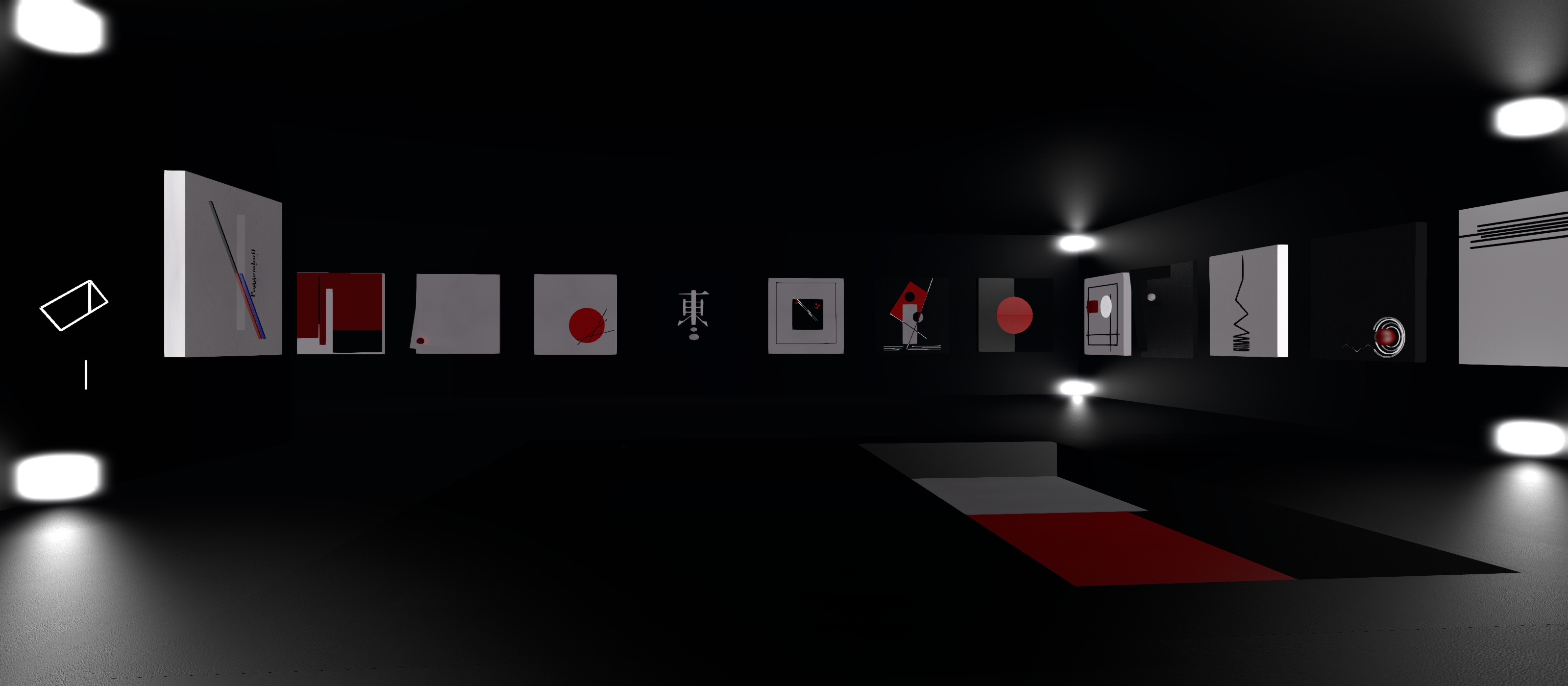
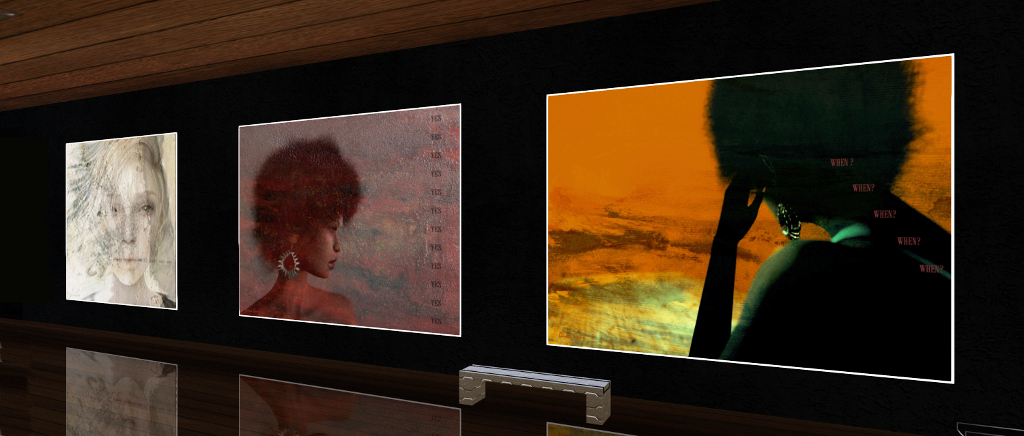
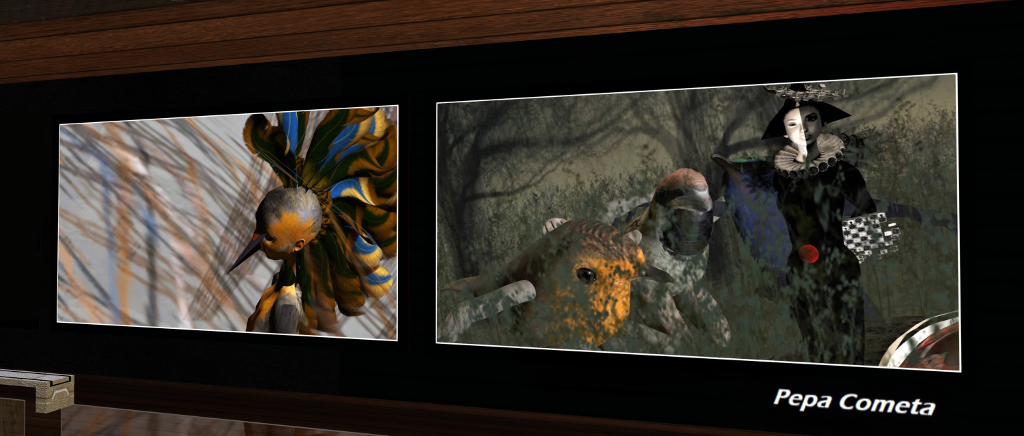
Ribong Gallery is a new exhibition centre developed by San (Santoshima) that opened in December 2018. Located in a large black-walled environment, the gallery offers a mix of exhibition spaces and what might be public areas where people can relax. For the opening, two exhibitions are presented, the overall design of the gallery allowing them to blend together.
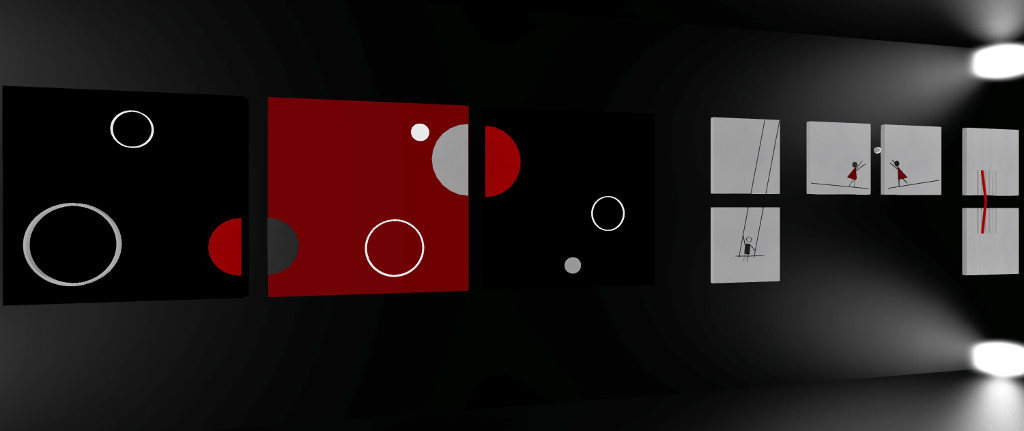
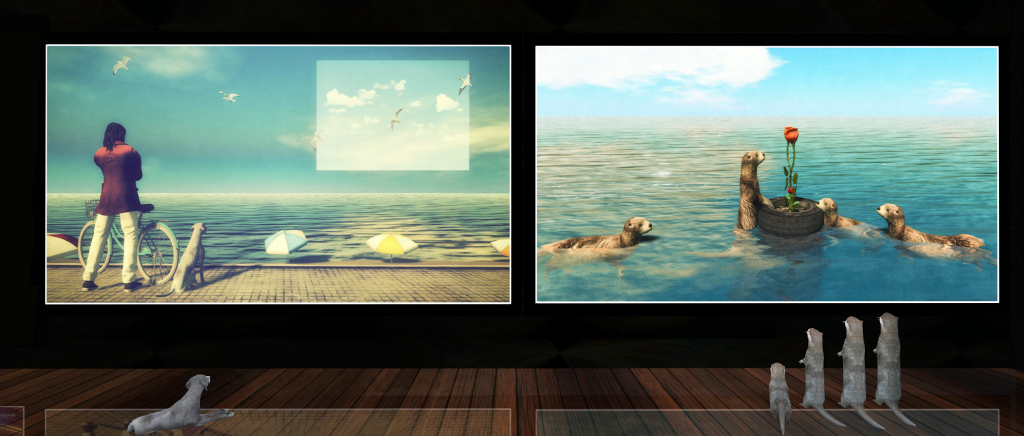
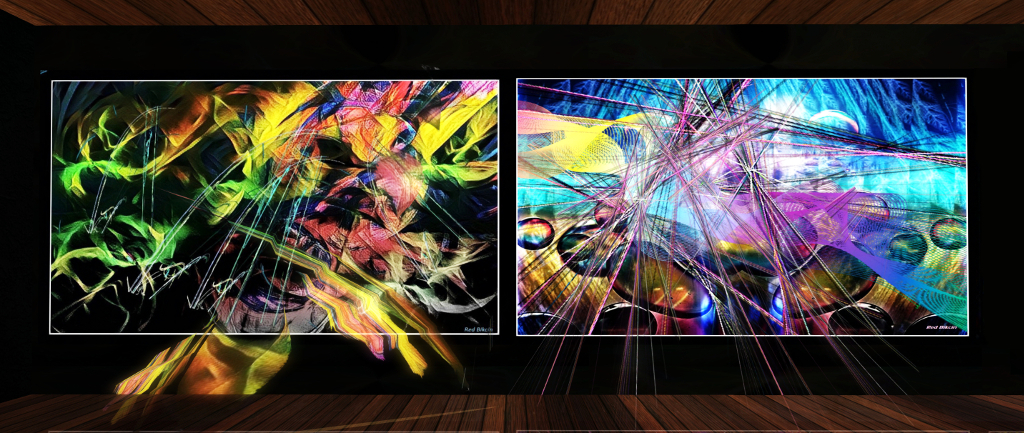
The first of is an ensemble exhibition, mixing 2D and 3D art by Aphrodite Macbain, Bleu Oleander, Bryn Oh, Cica Ghost, Gitu Aura, Grady Echegaray, Harbor (Harbor Galaxy). ini (In Inaka), Kara Mellow, Meilo Minotaur, San (Santoshima), Storm Nordwind, Theda Tammas, Xirana Oximoxi and Zen Arado. In’s not clear if the pieces on display are the result of invitations to the artists to display their work, or whether they have been drawn from San’s personal art collection.
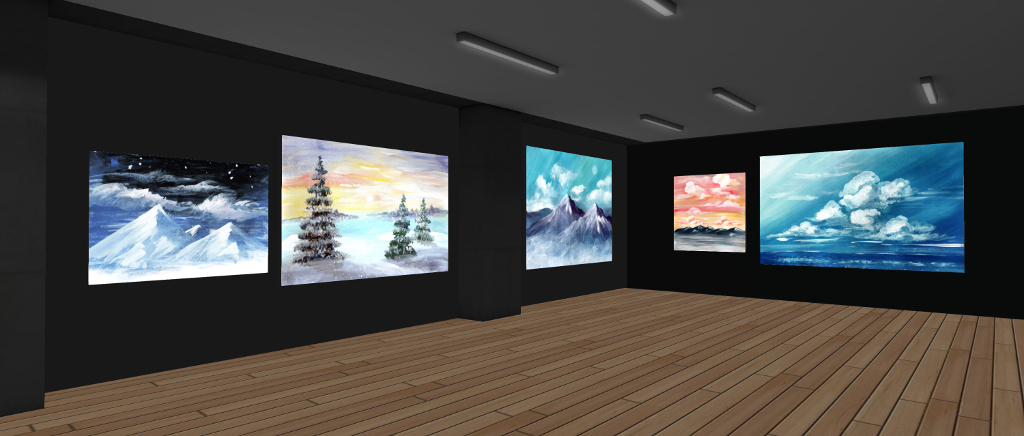
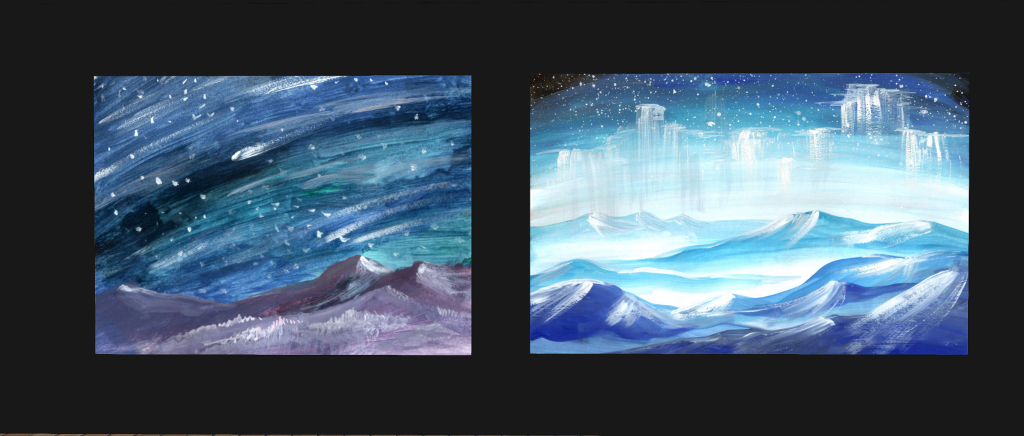
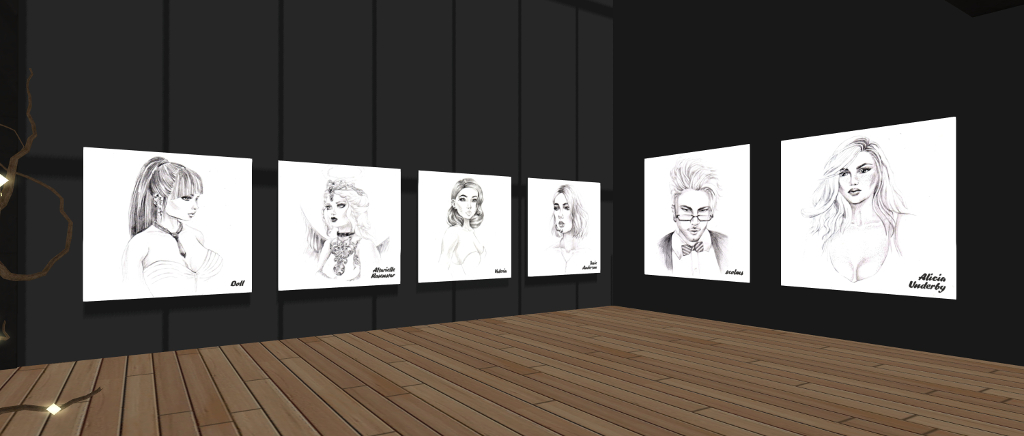
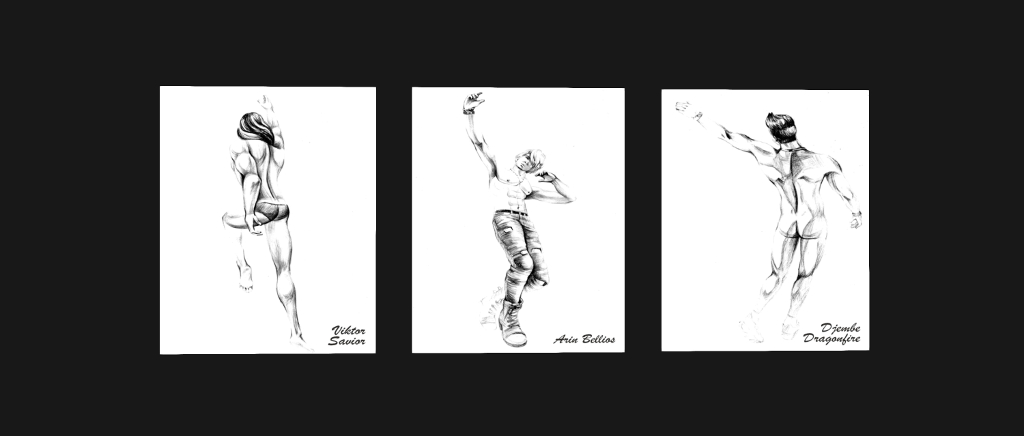
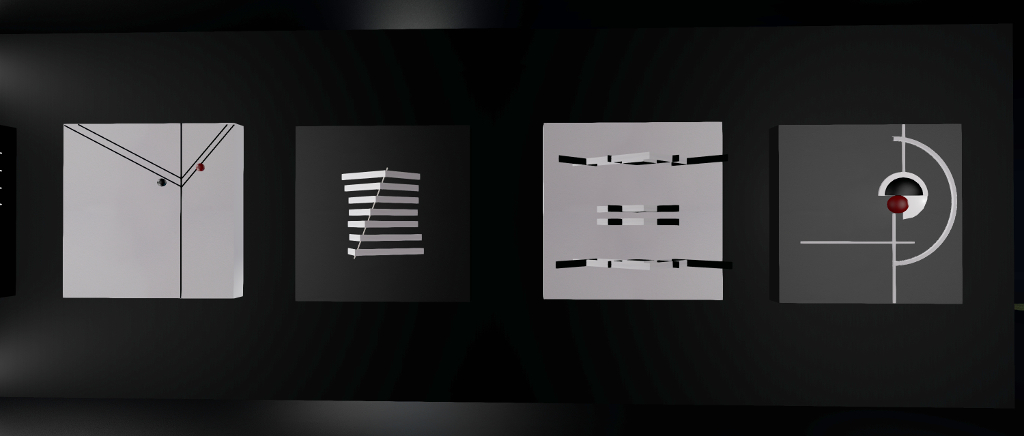
The 2D art can be found along the walls of the primary display space, just inside the main doors, and within some of the areas that appear set aside for resting and casual chat. The 3D elements can be found around the walls, mounted atop display plinths and – notably with Cica’s pieces – could be mistaken as part of the setting itself. Thus, careful exploration and study is advised!
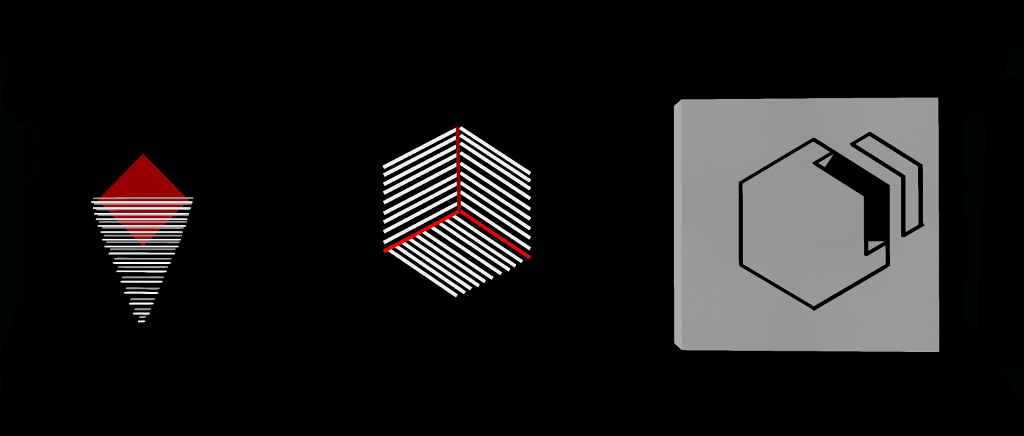
The second exhibit is entitled Big Bang Theory, and features animated photo-sculpture installation utilizing original physical world black and white and light-painted photographs by San herself. This takes the form of a number of large 3D elements located in both the main hall and the upper mezzanine-like level of the gallery. As the name implies, these are gently animated sculptures, each of which features one of San’s photos, the full set of which can be found pinned to the wall at the entrance to the exhibition, but you may need to cam in to see them in detail.
Each of these pieces is multi-faceted and almost hypnotic in their flowing movement, but whether intended to infuse a sense of the beginning of time – as suggested by the title of the installation – or not, I leave up to you. For my part I found them intriguing and – as noted – soothing pieces. Again, to appreciate them fully, I’d recommend careful camming (if you can flycam around the individual pieces, so much the better).
Also to be found on the same platform – but just across the region boundary – is the Art of Being gallery, featuring the work of Bleu (Bleu Oleander). At the time of my visit it featured Bleu’s imaginative take on art by Henri Matisse, Claude Monet, Salvador Dali, David Hockney, Adolph Gottlieb, Pablo Picasso, Marc Chagall, Jasper Johns and Edward Hopper.
Also found on the same platform, and beyond Art of Being is the Play as Being theatre, home to the Play as Being group, which defines itself as:
A group of people exploring reality by using our own life as a laboratory. A thought experiment to see what is left if we put down what we have, to see who we are. Can we make conjectures, hypotheses about what Being could be, and play with those in our day-to-day life? What happens when we do?
You can find out more by visiting the Play as Being website, which includes a schedule of weekly events for those wishing to join in.
Jane and Eloise, the latest installation by Bryn Oh officially opens on Saturday, December 8th. As with much of Bryn’s art, this is an immersive installation that carries both a story and a level of interaction – although the latter is perhaps more of a focus than may have been the case with prior pieces.
I wanted to play with the idea of what art can be in the virtual space … In a museum or theatre we stand back and look at a painting or sculpture, we don’t touch them nor interact usually, while in the theatre the movie tells us a story and we sit and listen. We follow the camera where it leads us and should we wish to open a door or look under a bed.. well that is not part of the experience … With this work I wanted to have a short narrative within an artistic environment focusing on colour, line and form but also creating a gamification of the artwork itself.
The narrative is that of two sisters – Jane and Eloise – who go fishing on Lake Superior. Theirs is not a happy tale, as they are caught by the changing weather, their boat capsizing on them. Sadly, Jane drowns, witnessed by Eloise, whose life is almost lost as well. Afterwards, Eloise is left tortured by guilt that she survived and nightmares – and the major part of the installation encourages visitors to share in those nightmares and to experience her confusion and distress first-hand.
The first element of the installation is a beach setting – the shoreline of Lake Superior, with changing tents set out on the sand and bathing wagons up to their axles in the water. If you have not previously accepted the Bryn Oh experience (or have revoked it since your last visit), you should accept it when prompted – as it is essential to your participation in the installation.
Travel along the breach and you’ll come to a small vignette depicting the final part of the fishing trip: Eloise, alive, washed up on the shore, the waterlogged canoe drifting just off-shore and Jane, laying just before the waves. Beyond this vignette, out on the horizon, the main part of the installation awaits: the brooding bulk of the maze.
The maze is a symbolic recreation of the nightmares that get embedded within our mind after a traumatic experience. It is the mind of Eloise … With a traditional artwork you can then step back and say observe and contemplate [with] this work, you enter the mind of Eloise and navigate a fairly scary maze trying to find the exit.
– Bryn Oh on Jane and Eloise
Providing you have accepted the experience, arrival at the entrance to the maze should equip you with a miner’s style lamp with head strap. A sign board on the wall near the entrance provides additional information on how best to enjoy it – in short, if you can’t use the recommended windlight (Firestorm should automatically switch to it), make sure you flick your viewer to at least midnight, enable projectors by turning on ALM and remove any face / body lights you are wearing. In difference to the instructions, you don’t need to have shadows enabled to obtain the projected light from the head lamp – but if you can run with them enabled, it adds considerably to the depth of the experience, allowing you to see it exactly as Bryn intended.
Within the maze, are corridors – patrolled by the demons of Eloise’s subconscious – and safe rooms. The idea is to make your way through the corridors, avoiding the monsters with the aid of the safe rooms. It’s a place best experienced in first-person Mouselook, and running may be required at times! In addition, some of the walls of the corridors include paintings, and elements of Bryn’s art can also be found in some corridors and in the safe rooms.
Along the way you might find what I call mouse holes. The mouse holes are thin doorways that only a single avatar can squeeze through into another hallway, if a monster is coming you can slip through and they can not follow, but if you are with friends then there might be some frantic pushing and screaming as the monster approaches 🙂 The maze can be scary and cause some anxiety, in tests I have watched people who find mouse holes and linger by them afraid to go further out into the maze.
– Bryn Oh on Jane and Eloise
Bryn invited me to try the maze with her, and I have to confess, it is addictive. If the monsters do get you, you’re teleported back to the start – and they are quite capable of sneaking up behind you! I also recommend having local sounds on; this both allows you to hear the monsters and adds further depth to the piece.
This is also a fascinating piece from a technical standpoint as well – and those from the Lab who read this review, I hop you’ll take note of what Bryn has to say vis-a-vis Pathfinding! Essentially, to prevent cheating, the maze rebuilds itself every hour, and as it includes creatures roaming it, it presented special challenges, as Bryn notes:
This work required that a whole new set of scripting was built because other forms would not work with it. For example, pathfinding is a great way to have a monster navigate a maze, except when a maze randomly rebuilds itself. In pathfinding the monster would need to know where each wall is, and then it could move through them.. when you make a new maze every hour the pathfinding creature can’t see those new walls. So a new type of movement had to be created where the creatures would “see” the maze as they move while also looking for people to chase.
– Bryn Oh on Jane and Eloise
All told the development of the maze took some 3 months, and the results are incredible – particularly if you happen to catch the maze rebuilding itself, as I did while exploring with Bryn.
Jane and Eloise has all the classic ingredients from Bryn: narrative, a beautiful use of light and shadow, colour and contrast, interaction and engagement, and despite the sadness of the narrative – offers a game element that when played with others or on your own can get to be addictive.