The artefacts of love and lust in Second Life

Artefatos, the G.B.T.H. Project

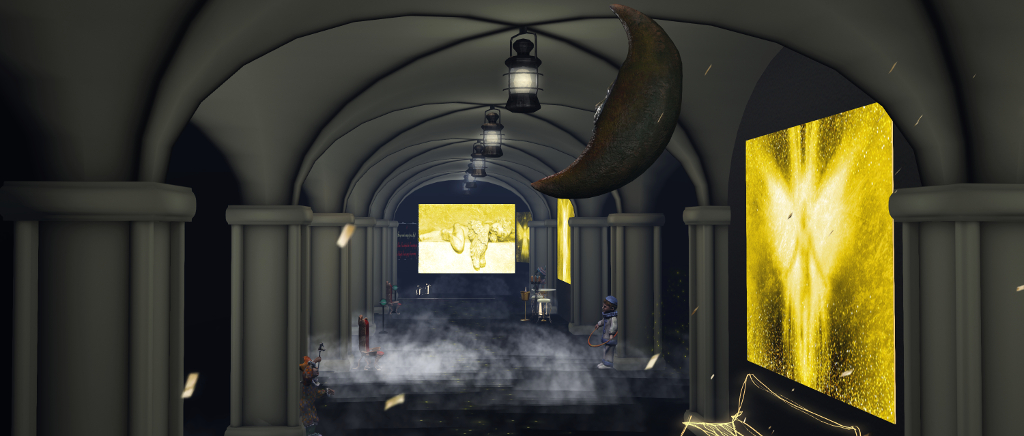
The hotel sits alongside a canal, the one building lit within the gathering gloom of night. Limned in teal, the entranceway beneath the heavy awning looks cold even in the gloom, but inside is the warm yellow glow of ceiling lights offering a more friendly invitation to come inside, while more of the warm illumination pours out of the entrance leading up to the hotel’s rooms.

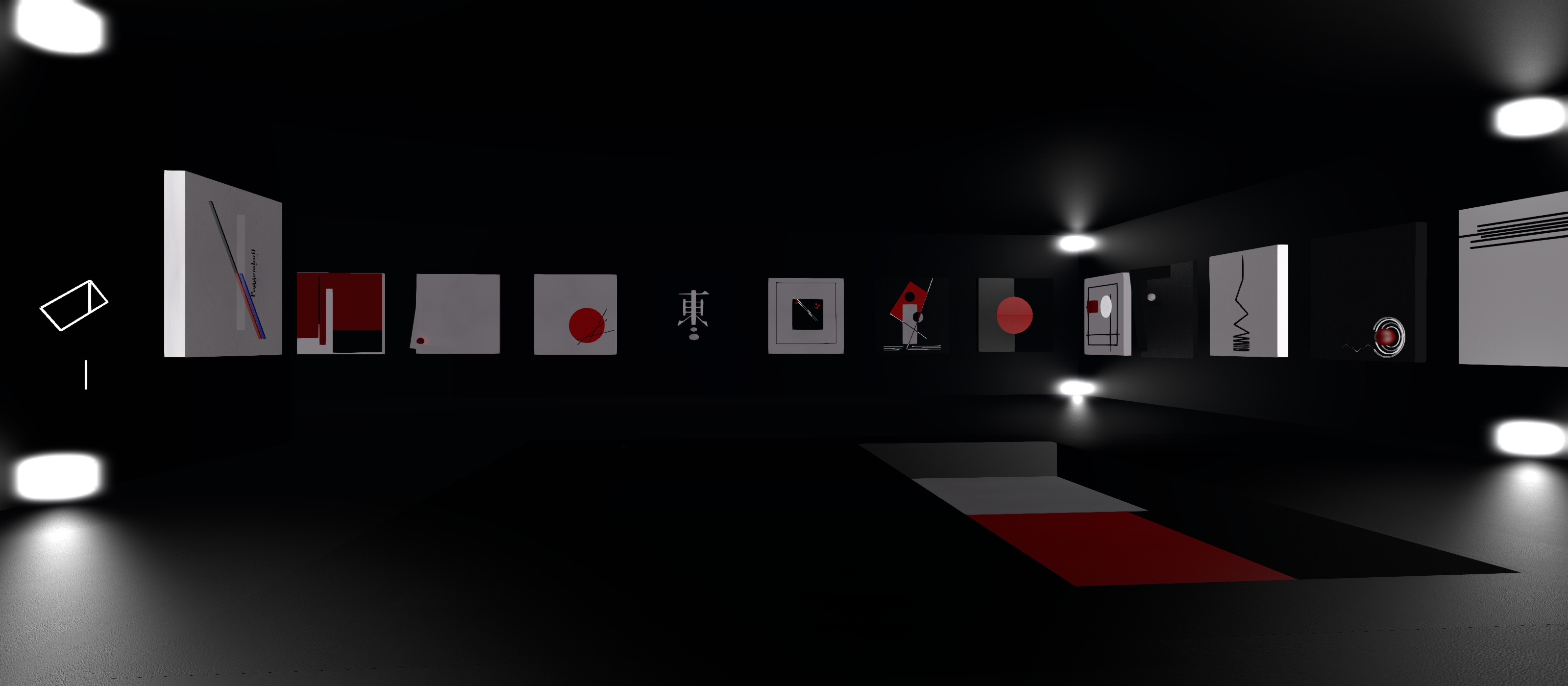
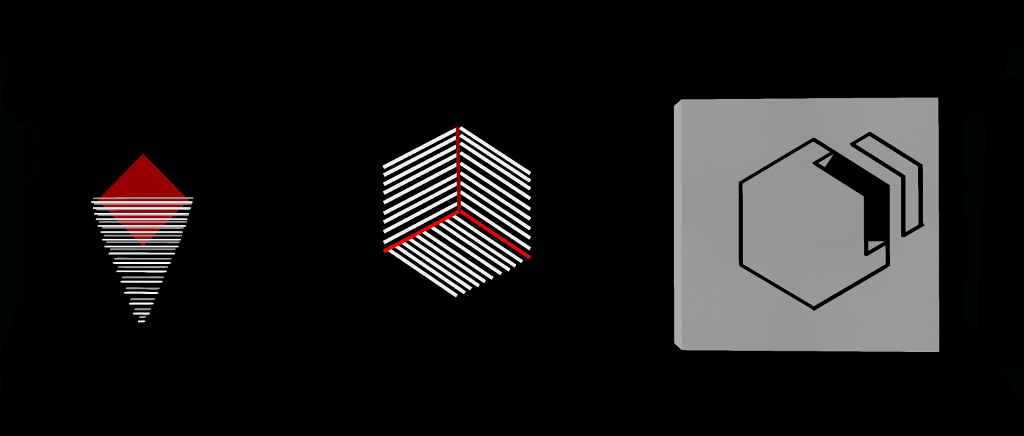
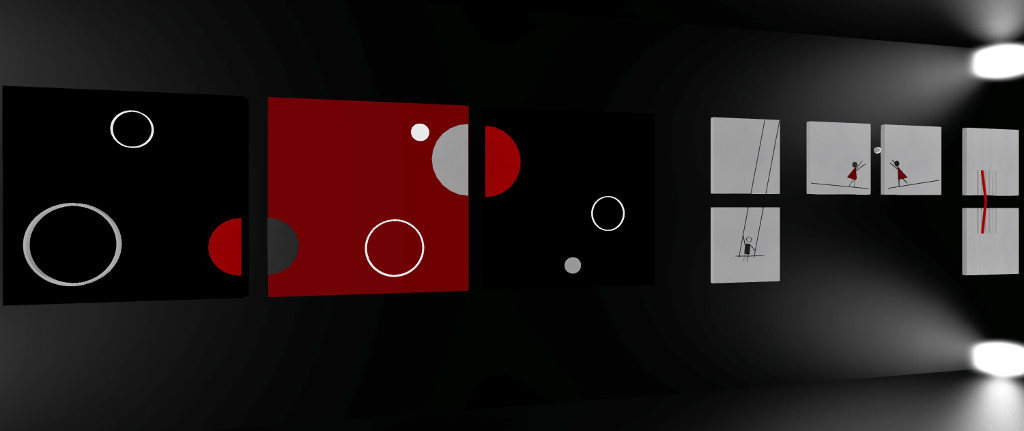
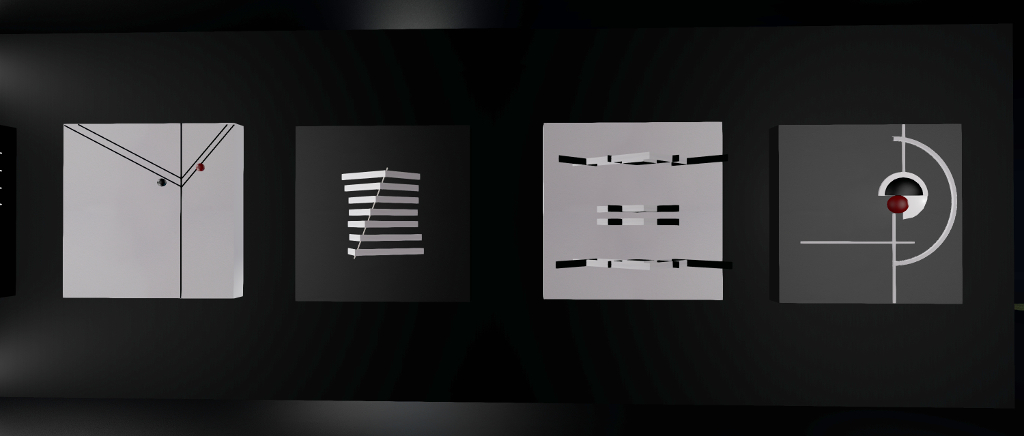
This is clearly a discrete establishment: the fact that the rooms can be accessed without the need to pass through the lobby area once a room is booked means patrons – and their guests – can come and go without too much notice. Thus, it is the perfect setting for a lover’s tryst – and for Artefatos (Artefacts), a provocative story-as-art installation by Ash (Ashratum), the latest exhibition presented at the G.B.T.H. (Grab By The Horns) Project, curated by Megan Prumier and Marina Münter.

Artefatos: The G.B.T.H. Project

The hotel lobby offers an introductory guide to the installation. In short, ensure you have Advanced Lighting Model (ALM) enabled in your viewer (absolutely essential, as the installation uses projected lighting and effects) – just go to Preferences > Graphics and ensure the ALM option is checked. Then climb the stairs to each floor in the hotel and visit each room in turn – there are two rooms to a floor for a total of 6 visits (although the 6th room offers more of a farewell, suggestive that the individuals in the stories might all be one in the same), each with a teleport door that should be touched to “enter” the room (touching the door also returns visitors to the landing “outside”) so they might proceed to the next door.

Each room forms a chapter of a story – the meeting of people brought together in love and – particularly – lust; erotic and sexual encounters. Written from a personal perspective (that of the / a woman in each story), they cast those visiting the rooms into multiple roles.

Artefatos, the G.B.T.H. Project

The most obvious of these roles as that of the storyteller’s male lover; written as recollections of recent encounters. In this, some might be stories designed to titillate and arouse as a kind of foreplay between lovers; in others they might be seen as expressions of regret for what has passed, while other hint at an unburdening of hurt. At the same time, there is an air of revealing secrets through the stories, casting the visitor almost into the role of confidante – although this is overshadowed by the sense that we are in fact voyeurs, having stumbled across the intimate letters from lover to former lover.

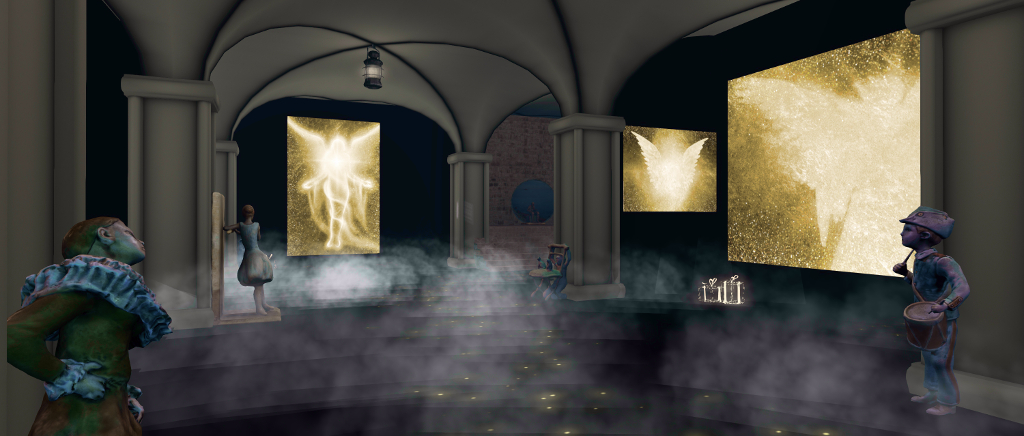
Thus, Artefatos presents a layering of interpretation through the stories, which are themselves made further tangible through the objects found within each of the room. These both reflect the story specific to each room whilst also casting visitors into two roles: that of the male lover – the props making us very much part of the story; and (again) that of voyeur, witnessing individual moments from each story from the outside, through the study of the artefacts that have been left behind.

Artefatos, the G.B.T.H.. Project

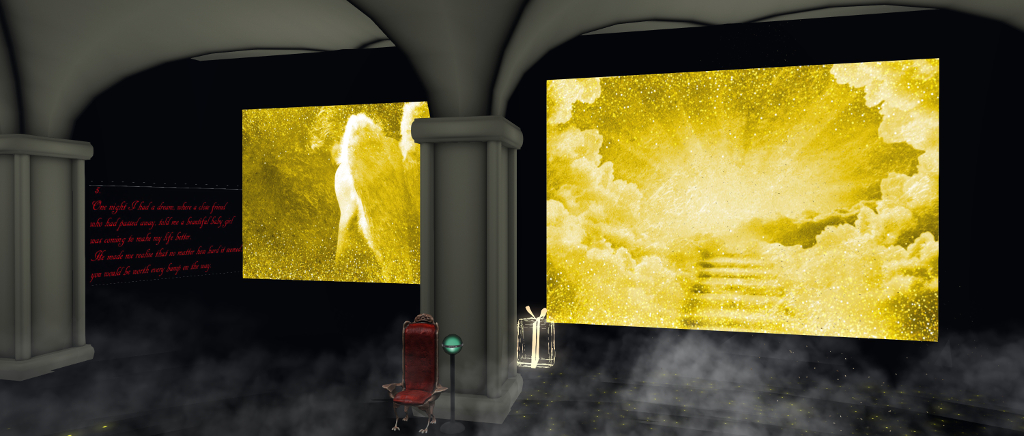
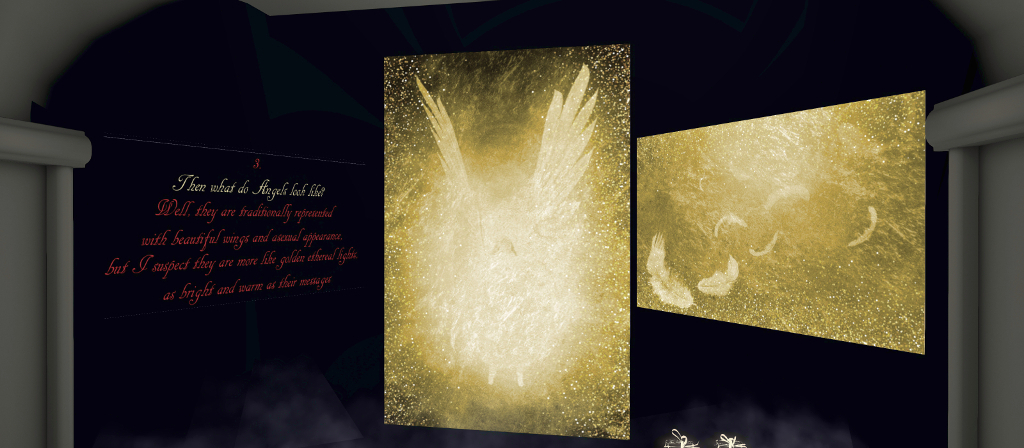
There is more to these objects than passive illustration, however. For those who speak Portuguese, approaching the items in each room allows the story to unfold through the spoken word via local sounds. For those who don’t speak Portuguese, a note card giver in the wall of the entrance hall to each room will supply the story in English, while extracts are projected onto each bedroom wall – hence the need to have ALM enabled.

The audio project can sometimes be disconcerting, as it is possible to stand within the room and hear multiple voices; but it can also deepen the sense of immersion within the installation, regardless of whether or not you understand what is being said. The passages layered one over the other can become fragments of memory; words said in the past, echoing in our ears. Thus we become not only the man to whom each story is projected, but the male half of the story as he perhaps revisits the scene of an encounter, hearing once again the words said to him in its wake or aftermath.

Artefatos, The G.B.T.H.. Project

A fascinating installation offering a different perspective on artistic expression in Second Life, Artefatos further establishes the G.T.B.H. Project as a forward-thinking gallery space in-world, and will remain open through until November 8th, 2018.

SLurl Details

Moni’s Changing Moods in Second Life

Nitroglobus Roof Gallery: Changing Moods

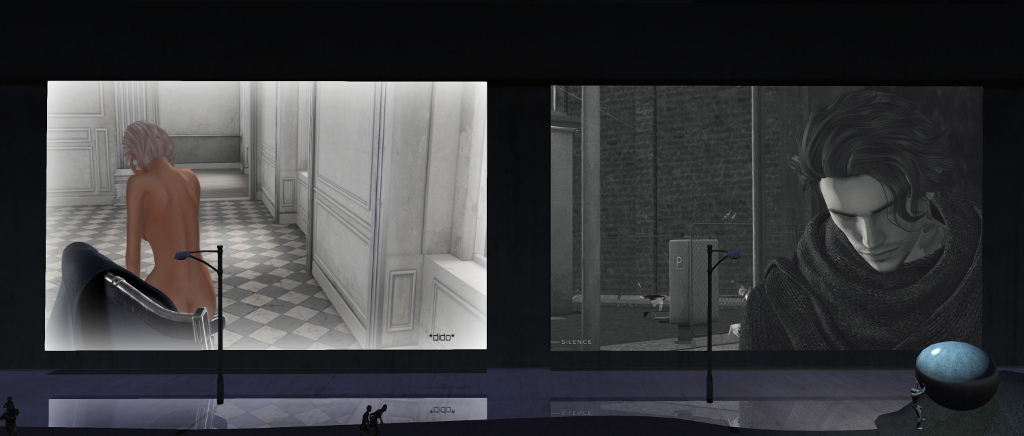
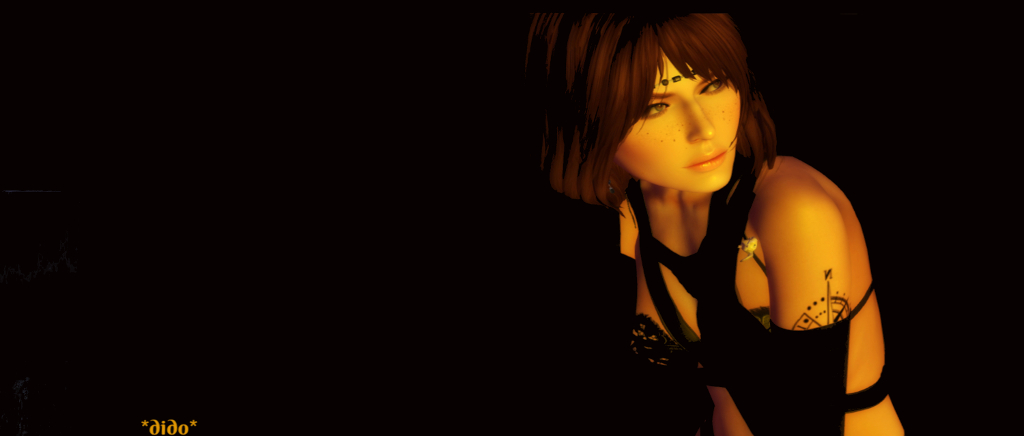
Monique Beebe makes a further return to Nitroglobus Roof Gallery, curated by Dido Haas, with a new exhibition entitled Changing Moods, a must-see exhibition, although part of it should be considered NSFW.

This is Moni’s third appearance at the gallery, and having covered her first two – Hidden Faces (see here for more) and Sensuality (see here for more), I confess to having been excited by the news of her return, as I’ve found her to be one of the most sensuous, evocative artist and – given she is generally the subject of her own work – models in Second Life.

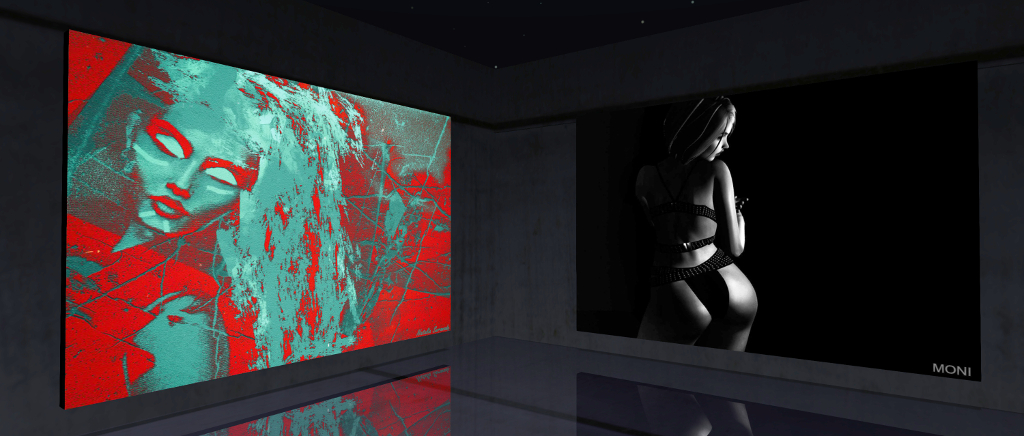
The traits of sensuality, strength, vulnerability and expressive beauty seen in both Hidden Faces and Sensuality are clearly present in the 14 images presented within Changing Moods, which takes a different direction to the two prior exhibitions by presenting all of the photographs in monochrome. This is a particularly striking decision as it richly casts Moni’s work in a new light: black-and-white photography can often lead to bold images bereft of the greater softening afforded by the blending of multiples hues and tones common in colour photography; it also tends to draw the eyes into the central figure(s) within a tableau.

Nitroglobus Roof Gallery: Changing Moods

This is very much the case with many of the images Moni present here. But while perhaps appearing more hard-edged than might have been the case had they been produced in colour, the monochrome presentation also serves to heighten the beauty within each piece and – to my eye – induces more of a feeling that we are witnessing Moni’s inner perspective of herself, as shaped by her moods and desires – some of which might be considered leaning towards the erotic.

Narrative is another powerful factor within Moni’s photography, and this is also brought to the fore within the pieces offered in this exhibition. Take for example Robotoca, Almost Real, and The Mask We All Wear. All offer up ideas of identity, place and self-image in an increasingly technological world where the demands to reveal all perhaps causes us to react with a greater desire to hide, while the pressure to conform evokes the need to be strikingly  different.

Moods and desire as also powerfully incorporated into these works in a variety of ways, from the direct – as with Captured, with its strong portrayal of erotic desire -, through the almost wistful subtext contained within InnocentThe Look and (to a degree) Wet.

Nitroglobus Roof Gallery: Changing Moods

There is also something else within these images which is salient for the times in which we live. It is an over-arching narrative that collectively runs through all of them and which, in so doing, completely alters the perspective they present. This is entirely intentional on Moni’s part, as Dido explains in the liner notes accompanying the exhibition:

Moni presents work that shows how her ‘Doll’ is created. She uses artificial arms, legs and face to illustrate this process. Moni gets the impression in SL women are often treated like Dolls; pampered, loved and dumped after usage.

When viewed with this in mind, the context of the images presented in Changing Moods is dramatically altered. We are no longer in the mindspace of personal thoughts, moods, and desires, but have stepped into that questionable space of how – as Dido notes – women can so often  be regarded and treated as objects. Thus is the subtext present within the images dramatically shifted. Take the way in which Captured, for  example, moves from being a sensually secretive desire within the mind of the subject to become a darker voyeuristic (and subjegative) desire to see a woman so helpless on the part of an observer.

Nitroglobus Roof Gallery: Changing Moods

Evocative, provocative, challenging and captivating is another stunning exhibition of photography by an exceptionally talented artist, Changing Moods is open through until the end of October 2018, and one not to be missed.

SLurl Details

The portraits of Rofina Bronet in Second Life

Diotima Art Gallery: Rofina Bronet

Currently open at the Diotima Art Gallery curated by Redi (Red Bikcin), is an exhibition of avatar portraiture by Rofina Bronet.

I confess that prior to receiving an invitation to view this exhibition, I was unfamiliar with Rofina’s art, and that having visited this exhibition, I find her approach to presenting avatars intriguing.

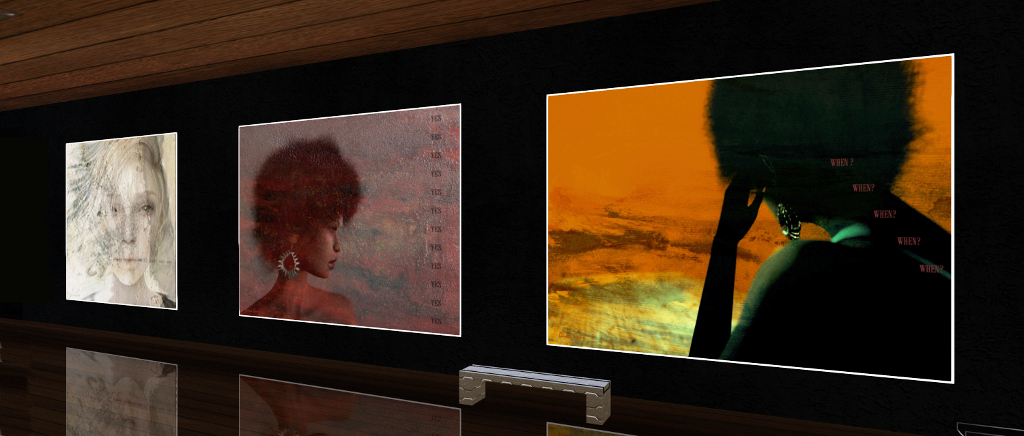
On display are eighteen portraits in a mix of colour and monochrome images that are striking in their presentation. The approach taking with each of them is to focus closely on the subject’s head, an approach that in many of the images offers a unique perspective on the individual in the picture.

Diotima Art Gallery: Rofina Bronet

At times this can be a little disconcerting in the way it gives prominence to facial features and the shape of the subject’s head. The result can be a little jarring when viewing the images, but the result is also visually striking, drawing  – challenging, even – the observer to closely study each image.

Many of the images – notably those in monochrome – offer the subject as the sole focus of the image, and have been taken in such a way that the subject is not looking at the camera. Rather, they are either looking to one side of the camera, or ignoring it completely, as if something out-of-frame has captured their attention.

Diotima Art Gallery: Rofina Bronet

This gives an added depth to the studies that is captivating. By having them appear as if they are focusing on something other than the camera, the portraits take on a unique and personal life of their own. Rather than appearing posed and framed, they come across as pictures taken in the moment; a chance event. Combined with the above-mentioned perspective carried within each image, this approach draws the observer into both studying the subject more deeply and create a narrative around that “moment in time” in which  the image seems to have been captured.

Alongside of these images are a number – notably in colour – are several in which the subject is looking at – or towards – the camera. These images are presented against a broader backdrop, one which combines with the subject to again create a narrative within the image; one that also brings the subject naturally to life.

Diotima Art Gallery: Rofina Bronet

This is a fascinating exhibition, and for me, an engaging introduction to the art of Rofina Bronet, one I enjoyed receiving.

SLurl Details

The art of Barry Richez in Second Life

Alphalune Creations Gallerie

Alphalune Creations Gallerie opened its doors to the public on September 29th as the new home for the art of Barry Richez.

A long-time resident of Second Life, Barry is well-known for both his 2D and 3D art and his forward, future-thinking outlook. The new gallery space combines all of these in an environment that reflects Barry’s futuristic outlook and offers a unique setting for both his 3D and 3D artwork.

Alphalune Creations Gallerie

Located in the sky, the gallery is a place of two halves. Contained within a skybox with a cityscape backdrop that suggests it exists within a modern setting, it offers a central arrival point bordered by the gallery buildings proper: primarily 2D art to one side, and primarily 3D sculptures on the other, each unit comprising multiple levels.

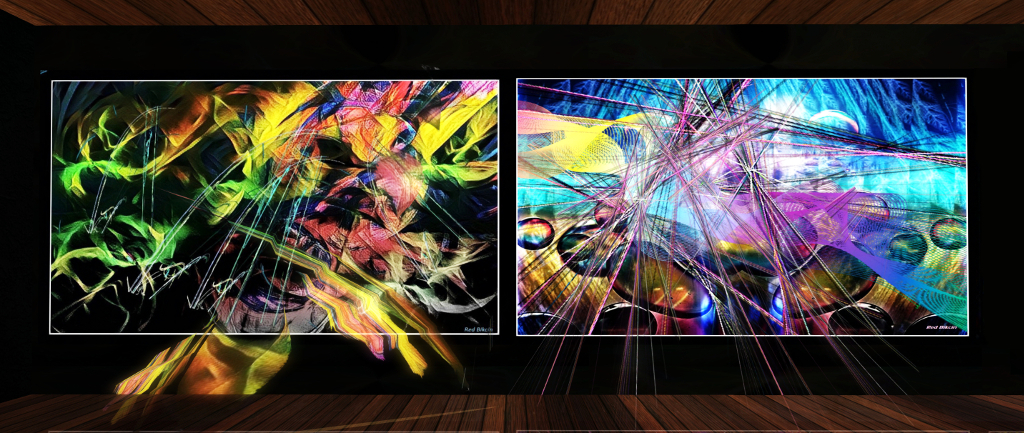
The 2D gallery presents Barry’s digital paintings, beautiful fractal pieces so intricate in form and design, they might so easily be mistaken for photographs of physical 3D objects presented against velvet backdrops. Others appear more abstract in nature, swirls and dishes, curls and splashes; images that through their very abstract form are suggestive of dense nebulae – albeit, perhaps, without the familiar depth of colour as the pieces here tend to focus on fairly fixed palettes, although this in no way detracts from their beauty.

Alphalune Creations Gallerie

The 3D section offers a rich mix of Barry’s sculptures, most with its own story to tell. Movement between the levels is achieved by teleport disks (the 2D gallery space offering stairs as well), and the art structured in such a way that some levels are almost a mini-gallery of itself – particularly where the 3D work shares space with more of Barry’s fractal images. At the same time, one of the levels forms an installation in is own right, a rich blending of colour and animated pieces surrounding a sculpture Barry first presented at the University of Western Australia in Second Life.

In this latter regard, the gallery also offers a mini-retrospective of Barry work: those familiar with his past presentations will doubtless recognise some of the sculptures and designs presented here.

Alphalune Creations Gallerie

Considered, balanced and visually captivating, Alphalune Creations Gallerie offers the perfect insight into the art of Barry Richez, and should be a destination for all lovers of art in Second Life.

SLurl Details

Four kilometres of art in Second Life

DC Spensley Retrospective

Despite receiving an e-mail invitation, I regret I was unable to attend the official opening of David “DC” Spensley’s towering – in a literal sense – art retrospective on September 22nd, 2018. However, as soon as time allowed, I did take the opportunity to jump over and immerse myself within it.

Known in-world as Dancoyote Antonelli, DC is one of the pioneers of visual arts in virtual worlds, working independently and in collaboration with other early pioneers to create 3D art that were considered ground-breaking at the time. In the United States, his work has been referenced in mainstream press, including The New York Times, Reuters, Step by Step Design, and Fibreculture Journal.

In 2006, DC also founded the world’s first virtual, aerial dance company – the ZEROG SkyDancers. On seeing the troupe perform, former Linden Lab alumni John “Pathfinder” Lester compared their work as genre-expanding as the Cirque Du Soleil. More recently, in 2014, DC and the ZEROG Skydancers again pushed the boundaries of performance art and dance, with Avant Garden. This mixed reality performance featured dancer Kathleen Moore performing on stage at the Little Boxes Theatre in San Francisco, a rear protection screen allowing her to interact with the troupe as they performed within Second Life.

Kathleen Moore performs on stage at the Little Boxes Theatre in San Francisco, August 2014, interacting with members of the ZEROG Skydancers performing in Second Life.

For this retrospective, DC presents many elements of his work (and notable elements by other artists) in which is likely to be the tallest structure yet built within Second Life: rising 4,000 metres from its water level base, the Tower of Light. The art is presented on a total of 40 levels extending from the tower, with a number being interactive either by touch (control panels and media boards) or physical avatar collision. Information plinths are placed on each level to deliver contextual notes and insights on each of the elements being presented, making this an informative, as well as visual installation.

Movement between the levels is achieved via a teleport HUD available from the landing point, or by sitting on a tour cushion,. The latter also allows for direct transfer to a desired level within the two (by means of a smooth vertical ascent rather than a TP), or can take riders on a “grand tour”, visiting each of the levels in turn. All three option are valid means of travel, delivering the visitor to each level alongside its associated information plinth, although I enjoyed the “grand tour” the most.

DC Spensley Retrospective

In a considered touch, the “tour cushions” will not simply poof should a visitor stand at any given level. Instead, they remain rezzed for long enough to get up, inspect the art, try any supplied controls or watching any associated video (if trying them / watching while seated proves inconvenient) before sitting once more in order to resume a journey to other levels.

Exploring the Tower of light is also both an exploration of DC’s thinking and his approach to art and of something of the history of visual arts in SL as a whole – although it should be noted this is not a chronological journey through DC’s art. Rather it is a thematic voyage, enfolding within it his concept of “hyperformalism”, exploring the nature of “native” art produced within a virtual world.

Rather, the historical aspect is born out of the majority of these pieces either being created before the advent of true mesh capabilities in Second Life, or which eschew the use of mesh in keeping with the aim of hyperformalism. Thus, these are primitive art, a term I use in reflection of their construction, not as a suggestion of any lack of sophistication they might otherwise contain; rather the reverse in fact: the nature of primitives actually requires these pieces to be sophisticated in design and scripting (and examples of all the scripts can be found in the relevant information note cards provided by DC).

DC Spensley Retrospective

It is also the information cards that offer insight into DC’s thinking and ideas around hyperformalism, with some also acting as a glimpse of part of the platform’s history. Of those who, like me, have been active in SL for the last decade, some of the names mentioned are liable to set memories tumbling: Qarl Fizz, Dekka Raymaker (who only returned to SL in August 2017 after a 6-year hiatus), and Nomasha Syaka to name but three (Nomasha’s sculpted horse was a decorative mainstay in many of my early SL homes, and is still to be found within the Library section of inventory).

When visiting, I would suggest allowing sufficient time to visit all 40 levels within the Tower, rather than breaking a tour up over two or more visits, as this offers the fullest potential to appreciate both the art and the concepts involved in DC’s work.  And as a purely subjective opinion, I would suggest using the viewer’s default midnight setting when travelling through the installation. This removes the distraction of the surrounding clouds, and more particularly adds a tangible depth to the colours within the Tower and the art it presents, giving a greater sense of presence whilst touring.

DC Spensley Retrospective

SLurl Details

A further trip to The Galleries in Second Life

The Galleries Museum

The Galleries, curated by Ernie Farstrider is an extensive gallery complex ideal for those wishing to explore many of the rich facets of art in Second Life. As I last wrote about the complex nearly a year ago, I thought it about time I talked a little more about it, this time taking a look at the Ground level facilities of The Galleries Museum.

Modelled on New York’s Solomon R. Guggenheim Museum, designed by the legendary Frank Lloyd Wright, the building is very much a gallery space, despite the “museum” in the title, and at the time of my visit had just opened a new exhibition of art by Violetta Carolina, who returns to the gallery for the first time in five years.

The Galleries Museum

The exhibit features Violetta’s 2D the 3D art, the former presented as a series of bold paintings, rich in colour, leaning towards an abstract look, but each piece individually striking in tone and look. With a distinctly modern cast to them, the sculptures offer both contrast and compliment to the 2D pieces,  making this an unusual (in the positive sense of the word) and imaginative exhibit.

Beyond it, in the great atrium section of the building, are exhibition spaces given over to multiple artists,  all of which can be toured by climbing the familiar ramp up from the lowest level (or, if you prefer, but taking one of the elevator teleport to the uppermost level and then winding your way back down).

The Galleries Museum: Violetta Carolina

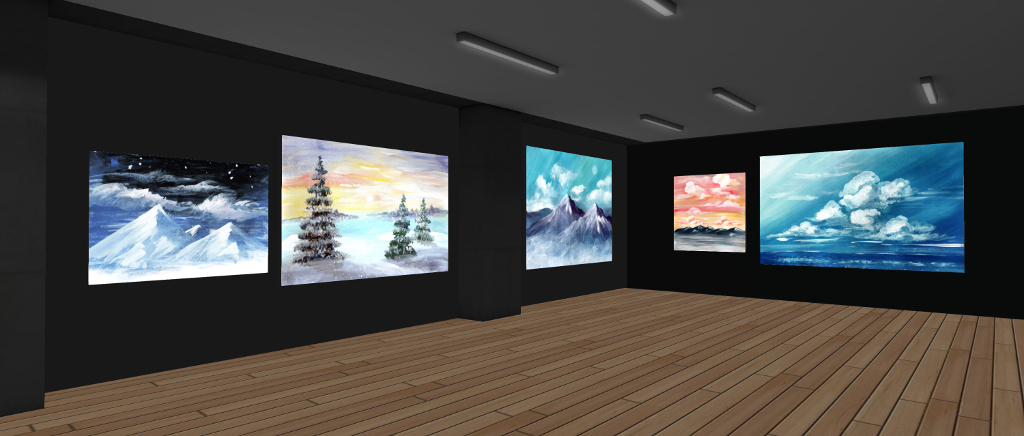
The atrium provides space for at least eight artists on the ramp itself, with additional space on the lowest level, and the range of large on display mixes images captured in-world and creations from the  physical world uploaded for display in Second Life. I’m not going to offer a cast list of artists exhibiting their work at the time of my visit, simply because I’m not sure how quickly displays change, and all too often such lists can look more like the reading a cast list. However, I did enjoy seeing images by Graham Collinson, and Kayly Iali during my visit, as I’ve always enjoyed their work.

Located outside the front of the building is a teleporter that will carry visitors up to the sky complex of galleries, where a further exploration of art can be enjoyed  – see my review from October 2017, but please keep in mind the artists on exhibition may well have changed.

The Galleries Museum: Graham Collinson

SLurl Details

Georgiana, home of The Galleries, is rated Moderate.