Omerta, November 2021 – click any image for full size
Poking my nose into the Destination Guide recently caused me to spot an entry for Omerta City (actually now featured in the DG Highlights at the time of writing), a Full region design by Lux Voxel that leverages the additional private island Land Impact bonus.
An urban environment, this is a place packed with detail – although I’ll say up-front that this comes at a price; unless you’re running on a fairly robust system, you might find it heavy going if you tend to run the viewer with the likes of shadows enabled and / or a high Draw Distance, so be prepared to make some adjustments to your viewer!
Omerta, November 2021
Omertà is a Southern Italian code of silence and code of honour and conduct that is often associated with the Mafia, and I’d venture to suggest the selection of the name for this setting is no accident given it is sponsored through Lux’s own brand Mesh Mafia. Not that it is particularly mindful of Southern Italy or Sicily, being far more leaning towards being somewhere in the United States. However, it does have the feel for a corner of a city where one could well imagine organised crime keeping an eye – and hand – on things; and enforcing their particular brands of honour codes.
This is a location of multiple faces, with waterfront areas, low-lying and aging business areas overlooked by places of business topped by apartments occupying superior, elevated positions. Within all of this are a range of settings that make exploring the city something of an adventure. Many of the shops are outfitted with interiors that invite visitors into them; clubs and pubs present similar places to spend time within, at least one also containing the kind of racket one might associate with criminal activities as NPC exotic dancers seek to entertain those stepping through the doors.
Omerta, November 2021
Caught under a night-time sky by default, Omerta also has a sense of mystery to it: tucked away here and there are shops specialising in voodoo and magic, for example, whilst the bones of an old and long-deserted and ruined fun fair rises from and overgrown lot. There’s also a sense of life throughout: a corner that may have once been a shop topped by living spaces has been converted into a place for children to use their skateboards, as such corners so often get turned into places for childhood recreation where no formal parks or other spaces exist.
Elsewhere can be found roadworks and the suggestions that parts of the city may be about to undergo redevelopment. There’s also a feeling that the age of the city has lead to something of an unfortunate accident: the subway station sits with its platforms barred to public access, they and the tracks they serve being flooded.
Omerta, November 2021
As noted, Omerta can be heavy-going at times: there is both a lot of mesh and an impressive number of textures which can take time to load and render, particularly if you are prone to keep shadows running at all times (I actually had some issues with texture loading with shadows disabled); as such, it can be a frustrating visit at times (possibly not helped by the region surround / dome).
However, it is more than worthwhile persevering, as the city is also filled with photographic opportunities throughout – and not just under the default EEP settings; as the banner image here hopefully shows, Omerta lends itself to other EEP settings as well.
Lost Unicorn Gallery: Serina – Fantasies and Illusions
Currently open at the Lost Unicorn Gallery, curated by Natalie Starlight, is a superb exhibition of fantasy avatar studies by : SERINA :: ( SerinaK ) entitled Fantasies and Illusions.
Hailing from Japan, Serina is the owner of the Alter Ego mesh clothing brand, and I’m not sure how long she has been involved in SL photography – she joined Flicker in 2018; but I believe this is the first time I’ve see her work in a solo exhibition. And I use the term “superb” above quite deliberately: the pieces exhibited at Lost Unicorn are genuinely captivating.
As avatar / fantasy studies, the pieces presented in the exhibition are rich in colour, detail, motif and visual story, where everything has clearly been carefully considered in compositing and frame that makes them instantly attractive. Most are rendered in colour, although some monochrome pieces are hidden within the collection, their muted tones deliberately chosen to bring forth their story for the eye to see without the need to view any title.
Lost Unicorn Gallery: Serina – Fantasies and Illusions
Whilst focused on fantasy figures and framing, several of the images touch upon the surreal – perhaps most notably with Blind Justice, but elsewhere as well, in subtle touches. This reflects Serina’s broader interest in art that encompasses fantasy, surrealism and fine art. But there is more to be found within these pieces.
Although each an every piece can be appreciated as it is seen, its initial narrative ready to be captured by the eye, this is but an illusion; each carries a deeper story. In some, this might appear to be a personal statement, in others more a comment on society at large. I’m not going to point to individual images here as is often my wont, because these deeper narratives are best discovered by seeking the name of each piece through a right-click → Edit after each has been viewed free from preconceptions brought forth by knowing an particular picture’s title in advance.
Occupying the main lower hall at the gallery, Fantasies and Illusions makes for a grand exhibition – one that flows into the rest of the gallery space as a whole, where the fantasy theme continues with images by a number of artists. Thus the gallery offers a broader, worthwhile visit that I also recommend.
Lost Unicorn Gallery: Serina – Fantasies and Illusions
As noted above, this is the first time I’ve seen an exhibition focused on Serina’s work, and on viewing, I hope it is not the last that I have the opportunity to do so.
Firith Galad, November 2021 – click any image for full size
It has been a while since I’ve dropped in to a region designed by Camila Runo – the last was her take on the bayou lands of Louisiana back in May 2021 (see: A trip to the Bayou in Second Life), although my first encounter with her work came back in 2020 with the original Jambo! (A voyage to Africa in Second Life). Quite what caused the break in my visits I’ve no idea; but seeing Firith Galad a Forgotten Elven Realm listed in the Editor’s Picks of the Destination Guide immediately had me scurrying to pay a visit.
As anyone with an abiding love of Tolkien’s mythology (like me!) will know, Firith Galad is Sindarin (Grey Elven) in origin, and can be literally translated as “Fading Light” (Firith also being the last quarter of the Sindarin / elven year, and so give the time at which this build is available, that name also fits quite nicely). indeed, in respect of “fading”, a further layer of meaning might be found within the region’s name, as quick look at the About Land description reveals:
Surrounded by high mountains and cataracts lies Firith Galad, an ancient elven realm fallen into oblivion. The light is fading, winter is near …
Firith Galad, November 2021
Again, as those familiar with Tolkien’s mythology, the War of the Ring brought to an end the time of Elves, and the start of the Fourth Age, and the ascendancy of Man. At this time, many of the elves of Middle Earth departed into the West, and those left behind recognised they were doomed to fade with the passage of time. While no actual time-frame (before / after the War) is given, the title of the setting nicely fits with this idea of an elven enclave tucked away, perhaps high in Ered Luin (the Blue Mountains) of Lindon, the last remnant of their beloved Beleriand, and a place where they could escape the passing of time in the world around then, content to remain in isolation.
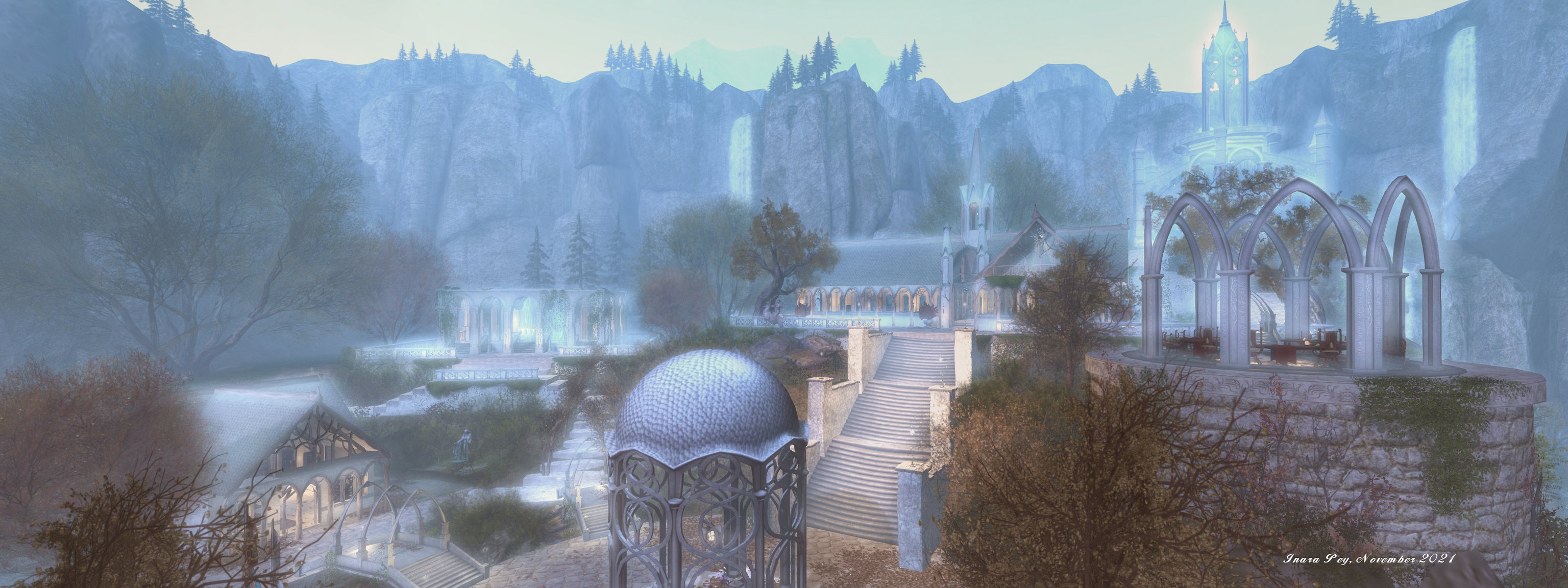
This is an ethereal setting caught in a ghostly light that, with the surrounding walls of rock, serves to separate the realm from the rest of the world, isolating it in a unique fashion whilst bathing it in a cool light mindful of winter, and in which the enclave is gently revealed as one approaches it. Set within a deep mountain valley, the setting is reached far path that clings to one side of the valley walls. It emerges from a tunnel – a hidden passage leading from the world beyond and into the valley. This tunnel is guarded by two gates bearing symbols of the gold and silver Trees of Valinor, Telperion and Laurelin, the first indication that in offering this build, Camila has perhaps cast her net of inspiration wider than Tolkien’s Lord of the Rings, (and certainly Peter Jackson’s interpretation of Tolkien’s world).
Firith Galad, November 2021
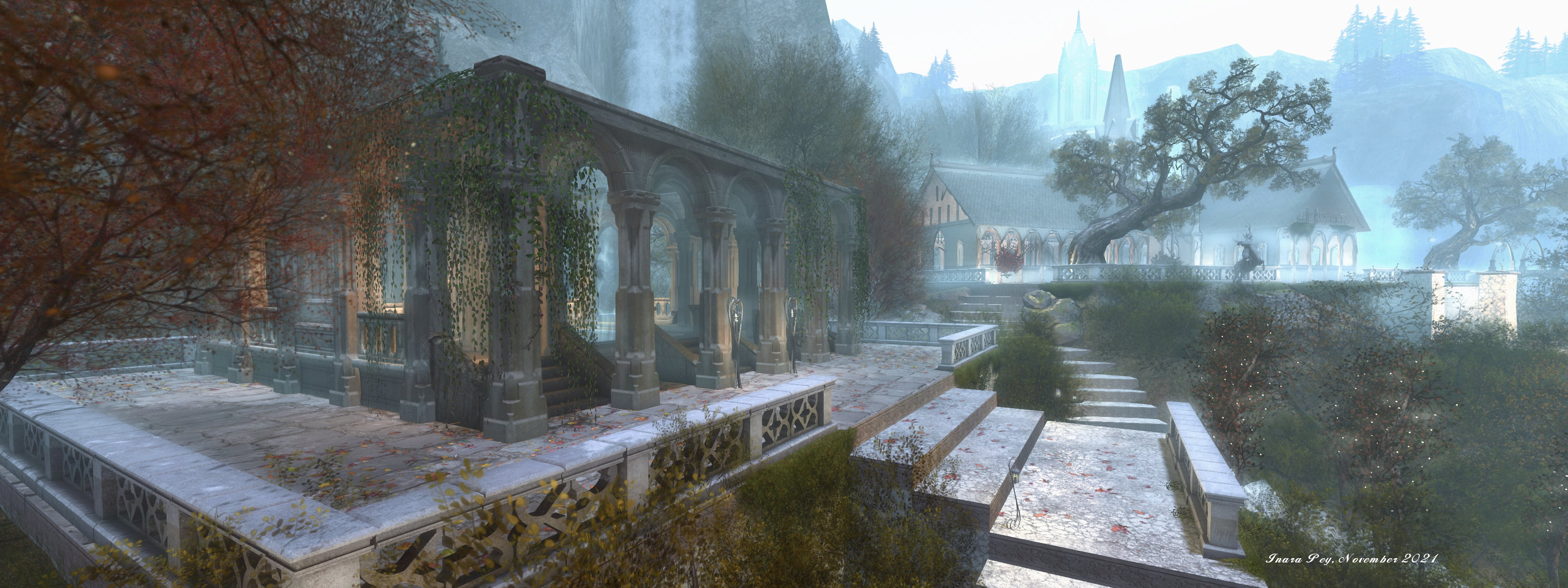
The path clings to the valley side as it runs from tunnel opening to a single stone bridge that gracefully spans the deep chasm of the valley to reach the enclave as it in turn hugs the far side of the valley’s steep walls. Here, beyond the banners bearing what might be an image of Telperion,, the enclave offers a tiered build, making use of shoulder and island of rock extending outward from the high peaks, with the core buildings reached via stair or bridge (or both), all sounds drowned by the thunder of the great falls that tumble to the valley floor far below.
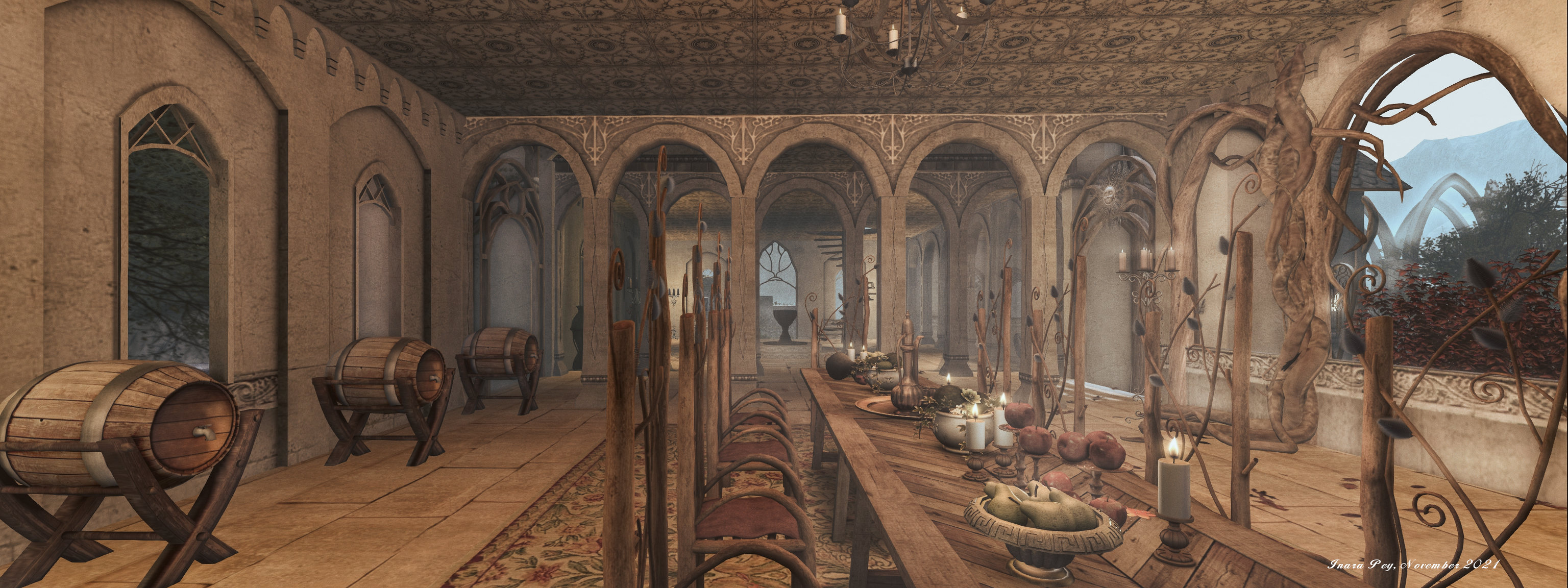
Dominating the realm is a great house, placed at the top of a broad stairway and occupying a large stone-flagged square. Climbing the stairs towards it, visitors are greeted by the sound of harp music, the house itself a place of meeting, feasting, music, and seeing – a basin of water mindful of the one that once belonged to Galadriel sits within it, light glittering above its slowly shimmering water as it appears to wait its time to reveal the future to those who look into it.
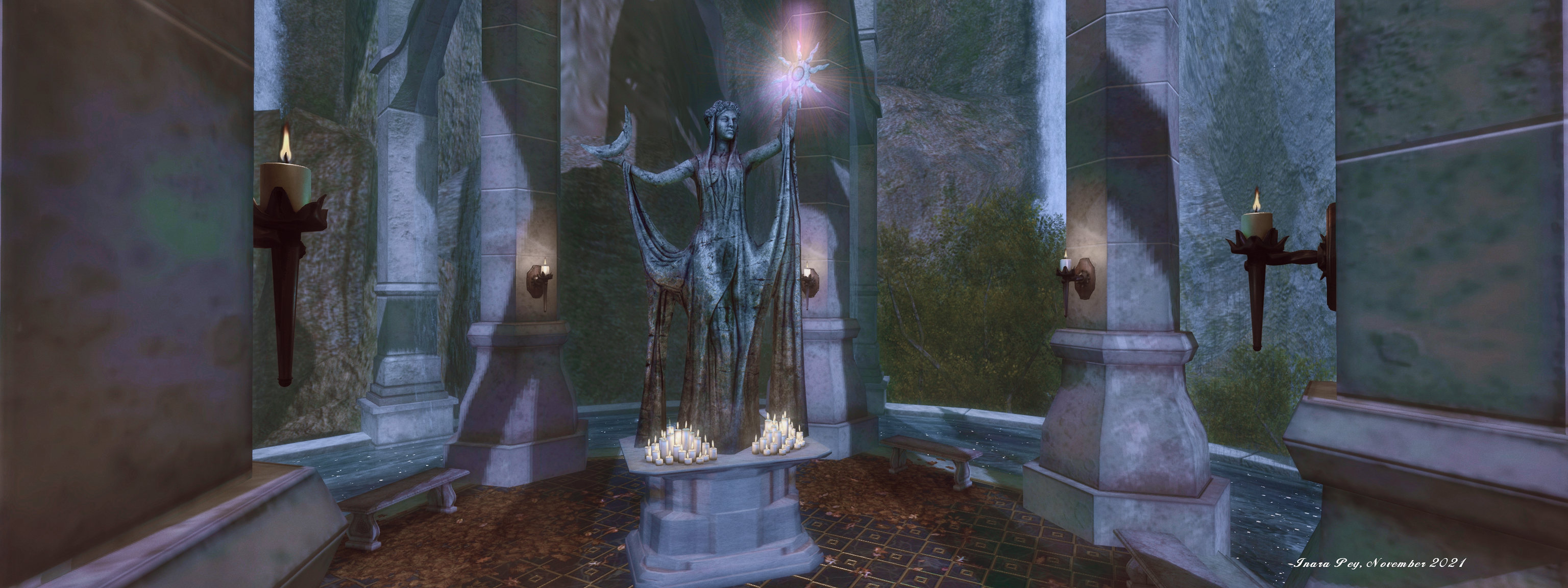
More steps rise upwards from one side of the house, climbing to where a great stone edifice rises, curtains of water falling from some of its buttresses in time to the falls behind it. A single span of stone reaches across the pool that collects this water to reach the centre of the structure. This is home to a tall carven figure, undoubtedly Varda Elentári, known to the Sindarin as Elbereth Gilthoniel, as she holds aloft the vessels holding the light silver and gold light of the corrupted Two Trees of Valinor in vessels fashioned by Manwe and Aulë, that they might become the Sun and Moon of Middle Earth.
Firith Galad, November 2021
Elsewhere within the setting, one might find a meeting place, its horseshoe table doubtless the place of many councils and meetings of fellowships, while across a bridge from the arrival point and its gazebo stands a smaller hall, given over a place of learning / research / study, albeit one with furnishing that are perhaps of distinctly “Mannish” origins in difference to the furniture to be found elsewhere. Then, between this library and the main house there can be found a stone pavilion in which water drops from the high roof to enter a rectangular pool at the pavilion’s centre, what appears to the face of Ulmo, Lord of Waters, and second to Manwe and Elbereth in leadership of the Valar.
With a richness of trees and greenery as befitting the Sindar, who also settled in the forests of Middle Earth during the Second Age, Firith Galad is one of the well-executed settings drawn from Tolkien’s mythology. The attention to detail in referencing The Silmarillion far more than The Lord of the Rings, gives this setting a uniqueness that is hard to deny, and which is a delight to visit and spend time within for any Tolkienite. And even if your interest doesn’t run so deep, Firith Galad is nevertheless captivating in its presentation and sheer photogenic nature.
Firith Galad, November 2021
My utter respect to Camila for her work with this 80-days build.
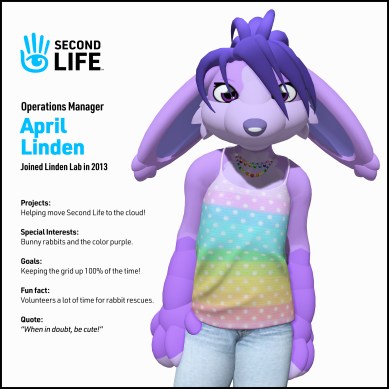
April Linden’s info page in the SL17B “Meet the Lindens” campaign designed to provide SL residents with short profiles on 47 Lab employees who volunteered to take part. Image courtesy of Linden Lab
November 5th 2021 finds me an unhappy / happy bunny Second Life bunny supporter.
Unhappy, because the day marks the last working day April Linden has with Linden Lab, and the grid will be the poorer for her departure. Happy, because the day marks the start of a new chapter in her life and career.
For those (can there be any?) unfamiliar with April, she has, for the last seven years, been a member of the Lab’s Engineering Team, the group of engineers responsible for keeping the servers that run all of SL’s various services purring (or grinding) along.
For the last few years she has been managing that entire team – and has used that position to keep Second Life users informed of all that goes on – the good and the bad – with SL’s servers and systems. In this regard, she has been our Number One Gridbun – so called because of her instantly-recognisable purple bunny avatar.
I’m the manager of the Second Life Operations team! It’s my team that helps keep the servers that run Second Life running. It’s my job to make sure they’re well fed, have the coolest toys, and know that going on vacation is okay!
– April Linden, in her official profile
With some 20 years experience in systems engineering environments, April was one of the many Lab employees who came to the company by way of first being a resident user of Second Life. Her attraction to the platform came via the empowerment it gives people to express themselves positively in a variety of ways. For April this was both the freedom to create (she had her own regions as a user), and – perhaps more importantly – because Second Life gave her the opportunity to undertake self-exploration in a safe, open environment without fear of repercussion, as she noted in 2018:
I come from a background – well, I’ll just be frank, where LGBT issues were not to be discussed, and it was through Second Life that gave me the power and the anonymity and the courage, really, to learn more about myself. And Second Life gave me the power to make my life so much better.
– April Linden
In this respect, April is a living example of the Lab’s recognition and support of people’s right to positively express themselves within an environment that embraces diversity.
April probably came to the notice of many Second Life users through her informative and insightful blog posts that would explain What Went Wrong and Why (what I call her W4 blog posts) after significant issues.
The bunny and the wizard: April Linden poses with her former boss, Oz Linden for an SL16B session
Reporting on technical issues and resolution had always been somewhat spotty where the Lab was concerned. During the “old, old” days of the Second Life website and blog, updates were fairly frequent – potentially due to the need for “Black Wednesdays”, when the grid would be down for between 6 and 8 hours on that day for deployment purposes (and often longer if things did go sideways). However, some time around 2008/9, communications became somewhat splotchy across the board, and technical updates a rate thing. Frank Ambrose (F.J. Linden) attempted to reverse this, up until his departure from the Lab at the end of 2011, but it was not until April took up the mantle once more that we were given informative and engaging blog posts on W4 situations.
And I really do mean informative and engaging – April has a way with words coupled with a deep understanding of the hardware and architecture running Second Life that she could communicate what had happened and what had been done to both rectify a situation and to try to prevent its recurrence in a way that many, many, users came to appreciate. So much so that, after particularly disruptive events, the first question that tended to be asked at User Group meetings tended to be, “Will April be blogging about what happened?”
In this respect, April did much to follow through on the re-opening of Lab / user communications initiated by Ebbe Altberg after he took over as the company’s CEO, and helped give users the confidence that communications really were opening up after a noticeable period without them.
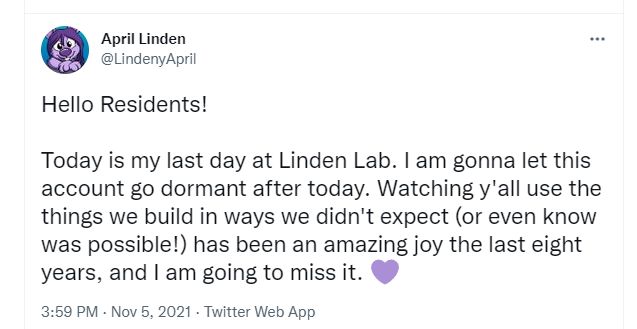
April’s farewell announcement
Most recently, April has been key to leading the Engineering Team through out Project Uplift – the work to lift, transition and place all of SL’s complex systems and services from a dedicated operational environment and into “the cloud” and Amazon AWS hardware and infrastructure. With the completion of the physical moves, she and her team have been engaged in the post-uplift work to better bed systems into their new environment and leverage new monitoring and engineering capabilities offered by AWS.
April announced her departure via Twitter, and the news was immediately responded to with a wave of well-wishing mixed with regret at see her leave the Lab. And it its true, April will be missed – not just because of her blog posts, but also because of her bright outlook and irrepressible positivity. Whoever takes over from her has some awfully big (bunny) shoes to fill.
To April, I can only repeat what I said in my own reply to her tweet – that I wish her every success with her new career path and all the very best for the future. BUT – I’m not going to say “goodbye”, as I’m absolutely sure that she’s find the time to remain a part of Second Life as an active resident.
Nitroglobus Roof Gallery: Milena Carbone – No Exit
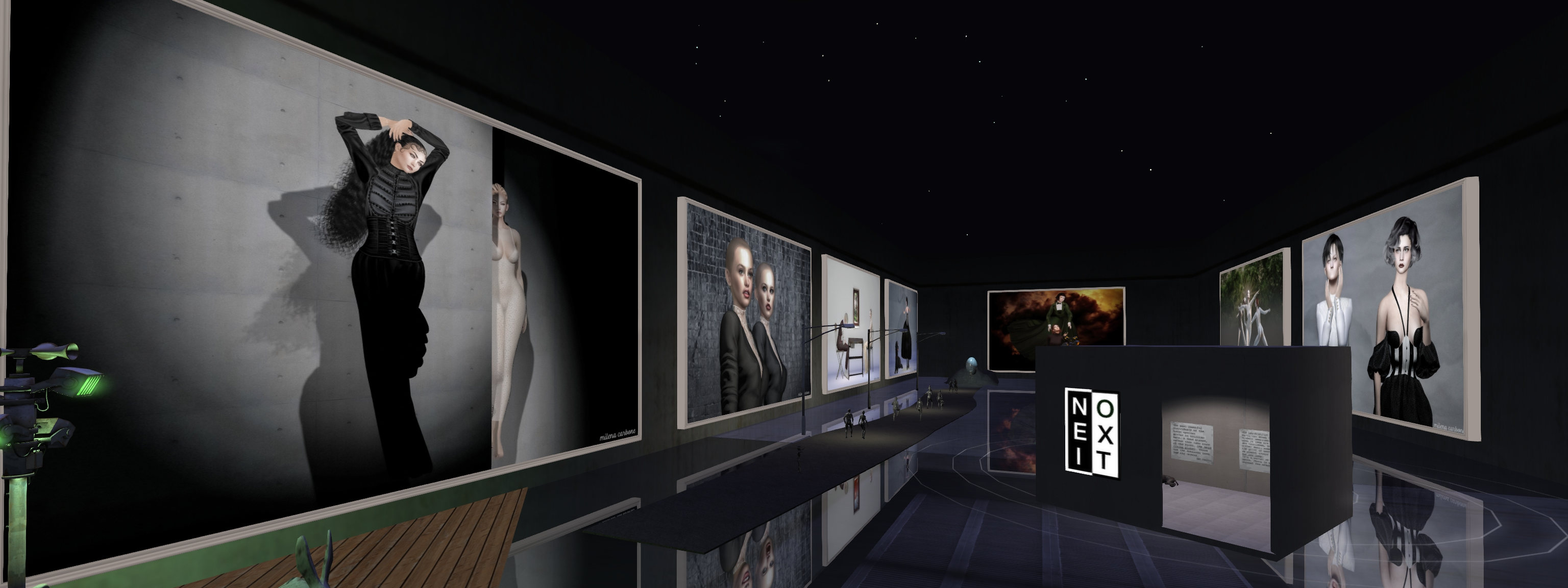
No Exit is the title of the latest 2D art exhibition hosted by Dido Haas at her Nitroglobus Roof Gallery. It features the images and words of Milena Carbone, and is very much something of an “accidental” exhibition which still nevertheless offers food for thought – something Milena is prone to do with her art.
I’ll let Dido explain why No Exit might be considered an “accidental” exhibit:
[Milena] initially intended to work on a totally different project. However, this was cancelled due to her RL work as well as to her lack of motivation. So the images shown at the walls of the gallery this month were not created for an exhibition. Instead they were taken from the stream of images which Milena regularly produces for herself.
I made the selection and pointed out to Milena that there were always two characters in each image, .which made Milena think of the French philosopher Jean-Paul Sartre’s play “No exit” (“Huis clos” in French). And voila the title for this exhibition was born.
– Dido Haas, explaining the origins of No Exit
The connection between Satre and images is important to understand, because – as if so often the case with Milena’s work, there is a philosophical theme running through No Exit that invites consideration and, by nature of the framing of the play’s own central theme.
The title of the play actual comes from the French legal term “in camera”, denoting a private discussion behind closed doors; within it, three deceased people find themselves trapped in a room with no exit, doomed to face eternity with only one another’s company. Thus they are faced with Satre’s truth that “hell is other people” (L’enfer, c’est les autres), itself a reflection of his fascination with existentialism (perhaps most notably through L’Être et le néant), and of the internal struggle that arises when forced to view oneself from both the point of view (that is solely from how they see you in a particular moment) and the perspective (i.e. how they perceive you and your actions within the broader context of their own cultural and societal influences and personal biases / experiences) of another consciousness.
Nitroglobus Roof Gallery: Milena Carbone – No Exit
However, before delving into these deeper themes, I would emphasise that these are images that can be seen and appreciated entirely in their own right and free from any more layer thinking. In fact, I would say they should be seen in this manner before being contextualised within the broader scope of theme and Satre’s world of ontological thinking; there is a beautiful minimalism to every piece that renders it fully as moment of narrative, encouraging us to freely construct a story around it, or to simply appreciate its form, tone, framing and expression.
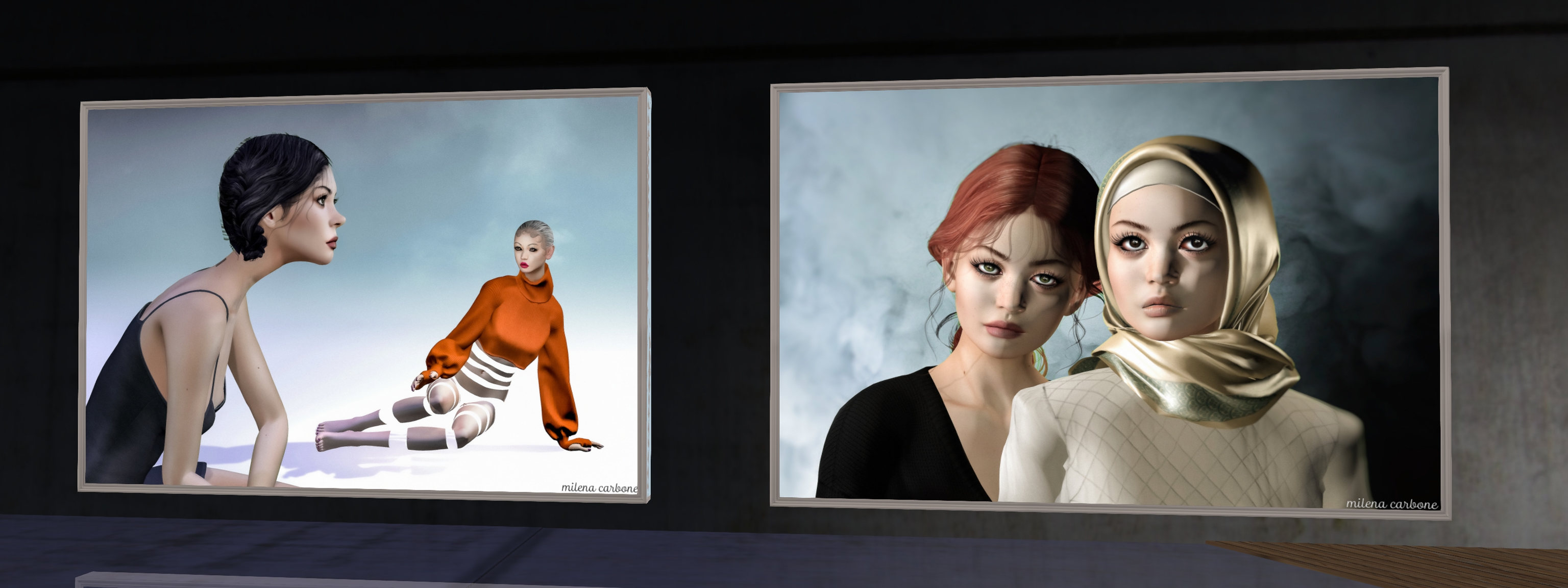
When Milena’s theme and Satre’s ideas are taken into consideration, these are images that taken on an entirely new depth. Take, for example, XXI Century. On the surface, a simple image of two women with different cultural heritages posing for a photograph – be they friends or relatives, it makes no difference. But, add the title of the piece into the equation, together with the fact one of the women is wearing an al-amira, and a more complex narrative emerges, that invokes thoughts of the manner in which during the first 21 years of the 21st century has continued to see the impact of “otherism” – the ostracising of those whose dress, system of belief and place of origin mark them as “different” and thus not to be trusted or allowed. It’s a negative attitude that has gripped many to the point of being without any exit; yet, were they to step outside of the strictures of peer / societal pressure, then the reality that we are all of one, single unique race would become that much harder to ignore.
Elsewhere, the questioning of self, and other others see is more direct (e.g. within Difference, Asymmetry, and The Invitation (the latter’s use of Black and white being particularly effective in bringing for the idea of differencing outlooks / perspectives that challenge our own). Whilst 7 Billion Bullets most clearly questions our entire attitude towards the preciousness of an individual life.
Nitroglobus Roof Gallery: Milena Carbone – No Exit
This image also leans itself to the central cube that sits between the two arms of the exhibition hall. Apparently open from the outside, in stepping in, it becomes a closed room with no exit – a physical representation of the room from Huis clos. Here we are forced to confront the fact that we are all essentially locked in rooms of self – everything we see or experience generates our world-view, making us all, in essence selfish; the imprint of those around us, through their thoughts and actions, rightly or wrongly, shaping our own views and outlooks, thus trapping us in our own hell of thought and convictions.
The words here carry both a startling reality of creating our own hell and – conversely – of allowing ourselves to become trapped in thinking that encourages us to retain that hell. The former is most succinctly stated through the commentary that global ammunition production means that each year, sufficient bullets are produced to wipe out all of humanity. Whether or not one is rooted in “the right to bear arms”, this is a grotesque factoid.; how much better might it be if the money poured into arms and ammunition were to be devoted to green sources of energy, improved food production, medicine and education?
Conversely, the fact that we are trapped within this one world is not an argument against attempting to expand elsewhere. For one thing, we are a naturally expansive race – and right now, we have nowhere else to go – a point of increasing concern given Earth’s finite resources. More to the point, space has more than anything else, given us the means to truly understand the fragility of this world and to actually start to take constructive (if limited) action to curtail damaging activities. For 60+ years, we have simply failed to more properly respond to what as been revealed, trapped as we have become in a materialistic, selfish need to have with no apparent exit – and pointing the finger of blame to a billionaire or two isn’t going to change (much less reverse) that; we – you, me, Milena, et al, are equally as guilty.
Milena is, I understand, absent from Second Life due to those physical world commitments mentioned above, and is liable to remain so for a while. As such, whether or not you are drawn to the philosophical / ontological expressions found with No Exit, or if you would simply like to again experience the attractiveness of her art for its own sake, this is an exhibition well worth witnessing.
Nitroglobus Roof Gallery: Milena Carbone – No Exit
L2 Studio and LLOOQ Gallery, July 2021 – blog post
The following notes were taken from my audio recording and chat log of the Content Creation User Group (CCUG) meeting held on Thursday, November 4th 2021 at 13:00 SLT. These meetings are chaired by Vir Linden, and agenda notes, meeting SLurl, etc, are are available on the Content Creation User Group wiki page.
AVAILABLE VIEWERS
This list reflects those viewers available via Linden Lab.
Release viewer: version version 6.4.23.564172, formerly the Apple Notarisation Fix RC viewer, issued September 24 and promoted October 15.
360 Snapshot RC viewer, version 6.5.0.564863, issued October 21.
Maintenance RC viewer updated to version 6.5.0.564805, on October 20.
Simplified Cache RC viewer, version 6.4.23.562623, dated September 17, issued September 20.
Project viewers:
Performance Improvements project viewer, version 6.4.23.564530, dated October 12.
Performance Floater project viewer, version 6.4.23.562625, issued September 2.
Mesh Optimizer project viewer, version 6.4.23.562614, issued September 1.
Legacy Profiles viewer, version 6.4.11.550519, dated October 26, 2020.
Copy / Paste viewer, version 6.3.5.533365, dated December 9, 2019.
Graphics Work
As has been previously reported in my user group meeting summaries, a core focus of work at the Lab is on performance improvements, both on the back-end and in the viewer.
With the viewer, the work is very much on improving graphics / frame rate performance (utilising the Tracy analyser). Much of this work has been to move non-rendering operations currently in the main rendering thread to their own / other threads.
In October, the first cut of a project viewer featuring the fruits of this work was issue (see Performance Improvements Viewer in the list above), and an update to this viewer is expected in the next working day or so.
Once the updated version of the viewer is available, users are encouraged to take it for a test and see if they can see improvements in rendering / FPS rates.
Overall, the Graphics team plan to spend around two more weeks in general performance updates. before the work will shift to stabilising the changes so far made to the viewer (which has been acknowledged as being “crashy” at this point in time).
Once the stabilisation work has been completed, the hope is that the viewer will be in a position to progress forward through the RC cycle to enter the queue for promotion to release status around the the end of the year, with actual promotion coming in early 2022.
Separate to the above, Runitai is currently working on the fork of the render pipe inside the avatar draw pool that handles the rendering of avatar rigged meshes. The aim is to move this work to the same machinery that handles the other draw pools, and so hopefully enable rigged mesh rendering to be handled on a batch basis, rather than one face at a time as is currently the case, thus giving a potentially substantial performance boost.
In Brief
WRT to performance, it was pointed out that the baseline hardware specifications LL give for Second Life are route in hardware between 10-15 years old, and so many users tend to stick to outdated hardware. Thus the situation is somewhat double-edged: ending support for older systems would allow LL to focus more on updating and improving SL to run on more recent hardware; however, by the same measure, it risks “locking out” users who may be unable to move on to more recent hardware in order to stay reasonably “current”.
Work is still in progress trying to overcome the Apple Notarisation / media issues and outlined here. Part of the problem was the result of LL using a very old VLC. However, getting a new VLC to be recognised by the notarisation process is also proving problematic.
A request was made to all region owners to be able to automatically drop a general information package on preferred viewer settings, etc., on users arriving in a region. Given automated notecard givers can already do this, and many of the “recommendations” are completely over the top for many systems (e.g. “set your graphics to Ultra, enable shadows and set your draw distance to 500+ m”), no advantage is seen in providing a capability to provide this information (presumably via a chat channel).
Similarly, pro-actively scanning viewer settings using LSL as visitors arrive and “advising” them about the recommended settings for a region should some of their own be “below” the recommendation, was also seen as not particularly advantageous unless it was somehow made an opt-in capability that those who do wish to receive such information can do so.
It is recognised that Pathfinding is overdue for some improvements, and it *might* be that it gets looked at in the future; however there are no definite plans beyond considering what might be done, and poking at feature requests, etc., that have been filed for Pathfinding.






 Inara Pey: Living in a Modemworld