Art Street Gallery: Gianmario Masala – The Eternal Leave
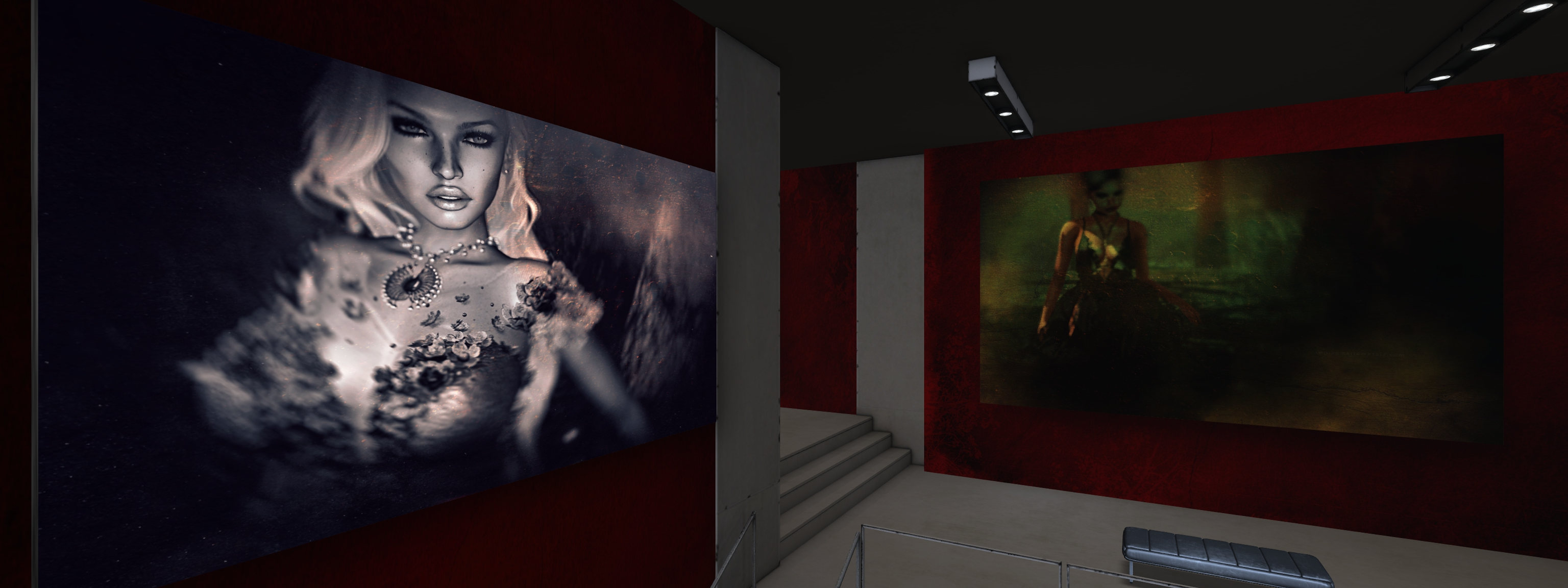
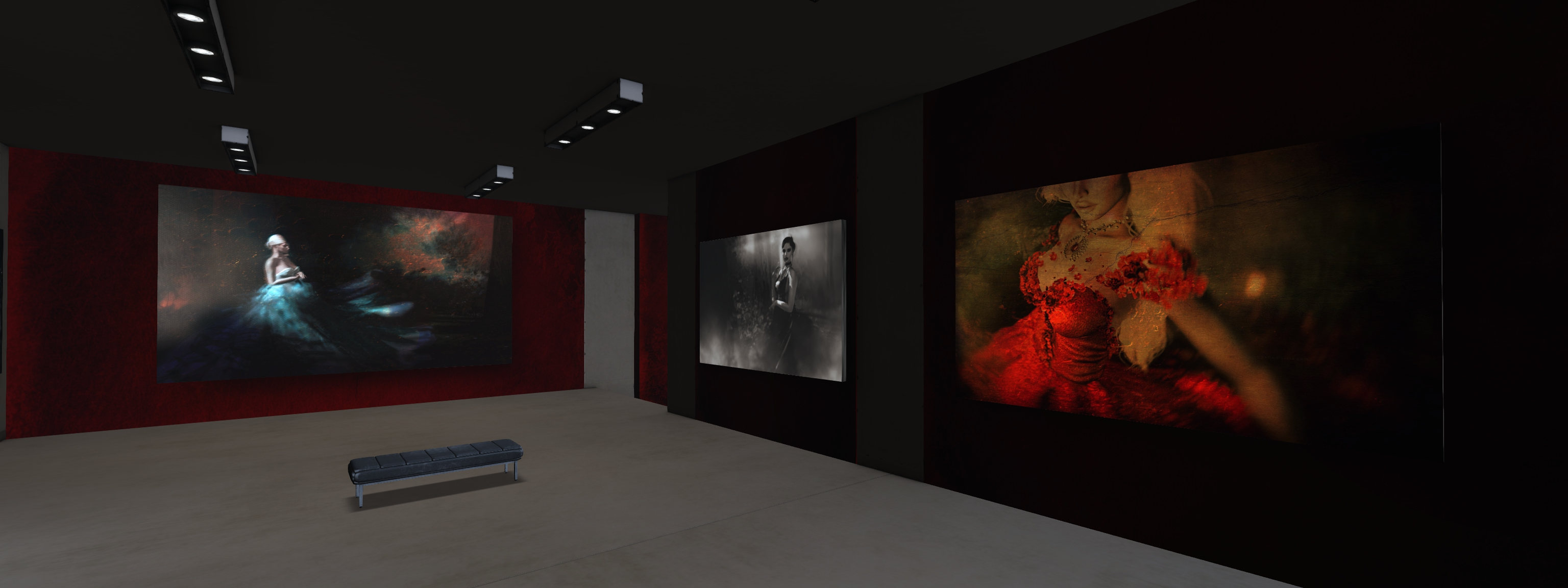
I recently received an invitation from Vally Ericson (Valium Lavender), owner of the ValiumSL regions in Second Life, to visit a new exhibition of images now on display at the Art Street Gallery, located in the air above the Valium regions. Entitled The Eternal Leave, the exhibition is devoted to the striking avatar studies of Gianmario Masala, an artist whose work I cannot remember previously encountering – which, having spent time viewing The Eternal Leave, I cannot help but regret.
Multi-talented, Gianmario received a Master of arts in Architecture after studying in Milan, and is also recognised as a musician and a motion picture set designer. In particular, he is an accomplished photographer, his work having been displayed in several collective exhibitions in Milan, Turin and Naples. In addition he has also mounted solo exhibitions, including Il parco agricolo sud Milano (“The agricultural park south of Milan”), displayed in Milan, Vigevano and Naples; and Harmonia, exhibited in Finland.
Art Street Gallery: Gianmario Masala – The Eternal Leave
Having entered Second Life in 2007, he was quickly drawn to the potential of photography within our virtual world, and started exhibiting his work in 2008. In 2010, his series Women Portraits was displayed on the metro stations of Milan as a part of a collaboration involving the Italian community of Arte Libera/2Lei in Second Life and the Brera Academy of Milan.
In both the physical world and within Second Life Gianmario’s art covers both landscape images and portraiture / avatar studies. His work involves considerable experimentation with a range of techniques from long duration exposures through to the skilled application of post-processing techniques and tools.
I try to create artistic images through post-production, giving them the aspect of a painted artwork. Through the variety of texture layering as a background, together with use of colour and focus, I try to give give the sensation of paintings of past centuries. In highlighting elements by fractured textures, I invite a sense of uneasiness, putting “beauty” up for discussion in order to reach a more deep sense of “truth”.
– Gianmario Masala on his art.
Art Street Gallery: Gianmario Masala – The Eternal Leave
For The Eternal Leave, Gianmario offers a selection of his avatar studies that bring together all of this in the most engaging of exhibitions spread throughout the various levels of the gallery. Mixing colour images with those in monochrome tones and / or black and white, these images are extraordinary in their richness of presentation and depth of narrative.
As a photographer, Gianmario notes he is influenced by some of the greatest painters down through the ages through to some of the most noted cinematographers and directors of the 20th and 21st centuries. This is also much in evidence through the images offered within this exhibition. The narratives, drawn as they are from classical art and from the central inspiration of music by English electronic band Massive Attack, are presented through the mix of subject, pose, colour, tone, camera angle and post-processing, whilst also opening the door on that discussion as the the nature of beauty and it truth.
Art Street Gallery: Gianmario Masala – The Eternal Leave
With the holiday period upon us, we’ll all possibly have more time for our SL explorations and travels, and when it come to art exhibitions, I can think of none better to visit for its breadth of presentation of avatar studies and portraiture than The Eternal Leave.
The NASA spacecraft has spent more than three years winding its way by planets and creeping gradually closer to our star to learn more about the origin of the solar wind, which pushes charged particles across the solar system.
Since solar activity has a large effect on living on Earth, from generating auroras to threatening infrastructure like satellites, scientists want to know more about how the Sun operates to better make predictions about space weather, and gain a better understanding of the mechanisms at work in and around our star. Over the years, we’ve done this with a number of missions – but the most fascinating of all to date is the Parker Solar Probe, a NASA mission that has literally touched the face of the Sun.
The spacecraft – launched in 2018 – is in a complex dance around the Sun that involves skimming closer and closer to our life-giving star, and they sweeping away again, far enough to cross back over the orbit of Venus – indeed, to use Venus as a means to keep itself looping around the Sun in orbits that allow it to gradually get closer and closer, with the aim of actually diving into and out of the Sun’s corona, what we might regard as the Sun’s seething, broiling atmosphere.
In fact, the probe actually first flew through the corona in April 2021; however, it was a few months before the data to confirm this could be returned to Earth, and a few more months to verify it; hence why the news has only just broken about the probe’s success. One of the aims of pushing the probe into the Sun’s corona was to try to locate the a boundary called the Alfvén critical surface. This is the boundary where the solar atmosphere – held in check by the Sun’s gravity – end, and the solar wind – energetic particles streaming outwards from the Sun with sufficient velocity to break free of that gravity – begins, creating the outwards flow of radiation from our star.
Up until Parker’s April 2021 passage into the corona, scientists has only been able to estimate where Alfvén critical surface lay, putting it at somewhere between 6.9 million and 13.8 million km from the gaseous surface of the Sun. As it passed through the corona, Parker found these estimates to be fairly accurate: the data it returned to Earth put the outer “peaks” of the boundary at 13 million km above the Sun’s surface – or photosphere; the data also revealed the boundary is not uniform; there are “spikes and valleys” (as NASA termed them) where the boundary stretches away from the photosphere at some points, and collapses down much close to it in others. While it has yet to be confirmed, it is theorised this unevenness is the result of the Sun’s 11-year active cycle and various interactions of the atmosphere and solar wind.
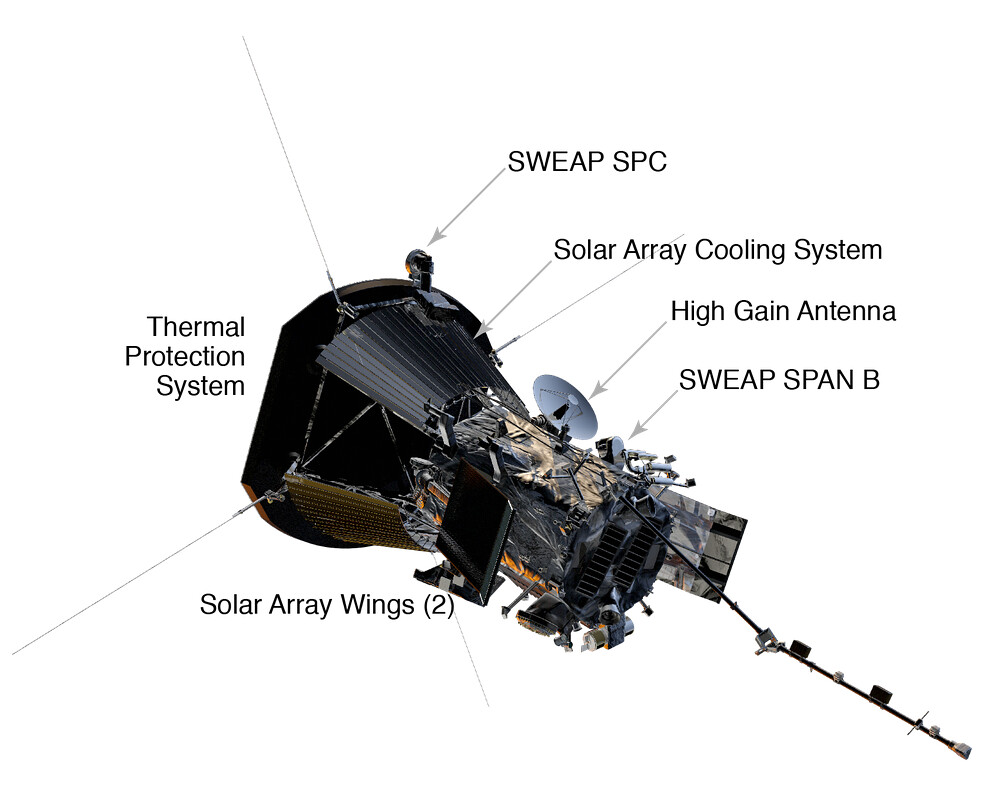
The Parker Solae Probe. Credit: NASA / I. Pey
The April “dip” into the corona lasted for five hours – as the mission goes on, future “dips” will be for longer periods). But give the spacecraft is travelling at 100 kilometres per second, it was able to gather a lot of data as it zipped around the Sun – and even sample the particles within the corona. The probe’s passage revealed that the corona is dustier than expected, the cause of which has yet to be properly determined, as well as revealing more about the magnetic fields within the corona and how they drive the Sun’s “weather”, generating outbursts like solar flares and coronal mass ejections (CREs), both of which can have considerable impact on life here on Earth.
To survive the ordeal of passing through the corona, where temperatures soar to millions of degrees centigrade, far hotter than those found at the Sun’s photosphere. – Parker relied on its solar shadow-shield: a hexagonal unit 2.3 m across made of reinforced carbon–carbon composite 11.4 cm thick with an outer face is covered in a white reflective alumina surface layer. This shield is so efficient in absorbing / reflecting heat, whilst passing through the corona the sunward face is heated to around 1,370ºC, but the vehicle, sitting inside the shadow cast by the shield never experiences temperatures higher than 30ºC.
In addition to mapping the Alfvén critical surface, Parker’s April 2021 trip into the Sun’s corona, the probe also passed through a “pseudostreamer,” one of the huge, bright structures that rise above the Sun’s surface and are visible from Earth during solar eclipses. This was compared to flying into the eye of a storm the probe recorder calmer, quieter conditions within the streamer, with few energetic particles within it. Exactly what this means is again unclear at this time, but it does point to further incredibly complex actions and interactions occurring with the Sun.
Since April, Parker has dipped back into the corona twice more, with the November 2021 passage bringing it to around 9.5 million km of the Sun’s photosphere – although again, the data from that pass has yet to be received and analysed. The next passage in February 2022 will again be at roughly the same distance from the photosphere, with a further five passes to follow at the same distance in 2022/23, before a flyby of Venus allows Parker to fly even deeper in to corona. By December 2025, and the mission’s final orbits, it will be descending through the corona to just 6.9 million km from the photosphere.
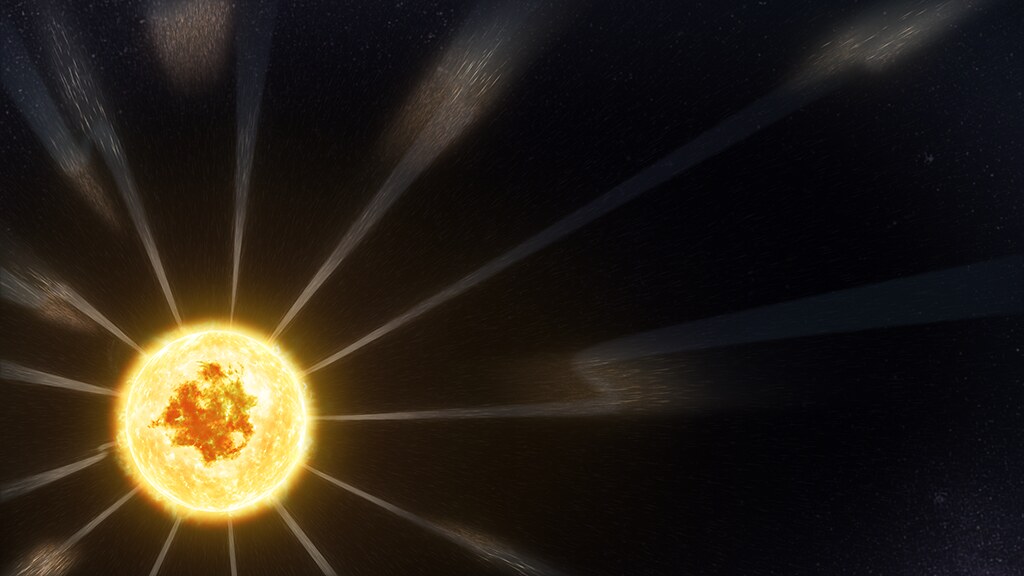
An artist’s depiction of magnetic switchbacks in the solar wind. Credit: NASA Goddard/CIL/Adriana Manrique Gutierrez
But that’s not all. Because Parker is in an elliptical around the Sun, it spends a part of its time much further away. This both allows the craft to dissipate absorbed heat from its shield, and for it to observe the Sun from a distance, giving scientists much broader opportunities to study the Sun, such as allowing them to study the physics of “switchbacks”. These are zig-zag-shaped structures in the solar wind, first witness by the joint ESA-NASA Ulysses mission that occupied a polar orbit around the Sun in the 1990s.
In particular, Parker’s observations suggest that rather then being discrete events, switchbacks occur in patches, and that these “patches” of switchbacks are aligned with magnetic funnels coming from the photosphere called called supergranules. These tunnels are thought to be where fast particles of the solar wind originate; so switchbacks may have something of a role to play in the generation of the solar wind or they may be a by-product of its generation or, given they seem to have a higher percentage of helium than other aspects of the solar wind, may serve a highly specialised role as a part of the solar wind.
Right now, scientists are unclear on what might be the case, or what actually generates switchbacks; but gaining clearer insight into their creation, composition and interaction with other particles in the solar wind, and with the Sun’s magnetic field might provide explanations for a number of solar mechanisms, including just why the corona is so much hotter than the photosphere.
Mars 2020 Mission Update
Scientists with NASA’s Mars 2020 Perseverance rover mission have discovered that the bedrock their six-wheeled explorer has been driving on since landing in February likely formed from red-hot magma. It’s a discovery with implications for our understanding and accurately dating critical events in the history of Jezero Crater – as well as the rest of the planet.
Even before the Mars 2020 mission arrived on Mars, there have been much debate about the formation of the rocks in the crater: whether they might be sedimentary in origin, the result compressed accumulation of mineral particles possibly carried to the location by an ancient river system, or whether they might be they igneous, possibly born in lava flows rising to the surface from a now long-extinct Martian volcano. However, whilst studying exposed bedrock at location dubbed “South Séítah” within Jezero, the science team noted a peculiar rock they dubbed “Brac”, selecting it as a location from which to collect further samples of Martian bedrock using the rover’s drill.
When taking samples of this kind, booth Perseverance and her elder sister, Curiosity, operating in Gale Crater half a world away, are both instructed to scour target rocks clean of surface dust and dirt that otherwise might contaminate samples. This is done by using an abrasion tool (think wire brush) mounted alongside the drilling mechanism. However, in checking the work on “Brac”, the mission team realised the abrasion process had revealed the rock was rich in crystalline formations.
Rather than going ahead and drilling the rock for a sample, scientists ordered the rover to study the formations using the Planetary Instrument for X-Ray Lithochemistry (PIXL) instrument – which is designed to map the elemental composition of rocks. PIXL revealed the formations to be composed of an unusual abundance of large olivine crystals engulfed in pyroxene crystal, indicating the formations grew in slowly cooling magma, offering some confirmation that volcanism has at least be partially involved in Jezero Crater’s history. However, PIXL’s data also suggested the rock, once hardened, has subsequently altered as a result of water action – confirming free-flowing water also had a role to play in the crater’s past..
The crystals within the rock provided the smoking gun … a treasure trove that will allow future scientists to date events in Jezero, better understand the period in which water was more common on its surface, and reveal the early history of the planet. Mars Sample Return is going to have great stuff to choose from.
– Ken Farley, Perseverance Project Scientist
The Sample Return mission has yet to be fully defined, let alone funded, but is being looked at as a mission for the early 2030s, quite possibly with European Space Agency involvement. In the meantime, a question Farley and his colleagues would love to answer is whether the olivine-rich rock formed in a thick lava lake cooling on the surface of Mars, or originated in a subterranean chamber that was later exposed by erosion; knowing the answer to this could determine the early history of Jezero Crater and its surroundings.
This 60-second video pans across an enhanced-color composite image, or mosaic, of the delta at Jezero Crater on Mars. The delta formed billions of years ago from sediment that an ancient river carried to the mouth of the lake that once existed in the crater. Taken by the Mastcam-Z instrument aboard NASA’s Perseverance rover, the video begins looking almost due west of the rover, and sweeps to the right until it faces almost due north.
Also within the latest updates from the Mars 2020 team is the news that Perseverance has found organic compounds within the rocks of Jezero Crater and in the dust that covers them. This discovery was made as a result of a review of findings from the SHERLOC (Scanning Habitable Environments with Raman & Luminescence for Organics & Chemicals) instrument.
This does not mean that the rover has discovered evidence of past microbial life on Mars; these carbon compounds can be created by both organic and inorganic processes. However, the fact that they have been found at a number of locations explored by the rover means that the science team can map their spatial distribution, relate them to minerals found in their locations, and thus both further determine their organic / inorganic origins and trace the distribution of minerals, etc., within the crater.
Further, the fact that compounds like these have been identified by both the Curiosity and Perseverance rovers means that potential biosignatures (signs of life, whether past or present) could be preserved, too. IF so, then assuming they exist, there may come a time when one our other rover might happen upon them.
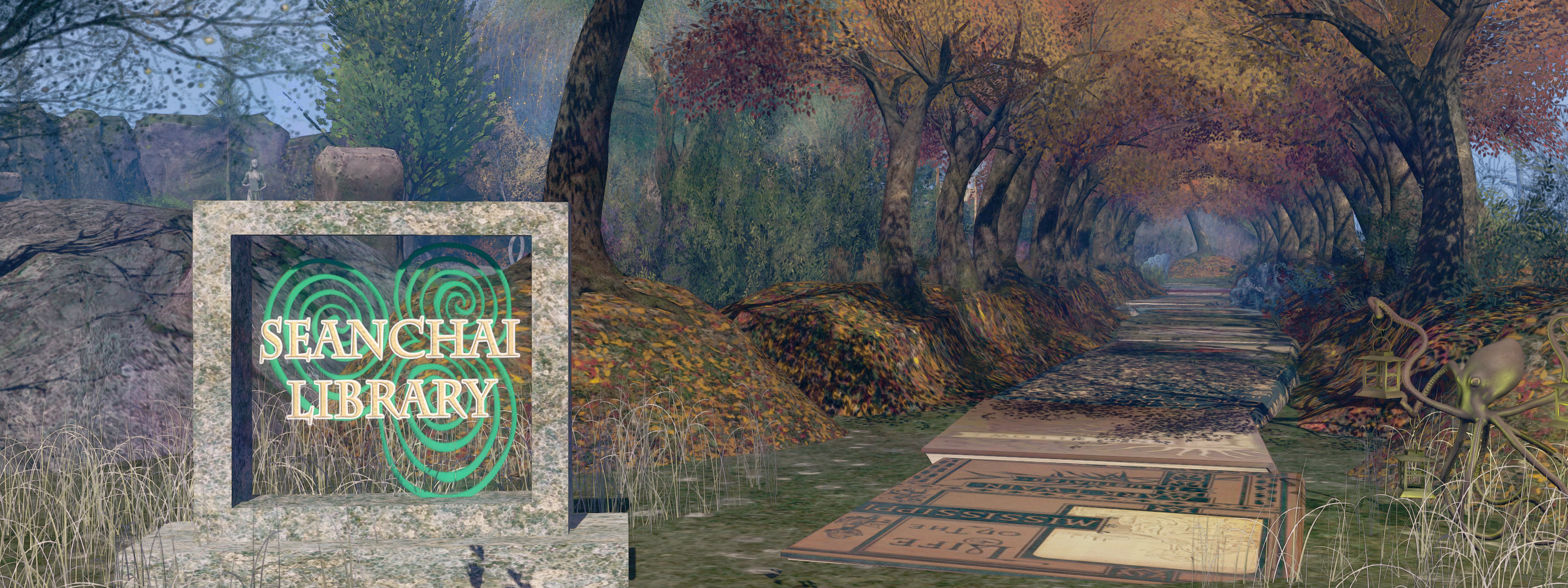
It’s time to highlight another week of storytelling in Voice by the staff and volunteers at the Seanchai Library. As always, all times SLT, and events are held at the Library’s home in Nowhereville, unless otherwise indicated. Note that the schedule below may be subject to change during the week, please refer to the Seanchai Library website for the latest information through the week.
Sunday, December 19th, Noon: A Christmas Carol – The Big Read
A Seanchai Library reading of Charles Dickens’ A Christmas Carol has long been a seasonal tradition in Second Life. Most often since 2012, the reading has been associated with the Library’s end-of year celebration of all things Dickens with the annual presentation of The Dickens Project, conceived and coordinated by Caledonia Skytower.
However, whilst presenting a seasonal setting for their events in the run-up and around Christmas, for 2021, Seanchai Library is taking a break from the full quota of activities for the Project – but they will be presenting the highlight of the Project in the form of The Big Read – a cover-to-cover reading of Dickens’ classic A Christmas Carol.
First published in 1843, with illustrations by John Leech, A Christmas Carol is a story with which we’re all familiar: the redemption of miserly Ebenezer Scrooge through the visits of four ghosts: his former business partner Jacob Marley and the spirits of Christmas Past, Present and Yet to Come.
Part secular story, part Christian allegory, A Christmas Carol was written at a time when Victorians were exploring and re-evaluating the traditions of Christmas “old” and “new” – carol singing, the growing use of Christmas trees and the sending / receiving of Christmas cards. Partially inspired by the stories of other popular authors together with his own experiences whilst a boy, A Christmas Carol was the fourth Christmas story Dickens wrote, but its themes of redemption, giving, kindness and the ability to transform the lives of others struck a collective chord among the novella’s readers, one that has continued to be heard down the decades since its publication.
In this very special reading, Seanchai regulars Corwyn Allen, David Abbot, Aoife Lorefield, Dubhna Rhiadra, and Caledonia Skytower are joined by Gloriana Maertens to take us back to Victorian London and this timeless tale.
Seanchai Winter Holiday setting
Monday, December 20th, 19:00: Prometheus
Gyro Muggins reads the final volume of Philip José Farmer’s tale of Father John Carmody, and ex-con who painfully grew a conscience, but who is still not entirely beyond benefiting himself.
Having been tasked with travelling to the planet Wildenwoolly entirely by his own means, and entirely without funds, Carmody find himself travelling with an unexpected – and unwanted – companion, the egg of a large sentient bird called a horowitz. Firmly attached to his chest with no obvious means to remove it, the egg leaves Carmody with no option but to travel to the homeworld of the horowitz.
In Prometheus, Carmody reaches Feral, the planet of the horowitzes – and finds himself cast into the role of a kind of Prometheus. Except that, rather than bringing light to that world, his role is that of an educator bringing moral enlightenment to the bird civilisation.
Wednesday, December 22nd 19:00 Adventures from Terry Pratchett’s Hogfather
Susan had never hung up a stocking . She’d never put a tooth under her pillow in the serious expectation that a dentally inclined fairy would turn up. It wasn’t that her parents didn’t believe in such things. They didn’t need to believe in them. They know they existed. They just wished they didn’t.
There are those who believe and those who don’t. Through the ages, superstition has had its uses; nowhere more so than in the Discworld where it’s helped to maintain the status quo. Anything that undermines superstition has to be viewed with some caution.
There may be consequences, particularly on the last night of the year when the time is turning. When those consequences turn out to be the end of the world, you need to be prepared. You might even want more standing between you and oblivion than a mere slip of a girl – even if she has looked Death in the face on numerous occasions.
Caledonia Skytower read selection from the 20th book in Pratchett’s Discworld series at Seanchai’s Winter Holiday setting.
Seanchai Winter Holiday skating pond
Thursday, December 23rd, 19:00: The Night Before the Night Before
The return of a Seanchai tradition with Kayden Oconnell, Aoife Lorefield, and Caledonia Skytower, Live at Seanchai’s Winter Holiday setting.
Friday, December 24th, 14:00: Christmas Eve Skating Party
I recently covered the promotion of the Second Life 360º Capture viewer to de facto release status (see: 360º Capture viewer now de facto SL release viewer), in which I referenced uploading images to platforms such as Flickr. Since that article, I’ve received questions on embedding images from the viewer into blogging platforms such as WordPress or viewing.
While I cannot speak to other platforms, it is possible to directly display 360º images (including those produced via the Second Life viewer and TPVs) directly into WordPress posts / pages. There are actually two ways of doing so:
If you are using Automattic’s own platform / hosting via WordPress.com, you can use dedicated shortcode created by Automattic.
If you are self-hosting and using WordPress.org, you can either use a dedicated WordPress.org plug-in such as Algori 360 Image, or try the shortcode option (which I believe should work, although I cannot verify, being a WordPress.com user).
For the purposes of this article, I’ll be covering the use of Automattic’s shortcode option. The key points of this approach are:
It works with both of the WordPress editors, Classic and Guttenberg (the “block” editor).
It supports any suitable 360º image with a .jpg file extension (not just those created with the SL viewer, although the notes below assume you are using the 360º viewer to initially create your 360º image(s).
It allows images to be viewed when embedded in a post / page, and has an option to display them in a full-screen mode and returning you to the post / page in which they appear when done.
As it works with URLs, it can be used to display 360º images you have uploaded to other platforms, such as Flickr (which I’ve also covered below).
It defaults all images to a single image size rather than a more usual equirectangular aspect ratio (2:1), which can look overly large within a post or page, depending on the theme you are using, as per the example below:
Embedding a 360º Image Uploaded to WordPress via the Classic Editor
Use the 360º viewer to take your image.
Upload the image to your WordPress Media Library.
Edit the image via your Media Library, and copy the URL as it is given.
The image URL can be found in the image editor Attachment floater (WordPress Classic dashboard version shown). Manually highlight and clip it to your clipboard or use the Copy URL to Clipboard button. Click for full size, if required.
Edit the post in which you wish to embed the 360º image and position the cursor when you wish the image to appear.
Switch to the Text view (click the tab at the top right of the WordPress text editor), and enter the following shortcode:
Where “path-to-photo” is the 360º image URL.
Switch back to Visual (click the tab at the top right of the WordPress text editor), the shortcode should appear as you’ve typed it.
Go to Checking Your Results, below.
Embedding a 360º Image Uploaded to WordPress via the Guttenberg Editor
Use the 360º viewer to take your image.
Upload the image to your WordPress Media Library.
Edit the image via your Media Library, and copy the URL as it is given.
Create a Shortcode block, and within it type:
Where “path-to-photo” is the 360º image URL.
Checking Your Results
Once you have created the 360º image shortcode:
Use the WordPress Preview option to check the layout of your post / page and that the image is properly displayed.
Use the Full Screen toggle option in the bottom right corner of the image to expand it to a full screen view and then click the icon again to return to the post / page view.
If you see a message similar to “Enter valid URL” or “failed to load the VR scene”, check to made sure you have added the shortcode and / or image URL correctly.
Embedding a 360 image uploaded to Flickr
As noted above, you can also use the WordPress shortcode option to display360º images you’ve uploaded to Flickr directly into your WordPress posts / pages, where they will play when clicked. Here’s how:
Upload a 360º image you’ve captured to your Flickr photo stream.
Click on the image in Flickr to display it.
Click the Share Photo arrow icon at the bottom right of the screen.
This will open a floater with a series of share options. Click on BBCode.
The floater will display URL information. click on the information to highlight it, then paste it into a suitable editor. It will look like the example below.
Flickr image BBCode – note the element highlighted in yellow
Trim the URL to just leave the part highlighted in yellow that starts with “https://live.static” and ends with “jpg”.
Follow the instructions above to create the 360º image shortcode using either the Classic or Guttenberg editor, replacing “path to photo” with the Flickr image URL from the BBCode.
The image below is an example of a 360º image uploaded to Flickr and embedded into this page using the above method, and which can also be seen here.
Elvion, December 2021 – click any image for full size
I have visited Elvion, the ever-evolving region design by Bo Zano (BoZanoNL), on numerous occasions over the last few years. It’s a place I frequently return to because with each iteration, Bo always offers us a rich and inviting celebration of nature and outdoor living.
He’s also someone who tends to sway away from typical seasonal designs, so for those who might already feel a little number from trudging through all the snow and cold that predominate region designs at this time of year, the current iteration of the region carries a subtle hint of winter’s presence whilst avoiding snow, whilst also embracing a touch of magic for the end of 2021.
Elvion, December 2021
Sitting within shallows speckled by light, the current iteration of Elvion sits as a Z-shaped island that cuts across the water, a low-lying ribbon of grass and sand. Scattered with trees rich in the colours of summer and autumn, the land capped at its northern end by a rocky beach and a horseshoe of rock from which water tumbles into a pool before flowing out into the wide expanse that surrounds the region.
Elvion, December 2021
The magic is infused into the region in a number of ways. There are, for example, the giant mushroom trees mixed with the “normal” trees. Then there are the tall pillars canted to lean together and form arches, their presence suggesting this was once the home of ancient structures, while paths are marked by plants that carry their own bulb-like illumination. Meanwhile, the rocks with their waterfalls are backed by strange, extruded outgrowths of rock that look petrified spider’s legs frozen over a portion of the landscape.
Elvion, December 2021
Within this setting there is much to be found in the way of details provided by Bo – including one of the Rack Pack bulldogs that have been part of a number of past Elvions – although whether it is Frank, Sammy Davis or Deano, I couldn’t say, this time around 🙂 . Here, horses roam; there stands a pair of albino reindeer, one of the small nods towards the winter season, alongside the EEP settings used in the region); further along, otters keep an anxious watch on the open waters as if expecting something.
Also to be found within the region are multiple places to sit and cuddle – my favourite being the Moon chair as it looks out through a vortex of lying fish (one of the other signs of magic / fantasy in the region); whilst art can also be found giving further ambience to the setting.
Elvion, December 2021
This is a place was wandering is easy and the land encourages the imagination to take flight and where peace can be found bathing under the watchful eyes of peacocks and time can be spent in simple reflection. A place where time can be allowed to pass on its own, and the mind can free itself from any sense of trouble or strife.
In other words, another engaging and ideal visit for visitors to enjoy – as I hope the images here confirm.
The following notes were taken from my audio recording and chat log of the Content Creation User Group (CCUG) meeting held on Thursday, December 16th 2021 at 13:00 SLT. These meetings are chaired by Vir Linden, and meeting dates can be obtained from the SL Public Calendar.
Available Viewers
This list reflects those viewers available via Linden Lab.
The Jenever Maintenance RC viewer, version 6.5.1.566306, issued on December 6.
The Koaliang Maintenance 2 RC viewer, version 6.5.1.565905, issued on December 6.
The Tracy Integration RC viewer version 6.4.23.563771 (dated Friday, November 5) issued Tuesday, November 9.
Project viewers:
Performance Improvements project viewer updated to version 6.5.1.566443, dated December 8.
Performance Floater project viewer, version 6.4.23.562625, issued September 2.
Mesh Optimizer project viewer, version 6.4.23.562614, issued September 1.
Legacy Profiles viewer, version 6.4.11.550519, dated October 26, 2020.
Copy / Paste viewer, version 6.3.5.533365, dated December 9, 2019.
General Viewer Notes
It is possible the two Maintenance RC viewers will be combined into a single release prior to their promotion in early 2021.
Work is continuing to work out the bug in the Performance Improvements project viewer in the hope it will be fit for promotion to RC status early in 2022.
Second Life Terrain Discussions
It has long been noted that the terrain in Second Life has never received a major overhaul, although the subject has been discussed from time to time. Currently, a terrain project still is not on the roadmap, but the floor was opened for suggestions as to what users might like to see if such a project were to be adopted by LL.
The questions was framed around “terrain” being the overall appearance of a region – land, water, the use of any region surround, support for flora, interactions with the wind, having much improved texture quality, etc., so as to offer a much improved graphical experience that does not put an undue load on the viewer when rendering or requires the simulator to send a mountain (no pun intended) of data to the viewer. In other words, how to make SL landscapes / environments “prettier” and “more up-to-date” without undue impact on overall performance.
In terms of the existing system, suggestions put forward included:
The ability to have Linden water on a prim (rather than animated diffuse, normal and specular maps).
One problem here is the potential for serious performance hits (e.g. linden water on prim / mesh faces being used (or over-used!) for mirror effects) – particularly given actually occluding “non-visible” Linden water (e.g. the “water” beneath the terrain map) in order to help improve viewer performance is very much something being actively looked at (and is being implemented in the case of the Catznip TPV).
Support for using splat / weight maps.
Proper blending / integration between terrain and any region surround.
Ability to instance “proper” trees, grass a fauna (rather than the (circa 2002) default Linden trees, etc., included in the build tools.
Ability to blend / layer textures to allow things like a base of dirt, overlaid with grass, then the two blend to give the impression of wheel ruts or a dirty / rock path through the grass, etc.
It was also pointed out that there are multiple limitations to the current terrain system and tools (e.g. the inability to create tunnels or caves, limitations is blending terrain between parcels under separate ownership, the manner in which alterations to the height fields can cause a bad stretching of the surface textures, etc.), as such, many region designers already prefer working entirely in mesh, and so a better effort might be to provided improved support for this approach, including:
The ability to use large terrain meshes that are not prohibitively expensive in terms of LI,.
Allowing proper texture blending on mesh terrain surfaces.
Support (again) for splat / weight maps. etc.
In terms of instancing flora, concern was raised how this might impact the landscaping market / economy (e.g. if LL provide a range of “nice trees”, will people still, buy their own? could the instancing system be made extensible, so that content from creators could be “plugged into” it?, etc.).
Overall, no conclusions were drawn, but a lot was offered up in terms of ideas, with the discussion also touched on issues of physics (notably the use of mesh terrain elements across region boundaries, the potential for increased physics collision calculations resulting on a performance hit; and also discussions of an expansion of the materials system allow the use of additional maps / making the materials system more a asset-based system (like EEP settings), consideration of updating SL to offer reasonable / real PBR support, etc.





 Inara Pey: Living in a Modemworld