Lab launches new Linden Homes

Bellisseria – New Linden Homes

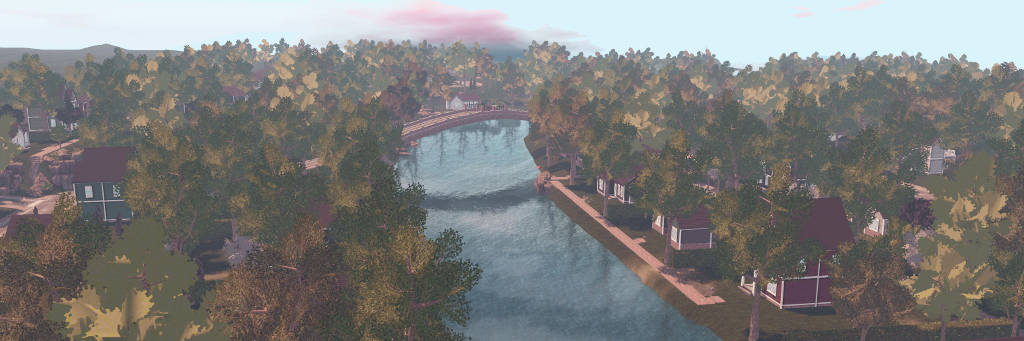
On Monday, April 15th, Linden Lab launched their new Linden Homes for Premium subscribers. These new Homes, each located on a 1024 sq metre parcel, are located in a dedicated new continent – which, as I revealed in my March preview, is called Bellisseria – situated between Sansara and Jeogeot.

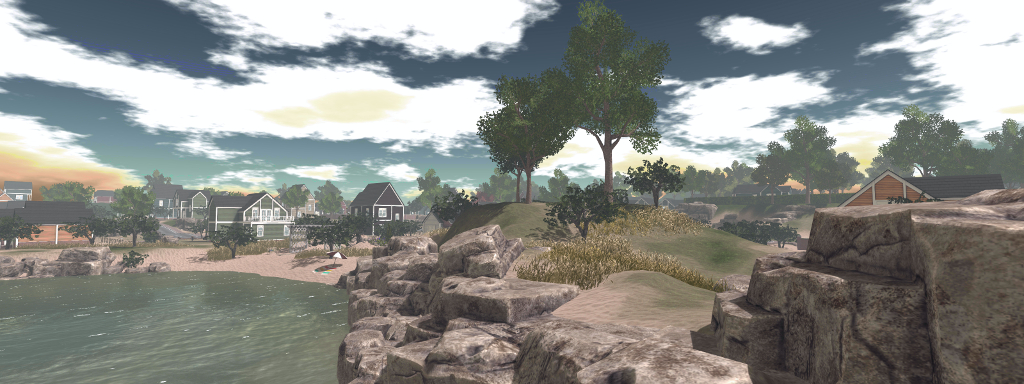
The continent itself – like the homes on offer – is a significant step up from the original Linden Homes and lands first introduced in 2010. Landscaped, and offering a degree of infrastructure: roads, rivers, paths, coastal regions with beaches, offshore-lighthouses, and so on. All of which offers an environment that is pleasing to the eye and make for a pleasant environment in which to live.
Bellisseria – New Linden Homes

For the initial release, two types of house are available: traditional suburban houses and houseboats, each of which comes in a total of four styles apiece. These four styles offer a varied set of looks that is enough to ensure neighbourhoods have a mix for looks. All come with a land impact of 351 LI, offering a lot of opportunity for furnishing.

It’s important to note that the houses / houseboats are not 1024 sq m in size; this is the size of the parcel on which they sit: and all have been designed to provide a degree of garden / yard space or waterside moorings for boats. The roads within the continent are driveable (although houses are not supplied with a driveway to link to the roads), while the waters are navigable in many places and a channels links the continent with Joegeot and Sansara.
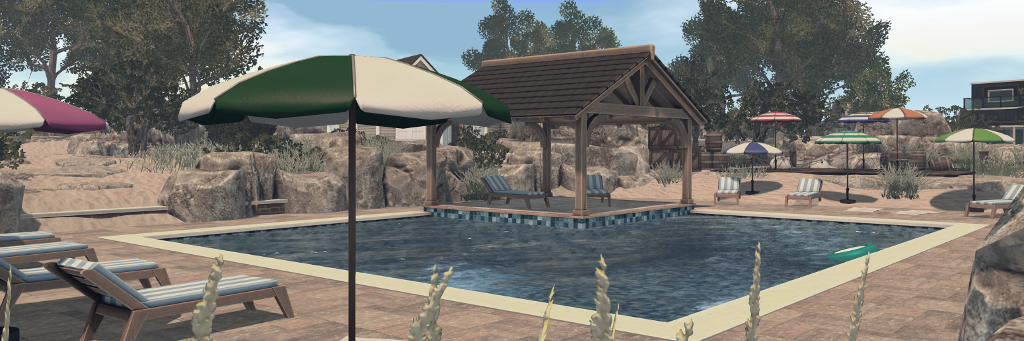
Bellisseria – New Linden Homes: coastal community space

Unlike the older Linden Homes, these have controls built-in via a panel on the interior walls close to the front door. So, no going to a website to change the decorative style, set the window shutters, etc., everything can be done directly from the control panel – including getting a pack of extra fixtures, should you want to use them, and a box of textures that can be used so that any additional elements – room dividers, walls, etc., – you might want to add can match with the overall décor.
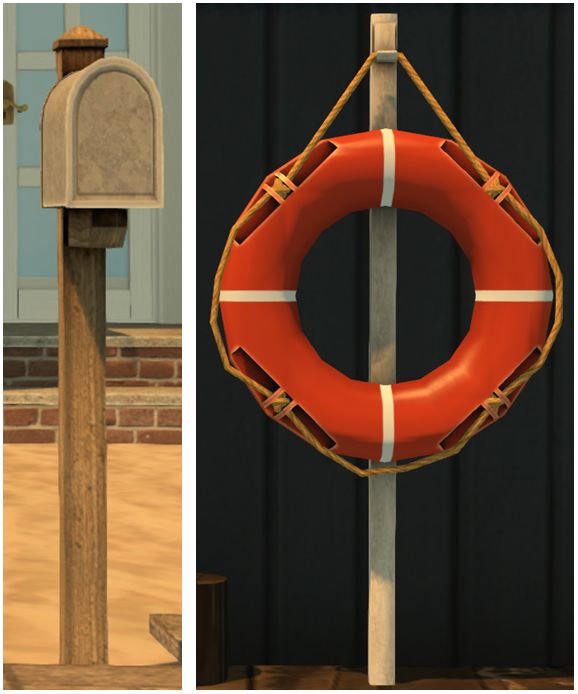
Individual style of house and houseboat are selected from the outside mailbox / life buoy. An interior control panel can be use for the window blinds, door control, etc.

To say these new Linden Homes are a major step up from the originals isn’t really saying a lot; the old Linden Homes  – as noted – are around 9 years old, and a lot has moved on in Second Life since then. However, the attempt to create a sense of community within the new continent is impressive and potentially goes some way towards reversing the “build and forget” approach to Linden Homes seen in the past – although how well it succeeds in terms of getting people not just to take the houses and engage within the develop to create local neighbourhoods / communities remains to be seen; and the matter really is up to those of us who take up the houses.

For my part, I like the approach, and several of the designs. Yes, the use of rooms in some can make them feel a little cramped, and some of the houseboat designs might not strike the right of aesthetic note, but there is no escaping the fact these are properties with potential, and if you are a Premium subscriber, they may well be worth taking a look at, even if you already hold land.

Applying for a Home

Note: for full details on the new Linden Homes – prerequisites for obtaining one, the application process, and so on, please refer to the Linden Homes wiki page.

If you have not used your default allocation of free tier – (1024 sq m), then a new Linden Home is yours without any additional payment. Otherwise, the standard Premium tier rates apply.

As with the original Linden Homes, the new homes are obtained through the Linden Homes registration page – which, at the time of writing still includes options for the existing Linden Homes, although these are to be gradually phased out. However, unlike the “old” homes, you only select with you want a house or a houseboat, not the actual style of the house / houseboat you prefer; these are selected in-world, via a mailbox for the houses or a life buoy for the houseboats. These controllers also let you change the style of your house / houseboat at any time, presenting another flexible option not available with the old Linden Homes.

The new Linden Homes are available through the existing Linden Homes registration page – just make sure Bellisseria is selected in the Theme drop-down (arrowed) and select your choice of house or houseboat by clicking on the buttons shown in the red square

The selection process is straightforward, and you’ll be required to accept the Linden Lab Terms and Conditions prior to being able to receive the details of your new home.  These are presented on the web page – just click the Go To Your Home button.

(Unsurprisingly) I’ve already claimed my new Linden Home. Being an aviator and sailor, I went for a houseboat, selecting what I personally think is the roomiest of the options, the Windlass. Split-level it offers a good feeling of space, with a rooftop deck, and good opportunities for customisation. Sitting on one of the numerous sandbars surrounding the coast of the new continent, it opens out onto a nice community beach on one side, and presents plenty of mooring space on the other.

My new Linden Home houseboat with one of my motorboats moored alongside. Note that the water in front of the houseboat is also part of the parcel, offering more mooring space, but the wooden piers are not part of the individual properties.

Using a houseboat means I also have room for boats and planes on the water – particularly through the use of a rezzing system that allows me to select which vehicle I have rezzed (up to the land capacity, obviously). For those interested, I’ve previously covered this approach to having vehicles available without using up all your land capacity in Adding a little vehicle space with a rezzing system.

Overall, a nicely done new environment. It will be interesting to see how things grow here – and how it might affect rentals among private estates for Premium members, given the overall attractiveness of this new continent. It’ll also be interesting to see how LL handle the retirement of the “old” Linden Homes, including any possible relocation among Premium subscribers who opt not to move voluntarily.

The launch was accompanied by a new video from the Lab, which I’ve embedded below.

Additional Information

Second Life: teleport / region crossing disconnects

As I’ve been reporting in my weekly Simulator User Group meeting summaries and my Third-Party Viewer Developer meeting updates, there have been widespread issues with disconnects during region crossings – both via teleport and physical region crossings (e.g. via boat or aircraft or on foot).

Various theories have popped up over the weeks as to why the problem is occurring  – with fingers most often being pointed at the server-side deployment of the Environment Enhancement Project (EEP). Whether or not EEP is responsible or not is hard to judge.

As I noted in my March 30th TPVD meeting notes, one of the problems with the issues is that they appear to strike randomly, and cannot be reproduced with any consistency; were a single cause behind them, it’s not unreasonable to assume that investigations would lead to a point where some degree of reproduction could be manifested.

It has been suggested by some users that de-rendering the sky (CTRL-ALT-SHIFT-6) before a teleport attempt can apparently ease the issue – although this is hardly a fix (and certainly no help to aviators and sailors), nor does it appear to work in all cases.

As trying to get to the root cause(s) of the problem is taking time, on Monday, April 8th, Linden Lab issued a blog post of their own on the matter, which reads in full:

Many Residents have noted that in the last few weeks we have had an increase in disconnects during a teleport. These occur when an avatar attempts to teleport to a new Region (or cross a Region boundary, which is handled similarly internally) and the teleport or Region crossing takes longer than usual.  Instead of arriving at the expected destination, the viewer disconnects with a message like:

Darn. You have been logged out of Second Life.

You have been disconnected from the region you were in.

We do not currently believe that this is specific to any viewer, and it can affect any pair of Regions (it seems to be a timing-sensitive failure in the hand-off between one simulator and the next).  There is no known workaround – please continue logging back in to get where you were going in the meantime.

We are very much aware of the problem, and have a crack team trying to track it down and correct it. They’re putting in long hours and exploring all the possibilities. Quite unfortunately, this problem dodged our usual monitors of the behaviour of simulators in the Release Channels, and as a result we’re also enhancing those monitors to prevent similar problems getting past us in the future.

We’re sorry about this – we empathise with how disruptive it has been.

As noted, updates are being provided as available, through the various related User Group meetings, and I’ll continue to endeavour to reflect these through my relevant User Group meeting updates.

Copyright, the EU and user-generated content (2)

On Tuesday, March 26th, 2019, the European Parliament voted in favour of the EU’s new European Union Directive on Copyright in the Digital Single Market. As I noted in Copyright, the EU and user-generated content, this has proven a controversial piece of legislation. Although intended to help protect the rights of content providers / creators, aspects of the Directive – notably Articles 3, 11 and 13 – have been seen by opponents as potentially causing damage to the Internet.

These three articles are, in summary:

  • Article 3, relating to text and data mining, which could adversely hit genuine research organisations and things like tech start-ups in Europe (see Why The Copyright Directive Lacks (Artificial) Intelligence as an example).
  • Article 11, (colloquially referred to as “the link tax”) which could severely restrict how we can share links, and information found on European on-line sites.
  • Article 13 (the so-called “meme tax”, although its scope is far greater), which has drawn the heaviest criticism,which could do much to block or restrict the availability of user-generated content.

Article 13 – which is now, somewhat confusingly, Article 17 –  has been of particular concern, as it pushes the onus of rights protection aware from rights holders and pro-actively onto the shoulders content sharing platforms, which potentially causes issues, as I noted when writing on the topic at the start of March:

Aimed at the likes of Google (including YouTube), Facebook and the like, Article 13 could fundamentally impact any platform playing host to user-generated content (UGC), including Second Life, Sansar and other virtual worlds.

Under the Article, all such services are expected to pro-actively prevent any content that might violate the Directive from being uploaded. They are to do so through the use of “proportionate content recognition technologies” – that is, automated content filtering, designed to block anything that might by in violation of copyright. However, such systems a) may not be affordable to those required to implement them, and b) don’t actually work as advertised (as is the case with Google’s multi-million-dollar ContentID system, which has been shown to be far from successful).

Drawing the loudest criticism, Articles 11 and 13 (/ 17) have seen the Directive pass through a number of re-writes, and amendments were being put forward right up until February 2019. The final Parliamentary vote was subject to intense debate, but saw the Directive pass with 348 votes in favour, 274 against. A proposal to allow MEPs to debate and vote on individual amendments was rejected by just five votes*.

So now the vote has been taken, what does this mean?

Well, contrary to the more alarmist reactions, the Internet is not about to totally implode before the weekend arrives; nor are we going to see sudden changes to policies relating to content upload within Second Life. But the risk to EU based content creators, bloggers, vloggers, streamers, etc., is still very much there, and shouldn’t be sidelined; it’s just that there are some more steps the Directive must go through.


Julia Rada, former rapporteur of the EU’s Parliament’s review of the 2001 Copyright Directive referring to the new EU Copyright Directive as “a disaster for the Internet and a generation”

The first of these will come on April 9th, when the Directive is put to the European Council for adoption. Until recently, this looked like a foregone conclusion. However, despite being one of two countries responsible for the final wording of Article 13 (/ 17) in particular, it seems Germany is having something of a change of heart, with their Minister of Justice publicly opposing the idea of upload filters:

We think #Uploadfilter is the wrong Way to go about it. Dear Union, if You want to maintain a Spark of Credibility, You support our Motion in the European Parliament. How we can prevent Upload Filters.

– German Minister of Justice Katarina Barley on Article 13 via Twitter, March 23rd

This means Germany might still retract its support, particularly giving the depth of public opposition to Article 13 (/ 17) that has been voiced. While this seems unlikely (see the video above), it is still important because five other member states – the Netherlands, Luxembourg, Poland, Italy, and Finland – have voiced public opposition to the Directive the vote. So should Germany, a key nation behind the legislation and of the EU, change its mind between now and April 9th, it would prevent a Council majority being reached. This would likely result in further negotiations n the Directive being required after the EU elections due to be held on May 26th, 2019 – elections which could see those determined to see the Directive passed over and above the many concerns raised, voted out of office.

And even if the Council pass the Directive, it will still take time to come into effect. EU nations (and probably the UK, despite Brexit), are theoretically allowed two years to transpose EU Directives into legislation; more often than not, it takes longer than this to be achieved. In the case of Article 13 (/ 17), the process could well be exacerbated by the fact  – and as I again noted in my March 5th article – it contains many holes which need to be dealt with. This in itself could result in a chaotic situation – something that activists in Germany and Poland, as well as concerned organisations such as the Electronic Frontier Foundation are already taking up ahead of the April 9th EU Council meeting.

Despite potentially benefiting from the Directive and Article 13 (/ 17) Google, whose parent Alphabet has spent $100 million pursuing the development of content recognition filters, has joined with other major players within EDiMA, including Amazon, Apple, Facebook, Twitter, Snap and Microsoft, in speaking out against the vote, noting the Copyright Directive stands at odds with other European legislation:

EDiMA, representing digital businesses and online platforms in Europe, regrets the lack of clarity and practicality of two key articles of the Directive.

Specifically, Article 11 of the Directive have been found to be ambiguous and will lead to the greater likelihood of litigation. Whilst Article 13 continues to be technically unworkable because it imposes a monitoring obligation on platforms, in conflict with the e-Commerce Directive which states that there should be none.

– from EDiMA reaction: EU Copyright Directive is not
fit for [the] Digital Era

The Computer & Communications Industry Association in Europe has similarly spoken out against the passage of the Directive, referring to it as a “missed opportunity” and commenting:

We regret the adoption by the EU Parliament of the #copyright directive. We fear that upload filters and the press publishers’ right will harm on-line innovation and restrict on-line freedoms.

Some hope that gentler language added to Article 13 (/ 17) after the September 2018 vote, and which talks of platforms putting the means in place for rights holders to more ready point to infringements in order to have them removed, might present a means to prevent the more dreaded impact of the Directive. But this is very far from certain.

As such, while a significant battle against the EU Copyright Directive has been lost, it is not unreasonable to say the war is now over – but it is going to be significantly harder to win for opponents of Articles 11 and 13 (/ 17) as the fight moves to a more national level in order to persuade governments and the Council of the Directive’s flaws.

Sources:

* Ciaran Laval, via Twitter, informed me this was actually the result of an error: a group of Swedish MEPs apparently intended to vote in favour of allowing the debate on individual Articles, but pressed the wrong electronic buttons. Unfortunately, the vote stands as recorded, but the error has been noted.

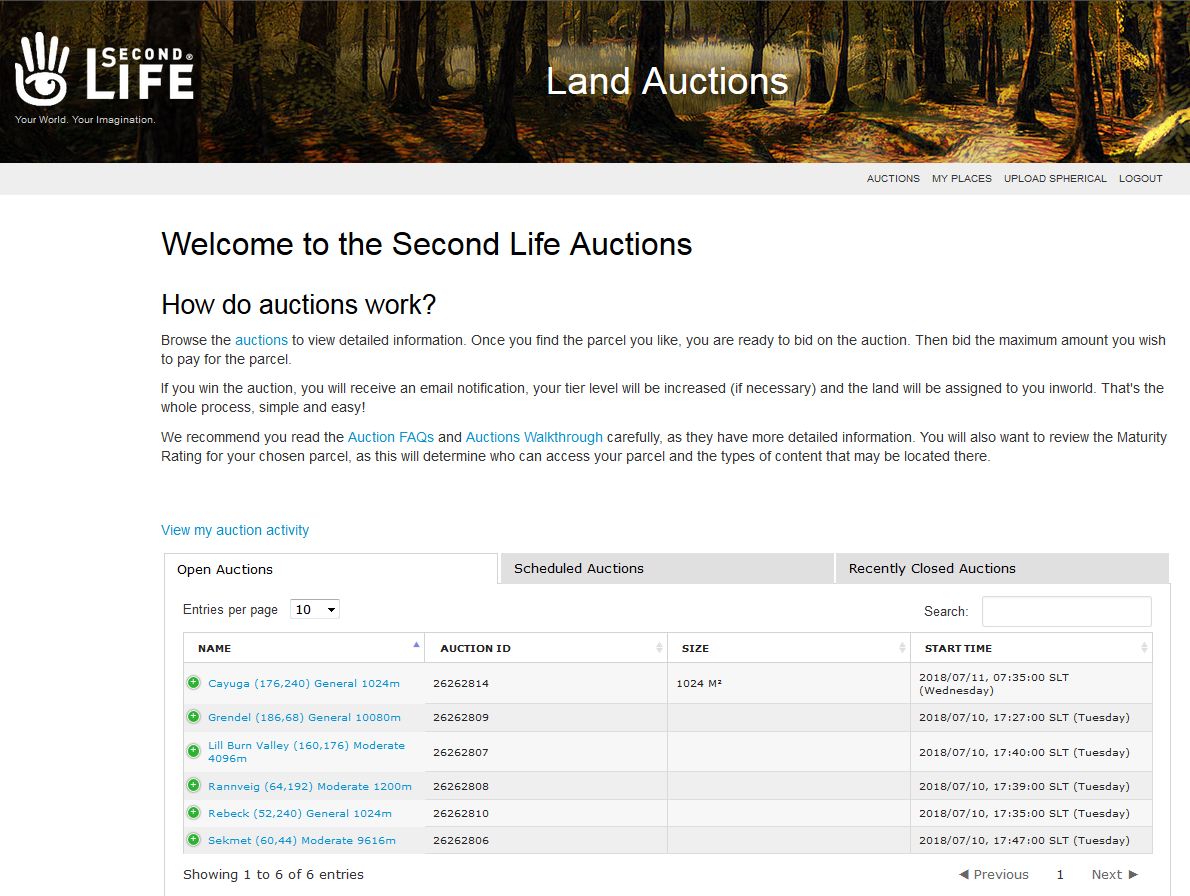
User-to-user Mainland auctions now live

Mainland auctions opened to user-to-user auctions on Tuesday, March 26th, 2019

After my February 26th oopsie (see Mainland land holders will soon be able to auction their land), Linden Lab confirmed on March 26th, 2019, that user-to-user Mainland auctions are now live.

The auction system leverages Second Life Place Pages as the medium for presenting land for auction and for placing bids, together with a new “cover page” listing available parcels up for auction, which can be found at https://places.secondlife.com/auctions.

If you are not familiar with Place Pages, you can find out about them via my Place Pages tutorial. This will be updated to include the relevant information on setting a parcel for auction in the near future, once the service has been confirmed as being “live”. In the meantime, additional details on Mainland auctions can be found in the Second Life Knowledge base as follows:

Again, and for clarity, do please remember, the auction system is for Mainland only. Private regions or parcels cannot be offered through it.

Farewell, Fran

Fran Swenson with her avatar (in the blue gown) Fran Seranade, and her daughter’s avatar, Barbi Alchemi (image courtesy of image courtesy of San Diego Union-Tribune / Bill Wechter

In 2013, I was able to write about the extraordinary Fran Swenson – Fran Seranade in Second Life – a Parkinson’s Disease sufferer who at the time had seen – and continued to see – something of an overall improvement in her condition, which she attributed to Second Life.

Fran’s story, which was reported in the likes of the San Diego Union-Tribune and Wired and came to be the focus of and one of the earliest editions of The Drax Files World Makers, was the trigger-point for her daughter, Barbara, establishing Creations for Parkinson’s in Second Life, designed to raise money for research into the disease and for a possible cure by supported the work of The Michael J. Fox Foundation for Parkinson’s Research and providing a meeting place for those stricken by the illness and those seeking a sense of community and support. Fran’s response to her condition and Second Life was also the subject of study by Donna Z. Davis (Tredi Felisimo in SL) and Tom Boellstorff  (Tom Bukowski in SL).

The avatar represents who I really feel inside. When I look at my avatar, I feel like I’m looking at myself … I’m dancing now and I can run, hop, jump and have fun. I’m not just in my apartment, I have the whole world now. It’s thrilling!

– Fran Swenson (Fran Seranade in SL) on the joy and
freedom Second Life gave her

I met Fran, and her daughter Barbara, on a number of occasions in Second Life in 2013 and 2014, although sadly, I allowed contact with them both to drift over the years since. Throughout those meetings, I was always stunned by Fran’s energy; she always exuded happiness and a sense of fun that was infectious. It is therefore with enormous regret – and following word sent by Draxtor Despres – that Fran sadly passed away at the age of 92 on March 3rd. With her passing, a genuine, warm and caring light has gone from Second Life and we have lost a true pioneer.

Fran was an earth angel whose extraordinary love touched all who met her. From her earliest days, it was her lifelong mission to help people wherever she saw a need. Mom always said, “Love is unlimited. The more you give, the more love there is to give.”

– Fran’s daughter, Barbara Richards (Barbi Alchemi in SL),
remembering her mother

An in-world  memorial for Fran is being planned, but will understandably take time to arrange – I hope to help spread the word for all who may wish to attend once the date and time have been confirmed. If you would like to make a physical world donation in Fran’s names to help further the work of The Michael J Fox Foundation for Parkinson’s Research, please use the link below, where you will also find a memorial to her.

To Barbara (Barbi Alchemi in Second Life) her brother (AlmostThere in SL) and their family, to all who knew Fran as a friend and an active members of the Creation’s community, I extended my condolences at this time – as I’m sure all who knew Fran and her story do as well.

Lab launches Second Life video travelogue

The Pen – subject of Linden Lab’s new video travelogue series

On Wednesday, March 6th, 2019, Linden Lab launched another new video series: Second Life Destinations, highlighting locations across the grid that residents might like to visit. The series is intended to be issued on a weekly basis and the Lab notes:

In this series, we’ll highlight different places focusing in on the beauty and imaginative possibilities in no more than 60-90 seconds so that you can get a quick peek at the creations and communities inside each virtual space. At times we may even speak to creators of theses spaces so they can shed some light on what inspired them. Look for each new episode on our blog and social media channels, including Facebook, YouTube and Twitter.

For the first in the series, the Lab visit The Pen, Bay City’s beatnik hang-out operated by Marianne McCann, home to a range of activities include Marianne’s regular “Expresso Yourself” events, where the microphone is opened to visitors to express themselves in words (prose or poetry) or song on the first Tuesday of the month between 18:00 and 20:00 SLT.

The Pen was recently the venue for Marianne’s 13th rezday celebrations, and these are the focus of the video, which includes the voice of singer Grace MacDonnogh, a long-time friend who has a wonderfully mellow way with music and lyrics.

As a seasoned SL travel writer (and videographer when my PC decides to behave itself), I admit to finding myself caught between two conflicting feelings regarding this new series. On the one hand, there are a lot of people like me in the blogging community: we may not all focus on blogging destinations (although equally, some do), but  considerable effort goes into writing-up places and taking photos  / producing videos. Give all that, a series like this might be felt as coming a little close to treading on toes. On the other hand, the series is intended to be limited to 60-90 seconds, and as such it shouldn’t really impact on the work done by videographers and bloggers.

Nevertheless, it’ll be interesting to see how the series develops. In the meantime, I’ll leave you with the first, which demonstrates the potential innocuousness of the series.