Copyright, the EU and user-generated content

Update: There is still time to sign the petition / wrte to MEPs, the Parliamentary vote on the Directive is now set for between March 25th and March 29th, 2019.

There has been a lot written over the last few months about the upcoming European Union Directive on Copyright in the Digital Single Market. It’s a controversial topic. Within it, the Directive is an attempt to reshape EU copyright law for the internet age, and the relationship between copyright holders and on-line platforms.

In short, the core issues with the Directive  – which has been under consideration by the EU for the last two years – come in three of its key elements, or Articles:

  • Article 3, relating to text and data mining, which could adversely hit genuine research organisations and things like tech start-ups in Europe (see Why The Copyright Directive Lacks (Artificial) Intelligence as an example).
  • Article 11, (colloquially referred to as “the link tax”) which could severely restrict how we can share links, and information found on European on-line sites.
  • Article 13 (the so-called “meme tax”, although its scope is far greater), which has drawn the heaviest criticism, and is the Article I’m focusing on here.

Driven largely out of the wants and needs of big media rights holding corporations concerns about re-use of the media (be it music, film, television, whatever), Article 13 sees a fundamental shift in rights management on the Internet. Whereas currently, the onus is on the rights holders to content to protect their rights, Article 13 seeks to make content platforms responsible for ensuring anything uploaded to their services is not in violation of any IP / copyright – or face severe financial penalties.

Aimed at the likes of Google (including YouTube), Facebook and the like, Article 13 could fundamentally impact any platform playing host to user-generated content (UGC), including Second Life, Sansar and other virtual worlds.

Under the Article, all such services are expected to pro-actively prevent any content that might violate the Directive from being uploaded. They are to do so through the use of “proportionate content recognition technologies” – that is, automated content filtering, designed to block anything that might by in violation of copyright. However, such systems a) may not be affordable to those required to implement them, and b) don’t actually work as advertised (as is the case with Google’s multi-million-dollar ContentID system, which has been shown to be far from successful).

Flaws contained within Articles 3, 11, and 13 have generated global concern from politicians across Europe, government organisations such as the Electronic Frontier Foundation, businesses Internet experts such as America’s Cory Doctorow and the UK’s Glyn Moody and more.
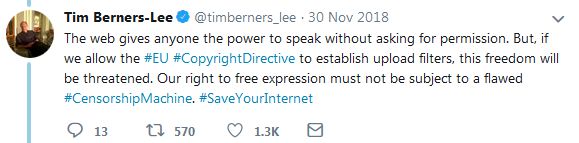
Tim Burners-Lee, the father of the World Wide Web has been a critic of the proposed new EU Copyright Directive

Even German politician Julia Rada, who in 2014 was appointed rapporteur of the EU’s Parliament’s review of the 2001 Copyright Directive, and whose initial report Cory Doctorow described as “amazingly sensible”, has become a fierce critic of the new Directive.

However, such concerns – and suggestions for improvements to the Directive – have been largely brushed aside by the Directive’s chief proponents, the right-of-centre EPP, which has been vitriolic in its response to public concerns, dismissing them as the actions of “bots”, etc. Despite this, efforts to get the Directive reformed did prevent it being passed in votes held during 2018, and for a time at the end of the year, it appeared that saner heads would prevail, and both Article 11 and Article 13 would be revised.

Unfortunately, this has proved not to be the case. Due to the way in which the EU works, a final log-jam in the wording was cleared at the start of February 2019 when France and Germany – two nations strongly in favour of the Article 13 – reached an agreement. This leaves Articles 3, 11 and 13 fully retained, with Article 13 somewhat worse than previously worded, as Julia Reda explained:

In the Franco-German deal [PDF]Upload filters must be installed by everyone except those services which fit all three of the following extremely narrow criteria:

  1. Available to the public for less than 3 years [and]
  2. Annual turnover below €10 million [and]
  3. Fewer than 5 million unique monthly visitors.

Countless apps and sites that do not meet all these criteria would need to install upload filters, burdening their users and operators, even when copyright infringement is not at all currently a problem for them.

– Julia Reda, February 5th, 2019

The potential implications of this are huge – and not just for EU-based services. Any service hosting content potentially covered by the Directive is liable to face significant issues, both in terms of trying to implement suitable content filtering and in potential penalties if they are considered to be in breach of copyright. Again, as Julia notes:

Even the smallest and newest platforms, which do meet all three criteria, must still demonstrate they have undertaken “best efforts” to obtain licenses from rights holders such as record labels, book publishers and stock photo databases for anything their users might possibly post or upload – an impossible task.

– Julia Reda, February 5th, 2019

Nor does it end there. There are significant ambiguities in Article 13 that potentially make the upload of content from EU nations problematic for platforms / hosting services:

  • What happens to content before a platform receives notice from a rights holder over its use?
  • How does a platform provider go about seeking this information?
  • The role of rights holders in producing the required information needed by content platforms to identify their content.
  • The kind of content that will require a license.
  • Whether or not there are added legal responsibilities for creators.
  • There is no “fair use” provisioning (although the concept of “fair use” has never actually been enshrined in any EU law).

The first two bullet points above could result in content having to be blocked simply on the basis that it might be in violation of IP or copyright, while the third essentially puts all the cards in the hands of rights holders – theoretically a good thing, but one fraught with even greater potential for misuse by those rights holders that enjoy significant power.

The issue of the kind of content that will require a license, combined with the first two bullet points above it is particularly problematic where something like SL is concerned. What happens, for example to all the in-world models based on European vehicle, boat and aircraft designs? And what about images uploaded as textures or uploaded audio files, the playing of videos in-world? Such questions barely scratch at the surface of things.

Such are the remaining concerns that already, five EU nations have publicly opposed the current version of the Directive – the Netherlands, Luxembourg, Poland, Italy, and Finland.

The end-result on copyright is a step back for the digital single market. It [the EU Copyright Directive] fails to strike a balance between protecting right holders and the interests of individual citizens. This is why the Netherlands, Luxembourg, Poland, Italy and Finland don’t support the final package.

– Joint statement by the EU nations opposing the Copyright Directive,
as seen on the Kingdom of the Netherlands website

However, five nations are not enough to prevent the Directive becoming law.
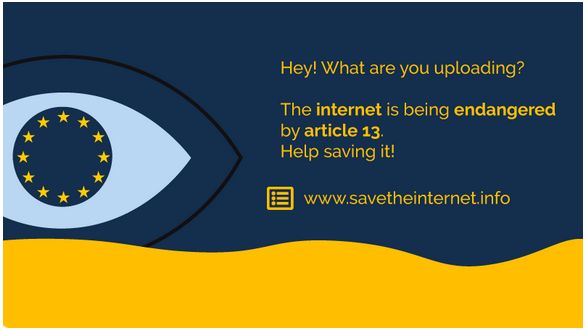
EUCD Petition

One of the final phases of this process is a vote on the current wording of the Directive by all 751 MEPs. This had originally been scheduled for March 23rd, 2019. However, in a cynical move aimed at preventing objections from the public being made and considered by MEPs, the EPP has pushed for the vote to be brought forward to March 12th.

This is why it is now vital for anyone in the EU concerned about the potential impact of Article 13 (and the Directive as a whole) to make your feelings known to your MEPs and to the European Parliament. there are two key ways to do this:

  • By visiting https://saveyourinternet.eu/act/ and using it to e-mail those MEPs from your country who have been in favour of, or have no opinion on, the Directive as it stands.
    • Because of the accusations that e-mails being received by MEPs voicing concern for about the Directive, it is very important you do not simply cut / paste text into e-mails “as is”, but you take the time to write a personal letter. However:
      • Glyn Moody’s has provided a blog post which might help in formulating your own blog post.
      • My own e-mail (sent earlier this year) can be found here – again, please do not simply cut and paste, but use it as a potential guideline for your own e-mail.
  • By signing a petition.

When I last spoke to Linden Lab on the subject, they indicated that they were following the progress of the Directive and would review matters once the Directive was approaching legal status. Those of us in the EU, can – and noted – make our voices heard; so please do make sure you take the time before March 12th to e-sign the petition, locate your country’s MEPs and send an e-mail.

Mainland land holders will soon be able to auction their land

Update, March 26th: user-to-user auctions are now live.

Update: Well, an Oopsie from me. Seems the user-to-user Mainland auctions aren’t *quite* live, but still in a testing phase. As such, this article has been revised.

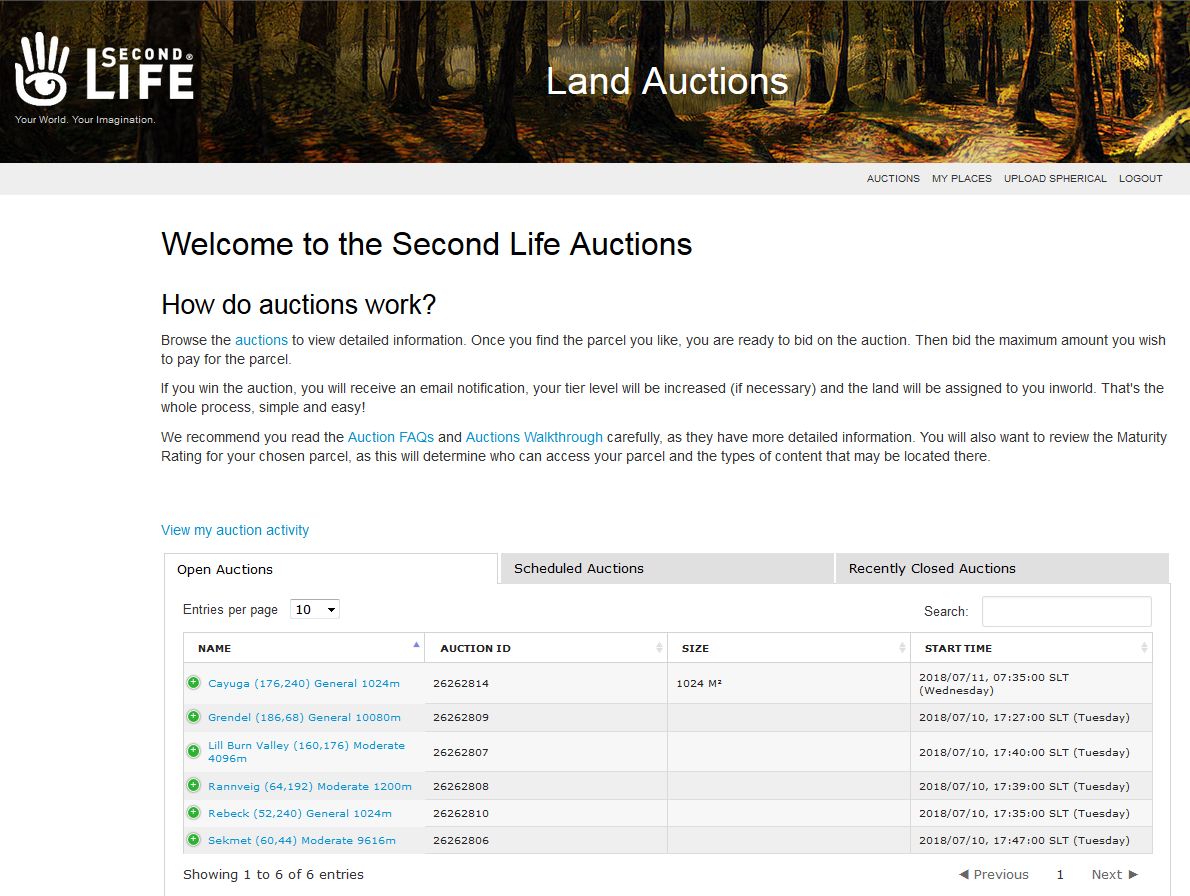
In July 2018, Linden Lab overhauled the Mainland auction system – see Second Life land auctions get a face-lift and the official blog post A Face lift for Auctions.

The “new” auction system leverages Second Life Place Pages as the medium for presenting land for auction and for placing bids, together with a new “cover page” listing available parcels up for auction. which can be found at https://places.secondlife.com/auctions. At the time the system launched, it was restricted to land being auctioned by Linden Lab, with the promise (at that time) that Mainland land holders would be able to start adding their own parcels “soon”.

“Soon” took a step closer to becoming an reality on Tuesday, February 26th, when a new Knowledge Base article appeared, entitled Creating Your Own Auctions. It is designed to walk Mainland land holders through how to set a parcel for auction. According to Alexa Linden, who contacted me on the matter, the system is still in testing, but will likely be ready t go in the very near future.

The Knowledge Base article outlines a number of requirements for those wishing to auction their Mainland parcels:

  • The parcel must be owned by an individual resident; group owned parcels cannot be auctioned.
  • Auctions can only be created by the parcel owner, and the owner must have a verified email address.
  • Parcels for auction must be set for auction via their associated Place Page.
  • There is a 15% commission payable to Linden Lab on all successfully concluded auctions.
  • When you create the auction, the ownership of the parcel is transferred to a temporary holding account named AuctionServices Linden.
    • You will no longer be listed as the owner and will not be able to edit, cut, sell, or change the parcel in any way once you create the auction.
    • If you cancel the auction, or if the auction completes without any bids, then the ownership of the parcel returns to you.
    • Note: it is not clear what happens to any payable tier during this time, but I presume it remains payable until such time as the auction concludes.
Mainland auctions for user-to-user auctions are now very close to being launched

If you are not familiar with Place Pages, you can find out about them via my Place Pages tutorial. This will be updated to include the relevant information on setting a parcel for auction in the near future, once the service has been confirmed as being “live”. In the meantime, additional details on Mainland auctions can be found in the Second Life Knowledge base as follows:

Again, and for clarity, do please remember, the auction system is for Mainland only. Private regions or parcels cannot be offered through it.

More Classic starter avatars for Second Life

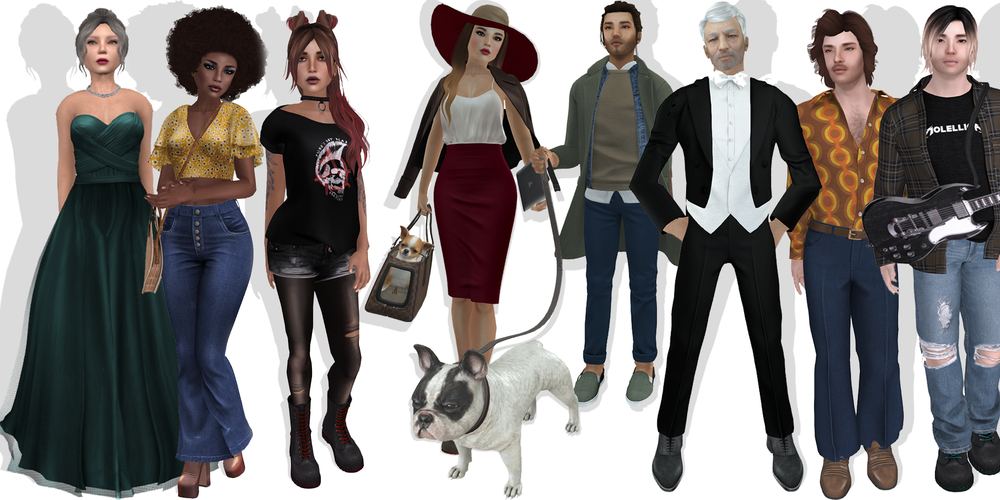
The eight January 2019 start avatars (l to r): Gretchen, Monique, Trixie, Bitsy, Ashton, Leonard, Greg, Monty. Credit: Linden lab

As noted in an official blog post, Linden Lab has issued another set of new Starter avatars.

The eight new avatars are all of the “classic” type, using the basic Second Life system mesh, rather than dedicated mesh body parts (although they have mesh clothing items). Between them, they offer a mix of more “everyday” types – as the official blog post again notes, previous starter avatars heavy leaned more towards the fantasy side of things.

The eight characters are (in the order they appear in the Avatar Picker):

  • Bitsy (complexity 15,813) and Ashton (17,268): two twenty-somethings(?) with an up-and-coming urban air and style, complete with pet dogs.
  • Gretchen (complexity 29,332) and Leonard (10,656): two older characters in more formal wear.
  • Monty (complexity 19,016) and Trixie (14,732): two younger avatars with the look of teens or early twenties, Monty coming with an electric guitar.
  • Greg (complexity 10,733) and Monique (9,226): two possible ’70s throwbacks.

(Complexity figures include all attachments.)

All are, as per the Lab’s usual procedure, supplied with No Mod elements (although the shapes are Modify). Surprisingly, given recent additions to the starter avatars, no discernible AO are provided (although some have poses that are activated on wearing them), with Gretchen being the notable exception to this approach. This lack of AO leaves the avatars with the horrendous Duck Walk.

I also admit to being a little confused by the promo picture used for the avatars: it shows Ashton with his dog on a leash, but so far as I could tell, the only option supplied with the avatar is a “carry” version of the dog.

The January 2019 new starter avatars are the default choice on the Second Life sign-up page

As starter avatars, these new looks are directly available to new users accessing the Second Life sign-up page on the web. Those already in-world can take them for a spin from the Me (/ Avatar) menu, and then selecting Choose Avatar. This will bring up the avatar picker (shown expanded, below), which will automatically default to the eight new avatar styles, then simply pick on the one you want to try.

The eight January 2019 “classic” starter avatars in the viewer’s Avatar Picker

Selecting an avatar will see it replace your current look (so if it’s a new look you’ve put together and haven’t saved – be sure to do so first!), and add the avatar to your Clothing folder. Or, if you prefer, you can open Inventory and navigate to Library > Clothing > Initial Outfits > then right-click on the relevant folder name and select Replace Current Outfit. This will also cause the look to be worn and copied to your own Clothing folder.

Having a broad choice of starter avatars is a good thing; I’m just a little surprised these come largely sans an AO; in this respect they seem a little at odds to previous classic and mesh starter avatar updates.


Bank of America user? Second Life might get you a cash back reward

R. Crap Mariner tapped me concerning a piece of information that might be of interest to those who use Bank of America credit Cards. I’ll let Crap explain:

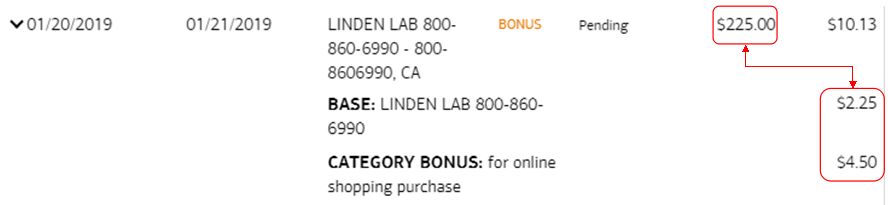
Bank of America changed their rewards card 3% cashback category from gas to a user choice from a list. since I recently bought a plug in hybrid car and barely use any gas, I changed it from gas to on-line shopping. thought it would just hit Amazon purchases, but turns out that LL/SL counts too? hope it’s real and not just a glitch.

To demonstrate, Crap sent me a copy of part of his most recent credit card build, showing the 3% cash back against a Second Life payment to Linden Lab.

A Bank of America credit card payment and the 3% cashback earned on it. Courtesy of R. Crap Mariner

Crap continues:

It’s the first month of them doing the flexible categories at 3%. Most credit card bonus offers don’t treat it as on-line shopping, but BOA appears to, but they might close this loophole. We’ll see.

So, if you do have a Bank of America credit card you use for Second Life purchases such as payment of tier, you might want to check your statements or arrange to have any cash back option to on-line shopping / purchases.

Second Life: LL confirm iOS client in the making

Logos © and ™ Linden Lab and Apple Inc

On January 9th, 2019, and thanks to a pointer from Whirly Fizzle, I blogged Lab working on a Second Life iOS client? noting that a Bit Bucket code repository had recently been set-up by Brad Linden for just such a purpose.

In writing the piece, which includes some of the Lab’s recent commentary of the subject of mobile / streaming solutions for Second Life, I indicated that I had contacted Linden Lab with a series of questions concerning the repository and what it might signify, and that I’d provide an update on receiving any reply.

Being so early into the work, the Lab declined to comment on all of the questions I asked, but here is what they did say via-email in responding to my enquiry:

As you point out, we discussed at our Town Hall events last year that we’re actively looking at ways to extend the reach of Second Life to new audiences including mobile platforms. For example, we’re in the early stages of work on an iOS companion app for Second Life.  

Right now we’re focused on getting a prototype out to our Residents, at which point we’ll be looking for feedback and suggestions. In the early stages, we will not be tying the app to a streaming service. However, we don’t have anything to formally announce yet about the specific features, capabilities, and availability.

– Brett Linden,  Second life Marketing Manager, via e-mail

Granted, it’s not a lot of information, but there are a couple of potentially interesting elements to the statement that might help contextualise things /  be indicative of some of the thinking still in place at the Lab. For example, the use of the term mobile platforms and noting that that the iOS work is offered as an example of this work.

This would perhaps suggests (and in answer to some of the questions asked following my original piece) that an Android client is still part of the Lab’s thinking. Certainly, it is something I’d anticipate, given both the popularity of the Android platform and the popularity of Lumiya and Mobile Grid Client*.

I also found the comment In the early stages, we will not be tying the app to a streaming service interesting, suggesting as it does that a future streaming solution is still very much part of the Lab’s broader thinking.

Again, this would make sense given the ongoing move of SL to the cloud. As well as providing the means to deliver SL as a whole to users, the cloud move further deepens the Lab’s relationship with AWS. This might in turn allow them to more positively and cost-effectively (to both the Lab and to users) supply a streaming service to mobile devices and web browsers at some point in the future. Perhaps this might even be part of a broader examination of their product offerings once Second Life is firmly established within a cloud-based infrastructure.

So, food for thought; in the meantime. I’ll continue to update on the iOS work as / if / when news emerges.

* I’m intentionally avoiding LittleSight here, as it is questionable as to whether the app is still being maintained and the repeated complaints that users have been unable to log-in since the last update (October 2016).

Lab working on a Second Life iOS client?

Logos © and ™ Linden Lab and Apple Inc

We’re in the early discussion stages, so Grumpity and I – Grumpity who heads-up Product here for Second Life – we talk quite a bit about what it would mean to invest in a mobile Second Life experience or product. So we’re trying to figure out how to validate the idea, and how much would it take to do it, and what could the value be to us and to customers to do it.

– Ebbe Altberg, April 20th, 2018 Town Hall meeting

I’m leading with the above quote because in the early hours of Wednesday, January 9th, 2019 (UK time), Whirly Fizzle directed me towards a Linden Lab code repository on Bit Bucket, which reveals that work has apparently started on an iOS client for Second Life.

The repository has been posted by Brad Linden, and shows some initial code segments Brad has been working on.

Brad Linden’s Bit Bucket repository for the iOS Client. Note I’ve redacted his given last name and some other information in respect of his privacy (although I understand it has also been posted to the forums)

That the Lab could start work on a mobile solution has in some ways been heralded over the course of the past 12 months, with Ebbe and senior SL managers openly discussing thoughts and possible options.

In his April 2018 discussion, for example, Ebbe pointed out that at that time, there were still issues the Lab wanted to address in trying to develop a mobile client, including what kind of investment it would be, both monetarily and resource-wise, and what the return on investment might be gained for the effort, as well as trying to figure out how such a client might be used.

I think the main question is if it would really primarily be a companion for existing users, so therefore increase the time spent in engagement and commerce. Or would it be an opportunity to actually reach users who don’t even have PCs and Macs, and would that be an addressable market, is something we have to wrap our heads around.

– Ebbe Altberg, April 20th, 2018 Town Hall meeting

By June, and the SL15B Meet the Lindens talks, it was clear that the Lab was thinking long and hard about the merits of both mobile and streaming solutions, with Grumpity and Oz openly discussing both.

– Grumpity and Oz Linden discussing mobile / streaming options at SL15B, June 2018

Both the question of how a mobile  / streamed solution might be developed and used was also a topic Ebbe returned to in his SL15B session in June 2018. Like Oz and Grumpity, he pointed to a previous streamed solution, SL Go (Grumpity and Oz referenced Bright Canopy, which was founded after SL Go had ceased to be available).

– Ebbe Altberg  discussing mobile / streaming options at SL15B, June 2018

Whether the repository indicates the Lab has now answered those questions and is ready to go ahead with an iOS client, or whether it is another aspect of testing the water and seeing what can be done, code-wise is unclear. I also freely admit to being insufficiently versed in code to guess whether this work is geared towards a dedicated iOS client, or part of a larger streaming option.

Turning to the man who is fronting the project, Brad Linden joined Linden Lab a the time of the Windlight integration over 11 years ago, and since that time has been focused on viewer development, specifically in the area of viewer stability.  Interestingly, the first indication that the Lab might be ready to move beyond talking about a mobile client came in December 2018, when Brad changed his Second Life Display Name from Brad Linden to Mobile Brad.

Brad Linden changed his display name to Mobile Brad in December 2018

I have contacted the Lab about the repository and what might be coming out of it placed with the Lab, and will update should a reply be received.

In the meantime, until such time as Linden Lab do clarify the work, it shouldn’t be assumed any kind of iOS client is about to be released in the immediate future. However, that the Lab is working on code would appear to be a positive sign, again given Ebbe’s words at the April Town Hall.

I hope will come to the conclusion to jump in soon; so more to come on that.

– Ebbe Altberg, April 20th, 2018 Town Hall meeting