Sansar Product Meetings week #32: quests and Avatar 2.0

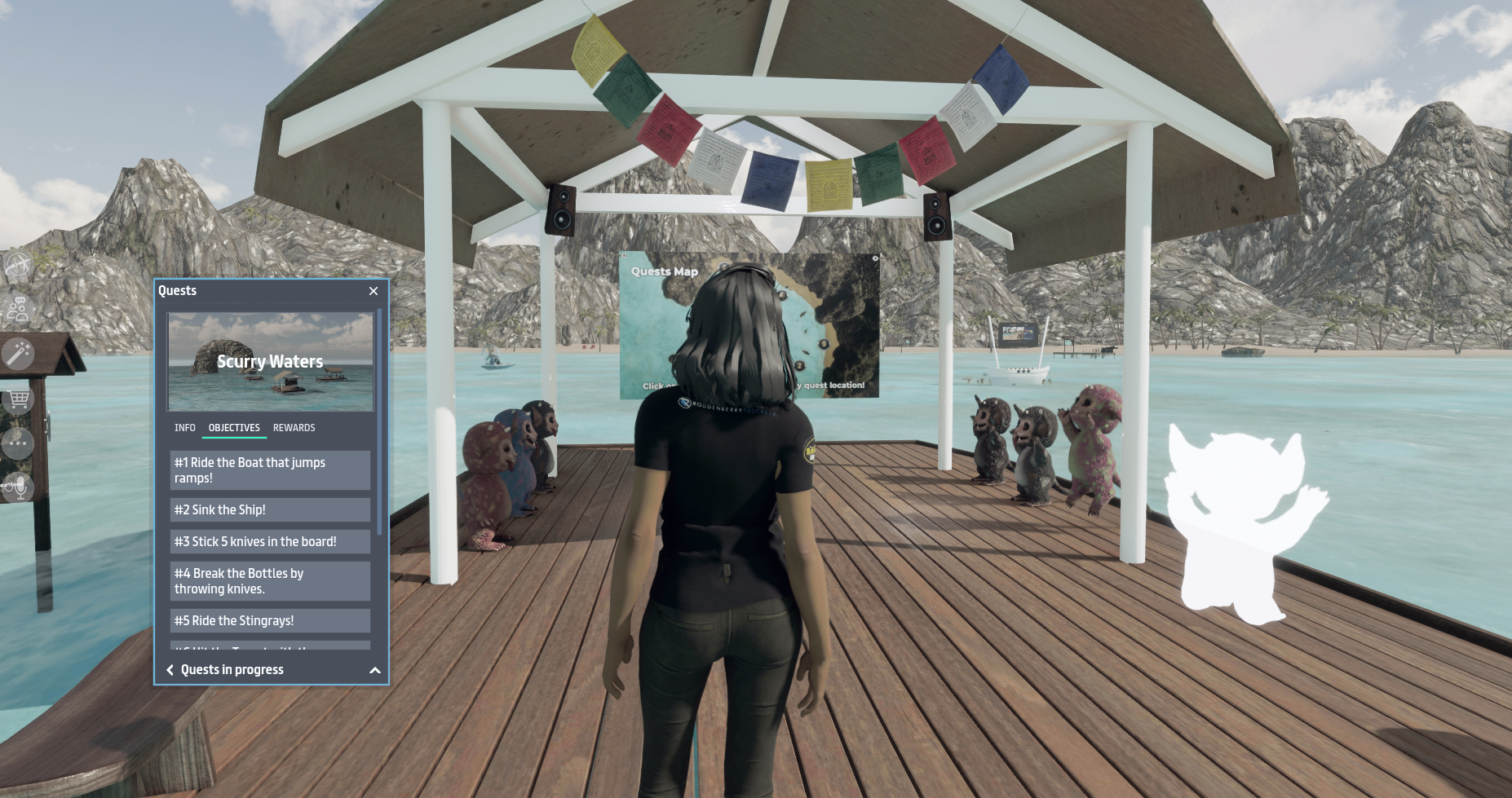
Target shooting in Scurry Waters

The following notes were taken from my recording of the August 8th (week #32) Sansar Product Meeting, which has a focus on questing and avatar 2.0. Note that there were questions that had to be referred back to the Lab for answers, or were related to individual issues encountered by creators, and which are not necessarily included in the notes below. Please refer to the meeting video, also embedded below.

Quest Update 2 – August 7th

A second Quest update was made on August 7th, 2019, which included both quest and non-quest related improvements.

Quest Updates

  • It is now possible to set objectives to address avatars by name, using the new [Player Name] token, which is automatically replaced by the avatar’s name.
    • For example, a quest giver could be set up as “Greetings, [Player Name]! Do you wish to embark on The Magical Mystery Tour?”
    • Then, when Joe Schmoe touches the quest giver, he sees, “Greetings, Joe Schmoe! Do you wish to embark on The Magical Mystery Tour?”
  • The quest panel has been updated to be more informative for users.

Other Updates

  • Sansar Store: it is now possible for creators to add “hidden listings” in the store. These can be used to give items directly to selected people by the creator giving the item URL directly to those they wish to be able to obtain the item. See Hidden Store Listings in the Sansar documentation for more.
  • New “Visibility” simple script:
    • Sansar > Client > ScriptApi > Examples > ScriptLibrary > Scene > ScriptLibrary.json.
    • At the time of writing, this is currently not integrated in the Scene Editor. You will have to import it in Sansar yourself.
  • General improvements: please refer to the release notes.

Avatar 2.0

Official Documentation – Recap

Avatar 2.0 Creator Programme – What Is It? – Recap

  • The Avatar 2.0 creator programme is designed to allow creators who create avatars, avatar wearables, accessories, etc to have their content tested by the Lab ahead of the avatar support being added to the client.
    • The Lab may only initially be reviewing around 2-4 items per creator. Additional items submitted will only be reviewed once all creators making submissions have been seen.
    • Creators are obviously free to test their items in their own 3D editor of choice, if preferred, and wait until the launch of Avatar 2.0 to make any necessary adjustments.
  • The programme will be discontinued once Avatar 2.0 has been released, when creators will be able to test their items directly in the client.

Avatar 2.0 Q&A

  • Creators have started availing themselves of the Avatar 2.0 creator programme, and feedback is being supplied to them.
  • It’s been reported that there are rigging issues in the avatar reference files and these are in the process of being reported to the Lab.
  • The initial release of avatar 2.0 will allow greater customisation of the avatar face.

  • Greater body customisation via deformation will be available in a future update to the release.
  • Concern has been raised that this will effectively lead to two classes of human avatar: one based on the Avatar 2.0 skeleton and the Lab’s own blend shapes / deformation options, and a second for custom avatars, again built using Avatar 2.0 outside of Sansar and which use fully custom blend shapes / deformations that behave differently.
    • Because of this, it has been suggested it would be better to rig more bones on the skeleton (e.g. the breast bones), so it doesn’t matter if the avatar is a system avatar or a fully customised avatar made outside of Sansar: he same set of deformations will work across both.
    • The alternative to this would be for creators to be able to create custom human avatars directly from within Sansar, then save them to inventory and then (if they wish) sell them on the Store. This is already the plan with avatar heads / faces with Avatar 2.0.
  • The Lab is working with Blender 2.8 for Avatar 2.0, and the avatar reference files documentation has been updated to reflect this.
  • Will Avatar 2.0 support users applying skins / eyes, etc., that they’ve bought from the Store? Not in the initial release, but something that is seen as a priority for adding in a subsequent update to Avatar 2.0.

Quest Q&A

  • Can the quest system be have a means to automatically record who threw / fired something within an objective (e.g. if two people are shooting at a set of targets, having a means for the target to record who hit it last)? This currently has to be manually scripted and an automated means of recording would ease the quest authoring / development. The Lab will take this on-board.
  • Can the quest panel be updated to not pop-up and start nagging as soon as a user with in progress quests logs-in? Possibly.
  • If a quest creator revises a quest and removes / changes objectives, it is possible for people who have already started the quest to be unable to complete it. This comes back to the idea of the creator (or the quest system) to provide a means for participants to reset the quest for themselves.
  • Testing / debugging quests needs an ability within the tools to reset individual objectives as well as the entire quest (which is currently provided). This is on the roadmap.

General Q&A

  • The usual four:
    • High heels for avatars: not on the roadmap at present.
    • 3D mouse support: not on the roadmap, will more likely be a general project to support game pads, joysticks, etc., if done.
    • Wiki: the more user-submitted guides that are made to the forum public documentation area, the more weight is given to the case for the Lab creating and offering / managing a wiki.
    • Persistence: the Sansar devs would love documented requirements on where and how persistence might be needed / used, particularly as persistence is under consideration at the moment.
  • Can users be given volume controls for other avatars? Right now if someone has their mic open or too loud or set too low, they have to be asked to close it or turn it down / up. For the latter it would be preferable if users simply had access to individual volume controls for other avatars so they can adjust the volume to suit their own needs. This has been requested numerous times, and will again be taken back to the Lab for consideration.
  • Can push-to-talk be implemented? Microphones can be toggled via the M key (but this needs to be added to the keyboard short cuts documentation)
  • Can the F4 ability to freecam and improved lighting be added to the Look Book / Home Space so that it is possible to test new clothes and footwear, take images for use with Store listings, etc., without having to view them in an experience, thus adding a further step to the development cycle? Will be looked into; lighting is being improved.
  • Will two people ever be able to hold the same object? Not on the roadmap.
  • Can creators have an option to turn off the ability for people to “steal” an object held by someone else by clicking on it (e.g. to prevent people disrupting things like shooting games by simple “click stealing” the guns of other participants in the game)? Will be looked at.
  • Can skirts / dresses / togas conform more naturally to the body position when sitting? Not easily, as this requires real-time cloth deformation, which is performance intensive.

Sansar Product Meetings week #31: Avatar 2.0 – preparing for the change

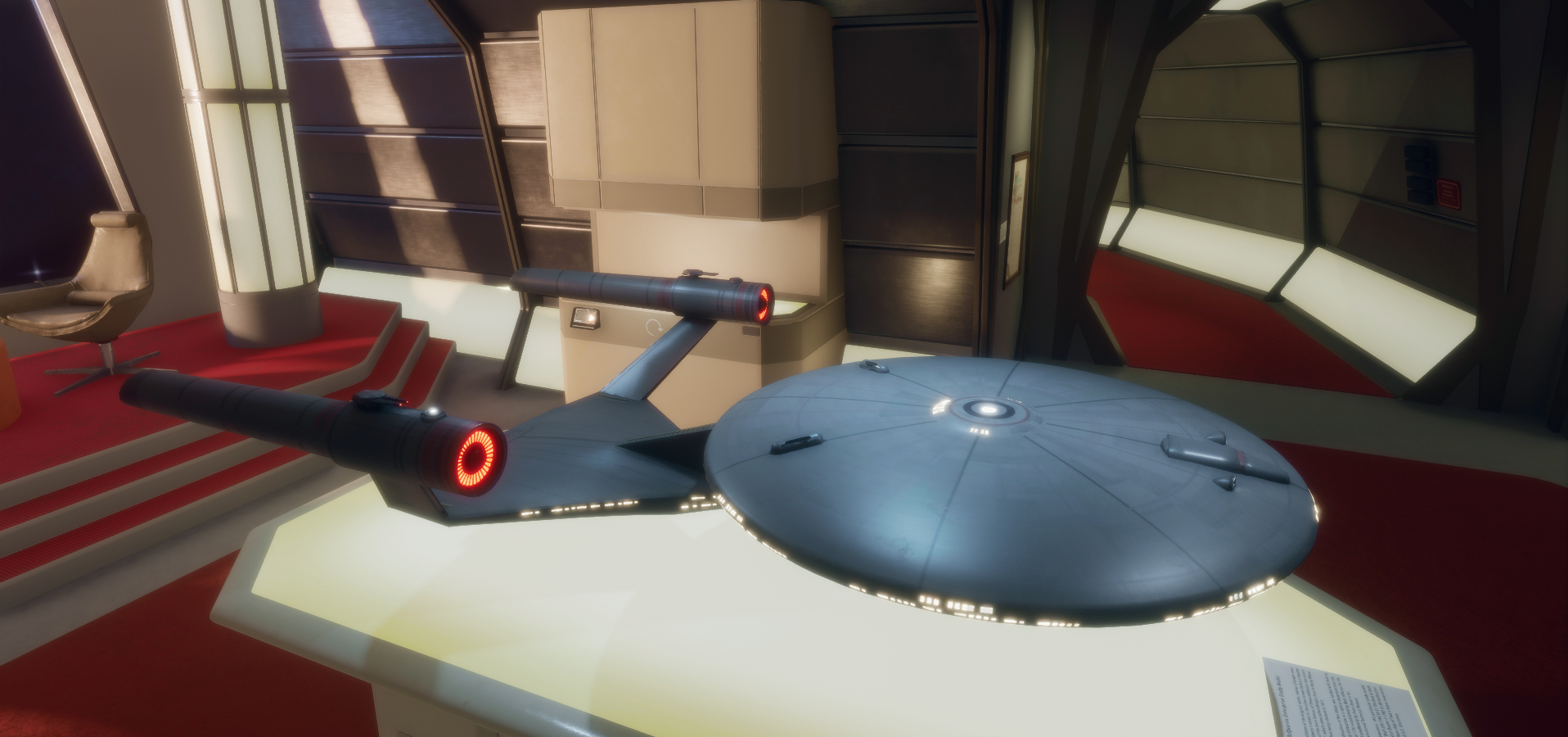
Channelling my inner Trekkie at the Roddenberry Nexus

The following notes were taken from my recording of the August 1st (week #31) Sansar Product Meeting, which focused on the upcoming deployment of Avatar 2.0 and how creators can start working with the Lab in readiness for the change-over. Also referenced in the meeting was the Quest Update release, made on Tuesday, July 30th. As with these meetings, a lot of general feedback was given to be “taken back to the Lab” for consideration, and as such, aren’t reflected in the notes below. The official video of the meeting is embedded at the end of this article for those wishing to watch the meeting in full.

Quest Update

For details on the July 30th Quest update, please refer to the official release notes.

Avatar 2.0

When Will Avatar 2.0 Be Released?

The current plan is for Avatar 2.0 to be released in late August / early September 2019.

Official Documentation

  • New avatars. New possibilities – published July 9th, updated August 1st: introduces the Avatar 2.0 update.
  • FAQ post – published July 7th, 2019. In particular, this FAQ highlighted the following information:
    • What wearable items will not be usable on Avatar 2.0? Any asset (avatars, rigged hair, rigged clothing) created using the avatar 1.0 avatar skeleton will no longer be usable in the new avatar 2.0 system. These items will be removed from inventories, and deprecated on the Store.
    • Why will these items no longer work? Changes to the base avatar’s skeletal structure had to be made in order to support Avatar 2.0 mean they will no longer work as expected.
    • Will it be possible for creators to update broken content? Yes, providing it has been listed on the Store – see below for more. 
    • Which avatar 1.0 assets should still work after the release of Avatar 2.0? All Marvelous Designer clothing, accessories and emotes created against the 1.0 avatar skeleton will have mechanism in place to help ensure they can still be used with Avatar 2.0, and will still be available via inventory and any listed items will still be accessible from the Store for purchase.
  • Get Started: Avatar 2.0 Creator Programme – published August 1st, 2019. Announcing the August creator programme to allow creators to prepare for the transition to Avatar 2.0. This includes links to:

Avatar 2.0 Creator Programme – What Is It?

  • Avatar 2.0 cannot be tested in the client until support for the new avatar skeleton is actually released.
  • The Avatar 2.0 Creator programme is designed to allow creators who create avatars, avatar wearable, accessories, etc to:
    • Develop their avatar-related content (avatars, rigged wearables (including hair), Marvelous Designer clothing, emotes, accessories) based on the Avatar 2.0 skeleton.
    • Send versions of their content to Linden Lab for testing and feedback (notes, images, even video).
    • Update their items based on that feedback, if required.
  • Note that depending on how many creators avail themselves of the Avatar 2.0 Creator Programme,  the Lab may only initially be reviewing around 2-4 items per creator. Additional items submitted will only be reviewed once all creators making submissions have been seen.
  • It is not a new requirement that all content must be reviewed by the Lab, it is purely to help creators who produce avatars and avatar-related items to prepare for the release of Avatar 2.0.
  • Creators are obviously free to test their items in their own 3D editor of choice, if preferred, and wait until the launch of Avatar 2.0 to make any necessary adjustments.
  • The programme will be discontinued once Avatar 2.0 has been released, when creators will be able to test their items directly in the client.

General Q&A

Quest System Feedback

See also the Quest Q&A from my week #30 summary.

  • It’s been reported that the text displayed at the end of a quest is too small to be comfortably read when see in VR. This is to be looked at.
  • There has been a request to add a “Quest Tester” role to allow someone else to be able to test a quest as it is being developed / updated and reset their progress (right now, the ability to reset quest objectives via the UI is only available to the quest creator, and only applies to them).
    • This is seen as a good idea, but a non-trivial enhancement that will be examined.
    • It might be possible to allow something through scripting so testers can re-set quests via an in-world object, and the scripting API does support this.
  • Will quests be made repeatable (right now, when a user completes a quest, that’s it, they cannot go back and try it again)? Yes, this is on the quest roadmap, however:
    • “Repeatable” quests are seen as a special class of quests that creators may wish to set up (e.g. a quest game then people can come back to and play over and over).
    • There are also quests that creators may not want users to be able to re-do (e.g. because of the nature of the reward(s) associated with them, once rewards have been deployed).
    • Therefore, the Lab will be approach the question of “repeatable” quests with both of these requirements in mind.
  • Can “open-ended” quests be supported (right now quests are designed to have a specific end point. It would be nice to have a capability for a creator to build an on-going quest narrative, adding new objectives, which users could return to and achieve)? Will be looked into.
  • Can users have a “quest journal” where they can look back over the quests they’ve completed? The current quest panel in the client UI is intended to provide similar functionality as it is built out.
  • Can clicking on a quest category trigger animations in an experience? The ability to trigger animations automatically (e.g. walk onto a dance floor and you automatically start dancing, pick up a sword and start wielding it, etc.) has been talked about at the Lab, but not time frame on when the might be delivered or extended into quests.
  • Can avatars be added to “classes” within quests (e.g. serfs, warriors, mages, etc)? Not at present. Would require some form of back-end data persistence, and use cases need to be defined. Where any such system to be introduced, it would likely be fairly generic in order for creators to define what they require to suit their own styles of quests.
  • Will the quest panels be customisable (e.g. to look like pages of a book if the quest is a storyline, for example)? There have been internal discussions on making the UI elements in general customisable, however, it is a complex objective, and so is not currently on the roadmap.

In Brief

  • The usual four:
    • High heels for avatars: not on the roadmap at present.
    • 3D mouse support: not on the roadmap, will more likely be a general project to support game pads, joysticks, etc., if done.
    • Wiki: the more user-submitted guides that are made to the forum public documentation area, the more weight is given to the case for the Lab creating and offering / managing a wiki.
    • Persistence: the Sansar devs would love documented requirements on where and how persistence might be needed / used, particularly as persistence is under consideration at the moment.
  • There has been an uptick in the number crashes users are experiencing since the July 30th update. These are being investigated.
  • Mavelous Designer: there are a range of options in MD that are not supported in Sansar. Will more support for MD capabilities be provided? Discussions with MD are constantly on-going, as is integration. If there are specific features Sansar creators would find useful, these should be raised via feature requests so they can be looked at.
  • Will users be able to rez their own items in an experience? Possibly. However, it is not on the roadmap, and all the possible implications have to be considered before anything is implemented.
  • Will there been single-axis (non-uniform) scaling of objects (e.g. increasing just the height of a door to fit a doorway)? Has been discussed internally, is somewhat more complex than might seem to be the case; not clear to those at the meeting whether or not it is one the roadmap.
  • Try-before-you-buy from the Store (being able to try a demo directly from the Store before any purchase) has been discussed in the past. Still on the roadmap, but no ETA at present.

Sansar: live from the Official Star Trek 2019 Convention

Sansar brings you Star Trek Las Vegas

I make no secret of the fact that I’m a Star Trek fan. I started on a diet of re-runs of The Original Series (which remains my overall favourite, simply because I started watching it at an impressionable age, my early teens), and quickly got hooked on The Next Generation. Within Second Life, I’ve reflected this interest by writing about various Trek-related events or activities (see A Starship Enterprise in Second Life big enough for an avatar crew and Having a little fun with starships for example).

However, when it comes to Star Trek, Sansar is perhaps the place to be. I’ve written in the past about the reproduction of the bridge of the USS Enterprise, NCC-1701. It’s not entirely accurate, but it is nevertheless impressive. There’s also the Roddenberry Nexus.

Sansar: Roddenberry Nexus; Inara Pey, August 2018, on FlickrSansar: Roddenberry Nexus

These experiences reflect a partnership with Roddenberry Entertainment, which has also seen the broadcasting of the Roddenberry Entertainment’s mission Logs podcasts into Sansar, trivia competitions, and Q&A events with acknowledged Trek experts.

This involvement with Trek continues this weekend with Sansar providing access to Star Trek cast members and guest stars who are attending the Official Star Trek Convention taking place in Las Vegas.

Suzi Plakston – one of the STLV convention guests who can be seen via Sansar

These events comprise:

  • “Live From” on Thursday, August 1st, Friday, August 2nd, Saturday, August 3rd and Sunday, August 4th from 09:00 PDT, with guests:
    • Suzie Plakson (K’Ehleyr / Lt. Selar, M.D. in Star Trek: The Next Generation; Female Q, Star Trek: Voyager, Tarah, Star Trek: Enterprise).
    • John Billingsley (Dr. Phlox, Star Trek: Enterprise).
    • Jeffrey Combs (Brunt/Weyoun/Tiron, Star Trek: Deep Space Nine;  Penk, Star Trek: Voyager; Shran;  Krem, Star Trek: Enterprise).
    • Casey Biggs (Damar, Star Trek: Deep Space Nine).
    • Tim Russ (Devor, Star Trek: The Next Generation; T’Kar, Star Trek: Deep Space Nine; Commander Tuvok, Star Trek: Voyager; USS Enterprise NCC-1701-B Bridge Officer (/”Tuvok”) Star Trek: Generations).
  • “Meet-and Greets” 30-minute sessions with:
The Roddenberry Theatre, by C3rb3rus, location for the Star Trek Las Vegas events

So, if you are a Trek fan (and have a PC!), make a note of the dates and times, and join the fun – I might even see you at some of the sessions 🙂 .


Sansar at two years: observations and thoughts

Courtesy of Linden Lab

July 31st, 2019 marked the second anniversary of Linden Lab throwing open Sansar’s doors to any and all who might want to try out the company’s (at that time) VR-centric social platform. In 2018, I marked the platform’s “first public anniversary” with some observations and thoughts, so I thought I’d do the say on the platform’s “second anniversary”.

When the doors first opened, and as the Lab forewarned at length, Sansar’s capabilities were nowhere near as built-out and Second Life (with its – then – 14-year history of development), the platform was fairly roundly beaten by some in SL as being dead on arrival. I personally felt such reactions were overblown, simply because we had been so clearly forewarning. but, I did (and do) still feel that launch was perhaps premature, and possibly the result of a knee-jerk reaction to the (genuinely) overblown predictions of growth within the VR marketplace.

But that was July 2017. While the VR market is still trying to clamber its way to the forecasts made about it back then, a lot has changed for Sansar in that time. Releases for the platform have continued at the rate of one major release a month, with intermediate point releases that further help with bug fixes, put out minor improvements or smaller features.

In the last 12 months in particular the last 12 months have seen some significant updates, including:

Sansar’s “Three Pillars” of Audience

  • Content creation – including provided a set of well-round tools / support for tools for both avatar and world creation.
  • Socialisation – making sure people can interact with one another, make friends, hold social events.
  • Gaming  / exploration – quests, mini-games, people exploring experiences and discovering what has been put into them.


Landon McDowell on Sansar’s audience segements

  • Working to bring the Desktop (non-VR) mode more up to parity with the platform’s VR mode (wrongly seen by some pundits as a “de-emphasising” of the platform’s VR focus).
  • Adding far more capabilities for direct interaction by users within experiences – including the recent (and still developing) quest system, and support for things like guns for shooting games, etc.
  • For VR users, full-body tracking has been introduced, with plans to continue to improve it.

  • Use-generated events capabilities have been released, allowing experience creators to host their own events.
  • Support for custom avatars has been added, together with avatar scaling, etc.
  • The licensing / permissions system was introduced, and the Sansar Store finally integrated into the client.

At the same time the platform has seen numerous improvements to the UI, both in Desktop Mode and in VR mode; Users have been offered more of a feeling that they have their own “personal space” when logging-in directly to the Sansar client (rather than by way of an experience on the web Atlas) through the “Home Space”, and so on. There have also been a broad range of under-the-hood tweaks, updates and change through Sansar to better support avatar counts within experiences, to reduce experience load times, to improve overall performance and stability, etc. And, of course, creator capabilities have continued to be expanded.

So Sansar has hardly stood still over the course of the year, and is something of a decent beast to how it looked just a year ago.

Click gallery images for views of the Sansar Home Space

That said, there are some capabilities within the platform that are still lacking, or which have stirred a degree of controversy, together with decisions by the lab that have perhaps resulted in raised eyebrows.

An example of the first of these is the fact that there is still no easy way for content creators to offer updates to their products on the Sansar Store (outside of scripts) – a pretty fundamental capability if you want commerce to thrive on the platform.

The upcoming release of Sansar’s Avatar 2.0 has also caused some upset in that it will effectively put an end to the current avatar form, and “break” things like rigged hair and clothing (at least until the creator re-rigs it to the new avatar). However, this is countered by comments from within Second Life that once deployed, it may well encourage more avatar-related creators to give Sansar a go, given the enhancements it will bring to the Sansar avatar.

In terms of raised eyebrows, the decision to launch on Steam at the end of 2018 was perhaps the biggest. Again, given the overall state of Sansar’s development at the time, it appeared to be premature. Yes, Steam is considered the biggest platform for VR games, but Sansar’s lack of capabilities meant it might not gain traction among the more “consumer” type of Steam users – those who like to play fully-rounded games.

However, the decision can perhaps be made more understandable if referenced in terms of economics: provisioning the platform on Steam comes at a cost (30% of sales). This required an adjustment to the fees charged by the Lab – a bridge perhaps best crossed sooner rather than hit a much larger audience of creators with the increase further down the road.

The subject of Steam, however, perhaps brings us to the elephant in the room: user numbers.

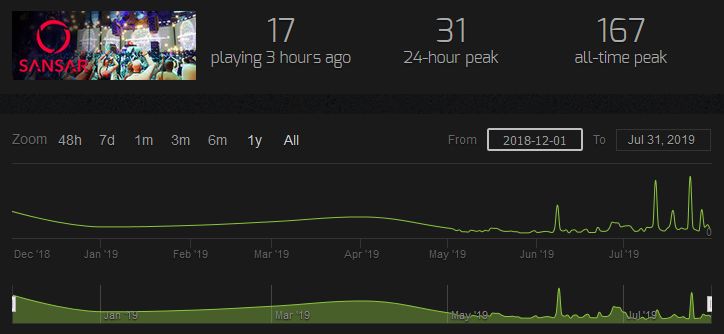
Steam stats reveal that, by-and-large, Sansar usage has been low, but they don’t necessarily reflect overall usage

Much has been made of this – particularly by pointing to the Steam stats. However, it’s important to remember that the Steam stats only represent one portion of those coming into Sansar: those accessing the platform through Steam’s own gateway (or who have maybe tied their Sansar account to Steam). As Linden Lab has noted, they don’t include people coming into the platform either directly through Sansar’s front door on the web, or by their local (non-Steam) installation of the client, or through specifically publicised events. Thus, when looking purely at the Steam stats, it is possible the entire picture isn’t being seen.

Nevertheless, and with the exception of recent events, it is not unfair to say that user numbers for Sansar have been disappointingly low. This has even been remarked upon by Landon McDowell, the Lab’s Chief Product Officer, and the person most directly in charge of Sansar’s development.

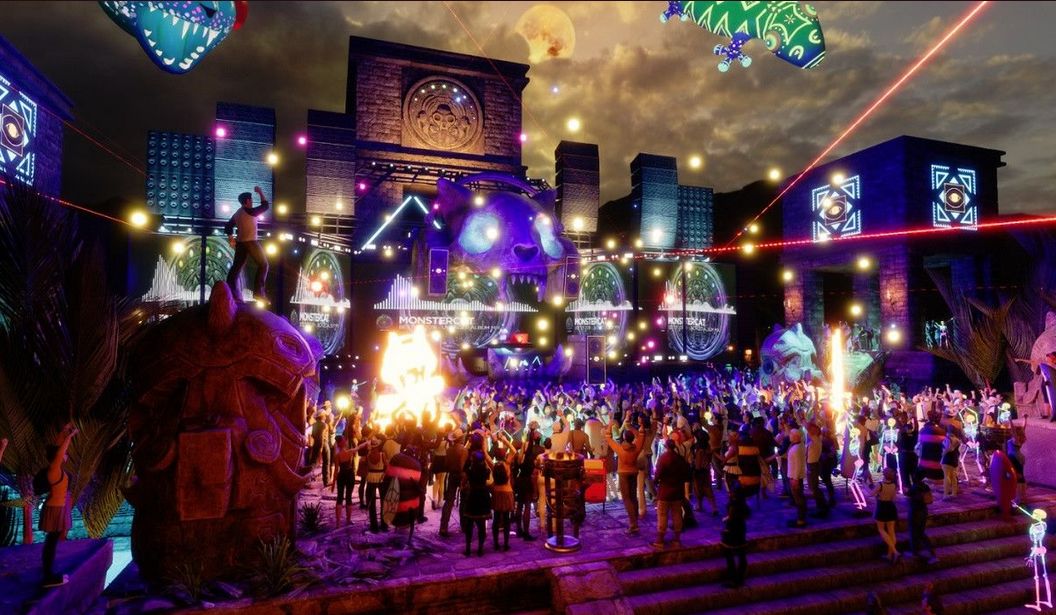
More recently, there have been some significant upticks in Sansar’s user counts – notably due to Linden Lab’s partnership with Monstercat, the Canadian independent electronic dance music record label. But again these tend to be spikes, rather than signs of a growing upward curve – which remains something Sansar has yet to really achieve. But this doesn’t mean Sansar has in any way “failed”.

The fact is, the virtual entertainment market is a highly competitive space; as such building an audience will take time (as the old adage goes, “it took my X years to become an overnight success”). With Sansar, this ability to to grow an audience has undoubtedly been hampered by the lack of broader capabilities.

The Monstercat launch event saw record currency for Sansar – although “record” is a relative term

However, there are signs that Sansar is now approaching a point in its development where it can start to appear to be far more sophisticated to incoming users, be they creators or “consumers”. Game play mechanisms are now appearing, opportunities for more direct immersion and  engagement (regardless of whether or not a user has a VR HMD system) are growing, and even the avatars themselves are about to become a lot more engaging. Thus, the potential for Sansar to grow its user base over the next 12 months is potentially there.

There are still significant questions around Sansar and its future, not just in terms of raising its user count, but in terms of keeping pace with developing technology around VR (it doesn’t, for example support the Oculus Quest or similar  Snapdragon based hardware). But again, it’s still too early to write-off Sansar on the basis of what it currently lacks, simply because it is still in development.

At the end of my look at Sansar’s first “public” 12 months back in July 2018, I noted that Sansar was not a place where I’d want to spend all my virtual time – and that is still the case today. But, having observed the development of the platform through the past year (and reporting on them), I confess to being somewhat optimistic that Sansar could well be in a stronger position in a year’s time.

Sansar Product Meetings week #30: more on quests

The first release of the new quest system was made on Tuesday, July 23rd

The following notes were taken from my recording of the July 25th (week #30) Product Meeting. Once again, this meeting had a focus on the new quest system, with some additional questions. As with these meetings, a lot of general feedback was given to be “taken back to the Lab” for consideration, and as such, aren’t reflected in the notes below – please refer to the meeting video, which is embedded at the end of this article.

Quests

  • The first pass of the quest system was released on Tuesday, July 23rd – see Sansar: user-generated quests release: an overview for more.
  • The Lab is working on some “best practices for quests” documentation, based on their own experience building quests, and on quest games in general.
  • Some time in around 2-4 weeks, there will be a special in-world questing tutorial event.

Quest Authoring Q&A

  • How does it work? Quest creation comprises two parts a) creating the quest data itself, using the authoring tool. This can be created and revised as often as required; b) using objects in scenes (experiences) that are directly linked to the quest and use / present the quest data.
    • The quest can be tested by the creator in the unpublished scene (by building and saving the scene).
    • The quest becomes public when the scene is published as an experience.
  • Quests are linear at present: start, objective A, objective B, etc. Can branches be offered (e.g. do objective A then choose either objective B or C)?
    • Possibly via custom scripting.
    • However, in the future it will be possible to author quest “storylines”, allowing multiple quests to be linked, and to be dependent one upon the last, thus offering a level of “branching”.
  • Will future updates to the quest system break what has been deployed? No. Features and a capabilities will be added, but will not break the established functionality. So, quests can be enhanced as new capabilities are added.
  • Can experiences with quests be made more readily identifiable in the Atlas? Not exactly, but the Lab is considering tools for monitoring how quests are being used (how many people participate, how many complete, etc.), and providing that information to creators.
    • Short-term this may be a manual system with reports curated by LL and made via Discord.
    • Longer term it should be more automated. This might also be built out to include the Atlas to show available quest experiences.

Badge System vs. Experience Points System

Since the week #29 Product Meeting, when the quest tools, rewards and the upcoming experience (XP) system  were announced, a badge system that could be used by individual experience creators, rather than having a global XP system as proposed, as this is seen by some as being more flexible.

  • The Lab views a global XP / level system as being more immediately understandable by users, as they can earn XP points and level up no matter what they are doing or how they participate in Sansar – there is no dependency on visiting specific experiences or having to complete specific tasks.
  • In time the XP system will be expanded beyond quests, but the first pass will be focused on questing.
  • However: the Lab is looking at a badge system, and see it differently to any kind of XP system, as badges can be used to show what a user has specifically done – i.e. a creator can gain various badges to mark their achievements as a creator, while a gamer who is good with shoot-em-ups, etc., can earn badges to reflect what they’ve achieved through that interest, etc.
    • These types of achievements would likely be made available through user profiles.

General Q&A

  • The usual trio:
    • High heels for avatars: not on the roadmap at present.
    • 3D mouse support: not on the roadmap, will more likely be a general project to support game pads, joysticks, etc., if done.
    • Wiki: the more user-submitted guides that are made to the forum public documentation area, the more weight is given to the case for the Lab creating and offering / managing a wiki.
  • Persistence: the Sansar devs would love documented requirements on where and how persistence might be needed / used, particularly as persistence is under consideration at the moment.
  • There is an issue with scripts failing to execute in experience instance with high numbers of avatars. The Lab has already started tweaking scripts within their own event instances, but are requesting more bug reports on where creators are seeing issues.

Streaming Sansar

Apparently, LL are in discussions with a number of streaming service providers about providing Sansar as a streamed (consumer?) option they could be delivered to a range of devices. No time frames on when this might surface (not in 2019), if it goes ahead.

Sansar: user-generated quests release: an overview

Scurry Waters in Sansar shows what can already be done with the quest system, using it to present games and unlock activities

On Tuesday, July 23rd, 2019, Linden Lab issued a Sansar point release containing the first cut of the user-generated quest authoring tool.

Also within the release are a couple of performance improvements:

  • Avatar movement and camera rotation are faster in keyboard turn mode.
  • Panels now retain their positions in the avatar editor.

Quests – Key Points

Quests are seen as a means of generating user engagement within experiences. A basic system – available only to the lab – has been used to provide a flavour of quests / hunts in places like the Sansar Social Hub, but which offer Sansar Dollar rewards.

The new quest system provides an new quest authoring tool directly to experience creators, however there are some key points to note about this first release:

  • Quests can only be linked to experiences owned by the quest creator (so creator X cannot develop a quest for use in creator Y’s experience(s).
  • Quests can be set for an individual experience or across multiple experience – again, providing all the experiences at are owned by the creator making the quest.
  • While it includes a tab for establishing rewards within a quest, this is not active with this initial release.
  • Once the rewards capability has been added by the Lab in a future update, quests will initially be limited to offering up to three objects as rewards, which will be presented to users completing a quest through the Sansar Store.

How quests might be used is down to individual creators. Ideas include:

  • Guided tours of experiences.
  • Simple introductions to a game.
  • Games.
  • Hunts. / actual quests.
  • Leaning experiences.
  • etc.

Obviously, some of these will be more likely to be attractive to users once the rewards system has been added – and may well require more that 3 rewards in order to maintain focus / interest  – and this is something the Lab have indicated they would be willing to review in the future. But even without a reward system, the deployment of the quest system offers creators the opportunity to play with the tools and gain familiarity with them.

Quest creation comprises two parts:

  • Creating the quest data itself, using the authoring tool.
  • Using objects in scenes (experiences) that are directly linked to the quest and use / present the quest data.

The quest can be tested by the creator in the unpublished scene (by building and saving the scene), and it becomes public when the scene is published as an experience.

The Tools

The initial quest system comprises:

Quest Building Basics

There is Lab-supplied documentation on making quests and assigning objectives. the following is a simple overview of the basics.

There are three parts to creating a quest:

  • Define the quest – via the quest authoring tool.
  • Define the objectives for the quest – via the quest authoring tool

Defining a new Quest

Create button > Create Quests > Quest Creator > New Quest.

  • Every quest requires a name (up to 100 characters) and a description (up to 250 characters).
  • Quests can optionally have:
    • A thumbnail image, displayed when a user viewer the quest, and captured using the For A Quest drop-down in the snapshot tool to generate any required image.
    • A completion message up to 250 characters in length, displayed when users complete the quest.
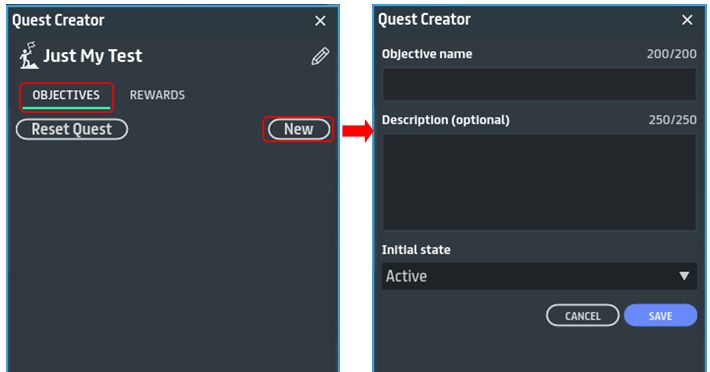
Creating a new quest from within the client. Note that the quests definition fields are show on the right for convenience, but will actually appear in the “middle” Quest Creator panel in the image.

Save the quest when done.

Editing a Quest

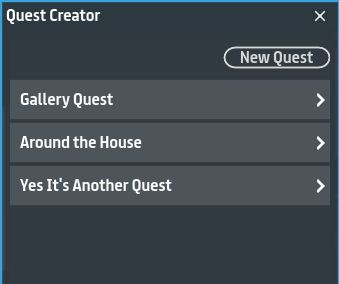
The Quest Creators records all quests you have created. To edit a specific quest (e.g. to add / change objectives):

  • Create button > Create Quests > Quest Creator.
  • The list of all your quests will be displayed.
  • Click on the name of the quest you want to edit.
  • The Quest Creator will display the quest and all defined objectives.
  • Edit and save as required.

Defining Objectives for a Quest

Note that when you create a new quest, you will automatically be presented with the option to add objectives to the quest – and you can have as many objectives in a quest as you require.

Select the required quest (if not already selected) > make sure Objectives is selected (default) > Click New to display the objective fields.

  • All objectives require a name (up to 200 characters), and should be set to Active or locked:
    • Set to Active if there is no dependency on the objective (i.e. it can only be completed if pre-requisites are met.
    • Set to Locked if it is dependent on completing certain objectives.
    • Prerequisites can be other objectives, scripted activities etc.
  • An optional  description, up to 250 characters.
Setting an objective in a quest. panel images shown side-by-side for clarity

Save the objective when done.

Adding Objects as Givers and Objectives in an Experience

Notes:

  • All quests require a Giver – the item that sets users on the quest, generally through direct interaction.
  • A quest can have as many objectives as required.
  • A quest should have a completion element.

Basic steps: edit the experience scene in which the quest will appear > add and place an object as the quest giver. Then:

  • Right-click the object and rename the object, if required.
  • Right-click the object > Add > Script.
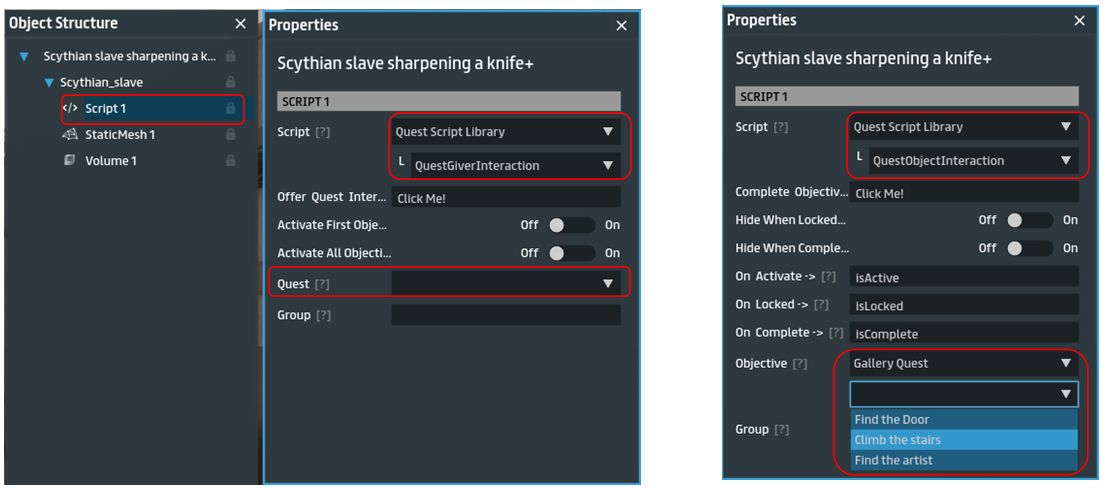
  • In Object Structure right click on the new script (general “Script1”) > Properties. Then:
    • Set Script to Quest Script Library
    • Set the script type to one of the available scripts (QuestGiver, QuestGiverInteraction, etc).
    • Use the Quest drop-down to select the quest with which the object is to be associated.
    • If setting a quest objective, also set the quest objective with which the object is to be associated (below, right).
Setting an object as a quest giver (left), and as a quest objective (right)

Testing a Quest

To test a quest in a scene:

  • Build and save the scene.
  • Visit the scene.
  • Click the quest giver – the quest should launch > test the objectives.
  • To reset the quest at any time (incl. testing): Create button > Create Quests > select quest > Edit > Reset Quest.

Feedback

A simple, easy-to-understand system (easy enough for me to understand!) with some built-in complexity (see the associated scripting documentation) and with a lot of potential for expansion. As always, check the official documentation for full details on the capability.