A Mars Namaste and taxis to the space station

CuriosityIt’s been a busy couple of weeks on and around Mars and with space exploration in general. This being the case, I’m going to be tagging some of the other items of potential interest to the end of this Curiosity update.

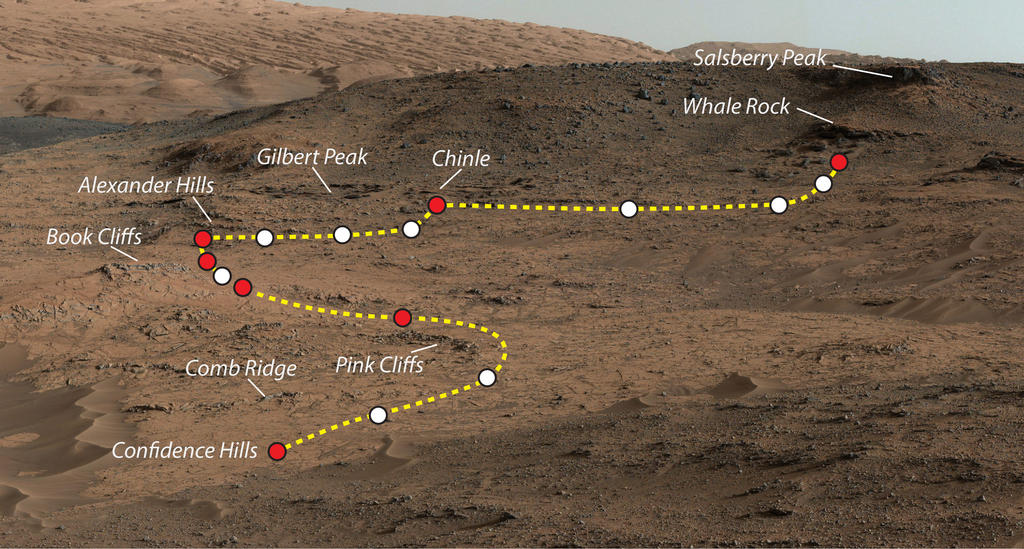
On September 24th, Curiosity obtained its first sample of rock gathered from the foothills of “Mount Sharp”, or Aeolis Mons as it is more correctly named. The sample was taken from a rock in the area dubbed “Pahrump Hills”, an uprising within the initial transitional zone between what is regarded as the floor of Gale Crater and the material making up the huge mound of “Mount Sharp” located at the centre of the crater.

The rover officially arrived within the area of interest on September 19th, and conducted surveys of its surroundings and a potential candidate area was selected for sample gathering. On September 22nd, an initial “mini drill” test operation was carried out on a rock surface in the target area, dubbed “Confidence Hills”, to assess its suitability for sample gathering.

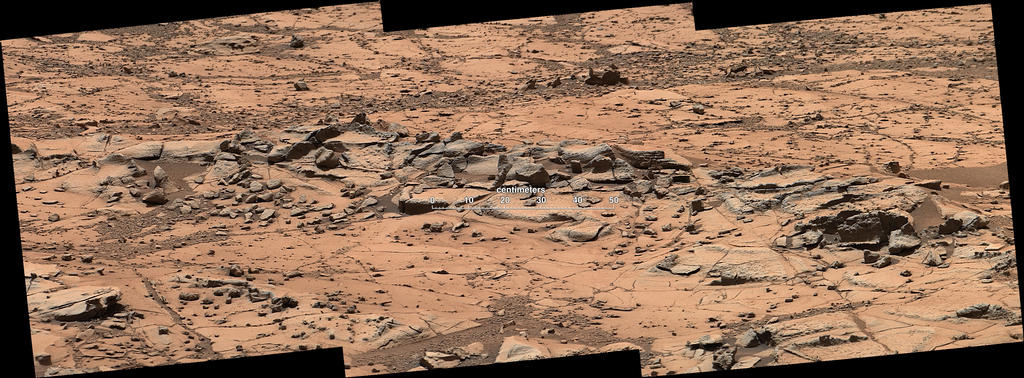
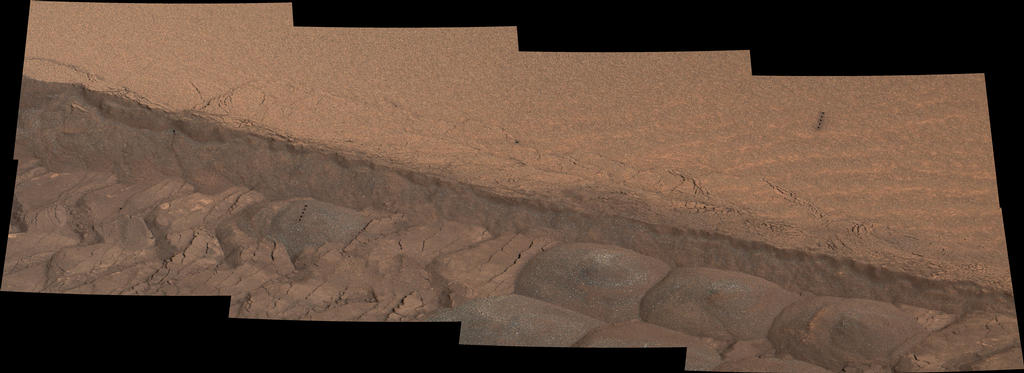
A mosaic of images captured by Curiosity's Mastcam showing the Pahrump Hills area the rover is currently investigating (foreground) and the Murrary formation, a near-term destination, beyond
A mosaic of images captured by Curiosity’s Mastcam showing the Pahrump Hills area the rover is currently investigating (foreground) and the Murray formation, a near-term destination, beyond – click any image for full size

As noted in a previous update, “mini drilling” operations are used to test a potential target for a range of factors prior to actually committing the rover’s drill to a sample-gathering exercise, the intention being to ensure as far as possible that nothing untoward may happen which may damage the drill mechanism or adversely impact future sample gathering work.

The September 22nd mini drilling was important for two reasons; not only was it intended to assess the suitability of the target rock for sample gathering, it also marked the first time the drill cut into what is essentially “new” and “softer” material compared to previous drilling activities, and it was doubly unclear as to how the drill or the rock might react.

The bore hole image from the September 24th sample-gathering at “Parump Hills”. A “merged-focused product” combining a set of images captured by the Mars Hand Lens Imager (MAHLI) from just 2 centimetres above the hole, it show the bore cut by the rover’s drill and surrounding tailings which, interestingly, don’t share the same distinctive light gray colouring seen with samples gathered on the crater floor. The hole is 1.6cm across and about 6 cm deep. The images were taken on September 24th, 2014, during the 759th Sol, of Curiosity’s work on Mars

The sample-gathering drilling took place on September 24th, PDT (Sol 759 for Curiosity on Mars) and resulted in cutting a hole some 6 centimetres (2.6 inches) deep into the target rock and the successful gathering of tailings. “This drilling target is at the lowest part of the base layer of the mountain, and from here we plan to examine the higher, younger layers exposed in the nearby hills,” said Curiosity Deputy Project Scientist Ashwin Vasavada following the operation. “This first look at rocks we believe to underlie Mount Sharp is exciting because it will begin to form a picture of the environment at the time the mountain formed, and what led to its growth.”

Curiosity is liable to stay within the “Pahrump Hills” area for a while prior to moving up onto the Murray Formation above it, which is regarded as the formal boundary area between “Mount Sharp” and the crater floor, and as such is designated a target of particular interest. As a part of its studies of “Pahrump Hills”, and as well as gathering an initial rock sample, the rover has been surveying the rocks in its immediate surroundings with other instruments including the ChemCam laser system and the high-magnification Mars Hand Lens Imager camera, also mounted on the robot arm.

Of particular interest to the science team have been a series geometrically distinctive features on the rock surface. These are thought to be common to the Murray formation mudstones, and are believed to be the accumulations of erosion-resistant materials. They occur both as discrete clusters and as dendrites with formations arranged in tree-like branching. By investigating the shapes and chemical ingredients in these features, the team hopes to gain information about the possible composition of fluids at this Martian location long ago.

Another merged-focused image from MAHLI, showing accumulations of erosion-resistant materials in the “Pahrump Hills” area on the slopes of “Mount Sharp”. Similar features on Earth form when shallow bodies of water begin to evaporate and minerals precipitate from the concentrated brines. The width of the image covers about 2.2 centimetres, and it combines a series of images captured on September 23rd, 2014, during Curiosity’s 758th Sol

Currently, the sample gathered from the “Confidence Hills” are held within CHIMRA, the Collection and Handling for In-Situ Martian Rock Analysis system, in the rover’s robot arm. This is a mechanism that allows sample material to be graded by the size of the tailings by passing them through a series of sieves as the robot arm is vibrated at high rates, producing multiple samples which can then be delivered in turn to the rover’s onboard science instruments for detailed analysis.

Continue reading “A Mars Namaste and taxis to the space station”

A look inside the alpha world of High Fidelity

HF-logoI tend to keep an eye on the High Fidelity blog as and when I have the time (I’m currently waiting to see if I get into the next phase of alpha testing, as I’ve so far failed to build the client (I sucketh at tech sometimes), so try to keep up with developments. I also confess to hoping for another video from AKA…). This being the case, it was interesting to get a look behind the doors at what has been going on within High Fidelity courtesy of self-proclaimed “bouncer”, Dan Hope.

Dan’s blog post turns the spotlight away from the work of the core High Fidelity team and focuses it on those alpha testers / builders who have built the client, made the connection and have started poking at various aspects of the platform and the worklist.

Austin Tate is a name well-known within OpenSim and Second Life. His c.v. is quite stellar, and includes him being the Director of the Artificial Intelligence Applications Institute (AIAI) and a Professor of Knowledge-Based Systems at the University of Edinburgh. Austin’s work has encompassed AI, AI planning and the development of collaborative workspaces using virtual environments and tools – particularly the I-Room.

Within High Fidelity, where he is known as Ai_Austin, he’s been extending the work on I-Rooms and collaborative spaces (both of which seem to have an ideal “fit” with High Fidelity) and has been working on 3D modelling, with Dan noting:

You might have figured out by now that 3D worlds are no good if they can’t handle 3D models accurately, which is why Ai_Austin also tests mesh handling for complex 3D objects. The image above shows the “SuperCar” mesh, which has 575,000 vertices and 200,000 faces, being tested in HiFi. There are several other meshes he uses, too, including one of the International Space Station that was provided by NASA.

SuperCar has also featured in Austin’s work within SL and OpenSim, where he has been providing invaluable insight into working with the Oculus Rift, the development of support for it within the viewer, using it with other hardware (such as the Space Navigator). In fact, if you have any interest at all in the areas of AI, virtual world workspaces, VR / VW integration, etc., then I cannot recommend Austin’s blog highly enough (We also share a passion for astronomy / space exploration and (I suspect) for racing cars, but that’s something else entirely!).

Ctrlaltdavid might also be a name familiar to many in SL and OpenSim, being the HiFi name of Dave Rowe (Strachan OFarrel in SL), the man behind the CtrlAltStudio viewer which focuses on adding OpenGL stereoscopic 3D and Oculus Rift support to the viewer.

With High Fidelity, he’s working on Leap Motion integration, to provide a higher degree of control over an avatar’s hands and fingers than can be achieved through the use of other tools, such as a the Razer Hydra. The aim here is to increase the sense of immersion for users without necessarily relying on clunky hand-held devices. As we know, the Leap Motion sits on the desk and leaves the hands free to gesture, point, etc., and thus would seem and ideal companion when accessing a virtual environment like HiFi (or SL) when using a VR headset; or even without the headset if one wishes to have a degree of liberation from the keyboard.

Dan Hope demonstrates avatar finger motion using the Leap Motion, as being coded by CtrlAltDavid in High Fidelity (Image: High Fidelity blog)

Opening this look at the work of various alpha testers / builders, Dan notes:

We can’t create a truly open system without making it compatible with other open-source tools, which is why Judas has been creating a workflow that will allow artists to make 3D models in the open source program Blender using HiFi’s native FBX format.

This forms a useful introduction to the work of Judas, who has been involved in bringing High Fidelity and Blender closer together in terms of providing improved FBX support for the platform, which is now bearing fruit. “Only last week something was added in that allowed me to import the HiFi avatars into Blender without destroying the rigs we need to animate them,” Judas is quoted as saying in the blog post.

Continue reading “A look inside the alpha world of High Fidelity”

OpenSimulator Community Conference registrations open

2014 banner

Registrations have opened for the 2014 OpenSimulator Community Conference. Attendance is free, but for those wishing to donate to the supporting this and future conferences, there are a number of options to do so, ranging from $10.00 USD through to $200.00 USD, all of which offer various benefits to purchasers.

For the full range of ticket options and their repsective benefits, and to book your place at the conference, please visit the conference ticket page.

Note that tickets will be available strictly on a first come, first served basis, and that the conference will be streamed via UStream for those unable to secure a ticket.

The current keynote speakers for the conference are:

  • Dr. Steve LaValle, a professor of Computer Science at the University of Illinois, is the principal scientist for Oculus VR, who will be addressing attempts to bring the Oculus Rift headset to the mass consumer market
  • Philip Rosedale, CEO of High Fidelity Inc., who will address the question, “What is the Metaverse?” and discuss the opportunity to develop an open platform for virtual reality over the internet, including new hardware devices that catalyze entirely new kinds of interactions between avatars.
OSSC keynote speakers Steve Lavalle (l) and Philip Rosedale (r)

About the OpenSimulator Conference

The OpenSimulator Community Conference is an annual evnet that focuses on the developer and user community creating the OpenSimulator software.  Organised as a joint production by the Overte Foundation and AvaCon, Inc., the conference features two days of presentations, workshops, keynote sessions, and social events across diverse sectors of the OpenSimulator user base.

The 2014 OpenSimulator Conference will take place on the OpenSimulator Conference Centre grid on November 8th and 9th, 2014, with registrations opening on September 15th, 2014, and interested parties can sign up to receive an email reminder to register.

The conference will include four themed tracks and a Learning Lab for hands on hackerspaces, speedbuilds, and more:

About the Organisers

The Overte Foundation is a non-profit organization that manages contribution agreements for the OpenSimulator project.  In the future, it will also act to promote and support both OpenSimulator and the wider open-source 3D virtual environment ecosystem.

AvaCon, Inc. is a 501(c)(3) non-profit organization dedicated to promoting the growth, enhancement, and development of the metaverse, virtual worlds, augmented reality, and 3D immersive and virtual spaces. We hold conventions and meetings to promote educational and scientific inquiry into these spaces, and to support organized fan activities, including performances, lectures, art, music, machinima, and much more. Our primary goal is to connect and support the diverse communities and practitioners involved in co-creating and using virtual worlds, and to educate the public and our constituents about the emerging ecosystem of technologies broadly known as the metaverse.

 Related links

J’arrive: a new chapter begins

CuriosityOn Thursday September 11th, a special teleconference was held by the NASA Jet Propulsion  Laboratory to discuss the status of the Mars Science Laboratory and the Curiosity rover.

The conference featured Jim Green, director, Planetary Science Division, NASA Headquarters, Washington, John Grotzinger, Curiosity project scientist, California Institute of Technology, Pasadena and Kathryn Stack, Curiosity Rover mission scientist, NASA’s Jet Propulsion Laboratory, Pasadena. California, and marked the first direct conference on the mission hosted by JPL since the start of the year.

The focal point for the briefing was to announce that just over two years since its arrival on Mars, having covered a distance of some 6 kilometres and having already fulfilled its primary mission objective – to locate a region on Mars which shows both chemical and geological indications that it may once have been amenable to development and support of microbial life – the rover had, again in geological terms, arrived at its primary exploratory target: Aeolis Mons, which NASA refers to as “Mount Sharp”.

Curiosity still has around two kilometres left to drive before it can be said to be actually “on” or climbing Mount Sharp, but the changes in geology and terrain which it is now encountering are sufficiently clear for the science team to state the rover is effectively traversing the “boundary” between the floor of Gale Crater and the slopes of Aeolis Mons itself.

Originally, it had been intended to drive the rover further south from its current location near an uprising dubbed the “Pahrump Hills” – originally seen as a potential target site for further sample drilling – to a series of low buttes named after the late co-founder of The Planetary Society, Bruce Murray. From orbit, this had been seen as the best route by which the rover could skirt an extended line of sand dunes lying between it and “Mount Sharp” and commence a climb up onto the lower slopes.

However, further examination of the terrain adjacent to the Pahrump Hills / Zabriskie Plateau has revealed it to be softer than the terrain than the rover has been crossing, and potentially more suited to driving onto the slopes of the mound. Dubbed the “Murray Formation”, this terrain also forms a visible boundary between the Mount Rainer-sized mound of “Mount Sharp” and the crater floor sediments, and so offers the potential for further science discoveries. Thus, from a driving characteristics point of view and a science perspective, it offers a shorter, more interesting route onto the mountain proper.

The view from “Amargosa Valley”: a mosaic of images capture by Curiosity’s Mastcam showing the “Pahrump Hills” (centre of the image, just above the scale bar), above which sits the Murray Formation and the revised route up onto the lower slopes of Mount Sharp (click any image for full size)

As well as being geologically different to the sediments of the crater floor, the Murray Formation is topographically different as well, which is driving a lot of interest in the science team in terms of what it might indicate about the way in which “Mount Sharp” was formed. The floor of Gale Crater – more correctly known as Aeolis Palus – bear the marks of considerable cratering which can be seen from orbit. However, the layers of the Murray Formation – essentially a scarp between the crater floor and Aeolis Mons – have almost no visible cratering at all.

The topological differences between the plains of Gale Crater and the slopes of Mount Sharp can be seen in this false colour image. Note the rich cratering evident across the sedimentary basin of Gale Crater and the almost complete absence of cratering along the Murray Formation.

During the course of the next few weeks, the rover will pass over / around Pahrump Hills, hopefully gathering a suitable rock sample using the “compressed drilling” routine,. Then it will turn more sharply southwards than originally planned, travelling directly onto the Murray Formation, rather than continuing in a more south-westerly direction to Murray Buttes before turning onto the slopes of the formation. The rover will still study the area of the Murray Buttes, but will now do so at their eastern extremes, allowing the science team to also investigate some nearby sand dunes.

While “Bonanza King” proved to be unsuitable for drilling for an actual sample for analysis, it did provide sufficient data to help the team in determining a revised science programme, and in their decision to traverse the Murray Formation and onto “Mount Sharp” proper sooner rather than later. This is because spectral analysis for the rock revealed it to have very high silica content (the only location on Mars so far studied with similar levels of silica is half a world way and was studied by the Spirit MER), which stands a marked contrast to rock samples so far gathered by the rover.

The interior of “Bonanza King”, seen here following the “mini drill” test to assess its suitability for sample drilling, showed intriguing promise. Sadly, the rock moved too much during the test drilling to be deemed safe for sample gathering. Evidence of the movement can be seen in the way the light-coloured tailing have unevenly flowed away from the drill cut, rather than circling it

Continue reading “J’arrive: a new chapter begins”

This is as Easy as it gets

HF-logoOn August 14th, the High Fidelity team issued a blog post featuring the first number by AKA, the company’s informal group of singers of Emily, Ozan and Andrew. While light-hearted in nature, the video further demonstrated HiFi’s work on facial expression and gesture capture.

I wrote about the video and post as a part of a quick update on HiFi, and noted at the time that “executive producer” (and HiFi co-founder) Ryan Karpf would be providing more information on what went into the video and session.

Ryan Karpf, HiFi co-founder and "executive producer" for AKA's cover of "Easy"
Ryan Karpf, HiFi co-founder and “executive producer” for AKA’s cover of “Easy”

Keeping to his word, Ryan did just that on Tuesday August 26th, releasing a video on how it was all done (embedded below), together with a brief blog post inviting those already in the Hi Fi Alpha testing programme to consider submitting their own videos … assuming, that is, they have the hardware.

Ryan’s piece explains how the team put together the music video and overcame some stumbling blocks, although I admit I’d probably have a better chance of understanding Brad Hefta-Gaub’s explanation of a server crash issues had he been speaking Klingon (which is probably why I’m not in the Alpha)! Fortunately, Ryan is on-hand to offer a single-sentence translation into English. The video also reveals how the team were unable to film the song as a single “live” performance, as had been hoped, but in the end had to rely on traditional post-recording editing to produce the finished piece.

As well as being informative, Ryan’s video is also somewhat hypnotic … I confess to becoming quite captivated by the level of conversation going on between his eyebrows even before he presents us with more exaggerated facial movements to underscore a point! 🙂

It’ll be interesting to see how this work develops, and whether the HiFi team really do get to the point of being able to record a completely fluid and “live” performance; I rather suspect they will. But even without this, the Easy video tends to demonstrate how much more engaging something like a musical set could be when one can see more of the performer’s facial expressions and actions when playing a musical instrument reflected in their avatar.

In the meantime, and for ease of reference (and because I like it and find myself singing along with Emily), is the music video itself, complete with Chris and Ryan’s “outtakes”.


High Fidelity founder to address OpenSimulator Conference

2014 banner

On Thursday August 28th, Chris Collins, writing on behalf of the 2nd OpenSimulator Community Conference, announced a further keynote speaker at the event will be Philip Rosedale, co-founder of Second Life and most recently a founder of High Fidelity Inc.

The press release states that:

Mr. Rosedale’s keynote presentation will address the question, “What is the Metaverse?” and discuss the opportunity to develop an open platform for virtual reality over the internet, including new hardware devices that catalyze entirely new kinds of interactions between avatars.

Philip Rosedale: Opensimulator Community Conference Keynote Speaker
Philip Rosedale: OpenSimulator Community Conference Keynote Speaker

In 1995, Philip Rosedale created an innovative Internet video conferencing product called “FreeVue”. This was subsequently acquired by RealNetworks, where he was appointed Vice President and CTO in 1996.  During 1999, Rosedale left RealNetworks to co-found Linden Research Inc., operating under the name of Linden Lab, with the intention of developing an open-ended, Internet-connected virtual world. In 2003, Linden Lab publicly launched Second Life.

Rosedale departed Linden Lab in 2010, after serving twice at the company’s CEO and as the chair of the board. Since then, he has established both Coffee & Power and Worklist.net, both focused on distributed work and computing. In 2013, he co-founded High Fidelity Inc. to explore the future of a next-generation virtual reality system.

Commenting on his appearance at the OpenSimulator Community Conference, Chris Collins said, “Philip Rosedale is one of the foremost thinkers about virtual reality and the Metaverse today,” said conference chair Chris Collins. “We look forward to hearing his thoughts on the next generation of open Metaverse platforms, including OpenSimulator.”

About the OpenSimulator Conference

The OpenSimulator Community Conference is an annual evnet that focuses on the developer and user community creating the OpenSimulator software.  Organised as a joint production by the Overte Foundation and AvaCon, Inc., the conference features two days of presentations, workshops, keynote sessions, and social events across diverse sectors of the OpenSimulator user base.

The 2014 OpenSimulator Conference will take place on the OpenSimulator Conference Centre grid on November 8th and 9th, 2014, with registrations opening on September 15th, 2014, and interested parties can sign up to receive an email reminder to register.

The conference will include four themed tracks and a Learning Lab for hands on hackerspaces, speedbuilds, and more:

About the Organisers

The Overte Foundation is a non-profit organization that manages contribution agreements for the OpenSimulator project.  In the future, it will also act to promote and support both OpenSimulator and the wider open-source 3D virtual environment ecosystem.

AvaCon, Inc. is a 501(c)(3) non-profit organization dedicated to promoting the growth, enhancement, and development of the metaverse, virtual worlds, augmented reality, and 3D immersive and virtual spaces. We hold conventions and meetings to promote educational and scientific inquiry into these spaces, and to support organized fan activities, including performances, lectures, art, music, machinima, and much more. Our primary goal is to connect and support the diverse communities and practitioners involved in co-creating and using virtual worlds, and to educate the public and our constituents about the emerging ecosystem of technologies broadly known as the metaverse.

 Related links