Mercury, the smallest planet in our solar system is also one of the closest to Earth – the average separation between the two being around 77 million kilometres (although obviously, this varies widely depending on which side of the Sun they are on relative to one another). When you compare that to say, the 714 million km average distance between Earth and Jupiter (with the same caveat of position relative to one another and the Sun), you’d think Mercury would be an easy place to get to.
Not so. It actually takes more energy for a spacecraft launched from Earth to reach “nearby” Mercury than it does to get to the outer solar system. There are two reasons for this. The first is that – as we all know – Mercury is racing around the Sun much faster than Earth, with a sidereal period of just under 88 terrestrial days. This means it is moving more than half as fast again as Earth: 47.6 kilometres per second compared to our 30 km/s. So to catch it, anything launched from Earth has to be going very fast- and it’s going to be accelerating all the way as it will effectively be falling “down” the Sun’s gravity well.
And therein lies the second problem: the speed required to reach Mercury + the acceleration gained under the Sun’s influence means that the spacecraft is going to be zipping along way too fast to actually slow itself in order to achieve orbit – not unless it is carrying a huge amount of propellants – so much in fact, that the mass of those propellants couple with the size of their storage requirements make such a mission a non-starter; not without a means to get around this propellant problem.

And there just so happens that there is a means to do so – and it was actually proposed specifically to enable the very first mission ever launched to Mercury. It is called the gravity assist; using the gravity of one or more planets to either accelerate or slow a spacecraft, whilst also alter its course sufficiently enough so that it can intercept the orbit of its intended destination.
Gravity assists are commonplace today, used in many missions – both of the current mission to Jupiter – NASA’s Europa Clipper and the European Space Agency’s (ESA) Juice mission – are using multiple gravity assists to boost them to Jupiter and reduce the propellant load they would otherwise need. But it was with NASA’s Mariner 10 mission of the 1970s where the idea was first used. The mission used the gravity of Venus to both accelerate the spacecraft and swing it on to an orbit around the Sun such that it would be able to make 3 fly-bys of Mercury, the first two of which (1974 and 1975) would additionally adjust its orbit to enable the next fly-by (the last also occurring in 1975). Even so, the spacecraft was travelling far to fast to ever enter orbit around Mercury.
Launched in 2004, NASA’s MESSENGER mission utilised a fly-by of Earth (2005), two of Venus (2006/07) and three with Mercury itself (2×2008, 1×2009)in order to initially accelerate it and adjust its orbit so it could reach Mercury, with the 3 fly-bys of the planet then being used to slow the spacecraft so that in 2011, it could use its thrusters to slow itself sufficiently to enter orbit, becoming the first probe from Earth to orbit Mercury at the start of a 4-year mission there.
Now a joint mission by the European Space Agency (ESA) and the Japanese Aerospace Exploration Agency (JAXA) is about to become only the second mission to achieve orbit around Mercury and commence a joint period of study. It is, without hyperbole, one of the most complex missions ever undertaken, involving a multi-part space vehicle which includes two orbiters, and eight-year flight to Mercury, and no fewer than nine gravity assist fly-bys. The mission is called BepiColombo – named for the man who developed the concept of the gravity assist fly-by as noted above: mathematician, engineer and scientist, Giuseppe “Bepi” Colombo.

Four in One, and One for All!
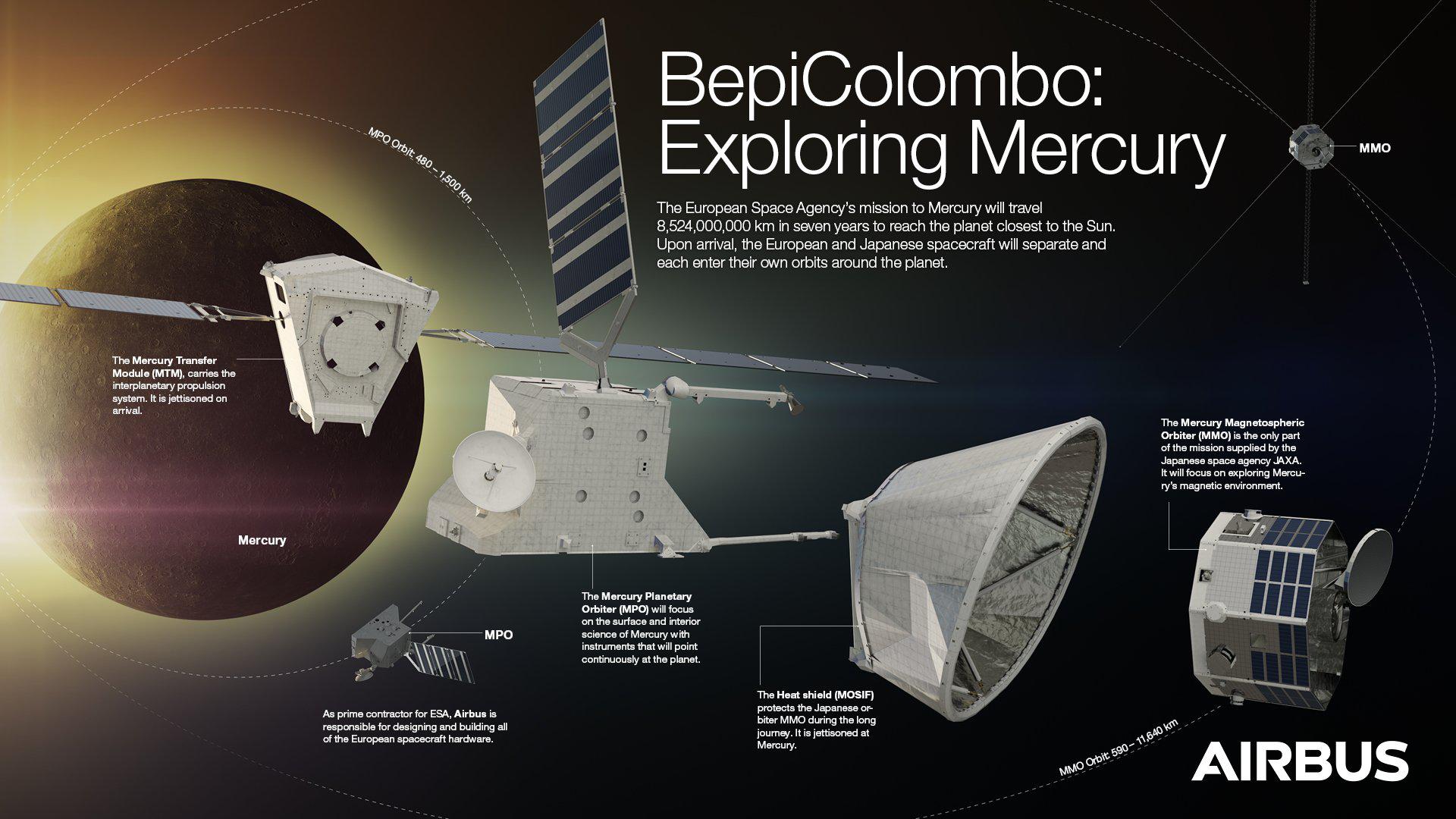
The mission comprises four main elements: three spacecraft stacked together for the voyage to Mercury, together with a special thermal shade and power relay unit. These are:
- The Mercury Transfer Module (MTM): a vehicle built by ESA and combining chemical and solar electric propulsion as well as serving as the initial power bus and navigation system for the rest of the stack.
- The Mercury Planetary Orbiter (MPO): a 1.15 tonne science satellite, again built by ESA and carrying a suite of 11 science instruments comprising cameras, spectrometers (IR, UV, X-ray, γ-ray, neutron), a radiometer, a laser altimeter, a magnetometer, particle analysers, a Ka-band transponder, and an accelerometer. The majority of these are located on the nadir side of the vehicle (the side constantly facing away from the Sun) for optimal performance.
- The Mercury Magnetospheric Orbiter (MMO, also called Mio – meaning “water channel”, Mercury being known as the “water star” in Japan): a small, 285 kg satellite built by JAXA carrying a further 10 instruments, 6 of which are packaged into the combined Mercury Plasma Particle Experiment (MPPE), with the remaining four operating as independent instruments.
- The Magnetospheric Orbiter Sunshield and Interface (MOSIF): a protective shroud for MMO to help with its thermal regulation during the mission’s time orbiting the Sun in order to reach Mercury, and to provide a power interface for MMO during this time.
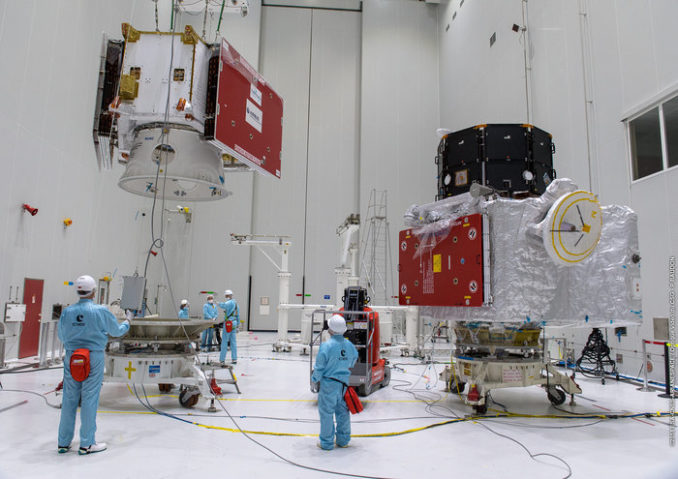
First selected for development by ESA in 2000 as the last of the agency’s Horizon 2000+ programme, the mission was to have included a 44 kg lander. Had this been flown, it could have carried a dual imaging system (descent camera and surface camera), an x-ray spectrometer, magnetometer, a seismometer, a drilling system for obtaining sub-surface samples and a micro-rover! Unfortunately, budgetary constrains meant it was cancelled well before contracts for its design and construction were arranged.
The science packages carried by the mission are multi-national, with instruments supplied by ESA member states (Austria, Finland, France, Germany, Italy, Spain, Sweden, Switzerland and the UK) together with Japan, Russia and the United States.
The Long Slog
Issues with developing the flight hardware – particularly the MTM’s solar electric propulsion system – led to a series of delays such that the mission did not launch until October 2018, just over 4 years after its target launch date of July 2014. Launch was aboard an Arianespace Ariane 5 booster – marking the 101st launch of that vehicle – out of Europe’s Spaceport in Kourou, French Guiana.
It was the easiest part of the mission, putting the combined vehicle into a heliocentric orbit close to that of Earth but with a hyperbolic excess velocity of 3.475 km/s. This meant that 18 months after launch, the mission swung by Earth in April 10, 2020, performing a fly-by / gravity assist at an altitude at closest approach of 12,700 km. A combination of the time of the fly-by (04:25 UTC), the size of the spacecraft and the degree to which it reflected sunlight meant that in some quarters, it was mistaken for a previously unknown near-Earth asteroid and gained a temporary designation as such – 2020 GL2.
Passing Earth successfully, the vehicle moved onto a trajectory heading in towards the orbit of Venus, where it would eventually complete two further gravity assist in 2020 and 2021, accelerating it on towards Mercury. The first of the fly-bys of Venus came just after reports had been made that the biomarker phosphine (PH3) had been detected in Venus’s upper atmosphere, suggesting it might contain microbial life. Requests were made for the BepiColombo to use the instruments on MPO and MMO to try to detect PH3 as well, although doubt was expressed as to whether they would be able to, as they were not calibrated for phosphine detection. No report on any attempts to do so has ever been released by ESA or JAXA, suggesting either the attempts were not made, or they yielded negative results. The original claim was also cast into doubt after a series of Earth-based follow-up studies failed to locate any phosphine in Venus’ atmosphere.
The August 2021 fly-by of Venus was significant as it put BepiColombo on a direct intercept with Mercury, the fly-by taking place in October 2021. This allowed instruments aboard both MPO and MMO to be directed at their intended target, together with camera mounted on the MTM.

Between October 2021 and January 2025, the mission completed six fly-bys of Mercury, allowing it to carry out a number of tasks. These included direct observations of the planet and measurements of its immediate environment, as well as helping to reduce the vehicle’s velocity so that it would eventually be able to enter orbit around the planet.
Originally, orbital insertion had been planned for December 2025, with the MTM to be jettisoned shortly ahead of that time, its job done. However, April 2024 saw the MTM’s solar electric thrusters develop a fault which prevented them for operating at full power, and would thus be unable to generate the thrust required to brake the spacecraft into orbit in December 2025. This resulted in the cruise phase of the mission being extended through November 2026, thus allowing the thrusters to be used in a series of lower-power firings over the extended cruise phase to help reduce its velocity such that it would be able to achieve orbital insertion.

The last of these braking manoeuvres was completed in June 2026, successfully reducing the spacecraft’s velocity such that both the MPO and MMO would be able to enter orbit around Mercury under their own power. The solar electric thrusters on the MTM were therefore shut down for the last time, and the vehicle started its coast towards the mission’s Mercury Arrival Phase (MAP).
On September 3, 2026, this MAP phase of the mission commenced with the successful separation of the MTM, its work done. This means that the MPO is now the provider of power, navigation and propulsion for the mission. The next major milestone will come on November 21, 2026 as the spacecraft enter an initial 60-hour polar orbit around Mercury. Then, for a period of roughly 20 days, the MPO’s thrusters will be periodically used to drop that orbit to 9.3 hours and occupying with a perihermion of 590 km extending out to an apohermion of 11,640 km. At this point, MMO Mio will be spun-up and released into this orbit on December 10, 2026, allowing it to commence its primary mission, after which the MOSIF protective shield for MMO will be jettisoned, its job also done.
MPO will then continue to refine its orbit to 480 km x 1,500 km and a period of 2.36 hours through early 2027, prior to commencing its primary science mission around the start of April 2027.
And the Objective Is?
The primary objectives of the BepiColoumbo mission are to study the likely origin and evolution of a planet so close to its parent star; gain insight into Mercury’s actual form, interior, composition and internal structure; study the planet’s tiny and unstable exosphere (comprising, in decreasing order, hydrogen, helium, oxygen, sodium, calcium, potassium and other trace elements) and its magnetosphere, gain a greater understanding of its interactions with the solar atmosphere and – entirely separate to the planetary studies – test Einstein’s general theory of relativity.
The primary mission is expected to last around a year, with the potential for an extended mission (subject to funding and propellants) through until the end of December 2029. The overall cost of the mission from development through to launch and the end of the primary mission of €1.65 billion (US $1.86 billion).
Nancy Grace Roman Space Telescope – Update
In my previous Space Sunday piece, and at the time of its launch, I covered some of the history of the Nancy Grace Roman Space Telescope (NGRST, or more simply, RST) together with some biographical notes about the woman after whom it was named. Since then, three further milestones have been passed:
- On August 31, 2026, the critical mid course, 3-minute burn of the observatory’s thrusters system was successfully performed. At the time of writing, NASA were still evaluating whether a second mid-course correction manoeuvre would be required, the first was so accurate.
- On September 1, 2026, the high-gain communications antenna was unfolded from the rear of the observatory and commenced testing.
- Also on the same day, the deployable aperture cover, designed to protect the telescope’s optics from the light of the Sun, successfully unfurled and one of the two main science systems, the Coronagraph Instrument (CGI), was powered-up for initial testing.
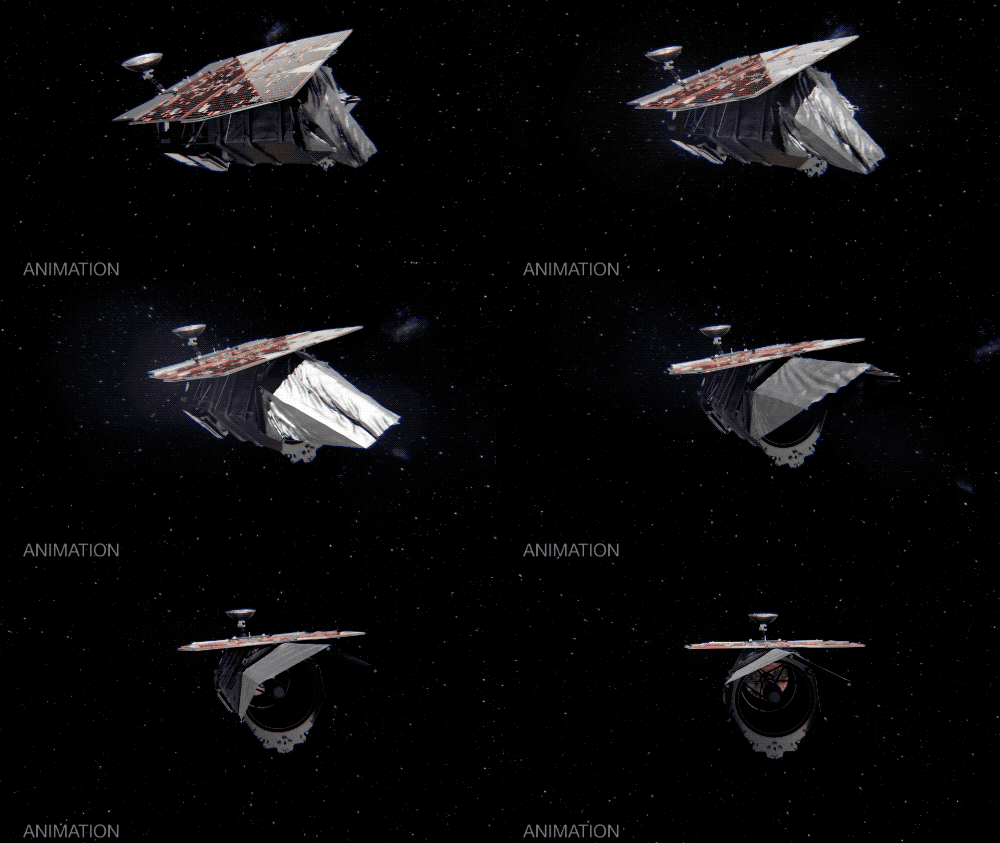
If the second mid-course correction burn is not required at it heads for its halo orbit around the Sun-Earth Lagrange L2 position, it will mean the observatory will have a small additional reserve of propellants to help with it regime of on-orbit station-keeping manoeuvres, one of which will be required roughly every 28 days once it enters its planned operational orbit around the L2 position.
Still to come is the powering-up of the Wide Field Instrument (WFI) suite and its initial check-out, after which the telescope will enter fully into a pre-commissioning phase of operations.


