Update: December 15th: Aneli has announced the exhibitions below will be the last for La Maison d’Aneli
Here I am at the end of my adventure as a gallery owner, of course I will stay on Second Life as a simple artist … I thank all the people who accompanied me …. what a beautiful adventure we have shared, more than twelve years with an exhibition per month, and you always there. Long live creation!
– From a note sent out by Aneli Abeyante
The exhibition below will remain open through to January 14th, 2023. Aneli also notes that the La Maison d’Aneli group will remain open for people to share information on their artistic events and exhibitions.
—-
December 14th, 2022 sees the official opening of five new exhibitions to see out the year at La Maison d’Aneli, curated by Aneli Abeyante. Produced and presented by five artists with highly individual skills and outlook, they present an intriguing mix that can engaging, amuse, possibly confuse, and provoke – and all of which are now available for viewing ahead of the formal opening.
Before going into specifics, when visiting all of these exhibitions, do make sure you have Advanced Lighting Model (ALM) enabled in your viewer (Preferences → Graphics → make sure Advanced Lighting Model is checked); although shadows do not have to also be enabled, so you can set the drop-down to No Shadows to reduce the rendering load. Also note also that this piece includes SLurls for teleporting directly to each exhibition.
La Maison d’Aneli, December 2022 – Yann Gyro (sempiternel)
Yann Gyro (sempiternel) is an artist whose work I do not recall having come across before, so his 3D installation at La Masion d’Aneli came as a new experience for me, being a piece I had difficultly in interpreting. Predominantly greyscale / black-and-white in nature, it appears to comprise multiple elements which at first seem to have no connection: a bridge wit water running over it and a broken egg below; black snow falling from a white sky, a series of heads in various stages of being drawn, a female head gazing upwards through a hail of falling musical notes and with a starscape and astronaut floating within, a map of the world formed by irregular blocks mounted on an irregular grid, and so on. Footsteps on the ground provide a guide to exploring the installation – and should be followed. But how might it be interpreted?
I eventually concluded this is a piece about finding balance. That on the one hand we have been given the gifts of evolution, creativity and the power to shape our own future (symbolised by the evolving heads, the musical notes falling from the sky; the dream of space travel an our quest to understand the cosmos contained within the female head; and the figure rising within the double helix); whilst on the other, those same gifts can result in environmental and physical destruction (the falling black snow; the shattering bridge and broken egg; the flower in the bell jar). Thus comes the suggestion that should we fail to balance these two sides in the manner of a gyroscope, they we will inevitably wobble, falter, and fail to keep to the true path of our potential.
La Maison d’Aneli, December 2022 – ZackHerrMann
ZackHerrMann, meanwhile, presents a further chapter in the life of his alter-ego Linda Cluster in celebration of art and music, using the virtual immersion of Second Life to recreate his physical world works representing Linda Cluster to give them greater depth and visual appeal.
Vibrant in their use of colour, animations and sue of geometry and symmetry, be aware that some of the surfaces within this installation are media-enabled, so be sure to click the “movie camera” icon in the top right of the viewer window to make sure media is enabled (you do not need to have the audio stream enabled, as this applies to the gallery as a whole (unless to want to).
La Maison d’Aneli, December 2022 – Thanos Runner
Drawing is above all my favourite discipline, because everything starts from drawing. It’s the idea, it’s the mood, it’s the choice, and all artistic work begins with a drawing. For me, drawing expresses the gift of self, communicating the sensitivity, character, and sentiment of the individual.
– Thanos Runner
Using his own words is perhaps the best way to introduce Livlic Ateliers by Thanos Runner. A multi-talented artist who prefers to focus on the human body and produce portraits of those he encounters through the medium of drawing rather than painting or digital composition.
His work is utterly captivating in the manner in which he captures his subjects and brings to the fore the beauty which can be called forth through the use of graphite lines on what paper by the skilled hand. At the same time his offers a richness of dialogue on the human form through his coloured images as they celebrate the human body.
La Maison d’Aneli, December 2022 – Onceagain (Manoji Yachvili)
Located in northern Tuscany, the Apuan Alps are renown for their Carrara marble, the most quarried marble it the world and used since Roman times for monumental sculpture and in architecture, but which today sees much of the 9 million tonnes quarried annually devoted to the production of toothpaste – and in the process is devastating the mountains at an accelerated rate.
As a native of the region, Onceagain (Manoji Yachvili) presents Cave Hominem, a series of photographs of the quarrying operations as a pictorial diary of the destruction being wrought for Second Life users to absorb. Offered in monochrome shading which enhances the rude damage being wrought on a daily basis – damage which she notes has led to visible changes in the look of mountains from her home – and set within an environment reflective of that encountered within the quarries themselves, this is an exhibition encompassing environmental damage we all too willingly inflict on the world around us which rings out as loudly as the roar, clang and bang of the instruments and tools of destruction used to wreck the Apuans and lay claim to their rock.
La Maison d’Aneli, December 2022 – Traci Ultsch
With As Above, So Below, Traci Ultsch complete the circle of exhibitions by presenting an installation that is left open to interpretation in a manner similar to that of Yann Gyro’s at the top of this article. It is also a piece where, again, having ALM enabled is absolutely essential (otherwise all you’ll see is the inside of a white cube!). Presented in monochrome, eye-pipingly visual (perhaps literally so in the case of the main image?) I am at a loss to describe this work – so I’ll instead urge you to go see it for yourself, together with the other four exhibits herein reviewed.
The official opening for all five exhibitions will take place at 12:30 SLT on Wednesday, December 14th, 2022, with music provided by Traci Ultsch.
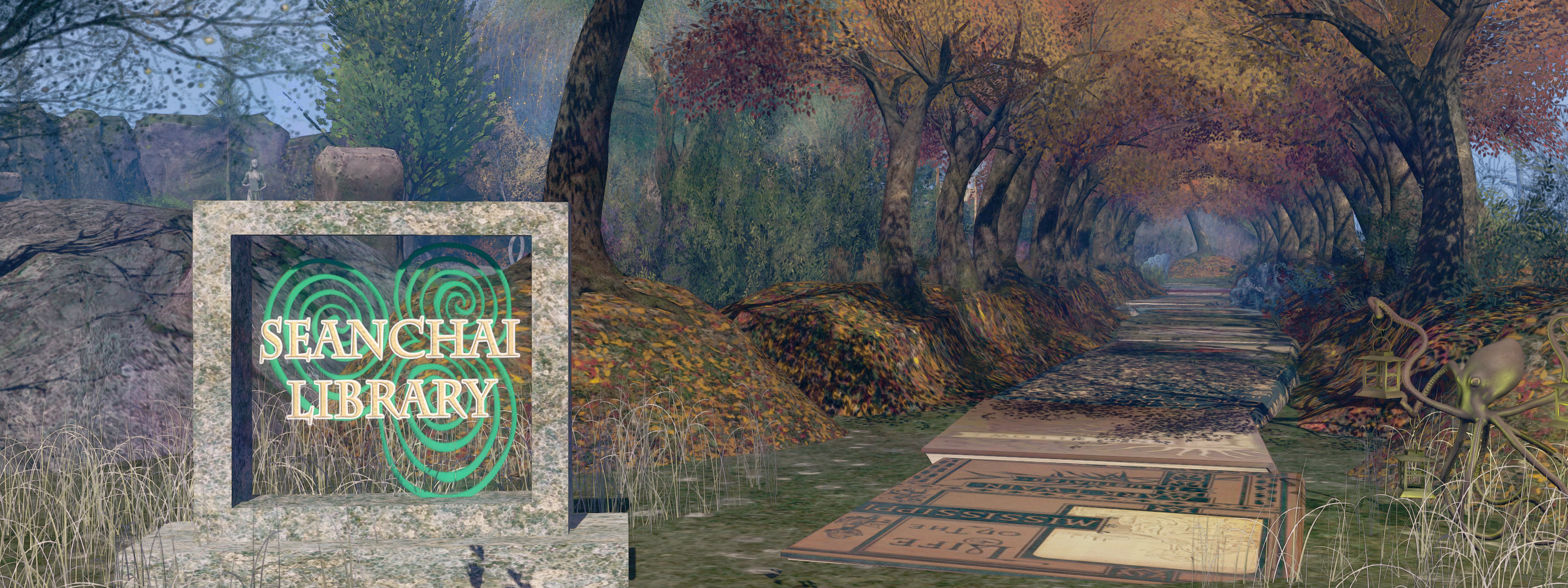
It’s time to highlight another week of storytelling in Voice by the staff and volunteers at the Seanchai Library – and this week previews the launch of a very special event.
As always, all times SLT, and events are held at the Library’s home in Nowhereville, unless otherwise indicated. Note that the schedule below may be subject to change during the week, please refer to the Seanchai Library website for the latest information through the week.
Monday, December 12th, 19:00: Call Me Joe
How do you explore an utterly hostile, alien environment; a place so utterly different, humans cannot possibly survive, and which is awash with lifeforms which, even if a human could survive on the surface, would rip him or her apart on contact?
You send in artificial constructs – creatures as powerful and strong as any of the predators roaming that world – creatures controlled by the human mind using psionics.
One such creature is Joe. Incredibly strong, Joe is more than a match for predators on this hostile world; unfortunately, he is controlled by the bad-tempered, wheelchair-bound Ed Anglesey. A man less than popular with his colleagues aboard the space station orbiting this alien world – but a man nevertheless capable of operating the artificial life-forms they send down to the world below.
Equally unfortunately, Joe – like the other units Anglesey has controlled – keeps suffering small, but irritating malfunctions. But are these caused by the environment and the fights Joe faces, or are they something more subtle; such as a manifestation of Anglesey’s fears at being so exposed on this alien world, despite the power and capability inherent in Joe’s body?
Or could the answer be in something else entirely? That’s the task assigned to psionic expert Cornelius, brought to the station in order to discover what is happening. And what he finds come as quite the surprise.
First written in 1957, Poul Anderson’s short story-turned-novella offers what might now be regarded as a quaint view of Jupiter as a world, and (possibly) a nugget of an idea used 50-ish years later by a certain film director.
With Gyro Muggins.
Tuesday, December 13th, 19:00: Selections from Terry Pratchett’s The Hogfather
Logos representative only and should not be seen as an endorsement / preference / recommendation
Updates from the week through to Sunday, December 11th, 2022
This summary is generally published every Monday, and is a list of SL viewer / client releases (official and TPV) made during the previous week. When reading it, please note:
It is based on my Current Viewer Releases Page, a list of all Second Life viewers and clients that are in popular use (and of which I am aware), and which are recognised as adhering to the TPV Policy. This page includes comprehensive links to download pages, blog notes, release notes, etc., as well as links to any / all reviews of specific viewers / clients made within this blog.
By its nature, this summary presented here will always be in arrears, please refer to the Current Viewer Release Page for more up-to-date information.
Note that for purposes of length, TPV test viewers, preview / beta viewers / nightly builds are generally not recorded in these summaries.
Official LL Viewers
Release viewer: version 6.6.8.576863 – Maintenance P (Preferences, Position and Paste) RC viewer – December 12 – NEW (promoted as this summary was being prepped).
Release channel cohorts:
No other changes,
Project viewers:
Puppetry project viewer updated to version 6.6.8.576972, on December 8.
Back in November I wrote a piece on three cafés within the Mainland continent of Heterocera (see: The coffee houses of Heterocera in Second Life). At the time, I noted that I might do further pieces of a similar nature in the future – although at the time, I didn’t realise how popular that article would be; following it I received several notes card and IMs suggesting other cafés I might appreciate visiting (thank you to all who sent them!) and the Destination Guide has recently highlighted its section on cafés and similar social spots.
Given the feedback I’ve had, I thought I’d offer another handful of such spots in Second Life, starting with a further destination in Heterocera: Jitters Coffee Shop.
Located in the north-east of Heterocera and bordering Beach Road (Route 4), Jitters is the property of Cynthia Deere and landscaped by Emm Vintner (Emmalee Evergarden) of The Nature Collective fame (and who has helped with or formed other cafés with Second Life (and Heterocera).
Jitters Coffee is a feeling and a hope that we can all come together over a cup of your beverage of choice and have splendid conversations!
– Jitter Coffee Shop About Land
Jitters Coffee Shop, Heterocera – December 2022
Occupying a tidy 4,256 square metre parcel, Jitters was, at the time of my visit dressed for winter which, given the largely outdoor nature of the seating, might make a visit a little on the chilly said at this time of year! Fortunately, warmth can be found in front of the terrace fireplace or the open fire pit a very short walk from the shop, for those who feel they may need warming up.
This is an wildlife-friendly spot, the grounds around the coffee shop playing host to a number of bird boxes and houses (some of them occupied / in use), while foxes and owls keep a watchful eyes on all comings and goings, whilst deer, rabbits and a weasel are also to be found. Being sited at the roadside, it’s a place that can easily be added to a road tour which might also encompass the cafés feature in my previous piece.
The Rainy Café, Jeogeot – December 2022
My next stop keeps with the winter theme, although it shifts continents and isn’t accessible by road, although that shouldn’t keep folk from visiting. Designed and built by Evangeline Miles, The Rainy Café sits within a skybox setting above the southern coast of Jeogeot. Established in Autumn 2021, this is a place which, despite being down on a southern continent, is joining in the general winter theme common to Second Life at the end of each year.
Come in out of the snow. The coffee and treats are fresh & there are plenty of cosy corners to curl up in. Discover a carefully-curated space for those who think life is better with coffee, conversation, & calm snowy days.
– The Rainy Café About Land
The Rainy Café, Jeogeot – December 2022
Sitting with woodlands where snow is falling gently to blanket the ground, The Rainy Café offers respite from the weather with a cosy interior composing the central coffee bar and sofa-style seating warmed cast-iron and electric heaters, it has been extended with the addition of two glass conservatory wings with counter seating and high tables. It’s a functional setting edged with cosiness. For those who prefer, there is a table outdoors to the rear of the café, whilst sitting back among the trees is a glass Gazebo offering a warm, cosy retreat for those who seek it.
Also found within southern Jeogeot and down on the ground is Pumpkin Spice Café. This is an ultra-modern design set alongside a small garden, both the work of Nutmeg (NutmegPinch) and Becca Vichan. Unlike the previous locations, this is a two-storey café brought to life by the presence of static non-player characters (NPCs) either seated in the building’s lower deck or queuing for coffee indoors. Upstairs is a small lounge area where coffee appears to be offered on a self-service basis and the seating a chic mix of sofas and armchairs. Outside, the garden offers a relaxed circular walk and a circular seating area sitting below a shaded swing.
Pumpkin Space Café, Jeogeot – December 2022
My last two stops for this article like within Corsica, and between them offer the opportunity for a road trip, each with its own attractions.
The first is NovaOwl Café, down on the continent’s south coast. It combines both a café and the NovaOwl Gallery operated by ULi Jansma, Ceakay Ballyhoo & Owl Dragonash and a regular feature for art reviews in this blog, and which thus offers the opportunity to appreciate the current exhibitions on both the ground level alongside the café or in the sky galleries above. The outdoor deck of the café is used to host opening events at the ground-level gallery, whilst the indoor area offers addition dance space alongside the coffee bar whilst a mezzanine above offers a comfortable seating area.
NovaOwl Café, Corsica – December 2022
Across the water to the north, Circuit la Corse – the major road looping around Corsica – passes around the continent’s southern headlands. Follow this eastwards and eventual and by way of tarmac, cobbles and wooden boardwalks, it is possible to reach The Reading Room by Shoshin Café, operated by Zoe Foodiboo.
A haven for those who love reading, this is a novel café in that it is divided sharply into two parts. Approached from the road, it appears to be a glass-fronted reading room / library with little hint of it being a café. However, two of the large bookcases forming the back wall of the reading room are in fact doors. Behind them is a single large room where group reading can be enjoyed with a cup of coffee or tea or other beverage. With an opportunity to have your poetry feature on a board outside the front of the café, allowing The Reading Room to offer a personal touch for those wishing to available themselves to the offer.
The Reading Room Café, Corsica – December 2022
Diverse but linked by a common theme, the cafés of Second Life offer plenty of reasons to explore the Mainland continents and also, for those who wish to, the many private estates found throughout the grid – some of which are also connected by water and may well be the subject of a further article in this series.
Apollo 17 lifts off from Launch Complex 39A, Kennedy Space Centre, December 7th, 1972. Credit: NASAAt 05:33 UTC on December 7th, 1972, the last of the Moon-bound Saturn V rockets thundered into the Florida skies from Kennedy Space Centre’s Launch Complex 39A At the start of the Apollo 17 mission.
Looking back at the Apollo era now, it is incredible to think that the entire project was conceived and – in terms of its lunar aspirations – executed in just 13 years, with the missions to the land humans on the Moon all taking place within a span of just 42 months. It was originally initiated in early 1960 under the Eisenhower administration as a means for the US to expand its space capabilities by providing a vehicle system capable of being used in the construction of a space station and, eventually, of carrying humans to the Moon. But in 1961 the project was co-opted as the best means of achieving President Kennedy’s desire to see America “commit itself to achieving the goal, before this decade is out, of landing a man on the Moon and returning him safely to the Earth”.
In doing so, Apollo set in motion the biggest single increase in NASA’s capabilities ever witnessed, giving rise to the facilities – such as the Merritt Island Launch Operations Centre with its massive VAB and two launch facilities at pad 39A and Pad 39B, and the sprawling mass of the Johnson Space Centre in Texas (often colloquially referred to as “Mission Control”) – people take for granted today as the most public elements of NASA’s infrastructure. Even so, by the time Apollo 11 landed on the Moon, the programme had already started towards closure: Apollo 20 had already been diverted for use in the Skylab project, while Apollo 18 and 19 would be cancelled early in 1971, leaving Apollo 17 as the last Apollo flight to the Moon.
The Apollo 17 crew, 1972: seated in the lunar rover replica is Gene Cernan (Commander), with Harrison Schmitt (Lunar Module pilot) to the left behind him, and Ronald Evans (Command Module pilot) to the right, and the Saturn V launch vehicle on the pad behind them. Credit: NASA
A “J-Class” mission, Apollo 17 was one of only three of the lunar flights designated as being for “extensive scientific investigation”, the missions up to and including Apollo 14 being focused primarily on the task of making precision lunar landings, with all science activities running secondary to that. It was also the only Apollo mission to the Moon to carry a full trained scientist in the form of geologist Harrison H. Schmitt.
Initially, Schmitt had been slated for Apollo 18, but when that mission was cancelled, there was a push from the science community to have him moved to Apollo 17 – a push resisted by mission commander Eugene Cernan, who (understandably) wanted to keep his original team of himself, Ronald Evans and Joe Engle. However, Cernan’s own leadership of the mission was seen as questionable by some at NASA after pilot error on his part caused during a training flight resulted in a helicopter crash; so when it became clear the choice was to replace Engle with Schmitt or have the who crew replaced, Cernan capitulated – and he and Schmitt went on to form a strong working relationship and friendship.
En-route to the Moon: Harrison Schmitt catches a cheeky-looking Eugene Cernan (l) and Ronald Evans (r). Credit: NASA
The only night-time launch for an Apollo lunar surface mission, Apollo 17 proceeded precisely on schedule despite a brief launch-pad delay. Planned as the longest of the Apollo missions at 12 days and 14 hours, it would also become the most successful of the three lunar science flights for Apollo, with the science work commencing whist en route to the Moon, with the crew carrying out observations of Earth and its weather patterns. Also carried aboard the Command Module were 5 additional crew members: pocket mice the crew unofficially named Fe, Fi, Fo, Fum and Phooey. Carried in their own self-contain life support unit, they were part of an experiment to investigate exposure to cosmic rays in interplanetary space, although the findings of the experiment were ultimately inconclusive.
This science work took a further turn when, as the CSM and LM combination approached the Moon, a panel on the side of the Service Module was jettisoned to expose the contents of the Scientific Instruments Module (SIM), a battery of lunar science packages Evans would monitor whilst his crewmates were on the Moon’s surface.
America’s exposed Science Instruments Module (SIM) imaged from the Lunar Module Challenger. Credit: NASAThese experiments comprised a lunar sounder designed to map the interior geology of the Moon to a depth of 1.3 km; an infra-red scanning radiometer intended to obtain a temperature map of the Moon’s surface to assist in understanding structural differences in the lunar crust; and a far-ultraviolet spectrometer to obtain data on the composition, density, and constituency of the lunar atmosphere and detect far-UV radiation emitted by the Sun that had been reflected off the lunar surface. Also in the SIM bay were a pair of cameras for imaging the Moon and a laser altimeter.
twenty-four hours after entering orbit around the Moon, Schmitt and Cernan boarded the Lunar Module Challenger, departing the Command Module America on December 11th, 1972 to touch down within the Taurus-Littrow valley at 19:54:58 UTC that day. The landing marked the start of some 75 hours on the lunar surface. During this time, Cernan and Schmitt carried out 3 EVAs, two of them making use of the third Lunar Rover vehicle to the carried to the Moon.
Challenger orients itself ready to start its descent to the lunar surface, as captured by Ronald Evans aboard America. Credit: NASA
The rover was deployed during the first EVA, with Cernan managing to repeat an error made by John Young on Apollo 16, accidentally ripping off one of the dust guards over the rover’s wheels such that both he and Schmitt would be showered in lunar “fines” (dust) kicked up by the wheel when the rover was in motion despite efforts to make repairs under Young’s supervision. In addition, this EVA also saw the two men deploy the surface experiments designed to be used within the vicinity of the Lunar Module.
The second EVA, on December 12th set a series of records for lunar surface operations: the furthest distance travelled from the LM (7.6 km), the longest distance travelled in a single EVA overall, the most time spent of the surface of the Moon in a single EVA (7 hours, 37 minutes) and the largest haul of samples from a single EVA to that point – 34 Kg. Along the way they visited several sites – Nansen Crater, at the foot of the South Massif; Shorty crater, and Camelot crater,
This EVA would go down in history for other reasons as well. At Shorty Crater, Schmitt came across orange soil, never before seen on the Moon. Initially it was thought he’d come across a volcanic vent in the lunar crust, but subsequent analysis of the material’s tiny volcanic beads revealed it has been formed some 3.5 billion years ago during the Moon’s volcanic period, and was exposed when a small asteroid slammed into the Moon to form Shorty a mere 20 million years ago.
Between Nansen and Shorty, the crew also stopped at a then-unnamed crater where Schmitt stumbled and fell in an awkward pirouette. While the fall left him uninjured, it prompted duty CapCom Robert Parker to quip to the crew that the Houston Ballet had called, requesting Schmitt audition for them on his return to Earth (in 2019, the crater was officially named Ballet Crater in honour of Schmitt’s tumble). Also during the EVA, both men (led by Schmitt) offered their own take on the popular song I Was Strolling in the Park One Day, which more than anything else revealed the bond that had grown between them.
The final Apollo era lunar EVA began at 22:35 UTC on December 13th, 1972, carrying out surveys of three “stations”: the North Massif and the Sculptured Hills; a house-sized boulder Cernan dubbed “Tracy’s Rock” after his daughter; and Van Serg crater. Whilst short in distance that the second EVA, this one set a further new record for samples collected – 66 Kg, including the 8 Kg sample designated 70215, a small part of which is now displayed at the Smithsonian Institution as one of the few samples of lunar rock the general public can touch.
At the end of the EVA, Schmitt and Cernan unveiled a plaque mounted on the side of the Lunar Module’s descent stage, commemorating both their own time on the Moon and the Apollo mission as a whole. Schmitt then climbed back into the LM, leaving Cernan as The Last Man On the Moon, expressing some of his thoughts thus:
I’m on the surface; and, as I take man’s last step from the surface, back home for some time to come – but we believe not too long into the future … And, as we leave the Moon at Taurus-Littrow, we leave as we came and, God willing, as we shall return, with peace and hope for all mankind.
– Eugene Cernan, December 13th, 1972
A composite image of Harrison Schmitt alongside of “Tracy Rock”, taken by Eugene Cernan. Credit: NASA
Cernan and Schmitt successfully lifted off from the lunar surface in the ascent stage of the LM on December 14th, 1972 at 22:54 UTC. Following a 7-minute ascent, they entered lunar orbit and coasted to a rendezvous with America, where Evans had been busy with his own work. Following docking and transfer, Challenger was jettisoned at 04:51 UTC on December 15th, 1972, to be successful de-orbited to crash on the Moon’s surface where seismometers left by several Apollo mission recorded the impact.
While en route back to Earth, Evans completed one of only three “deep space” EVAs so far performed, and the last EVA of the Apollo missions to the Moon. At 296,000 km from Earth, he departed the Command Module, watched over by Harrison Schmitt, and retrieved the film cassettes from the cameras in the SIM on the Service Module.
America re-entered Earth’s atmosphere and splashed down safely in the Pacific Ocean at 19:25 UTC, December 19th, 1972 just 6.4 km from the recovery ship USS Ticonderoga. The splashdown brought the Apollo lunar missions to a close. However, 5 more missions would fly under the Apollo banner: the four Skylab missions between 1973 and 1974 (which included the final flight of an Apollo Saturn V rocket), and the lS half of the Apollo-Soyuz Test Project (ASTP) in 1975.
Apollo 17 marked the last time Cernan flew into space, and the first and last times Schmitt and Evans did likewise. In 1976, Cernan departed NASA for the private sector, but maintained strong views on the direction of the US space programme, being highly critical of the Obama administration’s cancellation of the Constellation Programme and NASA’s move to rely on private sector resources. He passed away in January 2017, and is the subject of an obituary in these pages,
Ronald Evans remained at NASA until March 1977, performing key roles in both the ASTP mission and in the development of the space shuttle system. He passed away in 1990 after suffering a heart attack in his sleep. Harrison Schmitt was the first of the three to depart NASA, doing so in 1975 to pursue his political aspirations as a Republican Senator for New Mexico (1976-82). He became chair of the NASA advisory council in 2005 but then abruptly resigned 2008, clashing with NASA on the subject of climate change – of which he is a fervent denier (going so far as to state in 2013 that rising CO2 levels in the atmosphere are “good” because they allow us “to grow more crops”). He has also aligned himself with extremist conspiracy theorists such as Alex Jones.
Artemis 1 Comes Home
While it was not planned this way, fate determined that the 50th anniversary of Apollo17 landing on the Moon would be shared with the return to Earth of the first of NASA’s next generation of crew-carrying, lunar orbit capable vehicles, the Orion Multi-Purpose Crew Vehicle (MPCV).
I’ve covered the 26-day mission of Artemis 1 over the last few editions of Space Sunday. In many respects, it is the “reverse book-end” of Apollo 17; while the latter brought America’s first forays to the Moon to an end, Artemis 1 opens the door to a far more ambitious, international, and potentially far-reaching return to the Moon.
Perhaps the most iconic image of the Artemis 1 mission. Captured on December 5th, 2022 as the vehicle swings around the Moon, it shows the crescent Earth in the distance, the shadow of the Moon partially covering it. Credit: NASA
The mission, launched on November 16th, 2022, sent the Orion vehicle on a wide, slow cruise out to the Moon, which it transited past on November 21st, to enter a distant retrograde orbit (DRO), where it remained until December 5th, when a second close pass by the Moon allowed it to fire its main engine and start its way back to Earth.
The extended nature of the mission was to allow the systems on Orion to be thoroughly checked out over the duration of a typical mission duration, and to gather data on how well the vehicle protects the crew from radiation in the interplanetary medium – and the likely impact of exposure to the likes of cosmic radiation on humans who will spend 20-30+ days away from the protection of Earth’s magnetic fields.
December 11, 2022: Artemis 1 approaches Earth ahead of the Orion capsule separating from the Service Module. Credit: NASA
Approaching Earth on December 11th, 2022, the Orion capsule separated from is its European-built Service Module at 17:00 UTC, immediately performing a “skip” re-entry. This saw the capsule descend to around 60 km above the Earth before rising once more to 90 km to start its “full” re-entry. This “skip” manoeuvre allowed the vehicle to shave off its huge velocity – 40,000 km/h – in stages, both reducing the over G-load the vehicle would face in a single go whilst also offering a greater flexibility in selecting a splashdown location should there be an issue with the primary.
Splashdown came at 17:40 UTC bringing to an end a test flight covering a total distance of 2.3 million km. Prior to striking the water, the last of the vehicle’s velocity was reduced through the use of no fewer than 11 parachutes, opened in groups during its descent through the denser atmosphere.
Splashdown! 17:40 UTC, December 11th, 2022: the flight of Artemis 1 concludes as the Orion capsule splashes down safely off the coast of California. Credit: NASA / US Navy
While the mission will be subject to an extensive post-flight analysis, the general consensus is that SLS rocket and the Orion vehicle passed the test with more-or-less flying colours, helping to ensure things remain on course for the crewed mission of Artemis 2, due to take place in May 2024 over 10 days, head of the first planned lunar landing for Artemis 3, currently planned for launch in 2025.
Cica Ghost is back with a final installation for the year as she presents Trolland, a whimsical and fun setting much in keeping with her more recent installations. It comes, as all Cica’s installations do, with a little quote that helps describe it:
A troll is a class of being in Germanic mythology and Scandinavian folklore. In Old Norse sources, beings described as trolls dwell in isolated rocks, mountains, or caves, live together in small family units, and are rarely helpful to human beings.
This, plus the title of the installation reveal what it is all about; in this case, a total of three trolls. In this, and given my fondness for Tolkien, I couldn’t help but conjure thoughts of three trolls in particular: Bert Bill and Tom from The Hobbit. Now to be sure, these three individuals have probably done more to give trolls a bad name in the last 100 years than any single other source. Brutish, rude, thieves, uncouth in their lack of manners – and quite partial to human flesh -they are perhaps the worse kind of Troll one might imagine. But in truth, they were born of a standalone story designed to appeal as much to youngsters as adults (The Hobbit was only “retconned”, so to speak, into he broader mythology in subsequent editions, as the likes of The Lord of the Rings were more fully fleshed out for publication), rather than being representative of trolls as a whole.
Cica Ghost, Trolland, December 2022
As such, and in fairness, the creatures depicted in Cica’s installation don’t appear to be drawn from Tolkien’s story either consciously or otherwise; its just something my imagination was bound to dredge up because, as they say – J.R.R. Tolkien is Hobbit-forming (yes, I’m here through the season, folks, get your tickets from the box office!). Perhaps the presence of a camp fire with a cooking pot suspended over it also contributed to setting my imagination off on its little flight of fancy; you might (and probably will!) see things otherwise.
But that is, after all, the beauty and power of art, isn’t it? To call to our imaginations, and entice us on journeys. through their canvas and / or setting.
Cica Ghost, Trolland, December 2022
It cannot be denied that Cica’s Trolls look a lot friendlier than Tolkien’s and any grumpiness that might exude might the result of the landscape where they live. Cut through by deep channels which forced people to meander in their excursions, it may well be fun for explorers, the winding paths leading pat giant mushrooms, strange outcrops which might be rocks or petrified giant plants, some complete with wheels of stone suspended by rope from their arms to for swing-like seats, rock cars and a hidden gift.
But if you’re a troll and simply want to go from A to B to collect something? What might be a fun walk and photo opportunity for humans becomes, perhaps, an annoying chore. So, if these trolls do come off as not being especially helpful as you come across them, remember, you’re just visiting, they live here!
Cica Ghost, Trolland, December 2022
Caught under a mauve sky freckled with white clouds, a haze softening the horizon, Trolland makes for an engaging and fun visit to see out the year.


 How do you explore an utterly hostile, alien environment; a place so utterly different, humans cannot possibly survive, and which is awash with lifeforms which, even if a human could survive on the surface, would rip him or her apart on contact?



 Inara Pey: Living in a Modemworld