Space Sunday: rockets, rovers and spaceplanes

A Falcon 9 Lifts-off from SLS-40 at Cape Canaveral Air Force Station, carrying an Earth observation into a polar orbit – the first such launch fro CAS since 1969

SpaceX has been keeping busy over the last week.

On Sunday, August 30th, the company launched Argentina’s SOACOM-1B Earth observation satellite (and two other payloads piggybacking  on the flight) from Space Launch Complex 40 at Cape Canaveral Air Force Station, utilised a Falcon 9 first stage make its fourth successful launch and landing (returning to the SpaceX Landing Zone, also at Cape Canaveral, nine minutes after lift-off), after boosting the rockt’s upper stage and payload safely on its way.

The launch marked the first into a polar orbit – vital for Earth observing satellites as it allows them to pass over just about every point of Earth at some point during their orbits – from  Cape Canaveral since 1969. Such launches were suspended that year after a section of a Thor rocket launch came back to Earth over Cuba, allegedly killing a cow on impact, and causing something of an international incident.

This 333 second exposure captured via the 4m Blanco telescope at the Cerro Tololo Inter-American Observatory, shows at least 19 streaks crossing its line of sight created by the second batch of Starlink satellites launched November 2019. Credit: Clara Martínez-Vázquez and Cliff Johnson / CTIO

On Thursday September 3rd, and after delays due to weather, the company launched another Falcon 9 vehicle, this time from Pad 39A at Cape Kennedy.  It carried 60 Starlink Internet satellites into orbit, the rocket’s first stage successfully returning to Earth to land on the autonomous landing ship Of Course I Still Love You.

Starlink is designed to provide a global Internet service from orbit using a constellation of some 12,000 satellites operating in three “shells” (different altitudes) around the Earth. However, the system has come in for fierce criticism for the way  – with less than 1,000 satellites currently in orbit, it is already causing noticeable levels of pollution is is impacting astronomers.

While SpaceX has tried to minimise the amount of light the satellites reflect, CEO Elon Musk has also demonstrated a cavalier attitude towards the concerns of astronomers, and also towards those voicing concerns over the potential for the system to greatly add to the amount of debris orbiting the Earth over time,  particularly if SpaceX opt to expand the programme to a long-term goal of flying 42,000 Starlink satellites.

Also on September 3rd, the company completed the second successful Starship prototype launch from their Boca Chica, Texas, facilities. Starship is the upper section of their huge interplanetary launch vehicle that is central to Musk’s “plan” to “colonise” Mars (although initially the vehicle will be used to ferry cargo such as multiple satellites to orbit – for example, a single Starship could carry 400 Starlink satellites).

The second Starship prototype flight, utilising vehicle SN6 (which again only comprises the cylindrical fuel tank section of the vehicle, topped by a 23-tonne mass simulator, all powered by a single Raptor engine), was again to a modest 50 metres altitude, the same height as achieved during the SN5 prototype flight some 3 weeks ago. This was sufficient for the vehicle to clear the launch platform and translate a short distance to the landing area and make a successful landing.

As I noted following the SN5 flight (see: Space Sunday: Hops, glows, plans and Perseids), SpaceX plan to build out a test programme incrementally, moving from an unspecified number of low-altitude flights to flights of increasing height and complexity, including those using a “complete” prototype vehicle flying up to 20 km, allowing the vehicle’s horizontal descent and handling capabilities using the planned aerodynamic surfaces, as well as the vehicle’s ability to translate to a vertical orientation for landing.

Alongside the ongoing Starship prototype flights, SpaceX plan to commence test of prototypes of the reusable Super Heavy booster intended to push Starship vehicle reach orbit. The launch platform for the prototypes of these behemoths is currently being constructed at Boca Chica, as is the enormous “high bay” building where the prototypes will be assembled.

A conceptual image of a Super Heavy returning to land after launching a Starship vehicle. Elon Musk recently indicated the lower end of the vehicle will be revised to have just four landing legs rather than the 6 finned units seen in this image, and which will deploy in a similar nature to the three on the Falcon 9. Credit: SpaceX

Initial Super Heavy prototypes will be powered by just two of the enormously powerful Raptor engines, with the production vehicle likely being powered by 28 of the motors. This is reduction in the number of motors from 31 or 32, and this number may decrease further if SpaceX can further improve on the Raptor’s performance as they aim to try to operate it as an very of 250 tonnes of force (that’s well over half a million pounds of thrust) per motor. If this can be achieved operational Super Heavy boosters will have slightly more than twice the launch thrust as both NASA’s Saturn V rocket and the agency’s upcoming Space Launch System.

Musk reckons the the first Super Heavy prototype vehicle is liable to fly in early 2021. That’s also the year he has timetabled for the first Starship prototype flight to 20 km altitude flights.

Toyota’s Lunar Rover Gets a Name

Back in July 2019, I reported on an agreement reached between the Japan Aerospace Exploration Agency (JAXA) and the world’s second largest manufacturer of motor vehicles, Toyota, for the latter to develop a pressurised rover for use on the Moon.

Since then, both JAXA and Toyota have been working on the design and developing / testing elements of the vehicle, which has the goal of being powered by fuel cells and capable of an operational cruising range of up to 10,000 km (allowing it to practically circumnavigate the Moon on one set of fuel cells). At just over 6m in length and 5.2m wide, the vehicle is intended to provide some 13m³ (460 ft³) of living / working space for crews of 2-4 at a time, and will be delivered to the lunar surface by a dedicated automated lander to be built by Mitsubishi Heavy Industries.

An artist’s impression of the Toyota Lunar Cruiser showing it with its stowable solar cell arrays deployed to supply additional electrical power when parked, and an astronaut added for scale. Credit: Toyota

At the end of August, Toyota and JAXA announced the unofficial name for the rover: Lunar Cruiser, a nod towards Toyota’s Land Cruiser 4×4 utility vehicle, first developed in the 1950s and which are still in production today as luxury and capable SUVs. The Land Cruiser in turn has a heritage rooted in rugged 4×4 designs – notably America’s original Willy’s Jeep and the UK’s Land Rover (from which Toyota “borrowed” the first part of their 4x4s name).

Japan plans to fully develop the vehicle and its lander over the next 8 years, and make it available in support of human missions to the Moon, such as the Artemis programme.

China launches Secretive Space Plane

China launched an experimental reusable spacecraft on Friday, August 4th, following months of low-key preparations at the Jiuquan Satellite Launch Centre. It was delivered to orbit via a Long March 2F launch vehicle, with the launch reported by the Chinese state media Xinhua some three hours after the rocket lifted-off.

No images of the launch vehicle or the space plane have so far been released; however, orbital images of the Jiuquan facilities captured in July revealed modifications being made to a launch pad there, which suggest it has been updated to handle Long March Long March 4F with a 5 metre diameter payload fairing. This in turn suggests the Chinese space vehicle could be roughly comparable to the US Air Force X-37B automated space plane.

While little is known about it, the Chinese experimental space plane could be of a similar size ro the USAF’s X-37B space plane, seen here.

The vehicle remained in orbit for several days, during which time it is reported to have been used to test reusable technologies that will be used to provide  “support for the peaceful use of space” according to the Chines state media agency.

China first indicated it is in the process of a space plane in 2017. Under a “space operations roadmap” released at the time, the China indicated it plans to have a single stage to orbit (SSTO) space plane capable of taking off and landing horizontally. It’s not clear if the launch of this experimental vehicle was part of the programme, or a separate initiative. However, Chinese officials have indicated this will be the first in a series of launches of the vehicle to verify rapid re-launch and repeated use capabilities, and to reduce the country’s cost of payload access to space.
Stories with a new home in Second Life

Seanchai Library

It’s time to highlight another week of storytelling in Voice by the staff and volunteers at the Seanchai Library. As always, all times SLT, and events are held at the Library’s home in Nowhereville, unless otherwise indicated. Note that the schedule below may be subject to change during the week, please refer to the Seanchai Library website for the latest information through the week.

Sunday, September 6th, 13:30: “Welcome to Our Home”

Seanchai Library celebrates their new, spacious home today with an opening session of stories.  Join them for an hour of tales, followed by an hour of Music and Dancing in the new Ceiluradh Glen.

Seanchai Library’s new Ceiluradh Glen

Monday, September 7th: Anything You Can Do

Gyro Muggins reads Randall Garrett’s (writing as “Darrell T. Langart”, one of his many pen-names) story of an alien encounter first published in serial form in 1962.

What do you do when you finally make contact with E.T. after it crash lands on Earth and you find that, unlike Hollywood, it’s not here  for reasons of conquest- but that, despite its clear intelligence, it just doesn’t care about the destruction and death it wreaks across a city, because its norms of behaviour are so thoroughly  – well, alien – compared to ours, and its sheer power means very little can actually harm it?

Well, you obviously take a man and rebuild him – but not with bionics; rather you do so purely biologically- so that he can match anything the alien can do. But then, when you’ve done so, is your creation still human?

Tuesday, September 8th:

12:00 Noon: Russell Eponym, Live in the Glen

Music, poetry, and stories in a popular weekly session at Ceiluradh Glen.

19:00: Firelight

Willow Moonfire reads selections from what is effectively the epilogue of Ursula K. Le Guin’s Earthsea saga.

Ged of Gont reminisces about his life in the comfort of his home as he prepares to pass on. Firelight is a short story full of warmth that brings closure to Earthsea, and also to Le Guin’s own life. Published posthumously, it’s hard not to hear Le Guin’s own voice in Ged’s — saying goodbye along with her beloved character.

Wednesday, September 9th, 19:00: More of Cale’s Greatest Hits

Caledonia Skytower reads various short selections of popular stories that she has presented over the last 12 years. This week’s selection includes selections from Neil Gaiman’s The Graveyard Book and a touch of Maeve Binchy!

Thursday, September 10th

19:00 Captains Courageous, Pt 2

Shandon Loring reads Rudyard Kipling’s adventure. Also in Kitely: teleport from the main Seanchai World grid.kitely.com:8002:SEANCHAI.

Harvey Cheyne Jr. an arrogant, spoiled son of a multi-millionaire, is en route to Europe with his parents via luxury liner. As the ship enters the fishing grounds of the Grand Banks, He manages to fall overboard – the result of rushing to the deck in a heavy sea feeling sick from attempting to smoke an illicit cigar.

His fall passes unobserved aboard ship, which passes onward, leaving him to drown. Fortunately, he is rescued by Portuguese fisherman, Manuel. Unable to convince any of the fishermen of his position in life or his father’s wealth, Harvey finds himself forced to earn his passage aboard one of the larger fishing vessels.

At first indignant, Harvey quickly learns it is work – or go hungry. And so he embarks on a new life one which eventually leads him to a surprising realisation.

21:00: Seanchai Late Night

Contemporary Sci-Fi-Fantasy presented by Finn Zeddmore form such on-line sources as Escape Pod, Light Speed and Clarkesworld magazine, and more.

Pandemonium and Perspectives in Second Life

Attention Gallery – Jon Wyck

The September exhibition at Attention Gallery, owned, managed and curated by Isle Biedermann and Mirabelle Sweetwater (Biedermann), opened on Saturday, September 5th. It offers a double-header of an exhibition, displaying the art of Jon Wyck and Deckhard Neox  in what are two somewhat contrasting exhibitions in terms of their respective themes, which can perhaps best be described as “light” and “dark”.

With Perspectives of light and Life, Jon Wyck presents ten images that offer a mix of landscapes and avatar studies, each neatly reflective of its title. Each is intriguing in its representation of light, be it Moonlight over a shadowed tower, sunlight filters through drapes that adds warmth to a sculpture, the metronomic sweep of a lighthouse lamp caught in mid-rotation, the curtain of light created by the skyscrapers of a city backdrop, or use of colour throughout an image as a whole.

Attention Gallery – Jon Wyck

At the same time, and as the title of the selection indicates, each of the images in this selection offers a comment on life, from the desire for an island retreat to the thrill of living on the edge trying to control a powerful machine, going by way of reflections on art, mysticism and and beauty of nature around us.

With October and Halloween once again approaching, Deckhard Neox offers a trip into the darker side of life with his ten pieces, as he explains in his introductory notes:

PANDEMONIUM is my small gift to horror genre in film and literature, genre that I loved and feared since my early childhood. Emotions, either beautiful, uplifting, inspiring or in this case terrifying make us human and thus curious, enchanted and alive, forever searching for mysteries of life … and death.

– Deckhard Neox

Attention Gallery: Deckhard Neox

The result is a series of images that celebrate all that we tend to bring to mind when we consider in the silver screen’s (and television’s) delight in thrilling  / scaring us: werewolves, vampires, knife-wielding and masked maniacs, balloon-carrying clowns, the threat of shadows moving in the darkness and more.

These are – in a literal sense as much as thematically – dark images (so much so, I admit to finding myself wishing they were perhaps presented in a larger format just to bring more of their details to the fore). Each evokes a sense of atmosphere whilst also playing due homage to the film it is intended to evoke, sometimes clearly – as with The Well (The RingHalloween (Halloween), They All Float (It – film and mini series), etc. Others are more subtle – such as Ave Satani (The Omen – which also carries a hint of a certain “hell hound” from Holmesian mythology that has oft been played for horror).

Attention Gallery: Deckhard Gallery

Two small but engaging displays that will be available through until the end of the month, I believe.

SLurl Details

2020 SL project updates week #36: TPVD summary

Pony Box, July 2020 – blog post

The following notes are taken from the TPV Developer meeting held on Friday, September 4th, 2020. These meetings are generally held every other week, unless otherwise noted in any given summary. The embedded video is provided to Pantera – my thanks to her for recording and providing it. Time stamps are included with the notes will open the video at the point(s) where a specific topic is discussed.

Two length text conversations dominated the meeting. The first focused on mesh heads and brains, the second on graphics and users and system updates.

SL Viewer News

[0:14-3:05]

  • Current release viewer version 6.4.7.546539, dated August 11, promoted August 17, formerly the Arrack Maintenance RC viewer – No Change.
  • Release channel cohorts:
    • Bormotukha Maintenance RC viewer, version 6.4.8.547468, issued August 28.
    • Love Me Render RC viewer, version 6.4.8.547427,August 21.
    • Mesh uploader RC viewer, version 6.4.5.544027, July 27.
  • Project viewers:
    • Project Jelly project viewer (Jellydoll updates), version 6.4.8.547487, issued August 26.
    • Custom Key Mappings project viewer, version 6.4.5.544079, June 30.
    • Copy / Paste viewer, version 6.3.5.533365, December 9, 2019.
    • Project Muscadine (Animesh follow-on) project viewer, version 6.4.0.532999, November 22, 2019.
    • Legacy Profiles viewer, version 6.3.2.530836, September 17, 2019. Covers the re-integration of Viewer Profiles.
    • 360 Snapshot project viewer, version 6.2.4.529111, July 16, 2019.

General Viewer Notes

  • All three RC viewers have updates that are being queued for issue.
  • It is possible the Bormotukha Maintenance RC viewer will be promoted to release status at the start of week #37 (commencing Monday, September 7th).
  • As  noted in my previous CCUG summary, a new Love Me Render (LMR) RC viewer should be available soon (it is currently in QA, so could potentially appear in week #37). This viewer will have further EEP fixes, although not all of them may be in the initial RC release.
  • The Legacy Profiles viewer is awaiting a back-end update to the feeds, which may be being worked on.

In  Brief

  • [4:09-7:00] there is an intermittent problem of people viewing the Lab’s own web pages via the viewer’s built-in viewer finding at time that the website doesn’t see them as logged-in (although it should pick this up from the viewer).
    • This appears to be the result of a validation issue with the token generated at log-in and which should be passed to LL’s websites to allow the viewer to access them without the need for a further log-in.
    • LL are hesitant to fix the issue at the moment, as the back-end service handling the tokens is in the process of being moved to the cloud. Once the service has been transitioned, then the matter will be investigated and rectified.
    • This issue may have been triggered by changes make to the way server certificates are validated, which may have had an unintended knock-on impact.
  • [9:07-15:20]  a general discussion on performance issues that are most often tied to Linden Water, and suggestions on how it might be dealt with.  This largely matches the discussion summarised in my previous CCUG summary. These again included the idea of an update to prevent the viewer attempting to draw the Linden Water plane when above a certain altitude (and the majority of users cannot see it when at that altitude or above), or f having a UUID that can be set via the environment controls that effectively stops Linden Water Rendering when applied. Again, these are just *suggestions*, not things that have / are / will be implemented.
  • [21:12-23:12] OpenGL replacement: LL are not considering “seriously starting” on any OpenGL replacement work within the viewer until they have reasonable confidence the worst of the EEP bugs have been dealt with, simply because this is consuming the majority of the rendering team’s bandwidth.
    • Currently efforts are focused on gathering data on people’s systems – how they are running in terms of graphics options, what they are capable of running allowing for their GPU., etc., in order to hep the Lab better define parameters they need to consider. The code for this is in the current release viewer, and is propagating to TPVs as they merge and release that code.
    • One problem is that there are users who have hardware capable of running Vulkan, but they’ve not updated their Windows OS to a version that can support it.
  • [32:08-33:03] Viewer stats: by log-in session, the official viewer currently has a average of around 76% of sessions using Windows 10 64-bit; 15% using OS X, and the rest split between other Windows + Linux flavours. In terms of average users, Firestorm believe that have around 6% of users on OS X, perhaps 2% using various Linux flavours and the rest on various versions of Windows (32-bit and 64-bit).


2020 Content Creation User Group week #36 summary

Aspen Fell – The Notebook, July 2020 – blog post

The following notes were taken from my audio recording and chat log of the Content Creation User Group (CCUG) meeting held on Thursday, September 3rd 2020 at 13:00 SLT. These meetings are chaired by Vir Linden, and agenda notes, meeting SLurl, etc, are are available on the Content Creation User Group wiki page.

EEP Fixes

Love Me Render

  • The current Love Me Render (LMR) viewer (version 6.4.8.547427 at the time of writing) contains a number of EEP fixes (as well as other rendering updates) These include:
    • BUG-229107 [EEP] [Improvement] Ice level Slider Graduation.
    • SL-13539 [EEP] Large reflection on the water when facing certain angles.
    • BUG-228992 [EEP] Appearance lighting is broken when ALM is enabled.
    • BUG-228914 [EEP] Deferred Soften Shader fails to link when Atmospheric Shaders are disabled. This causes Debug viewer builds to crash.
    • BUG-228882 [EEP] Disabling glow rendering while ALM is off results in massive rendering flicker.
    • BUG-228781 [EEP] Specular color interpreted wrong (too bright) from point lights.
    • BUG-228581 [EEP] Specular map reflections are way too weak.
    • BUG-228840 [EEP] cloud texture is rendered backwards.
    • BUG-228431 [EEP] Water lighting is wrong at certain camera angles.
    • BUG-228752 [EEP] Sky turns black when render quality is lowered to Low-Mid.
    • BUG-225784 [EEP] BUG-225446 regression – HUDs are again affected by environment setting and BUG-225446 [FIXED] [EEP] HUDs are affected by Atmosphere & Lighting changes.
  • These a further EEP updates to come, likely in the next LMR viewer, which will hopefully be issued in the next week or so. These should include a fix  to allow horizon haze to modify the Sun’s light and tint when it is close to the horizon.

Additional EEP Issues

  • Moonlight: the Lab is also aware of a number of lighting issues related to the Moon (attenuation of moonlight through clouds, for example. Again, these will be addressed in time.
  • Mainland ambient lighting: users have repeatedly noted that the default Mainland environment remains darker than under Windlight.
    • This is the result of an error made during the EEP deployment that now requires a simulator-side configuration update to be made that is slightly complex in terms of implementation.
    • Essentially, a code fix needs to be made, and then a new estate setting added to the simulator code to manage it, together with code to ensure the update is correctly propagated to the affected regions.
    •  Currently, the resources required to develop, test and implement the required changes are all heavily engaged in cloud uplift work.
  • Density Multiplier issue: this is the result of the simulator restricting the multiple value. A fix for this is an upcoming simulator release.
  • Linden Water / performance issue:
    • As noted in previous CCUG summaries, rendering Linden Water appears to impact viewer performance to a greater degree than previously (leading to some simply disabling Linden Water rendering (CTL-ALT-SHIFT-7).
    • LL currently don’t have a solution for this, in part because the precise point in rendering where the bottleneck seems to occur is proving hard to pin down.
    • Some  suggestions for dealing with it were put forward at the meeting, including:
      • As there does not appear to be occlusion culling for water, perhaps auto-disabling Linden Water from being rendered in the viewer above a certain altitude (where the water generally isn’t visible anyway).
      • Or adding a special texture UUID that, when set via EEP in a region / parcel,  resulting in Linden Water rendering being disabled (CTRL-ALT-SHIFT-7, effectively) for all viewers within the region / parcel, rather than people having to manually disable Linden Water rendering. This could be helpful for major indoor shopping events, etc.
      • Note: both of the above were user-made suggestions, not ideas that have been implemented.
  • Specularity issues: EEP has altered specularity rendering such that specularity in point lights can appear too bright, and in Sun / Moon light, too dim. Fixes for this are in the currently LMR viewer referenced above, but there is some disagreement as to how well (or not) they correct issues.
    • Part of this may be the result of EEP making adjustments so the specularity in objects appears more realistic, but creators have previously had to manually compensate for a weakness in specular map rendering in the past.

ARCTan

  • Vir’s work in updating Jelly Dolls is now available in the Project Jelly viewer, currently availability as a project viewer (version 6.4.8.547487 at the time of writing). This work is also likely to find its way into a Maintenance viewer at some point.

In Brief

  • Date of next meeting: probably Thursday, September 17th, 2020.

A new home for Seanchai Library in Second Life

Seanchai Library’s new home

Founded in 2008, Seanchai Library is one of the longest running virtual world Libraries in existence. Specialising in presenting stories and poetry and more in voice, the Seanchai team and their friends have presented thousands of storytelling events across the grid over the past dozen plus years, and in the process has raised raised thousands of real US dollars for numerous charities.

Starting life as the West of Ireland Library and Cultural Centre, a part of the West of Ireland Charity Estate, Seanchai Library’s own story has been an evolving tale of growing chapters that have over the years have included many faces in a growing family of storytellers and readers, with new chapters being added as the Library has either moved to new locations or expanded it activities and presence. Some of these chapters include:

  • 2010: joining the Community Virtual Library (CVL) estate in Second Life, when the Library officially adopted the title Seanchai (pr. Shawn-a-kee – A traditional Irish storyteller/historian).
  • 2012: the launch of The Dickens Project. Now very much a part of Second Life’s Christmas tradition, complete with the support of Linden Lab, The Dickens Project has to date received nearly 5000 visits, hosted  61 events, and run over 88 hours of live programming featuring 65 performers, presenters, and artists.
  • 2014: Seanchai expanded to the OpenSim / Hypergrid enabled Kitely, offering a range of programmes and events to a broad audience of virtual world users, and presented the first virtual / physical world presentation in what would become their EXPLORE programme; Explore The Great Gatsby was presented in partnership with the Tacoma Little Theatre (TLT), Tacoma, Washington state.
  • 2015: In partnership with CVL, Seanchai Library established a presence on (the now defunct) InWorldz grid, which operated for two years prior to both CVL and Seanchai withdrawing from InWorldz.
  • 2017: Seanchai Library relocated to Holly Kai Park as part of the integrated arts programming at the Park.
Seanchai Library’s new home

I was particularly honoured to  play a small role in the Library’s move to Holly Kai Park and to share in their work through the Stories in the Park events that featured Seanchai’s storytellers and artists from across the grid.

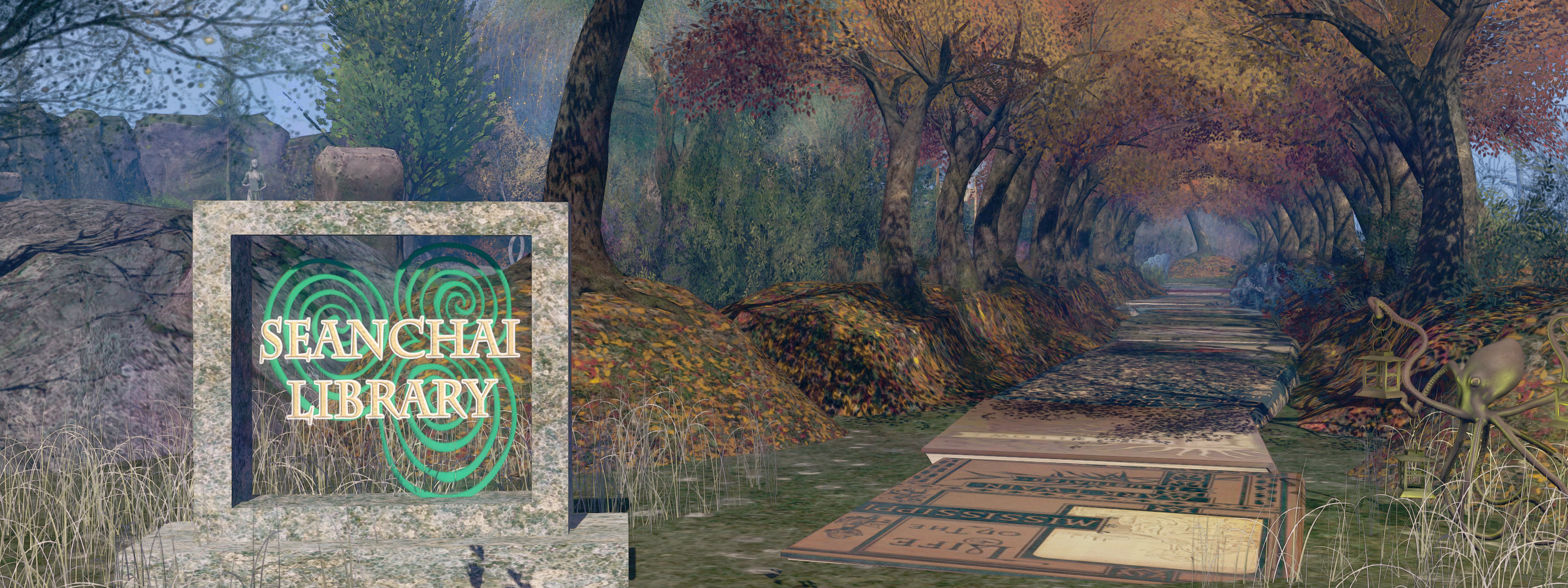
This coming weekend, Seanchai Library opens a new chapter in its story, as it transfers its base of operations to a new, bigger location that has generously provided by friend to the Library and to the arts (as well as a gifted storyteller / writer and raconteur), R. Dismantled.

Seanchai Library’s new home

For the last three years, it’s been my distinct pleasure to work with Cale and Shandon and Seanchai Library, and I look forward to continuing to cover their events and activities as I’ve done since 2011, and also to the opportunity of working with Seanchai through the auspices of the Phoenix Artists Collaboration (PAC) at both Seanchai’s new home at at PAC’s expanded home of Cherished Melody.

The new facilities officially open to Seanchai events on Sunday, September 6th, although they have been available to the public to visit even as the Library’s team has been preparing the land and setting up their new building and storytelling grounds. In particular, the new environment offers Seanchai Library far more space at ground level in which to offer storytelling settings, with space overhead in which to host special events and sessions.

Seanchai Library’s new home

In the meantime, if you would like to join Seanchai Library for their farewell event at Holly Kai Park, you can do so at 19:00 SLT, when Shandon Loring will be reading Rudyard Kipling’s Captains Courageous.

Seanchai Library Links