An abandoned vacation spot in Second Life

Dya’s Abandoned Vacation Spot, February 2020 – click any image for full size

An Abandoned Vacation Spot in the 30s. Sometimes you can still see the glamour of the past….

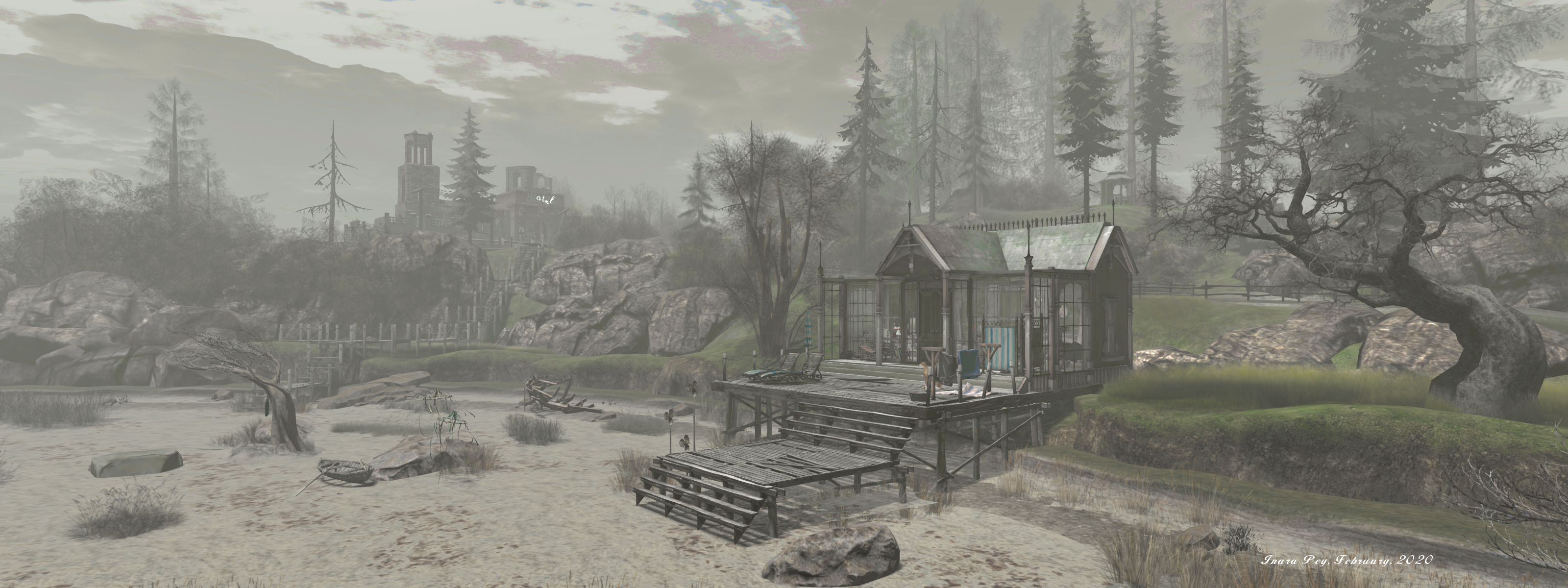
So reads a part of the description for Dya’s Abandoned Vacation Spot, a location we were drawn to courtesy of Maddy Gynoid. Designed by Dya OHare, this Homestead region presents a fabulous setting, an island sitting somewhere – possibly just off the coast or within the estuary of a broad river – that was once a place for holidays and fishing, but which has now faded well past its prime, the holiday makers long since departed, the water front now little more than moorings for fishing boats, but not a base of operations.

To say this is a beautiful setting would, frankly, be an understatement. The island has obviously been carefully considered and designed to present a setting that really could exist as much in the physical world as in the virtual. It’s made all the more natural through its single-track road which, just as might be expected of a vacation setting, neatly loops its way around the landscape, linking all the points of interest, and thus providing a natural means of exploration.

Dya’s Abandoned Vacation Spot – February 2020

The landing point sits in one of these aged waterfront buildings, one that is in slightly better overall condition than the rest, and home to Dya’s Gacha resale store.  From here, visitors have a choice: proceed on foot, take a bicycle from the rezzer a little further along the waterfront, or take the the steps down to the the piers where a motor boat rezzer awaits anyone who fancies pootling around the island by water.

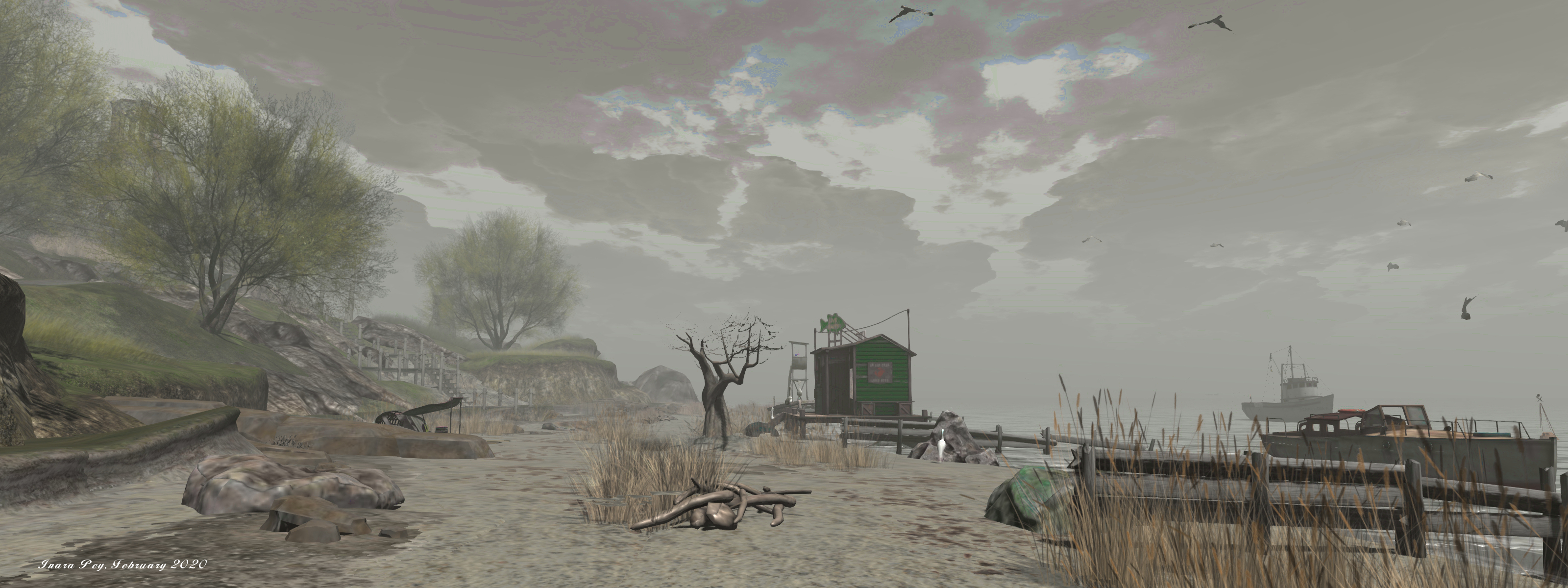
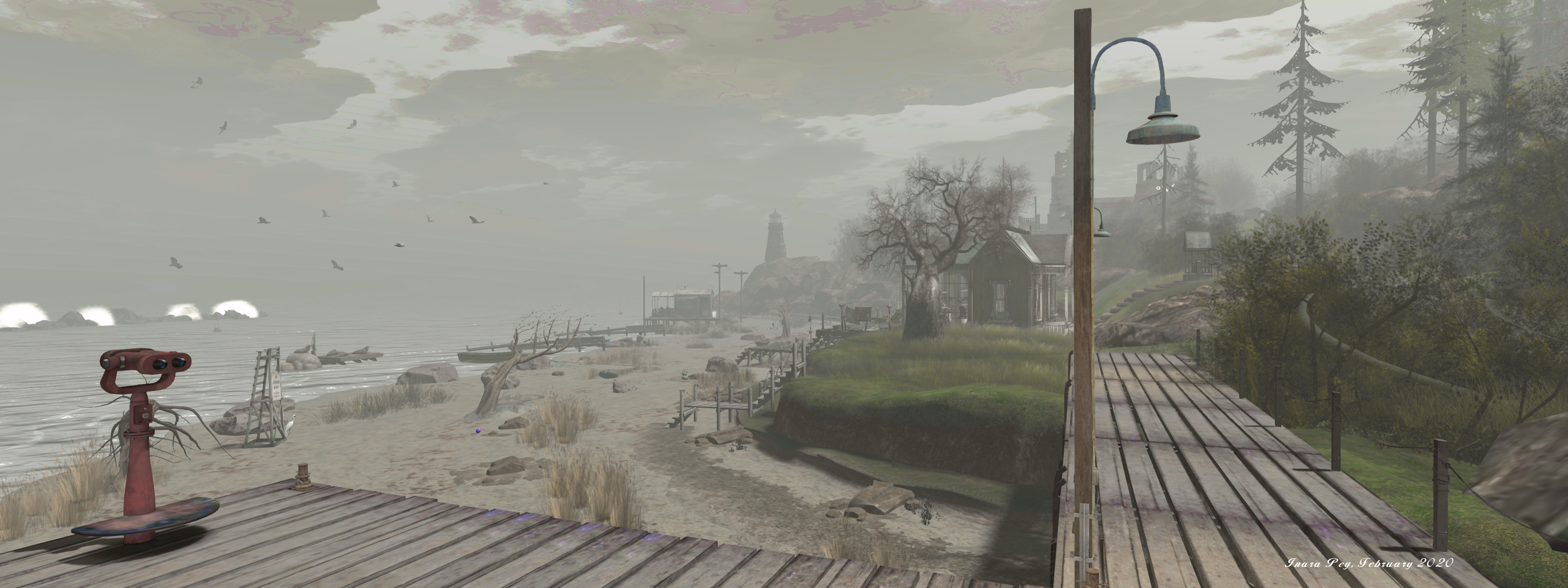
The road runs both north along the the shore, and east. The former route fully brings home the faded nature of the island’s heritage, passing between water to the one side and buildings that are falling apart on the other, their signs and façades harking back to when the the paved street was alive with visitors – although a couple of folk appear not to have realised the bar is no longer serving customers!
Dya’s Abandoned Vacation Spot, – February 2020

To the north, through a local rain shower, sits a more business-like wharf and buildings, where also sits the carved hull of a submarine whose shape looks born more of the Cold War era than from the 1930s. It sits as a single incongruity in the region’s overall design – and yet it still fits the setting, suggesting that while this was a holiday centre in the 1930s, time has indeed moved on, and the island has seen other uses.

Two beaches mark the south and east side of the the island, separated from one another by a rocky headland dominated by an old wooden lighthouse.  Both of the beaches reflect the island’s long-passed heyday; flotsam is scattered along sands that have a tired feel to them under the overcast sky, the trees along them apparently dead, marker buoys just offshore warning passing fishing boats not to get too close to the shore where they might run aground (and also mark the region’s boundary for those using the local motor boats to get around).

Dya’s Abandoned Vacation Spot, February 2020

Both of the beaches are also overlooked by a ruins of an ancient church, a place that looks older than than the rest of the island’s structures. Neon signs hand from one end of this old building, advertising it as a hotel, but whether it ever served this purpose or not is open to question; there’s barely the space for individual rooms, so perhaps the signs – still flickering, and so under power, are meant as a joke by whomever still uses the island.

This ruin can be reached by following the loop of the islands-road, which also provides access to the beaches by means of board walks and steps. The road also runs past what is perhaps the last standing holiday home overlooking the sands and sea. It’s a modest place, the deck bigger than the house, but it is still in use, simply furnished and offering a sense of life within a place mostly given to the past.
Dya’s Abandoned Vacation Spot, February 2020

While it has no obvious connection other than the period in which the island had its heyday being close to that of the book, where exploring, I couldn’t help but feel it sits as some kind of seaward Valley of Ashes from The Great Gatsby, albeit with strong differences; a place that, rather than being a place of run-down businesses, secrets and eventual tragedy, through which the rich of East Egg and West Egg pass under sufferance, the island sits as a place to be passed by and occasionally used by fishing as they travel to and from richer ports of call whilst plying their trade.

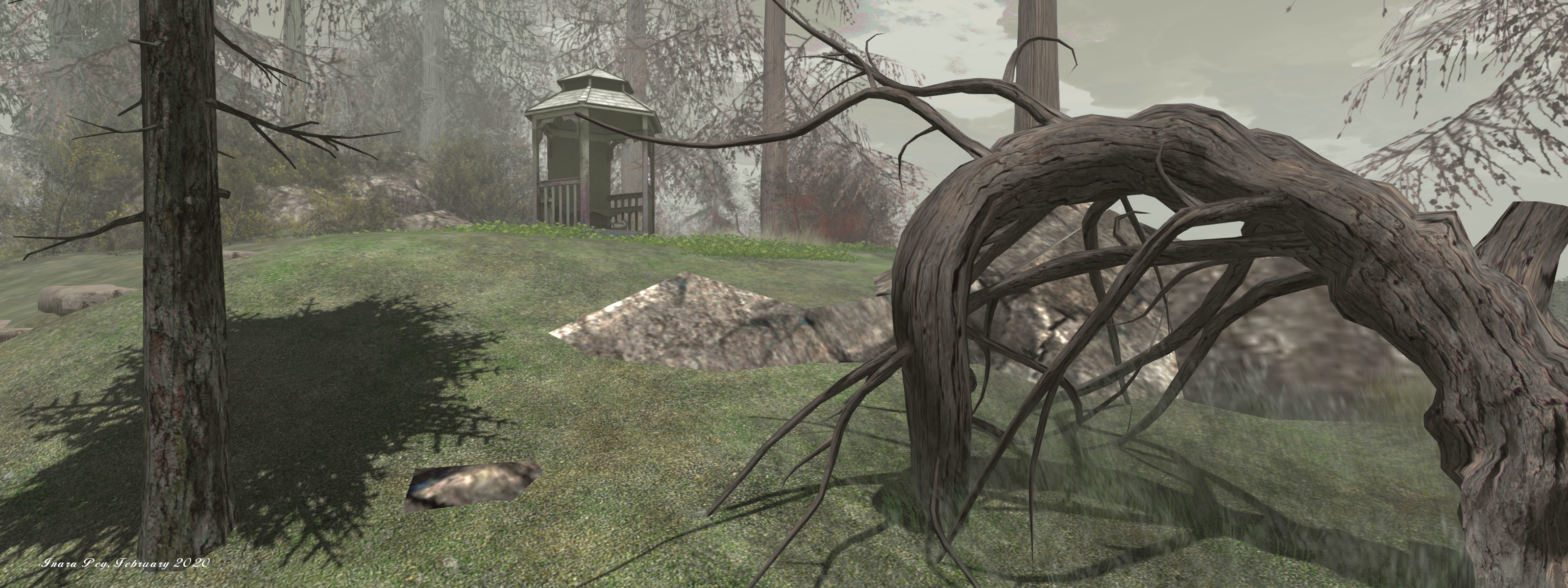
Why my mind should jump to such a connection, I’ve no idea; but it just seems to fit. What I can say is that with its wildlife and horses, sound scape and cloud-heavy skies, Dya’s Abandoned Vacation Spot is a captivating place to visit, rich in its own romance and utterly photogenic.
Dya’s Abandoned Vacation Spot, Februay 2020

SLurl Details

Art and idioms in Second Life

Vegetal Planet: State of Mind

Currently open at Vegetal Planet is an impressive 2D / 3D interactive installation led by Cherry Manga, made with the support of JadeYu Flang, that makes for a fun, and also thought provoking visit.

State of Mind is a journey through 20 popular idioms and expressions, taken without the need to move that far. It’s a journey that requires visitors to enable Advanced Lighting Model (Preferences → Graphics), although you do not require shadows to be enabled as well, if you’re concerned about viewer performance.  With ALM set, touch the sculpture at the landing point to deliver you to the main exhibition space.

Vegetal Planet: State of Mind

Located in a skybox, this is an environment that is in a state of flux, the scene within it changing periodically, gently paging through the 20 idioms. Visitors can either stand and watch the show or, by touching the east wall, can become a part of it, floating serenely as the scenes change around and below them.

Each idiom  / expression is presented as a complete scene, with the expression written in French or English and French against the wall that can set you floating. While is it easy to look at this and translate what is written, it’s more intriguing to observe the scenes as they appear and decrypt what is being illustrated. Sometimes this is easy – as with Head in the CloudsWalking on EggshellsStars in (Your) Eyes, others may take a little time to figure out, and some may not have an literal translation from French / English, so may not always be familiar to everyone.

Vegetal Planet: State of Mind

All of the pieces are, however, cleverly presented, often inviting the observer not just to try to identify the idiom being presented, but also consider how it came about – particularly with those that border on cliché. Take Thinking Outside the Box as an example – where did it originate, and how did it descend into a management consultancy cliché? Turns out it may well have originated with management consultants in the 1970s as a result of the “nine dots” puzzle, only to circle back to them through wider use to become a common training cliché.

Consideration of the derivation each saying is encouraged by the lack of any explanation for each setting beyond the expression appearing on the wall. Thus, in looking at the passing scenes, the grey matter is naturally stirred into questioning just why such expressions have become so recognised, that nine times out of ten we’ll happily use any one of them without otherwise considering where and how it might have be born and then enter into common usage.

Vegetal Planet: State of Mind

Fascinating, intricate and engaging, State of Mind will, I believe, be open for at least the next month.

SLurl Details

2020 Simulator User Group week #9 summary

Lost Lagoon, January 2020 – blog post

The following notes were taken at the Simulator User Group meeting held on Tuesday, February 25th.

Simulator Deployments

As always, please refer to the week’s deployment thread for updates.

  • The SLS (main) channel servers were updated with simulator update 2020-02-14T20:17:32.536748. It’s not clear on what this update contains, as the release notes generation process is currently broken.
  • A “large load” of RC simulators are planned to be updated on Wednesday, February 26th. However, at the time of writing, the status of the release was in the air due to some last minuted investigations to determine if the updates are fit for purpose.

SL Viewer

At the time of writing, the official viewer pipelines remain unchanged from the end of week #8:

  • Current Release version 6.3.7.535996, formerly the Yorsh Maintenance RC, dated February 7, promoted February 20 – NEW.
  • Release channel cohorts:
    • EEP RC viewer updated to version 6.4.0.536347, February 11.
    • Love Me Render RC viewer, version 6.3.7.536179, February 10.
    • Camera Presets RC viewer, version 6.3.6.535138, January 24.
  • Project viewers:
    • Copy / Paste viewer, version 6.3.5.533365, December 9, 2019.
    • Project Muscadine (Animesh follow-on) project viewer, version 6.4.0.532999, November 22, 2019.
    • Legacy Profiles viewer, version 6.3.2.530836, September 17, 2019. Covers the re-integration of Viewer Profiles.
    • 360 Snapshot project viewer, version 6.2.4.529111, July 16, 2019.

Sansar and Second Life

While Sansar and SL are very different platforms based on different technology and capabilities, it has often been asked if / whether capabilities found in Sansar might be ported / developed for Second Life.

As a result of the recent decisions at the Lab to cease development work on Sansar, lay off staff and considered options (see: Sansar: lay-offs, rumours, and confusion and Lab seeking a “plan B” to secure Sansar’s future), these questions have been raised again, including at the Simulator User Group meeting, where Simon Linden responded:

We are going to take a look at Sansar tech and see what might be brought into SL but that’s a long-term project … nothing at all has been decided.

Whether this means the upcoming long-term graphics / rendering project mentioned in the February 21st Lab Gab session with Ebbe and Grumpity Linden (see Lab Gab: Second Life in 2020 with Ebbe and Grumpity (and Keira!) ) might look towards poking at the Sansar render engine for ideas or not remains to be seen. However, a recurring request that has cropped up vis. Sansar capabilities and SL has been the potential for a similar level of Marvelous Designer™ cloth simulation to be added to SL – although it’s unlikely this could be done without some headaches.

However, as Simon notes, any project related to what might be adopted from Sansar for Second Life is a long term thing, and LL has enough on its plate vis cloud uplift, etc.

Speedlight: using the Android app

via Speedlight

Earlier in February, I reviewed Speedlight, the browser-based app for accessing Second Life from almost any web browser (see Speedlight: access SL via a browser (incl. mobile devices), February 14th). Created by long-term Second Life resident Glaznah Gassner, who is responsible for the SmartBot group / bot management application, SpeedLight is still very much under development, with the cost of the work paid form via the Gold account subscription fees and through optional Patreon support.

At the time of my first look at Speedlight, I focused on using it purely through a web browser on both a PC and on an Android device, highlighting its OS-agnostic nature. However, the team behind the app has also released Speedlight as an Android app available through Google Play, so this article serves as a brief introduction to the app.

The Android version is available for free, and offers all of the same capabilities when compared to running it within a browser, using the same style of interface. It requires Android 4.4 or above to run.

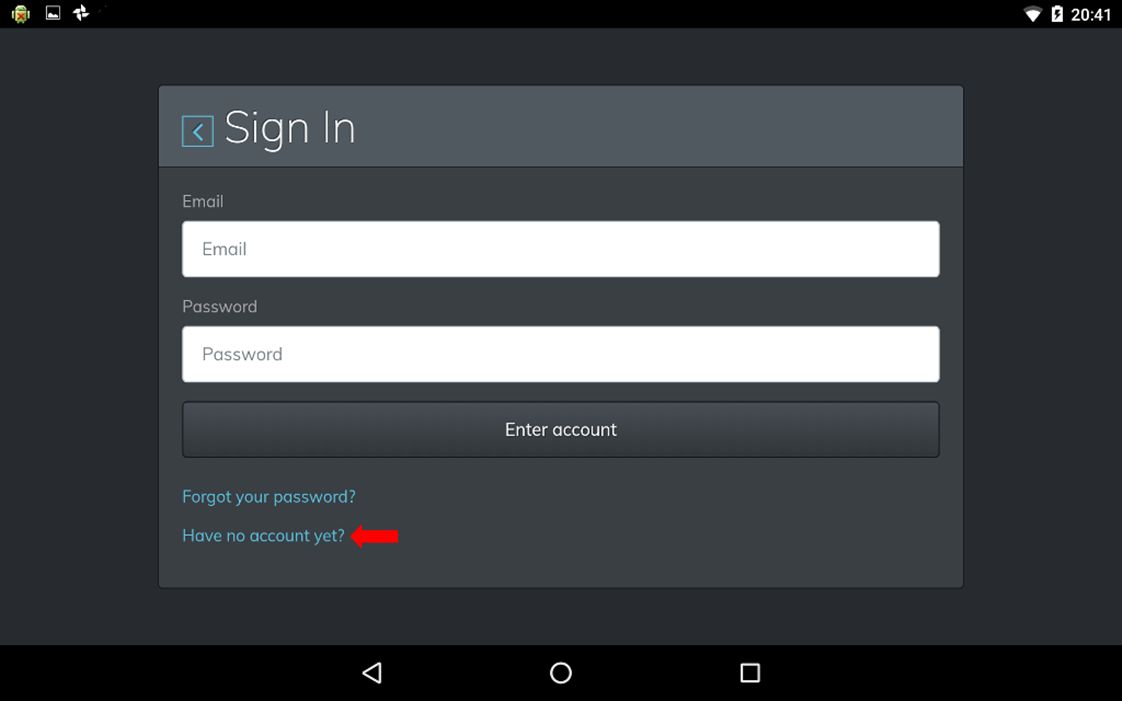
In order to use the app, you will need a Speedlight account, to which you can then link the Second Life avatar account(s) that are to be used with Speedlight (you can add and remove accounts as required). If you’ve previously created a Speedlight account via the Speedlight website, you’re good to go. If you don’t have a Speedlight account, the app will offer you the option of creating one through it.

You’ll need a Speedlight Account to use the app (in addition to your SL account) if you don’t have a Speedlight account when first using the app, you can see the Have No Account? link to create one

Those new so Speedlight will also then have to connect the avatar account(s) they wish to use with Speedlight. This is a on-time operation (unless you opt to remove an avatar account later). Link avatars to a Speedlight account is simple, and is covered in my article on the web browser version of the application (link below).

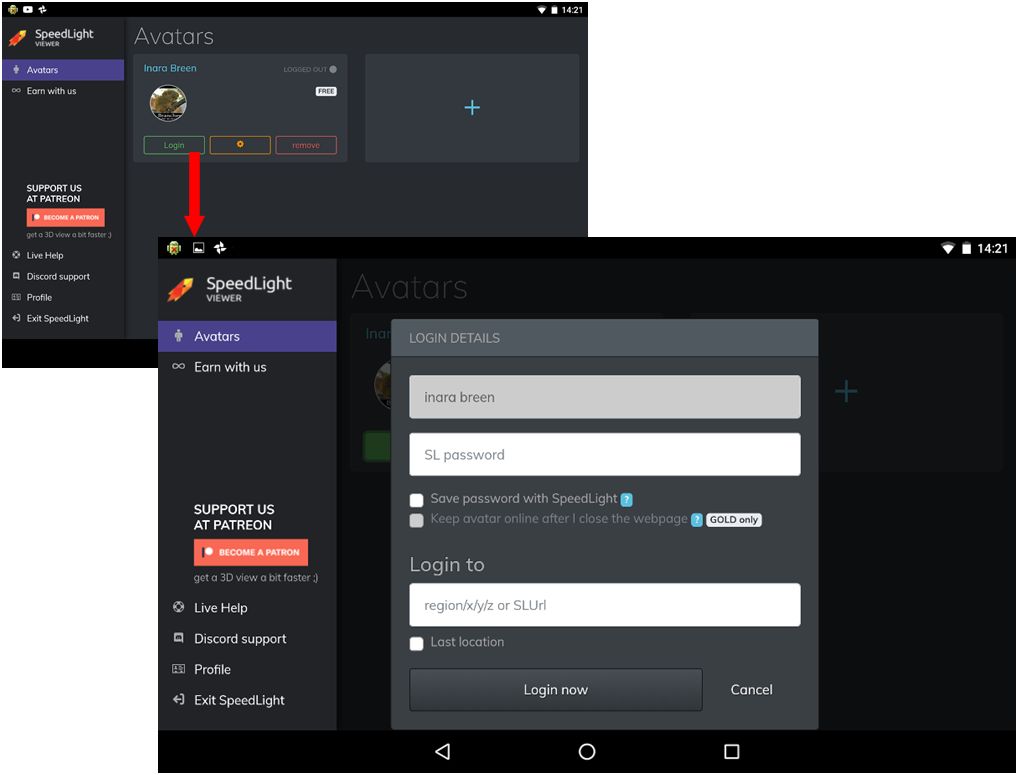
Those who already have avatar accounts link to their Speedlight account, will, on logging into the Speedlight Android app, be presented with a list of their available avatars (and can add more via the + panel if required. Tab the log-in button for the avatar that is to be used, and enter the required log-in credentials (you can optionally have the app save the credentials).

Logging-in to an SL avatar account via the Speedlight Android app

Once logged-in to Second Life via the app, note that:

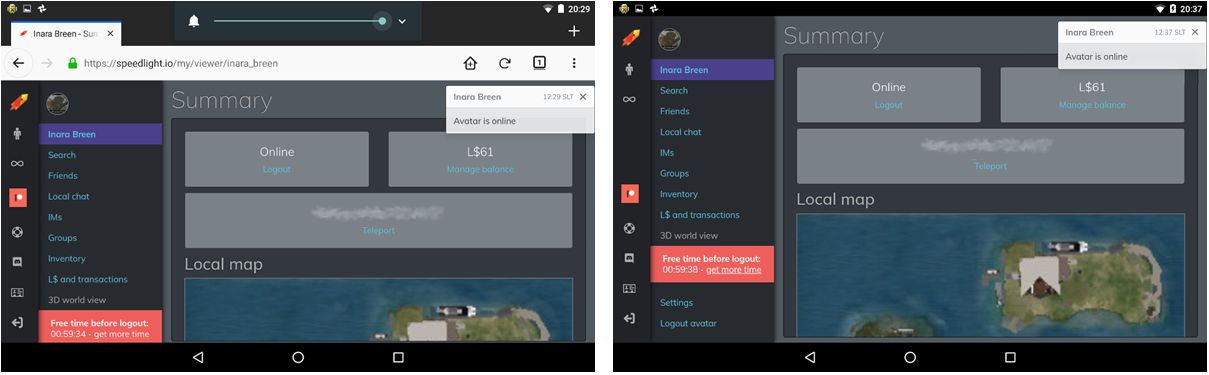
  • As with the browser version, Free account holders are limited to one hour of continuous log-in time before they must re-log, while gold subscribers can remain logged-in all the time, or until actually logged out or until the Speedlight app is closed.
  • The clock in the left menu column will advise you on the remained time before you may need to re-log or will be logged out.
  • The Speedlight menu on the left of the screen will switch to a set of icons, making room for your avatar menu, just as it does in the browser version of speedlight.
  • Minimising the app will not disconnect you, and you have the choice of:
    • Logging out of SL and leaving Speedlight active on your device.
    • Exiting Speedlight, both disconnecting you from SL and terminating the current app session on your device.
  • The application offers the same options for both Free and Gold account users as seen when running Speedlight in a web browser. The only difference between the two is the larger amount of screen real estate available to the application, as it does not require a browser tab.
  • Details on using the available options can be found in my article on using the web browser version (link below).
There is absolutely no difference is using Speedlight in a browser on a computer or mobile device (left) or via the dedicated Android app version (r), other than the latter doesn’t run in a browser tab (click for full size, if required)

Feedback

As light clients go, there is no faulting Speedlight. It does, as the saying goes, exactly what it says on the tin. If you’ve not seen it before, I do recommend reading Speedlight: access SL via a browser (incl. mobile devices) to get a more thorough overview.

Given the Android app gives an identical experience to running Speedlight through a web browser, whether you opt to actually install the app or not comes down to the choice between the convenience of a simple tap-to-launch (and potentially smaller memory footprint) the app brings, or being happy launching a browser and fiddling with URLs / bookmarks.

As noted above, the app offers the same capabilities as using Speedlight through a browser, and has the same seamless switching between devices (I was happily flicking between the app on my Nexus and browsers on both the device and on a PC without any issues or being logged out in more back and forth when using my test avatar account and playing with the app).

Still only text based for the time being, Speedlight is already a credible SL mobile solution, and I understand we’re now not that far from seeing the first iteration of its 3D world rendering.

Related Links

A return of Bryn’s Hand in Second Life

Bryn Oh: Hand

Bryn Oh first created Hand is Second Life in 2016. An immersive experience, it mixed art and storytelling with a touch of mystery and discovery.

Originally an installation that used Second Life Experience Keys, Hand recently transitioned to Sansar with the assistance of a grant from the Ontario Arts Council, and which I recently wrote about in Bryn Oh’s Hand in Sansar. That grant has also allowed Hand to once again be resurrected in Second Life.

In writing about Hand in 2016, I noted of the installation:

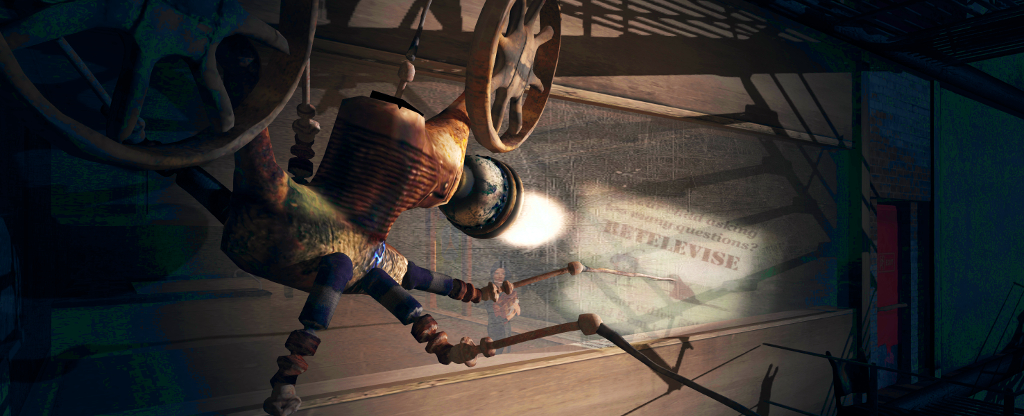
This [is a] journey takes us through a strange, broken urban setting with decaying, collapsing buildings; a place where adults are almost (but not entirely) absent, apparently leaving their children to fend for themselves. Technology is still active – drones  buzz around and project adverts on walls and floors for whoever might watch them – presumably as a form of currency / earning, and lights flicker and play. Walking through the streets and buildings there appears to be nods to dystopian sci-fi: a hint of Soyent Green here, a reference to rampant consumerism there. While Flit [the principal character] and the other children brought to mind shades of And The Children Shall Lead, minus the space alien angle.

Bryn’s Hand in Second Life, December 2016

Bryn Oh: Hand

This is still true, as is the use of Experience Keys to assist visitors, instructions for which are provided at the landing point. What is different with this iteration is that rather than using a teleport to reach the actual starting point of the story – Flit sitting in an underground station – visitors must find their way through a tunnel from one station to the next, where Flit is waiting.

From here visitors once again travel up the escalator and out into the the run-down setting of a city well past its prime. Here the story will unfold by finding, and following Flit as she appears at various points in the installation, either pointing the way through the story or ready for a chapter of it to be told. As you approach the latter, you should hear the narration (assuming you have local sounds enabled). However, if no audio is obvious, make sure local sounds are on, and touch the microphone alongside Flit.

Bryn Oh: Hand

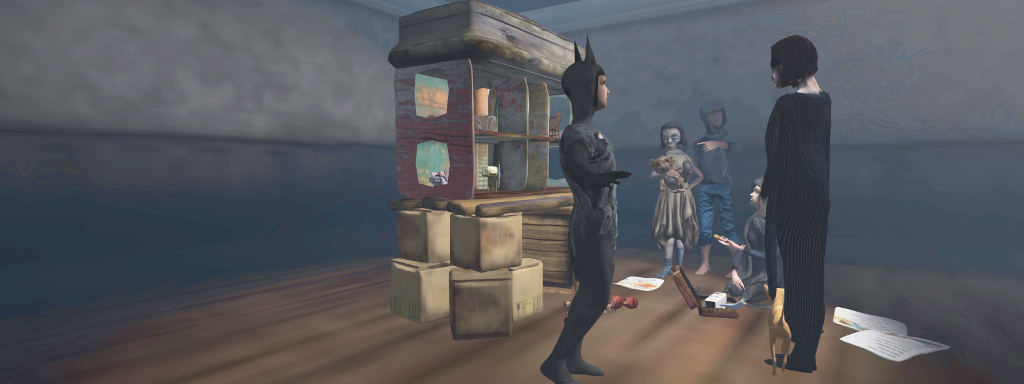
Aspects of the path through the story do require some care – making your way over tightrope-like planks and fallen towers for example, or climbing up piles of the detritus of humanity. Also, cleverly woven into the story are hooks to several other elements of  Bryn’s work – so don’t be afraid to touch things as you explore. Take the scene of the girl with the golden crown and her little entourage waiting to be found whilst exploring the rooms of the main building in the installation: touching the girl or the insects and creatures will offer you the chance to watch a video about The Girl with the Paper Crown.

Hand, whether visited in SL or Sansar – and a visit to both shows some of the core differences between the two – remains a captivating story, one that encourages us to fill-in the blanks through our own imaginations, adding to the richness of the tale Bryn tells through character, setting and the words of her narrator.

Bryn Oh: Hand

SLurl Details

  • Hand (Immersiva, rated: Moderate)

ALS Awareness Week 2020 in Second Life

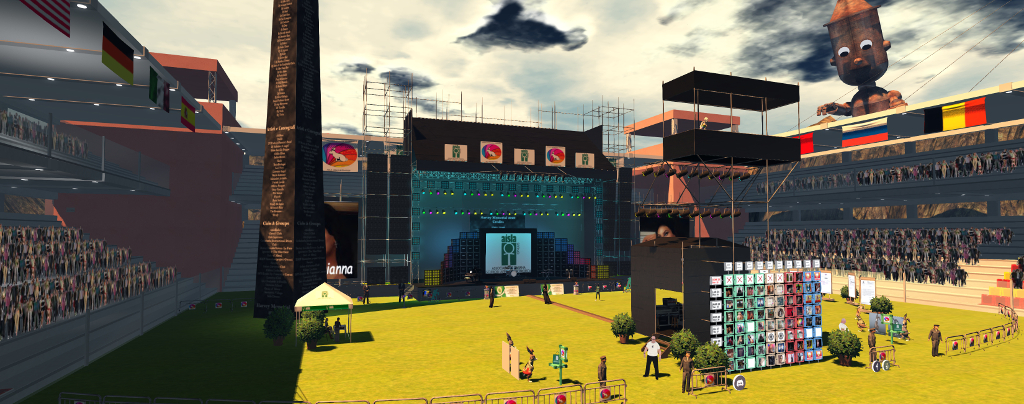
The ALS Awareness Week stage and dance area, 2020

The 2020 Harvey Memorial Ensemble ALS Awareness Week is taking place between Sunday, February 23rd and Sunday, March 1st, 2020.

Dedicated to the memory of ALS victim and Second Life resident Harvey22 Albatros, the week focuses on music and art, with both live performers and DJs offering sets, and a number of SL artists offering pieces for auction, with all proceeds as well as donations during the week going to AISLA, the Associazone Italiana Sclerosi Laterale Amiotrofica.

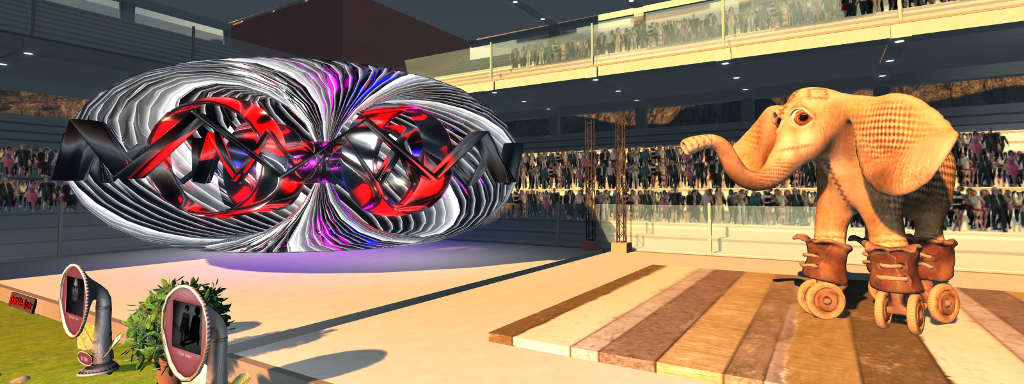
Art by Cica Ghost (foreground) and Solkide Auer

Amyotrophic lateral sclerosis (ALS), sometimes also referred to as motor neurone disease (MND) or by the synonyms Lou Gehrig’s disease and Charcot disease, is a specific disorder that involves the death of neurons that control voluntary muscles.

For about 90-95% of all diagnosed cases, the precise cause of the disease is unknown; for the remaining 5-10% of diagnosed cases, it is inherited from the sufferer’s parents. There is no known cure, and symptoms generally first become apparent around the age of 60 (or 50 in inherited cases). The average survival from onset to death is three to four years. In Europe and the United States, the disease affects about 2 people per 100,000 per year.

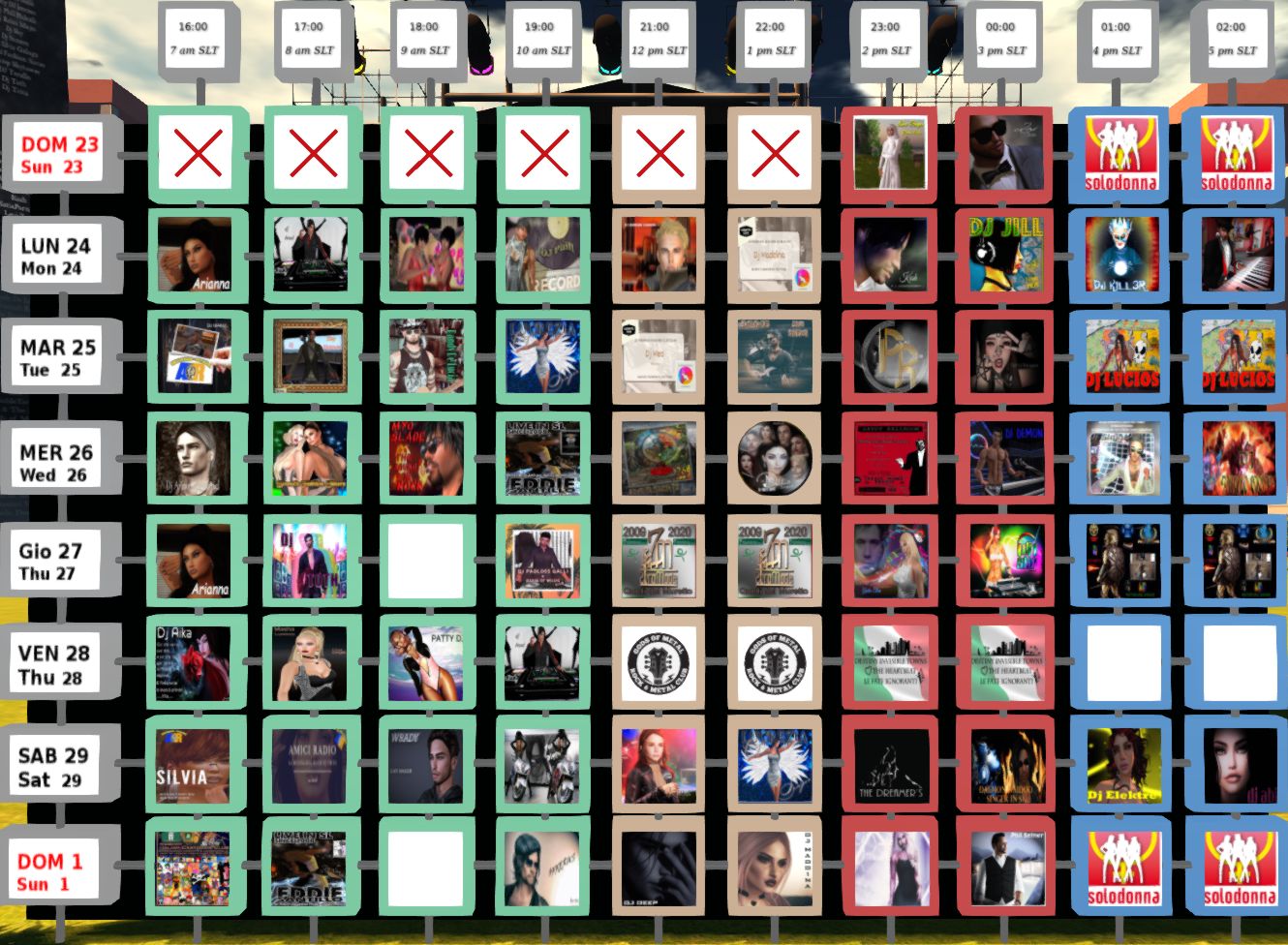
ALS Awareness Week 2020 schedule board

The Harvey Memorial Ensemble in Second Life features a daily schedule of music running from 07:00 SLT through to 18:00 SLT, comprising a mix of live performances and DJ sessions lasting between one and three hours. A schedule board (seen above) is available at the event location.

In addition, there is a special art auction taking place throughout the event, featuring 3D pieces donated by Solkide Auer, Cica Ghost, Mistero Hifeng and Bryn Oh. Those wishing to keep up with the event outside of Second Life can do so via the event’s Facebook page or Discord server.

SLuel Details