Logos representative only and should not be seen as an endorsement / preference / recommendation
Updates for the week ending Sunday, February 2nd
This summary is generally published every Monday, and is a list of SL viewer / client releases (official and TPV) made during the previous week. When reading it, please note:
It is based on my Current Viewer Releases Page, a list of all Second Life viewers and clients that are in popular use (and of which I am aware), and which are recognised as adhering to the TPV Policy. This page includes comprehensive links to download pages, blog notes, release notes, etc., as well as links to any / all reviews of specific viewers / clients made within this blog.
By its nature, this summary presented here will always be in arrears, please refer to the Current Viewer Release Page for more up-to-date information.
Note that for purposes of length, TPV test viewers, preview / beta viewers / nightly builds are generally not recorded in these summaries.
Official LL Viewers
Current Release version 6.3.6.535003 and dated January 22nd, promoted January 27th, formerly the Xanté RC viewer, – NEW.
Kindred Spirit, February 2020 – click any image for full size
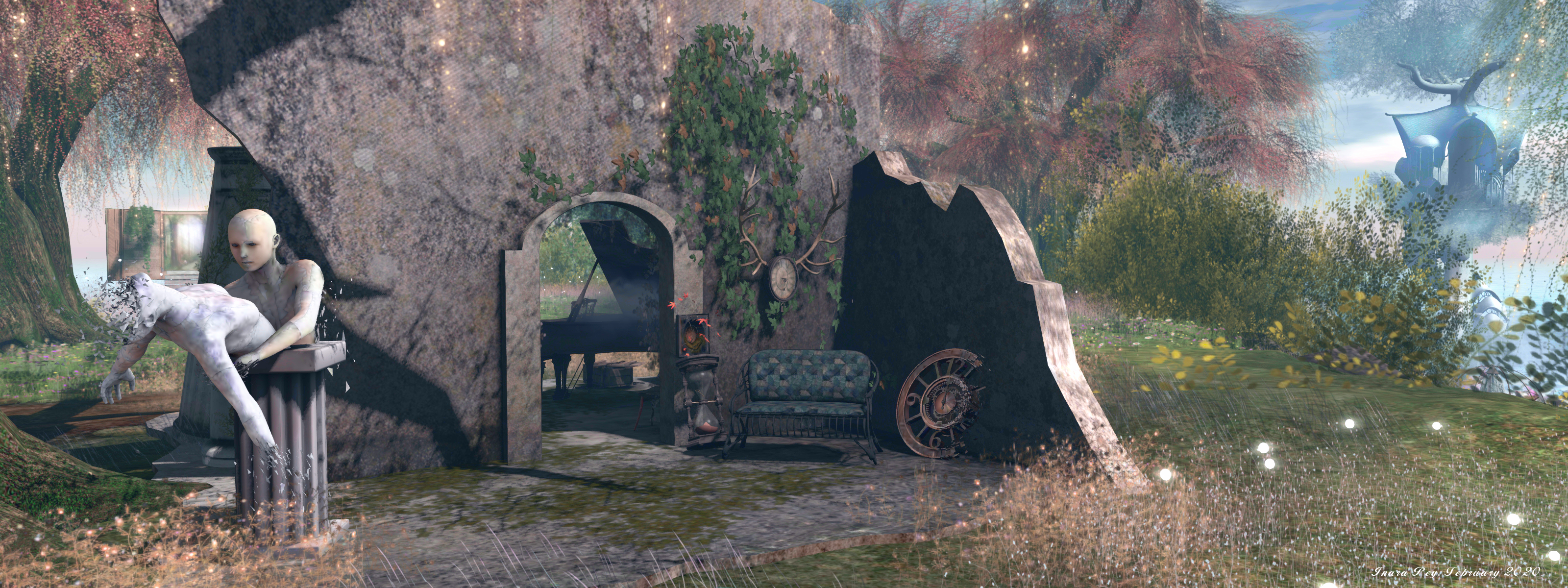
We dropped into Bart Bader’s Homestead region of Kindred Spirit at the weekend as we bounced around Second Life. It’s a place that has recently had a make-over, a Bart noted to me as we chatted while I took photographs in preparation for this article.
I did have it as a rural country sim, but returned to my love of Fantasy for this build. Every month I’ll be making small additions to keep it fresh. We’ve had a few of the Photo clubs using it for their challenges, so changing things up helps keep it fresh for them.
– Bart Bader, discussing Kindred Spirit
Kindred Spirits, February 2020
With the new design, Bart has created a setting that is eye-catching and imagination calling. The fantasy element is evident almost from the time of arrival, but in the must subtle of ways. The landing point, located towards the south-west corner of the region, sits at the end of a meandering track illuminated by ornate lighting posts that glow from within, the delicate forms of Noke Yuitza’s glass roses growing large to one side of the track, a crystal raised amidst ruins on the other. More fantasy elements await the opportunity to reveal themselves as visitor explore the region.
This is a place of multiple settings, each carefully separated from the rest to give a sense of space and privacy, all of them drawn together by landscaping and theme into a contiguous whole that draws visitors ever deeper into a feeling that they are in a mystical realm. Beyond a three-way bridge, for example, the path branches, one arm dipping down to the west where a ring of elven arches encircle a netted bed, while a second arm leads to a cliff edge sculpted by the fall of water from high pools to form arches, walkways and vantage points offering views to the east across the bay that cuts deeply into the landscape.
Kindred Spirit, February 2020
Here steps lead down to the very water itself, where tiles of flagstones raise their backs above the gentle waves, leading the way to a cavern below the cliffs – a place, Bart informed me, recently added as a part of refreshing elements of the build over time. The cavern, cliffs and their surrounds present multiple places to sit that in turn offer a captivating view to the eastern extent of the region of which more in a moment.
The region is split into two large islands linked by a single narrow bridge. The more northern of these islands continues the presentation of multiple settings ranging little track-side cosy spots to more hints of elven influence together with medieval twists – notably the low-lying ruins at the north-east headland of the island. To the east lies a marvellous grass-topped plateau to the east, home to the remnants of what might have once been a little chapel, but is now home to the first of a number of Mistrero Hifeng’s sculptures to be found within the region, and an aged piano.
Kindred Spirit, February 2020
To the eastern end of this almost garden-like setting stands a circular gateway with stone steps beyond forming a cleft that descends once more to water level, and what can only be described as the most marvellous water garden that dominates the eastern side of the island – and perhaps the region as a whole – with its beauty.
It is here that frosted trees raise their boughs to the sky as they in turn rise from the waters, forming an extended copse through which mist swirls and stepping stones wind. Awaiting discovery here are sculptures, statues, more of Yoke’s glass flowers, a little draped pavilion with winged chair and ornamentation and more, all watched over by another of Mistero’s statues sitting atop a winding stair. It is a place just made for photography, and with several places to sit and appreciate it scattered through out.
Kindred Spirit, February 2020
Standing tall over this quite beautiful setting, and at its easternmost extreme, there rises a tall tree. It is home to an elven platform reached by a covered stair that coils upwards around the tree trunk. Reached via a path passing beneath what can only be described as water splashes frozen in time to form a series of arches, the tree stands as if looking eastward across the Sundering Sea, awaiting sign of ships sailing from the far-off lands of Middle Earth to reach the hallowed lands of Aman, of which Kindred Spirit might be considered an offshore pairing of islands.
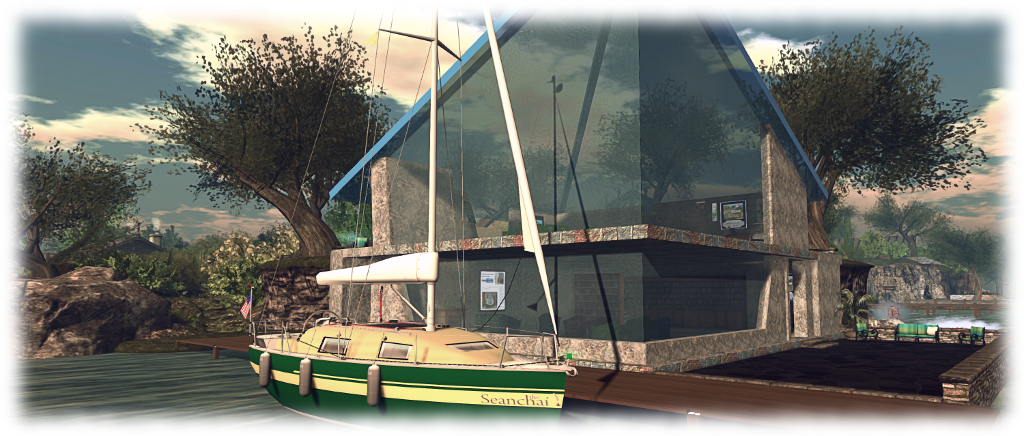
It is this water garden that so captivated me on looking outward from the southern island’s cliffs, and which I would suggest is the gem of this evocative region. However, the north island has one more setting – possibly easily missed when crossing the bridge if one is focused on following the track eastwards. Clearly revealed from the high elven platform and sitting on a low shelf of rock thrusting out into the bay is a glass pavilion (a Trompe Loeil design popular with region designers), fronted by a deck built out over the water. Home to the cosy bric-a-brac oft found in the presence of men and women, it is distinctly un-elven in look and feel, yet it fits the setting perfectly, not only offering another little setting-within-a-scene, but also reminding us that while Aman was the spiritual home for Tolkien’s elves, it was by no means exclusively so; and thus with the pavilion, Bart adds another delightful twist to the fantasy themes running throughout Kindred Spirit.
Kindred Spirit, February 2020
Now to be sure, there is a lot of mesh and textures used throughout the region which can impact performance, so disabling shadows when walking around or dropping draw distance might be advisable. However this is a small price to pay for spending time in what is, without a doubt, a captivating, utterly photogenic setting, one that calls on the imagine to take flight.
An artist’s impression of the CHEOPS observatory. Credit: ESA
On January 29th, 2020, the latest mission to study planets beyond our own solar system opened its eye to take a first look, in what is the start of a 3.5-year-mission to examine stars with known exoplanets.
The CHaracterising ExOPlanets Satellite (CHEOPS) a joint European / Swiss mission, was launched on December 18th, 2019 by a Soyuz-Fregat from Guiana Space Centre in Kourou, French Guiana, together with a number of other payloads. It forms the first of ESA’s new S-Class (Small Class) missions, capped at a maximum budget of €50 million apiece. It’s a small mission not just in terms of cost, but also in its physical size: CHEOPS measures just 1.5 metres on a side. Following launch, it entered a 700 km Sun-synchronous polar orbit.
The completed CHEOPS prior to being shipped for launch. The telescope cover is the circular gold element. Credit: ESA
Once there, initial testing of the satellite commenced. These first confirmed that communications between it and mission control were all working correctly. Once these had been thoroughly tested, the command was sent to boot-up the primary computer system so it could be run through a series of diagnostics before the primary science components were initialised. These tests also included the vehicle’s temperature control systems and the primary elements of the main telescope system – a 30 cm optical Ritchey–Chrétien telescope.
CHEOPS launched on December 18th atop a Soyuz Feegat rocket from Guiana Space Centre in Kourou
These initial commissioning tests culminated in the opening of the telescope’s primary baffle – otherwise known as its lens cap. This was the most critical aspect of the initial commissioning – if the the baffle failed to hinge open, the telescope would be unable to observe its target stars.
Fortunately, the opening went as planned, allowing the final set of tests to commence. Over the next couple of months, these will see CHEOPS take hundreds of images of stars – some with exoplanets, some without, in order to examine the measurement accuracy of the telescope systems under different conditions, and confirm its operating envelope. At the same time, this period of testing will also allow this mission team to further integrate all aspects of ground operations. Again, if all goes according to plan, some of this first light images will be released by the CHEOPS science team, and the end of the tests will see the telescope commence its primary operations.
While thousands of exoplanets have been discovered, few of them have been accurately characterised in terms of both mass and diameter. This limits our ability to fully assess their bulk density, which is needed to provide clues to there composition and their possible formation history.So to help us gain better data, CHEOPS will accurately measure the size of known transiting exoplanets orbiting bright and nearby stars. These are planets that cause dips in the brightness of their parent stars as they pass between the star and Earth.
By targeting known systems, we know exactly where to look in the sky and when in order to capture exoplanet transits very efficiently. This makes it possible for CHEOPS to return to each star on multiple occasions around the time of transit and record numerous transits, thus increasing the precision of our measurements and enabling us to perform a first-step characterisation of small planets.
– Willy Benz, CHEOPS principal investigator
The transit method offer a “direct” means of detecting exoplanets, but it is not the only option open to us. A second method, generally referred to as the radial velocity method, or Doppler spectroscopy, can detect planets “indirectly”, by directing the doppler shifted “wobble” in a star’s motion. Around 30% of all exoplanets have been detected by this method, but it can be somewhat less informative than the transit method. This being the case, another aspect of the telescope’s mission will be looking at stars where orbiting planets have been detected via the radial velocity method in an attempt to detect the planets by the more direct transit method and again, by repeated observations, allow scientists to start to characterised them.
As a whole, CHEOPS will be particularly focused on exoplanets characterised as “super-Earths” – those thought to be between Earth and Neptune in size, many of which may well be solid in nature. While it will be able to characterise these exoplanets with a new level of precision, its work will pave the ways for follow-up observations in the future by telescopes like the James Webb Space Telescope (JWST – operating in the infra-red), and by large ground-based telescopes like the 40m Extremely Large Telescope currently under construction, allowing them to both refine the CHEOPS data and add to it.
It’s time to highlight another week of storytelling in Voice by the staff and volunteers at the Seanchai Library. As always, all times SLT, and events are held at the Library’s home unless otherwise indicated. Note that the schedule below may be subject to change during the week, please refer to the Seanchai Library website for the latest information through the week.
Sunday, February 2nd 13:30: Tea-Time Special: Death on the Nile
First published in 1937, Death on he Nile is one of Agatha Christie’s most famous and enduring Hercule Poirot murder mysteries. The book has been the subject of multiple theatrical, film and television adaptations, most of which had by necessity condensed elements of this tale of love, jealously, and betrayal to more readily fit the requirements of their format.
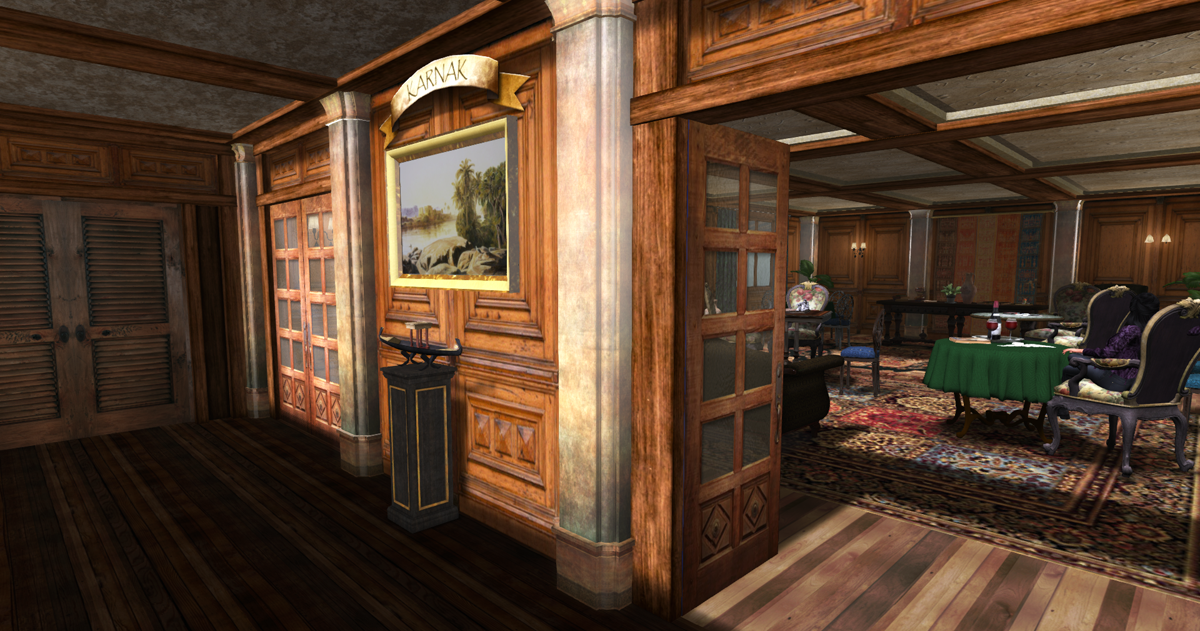
Over the next six weeks, Seanchai Library presents the opportunity to enjoy the story in full – and within a setting inspired by the novel, as Corwyn Allen, Da5id Abbot, Kayden Oconnell, Gloriana Maertens, and Caledonia Skytower bring Christie’s characters once more to life for us to enjoy.
Seanchai Library: Death on the Nile
Monday, February 3rd 19:00: Out of the Silent Planet
The first novel in C.S. Lewis’s classic sci-fi trilogy which tells the adventure of Dr Ransom who is kidnapped and transported to Mars
In the first novel of C.S. Lewis’s classic science fiction trilogy, Dr Ransom, a Cambridge academic, is abducted and taken on a spaceship to the red planet of Malacandra, which he knows as Mars. His captors are plotting to plunder the planet’s treasures and plan to offer Ransom as a sacrifice to the creatures who live there. Ransom discovers he has come from the ‘silent planet’ – Earth – whose tragic story is known throughout the universe…
Join Gyro Muggins for more.
Tuesday, February 4th 19:00 The Daughter of Odren
For fourteen years, Weed, as she is called, the daughter of Lord Garnet, has brought offerings to the standing stone. Alone in a shallow valley, she implores the stone not to forget her. To remember who he is and the life he led. To wait until the day he will be avenged.
Now the day has finally arrived. After fourteen long years of waiting, he will have his revenge and she will have her father back.
Caledonia Skytower reads selections from Erin Morgenstern’s novel.
Deep beneath the surface of the Earth and upon the shores of the Starless Sea, lies a network of tunnels and rooms filled with stories and tales. The ways into this secret place are many, but hidden, and perhaps set for just one individual to find. They exist where least expected: on the floors of forests, behind doors inside private homes or around alleyway corners or within mountain caves – almost anywhere in which they cannot be anticipated.
Zachary Ezra Rawlins is searching for his door, though he does not know it. He follows a silent siren song, an inexplicable knowledge that he is meant for another place.
When he discovers a mysterious book in the stacks of his campus library he begins to read, entranced by tales of lovelorn prisoners, lost cities, and nameless acolytes. Suddenly a turn of the page brings Zachary to a story from his own childhood impossibly written in this book that is older than he is…
Thursday, February 6th, 19:00 A Pocketful of Crows
am as brown as brown can be,
And my eyes as black as sloe;
I am as brisk as brisk can be,
And wild as forest doe.
(The Child Ballads, 295)
So begins a beautiful tale of love, loss and revenge. Following the seasons, A Pocketful of Crows balances youth and age, wisdom and passion and draws on nature and folklore to weave a stunning modern mythology around a nameless wild girl.
Only love could draw her into the world of named, tamed things. And it seems only revenge will be powerful enough to let her escape.
Beautifully illustrated by Bonnie Helen Hawkins, this is a stunning and original modern fairytale.
With Shandon Loring. Also in Kitely – grid.kitely.com:8002:SEANCHAI).
Now open at La Maison d’Aneli, curated by Aneli Abeyante, is an exhibition that sees artists both familiar and perhaps new to followers of art in Second Life, displayed within a new layout for the gallery space.
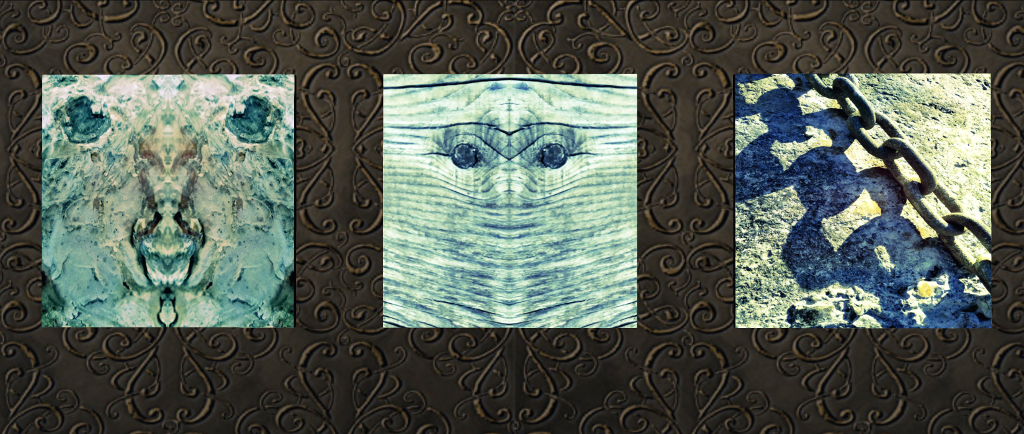
The untitled exhibition features the work of JadeYu Fhang, Eylinea, Gaston Wonder, Vroum Short, Adwehe, and Aneli herself, five of whom present pieces of a distinctly digital nature, with Gaston Wonder providing a balance with photography grounded in the physical world.
La Maison d’Aneli, February 2020 – Gaston Wonder
In describing his work, Gaston notes:
I find it interesting the way we have to interpret Art, we are all different, we did not have the same feeling while looking at an Art object or a photo, I don’t care about the rules for Arthas no limit, there are no things better than others, there is only one emotion specific to each.
His work, often focusing on the inorganic – wooden planks, chains, wood and stones on a beach, a broken wall and more – offers a marvellous glimpse into the organic world, the lay of metal and shadow, chain against background, grain and knot of wood forming facial features, sometimes almost human, sometimes alien or even insect-like. Each evokes familiarity that in turn generates a focused emotional response.
La Maison d’Aneli, February 2020 – Vroum Short
Next to Gaston, Eylinea is a relative newcomer to Second Life, an environment that that encouraged her to explore artistic expression through digital mediums. Here she displays a series of pieces, a selection of which are animated, and all of which sit within abstraction and expressionism. Her work is reflected across the hall by Aneli’s exhibition, which offers further animated abstractions together with pieces that suggest they have been formed from copper beating as modern expressionism.
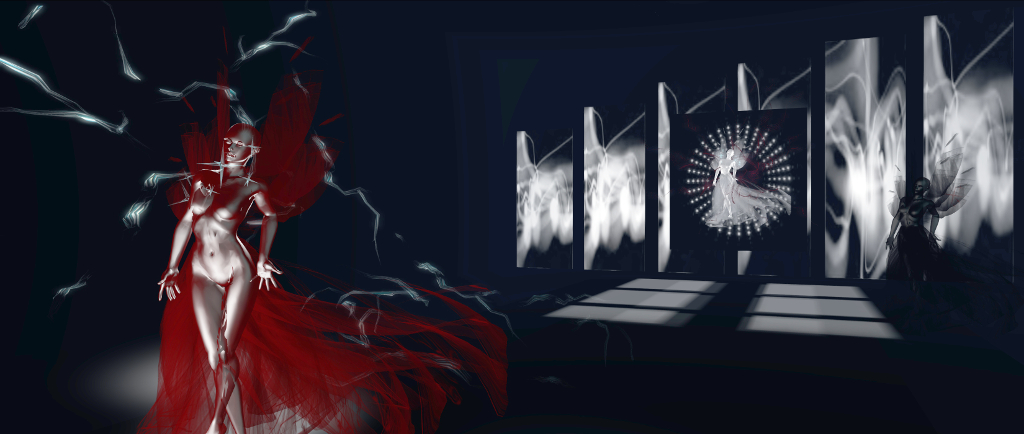
Making up the four displays on the lower floor, Yadeyu Fhang offers an immersive space, that once again presents a surrealism environment that deliberately cross the line between the physical and the digital. Yadeyu notes she is often influenced by the work of Kubrick and Lynch, and there is evidence of that here, together with a touch of French noir through the use of monochrome and lighting.
La Maison d’Aneli, February 2020 – Adwehe
On the upper floor of the gallery space, Vroum Short presents a further immersive space, rich in colour and form, suggestive of he undersea environments or an alien landscape alive with plants. Adwehe is another relative newcomer, and – while I’m not sure – this might be their first exhibition. Featuring both 2D and 3D pieces, it’s an expressive display, one in which Adwehe acknowledges the support and influence of Vroum and her work at VeGeTaL PLaNeT.
A half-dozen fascinating displays by six fascinating artists.
Florence at Low Tide, February 2020 – click any image for full size
In September 2018, we visited Florence Bay, a homestead region held by Gnaaah Xeltentat and Tomaso Franizzi and landscaped by Minnie Atlass (see A rendezvous with Florence Bay in Second Life). The island was designed as a mix of public / private spaces, with both Gnaaah and Tomaso have their homes located there. It was a charming, eye-catching setting, and we thoroughly enjoyed spending time exploring it – so it was with a sense of anticipation we accepted an invitation from Gnaaah to visit the latest Homestead setting he’s offering to the public as a destination.
Designed and built by Iska (sablina), Florence at Low Tide presents a wholly new design that maintains some of the rugged wildness of Florence Bay whilst moving the setting very much more southwards than that build, placing the region more in keeping with it’s name, as it carries a strong Mediterranean theme.
Florence at Low Tide, February 2020
The land has a distinct north-south orientation, with the southern lowlands offering a shale foreshore cut by stream that tumbles down from the northern uplands and a waterfall that drops from a truncated peak in the north-est corner of the region. With the west side of the region separated from the rest by a narrow channel spanned by two solid bridges, the region offers a Tuscan look with the houses and buildings to be found either side of the bridges.
Chief among the buildings is a large villa with a south-facing aspect, its terraced swimming pool overlooking the receding tide to the south, where the exposed shale is home to a – temporarily – beached fishing boat and numerous rowing boats that sit on the grey stones or are surrounded by reeds as they manage to keep a measure of water about them. Behind this villa sits a bar with an outdoor music space, it and the small house beyond it separated from the local petrol station by the narrow road that runs around a portion of the setting, offering an easy means of exploration.
Florence at Low Tide, February 2020
That the tide is out is again revealed by the channel splitting the region. The height of the bridges, coupled with the sheer sides of the channel walls suggests that when the tide is in, much of this little gorge sits underwater. Such is the lie of the land to the north-west, it would appear that the lighthouse sitting out on the low headland is in fact cut off from the rest of the island once the tide does come in.
The lighthouse looks across the bay to the high peak that feeds the waterfalls and stream to the east. At the time of our visit, this area was still being worked on by Iska, so aspects may yet change (land capacity allowing). Across the bridge, the road passes a field of sunflowers and the gates to a little chapel perched on a shoulder of the hills, the stream curling and churning down the slopes around it.
Florence at Low Tide, February 2020
From here it is possible to climb the rocks up to the large pool sitting at the foot of the waterfalls, feeding the stream. There are a couple of adjustments to the stream sections that could be made here, but they can easily be ignored in a trek up to the pool and then back down the far bank of the stream.
Below the stream as it turns past the chapel, the road loops around an orchard watched over by a vineyard and a stone-built farmhouse that sits like a centre point within the region, commanding views out over the southern shores and west towards the rest of the little village.
Florence at Low Tide, February 2020
Through all of this, there’s a lot of small details waiting to be found. These range from a trio of little sailing boats fashions from little pieces of wood to boules at the bar, going by way of the local cat community – some of which are taking a very keen interest in the region’s bird population.
Caught under a late afternoon sky, rich with ambient sounds and opportunities to sit in and around the houses (and in some of the rowing and motor boats), Florence at Low Tide makes for another charming visit, rich in opportunities for photography and simple exploration. Our thanks to Gnaaah for the invitation to drop in.







 Inara Pey: Living in a Modemworld