2019 Simulator User Group week #48 summary

Fox Road, October 2019 – blog post

Simulator Deployments

Please refer to the server deployment thread for news and updates:

  • On Tuesday, 26th November, servers on the Main SLS channel were updated with server maintenance release 2019-11-15T21:13:13.532828, previously deployed to a release candidate channel. It comprises:
    • Improves crash detection during shut-down.
    • Fixes some race conditions with LSL scripts that could cause them to handle the same event more than once during a roll.
    • Includes updates to improve simulator security.
  • On Wednesday, 27th November, there should be a single RC deployment 2019-11-19T22:26:38.532992, which is functionally the same build as 532828, but compiled using updated server build tools.
    • Given the issues with Tuesday deployment (see below) the status of the deployment was in a state of flux at the time of writing.

Tuesday Deployment Issues

The Tuesday server updates required an extended deployment window, together with more restarts of the updated simulators than is usually the case. Given the simulator version had been deployed to RC servers in week #47, the issues encountered with the deployment took LL by surprise:

This is one of those situations where we are left trying to figure out what went so wrong; we don’t know of changes that would have caused this much churn. That is the big difference between our Tuesday and Wednesday updates. Tuesday is more than 2x bigger, and divided up differently. Seeing something happen and knowing why it happened are two completely different things. Given that last week was OK, I suspect it is a scaling problem however.

The real frustration is that there isn’t a good way to test or simulate the scale where the issues happen. Updating one or two servers can be perfectly fine; but then do a few hundred and something goes up in smoke.

– Simon Linden, commenting on the November 26th deployment issues

Currently, the Lab is digging into what may have gone wrong (e.g. by checking server logs, etc.). They have already tracked down what might be a contributing factor, but the overall root cause analysis will take time. However, as the issues appears to be with the deployment process itself rather than the updated simulator code, at this point in time it is unlikely the simulator update will be rolled back.

SL Viewer

The following viewers were updated during the latter half of week #47:

  • November 22nd:
    • The Wassail Maintenance RC viewer updated to version 6.3.5.533043.
    • The Project Muscadine (Animesh follow-on) project viewer, version 6.4.0.532999.
  • November 20th

The remainder of the viewers in the current pipelines are as follow:

  • Current Release version 6.3.4.532299, formerly the Ordered Shutdown RC viewer, dated November 4th, – No Change.
  • Release channel cohorts:
  • Project viewers:
    • Legacy Profiles viewer, version 6.3.2.530836, September 17th. Covers the re-integration of Viewer Profiles.
    • 360 Snapshot project viewer, version 6.2.4.529111, July 16th.

Name Changes

  • There are concerns over how long names might be cached within services, how changes might be tracked by external databases (e.g. customer lists for things like redelivery terminals), etc.
    • To help ensure user-developed tools, etc., can keep up with Name Changes, Linden Lab plan to offer a REST API (REpresentational State Transfer) that can be used to perform a name<-> avatar key translations and that will always return the same key for any name an account has ever had, and the key will always return the current name.
    • Creators are again reminded that their products and tools should utilised the avatar agent key, no avatar names.
  • LSL enquiries on agent key will return the current name for an avatar, not any past name(s).
  • There was concern that Name Changes could lead to issues in tracking griefers. However, as was pointed out in the meeting:
    • There are fees associated with Names Changes – signing-up to Premium and then for each change. These are unlikely to find appeal with griefers.
    • Griefers already create multiple accounts, and this will remain likely remain their preferred means of causing upset.
  • BUG-216397 “llName2Key, llRequestUserKey both accept a lone “R” as a surname for “Resident” agents” has been raised with the Lab again, and has been marked for inclusion in the next internal maintenance fix for Name Changes.
  • Once again, a “fee” figure was mentioned at the Simulator User Group meeting (US $20) – but it is important to note this is only a guess on the part of a user, and not any form of statement from Linden Lab. So If you hear it anywhere in the next month or so, ignore it.

Artistry at THE EDGE in Second Life

THE EDGE Art Gallery: Artistry – Ladmilla and Eli

Open through until December 23rd 2019 at THE EDGE Art Gallery, curated by Ladmilla, is the gallery’s final exhibition for the year. Entitled Artistry, it is again an ensemble exposition, bringing together an interesting mix of talents and a stirring of 2D and 3D art, with images from both the virtual and physical realms.

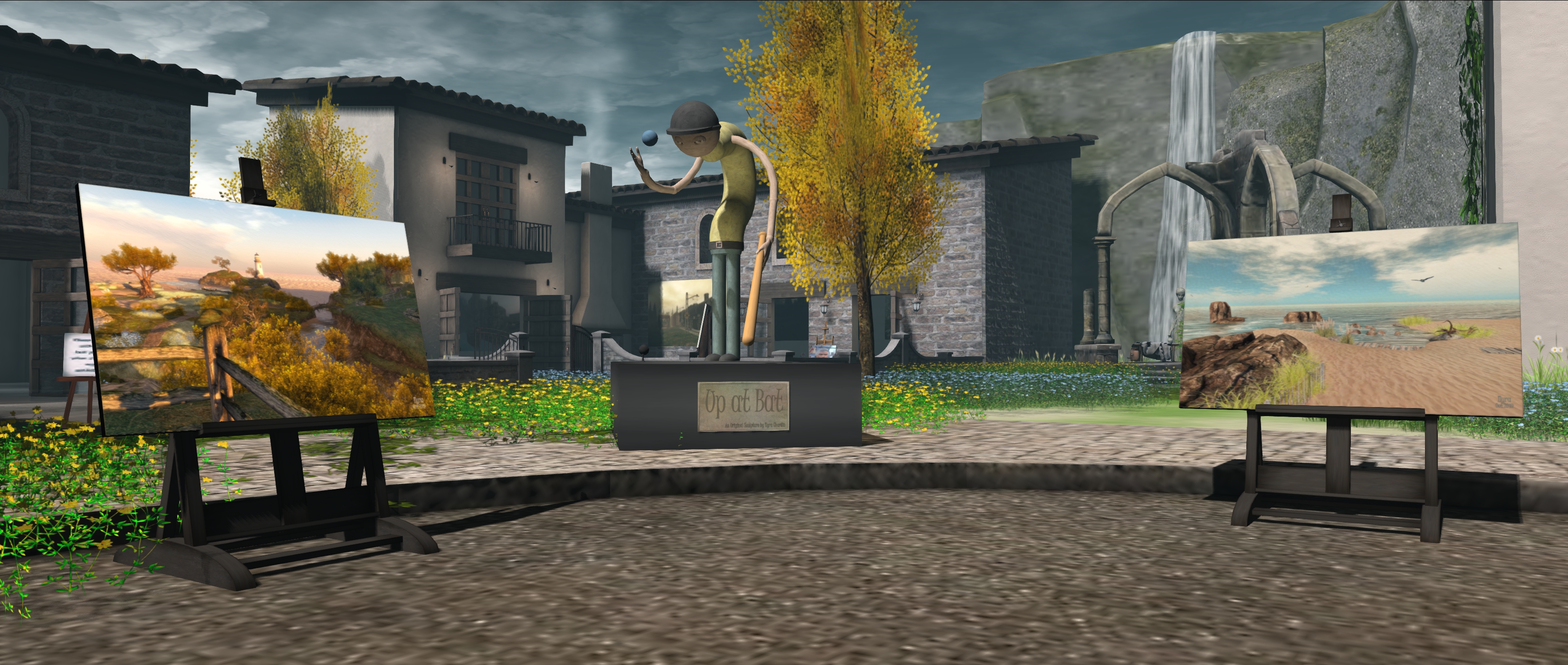
In all, eight artists present displays at the gallery, their number rounded-out by a further display of art by Lamilla herself, accompanied with words by her Second Life partner, Eli Medier. As usual, the majority of the artists participating in this session display their art within the gallery’s individual Tuscan-style houses set around the gallery’s grounds / gardens, with Ilyra Chardin presenting her pieces within the garden itself.

THE EDGE Art Gallery: Artistry – Ilrya Chardin

It is the latter that mixes 2D and 3D art, with Ilyra’s 2D digital mix media, most of which originate with photos taken within Second Life, sharing the space with six very distinctive pieces of mesh sculpture.

Two artists making a return visit to THE EDGE having been a part of the September / October ensemble exhibition at the gallery are Davenwolf Dagger and Loegan Magic.

THE EDGE Art Gallery: Artistry – Davenwolf Dagger

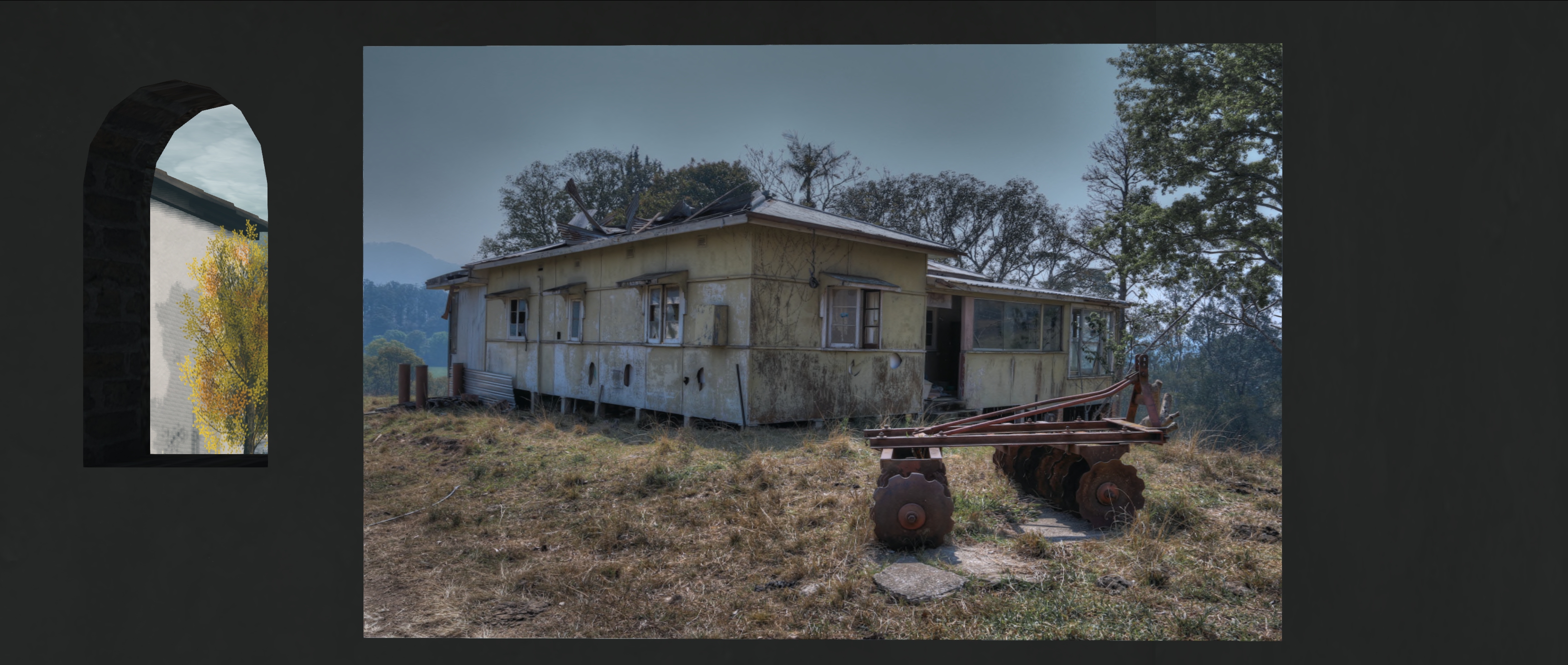
As I’ve admitted to in past articles on his work, I’m something of a fan of Davenwolf’s evocative photography, in which he captures physical world locations in the most captivating way, and through his pictures, weaves a pictorial narrative. With Broken Dreams, he takes this a stage further, combining words with his images (please read the text panels before examining the art) to present a haunting story of a once-loved house and home (and a place which now, thanks to Australian bush fires, may no longer exist).

With Simple Things, Loegan offers more of his enticing looks at Second Life, offering a marvellous selection of focused images that convey stories about the digital spaces in which we chose to spend so much of our lives – but which also contain within them moods and thoughts that extend beyond the digital and into the physical, thus tying the two together in an elegant reflection of how our physical and digital lives intertwine.

THE EDGE Art Gallery: Artistry – Loegan Magic

Through Out of the Mist, Thomas Crown simply presents as series of images of Second Life that offer unique glimpses of this world through his eyes, and the landscapes and residents that bring it to life. And by “residents”, I’m not referring to avatars; a world is brought to life as much by its animals and wildlife and even by the vehicle humans have created to assist them in their travels through the places they inhabit. So it is these “residents” – wild fowl, horses, steam trains, boats, and cattle, to which I refer and which are evocatively portrayed here.

Avatars are very much the focus of Tresore’s From Dark to Light, in which she presents her avatar in a variety of story-laden setting and styles from period to fantasy and back, in which colour – notably red and black – play as much a role in many of the pieces as her avatar’s pose and style of dress. Colour and depth are also very much present to great effect in Raging Bells’ untitled selection of SL photographs, offering as they do a sense of the richness of life and opportunity within this virtual realm.

THE EDGE Art Gallery: Artistry – Raging Bells

I admit to not having to have previously come across Zia Branner’s work in Second Life, or that of BigZee. Zia is a physical world artist who constructs marvellous images through the use of acrylics (mainly on canvas) together with structure paste, gel, sand, glue, bandages and paper, and perhaps oil crayons and acrylic ink to accentuate parts of a an image. Held under a layer of mat or gloss varnish, this gives such pieces a sense of physical texture that is clearly evident when presented through a digital medium like SL. BigZee meanwhile, presents images from Second Life that offer their own sense of texture and life through his use of especially vibrant and attention-grabbing colours.

In Shadows, Ladmilla and Eli round-out the exhibition with a series of very tonal images by Ladmilla combined with words by Eli. Utterly captivating in their own right, the narrative in each image is given even greater depth and poignancy through Eli’s words as they perfectly amplify the mood and feeling exuded by each piece.

THE EDGE Art Gallery: Artistry – Zia Branner

As always with THE EDGE, a fascinating selection of art and artistry.

SLurl Details

Bellisseria extension: new homes theme takes shape(?)

What form might the upcoming Linden Homes theme take? We don’t yet know – but it would appear new regions in support of them are being developed / tested by the Lab

As those who follow the development of the “new” Linden Homes are already aware, a further theme is due to be previewed at the RFL SL Christmas Expo, and it appears that when released, this will take the form of a large-scale increase to Bellisseria’s southern extent.

This year Linden Lab, the Society’s partner in the fight against cancer, is joining the 9th Annual SL Christmas Expo. Not only will Linden Lab be decorating Linden homes as part of the Lights of Hope contest but the Expo will be the venue of the BIG REVEAL!  The long-anticipated ALL NEW Version 4 LINDEN HOMES will be UNVEILED at the Lights Of Hope!  Expo visitors will be treated with the newest premier member homes as well as some very VERY Special Linden surprises and incentives!

– from the announcement of the 9th SL Christmas Expo

The additional regions can be seen in the Bellisseria development / test SSP continent. If I’m honest, in their current form, that look like an artificial, rectangle-like bolt-on to the more organic form of the original continent – but this may well change as the new expansion grows over time. It this, it has something of the “bolt-on” feel of the original Houseboat expansion.

The new Linden Homes SSP extension regions

What’s interesting about the new extension, however, are the individual parcels. These are somewhat different to those seen with the Traditional Homes and Houseboats. Also, whereas the Traditional Homes sit alongside what are clearly roads, the profiles of the houses in the extension regions not only have a different outline, that also appear to be built around a different style of road / footpath.

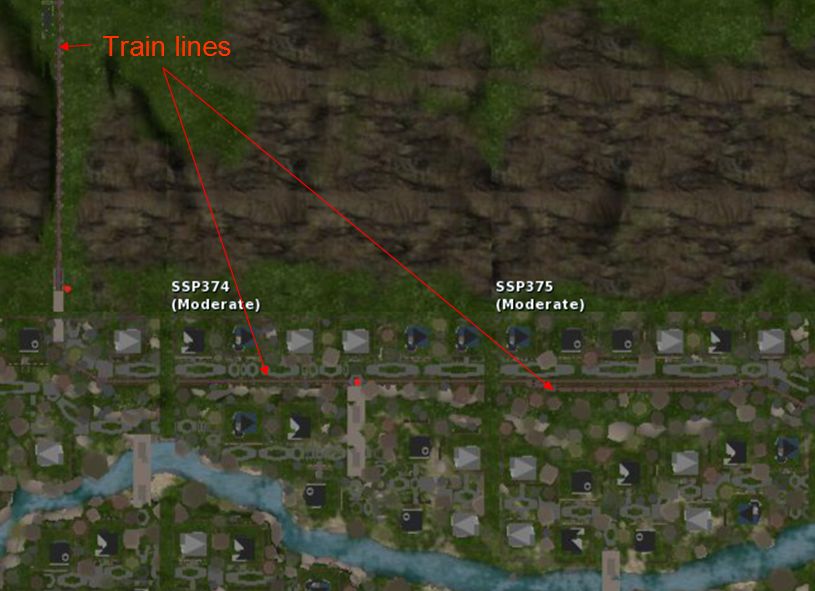
Nor is that all. The south extent of the existing regions of Bellisseria show the continent’s railway line passing through a cutting in the mountains and onward into the new regions.

The Traditional Homes parcels in Bellisseria (l) compared with a parcel from the extension – note the different house profiles and road / footpath elements

The extension of the railway lines tends to demonstrate that – as promised – they will be a prominent feature of the continent and the new Linden Home theme. On the flip side, the new regions do not appear to include Houseboats – which might disappoint some – but they do appear to offer beach houses and island homes.

In his SL16B Meet the Lindens session, Patch Linden indicated that there are likely to be commercial opportunities arising in Bellisseria – at the time suggesting one of these opportunities might come with the Trailers and Campers. Such opportunities have yet to appear, and whether or not they will as a part of the eventual deployment of the new Bellisseria extension (whenever that happens) remains to be seen.

Within the development / test regions, the Bellisseria railway lines appear to be a core part of the new extension’s infrastructure

Another point of interest with the SSP development regions is the demarcation of a series of SSPXT regions (located to the east of the main continent and shown in teal or green). It’s not clear what these are to be, but one guess is perhaps the green regions will be shaped into outlying islands, and the teal regions might form some kind of archipelago. Then again, they might be something else entirely – time will tell as to whether they stay and are developed (and become clearer) or not.

In the meantime, and beyond the promise of previewing them at the 2019 SL Christmas Expo, it’s not clear when the new Linden Homes theme will become available – but doubtless, many are watching the SSP development regions with interest. However, those wishing to obtain one of the new homes – whether Premium or not – might want to enter the Christmas Expo’s One Of A Kind (OOAK) auction – on offer is a 6-month Premium subscription and one of these new Linden Homes provided on a specially designed parcel, and with extras. See EPIC OOAK Linden Home Auction @ 2019 SL Christmas Expo for more on this.

2019 viewer release summaries week #47

Logos representative only and should not be seen as an endorsement / preference / recommendation

Updates for the week ending Sunday, November 24th

This summary is generally published every Monday, and is a list of SL viewer / client releases (official and TPV) made during the previous week. When reading it, please note:

  • It is based on my Current Viewer Releases Page, a list of all Second Life viewers and clients that are in popular use (and of which I am aware), and which are recognised as adhering to the TPV Policy. This page includes comprehensive links to download pages, blog notes, release notes, etc., as well as links to any / all reviews of specific viewers / clients made within this blog.
  • By its nature, this summary presented here will always be in arrears, please refer to the Current Viewer Release Page for more up-to-date information.
  • Note that for purposes of length, TPV test viewers, preview / beta viewers / nightly builds are generally not recorded in these summaries.

Official LL Viewers

  • Current Release version 6.3.4.532299, formerly the Ordered Shutdown RC viewer, dated November 4th, – No Change.
  • Release channel cohorts:
    • Wassail Maintenance RC viewer updated to version 6.3.5.533043 on November 22nd.
    • EEP RC viewer updated to version 6.4.0.532771 on November 20th.
  • Project viewers:
    • Project Muscadine (Animesh follow-on) project viewer updated to version 6.4.0.532999, November 22nd.
    • Copy / Paste viewer updated to version 6.3.5.532860 on November 20th.

LL Viewer Resources

Third-party Viewers

V6-style

V1-style

Mobile / Other Clients

  • No Updates

Additional TPV Resources

Related Links

Winter’s blanket at The Four Seasons in Second Life

The Four Seasons, November 2019 – click any image for full size

Elyjia Baxton has a long association with regions designs in Second Life, be it those of her own, or those created with Brayan26 Friller, and I’ve been fortunate to cover a number of them in these pages. In 2018, she produced Snow Falls, a winter wonderland rich in detail (and later to become A Way of  Life – see: Enjoying some Snow Falls in Second Life and A Way of Life in Second Life). Now, for 2019, she has (with Brayan’s involvement) returned to the theme of Snow Falls, turning her current Homestead region The Four Seasons into another winter wonderland.

It’s a setting that has a certain Scandinavian feel in that the region is intended to be surrounded by tall, snow-capped mountains which, together with the crystal clear (and cold-looking) waters, bring to mind a location sitting within a deep fjord.

The Four Seasons, November 2019

I say “intended”, because the region seems to be a victim of BUG-225295, which can make whether or not a region surround rezzes something of coin toss. During our first visit, we saw the region entirely sans surround, for example, and when I returned to take the photos seen here, it only popped-up when I was well into the second hour of my visit, despite several attempts on my part to force it to rez.

However, whether or not the surround pops up for you is actually  – to me – neither here nor there; the region is attractive in its own right with our without the frame of mountains ringing it. In fact, I’d go so far to say that I found the lack of the surround allowed more of the colours evident in the region’s windlight setting to be better reflected within the region itself – as I hope is apparent in the majority of the photos in this article.

The Four Seasons, November 2019

Certainly, the lack of the surround, should it fail to rez for you, doesn’t actually detract from the beauty of the region, which is a wonderful mix of a low-lying landscape running south to north from the landing point, and Arctic-looking waters that cut into it to form channels and bays frozen into stillness by the cold, and on which snow is in places lying.

The landing point, with its parade of shops, offers the suggestions that beyond it, there just might be a bustling town, while the land to the north, with its wooden cabins, stone-build pavilion and gazebos and timber church, speak to the “rural” outlying regions of that town; a place where winter brings with it a sense of Yuletide spirit and celebration by means of crisp walks in the snow and cuddles under blankets before open braziers.

The Four Seasons, November 2019

From the shops and landing point, a rutted, snowy track points the north, an invitation to set forth and explore and visit places like the timber chapel, the pavilion and Santa in his gazebo. Along the way, there is plenty of detail to appreciate, from foxes to snowmen to reindeer and more. Rowing boats bravely left out on the water now sit frozen in place, offering more places to sit and appreciate the landscape.

This is very much a place that puts one in the winter spirit: the weather has been handled such that just looking at the setting makes you want to bundle up in warm clothes before going out into the snow and exploring – to the degree that I felt my avatar was positively under-dressed in jeans, shirt and western boots and at risk of catching a nasty cold!

The Four Seasons, November 2019

As well as following the main path around the region,  there’s also the opportunity to head westwards from the landing point and visit a glass-sided pavilion where shelter from the weather might be found in front of a decorated tree (although a little fireplace would help add to the appeal!). Meanwhile, across the first bridge and off to the east, a cosy little cabin offers a similar refuge from the cold, warmed by a cast iron stove.

Rounded-out by a soft sound scape over which a slightly mournful bell slowly tolls (perhaps bringing to mind the words of John Donne), The Four Seasons offers a rich, wintertime setting for the time of year, with many opportunities for photography. Those taking pictures may like to consider submitting them to the region’s Flickr group.

The Four Seasons, November 2019

With thanks to Shawn for the pointer to the region!

SLurl Details


Space Sunday: Europa’s water and a Starship’s mishap

An artist’s impression of what the 2012 water plume might have looked like if seen from the vicinity of Europa. Credit: NASA / ESA / M. Kornmesser.

What has long been suspected has likely now confirmed: water is present under the ice of Jupiter’s moon Europa.

As I’ve noted on numerous occasions in this space Sunday articles, it’s long been thought that an ocean of water exists under the cracked icy crust of Europa, potentially kept liquid by tidal forces created by the moon being constantly “flexed” by the competing gravities of Jupiter and the other large Moons pulling on it, thus generating large amounts of heat deep within its core – heat sufficient to keep an ocean possibly tens of kilometres deep in a liquid state.

Europa’s internal structure, showing the subsurface ocean that could be up to 100 km deep

Circumstantial evidence for this water has already been found:

  • During its time studying the Jovian system between 1995 and 2003, NASA’s Galileo probe detected perturbations in Jupiter’s magnetic field near Europa – perturbations scientists attributed to a salty ocean under the moon’s frozen surface, since a salty ocean can conduct electricity.
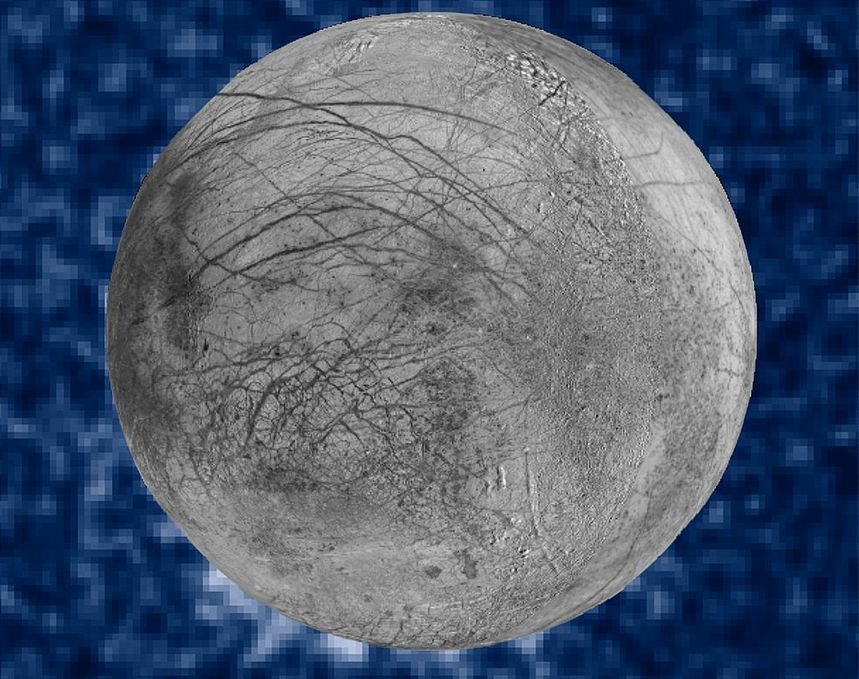
  • In 2012 the Hubble Space Telescope (HST) captured an image of Europa showing what appeared to be a plume of water vapour rising from one of the many cracks in Europa’s surface – crack themselves pointed to as evidence of the tidal flexing mentioned above. The plume rose some 200 km from the moon.
  • In 2014, HST captured images of a similar plume rising some 160 km above Europa.
A composite image showing suspected plumes of water vapour erupting from Europa at the 7 o’clock position, as imaged by the Imaging Spectrograph on the Hubble Space Telescope in 2014. They rose 160 km, and are believed to have come from the sub-surface ocean. Note that the image of Europa is superimposed on the original, and comprises a mosaic of images taken by the Galileo and Voyager missions. Credit: NASA, ESA, W. Sparks (STScI), and the USGS Astrogeology Science Centre

Now a new paper, A measurement of water vapour amid a largely quiescent environment on Europa, published on November 18th, 2019 in Nature, offers the first direct evidence that water is indeed present on Europa. Specifically, the team behind the study, led by US planetary scientist Lucas Paganini, claims to have confirmed the existence of water vapour on the surface of the moon.

Essential chemical elements (carbon, hydrogen, oxygen, nitrogen, phosphorus, and sulphur) and sources of energy, two of three requirements for life, are found all over the solar system. But the third — liquid water — is somewhat hard to find beyond Earth. While scientists have not yet detected liquid water directly, we’ve found the next best thing: water in vapour form.

– Lucas Paganini

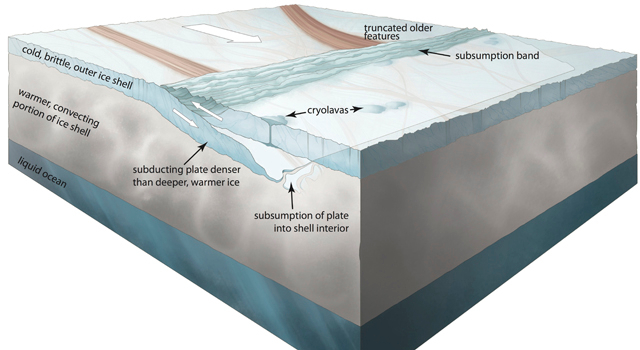
Evidence of plate tectonics have been found on Europa, again pointing to the influence of tidal flexing. This conceptual illustration shows the subduction process where a cold, brittle, outer portion of Europa’s 20-30 km thick ice shell moved into the warmer shell interior and was ultimately subsumed. This resulted in a low-relief subsumption band at the surface in the overriding plate, alongside which cryolavas containing water vapour may have erupted. Credit: Noah Kroese, I.NK

Using the W.M. Keck Observatory in Hawaii, Paganini and his team studied Europa over a total of 17 nights between 2016 and 2017. Using the telescope’s spectrograph, they looked for the specific frequencies of infra-red light given off by water when it interacts with solar radiation. When observing Europa’s leading hemisphere as it orbits Jupiter, the team found those signals, estimating that they’d discovered sufficient water vapour to fill an Olympic-size swimming pool in a matter of minutes. However, the discovery has been somewhat tempered by the fact water may only be released relatively infrequently.

Such infrequent releases help explain why it has taken so long to confirm the existence above Europa, but there are other reasons as well. The components that comprise water have long been known to exist on the moon whether or not they indicate the presence of water. Thus, detecting these components within a plume doesn’t necessarily equate to the discovery of water vapour – not unless they are in the right combinations. There’s a further pair of complications in that none of our orbital capabilities are specifically designed to seek signs of water within the atmospheres of the other planets or expelled from icy moons. So Earth-based instruments  – like the Keck telescope spectrographs – must be used, and these deal with the naturally occurring water vapour in our own atmosphere.

Within Paganini’s team there is confidence that their findings are correct, as they diligently perform a number of checks and tests to remove possible contamination of their data by Earth-based water vapour. Even so, they are the first to acknowledge that close-up, direct studies of Europa are required – particularly to ascertain if any water under the surface of Europa does form a globe-spanning ocean, or if it is confined to reservoirs or fully liquid water trapped within an icy, slushly mantle. It is hoped that NASA’s Europa Clipper and Europe’s JUICE mission (both of which I’ve “previewed” in Space Sunday: to explore Europa, August 2019) will help address questions like this.

Continue reading “Space Sunday: Europa’s water and a Starship’s mishap”