Logos representative only and should not be seen as an endorsement / preference / recommendation
Updates for the week ending Sunday, July 14th
This summary is generally published every Monday, and is a list of SL viewer / client releases (official and TPV) made during the previous week. When reading it, please note:
It is based on my Current Viewer Releases Page, a list of all Second Life viewers and clients that are in popular use (and of which I am aware), and which are recognised as adhering to the TPV Policy. This page includes comprehensive links to download pages, blog notes, release notes, etc., as well as links to any / all reviews of specific viewers / clients made within this blog.
By its nature, this summary presented here will always be in arrears, please refer to the Current Viewer Release Page for more up-to-date information.
Note that for purposes of length, TPV test viewers, preview / beta viewers / nightly builds are generally not recorded in these summaries.
Official LL Viewers
Current Release version 6.2.3.527758, formerly the Rainbow RC viewer dated June 5, promoted June 18 – No change.
Release channel cohorts:
Bakes on Mesh RC viewer updated to version 6.3.0.529185 on July 11th.
Love Me Render viewer updated to version 6.2.4.529065 on July 9th.
Kokua updated to version 6.2.3.45800 (non-RLV) and 6.2.3.45801 (RLV variants) on July 12th (release notes).
V1-style
No updates.
Mobile / Other Clients
Lumiya is currently unavailable through Google Play – see my article and update here. However, it remains available to new users (or can be re-purchased if urgent) via SlideMe.
NASA’s official Apollo 50th anniversary logo. Credit: NASA
This week sees the 50th anniversary of the Apollo 11 lunar landing. To mark the event, this Space Sunday article and the next will look at that mission, and the three men who flew it.
Part 1: “Lift-of We Have Lift-off!”
On Wednesday, July 16th, 1969, at 13:31:51 UTC (9:31:51 EDT) five Rocketdyne F-1 at the base of Saturn V SA-506 came to life. Starting with the centre motor, then the opposing outboard pairs, the entire ignition sequence took 600 milliseconds. Held on the pad by four massive clamps, called hold-down arms, the five engines gradually built up thrust to 35,100 kN (7,891,000 lbf).
At precisely 13:32:00 UTC) (9:32:00 EDT) the huge hold-down-arms rocked back in a “soft release”, allowing the rocket, weighing almost 3,274 tons, to start its ascent, its acceleration slowed for the first half-second by a series of 8 pins connecting it to the pad to “reduce transient stresses resulting from abrupt disengagement of a vehicle from its launch stand”. When these pins dropped free from the base of the rocket, Apollo 11 was on its in a historic mission that would seen humans land on the Moon for the first time.
Saturn V SA-506, the Apollo 11 launch vehicle, is rolled out to Pad A at Launch Complex 39 at Kennedy Space Centre, May 20th, 1969
The two men destined to be the first to set foot on Earth’s natural satellite were Neil Alden Armstrong, just shy of his 39th birthday, and Edwin Eugene “Buzz” Aldrin Jr., who had turned 39 in January 1969, sat atop of the massive Saturn V rocket along with Command Module Pilot, Michael Collins, the youngest of the three (if only by a couple of months). Together, they formed only the second Apollo flight crew where all three men had previously flown in space (the first having been Apollo 10, the “dress rehearsal” mission for the Moon landing).
Armstrong, Aldrin and Collins were also perhaps the most technically competent trio on NASA’s astronaut roster at the time. All had served in the military – Armstrong in the US Navy, Aldrin and Collins in the US Air Force. Both Armstrong and Collins had also built up impressive résumés as test pilots, Armstrong as a civilian and Collins in the US Air Force.
In particular, Armstrong flew with the National Advisory Council for Aeronautics (NACA), NASA’s forebear, prior to being selected for the USAF/ NASA high-altitude X-15 research programme, (he flew the X-15 seven times between late 1960 and mid-1962) whilst simultaneously engaged by the USAF in their X-20 Dyna-Soar space plane project. Collins, meanwhile, took part in high-altitude flights, taking F-104 Starfighter jets to 27.7 km (90,000 ft) in order to experience the “weightless” environment of free-fall at the top of their parabolic flight arcs, helping him to achieve 3,000 hours in the cockpit.
An unusual portrait in black and white of Michael Collins, Edwin “Buzz” Aldrin and Neil Armstrong. Credit: NASA (this image was later colourised on numerous occasions by various artists)
As well as being aviators, Armstrong and Aldrin were also academics. Armstrong held a BSc in aeronautical engineering and an MSc in aerospace engineering, and Aldrin has a doctorate in astronautics. Aldrin particularly specialised in on-orbit rendezvous, which allowed him to work on Project Gemini as an engineer (and also earned him the nickname “Dr. Rendezvous” , not always meant kindly, by other astronauts).
Despite their qualifications, both Armstrong and Aldrin almost didn’t get selected for NASA’s astronaut programme: neither had the requisite military test pilot qualifications that were initially required. However, in 1962, NASA dropped the “military” element from the test pilot requirement, enabling Armstrong to apply for the Group 2 intake – although he almost missed the cut. his application arrived after the closing date, but fortunately Dick Day, a simulations engineer at NASA who have previously worked with Armstrong saw the application and made sure it was included.
Aldrin’s break came in 1963, when NASA further revised the requirements to test pilot OR 1,000 hours flying jets. This allowed he to re-apply (his first application having been turned-down due to his lack of test pilot experience), and he was invited to join the Group 3 intake alongside Michael Collins.
At 2 minutes 41 seconds into its flight, the S-IC first stage of Apollo 11 separates, four small separation motors pushing the upper stages way from it, prior to the S-II second stage main engines to ignite
A Saturn V launch is perhaps one of the most stunning sights to witness – and Apollo 11 was witnessed by around 1 million people in and around the Kennedy Space Centre. However, for the first part of their flight, the three men were pretty much passengers as the Saturn V rose into the sky.
For all their power, the five F-1 engines took 12 seconds to overcome the 100.6 m tall rocket’s mass and inertia and push it clear of the 120m tall Launch Umbilical Tower (LUT), angling it very slightly away from the tower in the process so to avoid the risk of any wind-driven contact between the two.
Immediately after clearing the tower, the rocket commenced its “roll”, a necessary manoeuvre in which the vehicle rolls around its vertical axis, allowing it to point itself along the line of flight it needs to achieve the required orbit. After that, things started to move quickly.
A minute after launch, the Saturn V was around 6.5 km (3.5 nautical miles) altitude and passing through the sound barrier. Twenty seconds later, it entered “Max Q”, the period of maximum dynamic pressure, placed on this frame as a result of it literally punching its way through the atmosphere.
At this point, the F-1 engines throttled back a little to prevent the vehicle shaking itself apart, but once through “Max Q” – a period of only a handful of seconds, they returned to full thrust, pushing the vehicle up to 62 km (42 mi) above the Earth, and taking only 2 minutes 41 second from launch to do so. At this point, and travelling at 9,960 km/h (6,164 mph), the huge first stage separated, the upper stages of the Saturn 5 pushed clear by a set of four separation motors.
From here, the four motors of the second stage took over. While the massive first stage coasted upwards behind it and then fell back to crash into the Atlantic ocean, the Second stage ran for 6 minutes, accelerating the rocket to 25,000 km/h (15,647 mph) and lifting it to an altitude of 175 km (109 mi).
With its fuel spent, the second stage separated, also to fall back to the Atlantic, while the single, re-usable engines of the all-important S-IVB stage took over. This stage initially ran for about 2.5 minutes, during which time it pushed Apollo 11 to a velocity of 27,900 km/h (17,432 mph), allowing it to assuming a near-circular orbit around the Earth averaging 184 km 98.9 na mi) before shutting down for the first time.
It was at this point that the three crew took a more pro-active role in the flight. For the next couple of hours, as they completed 1.5 orbits of the Earth, and in tandem with mission control, they confirmed their vehicles were ready to be committed for the flight to the Moon.
A diagram of the Saturn V Apollo launch vehicle.Credit: NASA
Interestingly, while mission commander, Armstrong had actually clocked less time in space than either Collins or Aldrin. However, he had the greatest experience in handling in-flight emergencies, having dealt with the first in-flight failure of a critical system during a US space mission.
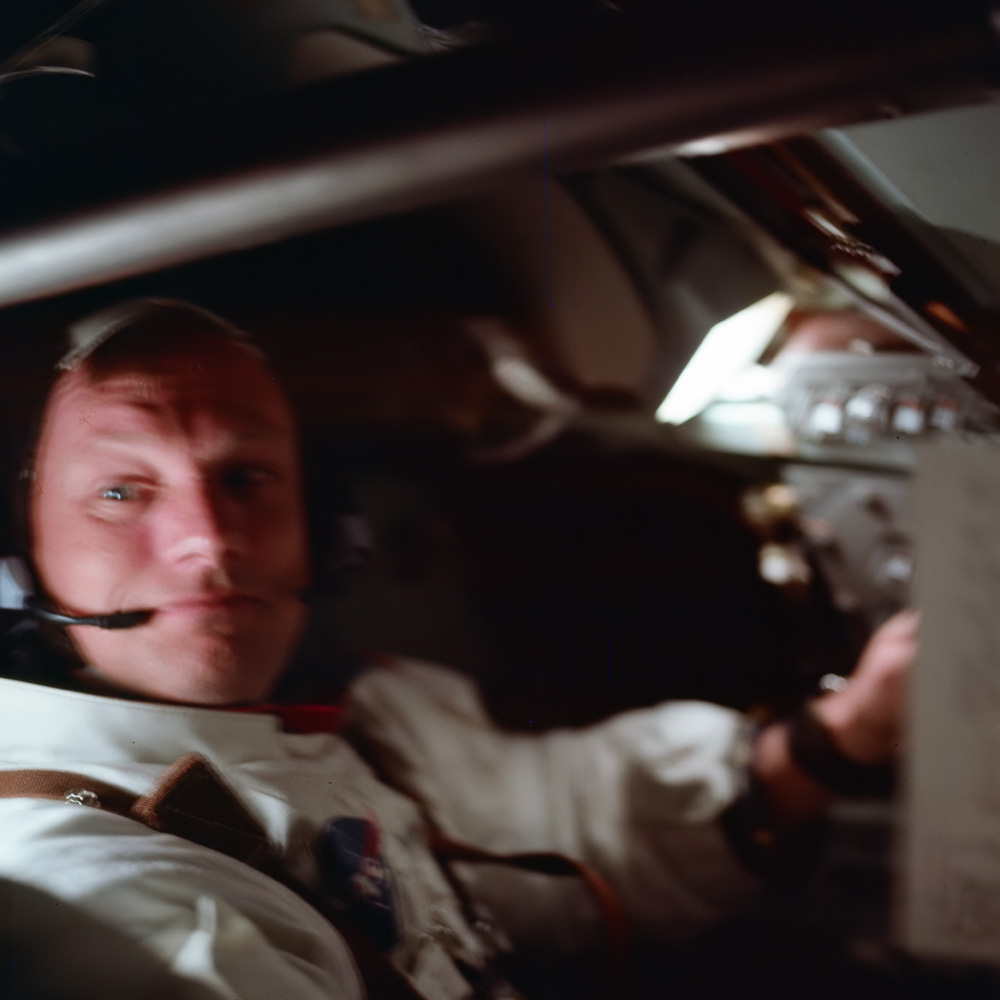
Neil Armstrong photographed by Buzz Aldrin as the crew prepare for TLI – trans-lunar injection. Credit: NASA / E.E. Aldrin
This occurred during his flight flight into space on the Gemini 8 mission, alongside David R. Scott. This mission was intended to be the first test of an orbital docking between two vehicles – Gemini 8 and an automated Agena target vehicle. In all, Armstrong and Scott were expected to complete four such docking as a part of the mission objectives.
However, shortly after docking, the Gemini’s Orbit Attitude and Manoeuvring System (OAMS) has suffered a serious failure, and Armstrong ordered Scott to release the docking mechanism before before vehicle broke up. Once free of the Agena (which was later stabilised by ground control allowing it to be used by Gemini 10 with Michael Collins), Armstrong took the took the unorthodox step of shutting down the OAMS and using the Re-entry Control System (RCS) to regain control. While this worked, undoubtedly saving his and Scott’s lives, under mission regulations, they no option but to immediately perform and emergency return to Earth, curtailing the mission.
Back aboard Apollo 11, their checks complete, the crew received the all clear for the critical trans-lunar injection (TLI) burn. This started mid-way through the second orbit of Earth, as the S-IVB motor was restarted and fired for 5 minutes and 47 seconds, accelerating the vehicle to around 40,085 km/h (25,053 mph), and pushing it away from Earth and into an energy-efficient trajectory towards the Moon.
As Michael Collins carried out the transposition, docking and extraction manoeuvre, either Aldrin or Armstrong took this image of the Lunar Module (LM) sitting in the top of the Saturn V S-IVB stage, awaiting the Command and Service Module (CSM) to dock with it and gently pull it free of the upper stage. Credit: NASA
It’s time to highlight another week of storytelling in Voice by the staff and volunteers at the Seanchai Library. As always, all times SLT, and events are held at the Library’s home at Holly Kai Park, unless otherwise indicated.
Sunday, July 14th 13:00: Tea Time with Jeeves
Just for summer, Seanchai Library takes a dive into the world of Reginald Jeeves, a well-educated, intelligent valets of indeterminate age who is employed by the amiable young man-about-town, Bertie Wooster, whom Jeeves routinely has to benignly rescue from the consequences of his idiocy.
Created by author, humorist, and lyricist (working with Guy Bolton and Jerome Kern) Pelham Grenville Wodehouse (October 1881 – February 1975), Jeeves and Wooster are perhaps his most iconic characters, their adventures eventually growing to 35 short stories and 11 novels, the majority of which are first-person narrated from the perspective of Bertie Wooster.
In Jeeves and the Hard-Boiled Egg things get very turned around as – once again – things go sideways, thanks to the relative of one of Bertie’s friends.
Set in New York, the tale sees Bertie visited by his friend “Bicky” Bickersteth, who is in something of a panic. Bicky has been living off of an allowance supplied to him by his uncle, the Duke of Chiswick – the condition being that Bicky use the allowance to improve himself financially, which he hasn’t found particularly appealing. Now his uncle is coming to New York to see just how well he is doing.
At Jeeves’ suggestion, Bertie and Bicky hit on a plan: Bicky will pretend to own Bertie’s apartment and Bertie will pose as his valet. To ensure things don’t get too out of hand, Jeeves will take on the role of Bicky’s visiting friend.
Things start out well enough: the Duke of Chiswick arrives and is duly impressed with the apartment and Bicky’s apparent success. Perhaps a little too well: the Duke has decided that since Bicky is doing so well, he doesn’t actually require any allowance.
From here, confusion steps in, involving chickens, handshakes-for-money, and a touch of blackmail; but it all leads to a satisfactory outcome, one that also includes the loss of a moustache that has caused some distress…
Join Da5id Abbot, Kayden Oconnell, and Caledonia Skytower as they read this delightful series at Ceiliuradh Glen.
Frost is seen in summer and ice patches form in spite of the hot Australian sun. To the Happy Folk, living on the continent’s green edges, the frost is a reason to laugh and joke. For the Inlanders (Wrightson’s fantasy view of the Australian Aboriginals), however, the frost was once seen as a warning that an ancient foe, the ice-bearded Ninya, were on the rise – and so it might be that they are again.
The first to recognise the rise of the old threat is young Wirrun of the People. He leaves his job and sets out to meet the Ninya, taking with him as a sidekick, the petulant Mimi, and for protection, the Power bestowed by the first of the creatures in their path.
To assist in his quest, Wirrun sends for the men from Mount Conner to sing the Ninya down and keep them in their caves. But he must also beat the Ninya to the Eldest Nargun, source of fire, and use it to hold the Ninya until the men from Mount Conner arrive. And so his adventure begins.
Tuesday, July 16th 19:00: The Penderwicks in Spring
Springtime is finally arriving on Gardam Street, and there are surprises in store for each member of the family. Some surprises are just wonderful, like neighbour Nick Geiger coming home from war. And some are ridiculous, like Batty’s new dog-walking business.
Batty is saving up her dog-walking money for an extra-special surprise for her family, which she plans to present on her upcoming birthday. But when some unwelcome surprises make themselves known, the best-laid plans fall apart.
Filled with all the heart, hilarity, and charm that has come to define this beloved clan, The Penderwicks in Spring is about fun and family and friends (and dogs), and what happens when you bring what’s hidden into the bright light of the spring sun.
Dive into Jeanne Birdsall’s classic revisiting to the lives of the Penderwicks, read by Caledonia Skytower.
Wednesday, July 17th: The Faraway Nearby
In this exquisitely written personal, lyrical narrative about storytelling and empathy, Rebecca Solnit explores the ways we make our lives out of stories, and how we are connected by empathy, by narrative and by imagination.
In the course of unpacking some of her own stories – of her mother and her decline from memory loss, of a trip to Iceland, of an illness – Solnit revisits fairy tales and other stories as she considers life. Her ruminations carry her through tales of Arctic explorers and of Che Guevara’s time among the lepers of the San Pablo colony in Peru during his great motorcycle ides around and through South America in 1951 and 1952; through to the romantic horror of Mary Shelley’s Frankenstein, and more.
Through these and other stories, Solnit consider the lives and works of artists and activists who experienced tremendous growth after witnessing or enduring great pain, and uses fairy tales to examine the idea of self-transformation. In doing so, she weaves these stories, real and fantastical, into a tapestry that charts the territories and extent of storytelling and shows how it allows us to explore, understand and even reframe who we are and how we might tell our own story.
Join Caledonia Skytower as she reads selections from this remarkable book.
Thursday, July 18th 19:00: Monsters and Myths
Shandon Loring resumes a tour through Bernard Evslin’s examination of monsters and myths with The Sphinx – Part 1. Also Also in Kitely – teleport from the main Seanchai World grid.kitely.com:8002:SEANCHAI.
The following notes are taken from the TPV Developer meeting held on Friday, July 12th, 2019. A video of the meeting is embedded below, my thanks as always to North for recording and providing it. The key points of discussion are provided below with time stamps to the relevant points in the video, which will open in a separate tab when clicked.
This was a short meeting with a lot of non-specific text chat. Please refer to the video for details.
EEP RC viewer, version 6.4.0.527723, dated June 6th.
Project viewers:
Legacy Profiles viewer, version 6.2.3.527749, released on June 5th. Covers the re-integration of Viewer Profiles.
Linux Spur viewer, version 5.0.9.329906, dated November 17th, 2017 and promoted to release status 29th November 2017 – offered pending a Linux version of the Alex Ivy viewer code.
Obsolete platform viewer, version 3.7.28.300847, May 8th, 2015 – provided for users on Windows XP and OS X versions below 10.7.
Anticipated Viewer Updates
A further iteration of the EEP RC viewer is with QA and should appear in week #29 (week commencing Monday, July 15th).
Bakes on Mesh is expected to go through at least one further RC iteration, although it is believed that all viewer-side required fixes have now been implemented.
The July 9th Love Me Render (rendering pipe improvements / fixes) update moved that viewer closer to being ready for possible promotion to release status.
The 360 Snapshot viewer has now been merged up to the current LL viewer release and is undergoing testing, so should be re-appearing as a project viewer soon.
The update of the viewer build process using Visual Studio 2017 / the latest Xcode is still stuck on a required update (to boost::fibers), and will likely remain that way for another week or so.
The project to improve texture fetching and caching in the viewer, which has been on hold for some time, is expected to re-start very soon. This work will likely including experimenting with using the HTTP/2 library, rather than the current curl library; this is also the project that includes support for higher texture memory in the official viewer as well as large on-disk caches. All of which, it is hoped will result in a noticeable performance improvement.
Other Topics
[5:15-7:23] It’s been noted the final deprecation of asset UDP messaging may be affecting the session times for scripted agent drivers built over LibOpenMetaverse, and the Lab threw out a question to open-source devs as to whether they could provide further information.
[27:02-27:40] There are some improvements coming to search, but it is too soon to say exactly how these will be reflected in the viewer; currently the focus is on improving the search infrastructure.
[29:40-31:25] work is continuing on the re-introduction of the “legacy” Profile floater. However, there are web-side changes needed (e.g. the feed needs to be turned into an API end-point). There is no planned simulator changes for this change, so profiles won’t be capabilities-driven.
On Friday July 12th Linden Lab hosted a town hall meeting on the subject of Tilia Inc., and forthcoming changes will affect those who have a US dollar (USD) balance associated with their Second Life account, and / or who transfer US dollar amounts out of Second Life.
The session involved:
Grumpity Linden (Senior Director of Product)
Patch Linden (Senior Director of Product Operations),
The session was moderated by Brett Linden, Head of Marketing for Second Life.
The following is a summary of that meeting, which addressed questions asked both through the official Tilia Q&A forum thread and during the meeting itself concerning Tilia and the announced changes.
Questions were selected on the basis of how broad an audience they might affect. Numerous questions of an account-specific nature, or applicable to specific country circumstances had been received (and were put forward at the meeting); however, due to the very specific nature of any answers relating to them, these were deferred with the recommendation that all such specific questions such be filed with support.
It was also noted that questions will also continue to be addressed through the official Tilia Q&A forum thread going forward.
The format of the event – including questions being asked multiple times, and / or not being grouped together means that this is not a full transcript of the session.
Instead, I have attempted to gather questions into logical topic headings and provide bullet-points of responses, together with direct quotes from either Grumpity or Patch where I felt they might offer greater clarity.
In addition, the video of the event ad recorded by Peetie Auer of SL4Live – TV is embedded at the end of this article, for those who would prefer to watch it. In addition, topics and questions in recorded in this summary include time stamps to the video. This will open the video in a separate browser tab and at the relevant point in the meeting, to again allow responses to be heard first-hand.
My thanks to Peetie for agreeing to my use of the video.
Summary: How Do the Tilia Changes Affect YOU?
If you have a US dollar balance associated with your Second Life Account on August 1st, 2019, or if you add a US Dollar balance to your Second Life account on or after August 1st, 2019 (e.g. by converting Linden Dollars to US dollars via the LindeX):
In addition, if you wish to credit process all or any part of that US dollar balance (that is, transfer it out of Second Life to PayPal or Skrill or another supported method) on or after August 1st, 2019, and have not already provided personal information to Linden Lab as a part of the credit process:
You will be required to provide personal information as outlined in Linden Lab’s July 1st blog post and listed in the Tilia FAQ.
(Note: you do not have to provide personal information if you have US dollar balance as of August 1st but never transfer funds out of Second Life – as per the note above, you will only need to agree to the Tilia Terms of Service.)
If you do not have a US dollar balance associated with your Second Life account on or after August 1st, 2019, and only buy L$ amounts:
You will not have to consent to the Tilia Terms of Service nor will you be required to provide any additional information to Tilia.
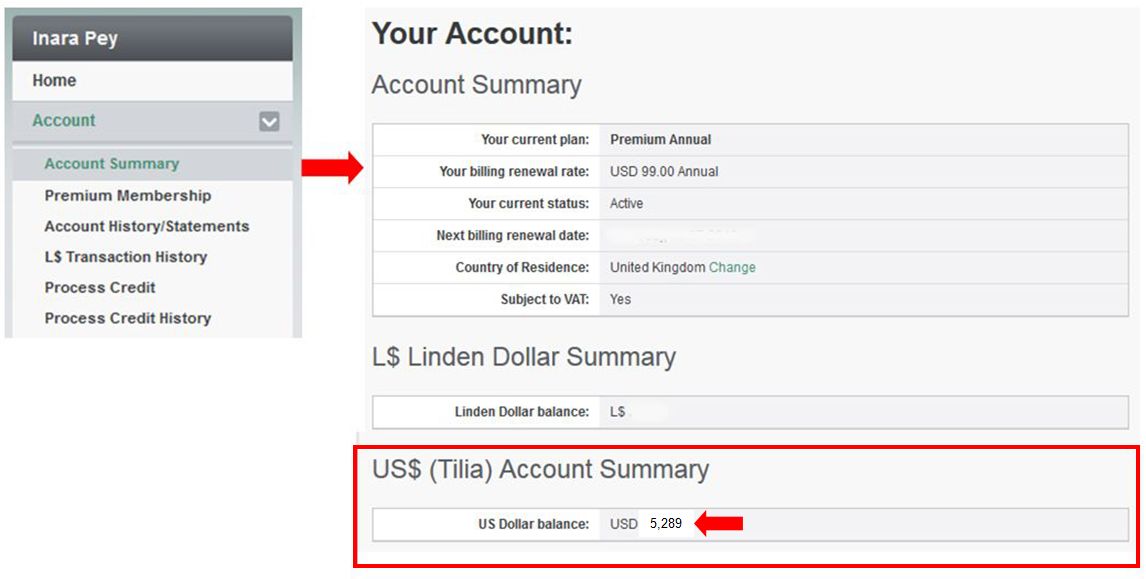
If you have a US dollar (USD) balance associated with your Second Life account on or after August 1st, 2019 you must consent to the Tilia Terms of Service. In addition, if you transfer out all or part of that USD balance on or after August 1st, 2019 you will be required to provide personal informationin order to do so (see the July 1st official Tilia blog post and the Tilia FAQ for details on the required information). Note: the USD balance given hre is for illustrative purposes only
Tilia Inc., is a wholly-owned subsidiary of Linden Lab. It was formed in 2015 and is focused on payments and the compliance work associated with operating virtual economies. As a part of this, it will provide services for both Second Life and Sansar.
Specifically in reference to Second Life, Tilia Inc., will, from August 1st, 2019, take over the management of all US dollar (USD) account balances user may have associated with Second Life. As such, it is central to the Lab’s work in seeking federal and state registration as a US Money Transmitter a form of regulated Money Service Business – MSB) and to comply with all US laws regarding the movement of money. This had been a stated goal within the Lab pretty much since Ebbe Altberg joined the company as CEO.
Note: while it is not relevant to this meeting or how users’ USD account balances are managed, I have written (and speculated) more broadly about Tilia Inc., in Tilia – a further look and a little more speculation.
The “Tilia Account” and “Tilia Wallet” / “US Dollar Wallet”
Two terms that have caused confusion amount users are “Tilia Account” and “Tilia Wallet” / “USD Wallet”.
The Tilia Account is the mechanism that will be used, from August 1st, 2019 to manage all US Dollar balances associated with Second Life (viewed via Account > Account Summary on your Dashboard at secondlife.com) and for managing transferring US dollar amounts from Second Life (viewed via Account > Credit Process on your Dashboard at secondlife.com).
You are effectively logged-in to it when you log-in to your Second Life account at secondlife.com. There is no separate “Tilia log-in” required.
The Tilia Wallet / US Dollar Wallet is, in simple terms, the US dollar balance associated with a Second Life account.
By default all “real money” balances (referred to as fiat money) held on a Second Life account is denominated in US dollars (USD).
Processing credit from Second Life (referred to as cashing out by many in the community) is expressed in US dollars, but can be converted to local currency by your preferred payment option (e.g. PayPal).
Does Tilia Affect Those Who Only Buy and Use Linden Dollars?
There is no need to provide any additional information to Linden Lab for purchasing L$.
Users can still purchase L$ amounts exactly as they have done prior to the August 1st, 2019 changes – through the viewer, via the Second Life LindeX web page, using credit cards and or other recorded payment options associated with their account.
Users are only affected if users have US Dollar balances, on or after August 1st, 2019, and / or who wsh to process credit their USD balances out of SL.
The changes specifically apply to USD credit processing and there’s no impact on the routine purchase of Linden Dollars we don’t need your ID we don’t need your sisters maiden name we don’t need your first-born and don’t even need a blood sample. You will continue to buy Linden Dollars as you did before.
Only those who have a USD wallet [balance] need to accept the Tilia Terms of Service and if you are one of those people then you will see the Tilia Terms of Service and [you will] need to accept them when you log into your account on the web.
How do users with US Dollar balances on their account consent to the Tilia Terms of Service? – By logging-in to their account via the secondlife.com website.
What if a user doesn’t want to consent to the Tilia Terms of Service?
So if you don’t have a USD balance and you don’t plan on having a USD balance and you will not sell Linden Dollars to acquire a USD balance, you don’t need to do anything. You will not be required to accept the terms of service and literally nothing changes.
If you do currently have a USD balance and you don’t want to accept the Tilia Terms of Service, you need to basically get rid of it; you need to either complete a process credit of your entire USD balance before August 1st, or spend that USD balance in Second Life. You can buy Linden [Dollars], pay for land, pay for a Premium membership etc. If you have a USD balance come August 1st, you will need to accept the Tilia Terms of Service.
At the start of the week, I dropped into Monocle Man, the gallery complex operated by Lynx Iuga and Kit Boyd, to take a look at the exhibition by DustinPedroia. As I mentioned, the complex also includes spaces for artists to display their work, so to round-out the working week, I decided to jump back and take a look at the rest of the complex.
As noted in my first article (see Art with a Monocle Man in Second Life), Monocle Man offers free gallery spaces for 20 days at a time to artists wishing to display their work. These spaces can be found via the teleport disk located outside the front door of the ground-level gallery that also provides access to other points of potential interest for visitors (left-click the disk for a list of destinations, right-click and select Teleport to go to the selected destination).
The sky gallery (“Gallery” on a teleport disk) provides two floors with space for up to four artists. Currently the spaces are being used by ViktorSavior and Lynx Iuga, with (I believe) an exhibition in the process of being set-up by RoseHanry (just the one image was on display during my two visits).
ViktorSavior has been something of a “featured” artist in these pages of late – for which I make no apologies; I find his work attractive and engaging. Here he presents more of his watercolour paintings, wonderful landscape that involve two of his favourite subjects: water and sky.
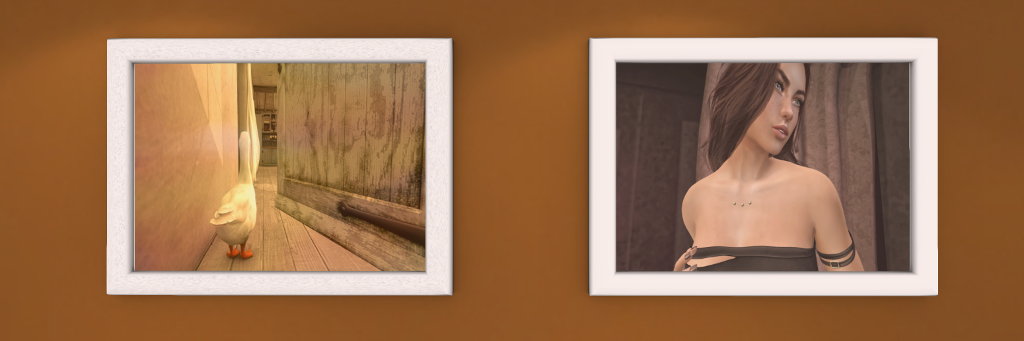
Upstairs, Lynx occupies two rooms with his art, a wonderfully broad mix of avatar, animal and landscape studies rich in colour and / or ton,e and beautifully focused on their subjects. They reveal a photographer and artist with an eye for setting and story, and a talent for spotting angles by which to add depth to his images. Just take his picture of a goose standing in a doorway as an example of this: the subject is central to the image, but the angle – shot from behind the goose and at its eye-level – serves to give us an usual perspective on the room beyond while offering an almost first-person perspective on the adventures of our white feathered subject as it venture through a door left ajar.
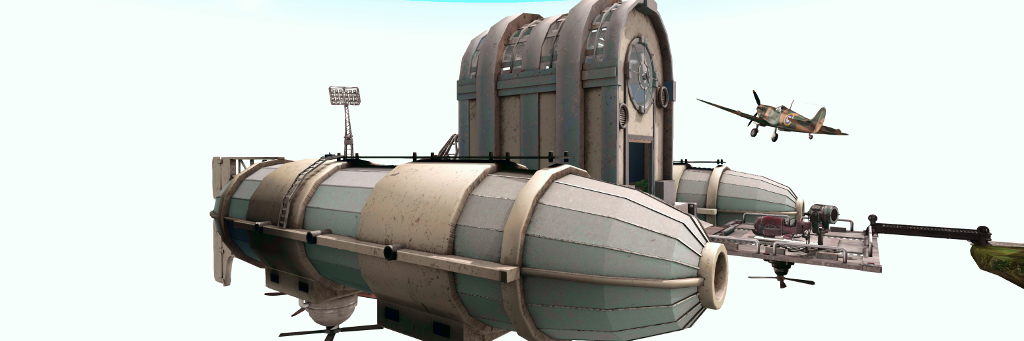
Elsewhere, the teleport system provides access to a photographic studio with two floors of space for posed photography, complete with lighting, pose and backdrop systems; a BDSM-oriented playroom / photographic area; a video cinema; a “fencing studio” overlooking London’s Houses of Parliament; a sky sphere (“Dome”) in which you can float around in a bubble (rezzer close to the teleport disk -and do allow the local sounds to play music, not the main stream); a second skydome (“Menhirs”) offering a model of Stonehenge in which to relax; and a strange steampunk-like aircraft hanger / workshop being held aloft on the backs of airships.
All of these additional spaces can offer opportunities for photography (as well as for relaxing in the case of the Stonehenge setting and sky sphere), but I admit to being attracted to the hanger setting (“Fly”), if for no other reason than it was such an entirely unexpected find.
Thus, Monocle Man makes for a broad-ranging visit, whether you’re out to view art, create art, display your art or simply explore. Those who are interested in making use of the gallery spaces should contact either Kit or Lynx in-world.














 Inara Pey: Living in a Modemworld