La Maison d’Aneli, curated by Aneli Abeyante, has opened the doors to its April 2019 ensemble exhibition, and once again brings together the work of several artists to offer a rich mix of art and artistic expression, featuring 2D and 3D art and a marvellous journey into machinima.
This exhibition starts at the gallery’s ground level, with a most unusual motor show by Willem Koba, which juxtapositions a shiny, pristine parking garage with SL cars and vehicles that have, to put it mildly, seen better days. I’m not sure of the purpose of this element of the exhibition, but it does make an interesting and unusual gateway to the teleport up to the gallery proper.
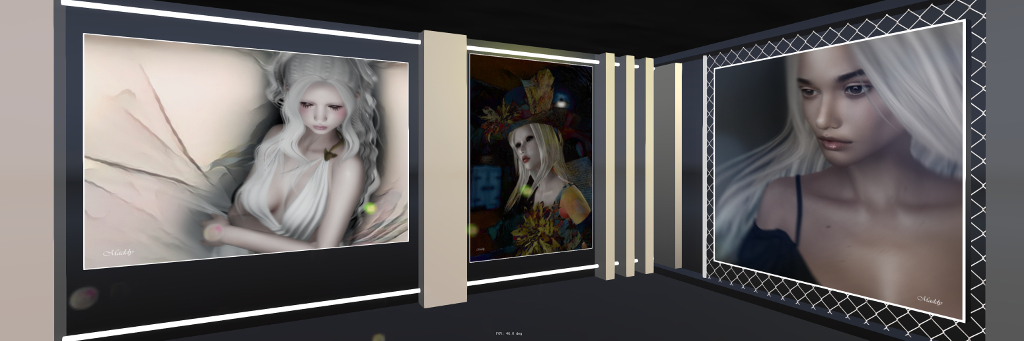
It is here that the rest of the artists within the exhibition display their work. Calypso Applewhyte and Magda Schmidtzau between them present two very different, yet at the same time somewhat reflective of one another. Magda – or Maddy – has the more extensive portfolio of the two on display, and it demonstrates the breadth of her avatar work, from portraiture, through nudes and fantasy to richly artistic pieces.
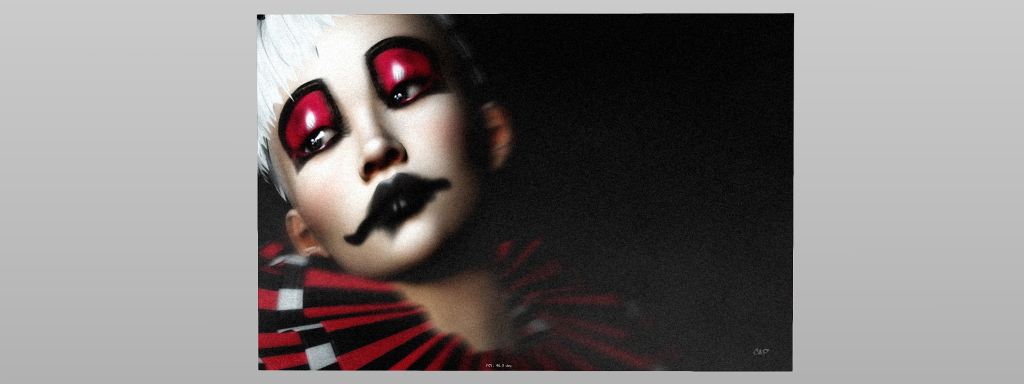
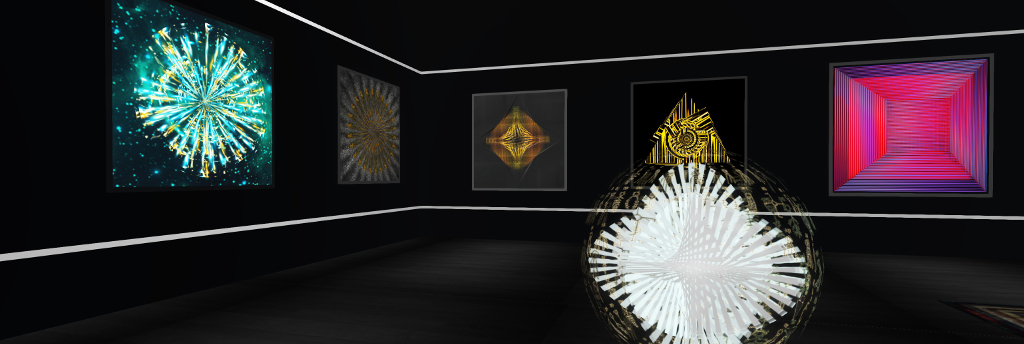
Located on he upper floor of the gallery, Calypso – or Caly – offers a more focused selection of work, which leans into fantasy and science fiction elements. Like Maddy’s selection there is a mix of colour and monochrome to the set, but I admit that – as much as I admire Maddy’s work – I was drawn more to Caly’s exhibition, simply because of its captivating “minimalism”. This can be seen in both the images and in the use of the display space around them. This latter point in particular allows the eye to more readily focus on each piece individually, without the distraction of neighbouring works intruding into the eye and mind. This minimalism also presents a rich vein of narrative within each piece, which for me is fabulously exemplified in the wonderful Ma tristesse, seen at the top of this article.
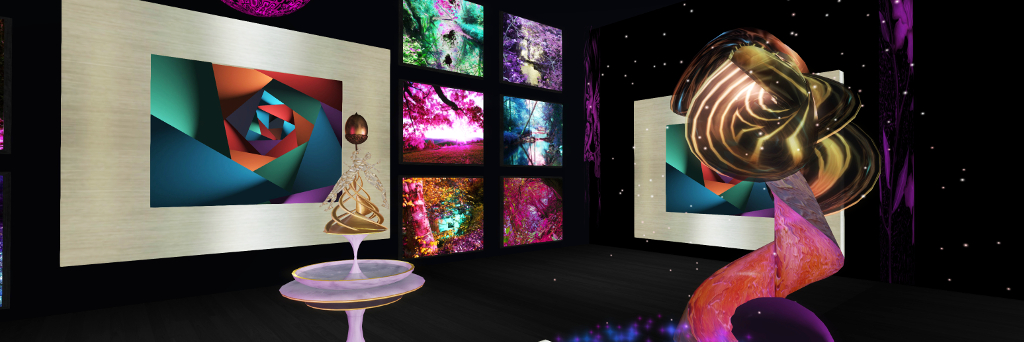
Also split between the gallery’s upper are lower floors are RazorZ and Bachi Cheng – both of whose art I don’t believe I’ve previously encountered in Second Life. RazorZ’s digital work is presented in both 2D and 3D, and is a glorious use of shape, colour and form; his sculptures wonderfully alive and vibrant, while his (apparently physical world) photographs are given a marvellous digital / alien life through the use of colour filtering / layering.
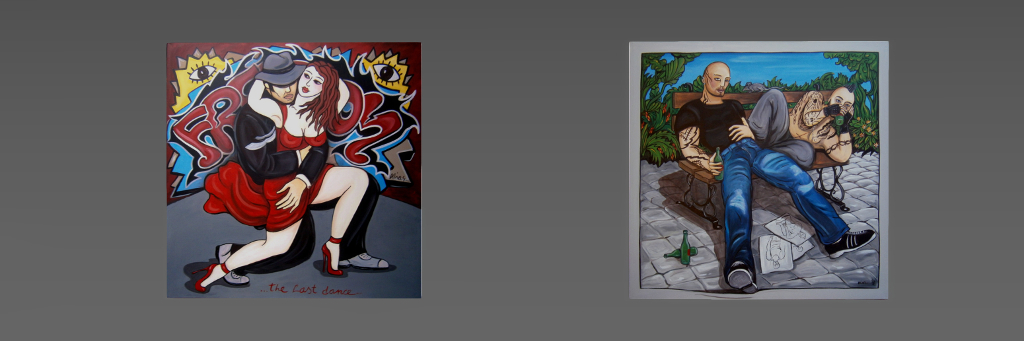
Bachi also presents some of her physical world art on the upper level of the gallery. These are raw, intense and emotive drawings, with Bachi noting, “I love to paint Moments. Moments of life, Moments of Love, Moments so deep that you never want to forget them, Moments at the edge of orgasm or despair, just life; like we ought to live it, plainly.”
Rounding-out the exhibition is a display of Aneli’s own 2D and 3D art, and a joint presentation by Iono Allen and Theda Tammas.
The majority of Aneli’s pieces are beautifully animated and make use of geometric expression to captivate the eye. Colour and monochrome, these are pieces that tend to draw the eye into them, casting an almost hypnotic calming influence through their gentle motion.
Iono and Theda present Samuari, a machinima short film, reached via a walk along an avenue of Torii gates set within a midnight landscape. Filmed by Iona, it utilises elements of Theda’s art (and Theda herself), within an extraordinary piece, worthy of the best of classical Japanese film-making. The story unfolds entirely visually and sans dialogue, supported only by the use of sounds and music. It is a film that, frankly, should not be missed.
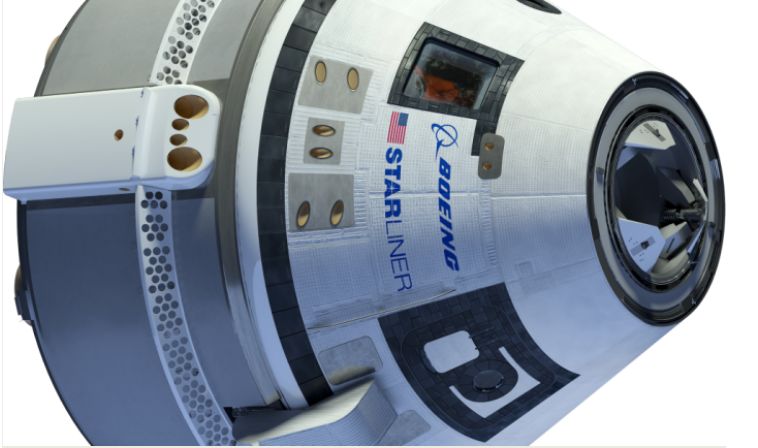
The CST-100 Starliner: further delays, with the crewed test flight potentially being extended into an “operational” flight – something NASA discussed with Boeing in 2016. Credit: NASA / Boeing
Boeing has opted to delay the first launch of its CST-100 Starliner, designed to fly crews to and from the International Space Station. The uncrewed launch, referred to as the Orbital Flight Test, has been pushed back from April to August 2019, with the company citing a tight schedule and conflicts with another launch – that of the Advanced Extremely High Frequency (AEHF) 5 military communications satellite due in June 2019 – as the reasons for the delay.
The “tight schedule” meant that the launch would likely slip into May – but the AEHF-5 launch would mean that the Starliner would only have a 2-day launch window before its own Atlas 5 booster would have to be removed from the launch complex in order to make way for the classified military launch.
Our Starliner team continues to press toward a launch readiness date later this spring,” the company said, which also included the completion of a final set of testing milestones. In order to avoid unnecessary schedule pressure, not interfere with a critical national security payload, and allow appropriate schedule margin to ensure the Boeing, United Launch Alliance and NASA teams are able to perform a successful first launch of Starliner, we made the most responsible decision available to us and will be ready for the next launch pad availability in August.
– Boeing statement
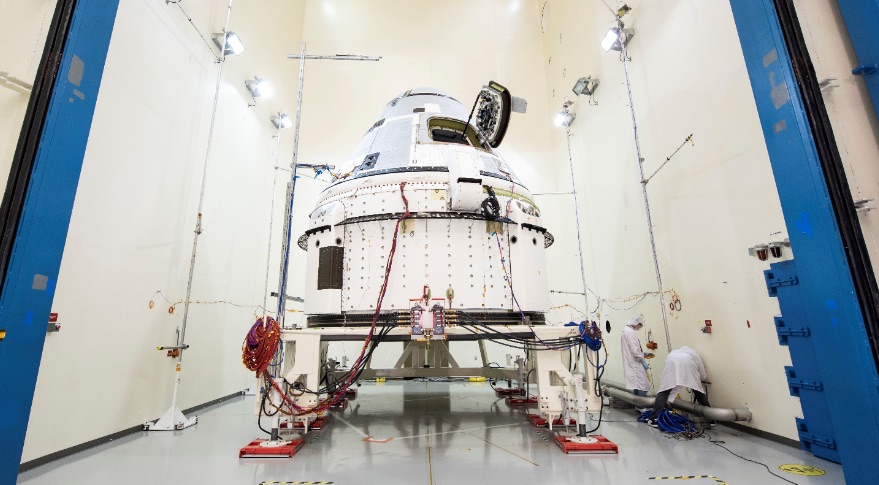
The CST-100 due to make the first crewed flight, at Boeing’s CST-100 processing facility. Credit: Boeing
The delay means that the second test flight of the vehicle, due to fly a crew of two NASA astronauts, Nicole Mann and Mike Fincke, together with Boeing test pilot Chris Ferguson, to the International Space Station, will also be delayed. That flight had been due to take place no earlier than August, but Boeing now state it will take place “later in the year”, with industry experts suggesting it will not proceed any earlier than November 2019.
Following the announcement, NASA indicated that the crewed flight for Starliner will include an extended stay at the International Space Station, lasting several months (the extract length of the stay still to be determined). This extension will effectively allow NASA to turn the mission from a test flight into a crew rotation mission – an idea that had been first mooted in 2016. All three of the crew have been training for ISS operations, and the move could offset the need for an extended use of Soyuz vehicles. As it is, in February, 2019, NASA issued a procurement notice to purchase two additional Soyuz seats from the Russian state space corporation Roscosmos, seats that the Russians didn’t plan to use for their own cosmonauts in order to help ease potential problems were either SpaceX or Boeing to encounter programme issues with their respective vehicles, the Crew Dragon and the CST-100.
While we have already made substantial progress this year, this shift gives us the time to continue building a safe, quality spacecraft capable of carrying crews over and over again after a successful uncrewed test, without adding unnecessary schedule pressure.
– John Mulholland, VP and Program Manager, Boeing CST-100 programme
Mars: of “Eclipses”, and Evidence of Ancient Life?
In March 2019, NASA’s Mars Science Laboratory rover Curiosity was able to record a “double eclipse” as the two Martian moons, Phobos and Deimos passed between the rover and the Sun; although while the media referred to them as “eclipses”, such is the size differential between the tiny moons and the Sun, they are technically transits.
The first transit took place on March 17th when Deimos, the more distant of Mars’ two captured moons, passed across the face of the Sun, its passage recorded by Curiosity’s Mastcam. The second event took place on Mars 26th, when the much larger – and closer – Phobos (11.5 km across) passed in front of the Sun, again filmed by Curiosity’s Mastcam. This event was the more dramatic of the two, not only because of the larger apparent size of Phobos, but because the Moon actually cast a visible shadow, which was captured by the rover’s navigation cameras. Images of all of the events were subsequently strung together to make a short video (below).
However, movie making isn’t the primary objective in observing the transits. Each set of these types of observations – which have also been made by the now-defunct Mars Exploration Rovers, help scientists further refine each moon’s orbit of Mars. When observations of Deimos commenced from the surface of Mars, for example, estimates for where it should be were about 40 km off.
According to NASA, scientists are in agreement present-day Mars is without life. However, whether there might once have been life there is open to debate, and a team from Hungary believe they have found organic material embedded in a Martian meteorite found here on Earth in the late 1970s.
Officially named ALH-77005, the Martian meteorite was found in the Antarctica’s Allan Hills during the Japanese National Institute of Polar Research mission of 1977 / 78. If the reference “ALH” and “Allan Hills” sounds familiar, it might be due to a furore that occurred around another Martian meteorite fragment in the late 1990s.
ALH-84001 caused a lot of controversy – not helped by the media – in the late 1990s
That fragment – ALH-84001, found in Allan Hills in 1984 – is one of the oldest fragments of Mars rock to have fallen to Earth, being dated at 4 billion years of age. When studying the fragment, a US team thought it might contain evidence for microscopic fossils of Martian bacteria within it.
From the start, the claims were considered controversial – although the way the White House and the media over-reacted at the time didn’t help. However, extensive and international study of shavings from the fragment revealed that all of the unusual features discovered within the meteorite could be explained without requiring the intervention of microbial life, and the wider scientific community rejected the hypothesis that the fragment offered evidence of past life. Nevertheless, the events surrounding ALH-84001 pushed the science of astrobiology firmly into thee public domain.
In their report on ALH-77005, Hungarian scientists Ildiko Gyollai, Marta Polgari and Szaniszlo Berczi state they have been able to determine the presence of mineralised organic matter within the rock, such as different forms of bacteria within the meteorite, suggesting that life could once have existed on the Red Planet.
Our work is important to a broad audience because it integrates planetary, earth, biological, chemical, and environmental sciences and will be of interest to many researchers in those fields. The research will also be of interest to planetologists, experts of meteorite and astrobiology as well as researchers of the origin of life, and to the general public since it offers an example of a novel aspect of microbial mediation in stone meteorites.
– Ildiko Gyollai from HAS Research Centre for Astronomy and Earth Sciences in Budapest
While the work will require independent study and review, and the lessons of ALH-84001 could result in some remaining sceptical of the Hungarians’ findings. Nevertheless, there report could change the examination of meteorites in the future. In light of their discovery, the authors posit that solar system materials should be studied to establish whether there is evidence of microbial forms within space rocks as well.
On Thursday, April 4th, 2019, a public Above the Book events was held at the VWBPE 2019 event featuring Grumpity and Patch Linden, who answered questions about the platform and Linden Lab. The following is a summary of the broader points raised during the session, with the full video also embedded at the end.
A general Q&A session from the audience was held
Grumpity Linden
Grumpity Linden – Director of Product for Second Life
Grumpity originally came to Linden Lab while working for The Product Engine, a company providing end-to-end consulting and software development services, and which supports viewer development at the Lab, and she was initially involved in the development and viewer 2 (as designed by 80/20 Studio).
She became a “full-time Linden” in 2014. Her current position involves coordinating the various teams involved in bringing features and updates to Second Life (e.g. Engineering and QA), liaising with legal, financial and compliance to ensure features and capabilities meet any specific requirements in those areas, etc. This work can involve looking at specifics within various elements of the overall SL product, such as UI design and layout, etc.
Patch Linden – Senior Director of Product Operations at Linden Lab
Patch Linden
Patch originally a Second Life resident, he joined linden Lab in 2007, after being invited to apply to the company as a result of his work as a community leader and mentor from 2004 through until the invitation was extended.
His role also encompasses Sansar, as he manages the respective support teams for both platforms. In this regard, he recently established a support centre in Atlanta, Georgia. For Second Life, his work also involves overseeing the content development teams, the Mainland Land Team, the Linden Department of Public Works – LDPW, aka The Moles, and managing the account support team.
Status Update
A lot of focus is on infrastructure work; making SL more performant for those in-world, and on moving Second Life services to the cloud.
The latter is especially time-consuming and difficult, as it requires moving services over without disturbing the way things are currently set-up.
As has been previously stated in public forums, there are currently no projections on whether this will lead to any reduction in region costs.
Currently, this work is taking a lot of resources in terms of staff, time and effort.
Overall, it is hoped the move will result in LL being more operationally streamlined and cost-effective, however, this could take time (a few years?) to achieve.
Feature work has obviously included:
The recent release of Animesh.
The continuing work to fully deploy the Environment Enhancement Project (EEP) that will replace the current windlight settings for controlling the appearance of the environment.
The continuing work to deploy Bakes On Mesh (BoM), that will allow system layers (skins / clothing) to be directly applied to worn mesh items.
Should be able to take advantage of the naked accessibility options available in iOS.
Won’t be available for some time yet.
iOS was selected because there are already popular Android solutions (notably Lumiya and Mobile Grid Client – there is also MetaChat for iOS).
An official Android client will follow, however.
Linden Homes are progressing (there will likely be another preview at SL16B).
Work is progressing on the new continent; this will be more organic and natural than the old Linden Homes mini-continents, and will be water / air navigable.
What Audience Does Linden Lab Try to Address with Features?
Everyone who uses the platform.
The roadmap is designed so the Lab spends time on features for home / land owners, features for content creators, features for new users, features for consumers, features for Premium members, etc.
Communities in SL tend to use the platform in a wide variety of ways and continue to surprise LL in how they use the platform. Thus, the Lab try to plan development of SL with as many communities as possible in mind.
For the education sector, a lot of work has been put into the RegAPI / Gateway programme to allow educational institutions to bring students directly into their in-world environments, and even brand user accounts specifically to their own institution.
Accessibility is always foremost in the Lab’s thoughts.
This can in part be addressed by communities themselves in how they take the RegAPI to build their registration process, and gear their gateways.
Accessibility options within the viewer are harder to build, due to the nature of the viewer, although some capabilities are presented through third-party viewers – Radegast being the most obvious (although currently stalled in development).
When considering features and updates, backwards compatibility is also foremost in the Lab’s thinking, both because of content available in-world that may be in use, but no longer actively maintained / updated, and because users have become reliant on specific capabilities / content.
This isn’t always possible, simply due to the age of SL.
In Brief
SL Search: there is a project on the roadmap (yet to be started) to overhaul SL search. It’s too early to discuss specific changes, but Search is complex, and a similar project performed with Marketplace Search took far longer than anticipated, although it yielded positive results.
Age Restrictions and Mobile: it is not anticipated that the arrival of an official mobile app for SL will change the current age range access restrictions (just as it hasn’t for the current mobile apps). Any changes in age related access will be a policy change, not the result of any specific technology change.
LEA and Art: the LEA is on hiatus and being restructured, and LL are in conversation with the LEA committee and others for the arts community about ideas for moving things forward.
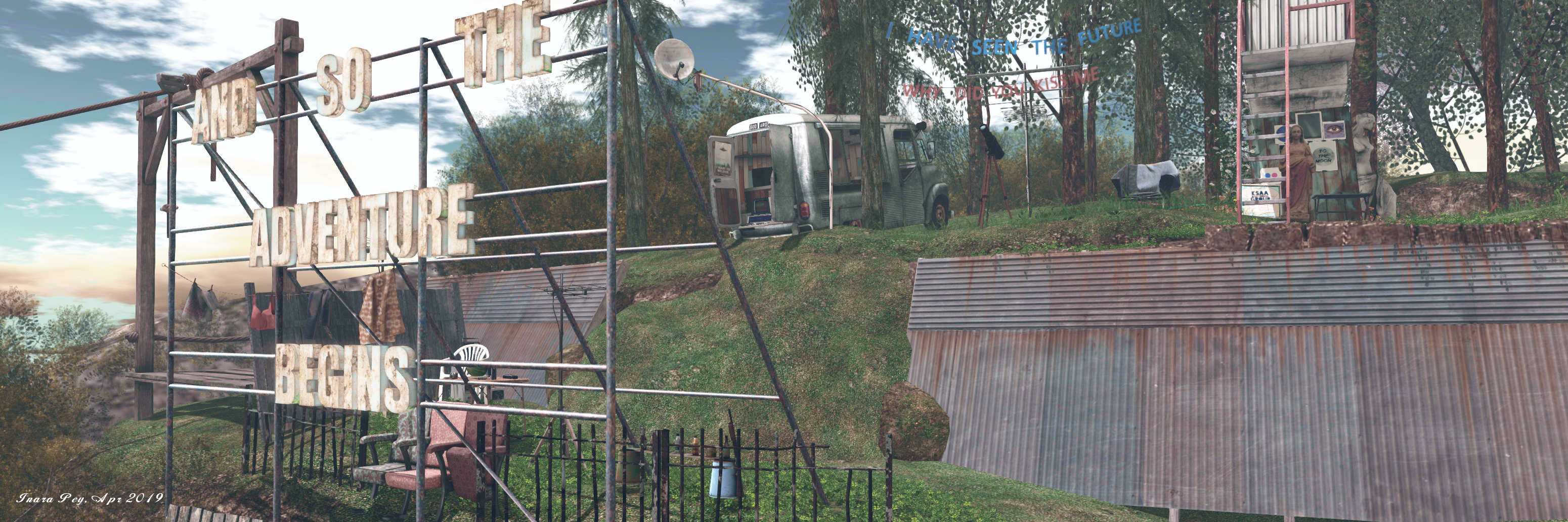
Located on the Homestead of Imagine Hall, the KSAA Music Commune is a curious region design, developed by a group of Japanese users to – as the name implies – promote their local music.
I say curious, because the overall design is a highly eclectic mix of elements with no discernible theme, but which somehow come together and work in a manner that – whether or not you attend any events there – presents itself as a photogenic environment that might best be described as, “rural shabby”.
I will start by offering a word of caution: be sure not to step back from the landing point on arrival. It’s tempting to do so, as you land at the foot of a step ladder, but the landing point is actually on the lip of a drop of around 4-5 metres, which can lead to a little confusion as stepping back can have you suddenly dropping / sliding downwards amidst a sea of grey as textures load and render…
The landing point is located on the region’s uplands on its west side. These form a shoe-like oval of grass and tree-topped rock that drops sharply down to the coast on the wets side, and fall in a long, graceful slope eastwards on the other, the grass slope forming a natural pasture / paddock.
It is possible to walk down this slope from the landing point – but for those who need a faster form of transport, there is a zip line awaiting passengers. This will drop people towards the bottom of the sloping paddock, just before it steps down to a sandy headland marked by a junk yard and aged and deserted big top tent. The junk yard is a haven of mess and oddities, with the wrecks of old cars, the remnants of an auto repair shop, and old furniture mixing it up with children’s toys, bric-a-brac and – indoors – computer hardware belonging to a Steam gaming enthusiast.
The upland area of the island is encircled by a railway track / grass path / dirt track which starts and ends at the sandy headland. Follow it south and west, and the railway tracks will take you over a narrow shelf of grass and rock and across a couple of usual bridges to the western end of the island, directly under the high peak. Here the grass path takes over briefly, offering the way to the dirt road, and a little farm sitting in the lee of the cliffs, shaded by cherry blossom trees.
Curling around to the north side of the island, the dusty road points visitors to a fork where they can either opt to turn off the road and enjoy the waterside view offered by a shanty bar (pedalo boats available from the rickety pier) and the small beach just past it. If preferred, visitors can continue up a tight, steep slope to arrive at the island’s main music venue, perched under a large water tower and overlooking the beach alongside the shanty bar. This is again an eclectic space, the dance area before the DJ’s “booth” largely taken up by a paddling pool. Beyond this, the road dips back down between dry stone walls to return to the junk yard.
There are various places to sit within the region, and plenty to attract the camera, although it is also true that perhaps a little more attention to detail is required; there are a fair few items floating serenely above the ground or over tables and desks and benches that can have one grumbling and / or grateful for the object derender button.
I also can’t speak to the frequency of events in the region – a second dance area can be found at the back of the junk yard – there were no in-world schedule boards apparent during our visit, and Group notices are in Japanese. However, there are Soundcloud links in the Profiles of some of the team responsible for the region, which may give a hint to the types of music played here. There is also a Flickr group for anyone who feels like contributing their photos.
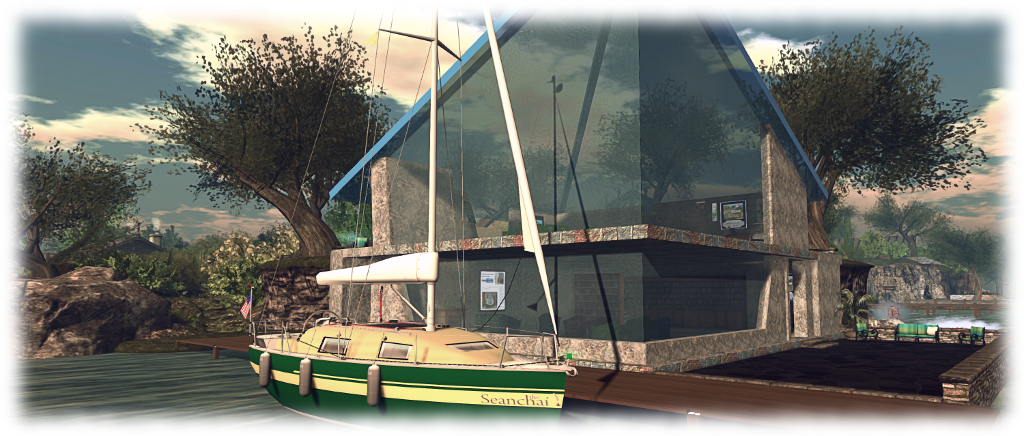
It’s time to highlight another week of storytelling in Voice by the staff and volunteers at the Seanchai Library. As always, all times SLT, and events are held at the Library’s home at Holly Kai Park, unless otherwise indicated.
Sunday, April 7th:
13:30 Tea-Time with Sherlock Holmes’ Greatest Hits
As voted for by Seanchai fans, followers and listeners. This week: The Adventure of the Speckled Band, which first appeared in The Strand Magazine in February 1892, and is notable for becoming the basis for a 1910 stage play written and produced by Conan Doyle, and which starred H. A. Saintsbury as Sherlock Holmes and Lyn Harding as Dr. Grimesby Roylott.
Dr. Grimesby Roylott confronts Holmes and Watson at 221B Baker Street (Sidney Paget, 1892)
Helen Stoner lives with her stepfather, Dr. Grimesby Roylott, last survivor of what was a wealthy but dissolute and violent tempered aristocratic family. Roylott himself is known for his violent temper, and served time in India for the murder of a servant.
Miss Stoner’s visit to Holmes is prompted by Roylott’s demand that she move into a room at his country estate where her twin sister died under mysterious circumstances two years previously, her dying words being, “the band! the speckled band!” Helen is unwilling to occupy the room as there is something decidedly strange about it; thus she seeks Holmes in order to confide her fears in him.
After her departure, Roylott arrives and forces has way into Holmes’ presence, demanding to know what Helen has been saying. Failing to gain any information from Holmes, despite a show of brute physical strength intended to intimidate, Roylott leaves. However, his actions have now firmly established himself at the centre of the Great Detective’s attention…
Have you heard? Willie Wonka is releasing five golden tickets in candy bars! Charlie Bucket may have a chance to find one as Caledonia Skytower continues Roald Dahl’s classic.
Monday, April 8th 19:00: The World’s Best Science Fiction 1969
Gyro Muggins read from this anthology of science fiction short stories, edited by Donald A. Wollheim, featuring nineteen authors, including such names as Brian Aldiss, Poul Anderson, Samuel R. Delany, Fritz Leiber, Robert Silverberg, and Kurt Vonnegut, Jr.
This week, Hemeac by E.G. Von Wald, the story about a student dealing with life in a university run by defective robots; and Street of Dreams, Feet of Clay by Robert Sheckley. Can an imperfect man find happiness in a perfect city?
Tuesday, April 9th 19:00: Two Houses
Caledonia Skytower shares another of her original tales: a young American couple on their honeymoon find their ties to Irish heritage are far more insistent than just a simple perusal of genealogies. As the past disturbs their future, Mark and Cate must unravel the mystery of two houses that suffered very different fates, but that are somehow connected.
Wednesday, April 10th 19:00: Bring Your Own Poem Night
bring a favorite poem of yours, or one you like, to be shared fireside in The Glen.
Thursday, April 11th 19:00: Rogue One: A Star Wars Story Part 2
With Shandon Loring. (Also in Kitely grid.kitely.com:8002:SEANCHAI).
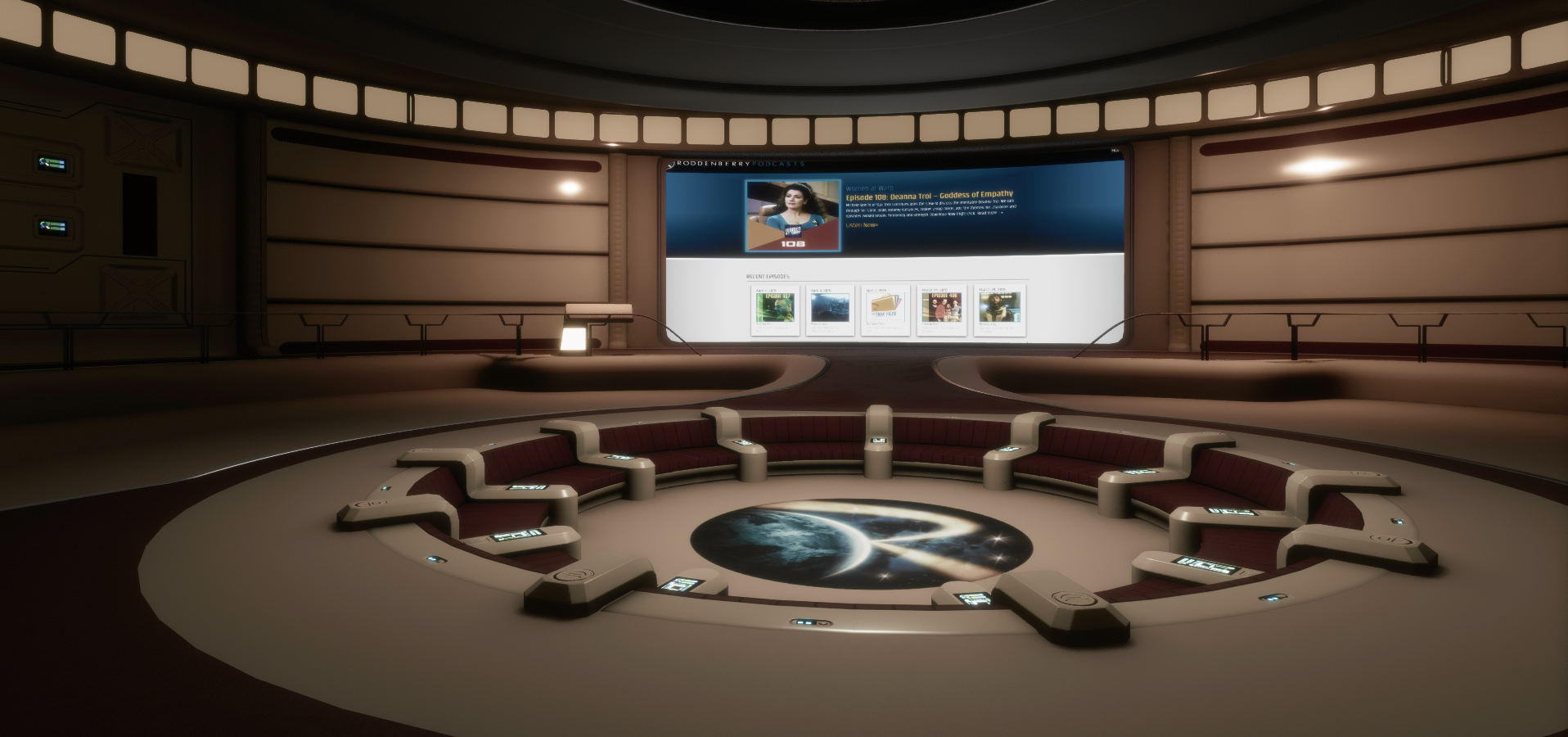
The Roddenberry Theatre: often the location for Product Meet-ups
The following notes were taken from my recording of the Sansar Product Meetings held on Thursday, April 4th. The first meeting, lasting 30 minutes, focused on Sansar Events and the changes made to the events system. The second meeting, lasting an hour, focused on upcoming features. This update focuses on the reasoning behind the events changes, and the confirmed work coming up for the R32 release and beyond.
Sansar Events
The Questing and Jumping Sansar release saw some changes to how events are managed. In short:
Events can no longer be joined by finding an experience, it must be done via the event calendar, with the event itself a special copy (not an instance) of the experience.
Active events are listed on a new Featured tab – Client Atlas only.
Event creators can change the scene tied to an event, customise the scene like any experience, and delete the experience if it’s no longer needed.
As Linden Lab is looking towards much more in the way of events hosting – specifically with “big partners”, these changes have been made to improve the management of events, the Atlas, and to better support the running of ticketed events. Thus, events are now viewed as much more their own type of experience, rather than being an activity tied to an experience and the Atlas.
The intent is to make events more a of driver of Sansar use.
In particular, it is hoped that ticketed events (with the hint of tiered ticketing, such as “general admission”, “VIP admission”, etc.), will be better supported through the new system.
This has resulted in making events harder to find via the Atlas, as events no longer appear towards the top of the event pages on the basis of the number of people attending. To address this (and other pain points):
With the next (R32) release, events will be folded back into the Atlas, rather than only appearing on the Events panel.
Some of the Atlas UI will be revised in order to make it more user-friendly to established and new users alike when trying to find things.
These revisions should mean that users more clearly see both experiences and events as they browse through the Atlas.
The featured section of the Atlas will be changing, so that both experiences and events will be listed.
More intelligence will be put behind featured events; e.g. events with an active attendance will be pushed into the featured listing in lieu of any specified as “featured” not having attendees (perhaps because they have not yet opened).
It will not be possible to bookmark / like the copy of an experience in which an event is being held; however, it will still be possible add events to your calendar.
In time, it might be that recurring events will be automatically retained in a calendar, rather than just the current date / time.
Concerns have been voiced that as events now take place in a dedicated copy of an experience, users will no longer be able to bookmark the original experience so they might return to it at a later date.
A counterpoint to these concerns is that currently, Sansar has disparate ways to find out what is going on: the Atlas to see what experiences creators are making, the Store to see what goods creators are making, etc., and it might be better to present users with a more holistic view of what creators are doing as a whole (this is kind-of possible via profiles).
However: a) such an approach, if taken, has yet to be clearly thought-through to determine how best to implement it; b) it will not compensate creators who wish to use events to encourage visitors to their actual experience.
Future Developments: R32 and Beyond
R32: Full Body Tracking
Vive Tracker support has been added to allow full body tracking.
The Lab provided a video of an Sansar skeleton moving in time to Landon McDowell’s daughter (wearing the trackers) as she danced (see below).
It is hoped that this will add a new dimension to Sansar for VR users (or at least, Vive system users for now), and that it might in the future be used to record custom emotes (gestures in SL parlance).
This has involved overcoming a lot of technical challenges, and there is still more work to do to refine the system further.
R32: New Movement Scripting API
This will:
Allow objects to rotate and turn.
Include a set of supporting Simple Scripts.
Enable frame-perfect animation; movements can be properly queued to be executed at specific times / in a specific order by the engine of the desired frame.
Allow animations to ease-in and ease-out one to the next.
Support multiple animation states, with blending between them.
This system should work for non-rigid bodies as well.
A major part of this is to allow the development and movement of non-player characters (NPCs), allowing simple patrol / follow behaviours, etc.
Initially these will be relatively simple: there is no pathfinding, complex interactions, etc.
However, it does Include line-of-sight location (e.g. if an NPC is designed to chase an avatar, it will only do so if it can “see” an avatar, so such NPCs could be avoided by keeping things like walls between you and them – see the official video below).
LL plan to suse this system to add some simple NPCs to the questing capabilities.
Longer-term it is hoped to have NPCs supporting looks, expressions, being able to play recorded voice audio and use Speech Graphics, utilise MD clothing, etc.
This should allow dynamic assets to drive animated assets, which in turn should enable things like animated held objects like guns, etc.
R32: General
Avatar crouching for desktop will be added as a part of R32. This should reduce the avatar capsule to allow walking through spaces with low ceilings, etc.
New throw capability for Desktop mode which should allow more accurate throwing and placement.
Throwing will likely include direction and strength indicators for Desktop mode users, allowing them to participate in games with VR users.
Placement controls should allow Desktop mode users more accurately place items they have picked up, rather than simply dropping them (e.g. pieces on a chess board can be accurately placed).
Beyond R32
Uniform scaling for avatars: scale them up or down proportionally.
Scaling of individual body parts (e.g. an arm or the head) will not be possible until the “avatar 2.0” is released.
Partial animation import:
Allowing a partial / simplified Sansar skeleton (with around 70 bones) to be downloaded and animating directly off of that.
Being able to hook this into Mixamo’s animator tools.
Feedback on the latest updates for using Marvellous Designer are being gathered and examples put together and will be fed back to MD in the hope of getting issues to work as expected.
Work is continuing on the questing system, including opening it to user-generated experiences.
Currently, the focus is on getting the system to work for the Lab and ironing out issues and bugs.
For the R32 release, the Lab hope to provide more quests beyond those added in the Questing and Jumping release, with the emphasis on showcasing what is possible, rather than building entire games.
Performance team continuing to work on a LOD system and performance improvements to get more avatars into an experience.
There is also a release with a focus on crash fixes coming soon.
Run-time joints: a feature which will hopefully appear later in 2019 that would allow users to parent things to their avatar (e.g. take a hat in and experience and wear it within that experience).








 Inara Pey: Living in a Modemworld