Space Sunday: questions of life, and the “Commercial Nine”

A computer generated terraformed Moon. While it may not have looked like this in its past, the Moon may once not only have had an atmosphere and liquid water on its surface, it may have had conditions suitable for life. Credit: unknown, via Lunar wikia

Throughout human history – and outside of flights of fancy – the Moon has always been thought of as an airless ball of rock, tidally locked to Earth so that it shows the same, almost never-changing face to us in the night sky. But it may not always have been so.

In recent years, our perceptions of the Moon have been changing as a result of a number of studies and missions. In 2009, for example, India’s first lunar mission, Chandrayaan I, produced a detailed chemical and mineralogical map of the lunar surface, revealing the presence of water molecules in the lunar “soil”. In that same year, NASA launched a pair of missions to the Moon, the Lunar Reconnaissance Orbiter (LRO) mission and the Lunar Crater Observation and Sensing Satellite (LCROSS).

LCROSS was a small satellite designed to follow the upper stage of the rocket used to launch it and LRO to the Moon and analyse the plume of debris created by the impact of the upper stage with Cabeus crater in the Moon’s south polar region. The impact came with a kinetic energy equivalent of an explosion created using 2 tons of TNT, and LCROSS recorded strong evidence of water within the resultant impact plume.

For its part, LRO entered lunar orbit to commence a comprehensive campaign of mapping, imaging and probing the Moon’s surface and environment. In doing so, it further confirmed the presence of abundant concentrations of water in the lunar south polar regions. At the same time and LRO has been studying the Moon, an ongoing analysis of the rock samples brought back by the Apollo astronauts has revealed strong evidence for a large amount of water being present in the lunar mantle – possibly as much as is present in Earth’s upper mantle.

An artist’s impression of the 2009 LCROSS satellite “shadowing” the Centaur upper stage used to launch both it and the Lunar Reconnaissance Orbiter (LRO), as the upper stage heads towards its lunar impact. Credit: NASA

These results and findings have given rise to the idea that very early on in the Moon’s history conditions could have been very different to how it is now. In the immediate period following the Moon’s creation (roughly four billion years ago), there are a period when it was very volcanically active (about 3.8-3.5 billion years ago), releasing considerable amounts of superheated volatile gasses, including water vapour, from its interior. This outgassing could have given rise to an atmosphere around the Moon dense enough to support that water vapour condensing out into liquid on the surface which could have conceivably lasted for several million years whilst the atmosphere remained dense enough to support it, before it either (largely) evaporated or retreated underground to eventually freeze.

In their new study, published in July 2018, Dirk Schulze-Makuch, a professor of astrophysics at Washington State University, USA, and Ian A. Crawford, a professor of planetary science and astrobiology at Birkbeck College, University of London, UK, review the evidence for liquid water to have been present on the Moon and examine the potential for it to have been life-bearing. In particular, they note that when all is said and done, if the early conditions on the Moon did give rise to a dense atmosphere and a water-bearing surface, then the conditions there wouldn’t have been that different to those being experienced on Earth when life here was starting up, and would have occurred in the same time frame.

A false-colour image of the Moon’s south pole highlights areas that are in permanent shadow. These account for around 3% of the south polar region, and could be places where frozen water exists beneath the surface (note the blue colour is not indicative of water, but simply a means of highlighting the shadow spots). Credit: NASA Goodard Space Centre

It looks very much like the Moon was habitable at this time. There could have actually been microbes thriving in water pools on the Moon until the surface became dry and dead.

Dirk Schulze-Makuch, co-author of Was There an Early Habitability Window for Earth’s Moon?,
quoted in Astrobiology Magazine

So does that mean life, however transient, got a start on the Moon? Possibly; however, some have suggested rather than giving rise to life directly, the conditions on that early Moon might have been ideal for life from Earth to gain a toe-hold.

As noted, the period when the Moon may have had its dense atmosphere coincided with life starting on Earth in a period referred to as the Late Heavy Bombardment, (4.1 and 3.8 to 3.5 billion years ago). During that time, bacteria such as cyanobacteria were believed to be already present on Earth, even as it was being bombarded by frequent giant meteorite impacts (hence the period’s name). So the suggestion is that this bombardment could have thrown chunks of bacteria-laden rock into space, where they were “swept up” by the Moon, transferring the bacteria to its surface, where it might have taken hold.

It’s unlikely that if it go started, life on the Moon got very far; within a few million years after the end of the Moon’s volcanic period the atmosphere would have been lost, and conditions would have become far too harsh for life to endure. However, in noting this, Crawford and Schulze-Makuch use their study as a call for a more robust study on the potential ancient habitability of the Moon, including a hunt for possible biomarkers.

Not related to the article: this image taken by LRO in 2011 highlights the Apollo 17 landing site and areas explored by Gene Cernan and Harrison Schmitt in 1972. Credit: NASA / NASA Goddard Space Centre.

Such an endeavour would likely be focused on the lunar south polar regions, simply because of the potential abundance of subsurface frozen water there. And as it is, NASA, India and China are already committed to studying the region in great detail. NASA will initially do so from orbit, while the Indian Chandrayaan-2 mission will attempt to place a lander and rover close to the Moon’s south pole in 2019. Also in 2019, China will send its  Chang’e 5 mission to the Moon’s north polar regions to gather and return around 2 kg of rock samples for detailed analysis on Earth.

Continue reading “Space Sunday: questions of life, and the “Commercial Nine””
Murders, wet worlds, myths and ghosts in Second Life

Seanchai Library

It’s time to highlight another week of storytelling in Voice by the staff and volunteers at the Seanchai Library. As always, all times SLT, and events are held at the Library’s home at Holly Kai Park, unless otherwise indicated.

Sunday, August 5th 13:30: Tea-Time on the Orient Express

Join Seanchai Library and friends aboard one of the most luxurious means of rail travel, the Orient Express, as they continue their investigations into the most disagreeable events that have occurred en route to Paris.

Having been required to return to London from Istanbul post-haste, Hercule Poirot sought passage aboard the most famous train, gaining seat initially in second class, only to be “upgraded” to first class by his friend – and member of the board of directors for Compagnie Internationale des Wagons-Lits, the operators of the service – M Bouc. Prior to his “upgrade”, Poirot is accosted by one Samuel Ratchett, an American also travelling on the train, who demands the detective’s aide as he believes his life is in danger. However, Poirot refuses, on account of finding the American a distasteful individual.

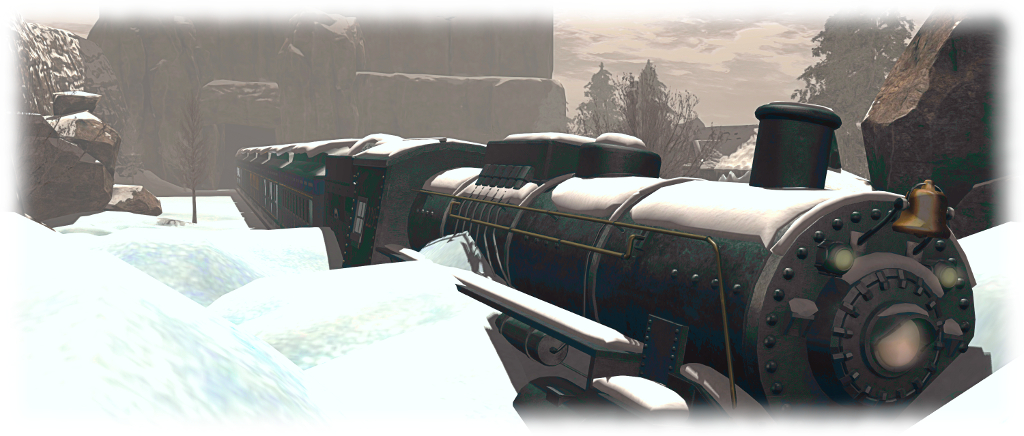
The locomotive trapped in a snow bank; a passenger murdered; a mystery for Poirot! Murder on the Orient Express

Then, on the night after his upgrade to the sleeping berth next to Ratchett’s, he is woken by two events: the first is that the train has become stranded in snow not far from the city of Vinkovci in Yugoslavia. The second is the discovery that Ratchett’s fears about his safety were correct: his has been murdered in his cabin. But who is responsible?

With nowhere to go until assistance for the stricken locomotive arrives, Poirot sets out to discover – did someone board the train in secret to put an end to Ratchett, or was one of his fellow passengers in fact the murderer? And what of Ratchett himself? Was he really all he seemed?

Offered in a special setting, Murder on the Orient Express, one of Agatha Christie’s most popular stories, continues into its second weekend reading!

Monday, August 6th 19:00: The Drowning World

They call it the Drowning World; Fluva, a planet on the fringes of the Commonwealth where the rain is – but for one month in the year – maddeningly torrential. For Chief Administrator Lauren Matthias, it is a new posting; one which comes with a major requirement: keeping the indigenous and warlike Sakuntala and immigrant and hard-working Deyzara, from annihilating one another.

But when the vessel used by bio-prospector Shadrach Hasselemoga crashes in Viisiiviisii, an immense, mostly unexplored jungle, and the wettest place on the planet, Matthias must dispatch a team made up of one Sakuntala and one Deyzara on a rescue mission. Can the two form an alliance long enough to both rescue Hasselemoga and survive the deadly jungle?

But as the mission unfolds, Matthias realises something much bigger and darker is occurring on Fluva. A mysterious presence is at work, manipulating events, one which not only puts the lives of the rescue mission at risk, but also her own – and which could ultimately threaten the Commonwealth itself!

Join Gyro Muggins as he reads story #21 in Alan Dean Foster’s Humanx Commonwealth series.

Tuesday, August 7th 1900: Brief Cases

Corwyn Allen dives into Jim Butcher’s 2018 collection of several of his excellent short stories and novellas from the universe of Harry Dresden.

The tales presented here not only offer excellent short narratives that dabble between the scenes of the other novels in the Dresden Universe series, they even encompass what might be Dresden’s greatest challenge…

….Becoming a father.

Wednesday, August 8th 19:00: Mythos

The Greek myths are the greatest stories ever told, passed down through millennia and inspiring writers and artists as varied as Shakespeare, Michelangelo, James Joyce and Walt Disney.

They are embedded deeply in the traditions, tales and cultural DNA of the West. In Stephen Fry’s hands the stories of the titans and gods become a brilliantly entertaining account of ribaldry and revelry, warfare and worship, debauchery, love affairs and life lessons, slayings and suicides, triumphs and tragedies.

Through them, you’ll once again fall in love with Zeus, marvel at the birth of Athena, wince at Cronus and Gaia’s revenge on Ouranos, weep with King Midas and hunt with the beautiful and ferocious Artemis.

Thursday, August 9th

14:00: Fireside Tales: The Following Shoes are a Gift from the Pope

With Caledonia Skytower.

19:00: The Ghost of the Bridge

Caledonia shares a draft of her latest short story, inspired by Pfaffenthal 1867 in SL, and a legendary ghost from Luxembourg.

The Virtual Pfaffenthal, July 2015 – blog post

21:00 Seanchai Late Night

Finn Zeddmore shares contemporary Sci-Fi-Fantasy.


Please check with the Seanchai Library’s blog for updates and for additions or changes to the week’s schedule.

The current charity is Feed a Smile.

The mandalas and art of Sheba Blitz in Second Life

InterstallART: Simply Spiritual

Mandalas, whether presented as art or an expression of spirituality or as a symbol of the universe or as a result of geometric teasings of fractals, have long fascinated me. The name literally means “circle” in Sanskrit, and within Buddhism and Hinduism the mandala is a spiritual and ritual symbol representative of the cosmos around us.

Within Second Life, an artist who captures everything of the rich context, ritual form, balance and harmony of the mandala in her art is Sheba Blitz, and she is currently the Artist in Residence for August at  InterstellART, where she is presenting Simply Spiritual, featuring several of her mandalas, and more besides.

Sheba draws on numerous sources as inspiration for her mandalas. Some of these may be close to the spiritual origins of the form – Buddhism and Hinduism -, others might be as diverse as western astrology or tarot cards. Whatever the source, she produces these marvellous pieces using gouache, acrylics or metallic paints on either canvas or paper, and the uploaded images offered for display within Second Life lose nothing of the intricate beauty of their production.

InterstallART: Simply Spiritual

One of the most fascinating forms of the mandala is created by Tibetan Buddhists. Called dul-tson-kyil-khor (mandala of coloured powders”), or sandpainting, it is a most intricate ritual that sees the production of the most stunning mandala art that has to be seen to be truly appreciated. None of the pieces produced – generally over the course of several days – survives long after its completion; instead, it is destroyed and the sands used taken to a body of water where they are given up as an offering. The entire process serves as both a metaphor for the “impermanence” of the physical world, and also as a means to reconsecrate the earth and its inhabitants.

In many respects, through their survival beyond the creative process, Sheba’s mandalas also offer a metaphor. However, rather than being representative of the impermanent nature of the physical world, their continuance serves as a reminder of the enduring beauty of the universe in which we reside.

InterstallART: Simply Spiritual

Sheba notes that she didn’t originally come to Second Life to display her work. However, after joining, she found herself drawn to the world of art in Second Life, attending exhibitions, seeking other artists, buying pieces by others, and immersing herself in the means to experience art in a new way. Fortunately, she was asked to start exhibiting her own work, and Second Life has been the richer for it.

More recently, the rich diversity of artistic opportunities she’s experienced in SL has led Sheba into new avenues of expression, notably in-world photography and 3D art and sculpture. Simply Spiritual also presents some of the fruits of these broader endeavours, with a number of Sheba’s paintings, photographs and 3D art also on display within the gallery space.

InterstallART: Simply Spiritual

An engaging visit, Simply Spiritual will run through until the end of August, 2018.

SLurl Details

Meditations on a Black Kite in Second Life

Black Kite; Inara Pey, August 2018, on FlickrBlack Kite – click any image for full size

In writing about the closure of Namaste and Kamigama recently (see here for more), I made mention of the fact that with all the “new” regions and ever-changing region designs in Second Life, it is sometimes easy to forget the more long-lived locations in-world that are open to public visit.

Those comments put me in mind of a region I first visited nigh-on six years ago, and to which I haven’t written about in the last four. So, I decided to heed my own suggestion and hop over to it and spend a little time there.

Black Kite; Inara Pey, August 2018, on FlickrBlack Kite

Black Kite is the home of Cloudy (Theblackcloud Oh), and it has been open to the public for as long as I can remember it being in Second Life. Over the years it has undergone changes here and there, but by-and-large it has always remained a tranquil, water-focused setting, and this remains true today.

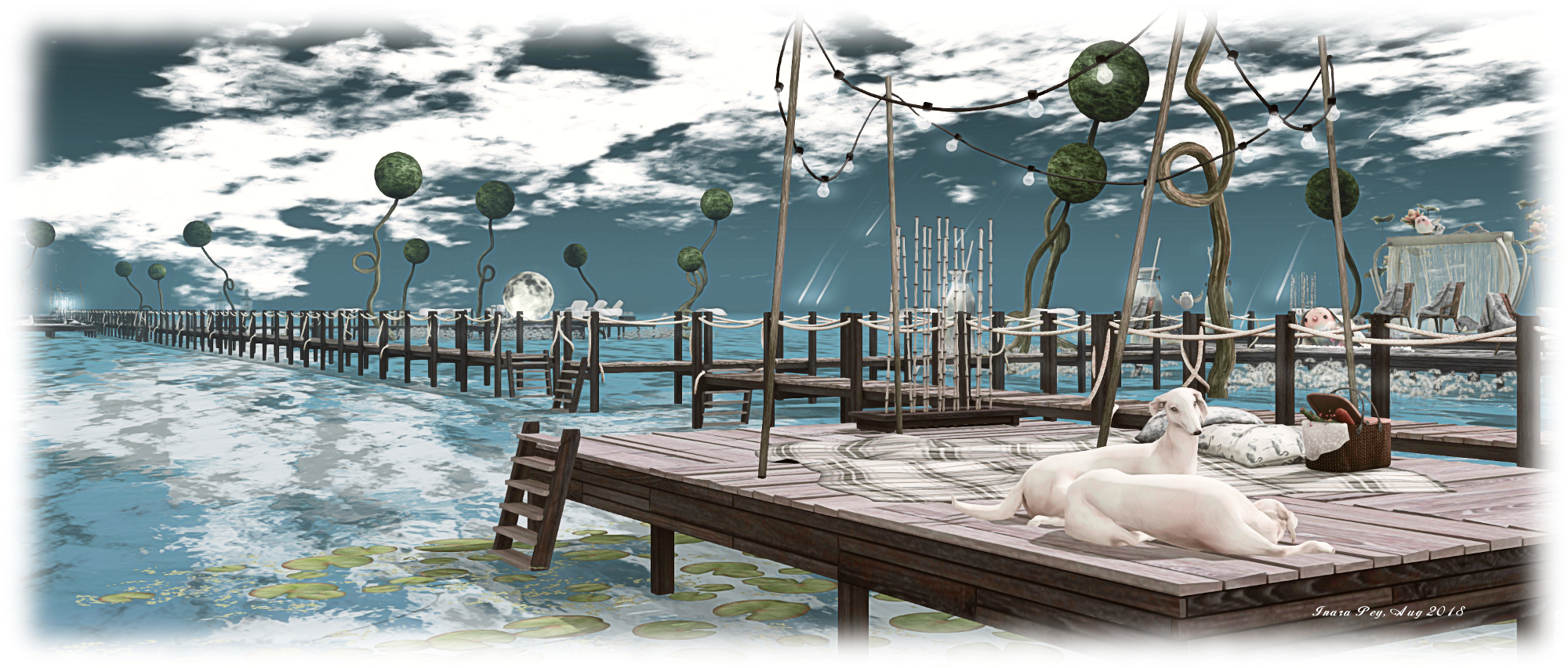
This is a place where azure waters gently flow under a matching sky broken by lazily drifting clouds of white. The ankle-deep water is dotted with wooden decks and board walks, some connected one to another, others sitting as isolated islands to be reached by gentle wading, short steps offering a way up onto them.

Black Kite; Inara Pey, August 2018, on FlickrBlack Kite

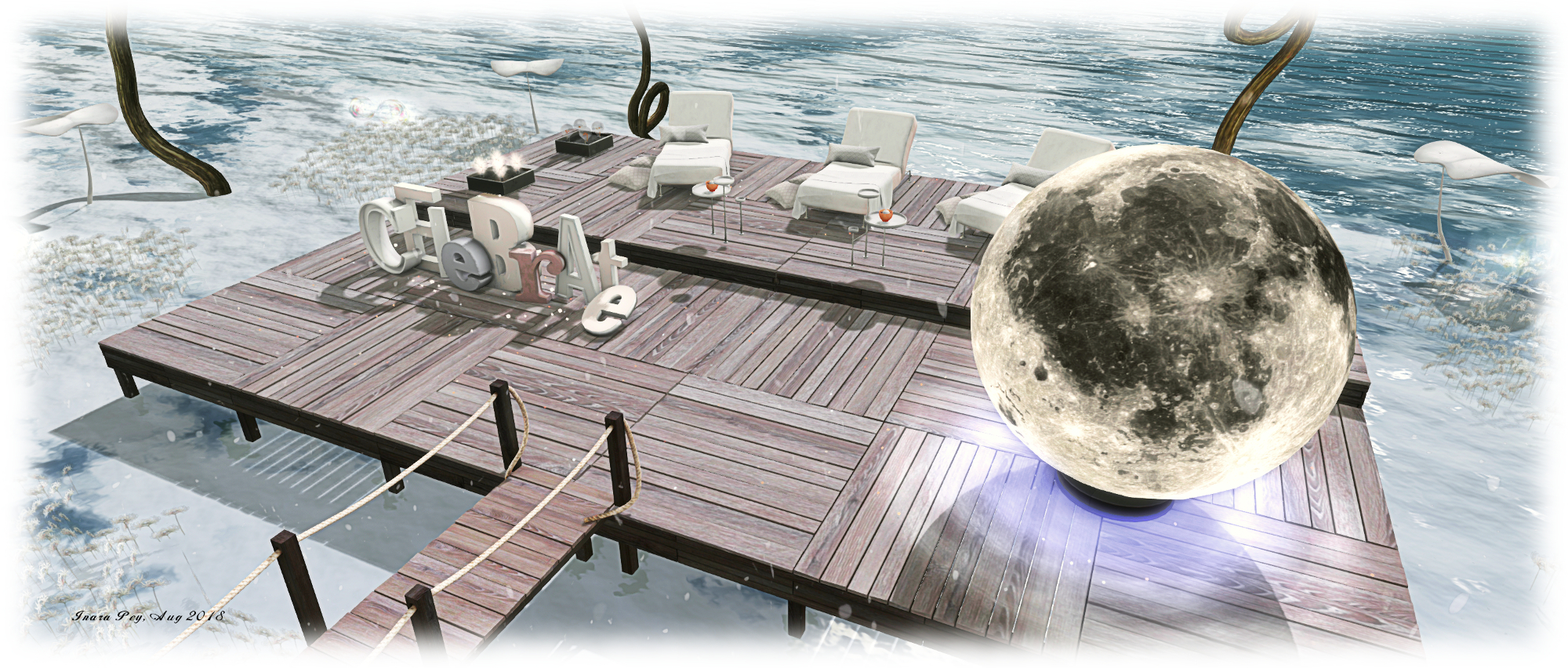
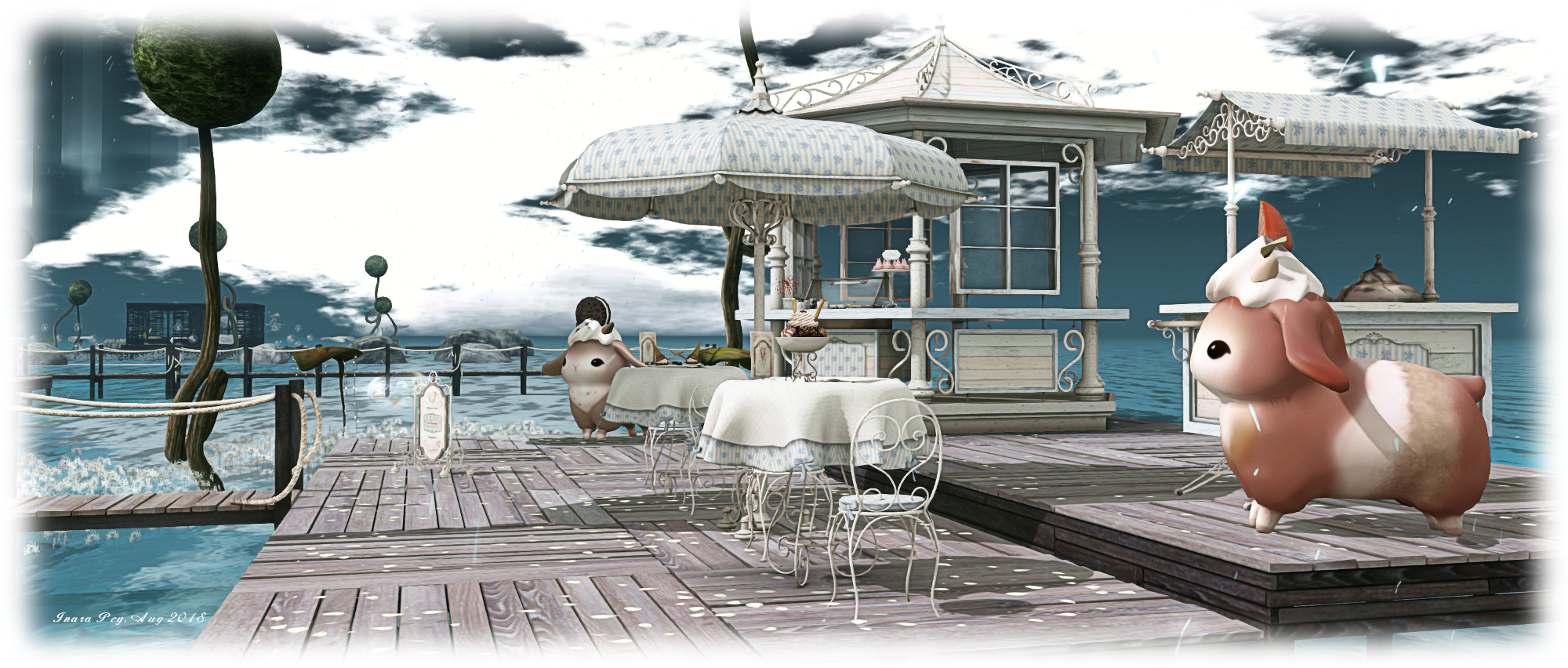
The decks are home to assorted points of interest – a couple are the location of the 8f8 store, another offers the chance to rest alongside the Moon, a third features a little open-air café (one of the elements of Black Kite that tends to remain as other elements come and go), while others offer places to simply sit and while away the time.

Watching over this is the region’s signature kite, caught on a mystical wind and aided in its oversight by the strange bobble-topped trees that rise from the waters alongside platforms and around the landing point. Throughout all of this are invitations to throw aside worries and care and just be: “Do what you want”, Celebrate”, “Nothing really matters”, “Dream” … Even “Go fly a kite”, painted on the water beneath the floating kite, reads more as an invitation than it’s more usual sentiment.

Black Kite; Inara Pey, August 2018, on FlickrBlack Kite

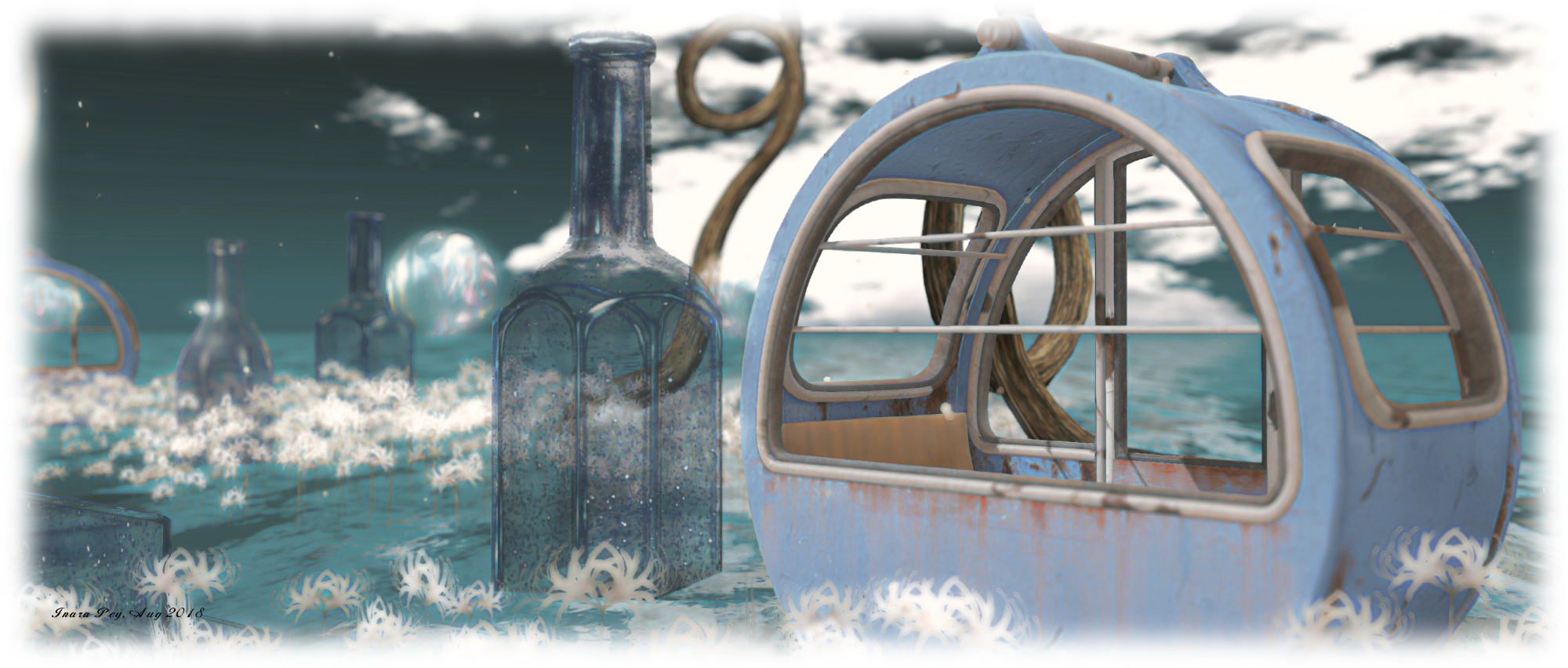
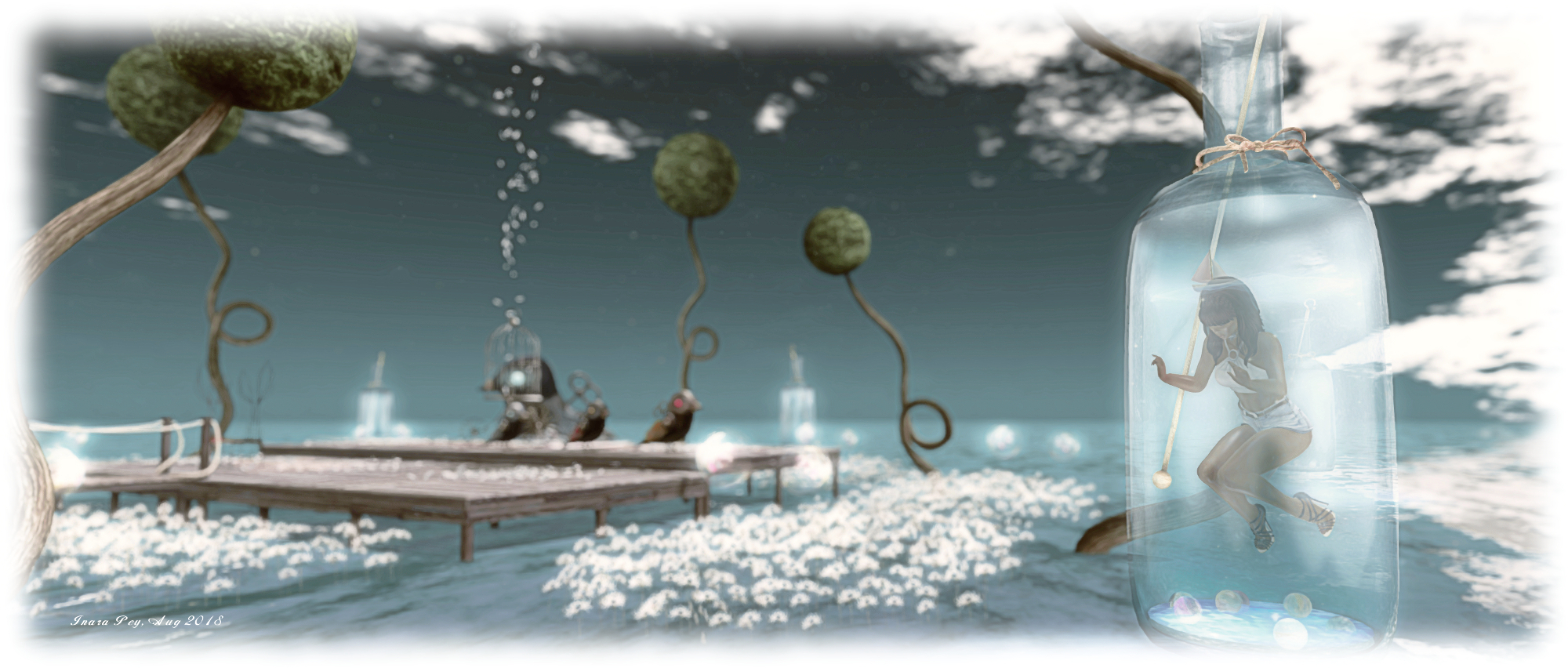
For those who have previously visited, the 8f8 store, the kite, the trees, the café and the water tower will all be reminders of Black Kite’s endurance in Second Life. So to are the bottles and jars scattered around, offering those who want to meditate in peace and quiet – and behind glass – the ability to do so. But so too are the subtle changes to be found on repeat visits spaced a little time apart from one another.

In my case, and on this trip, these changes took the form of a tower of shipping containers I can’t recall having seen before, and the arrival of assorted “cuteness” around the region – the “ice cream bunnies” at the café, for example, or the plushie birds. Small changes, perhaps, but enough to keep the camera and eyes roving, and the feet wandering through the region to discover what else might be.

Black Kite; Inara Pey, August 2018, on FlickrBlack Kite

Cloudy does still keep a private residence in the north-east corner of the region, and this is barred to public entry – but the rest of the region remains as open and as free to wander as ever. In fact, one of the joys of Black Kite always has been the fact it is uncluttered. Board walk, decks, platforms – all are scattered across the region with sufficient water between them as to engender among those using them a sense of being apart from others, free to relax in your own little space on one of the decks even when others may be a-visiting or enjoying a break for themselves.

Given that so many places occupying private islands come and go with (sometimes alarming) frequency, that Black Kite remains in-world, open to the public and asking so little in return, for more than six years now, having originally been claimed in March 2012, and remains under its original “ownership” is pretty remarkable. As such, I’m glad I’ve made the time to not only revisit for the first time in several years, but also to write about it once more.  And as with my two previous posts, I’ll again suggest that if you’ve never visited Black Kite before, and wish to see somewhere just that little bit different, you jump over and take a look for yourselves.

Black Kite; Inara Pey, August 2018, on FlickrBlack Kite

SLurl Details

Black Kite (Black Kite, rated: Moderate)

2018 Sansar Product Meeting week #31: physics

Scurry Waters: product meeting location

The following notes are taken from the Sansar Product Meeting held on Thursday, August 2nd. These Product Meetings are open to anyone to attend, are a mix of voice (primarily) and text chat. Dates and times are currently floating, so check the Sansar Atlas events sections each week.

The primary topic of the meeting was Sansar physics, although inevitably other subjects were also covered.

My apologies for the music in the audio extracts. This is from the experience where the meeting was held, and I didn’t disable the experience audio input.

Express Yourself Release Updates

The July Express Yourself Release (see my overview here) had two short-order updates following its deployment.  Both were to provide fixes for emerging issues. The first went out on July 19th, and the second on July 30th.

Client-side Physics

The Express Yourself release included an alteration to network behaviour that means physics interactions occur locally within the client first, allowing the user an immediate response. The idea is to allow the kind of immediate feedback to the user that will be essential to dynamic activities such as drive or flying a vehicle as well as allowing for more immediate response when picking an object up, walking, firing a gun, etc.

However, as the updates still need to pass through the server and then back out to everyone else, this can result in objects appearing to instantaneously move when control is passed to another avatar. More particularly, it was discovered the change could adversely affect any movement governed by scripts, which require additional time for server-side processing, and this resulted in some content breakage, which in turn caused the updates  – notably that of July 30th – to be issued in order to fix things.

It has also resulted in some behaviourial changes with scripted interactions; for example: when firing a scripted gun, as the action still requires server-side script processing, while initial movement response is client-side, it is possible to fire a gun while moving and have the projectile appear to spawn separately to the gun and avatar (e.g. behind or slightly to one side). This is to be looked at if the July 30th update hasn’t fixed it.

This work is going to be refined over time to make interactions both responsive and smoother, and is seen as an initial step towards more complex object interactions, such as being able to pick in-world objects up and hold them in the avatar’s hands.

Avatar Location Issue

One side effect of this is that avatars in an experience, when seen by others, can appear to be in a different place to where they have placed themselves. At the meeting for example, some avatars appeared to be in the local group in their own view (and, I think, to some others), but were appearing to still be at the spawn point for the experience in other people’s views. This seemed to be particularly noticeable with avatars standing still, with movement required to force the server to update everyone’s client on the location of an avatar. A further confusion from this issue is that as voice is based on an avatar’s position relative to your own, if they appear to be much further away, they cannot be heard, even if in their own view they are standing right next to you.

Avatar Locomotion Enhancements

Improvements to avatar locomotion are said to be in development at the Lab. This work includes:

  • The ability to use animation overriders.
  • Additional animation states (e.g. jump)
  • Avatar physics driving – allowing avatars to be affected by physics for things like ballistic movement or falling.

It has been suggested this work should include an ability for the avatar IK to be enabled or disabled alongside creator animations, depending on the animation type being used.

The client scripting idea requires careful consideration: will creators want their scripts run client-side? Could it be a toggle option so scripts can be expressly flagged to run of the server only? What would be the communications mechanism between script on the client and scripts on the server to ensure they remain synchronised? Should client scripts be limited to only certain capabilities, with the server still doing the heavy lifting? and so on. So – look for the ability to attach avatars to vehicles (and vehicles to avatars and objects to one another) in the future.

Vehicles

As noted above, the work on making physics more client-side active is aimed towards enabling better vehicles (using the term generically, and not as a representation just of road / wheeled type vehicles) and their controls in Sansar.  This will likely initially take the form of an ability to attach avatars to vehicle objects (a-la Second Life), allowing both to be “driven” via scripted control. This would allow for very simple vehicle types.  From there the Lab’s thinking is moving in two directions:

  • A scripted approach (client-side?) that would allow for a more flexible approach to defining vehicles and their capabilities;
  • A “vehicle component” within the platform that could be applied to different vehicle models to enable movement, etc. This would be potentially the easier of the two approaches, but would limit the degree of customisation that could be employed to ensure it fits certain vehicle types,

Scene Load Times

There has been  – from the start with Sansar – much discussion on scene load times. While a lot has been done on the Lab’s part to improve things there are some experiences that do still take a lot of time to load, and for some, depending on the circumstance may never load. There are really two issues for scene loading:

  • Bandwidth – the biggest.
  • Memory footprint – some experiences can top-out with a physical memory footprint of 14.5 Gb. For a PC with “just” 16 Gb of memory, that represents a struggle. Virtual memory (disk space) can obviously compensate, but can lead to a performance degradation.

In hard, practical terms, there is little the Lab can directly do to resolve these issues – a person’s bandwidth is whatever their ISP provides, and physical memory is whatever is in the box. However, as noted there has been a fair amount of work to offer improved optimisation of scenes, improve load times through the way data is handled – notably textures, potentially one of the biggest causes of download problems, and sound file handling (another big issue) – and more work is coming, with Lab CEO Ebbe Altberg recently noting a number of options being considered, by way of the Sansar Discord channel:

  • Progressive texture loading.
  • CDN distribution (for more localised / faster availability of scene objects materials and textures, rather than having to call them “long distance” through the cloud).
  • Background scene loading.
  • Addition of better LOD capabilities for model loading /rendering (if it is far away, only load / render the low-detail model).

Further indicators are, I understand, also planned for the Scene Editor, designed to keep experience creators better informed about the load times of objects and elements. Appropriate elements of this information will also be made available in store listing for items, allowing scene builders to again make more informed choices about the items they may be considering buying for inclusion in their experiences. There are also some practical work creators can do to ease things across the board: use smaller textures, decimate their mesh models correctly,  employ reuse of sounds and textures, etc.

In Brief

  • Aggressive render culling: Sansar can employ some aggressive render culling resulting in objects appearing clipped or vanishing from a scene unexpectedly. This is most obvious with animated objects using bone animations. This is to be looked at.
  • The last few minutes of the meeting were focused on ideas such as having a mini-map capability to find people within an experience; an ability to “go to” teleport to a friend; the ability to offer a teleport someone in an experience to your location, etc.

Carolyn Phoenix at Club LA and Gallery

Club LA and Gallery: Carolyn Phoenix

“There’s a crack in everything. That’s how the light gets in” are the words printed on the invitation to see an exhibition of photographic art by Carolyn Phoenix that recently opened at the Club LA and Gallery, curated by Fuyuko ‘冬子’ Amano (Wintergeist). Whether this is the title of the exhibition or a byline for it, I’m unsure. But I can say that the pieces on offer are hauntingly beautiful in their composition and presentation.

The mezzanine level of the gallery, where the exhibition is being hosted, has been converted into a dark, enclosed space in keeping with the title / byline. On display within it are 20 images by Carolyn, sharing the space with torso mannequins equipped with angel wings that add to the dream-like feel of the environment.

Club LA and Gallery: Carolyn Phoenix

The images themselves are mostly dark in tone and subject – so much so that specific details can be hard to make out beyond the shard or pools of washes of light each image contains. These bursts and flickers and beams of light reflect the title  / byline: they have seemingly entered the worlds of these pictures through cracks or holes or as a result of sunlight breaking through clouds or a lone bulb hanging from a ceiling or a reflection from somewhere, to revel things that might otherwise remain unseen.

What these casts of light reveal various from image to image.  Some are mindful of dreams or secret thoughts, often dark in tone – the kind of imaginings we’d rather not shed public light upon, but that nevertheless draw us to them. Others are lighter in nature, simply exulting in the play of light and shadow or the beauty of an artist’s expression of their work; there’s even a hint of playfulness about one.

Club LA and Gallery: Carolyn Phoenix

Some of the images seem to call into focus ideas of identity and of judgement. Teller (seen on the left of the banner image for this review) for example, with its reclined figure looking at a list of eyes from eyeless sockets, tends to suggest the idea of how we present ourselves to the world. The eyes, after all, are the windows of the soul; so how better to project who we might want to appear to be than by selecting our eyes, and only revealing what we want to be seen of ourselves? At the same time there is another potential interpretation: if the eyes are the windows into the soul and thus to who we really are, then how better to remove the potential for the light of understanding to penetrate our inner self than by expunging our eyes altogether, lest we be judged for what lies within.

Judgement is a theme brought into focus by a piece called Verdict (on the left of the image directly above these two paragraphs). But Again the meaning seems to be twofold. On the one hand, the tall figures surrounding the smaller one suggest a fear of judgement; of being looked down upon by others. But closer examination of the smaller subject, catsuited and hooded, perhaps suggests something else: a desire to be judged, to be found wanting and perhaps “punished”. Thus the light haloing the scene perhaps reveals kink-edged secret she at the centre of the image would rather remain hidden to all but a few – or even takes a guilty pleasure in having it so revealed…

Club LA and Gallery: Carolyn Phoenix

Nuanced throughout, a captivating display of photographic art well worth visiting. And while doingso, why not avail yourself of the exhibitions by tralala Loordes and Sighvatr (worthaboutapig), both of which can be seen or accessed on the ground floor of the gallery.

SLurl Details