Visiting the Apothecary in Second Life

The Apothecary; Inara Pey, April 2018, on FlickrThe Apothecary – click any image for full size

Update: The Apothecary has closed. Because of this, I’ve removed SLurls from this article.

The Apothecary is a new Homestead region design by Harlow Heslop which opened in April 2018. It’s an impressive outdoor design, which immediately puts one in mind of the Great Outdoors of North America, or possibly the wilder reaches of northern Europe or Scandinavia. Buildings are few, the landscape richly wooded with tall redwoods (hence the North American feel to the place) and larch, surrounded by tall mountains.

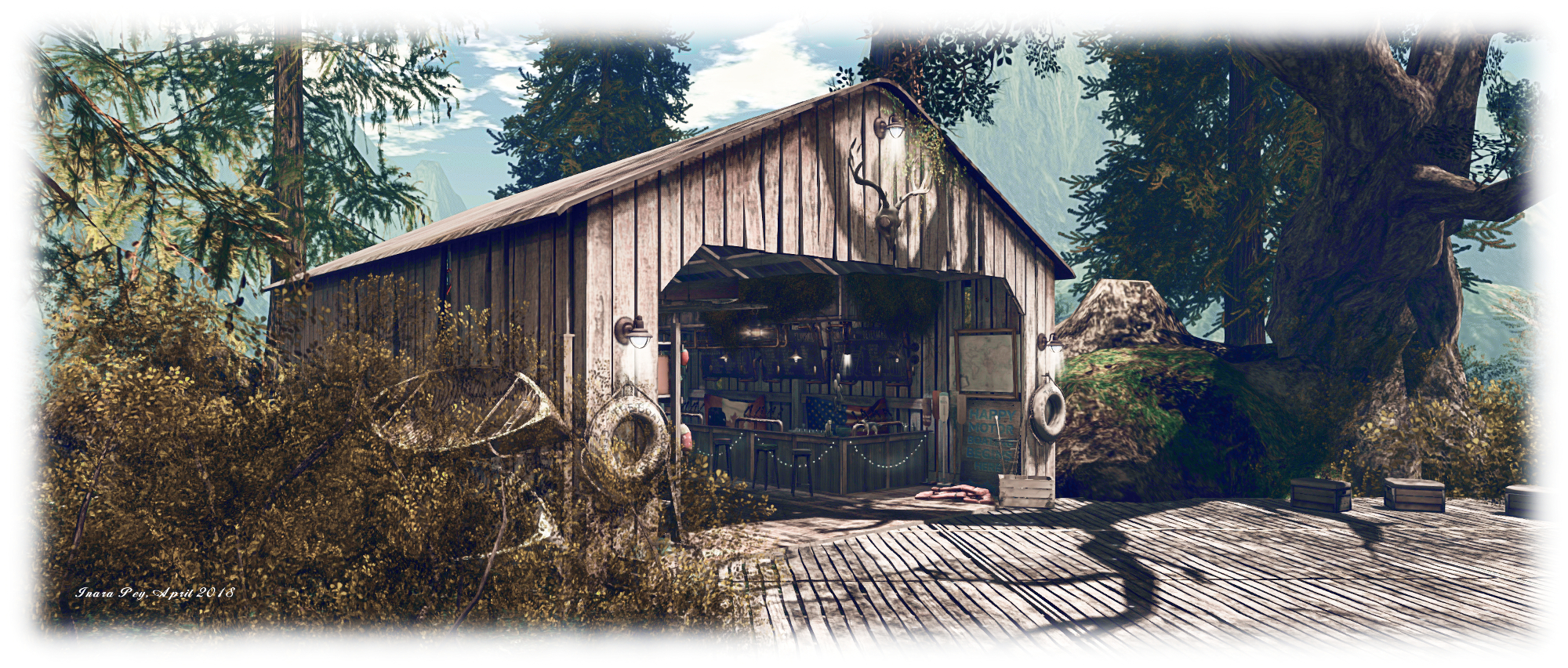
There is no landing point set within the region, but there is a greeter and welcome sign offering information on the region located on a deck in the north-east. This extends out over the water from the rugged coast of one of the three islands making up the landscape. An old barn sits close by, converted into a cosy lounge space complete with stacks of books and drinks on offer.
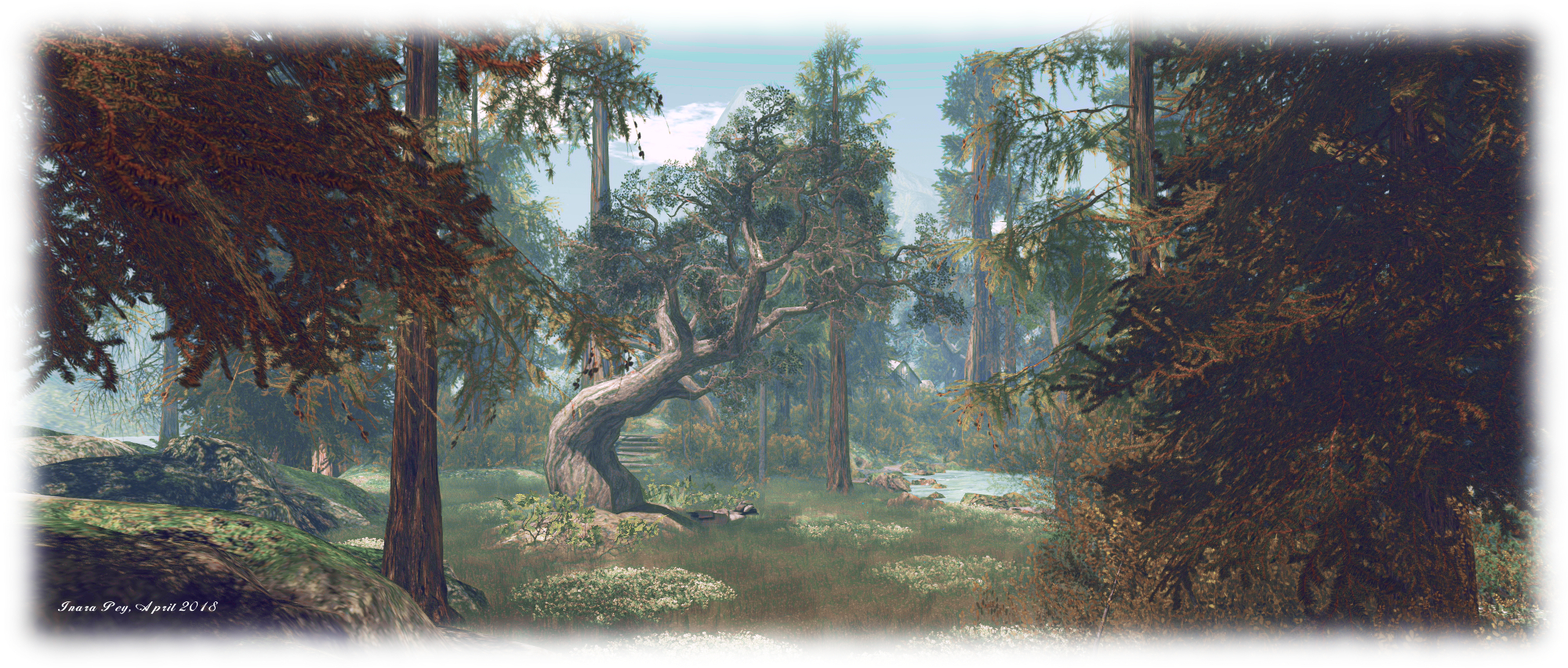
The Apothecary; Inara Pey, April 2018, on FlickrThe Apothecary

The land rises sharply alongside this, with stone steps climbing the steep slope, passing between the tall trunks of trees to where a wooden bridge watched over by four lanterns floating in the breeze, spans the narrow gorge separating this island from its much larger neighbour, a  folly like building beckoning visitors to cross the bridge to the plateau on which it sits

The drum-like building, complete with a glass-domed roof was once an aquae spadanae, a water spa – although it has been converted from this use. The pool is now a water garden, a large sculpture occupying its centre while around it, old sofas and armchairs offer comfortable places to sit and an upright piano offer an opportunity for music. The building looks to be under repair, given the scaffolding around and over a couple of windows.
The Apothecary; Inara Pey, April 2018, on FlickrThe Apothecary

Two paths descend from this plateau, one to a broad step of rock, bounded out its outside by an old path and with another open-air bohemian seating area on its inside, warmed by a fireplace. The second path – marked by stone steps and cobbled paths, offers a route around the rest of the island. Branching at the foot of the hill, one arm of the path leads the way to the Apothecary itself – a grand  old conservatory building, its frame and high roof now without glass, its floors largely overgrown and the bent back of an ancient tree reaching grasping boughs out through its woodwork. A chaise lounge and mossy grand piano sit within, along with the tools of a gallipot’s trade.

The second path leads onward around the island’s curve to another waterfront warehouse and deck. The warehouse is this time sheltering a bar with bar on tap and spirits on the shelves behind it, while the dock appears to be the setting for the occasional DJ events that may be held within the region. It looks out over the water towards the third island in the group.

The Apothecary; Inara Pey, April 2018, on FlickrThe Apothecary

This third island, compact and crowned with trees, is given over to a cosy camp site where couples and groups can enjoy quiet and intimate times.  How it is reached other than by flying, is a mystery at present; while a rowing boat is moored alongside the deck on the main island with oars seemingly at the ready, it is for cuddles only rather than being a source of transportation.

While  I opted for daylight when taking my photos, the region lies under a darkening sky rich in horizon haze. This gives the impression of the land sitting in either post-sunset dusk, or a pre-sunrise morning. The introductory notes indicate that The Apothecary will evolve over time, so I suspect it could be a place we return to from time-to-time as it changes. Those wishing to rez props for their photographs, or who wish to keep abreast of changes make to the region or DJ events held there, can join the local group for a modest fee of L$175. Those taking photos are invited to share them through the region’s Flickr pool.
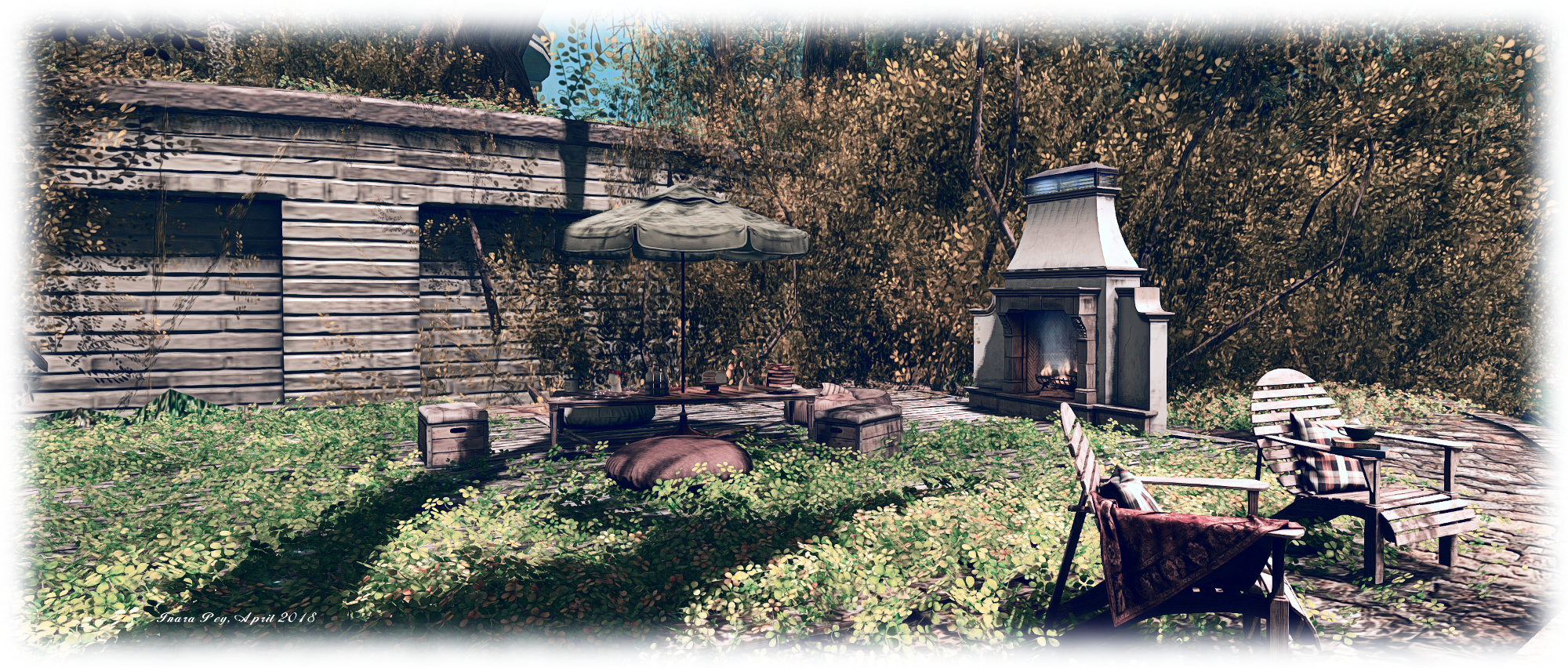
The Apothecary; Inara Pey, April 2018, on FlickrThe Apothecary

SLurl Details

  • The Apothecary (Havana, rated: Adult)
Crunching some numbers: the 2018 SL infographic

Courtesy of Linden Lab

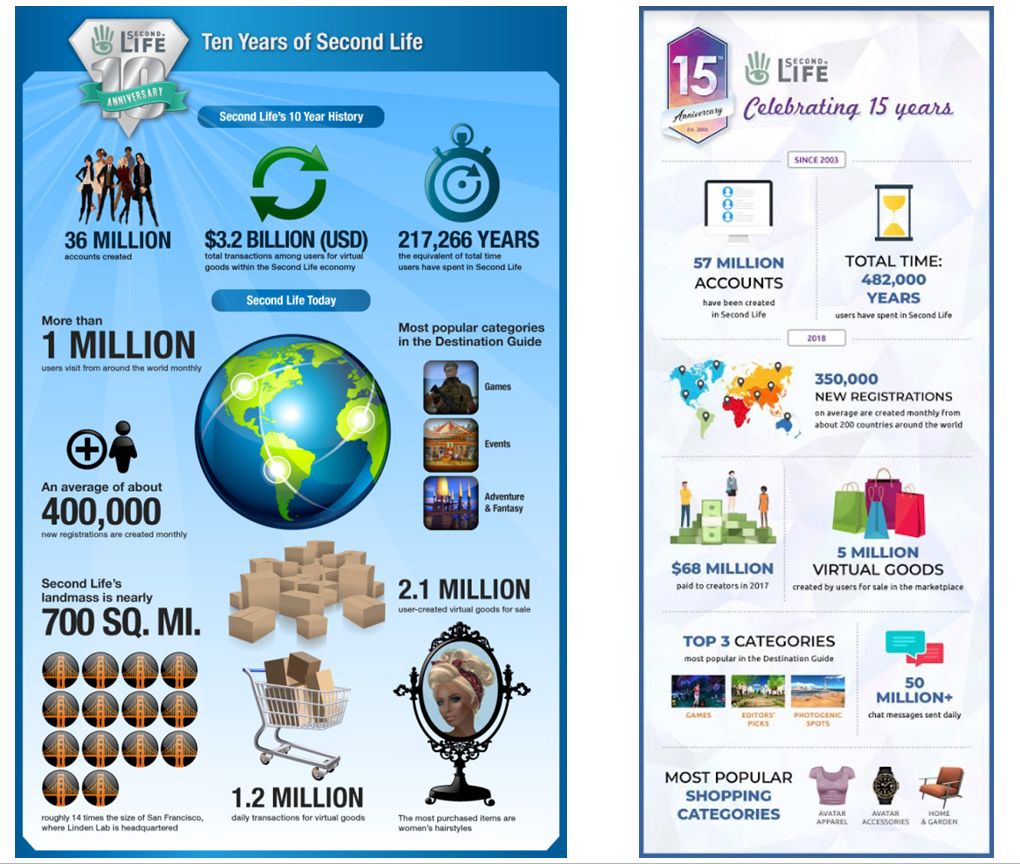
On Monday, April 23rd, Linden Lab issued an infographic on the state of Second Life as the platform approaches its 15th anniversary. The last time the company did this was, I believe, for the  platform’s tenth anniversary in 2013.

Both infographics obviously offer a potted view of Second Life which some might choose to take as spin – but casting the platform in a positive light is what PR is about. More than that, when all is said and done, the figures do go some way to showing the platform is still a vibrant place with a healthy economy and a (broadly speaking) positive engagement on that part of active users.

The “spin” element might be seen in elements such as the number of accounts created in Second Life: a total of 36 million between 2003 and 2013, and a further 21 million in the last five years (for a total of 57 million since 2003, when SL formally opened its doors to the public at large). These figures sound impressive, but when push comes to shove, “accounts created” is a pretty meaningless figure. What really matters is the number of active accounts operating within Second Life; and the fact is that over the years these have been dropping – perhaps not by the amounts some might think – although it is admittedly hard to pin things down to a precise figure.

Similarly, the number of new user registrations (400,000  reported in 2013 and 350,000 reported in 2018) doesn’t add up to a major indicator of SL’s health – but, in fairness nor do they indicate any kind of major decline, despite the 50,000 drop over the intervening period between the two infographics. But really, the issue with Second Life is not the number of sign-ups achieved, but the number of retained active users the platform obtains.

Side-by-side: the 2013 (SL10B) and 2018 (SL15B) infographics. But how useful are they?

Perhaps of more value, to a degree, are figures like the total hours users have spent engaged in the platform. in 2013, this cumulative total for 10 years was stated as an equivalent of 217,000 years; for the 15th anniversary it is put at 482,000 years.  What these show is that while the number of active users engaged in Second Life may have shrunk somewhat (notably since its peak in around 2008), those still engaged in the platform are between them potentially spending more time logged-in to the platform than they were five years ago.

Why this might be is open to speculation; but one group of reasons could be that the time an effort Linden Lab has put into improving the overall Second Life infrastructure, making batter use of technology, improving the performance of much of the platform (simulators, back-end systems, etc.), and the work put into enhancing user-facing capabilities, which have collectively encouraged people to spend more time in-world now than five years ago.

This increase in time spent engaged in the platform has other potential benefits as well – such as in increased economic activity. This is somewhat indicated by the 2018 infographic, which indicates that Second Life creators and land holders cashed out some $67 million in 2017. During sessions such as Lab Chat, and other public meetings, it had been indicated that the amount cashed-out by users in 2015/2016 was around $60 million; so it would seem that overall, the SL economy is experience an upturn, albeit a modest one. The strength of the economy might also be indicated by the rise in the number of virtual goods for sale: 2.1 million in 2013 and a stated 5 million in 2018 – although I point to this increase with the caveat that items for sale doesn’t necessarily translate directly into increases in goods sold.

Given that the 2018 infographic would tend to indicate overall engagement in the platform among engaged Second Life users has increased, the economy has apparently undergone something of a growth as well, it’s perhaps understandable why – as per the recent town hall meeting – there is now a much stronger emphasis within the Lab to pro-actively try to grow the user base going forward – and some interesting approaches are being tried.

So, what of the issues of active user numbers and new user accounts? It is true that Second Life is experiencing shrinkage in the number of active users. However, a degree of perspective is required when discussing it. At its peak in around 2008, SL averaged around 1.1 million active monthly log-ins. Today, it is lower – but by how much? That’s a tough nut to crack.

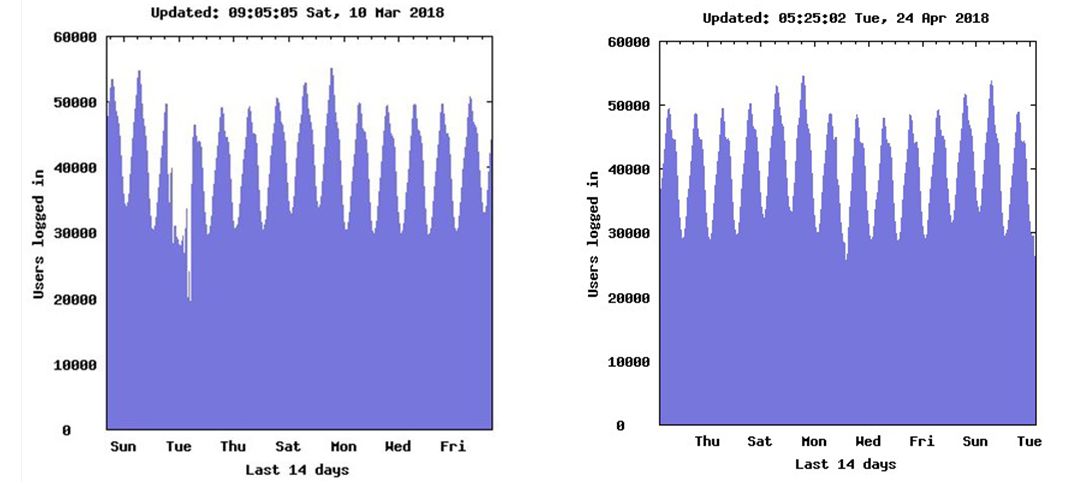
One of the few sources of real data we have comes from the SL Statistical Charts Page put together many years ago the most respected Second Life blogger (whose insight is genuinely missed), Tateru Nino, which is still active today. Among other things, it provides a series of breakdowns of concurrent log-ins – current and over set periods of times. These tend to collectively show that by-and-large average concurrency is between 30,000 and 50,000. Even when taking the bottom end of this range as the daily “average”, it still yields around 900,000 active monthly log-ins. That’s just 200,000 from the platform’s peak.

Second Life average concurrency is around 30,000-50,000 per day, as illustrated by these two 14-day extracts from Tateru Nino’s Statistics Charts, deliberately collected just over a month apart from one another

Of course, it might be argued that some of these concurrent log-ins are alt accounts or possible bots and so “don’t count”. But how large a figure is that likely to be? It’s impossible to know. Some factor it as being more than one-third, which might not be a wholly unreasonable figure; however, a counter-point to this is that just because someone is logged-in on two accounts doesn’t mean they’re not actively contributing to things like the economy through both of those accounts; so while it might be argued such activities reduce the total user count, it may not negatively impact the platform’s economy. Similarly, and where there are no empirical numbers available, it is fair to say that bot usage today is a lot less prevalent than when SL was at its peak; thus while their influence cannot be completely discounted, they are likely to have less of an influence on concurrency today than a decade ago.

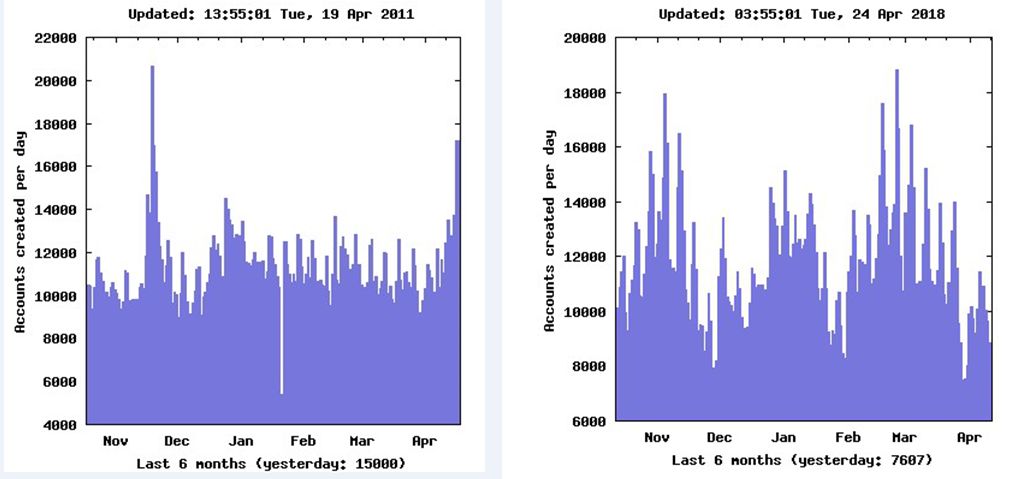
The most interesting aspect of the figures is perhaps those of sign-ups As noted above, the Lab notes a decline in monthly sign-ups of around 50,000 since 2013. Looking at Tateru’s data for 2011 (the nearest 6 month period to 2013 I have archived) and 2018, shows the average daily rare of sign-up hasn’t varied overly much across the years – although arbitrary daily figures can show more of a variation.

Sign-up across 2 6-month periods, in 2011 and up to April 2018. The averages for both are not too far apart

Both the infographic and Tateru’s stats would again point to the Lab’s optimism around growth, indicating as they do that while daily sign-ups have dropped somewhat over the years – Second Life potentially still generates interest, not all of which can be put down to existing users creating thousands of alt / bot account daily. The problem is, as noted earlier, getting more of those sign-ups converted to active, retained users.

Overall, the current infographic reveals that while there is undoubtedly room to grow the numbers of active users, and despite the downplaying of monthly active users by some, Second Life is still a healthy platform for both users and the Lab when it comes to generating revenue – and the weight of virtual goods tends to point to the Lab’s hopes to re-balance their own revenue generation away from such a heavy reliance on land tier as having merit.

More to the point, it does demonstrate that, despite all the fears about the arrival of Sansar, etc., as Second Life approaches a celebration of it’s fifteenth anniversary, it still offers a richness and depth that can keep us all engaged with it.

Lab announces SL15B music festival and invites auditions

On Monday, April 23rd, 2018, Linden Lab issued an invitation to live music performers to apply to be a part of the Second Life 15th Birthday celebration’s Music Festival.

2018 marks the fourth such festival the Lab has organised. It will be held as a part of the official Second Life Birthday celebration, taking place in mid-June 2018. For the successful applicant, it will be a paid event.

Xiola Linden explains things further in the official blog post:

Since we started Music Fest in Second Life, we’ve held an audition showcase to highlight some of the musical talent in the Second Life community. Many of you have been performing for years in virtual venues all over the grid, and we’d love to have you come showcase your talent at the try-outs for this summer Music Fest. All genres are welcome! From bands to solo acts, rock and roll to electronica – we encourage anyone to sign up for consideration. The Second Life Music Fest is an opportunity to perform at one of the biggest celebrations in Second Life, and it’s a paid gig!

She continues:

While we encourage everyone to sign up, it is not a commitment on your part and does not guarantee a spot at the auditions. We will review all submissions and extend audition invitations via email to the designated contact. Each invited act will have a short audition time (5 minutes max) to play and leave an impression on a panel of judges made up of Lindens and Residents. This panel will select acts to be invited to perform at the Second Life Music Fest. Upon completion of a half hour slot at the festival, the designated contact for each act will be eligible for payment (subject to Linden’s terms and conditions).

The 2016 Music Festival auditions

Those interested in taking part are invited to complete the audition application form – and to do so no later than Friday, May 18th. The blog post notes that completion of the application does not signify a commitment on the part of the artist to take part, nor a guarantee they’ll be called upon to audition before a panel of judges comprising Lab personnel and residents.

Musicians who are selected to audition will receive word directly from the Lab via e-mail. Those successful in their 5-minute audition, as judged by a panel of Lab staff and residents, will be invited to perform a 30-minute set at the Second Life Music Fest, and (subject to the Lab’s terms and conditions) receive payment for doing so.

The auditions will take place on (times are SLT):

  • 12:00 noon to 14:00 Friday, June 1, 2018.
  • 18:00 – 20:00 Saturday. June 2, 2018.

The venue for the auditions will be announced in due course and all residents are invited by the Lab to attend the auditions as a part of the audience.


2018 viewer release summaries week #16

Logos representative only and should not be seen as an endorsement / preference / recommendation

Updates for the week ending Sunday, April 22nd

This summary is generally published on every Monday, and is a list of SL viewer / client releases (official and TPV) made during the previous week. When reading it, please note:

  • It is based on my Current Viewer Releases Page, a list of all Second Life viewers and clients that are in popular use (and of which I am aware), and which are recognised as adhering to the TPV Policy. This page includes comprehensive links to download pages, blog notes, release notes, etc., as well as links to any / all reviews of specific viewers / clients made within this blog.
  • By its nature, this summary presented here will always be in arrears, please refer to the Current Viewer Release Page for more up-to-date information.

Official LL Viewers

  • Current Release version 5.1.3.513644, dated March 27th, promoted April 13th – formerly the Media Update RC.
  • Release channel cohorts (please see my notes on manually installing RC viewer versions if you wish to install any release candidate(s) yourself):
    • No updates.
  • Project viewers:
    • Animesh project viewer updated to version 5.1.4.514468 on April 16th – project overview.

LL Viewer Resources

Third-party Viewers

V5-style

V1-style

  • No updates.

Mobile / Other Clients

  • No updates.

Additional TPV Resources

Related Links

Space Sunday: SpaceX – balloons, bouncy castles and rockets

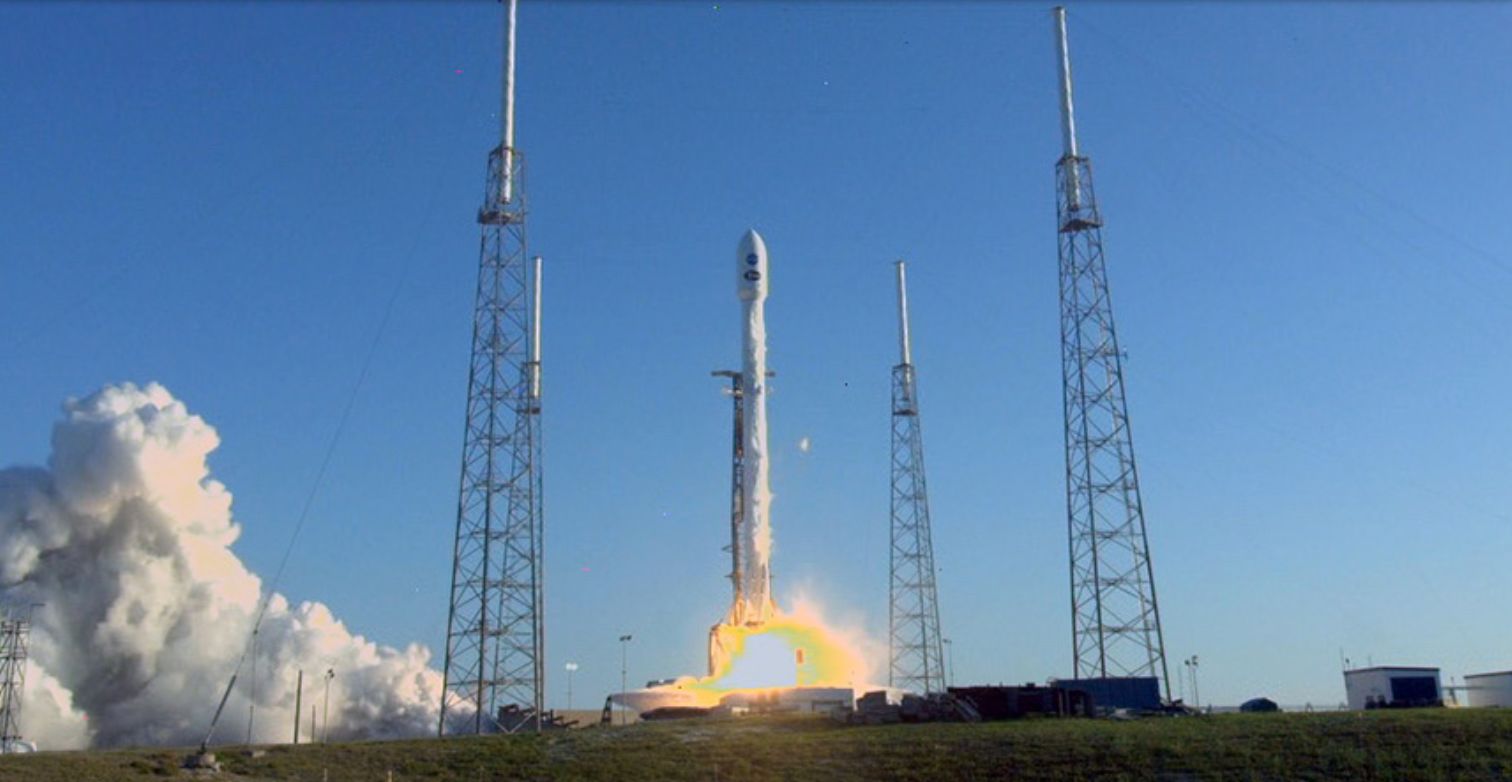
The Falcon 9 carrying TESS lifts-off from Launch Complex 40, Canaveral Air Force Station, Florida, on Wednesday, April 18th

After a two-day delay, NASA’s Transiting Exoplanet Survey Satellite (TESS) launched from Cape Canaveral Air Force  Station atop a SpaceX Falcon 9 booster on Wednesday, April 18th.

As I previewed in my previous Space Sunday report, TESS is designed to seek out exoplanets using the transit method of observation – looking for dips in the brightness of stars which might indicate the passage of an orbiting planet between the star and the telescope. Once in its assigned orbit and operational, TESS will work alongside the Kepler space observatory – now sadly nearing the end of its operational life, and eventually the James Webb Space Telescope – in seeking worlds beyond our own solar system.

It will be another 56 days before TESS has reached its unique orbit, a “2:1 lunar resonant orbit“, which will allow the craft to remain balanced within the gravitational effects of the Moon and Earth, thus providing a stable orbital regime which should last for decades. However, the launch was perfect after issues with the Falcon 9’s navigation systems prompted the initial launch attempt on Monday, April 16th. Once it had lifted the upper stage and its tiny payload – TESS is just 365 kg in mass and about the size of an upright fridge / freezer combination – the Falcon 9’s first stage completed a successful burn back manoeuvre and made a successful at-sea landing on the SpaceX Autonomous Drone Ship Of Course I Still Love You, waiting some 300 kilometres off the Florida coast.

The Block 4 Falcon 9 first stage captures an image of the autonomous Drone Ship Of Course I Still Love You just 3 seconds from touch-down. Credit: SpaceX live stream

The second stage of the rocket placed TESS into an initial 250 km circular orbit about the Earth before shutting its motor down for a 35-minute cruise period which correctly positioned the vehicle to allow the engine to be re-lit and send TESS on its way towards a 273,000 km apogee orbit. Over  the next several weeks, the instruments aboard TESS will be powered-up and calibrated, including the four cameras it will use to imaged the stars around us in an attempt to locate planets orbiting them.

The first exoplanet – the ” hot Jupiter” 51 Pegasi B, unofficially dubbed Bellerophon, later named Dimidium and some 50 light years away –  was discovered in 1995. In the 23 years since that event, some 3,708 confirmed planets (at the time of writing) have been found, with a list of several thousand more awaiting verification. Most of these have been discovered by using the transit method, with the vast majority by the Kepler space observatory. Such are the capabilities of TESS, it could double this count during its whole-sky survey, the first phase of which will last two years.

The count of confirmed exoplanets over the past 23 years. The sharp rise in 2016 is as a result of extensive follow-ups to observations made by the Kepler observatory in the K2 phase of its mission. Credit: NASA

TESS’s primary mission is scheduled to last two years – but it orbit means it could study the skies around us for decades, seeking out planets amount the 200,000 stars that are the nearest to us.

SpaceX: Party Balloons and Bouncy Castles?

Elon Musk loves to tease. He’s also generally in earnest when discussion space flight. Sometimes the two things combine in unusual ways. Take a trio of tweets he sent on April 16th, 2018, for example:

This is gonna sound crazy, but … SpaceX will try to bring rocket upper stage back from orbital velocity using a giant party balloon. And then land on a bouncy house.

Elon Musk’s trio of tweets, April 16th, 2018

Precisely what he meant has been the subject of much Twitter debate and theorising in various space-related blogs, but the CEO of SpaceX is now keeping mum on the subject; most likely enjoying the feedback and making plans.

SpaceX has serious ambitions to make their launch vehicles pretty much fully reusable. As we already know, the company has pretty much perfected the successful landing, refurbishment and re-use of Falcon 9 first stages (also used in triplicate on their Falcon Heavy booster), and plan to use the same approach with their upcoming BFR – standing for Big Falcon (or at least, a word that sounds close to “Falcon” but with a cruder meaning) Rocket – formerly, the Interplanetary Transport System.

To date, SpaceX has successfully recovered 24 Falcon 9 first stages, with almost half of those recovered now refurbished and either re-flown, or awaiting re-use. But the first stage – which does all the heavy lifting, is perhaps the “easiest” element of the vehicle to recover. It does not achieve orbital velocity (around 7,820 metres per second, or 17,500 mph), but instead tends to reach a peak velocity of around 1,716 metres per second (roughly 3,800 mph or Mach 5).

While this is still enough to generate a significant amount of heat and cause a first stage to break-up / burn-up in an uncontrolled descent, it is “slow” enough to avoid the need for extensive (and heavy) shielding to protect against the friction heat of passage back into the denser part of Earth’s atmosphere, providing the stage can be oriented correctly so three out of its set of nine motors can be re-lit. The exhaust plume from these forces the atmospheric compression generated by the rocket’s penetration of the upper layers of the denser part of the atmosphere (and which actually generates the associated re-entry heat), to occur away from the rocket, so the need for additional heat shielding is avoided.

However. recovering the upper stage of the rocket is altogether a different proposition. This does reach orbital velocity, and so finding a way in which it can be safely recovered without relying on expensive and heavy heat shielding which would both increase launch costs and reduce the payload carrying capabilities of both the Falcon 9 and the Falcon Heavy is a doozy of a problem. So much so, that SpaceX have twice cancelled attempts to make the rocket’s upper stage recoverable – and as recently as late 2017, it was believed further attempts at trying to get the stage to a point where it could be recoverable had been abandoned in favour of focusing on the BFR’s massive upper space ship stage – which as a crew / passenger carrying vehicle needs to be able to make safe landings.

So what do Musk’s tweets mean? how could a balloon be used to slow a vehicle and help it through the searing heat of orbital re-entry (where the heat load is around 27 times hotter than the heat experienced by the first stage)? The most likely explanation is that SpaceX are exploring the potential of using a ballute – a portmanteau of balloon and parachute – with the upper stage.

Continue reading “Space Sunday: SpaceX – balloons, bouncy castles and rockets”

Seanchai Library live from Fantasy Faire

Fantasy Faire 2018: The Halls of Story (Elicio Ember)

It’s time to highlight another week of storytelling in Voice by the staff and volunteers at the Seanchai Library. This week, all tales come from the Halls of Story, Fantasy Faire, 2018, unless otherwise indicated.

Sunday, April 22nd, 18:00: Mrs Piggle-Wiggle

Mrs. Piggle-Wiggle lives in an upside-down house and smells like cookies. She was even married to a pirate once. Most of all, she knows everything about children. She can cure them of any ailment. Patsy hates baths. Hubert never puts anything away. Allen eats v-e-r-y slowly. Mrs Piggle-Wiggle has a treatment for all of them.

The incomparable Mrs. Piggle-Wiggle loves children good or bad and never scolds but has positive cures for Answer-Backers, Never-Want-to-Go-to-Bedders, and other boys and girls with strange habits.

Join Caledonia Skytower at the Golden Horseshoe in Magicland Park, as she reads from Betty MacDonald tales of Mrs. Piggle-Wiggle.

Monday, April 23rd 19:00: The Crucible of Time

crucibleGyro Muggins reads the fix-up by John Brunner. First published as two-part story which appeared in Isaac Asimov’s Science Fiction Magazine, it’s an ambitious tale of alien intelligence which grew to a series of six linked tales pushed as a single novel in 1983.

Far off in space is an alien race which is so much like us, yet so un-alike. From the birth of their earliest civilisation through to their attainment of star flight as their star system passes through the galaxy, we follow their development through the ages.

Aquatic by nature, this race presents some significant challenges well outside the realms of anything encountered by humanity. But they are also driven by all too familiar hopes, fears, desires, needs, wants, prejudices, impact of religious ideologies, and the quest for knowledge we have experienced in the growth of our own civilisation.

Charting six periods of time, each a thousand years after the previous, the six stories focus on the efforts of a group of individuals in each era as they face one or more challenges, their success in overcoming these challenges inevitably leading them towards a greater understanding of their planet’s plight, and ultimately, the ability to deal with that plight and the survival of their civilisation.

Tuesday, April 24th 19:00: National Lampoon’s Doon

In a distant galaxy, far, far away, a plot is brewing as vast and elaborate as the Empire itself…

Evil powers plot to harvest the wild pools of beer that grow only on the savage, sugar-swept world of Doon, take control of the native pretzel population, and turn the plucky little orb into the lounge-planet of the universe!

And only one man, Pall Agamemnides, heir to a dukedom can stop the galaxy-wide web of conspiracy and intrigue that is being fomented, and bring an end to the threat facing Soon.

Although reliant on a knowledge of both Frank Herbert’s sprawling story of Dune and Herbert’s often heady and flowery prose, Ellis Weiner’s tongue-in-cheek Doon is a masterpiece, offering a perfect parody of Herbert’s novel and brilliantly and accurately mimicking his prose.

Join Corwyn Allen as he resumes his reading.

Wednesday, April 25th 19:00: A Selected View of George R.R. Marti

With Aoife Lorefield.

Thursday, April 25th 19:00: Monsters and Myths: Fafnir

With Shandon Loring. Also presented in Kitely (hop://grid.kitely.com:8002/Seanchai/144/129/29).


Please check with the Seanchai Library’s blog for updates and for additions or changes to the week’s schedule.