Logos representative only and should not be seen as an endorsement / preference / recommendation
Updates for the week ending Sunday, January 7th
This summary is published every Monday, and is a list of SL viewer / client releases (official and TPV) made during the previous week. When reading it, please note:
It is based on my Current Viewer Releases Page, a list of all Second Life viewers and clients that are in popular use (and of which I am aware), and which are recognised as adhering to the TPV Policy. This page includes comprehensive links to download pages, blog notes, release notes, etc., as well as links to any / all reviews of specific viewers / clients made within this blog
By its nature, this summary presented here will always be in arrears, please refer to the Current Viewer Release Page for more up-to-date information.
Official LL Viewers
Current Release version 5.0.9.329906, dated November 17, promoted November 29th – formerly the “Martini” Maintenance RC – No Change.
John Young: Gemini (l), Apollo, shuttle and in 2002, two years prior to his retirement from NASA after 42 years with the agency (r). Credit: NASA / Getty Images
On Saturday, January 6th, 2018, NASA announced the passing of astronaut John Watts Young. The US space agency’s longest-serving astronaut during his career, Young passed away on January 5th at the age of 87. He flew in space six times across three different space programmes: Gemini, Apollo and the space shuttle.
Young was born in San Francisco, California, on September 24th, 1930, and earned a Bachelor of Science degree with highest honours in Aeronautical Engineering from the Georgia Institute of Technology in 1952. He served in the US Navy from 1952 through 1962, serving as a seaborne officer prior to entering flight training , qualifying as a jet fighter pilot in 1953. After flying front-line fighters for 5 years, he joined the US Navy Air Test Centre in 1959, evaluating fighter aircraft and weapons systems.
In 1962, Young joined NASA and was part of Astronaut Group 2 alongside Neil Armstrong first man on the Moon, Charles “Pete” Conrad, commander of the first crewed Skylab mission, Frank Borman, commander of the first Apollo flight to the Moon (Apollo 8), James “Jim” Lovell, commander of Apollo 13, Thomas Stafford, commander of the US part of the Apollo-Soyuz Test Project (ASTP) mission, and Edward “Ed” White, who was to be killed in the Apollo 1 pad fire. He was the first of that group to fly in space as a part of the Gemini programme, the second of America’s manned spaceflight programmes, and the precursor to Apollo and the lunar effort.
John Young (r) with Gemini 3 commander Virgil “Gus” Grissom, standing in front of the Gemini simulator. Credit: NASA
He first flight into space was aboard Gemini 3 on March 23rd, 1965, sitting alongside Virgil “Gus” Grissom, the mission commander. The primary goal of the mission was to put the Gemini capsule through its paces during a 3-orbit flight – America’s seventh crewed spaceflight (or ninth, if you count two X-15 flights). It was also the final mission controlled from Cape Kennedy Air Force Station in Florida (Cape Canaveral Air Force Station today), before mission control functions were shifted to the newly opened Manned Spacecraft Centre, known today as the Johnson Space Centre.
The mission was noted for the “contraband” corned beef sandwich Young smuggled onto the flight in his spacesuit. Grissom knew nothing of the sandwich until Young produced it, and both men took a couple of bites each before Young stowed it again to avoid crumbs getting into the capsule’s electronics. Post-mission, Grissom commented, “After the flight our superiors at NASA let us know in no uncertain terms that non-man-rated corned beef sandwiches were out for future space missions. But John’s deadpan offer of this strictly non-regulation goodie remains one of the highlights of our flight for me.”
The sandwich incident seemed to leave Young sidelined; rather than being pencilled for a command slot, he was relegated to the role of back-up. However, with the Apollo programme starting to ramp-up, Ed White was rotated over to the Apollo 1 crew, and this opened a slot in the Gemini programme for Young to take the command of Gemini 10 in 1966. The 8th manned Gemini flight and with Michael Collins flying alongside Young, Gemini 10 was the first to perform a rendezvous with two Agena target vehicles.
The spacecraft launched on July 18th, 1966, 100 minutes after its dedicated Agena target vehicle. After a successful rendezous and docking, they re-ignited the Agena’s motor, the first time this had been done, and used it to raise their orbit from an average altitude of 265 km (145 nautical mile) to a 294 by 763 km (159-by-412-nautical-mile) orbit, ready for a rendezvous with the Agena target vehicle intended to be used by Gemini 8, which was unable to complete its mission. Collins then completed the first of two EVAs after the crew had rested, and then Gemini 10 detached from its own Agena to make a successful docking with the passive Gemini 8 target vehicle – the first such docking without any assistance in handling the target vehicle from Earth. After a further rest period, Collins performed a second spacewalk. With a double doubling, two EVAs and 10 science experiments, Gemini 10 was one of the most comprehensive space missions completed up to that time, with the capsule splashing down on July 21st, 1966.
John Young and Michael Collins, the crew of Gemini 10, 1966. Credit: NASA
For the Apollo programme, Young was initially assigned to back-up crews. However, following the Apollo 1 fire which killed Grissom, White and Roger Chaffee, the flight roster was reshuffled, and Young was placed on the Apollo 10 crew as Command Module Pilot. This mission, which also included Thomas Stafford and Commander and Eugene Cernan as the Lunar Module Pilot, was the final Apollo mission prior to the missions to the surface of the Moon, and was the second – after Apollo 8 – to actually fly to the Moon.
Launched on May 18th, 1969, the only Apollo Saturn V mission to lift-off from Launch Complex 39B, and only one of two Apollo missions to feature crews who had all previously flown in space (the other being Apollo 11). Reaching the Moon on May 21st, 2969, the Apollo 10 crew became – and remain – the humans who have travelled the farthest from their homes. This is because the Moon is in an elliptical orbit around the Earth, which varies by some 43,000 km (23,000 nmi) between perigree (the point closest to the Earth) and apogee (the point farthest from the Earth), and Apollo 10 was the only Apollo mission to take place as the Moon was approaching apogee, meaning the crew were some 408,950 km (220,820 nmi) from their homes and families in Houston.
On reaching the Moon, Young was left aboard the Command and Service Module (CSM), code-named Charlie Brown, while Stafford and Cernan took the Lunar Excursion Module (LEM) Snoopy to some 14.4 km (8 nmi) of the lunar surface, allowing them to overfly and survey the Apollo 11 landing area in the Sea of Tranquillity. To avoid the risk of Stafford and Cernan actually landing on the Moon, the LEM had been short-fuelled, forcing them to fire the descent unit motor to start an ascent back up to orbit. However, this initially did not go smoothly.
Due to a small series of input errors by Stafford and Cernan, Snoopy’s guidance system had the craft pointing in the wrong direction, and on engine firing, the LEM went into a violent spin. It took both men several seconds to recover control – time enough for the LEM to crash on the Moon. In the event, control was regain, the decent unit was jettisoned as its feul was expended, and the ascent stage motor carried Cernan and Stafford safely to a rendezvous with the CSM. Following the excitement of the initial ascent, Stafford reported the successful rendezvous and docking by radioing Earth with the message, “Snoopy and Charlie Brown are hugging each other.”
After Apollo 10’s return to Earth on May 26th, 1969, Young started training as back-up commander for Apollo 13. When disaster stuck that mission he played a central role in the team that developed procedures to stretch the Lunar Module consumables and reactivate the Command Module systems prior to re-entry, saving the Apollo 13 crew. Young then rotated into the Command slot for Apollo 16, with LEM Pilot Charles Duke and CSM Pilot Ken Mattingly.
Apollo 16 lifted-off on April 16th, 1972, and Young and Duke arrived in the Descartes Highlands on April 21st, 1972, at the start of the second-longest lunar surface mission (Apollo 17 being the longest). In 71 hours on the Moon, conducting three extra-vehicular activities or moonwalks, totalling 20 hours and 14 minutes, driving Lunar Roving Vehicle (LRV) 26.7 km (16.6 mi) and collecting 95.8 kilograms (211 lb) of lunar samples for return to Earth. Young was the ninth man to walk on the surface of the Moon, and in typical style, was exuberant throughout: jumping clear of the surface while saluting the US flag, and setting a speed record driving the LRV.
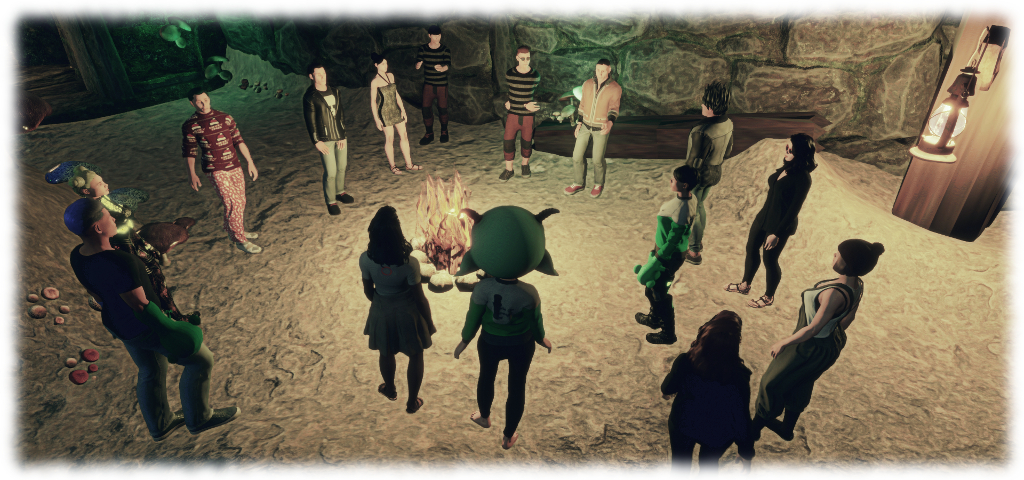
People gather around the camp fire for the first Sansar public Product Meeting of 2018
The following notes are taken from the Sansar Product Meeting held on the afternoon of Friday, January 5th, 2018 (I was unable to attend the morning meeting). These Product meetings are usually held every Friday at 9:30am PST and 4:00pm PST, and are open to all. There is currently no set agenda, and the meetings are a mix of voice and text. The official meeting notes are published in the week following each pair of meetings, while venues change each week, and are listed in the Meet-up Announcements. and the Sansar Atlas events section.
The January 5th afternoon meeting was attended by Ebbe Altberg, plus Carolyn from he Product Team and David and Sean from the Sansar character team. David has been working on the Marvelous Designer (MD) integration, and he and Sean were able to address questions around fashion, etc. Audio extracts feature Ebbe, David and Sean.
Avatar Notes
Custom skins: textures are seen as an important aspect of the avatar, allowing age, muscle definition, etc., to be applied. As such, it is something the Lab wants to expand upon. However, the focus at the moment remains on the fashion work, rather than on custom texture uploads and application, and it is down to the product team as to where the latter sits on the roadmap.
Texture resolutions: It has been noted that the avatar is a 60K polygon body apparently using 512×512 textures. Sean explained that the textures placed on the website aren’t actually the textures used on-line. Rather, an upload limit was hit within the ZenDesk software, forcing the use of lower resolution textures.
Avatar shapes / customisation: greater avatar customisation (changing height, shape, etc.), is “on the roadmap”. Currently, the focus is on increasing the amount of customisation available with the avatar face, with further bone morphs, work that is seen as “foundational” to adding the ability to customise the rest of the avatar shape.
How the facial work will be implemented is an open discussion. Sliders have thus far been used (as with SL), but this can be limiting when other forms of deformation are also applied. Recent games have tended to use a form of pick map for customising facial features – the user clicks on a point of the face (e.g. the cheek), and all the bones affecting that area respond to adjustments with the mouse, rather than having to adjust individual bones with individual sliders – and is mirrored where appropriate (e.g. cheeks, ears, etc.). This result in more natural looks, and is something that is being considered as a way of managing customisation in Sansar.
Fashion / Marvelous Designer
Cloth Physics and Layering
The integration of MD has allowed cloth physics to be used in Sansar – although currently these can only be seen / set within the Avatar App Lookbook (formerly My Looks) when editing an avatar. Cloth physics are actually “built-in” to the patterns exported from MD, with the cloth simulation code from MD being used within the client. This means it is unlikely that designers will be able to use other tools – such as Blender – with the cloth physics capabilities without using MD as well.
The reason for restricting cloth physics to LookBook for the time being is that simulating cloth movement, etc., in Sansar’s Runtime Mode can generate a considerable performance hit; the Lab therefore want to focus on making various performance improvements and further Runtime optimisations before they start looking at introducing cloth physics into the Runtime environment.
Currently, garments that are layered in MD (e.g a jacket over a shirt)and are exported to Sansar as a single item have their layering respected within Sansar (so the jacket renders over the shirt. However, individual items using the same layer will not be simulated correctly, and the Lab is working to rectify this. In the future, clothing should be layered relative to the order in which it is added to the avatar. So, for example, if you have a “layer 2” shirt and “layer 2” jeans, wearing the shirt first, then the jeans will result in the shirt appearing to be “tucked in” to the jeans, whereas wearing the jeans first, then the shirt, will result in the shirt appearing to be untucked.
In Brief
Roughness maps, handled directly by MD are coming into Sansar “too shiny”, requiring creators tweak them manually. This is to be referred back to MD.
It is currently anticipated that there will be no changes to the weighting / the way the IK rig is painted, etc.
User Engagement and Retention
2018 will see some attention switch away from developing technical capabilities towards broader issues of user engagement and retention.
Locating people: An upcoming change to the Atlas will allow experiences to be sorted in terms of current usage: those experiences with people currently using them will be listed with the most popular at the top, and then descending to those which are not currently being used.
This may be accompanied by a generic indicator that people are using an experience. This will not initially be a physical count of avatars, as there are issues around instancing (e.g. there may be 100+ in an experience, but spread across two or three instances, each with a different number of actual avatars in it – so while the count is 100+, you might be directed to an instance with only 15 other avatars in it).
An actual numerical indicator of the number of avatars in an experience might follow in the future.
Ebbe’s latest Sansar look
Sansar forums blogs, etc: it has finally been recognised that the current tool used for these – ZenDesk – is not well suited to the task (YAY!), although fixing this is not a high priority. There have been internal discussions at the Lab about using the platform and tools employed in creating the Second Life forums, blogs, etc., to build something for Sansar – potentially more as a cost saving opportunity then for the sake of functionality. Frankly, I’m still stunned that this wasn’t the route taken from the start given the Lab have the tools and the experience to use them, which could have been easily leveraged, rather than going for a tool entirely unsuited to the task and which presents information in a very unfriendly – and dare I say amateur – manner.
Better in-world tools: emphasis will likely be given to providing “in-world” tools for better social interactions among users (e.g. things like group chat / group messaging, etc.).
Avatar Animations and Interactivity: giving people things to do in Sansar would also help with user retention. This could be as simple as offering basic animations to allow avatar to sit, dance, Animations such as sitting are seen as more complex, for reasons previously noted, unless objects are specifically scripted for handling this; however, it might be possible for the Lab to implement a simple ground sit.
Improving the on-boarding process: the sign-up and getting started process is already seen (by the Lab) as a little complicated, so work may be put in on making this more straightforward.
One thing Ebbe indicated would be useful is collective agreements from creators / users on what they feel is needed to help with user retention. That is, not a myriad of individual ideas / suggestions, but a collection of ideas creator have agreed among themselves as perhaps being the most pertinent. While this should initially be geared towards the Lab’s focus of user engagement and retention, it might also include idea that help improve the creation and turn-around of scenes / experiences.
Feedback, Discussion, Engaging with the Lab and Future Meetings
In terms of engaging with the Lab, offering / receiving feedback (including discussing platform limitations / shortfalls) can also be carried out through Discord, which can also draw other creators into discussions. At some point in the future, the current meetings within Sansar may be expanded into a similar kind of structure as the SL User Group meetings: product, scripting, characters, engineering, etc.
Inventory – Scene and Avatar
Scene Inventory
The current inventory system in the Edit Mode doesn’t have any real inventory management tools. The have been discussions at the Lab on how to improve inventory & the inventory tools / options (e.g. use of nested folders, etc.). No single approach has been decided upon, but it is still being looked into – however, due to the emphasis on user engagement, it may slip down the priorities list.
Avatar Inventory
Unlike Second Life, Sansar avatars currently do not have a notion of inventory per se when in an experience; attachments and clothing can only be added / removed via the Avatar App – LookBook. This means that at present, an avatar cannot simply change outfit or wear a gun or other accessory from within an experience – the use must go to LookBook, change the outfit / add the attachment, then come back – and land at the experience’s spawn point.
From the point of view of games, this is hardly ideal. Options such as an avatar having a “backpack” (whether this would be physical or virtual is unclear) into which items can be placed and used, are being looked at. However, this kind of a solution also has questions around it: should such a backpack be persistent across experiences, so avatars can cross from one to another and retain items in it? Should it only apply to items collected in the current experience? Also, currently, only items from LookBook can only be associated with an avatar if worn / attached – so any notion of being able to “take” items from LookBook and drop them into a “backpack” to carry around experiences would require a considerable about of work – if possible.
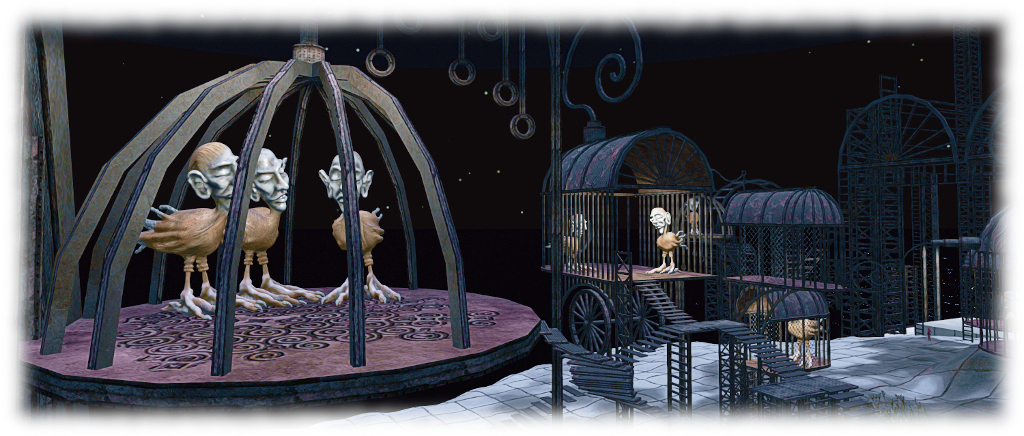
Bird People is Cica Ghost’s latest region-wide installation, and it presents something of a conundrum. In a largely denuded landscape, the ground of which has been partially and neatly divided into a black-on-white grid, sit giant, ornate metalworks. Some stand alone, others support great cages – or form cage-like structures, equally huge, while block-like towers, apparently made of stacked cubes also rise from the ground here and there. It’s a strange environment – and one, frankly, difficult to see when using the default landscape and following the viewing instructions (ALM enabled and Shadows set to Sun/Moon + Projectors).
Throughout the landscape, stairways rise, curl and undulate, some supported by metal structures, some starting from the blocky forms. All of them twist and turn, and run by rise and fall to connect the ground – or at least their foundation blocks – offering people climbs up to dizzying heights and the giant cages waiting there. Some of these cages, but many are occupied by strange creatures with the bodies of bird and the heads of men. Most of these creatures sit within their cages individually or in pairs, facing open doors or sides to their enclosures almost apprehensively, as if fearing stepping out into the world beyond.
What are we to make of this? The clue, perhaps, lies in the quote Cica has offered with the piece: We are all living in cages with the door wide open. It’s a quote from Star Wars creator George Lucas about creativity and imagination. It references the idea that we can all be creative, we can all soar far and wide on the wings of imagination, if we are only willing to just let go; So does the installation perhaps stand as a metaphor for this idea?
Certainly, there is a strong contrast between the expressions worn by the creatures who have stepped out of their cages and are variously gathered or dotted across the open spaces beneath their former prisons, and those who have yet to venture forth. The former – for the most part – appear happy, chatty, curious and even playfully (although there are one or two looking slightly wary). Those still within their cages look through open doorways with a mix of confusion, apprehension and uncertainty – or even close their eyes on their potential route to freedom. This contrast plays strongly into the idea that stepping beyond the confines of our personal cages – our comfort zones – if you will, and embracing the imagination can be a liberating, positive influence on us.
For me, and in keeping with the broader theme offered by Lucas’ quote, the installation stands as the embodiment of a piece written be Debbie Hampton , the blogger and writer behind The Best Brain Possible. In 2015 She used the quote as the title for an essay about overcoming personal fear and the apparent “comforts” we can have in allowing ourselves to become caged by a “normal” life; we become, in effect, our own jailers.
I’ve lived most of my life like a bird in a cage with the door wide open. At any time, I could have hopped on over to the opening, taken flight and soared to new heights. All along, I’ve known how to fly. No one clipped my wings.
So, what kept me in the cage? My own fear and self-imposed limitations held me there. I was my own prison guard. I think we are all born knowing how to fly, but life happens and beats us down little-by-little until we forget that we ever had this valuable skill.
I must also, and in passing, admit that Cica’s human-headed birds put me in mind of something else – something entirely unintended by Cica (I know this because I asked her!), so I’m not going to draw any parallels between the two. I’ll simply state that in looking at these creatures, I couldn’t help but be put in mind of the Brontitallians from Douglas Adams’ Hitch-Hiker’s Guide to the Galaxy – and while it may have been unintentional, it was also quite delightful.
A conundrum it may first be upon first arriving within it, Bird People is worth exploring and thinking about – although I do perhaps suggest you try a Midnight windlight setting rather than the default; it doesn’t detract that much from the experience (just ensure you do have LM enabled and Shadows set to Sun/Moon + Projectors), and it can certainly make navigation a lot easier when climbing the various stairways and reduces the risk of falling off them somewhat.
Grumpity and Alexa Linden host the Web User Group meetings on alternate Fridays at Alexa’s barn.
The majority of these notes are taken from the Web User Group meeting held on Friday, December 8th, 2017. These meetings are generally held on alternate Fridays, and chaired by Alexa and Grumpity Linden at Alexa’s barn. The focus is the Lab’s web properties, which include the Second Life website (including the blogs, Destination Guide, Maps, Search, the Knowledge base, etc.), Place Pages, Landing Pages (and join flow for sign-ups), the Marketplace, and so on and the Lab’s own website at lindenlab.com.
Not all of these topics will be discussed at every meeting, however, the intention within the group is to gain feedback on the web properties, pain points, etc., and as such is very much led by comments and input from those attending. Along with this are two points of note:
Specific bugs within any web property – be it Marketplace, forums, Place Pages or anything else), or any specific feature request for a web property should be made via the Second Life JIRA.
Alex Linden provides routine updates on the Lab’s SL-facing web properties as and when appropriate, which can be found in the Second Life Web thread.
Note that the SL forums are not covered by the Web User Group, as the management of functionality of the forums falls under the remit of the Support Team.
Web Single Sign-On
Single sign-on (SSO) should have been implemented for most of the Lab’s web properties (e.g. sign on to your account dashboard and then visit the Marketplace using the same browser, and you should be automatically logged in there) – although there are some properties (such as the JIRA and the land auctions domain) which are not currently part of the SSO process. However, there seem to be inconsistencies in how it is working, with some reporting that:
If the log into their dashboard, they can access the Marketplace via the Shopping link OK, but if they attempt to use the Marketplace via a separate tab, they sometimes have to log-in again, or
They also have to sign-in to different properties when opening them in new tabs, even if already signed-in elsewhere.
Having very restrictive cookie settings could cause problems with SSO. There may be a specific order of log-in that is required for it to work, which the Lab will check. Otherwise those experiencing such problems are asked to write-up a details JIRA on the problems they are experiencing, and the domains where SSO appears to be failing.
Governance, Legal, Finance and Technical
Often at user-group meetings questions are asked around matters of governance or which may be related to legal / financial issues (e.g. fraud or alleged cases of fraud). All of these matters are overseen by teams outside of the technical personnel who attend the in-world meetings, and so – while it may be frustrating for those raising the questions – cannot comment on or address such issues.
Marketplace
Blank folder names in listings: see BUG-9984 – this is still occurring, and the JIRA has been re-opened for comment, with a request that specific recent instances of the problem are reported (you may need to send an email to LetMeIn@lindenlab.com & request access to comment.
Variants in listings: this is a long-standing request – to allow things like colour variants of an item in a single Marketplace listing, rather than having to list the variants individually. This is something the Lab wants to address, although it is not on the short-term list of work they will be tackling, nor is it necessarily an easy thing to implement, but it is climbing slowing up the list.
Marketplace Demos: demos are a pain point for some users of the MP, in that they cannot be easily filtered out of searches, even when using boolean parameters. various ideas have been put forward over the years for better handling of searches / excluding demo items. However, most are difficult to implement successfully, simply because of the way the system can be gamed (e.g., boolean exclusion of “demo” can be currently gamed by people listing items as “d_emo” or similar). The Lab is aware of the pain points with demos and free item listings, but again, this are things which have yet to rise to the top of the list of improvements they would like to make to the Marketplace.
Feature Requests
Feature requests – raised via the Second Life JIRA – are the best way of bringing ideas to the Lab’s attention. These are reviewed an assessed (triaged) on a weekly basis. When raising a feature request, remember to state a clear user case: what the issue being addressed is, why it matters, how your idea improves things, an indication (the more detailed the batter) of how the idea can be implemented, and so on. If you’re proposing a UI improvement, then consider including mock-up images of whatever you are proposing; if it is possible to illustrate the idea clearly some other way, do that, and provide an explanation. Try to be as clear and direct as possible.
Place Pages
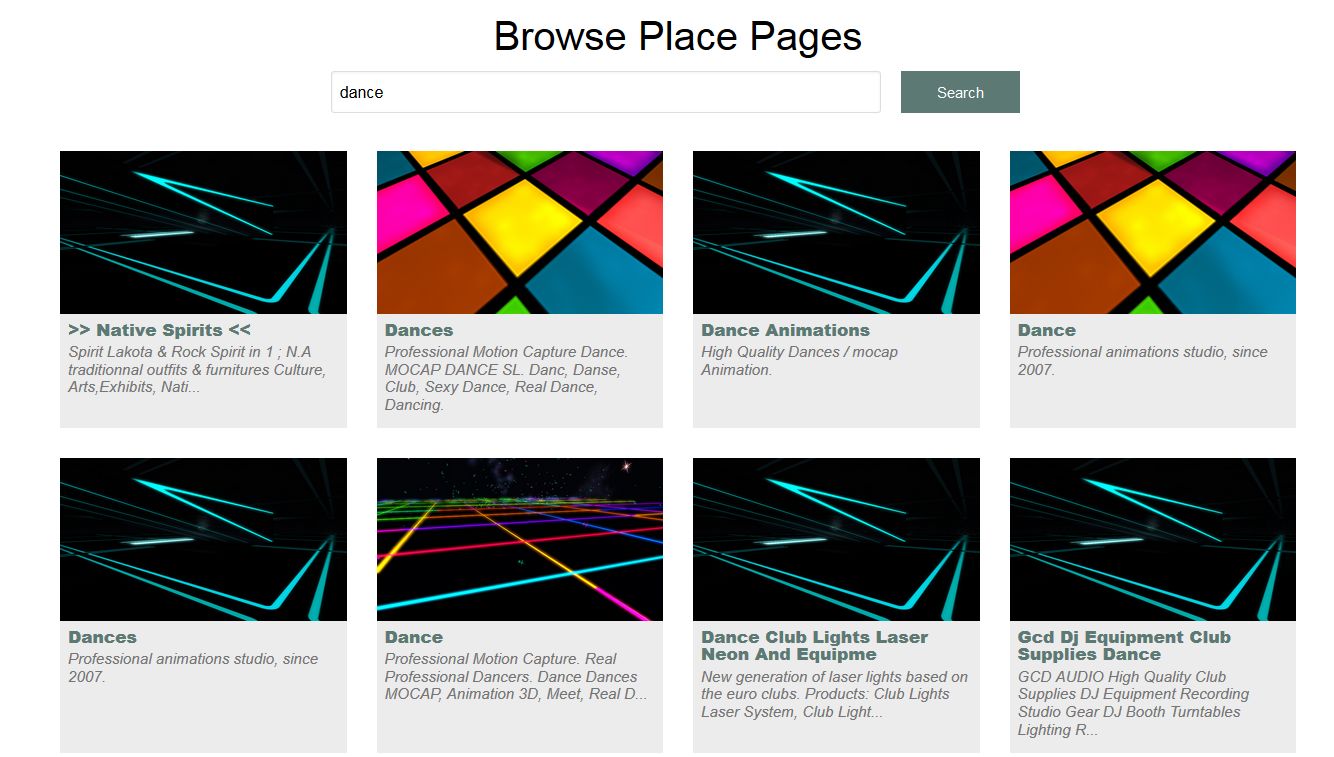
The Lab continues to tweak and improve Second Life Place Pages, the most recent addition being to the seach option, which now titles thumbnail images and descriptions of places matching the search criteria.
Place Pages search now titles results with thumbnails and descriptions
Other Items
The wiki search is currently broken: this is a known issue at the Lab and is being actively investigated.
Inventory & load times: The Lab hopes to do further work on inventory, looking to improve things like load times and overall inventory robustness. This work will initially focus on fixing some bugs and deprecating various old UDP messaging, mostly likely sooner in the year than later, before moving on to hopefully making it more performant.
Aditi inventory syncing: there is still an issue with synchronising Aditi (the beta grid) inventories with main grid inventories. The latest issues occurred just before Christmas and are still being investigated.
Re-activating old accounts: if yo have a Basic account you have not used in a number of years and wish to activate it, it is possible that its associated inventory has been place in what the Lab call “cold storage”, and could subsequently exhibit continued slow response times. If the account is to be regularly use, a request can be made to support to have the associated inventory for the account moved – although this must be done at a time when you are not using the account.
Keeping abreast of web property updates: Alexa Linden routinely posts updates on various SL web properties on the forums, where they can be seen and commented on.
SL Viewer
On Thursday, January 4th, the Nalewka Maintenance RC viewer updated to version 5.0.10.330148. On Wednesday, January 3rd, the follow two viewers were updated:
Whystler is a designer with an interest in architecture and history, as demonstrated by two experiences I’ve recently hopped through – The Bridge Room and Whyst Garden, the latter of which, at the time of writing, has been a featured experience in the Atlas.
The Bridge Room is a virtual puzzle – not an overly difficult one to solve, admittedly, but one which is still fun to visit. Whystler describes it thus:
Inspired by Architectural Fantasy drawings of the 17th and 18th centuries, this room of architectural monuments provides a challenge. Can you find your way from one end to the other?
And so it is that on spawning, visitors find themselves within a great stone hall with high, vaulted ceilings, supported by great square columns, which descend not to a floor, but into water, the base of each column forming an artificial islands, some of which are connected to at least one of their neighbours by one or two bridges. As Whystler states, the aim is to get from the spawn point at the base of one of these columns to the far side of the room via the bridges and avoiding falling into the water (which will cause a re-spawn). Again, it’s not an overly taxing challenge, but the architectural design makes for an interesting and fun visit.
The Whyst Garden offers a beautiful build which might have been lifted from a history book. It presents a melding of renaissance and classic Greco-Roman architecture, all brought together in what might be the façade of a great house or public building or temple with a formal garden terrace set before it.
What is particularly interesting about this build – besides exploring its various levels – is that it is entirely modular, as Whystler has attempted to explain in the limited amount of space in the experience description. Elements of the build can be found on the Sansar Store – the Draco columns (as seen in the image above) and basic blocks. However, this is far more modular in scale, again as per Whystler’s notes in the Altas description.
Visitors arrive on the far side of the garden area, and can then stroll past the large reflecting pool and then take the steps up one of the two wings of the building, then explore the building itself – note there is just the one way the mid-upper level.
This are two small, easily loaded experience which offer something to do, with The Whyst Garden in particular well suited to be photographed, if you’re interested trying out the Sansar snapshot capability.








 Inara Pey: Living in a Modemworld