Logos representative only and should not be seen as an endorsement / preference / recommendation
Updates for the week ending Sunday, January 21st
This summary is published every Monday, and is a list of SL viewer / client releases (official and TPV) made during the previous week. When reading it, please note:
It is based on my Current Viewer Releases Page, a list of all Second Life viewers and clients that are in popular use (and of which I am aware), and which are recognised as adhering to the TPV Policy. This page includes comprehensive links to download pages, blog notes, release notes, etc., as well as links to any / all reviews of specific viewers / clients made within this blog
By its nature, this summary presented here will always be in arrears, please refer to the Current Viewer Release Page for more up-to-date information.
Official LL Viewers
Current Release version 5.1.0.511732, dated January 9th, promoted January 16th formerly the Alex Ivy Maintenance RC – NEW.
Project Render Viewer version 5.1.1.511873, January 17th, 2018.
Linux Spur viewer, version 5.0.9.329906, dated November 17th, 2017 and promoted to release status 29th November – offered pending a Linux version of the Alex Ivy viewer code.
Lava tubes could provide ready-made tunnels for bases on the Moon and Mars – and tubes in the Canary Islands are already being used for ESA astronaut training. Credit: ESA/L. Ricci
One of the major issues in sending humans to the Moon – as the United States, China, Russia and Europe want to do (either individually or in some sort of joint venture among some of them) – is where, exactly, to send them. The Moon is an uncompromising place: without any discernible atmosphere or magnetosphere, the lunar surface is open to the full fury of both solar and cosmic radiation. This makes living there without adequate protection somewhat hazardous. Then there is the question of consumables – notably water.
Protection can be found in one of two possible ways: by covering a base under a substantial layer of lunar “soil” – more correctly called regolith – or by placing it underground. While the former is feasible, and could even be achieved via 3D printing, excavating the space needed for a base would be a hefty undertaking, requiring heavy equipment.
However, things could be eased if advantage could be taken of lunar lava tubes. These are natural conduits formed by flowing lava moving beneath the hardened surface of a previous lava flow, draining lava from a volcano during an eruption. When the lava flow has ceased and the rock has cooled, they can form a long cave, or network of tunnels – some of which can break the lunar surface in what are called “skylights”, resembling distinctive pits in a landscape. In recent years, over 200 of these pits have been discovered on the Moon’s near side, notably in the great lava plains around the equatorial regions, many of which have been confirmed as entrances to underground lava tubes.
Water is also present on Mars in the form of subsurface ice located around the polar regions – the only parts of the Moon where there is little or no sunlight. If it can be extracted, it could be invaluable to a human presence on the Moon: it could be purified and used for drinking; through electrolysis it could be broken down into its components, hydrogen and oxygen, with the latter used to help maintain the air within a base, the former used alongside carbon dioxide in processes for creating fuel stock space vehicles or surface craft. The difficulty is in accessing the water ice in volume. One way of doing so might be through drilling – although this would again be costly and slow. Another way might be through finding lava tubes which may have become repositories for water ice deposits. The problem is, until now, little evidence for polar region lava tubes has been found.
Philolaus Crater, roughly 70 km (40 mi) in diameter, close to the lunar North Pole, may house lava tubes that could hold the key to both the location of a future lunar base and to accessing subsurface water ice. Credit: NASA
Pascal Lee, the co-founder and chairman of the Mars Institute, a planetary scientist at the SETI Institute, and the Principal Investigator of the Haughton-Mars Project (HMP) at NASA’s Ames Research Centre – and, totally coincidentally, whom I’ve had the pleasure of meeting a number of times – reports he’s now discovered pits in the north polar region which could be indicative of lava tube skylights.
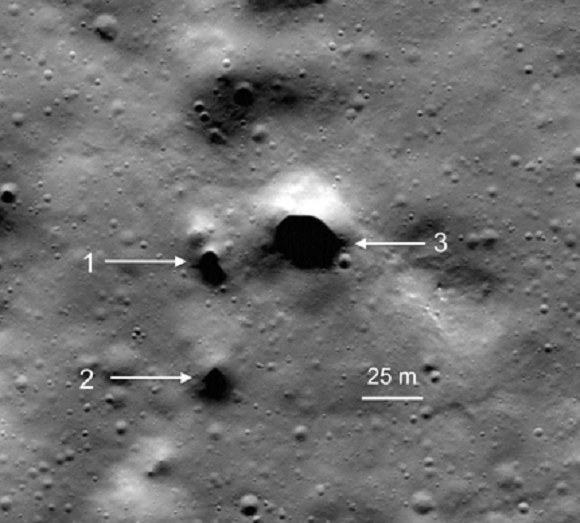
He found the pits while studying images gathered by NASA’s Lunar Reconnaissance Orbiter of the north-eastern floor of Philolaus Crater, about 550 km (340 mi) from the North Pole, on the lunar near side. They appear as small rimless depressions between 15 to 30 metres (50 to 100 ft) across, with completely shadowed interiors. Most particularly, the pits are located along sections of winding channels criss-crossing the crater floor. Called “sinuous rilles”, these are generally associated with collapsed, or partially collapsed, lava tubes, increasing the possibility they might be skylights leading to intact lava tubes.
“The highest resolution images available for Philolaus Crater do not allow the pits to be identified as lava tube skylights with 100 percent certainty,” Lee states, “but we are looking at good candidates considering simultaneously their size, shape, lighting conditions and geologic setting.”
Should they prove to be entrances to lava tubes, the pits offer an exciting prospect for lunar explorers. They could present a means to access sub-surface water ice – particularly if some of the tubes contain frozen water – which is not yet certain. They might also provide the necessary protection from radiation, making them an ideal location for a subsurface base. If there is water ice in the tunnels, solar collectors ranged on the crater floor could be used to channel heat into the tunnels to melt it, allowing it to be stored and used. A further benefit with Philolaus Crater is that it is one of the Moon’s younger craters, one of the few large craters formed during the Copernican Era formed within the last 1.1 billion years. Scientists located there would be able to study the Moon’s more recent evolution.
NASA Lunar Reconnaissance Orbiter image showing some of the newly discovered lava tube skylight candidates at Philolaus Crater. Credit: NASA/LRO/SETI Institute/Mars Institute/Pascal Lee
In terms of a location for a base, the crater has two additional benefits. The first is that as it is on the lunar near side, it will be in direct line of communication with Earth. The second is more poetic, as Lee himself notes:
We would also have a beautiful view of Earth. The Apollo landing sites were all near the Moon’s equator, such that the Earth was almost directly overhead for the astronauts. But from the Philolaus skylights, Earth would loom just over the crater’s mountainous rim, near the horizon to the south-east.
He continued, “Our next step should be further exploration, to verify whether these pits are truly lava tube skylights, and if they are, whether the lava tubes actually contain ice. This is an exciting possibility that a new generation of caving astronauts or robotic spelunkers could help address” says Lee. “Exploring lava tubes on the Moon will also prepare us for the exploration of lava tubes on Mars. There, we will face the prospect of expanding our search for life into the deeper underground of Mars where we might find environments that are warmer, wetter, and more sheltered than at the surface.”
Update, January 25th: Oh Deer has sadly closed, and Bambi is apparently taking a leave of absence from Second Life.
We made an early return visit to Oh Deer, the Homestead region designed Bambi (NorahBrent), after receiving news from both Miro Collas and Shakespeare that the region had been given a makeover.
Our first visit to the region was made in October 2017, when we found it to be rich in autumn’s charms, offering a mix of buildings and open spaces visitors were welcome to wander in and through. Returning in mid-January 2018, we found that not only has it been redesigned, but the clock has also marched forward, the environment settings perhaps suggesting a late spring morning; a time when the sky hasn’t quite made up its mind whether or not to let the sun in all its glory, but the air is warm enough to raise a morning mist from dew and stream.
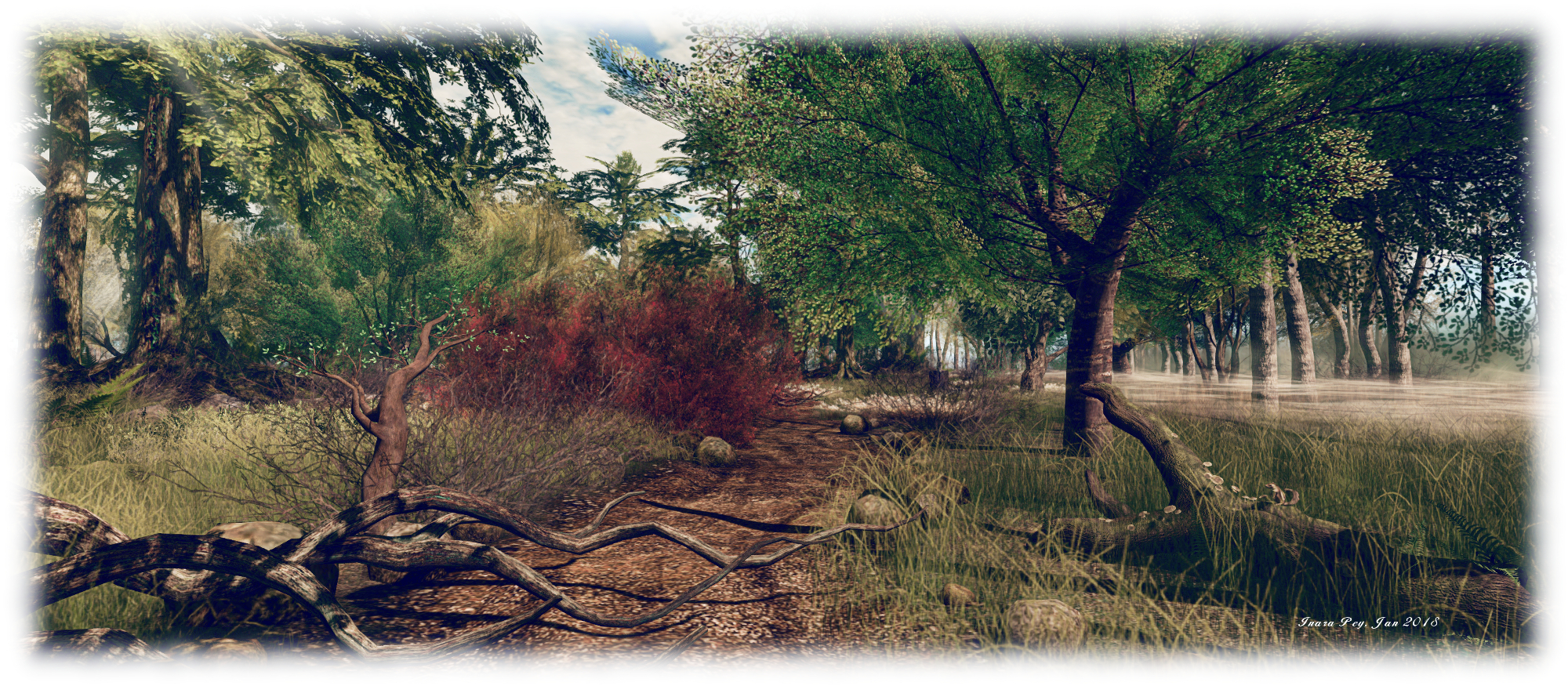
In this iteration of the region, buildings are conspicuous by their absence; not a single house or shop or any other permanent structure is to be found. Instead the land, split by a meandering stream, is given over entirely to nature, rich and greens and browns, with animals, plants and birds adding their own splashes of colour.
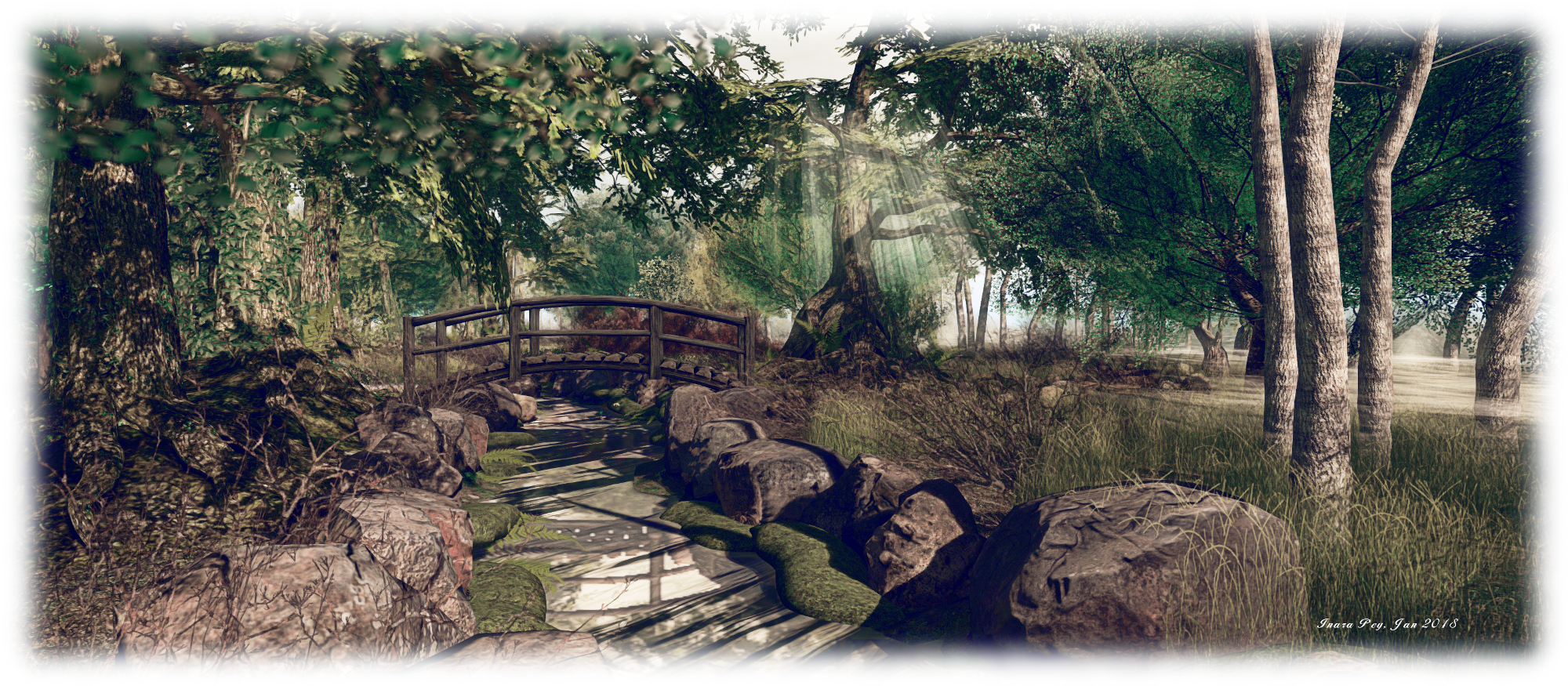
From the landing point alongside the single bridge spanning the quiet waters of the stream, visitors are free to wander where they please. Whether this be southwards, along the meandering track pointing away from the bridge, or north over the bridge to where the same track arcs around to take its own winding route south along the far side of the stream, is entirely a matter of choice. Or, if preferred, visitors can strike off the trails, and wander through knee-high grass and between the trunks of tall trees to where the mist hugs the ground, adding an ethereal feel to the landscape.
Across the land can be heard the sounds of birds, crickets and the rat-a-tat of a woodpecker busy drumming on the stump of a fallen tree. Squirrels frolic on the ground near the landing point, while fallow deer wander under the branches of trees, their coats as dappled as the sunlight filtering through the canopy of leaves overhead. Further afield, foxes might be seen, while cormorants , osprey, turtles and bear can be found scattered along the banks of the stream as it winds through the land.
This is, in a word, a tranquil setting; a place perfect for finding a little peace and forgetting the hustles and toils of life. To encourage people to tarry a while, picnic baskets sit on benches to one side of the landing point, while a little camp site hides behind the bowl of a tree on the other. It would be nice to perhaps have a couple of places visitors might rest further out from the landing point, where the peace of nature and the playfulness of foxes or rabbits or the wandering of deer might be observed, but this is a minor point.
Simple and elegant in this iteration, Oh Deer offers a charming rip into the countryside, one suited to being seen in the cool spring light in which it is set, or under the blue skies of summer – as I’ve done with some of the images here. As always, photos can be submitted to the region’s Flickr group.
It’s time to highlight another week of storytelling in Voice by the staff and volunteers at the Seanchai Library. As always, all times SLT, and events are held at the Library’s home at Holly Kai Park, unless otherwise indicated.
Sunday, January 21st, 13:30: Tea-Time with Robert Burns
Corwyn Allen and Caledonia Skytower get ready for Burns Night with some poetry by Scottish bard Robert Burns. Perhaps with a dram or two of whisky on hand!
Burns is the best known of the poets who have written in a form of the Scots language, although much of his writing is also in English and a light Scots dialect, accessible to an audience beyond Scotland. He also wrote in standard English, and in these writings his political or civil commentary is often at its bluntest.
Monday, January 22nd 19:00: The Wolfen
Whitley Strieber is perhaps best known for his book for Communion, a non-fiction account of his alleged experiences with non-human entities. However, his is also a writer of horror fiction, with The Wolfen being his first published novel (1978).
When two New York Police Department uniformed officer are violently killed, detectives Becky Neff and George Wilson are tasked with investigating the incident and bringing the perpetrator/s to justice. The evidence reveals the two uniformed officers were quickly and brutally attacked by some kind of animal – so rapidly, in fact, neither were able to fire their service handguns – one even had his hand and gun ripped from his arm before having time to open fire on his attacker. Worse, both men were disembowelled, their organs devoured.
Gathering the evidence from the crime scene, Neff and Wilson start their investigation by trying to understand what kind of animal might have left the bloody paw prints around the bodies. This leads them down a path that touches on the issue of police corruption which involves Neff’s policeman husband is taking money from certain groups. As more bodies are discovered, Neff and Wilson are drawn into a world where the natural meets the supernatural: the forgotten parts of New York where the abandoned of the city live – and are preyed upon by the Wolfen.
Join Gyro Muggins as he takes us inside Neff and Wilson’s investigations.
Tuesday, January 23rd 19:00: 21 Balloons
Faerie Maven-Pralou reads from William Pène du Bois’ 1947 children’s classic, The Twenty-one Balloons.
A steamship en route across the North Atlantic comes across the strange wreckage of twenty deflated gas balloons and rescue, much to their surprise, a lone man – one Professor William Waterman Sherman.
The professor had last been seen some three weeks previously, departing San Francisco aboard a giant balloon, determined to spend a year aloft and drifting on his own.
Now, as word spreads that the professor has been found alive and well – and in completely the wrong ocean to the one he had last been seen flying towards – the world awaits the story of how he came to circumnavigate the globe in record time, only to be fished from the wreckage of twenty balloons when he had started with just the one. When he has sufficiently rested and recovered after receiving a hero’s welcome on his homecoming, the good professor tells a tale most fantastic…
Wednesday, January 24th 19:00: Fractured Symmetry
In the future and 1,000 light years from Earth, a woman of action works for a reclusive, enigmatic genius…
Blair MacAlister is an expert at Judo, a credible AI hacker, and a certified pilot of craft atmospheric and interstellar. Her favourite weapon is sarcasm, or failing that, her ever-present blaster. Her boss is Terendurr the Black Stone: technical wizard, expert in the ethnography of myriad races, fancier of rare foods and wines, and even rarer fractalites. An Entharion Quadromorph, exiled from his homeworld and under constant threat of assassination, he is also somewhat irritable.
Together they investigate mysteries based on science, in a setting that brings them into contact with all the main races of Civspace: The mysterious Junn, the affable but biologically intense Raylics, the chaotic and powerful Oro-Ka, the commercial minded Keret, and the cynical Phair.
At the centre of their cases are transformative genetic therapies, unlikely fossils, the linked neurology of symbiotes, and more. Terendurr is over 300 years old and has seen and endured the worst and strangest the galaxy has to offer. Will Blair prove as durable as her boss?
Join Corwyn Allen as he reads from Fernando Salazar’s 2017 novel.
Thursday, January 25th
19:00: Star Wars: The Force Awakens
With Shandon Loring. Also presented in Kitely (hop://grid.kitely.com:8002/Seanchai/144/129/29).
21:00: Seanchai Late Night
Contemporary science fiction with Finn Zeddmore.
Please check with the Seanchai Library’s blog for updates and for additions or changes to the week’s schedule.
The featured charity for January / February 2018 is Reach Out and Read, giving young children a foundation for success by incorporating books into paediatric care and encouraging families to read aloud together.
Grumpity and Alexa Linden host the Web User Group meetings on alternate Fridays at Alexa’s barn.
The following notes are taken from the Web User Group meeting held on Friday, December 19th, 2017. These meetings are generally held on alternate Fridays, and chaired by Alexa and Grumpity Linden at Alexa’s barn. The focus is the Lab’s web properties, which include the Second Life website (including the blogs, Destination Guide, Maps, Search, the Knowledge base, etc.), Place Pages, Landing Pages (and join flow for sign-ups), the Marketplace, and so on and the Lab’s own website at lindenlab.com.
Not all of these topics will be discussed at every meeting, however, the intention within the group is to gain feedback on the web properties, pain points, etc., and as such is very much led by comments and input from those attending. Along with this are two points of note:
Specific bugs within any web property – be it Marketplace, forums, Place Pages or anything else), or any specific feature request for a web property should be made via the Second Life JIRA.
Alex Linden provides routine updates on the Lab’s SL-facing web properties as and when appropriate, which can be found in the Second Life Web thread.
Note that the SL forums are not covered by the Web User Group, as the management of functionality of the forums falls under the remit of the Support Team.
Lindens in the Web Team
A number of Lindens attend the Web User Group meetings in addition to Grumpity and Alexa (who are part of the Second Life Product team). While they may not be present at every meeting, Lindens staff directly involved in supporting the SL web services include:
Spidey Linden: QA Lead for SL Web and Marketplace.
Shrike Linden: a QA tester on the Second Life web team.
Nazz Linden: a web developer who has thus far primarily worked on secondlife.com and the Place Pages.
Natty Linden: a web developer with a focus on the Marketplace.
Sherbert Linden: a web developer working on various SL web properties.
Support Portal Migration
Some people have reported that their support ticket histories are no longer intact. This may be a result of the ongoing migration of data from the old support system to the new system (see here and here for more). If there are specific tickets raised prior to the start of 2017 people need to view, a new support ticket, including details of the ticket which needs to be viewed, should be raised, and the support team should be able to access the old ticket and provide any information on it.
360-Snapshot Viewer
Currently a project viewer (version 5.1.0.506743 at the time of writing), this is still in the process of being updated to offer higher resolution 360-degree images taken in Second Life, and for the uploading of 360 images to Place Pages (as well as the other viewer snapshot upload options).
Feature Requests
Feature requests are suggestions forwarded to the Lab on ideas and improvements which might be added / made to Second Life. They are raised via the Second Life JIRA:
Once logged-in to your Dashboard, click ob Create Issue (top right of the window).
A pop-up Create Issue form is displayed.
Click on the right of the Issue Type box on the form to display a drop-down, and select New Feature Request.
When filing a feature request, give as much information as clearly and concisely as possible: what the feature request is, what it is for, why it should be considered beneficial, what it might help improve, how it might work, etc., – as these things apply.
If you are requesting a UI change to the viewer, and can include images of proposed changes or new floaters / panels the feature would require, be sure to attach them.
Filing a Feature Request via JIRA – click for full size, if required
In 2017, 383 feature requests were filed via JIRA. Of these, 167 (roughly 43%) were accepted by Linden Lab for transfer into their internal JIRA system. It’s not clear how many of the accepted items were eventually actioned, but the figures nevertheless show that feature requests are triaged and some are taken for current or future consideration and possible implementation at a later date.
When launched on Valentine’s Day 2012, One Billion Rising (OBR) was the biggest mass action in human history; a call to action based on the staggering statistic that 1 in 3 women on the planet will be beaten or raped during her lifetime. With the world population at 7 billion, this adds up to more than one billion women and girls who are at risk. OBR aims to bring people together, raise greater awareness of the plight of those at risk the world over, and bring about a fundamental change in how vulnerable and defenceless women and girls are treated.
Since its inception, One Billion Rising has grown and the local campaigns deepened, it has also brought in economic violence and the violence of poverty, racial violence, gender violence, violence caused by corruption, occupation and aggression, violence caused by environmental disasters, climate change and environmental plunder, violence impacting women in the context of state sponsored wars, militarization, and the worsening internal and international displacement of millions of people, and violence created by corporate greed, among so many others.
On Wednesday, February 14th, 2018. One Billion Rising continues to sustain the theme of “Solidarity Against the Exploitation of Women”, and activities in Second Life event will be focused on a four-region stage where 200 people can come together to dance, surrounded by an area of art installations, an arena for poetry and dramatic productions, and informational exhibits. Activities at 00:00 SLT on the morning of February 14th, and will continue through a full 24 hours across the OBR regions.
To support the event, the organisers are currently seeking volunteer stage managers, security helpers, greeter, general volunteers to help gather information etc. Bloggers interested in covering the event both in the run-up and on the day itself are also being sought, as are sponsors to help cover the cost of the regions.
If you are interested in helping with any of these aspects of the event, please follow the links below:








 Inara Pey: Living in a Modemworld