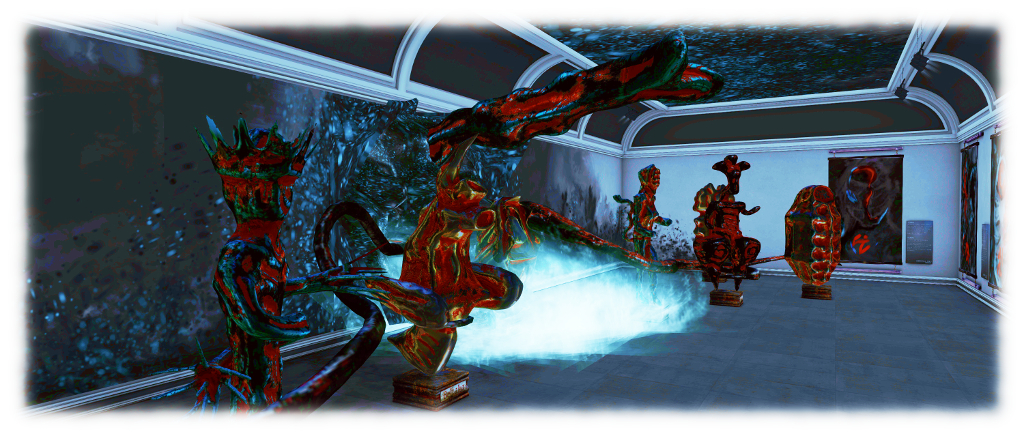
“We are chased by evil throughout our lives.” Federico Sosa (TheBDKX) states in introducing Dementophilia, his new exhibition at The Vordun Museum and Gallery. “Devils we try to hide, and slowly eat us up from inside, draining our strength. The worst of all evils. Ourselves.”
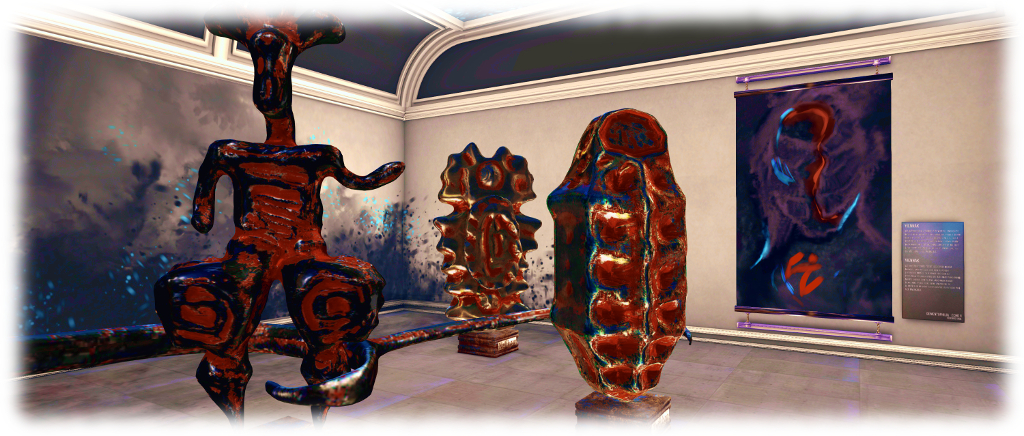
Dementophilia is described as “an abnormal, obsessive attraction towards insanity, and it is the perfect title for this exhibition. Located in the rear hall of The Vordun, it features eight paintings and eight sculptures, together with a large central mixed 2D and 3D element – the Vortex. Together they personify the darker imaginings from the depths of the mind
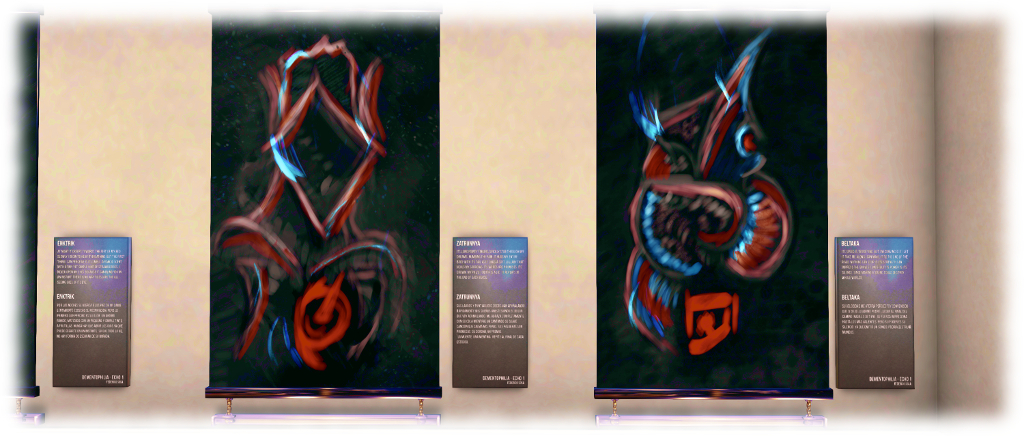
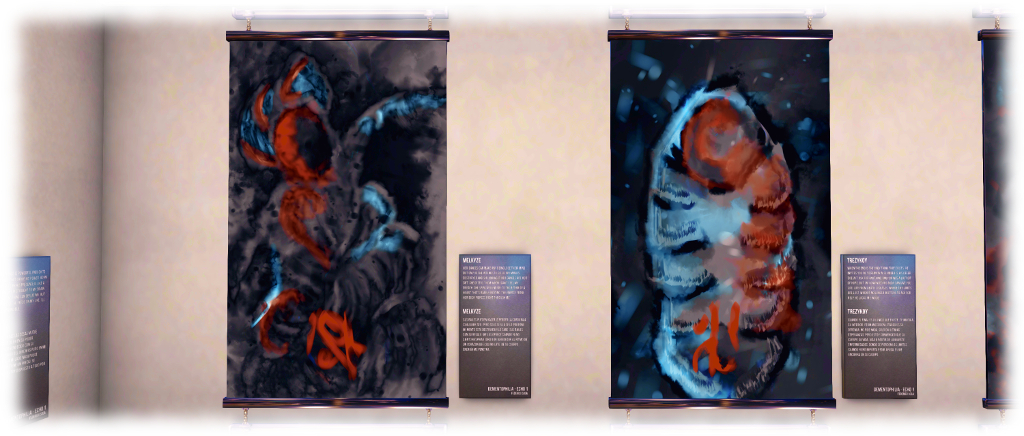
The eight images and eight statues are paired, the statues physical manifestations of the paintings, brought forth by the vortex bursting forth from the rear wall of the hall. Each painting / statue represents a creature – or is that an elemental aspect, a beast if you will, of our psyche? In addition, each painting is partnered with a description of the demon it represents: Enktrik, Zatrunnya, Beltaka, Fenniaq; Nelikaw, Trezykoy, Melkyze, Yiennak; each description reads as the writings of an unsettled mind – and what mind wouldn’t be unsettled seeing creatures such as these rising from the subconscious.
Thus, entering the hall is akin to entering those thoughts beneath our reasoned consciousness; a place where our personal devils reside; parts of our being alien and terrible – yet playing a vital role in forming our personality, again as Federico notes: “Locked inside, they can heal our wounds. Out in the open they reign. Beasts from within. Beasts of love and Pain. Beasts that are on the loose, fighting against the external consciousness.”
Within this exhibition, these beasts have been named, their nature understood, suggesting their keeper is long familiar with them. Their presence speaks to that battle with an “external” consciousness, a mind acutely aware of their existence. A mind willing to make them manifest – or, perhaps, a mind succumbing to their dominance. It is down to us to decide which.
Dementophilia is intriguing in both its concept and interpretation. As manifestations of darker thoughts and desires, they capture the unreality of the subconscious. As pieces of art, they offer an abstract hint of demons from the realms of Hieronymous Bosch.
I did find myself wondering how much deeper the impact of the exhibit might be if presented in a more tailored environment / setting and with an appropriate Windlight, but nevertheless, it still makes for a thought-provoking visit.
The following notes are taken from the Sansar Product Meetings held on Thursday, October 26th, a day early to allow for the 1st Sansar Halloween Blitz Dodge Cannon Ball Tournament, which is being held on Friday, October 27th, 2017 – see here for more.
Product meetings are usually held every Friday at 9:30am PDT and 4:00pm PDT, and are open to all. There is currently no set agenda, and the meetings are a mix of voice and text. The official meeting notes are published in the week following each pair of meetings, while venues change on a weekly basis, and are announced in the Meet-up Announcements.
The October 26th meetings took place at Darkwood Forest by C3rb3rus. Product team members Cara and Carolyn attended the morning and afternoon sessions respectively, together with Torley and Brett, respectively. Jenn, as usual, led proceedings. I did miss a portion of the morning session, as everyone ran away while I had to go AFK (meanies! 😀 ), so the official write-up may cover topics not mentioned here.
The next release, currently targeted for Tuesday, October 31st, starting at around 11:00am SLT. This means that Sansar will be down for around 90 minutes. An outline of some of the features to be included in the release were previewed at the start of October, and further information is given below.
Social Updates
Connecting with people: it will be possible to search for people by name via the client’s People App and send them Friend requests to add them to your Friends list. However, because Avatar Names are not unique, and can only be verified via Avatar ID, searches must be via Avatar ID.
Desktop mode avataridentification: it will be possible to identify people round you in Desktop mode, by clicking on them to display their Avatar Name / Avatar ID. This will also allow you to Friend / audio mute an avatar.
Sort client Atlas entries: the sort options recently added to the web version of the Atlas (e.g. those under the All, Sansar Studios, and creator tabs) will be available in the client Atlas. sorting as a whole is also improved.
Scripting Updates
Trigger collision events on non-dynamic objects: it will be possible to trigger events on non-physical and static objects. This also mean that scripts triggering events can be attached to animated objects.
New scripting APIs: details, however, still TBC.
Other updates
Publish work flow: the experience publish work flow includes additional contextual dialogue designed to make the process more intuitive.
Documentation: Links within the UI (presumably leaning towards the UI’s Edit Mode) to Knowledge Base articles.
Website calendar: to advertise events such as the daily meet-ups and the weekly Product Meetings, with links to the host experience. This will eventually be expanded to the client, and to include creator / community events.
Events Feature
A new feature in the works is for promoting events. This was intended to be part of the Friends release, but at the time of the October 26th Product Meetings, it looked as if it will slip to a separate update, following “soon after” the Friends release. This will:
Initially be a “little section” on the Web Atlas which can be expanded to see more events.
Be expanded in future iterations – although exactly what form it will take (Events tab in the Atlas? A calendar?) is still under discussion at the Lab.
Include a means (most likely an e-mail address) through which event organisers can submit their events for inclusion in the listing.
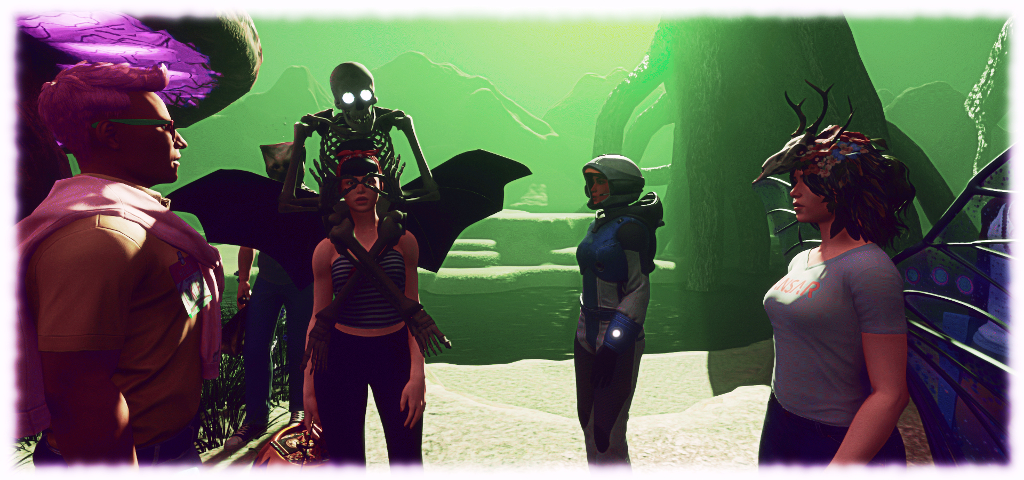
Darkwood Forest – Torley (l), Jenn (centre left), and Cara (r) from the Lab at the morning Product meeting, with Tyler Scarborough in the spacesuit (centre r)
Fashion Release
The initial Fashion release is currently on-track for around mid-December 2017.
The Lab will be extending invitations to creators to join a beta testing group for the fashion capabilities. This will be a selected group, and subject to NDA due to some proprietary aspects of the fashion capabilities.
Other Items
Audio Discussions and Torley’s Tips
Sounds approaching white noise (e.g. background “swooshing” style noises) can be broken up through camera issues. This is a known issue, and should improve when the Lab has full audio stream integration in the future, which is currently waiting on some third-party fixes.
While it has not been confirmed as something the Lab will implement, there has been discussion around possibly adding controllable fall-off curves for sounds in Sansar in the future. In addition, Torley has been experimenting with how reverb can be used (e.g. for enhancing echoes, etc). Galen has also put forward a suggestion for handling reverb.
Torley also offered some sound design tips:
If using a relatively constant background noise (e.g. a engine rumble), rather than using a single large emitter, or several very large overlapping emitters using the same sound, try using multiple emitters using variations of the sound. This prevents it becoming too homogeneous and can introduce subtle variations that add depth.
Use large audio blocks as a means to initially map the background sounds in a scene, then refine by differentiating the sounds into smaller areas, duplicating and varying as required, then add more focused sounds to build the layering.
Only use point emitters for sounds in very localised situations (e.g. a sound emanating from a specific point). For fall-off, spherical emitters are better than square emitters.
Resources such as audio volumes.etc., have a level of opacity assigned to them, defined by the physics engine. Requests have been made to offer greater variance in the level of opacity / transparent in various resource types, and this is something the Lab is examining, particularly as the layering of resources in a scene is liable to become more complex. Similarly, consideration is being given to changing the colour coding used in the Edit mode, as this can cause issues for people with colour vision issues.
Store Related
Listing / product updates: adding the ability to offer product updates remains a “high priority” for the Lab, although it is seen as having a complex series of interactions (e.g. with licensing / permissions and the proposed supply chain economy), such that implementation isn’t as straightforward as it might appear. However, the increasing need to update “standalone” products and present them to customers (e.g. so that products can keep pace with things like scripting improvements) has been recognised and is also being discussed at the Lab.
Product ratings: one outcome of the recent Store focus groups was a preference to so product ratings removed from listings. Currently, there’s no time frame on if / when this might be done.
In Brief
Web search bar: the placement / visibility of the search bar on Sansar web pages was improved with an update on Wednesday, October 25th.
Collision (?) Crashes: there is a potential client / experience crash which may be related to collisions with physical objects (e.g. get hit by a ball thrown by someone once or a number of times, and the experience may crash). It doesn’t happen with every collision with physical objects, nor is it necessarily related to the volume of collisions occurring within an experience. Galen has identified the crashes may be linked to an experience having a large number of complex surfaces, the speed at which items may be moving – the faster the physical object(s) is/are travelling, the more they might be prone to crashing the experience.
VR Friend Request Issues: some have noticed issues trying to accept / give Friend requests in VR mode. These appear to be related to the accuracy of the gaze pointer and the HTC Vive controllers perhaps more than Oculus Touch controllers. The Lab is aware of the problem and investigating it.
More granular control over animated objects: the Lab is planning to provide better control over animated objects via scripts (start, stop, point from which they animate, point at which they stop animating, etc), in time.
Resource metrics: Galen has requested the addition of a new tab to the Debug dashboard which would allow creators check their resource utilisation (e.g. server CPU and memory use), FPS, etc., in order to better optimise their work (particularly where scripts are concerned) . This has been taken aboard by the Lab as a means to help creators in optimising their experiences.
Revise dynamic object highlighting in Desktop mode for better control: currently, any dynamic object is highlighted in blue in Desktop mode, whether or not it is intended to be held by an avatar. This can lead to people trying to pick up scripted dynamic objects that are not intended to be held, risking them being repositioned or even crashing the experience. SIN has requested that the blue highlighting is updated so it can be toggled on / off by creators according to whether or not an objects can be held, to remove user confusion (as well as requesting the crash issue itself be looked at).
Bug Fix Release: each Sansar release includes bug fixes, as do updates. However, the Lab is considering focusing an early 2018 release on the list of bugs / issues which don’t make it into a release or update as they are not necessarily seen as urgent.
Adult Content in Sansar: allowing adult in Sansar is currently not on the roadmap.
Writing for Ars Technica on Monday, October 23rd, Samuel Axon, the Senior Reviews Editor, tells of his time Returning to Second Life. It’s a lengthy, involved piece, and perhaps one of the most broadly integrated write-ups on Second Life to have appeared in a good while.
Mr. Axon is no stranger to SL, having been dipping in and out over a number of years up until around 2012. As such, he brings to the piece first-hand experience based on more than just random exposure to the platform. In addition, he spoke directly with Peter Grey, the Lab’s Global Director of Communications, and Bjørn Laurin, Vice President of Platform – who has responsibility for both Second Life and Sansar. But that’s not all, he also sought out a number of Second Life creators to gain their insights as well.
The opening paragraphs encapsulate Second Life on a number of levels: the early hype around it being the “Internet 2.0”, the media hysteria of 2006/7, and an attempt to explain, as quickly as possible, was SL “is” for those who might view it as some kind of MMORPG.
From there, the article weaves a fairly comprehensive tapestry of several aspects of Second Life: commerce, creativity (and their relationship), social interactions and the changing face of discovery in SL, and more.
Samuel Axon, writing for Ars Technica
For example, with commerce and creativity, he brings together several threads: how both have given rise to what might be regarded as “unusual” (to the outside world) markets – such as breedables; how creativity has changed thanks to mesh and (for many) the move away from prims to external tools; the influence this has had with commerce, the rise of the Marketplace, and its impact on land in in-world stores.
The article also doesn’t shy away from issues. It delves into the question of why Second Life failed to become as all-encompassing as the early days seemed to promised. Here the finger is pointed squarely at social media being a major reason (outside of the overall hype surrounding SL), and I wouldn’t dispute it’s validity. Back when SL was at the height of its hype (2006-early 2008), Twitter was just starting out, as was the iPhone, Android had yet to arrive, and even Facebook had yet to start its meteoric rise in user numbers (2008 onwards). Thus, there wasn’t really anything out there by which SL’s real potential could be measured and the hype around it countered.
Sex in Second Life is also dealt with head-on, with a very tidily written sidebar to the main article. In it, Mr. Axon offers one of the most considered and well-balanced ripostes to those who insist Second Life is, to its larger extent, “all (/just) about sex”.
There are one or two elements in the article which might have been tackled a little differently. The changing face of discovery – where to go and what to do in Second Life – is examined, with a degree of lamentation that the kind of exploration possible when SL was more mainland / very large private estate oriented (i.e. pre Homestead) no longer seems to be the case, with the bias now towards “siloed” activities on isolated private islands or “big public” calendared events, with information on them effectively coming through word-of-mouth.
However, rather than lamenting the change, I’d perhaps liked to have seen it examined more along the lines of how we tend to imprint our physical world activities on Second Life. It’s fair to say our social activities in the latter are “siloed” between our homes and public venues / calendared events. We visit family and friends via the most direct means possible, rarely taking time to explore what lay between; we rely on specific “word of mouth” to get news on events of interest – websites, social media, clubs / organisations, etc. So is it really that surprising social activities have evolved in a similar manner in SL, particularly as some of the tools – like Groups – naturally lean in that direction, and are very effective in their reach?
Later in the article, Sansar enters the equation – as might be expected, given there is much concern about how it might impact Second Life. Here, those concerns are confined more to the technical / fiscal: that Sansar will draw off resources / investment from Second Life to its detriment.
While these – and other – concerns are valid, right now none of them are coming into play. On the technical / fiscal front, for example, we know the Lab is still recruiting skills specific to Second Life, and we’re still seeing user-visible capabilities added to the platform, Animesh being the most recent (albeit on a test basis), with things like the Environmental Enhancement Project and Bakes on Mesh (see my CCUG updates) following it down the pipe. The Lab is also continuing its overhaul of the infrastructure underpinning Second Life, up to and including an attempt to move SL services to the cloud. If nothing else, and providing other factors don’t come into play, all of this work should help towards SL’s continued longevity.
I could go into greater lengths, but really, suffice it to say that in Returning to Second Life we have an informed, balanced piece on the platform, which reasonably attempts to reconcile past with present and offer honest insight into why, fourteen years after its public opening, the platform still has appeal, as well as offering viewpoints from both the Lab’s and users’ perspectives. As such, it is more than worth a read in its own right, and if you haven’t done so already, I urge you to do so.
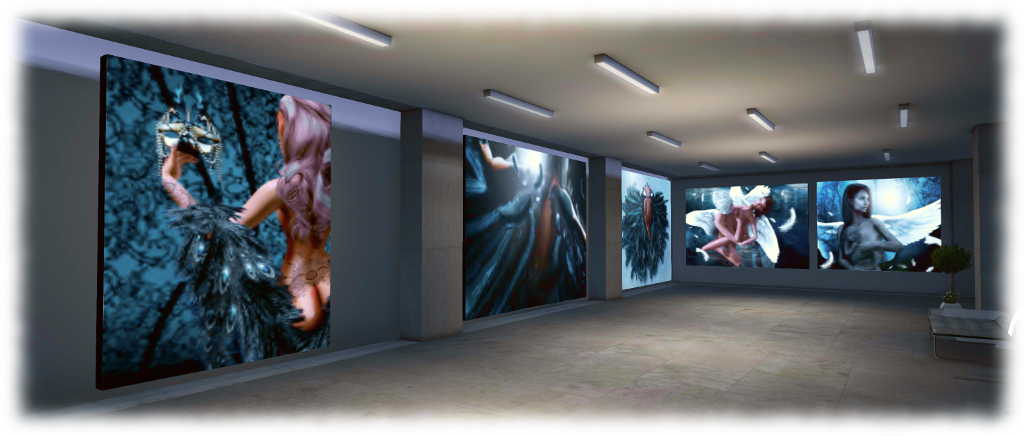
DixMix Gallery, curated by Dixmix Source, has another triple exhibition, this one featuring the work of Purple Leonis ONeill (Nel4481), Juris Bergmanis (JurisJo) and Imani Nayar. All three are very different in terms of their tone and style, making exhibition an interesting visit.
Purple’s work is located in the Grey hall of the gallery, just inside the main entrance. she presents thirteen images spilt between the gallery’s two levels. – two in a very large format, and all in rich, vibrant colours. Entitled Fantasme, there is a strong avian / fantasy theme running through the series, offering a unique set of avatar studies which are – in a word – entrancing.
Within the Black hall, Imani Nayar also presents thirteen black and white images under the collective title Exposed. All are avatar studies, and as the title of the exhibit might suggest, some of them should be considered NSFW.
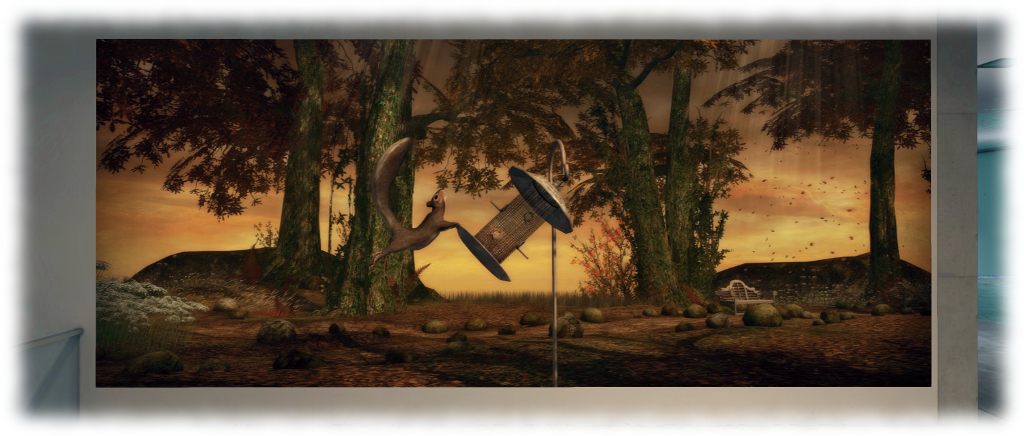
Above the Black hall is the White gallery space, where Juris Bergmanis is displaying eleven quite stunning landscape images captured from around Second Life; and when I say stunning, I mean just that. They all share a common theme of sky and colour, suggesting they are intended to celebrate autumn.
It’s a shame that, again, no biographical information is provided on the artists for those unfamiliar with them, as I’ve mentioned before. However, it is fair to say that such is the diversity of the three styles on display here, the lack of background information doesn’t detract from appreciating the pieces which are offered within each of the three exhibits.
Attention all personnel: non-human presence located in cryogenic bay. Quarantine procedures have been activated. Please report to security personnel for instructions. Thank you for your co-operation.
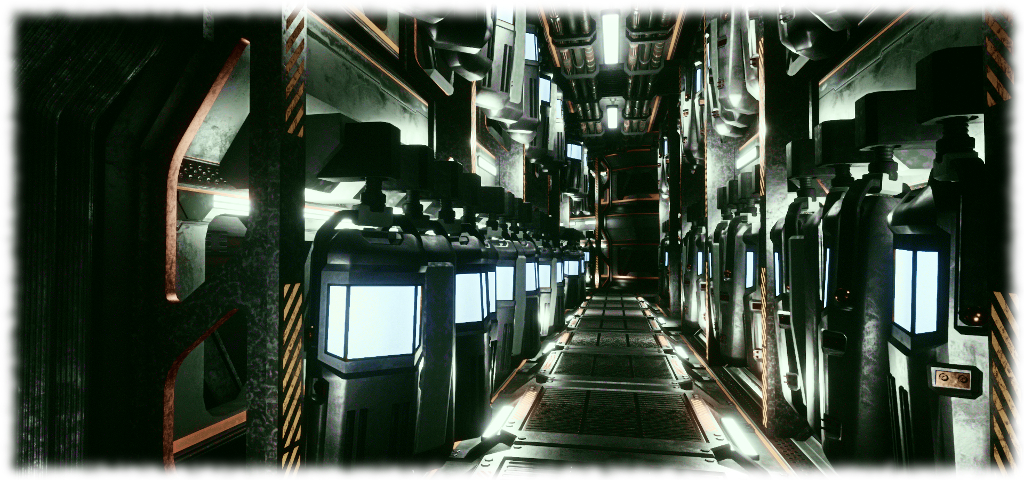
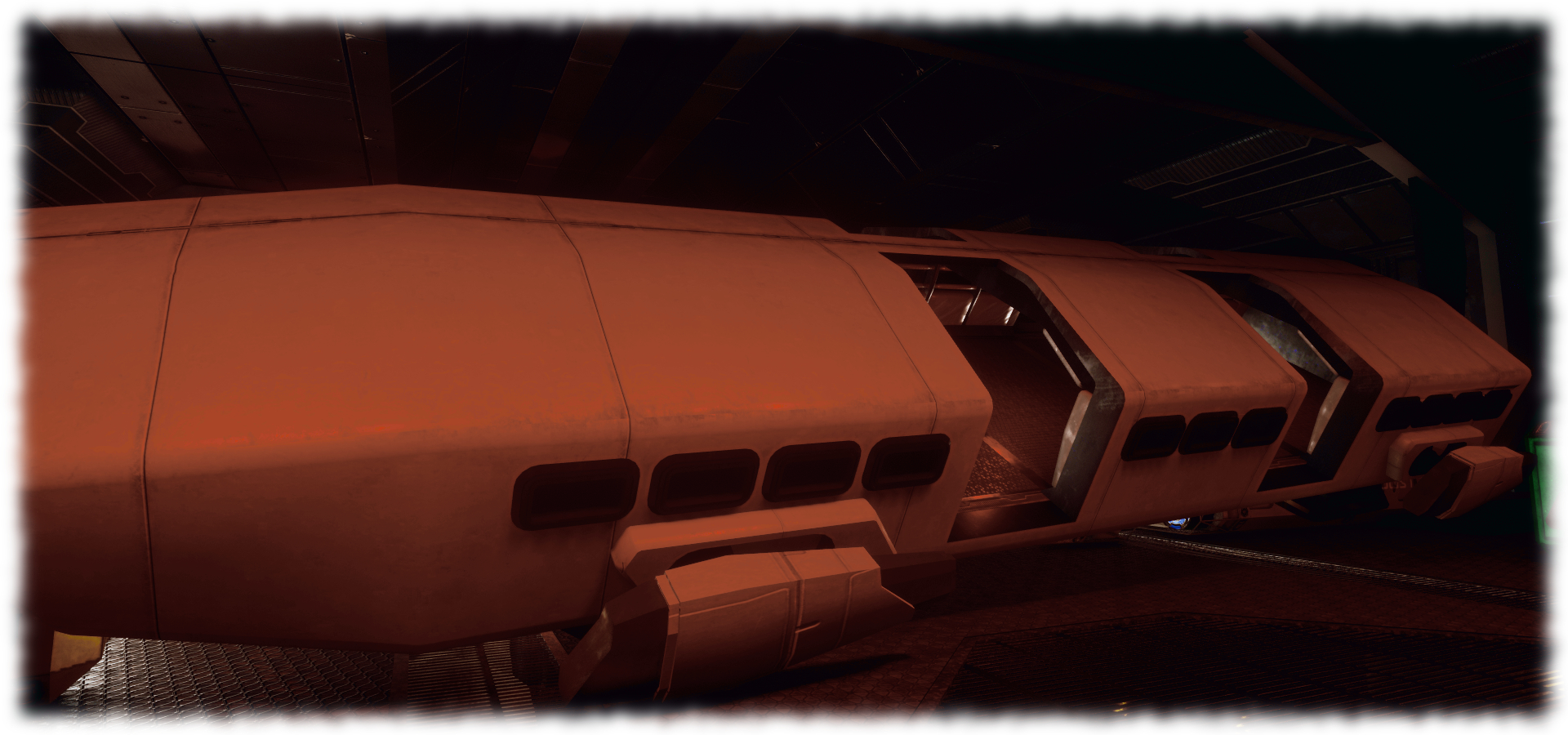
This is the warning you’ll hear on entering the main part of Tyler Scarborough’s Stasis Interrupted: Chapter 1, which might be described as a science fiction horror story. The warning – the first of several which cascade down on you – is given within a vast chamber deep within what appears to be a massive colony transport vessel. The chamber as stacked with stasis pods, presumably each one designed to hold individual colonists in a state of suspended animation during the voyage. However, all is not well, as evidenced by the warning.
Walking a little deeper into this huge chamber will trigger the additional alerts, each more dire than the last, culminating in a call for all personnel to get to the escape vehicle launch bay and evacuate the ship. Clearly, a major incident has occurred, and the warnings are your cue to find the escape vehicles.
Three massive airlocks separate the cryogenic bay from the rest of the ship – but only one of these is operational, alarms grinding and warning lights flashing. Beyond it lies the first signs of trouble: blood slicks the floor leading the way to the crew stasis pods, all of which are empty. Several identically dressed bodies lies on the floor. Bald and with bare feet, they would appear to belong to former colonists – and all clearly died violently. Just what has happened? Dimly lit corridors beckon you onward…
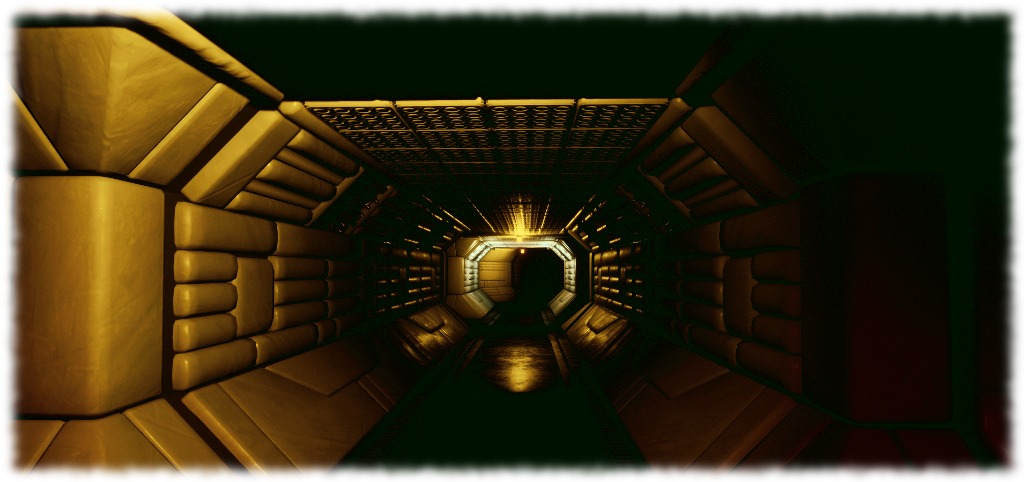
Finding your way through the ship is not as straightforward as might first appear. Beyond the crew stasis pods is a network of corridors, all under emergency lighting. Visibility is reduced to what can be seen through the sweep of yellow light cast by strobing lights, some of which may reveal more of the crew as you progress, and which can lead to a slight sense of disorientation.
Stasis Interrupted – with mains power apparently down, only emergency lighting is available within the ship, reducing everything to dark corners, shadows, and the metronomic sweep of yellow light
Eventually, the corridors will lead you to the ship’s cargo deck, stacked high with containers of equipment and supplies. Once again, finding your way across this area isn’t entirely straightforward. Just keep your eyes on the deck, and you may find the way. Once you do reach the far side of the cargo bay, things get a little easier, as emergency light sticks help direct you to the last of the escape vehicles.
It is aboard the escape vehicle that you’ll encounter the disembodied voice of another survivor, giving you instructions on what to do next. Unfortunately, whether by accident or design, the audio message was too distorted for me to clearly understand. Also, shortly after hearing it, I found myself back at the spawn point with a teleport script error message. My assumption is that the message marks the end of “chapter 1” of the adventure.
Stasis Interrupted – this is not the escape vehicle you are looking for …
This abruptness of this apparent “ending” (assuming it’s not an error) did spoil things a little for me; Stasis Interrupted is otherwise an exceptionally well crafted experience. The transport vessel feels huge, as one might expect such a space craft – presumably on a one-way trip – to be. Certainly, if this is the first chapter of an unfolding story, then I’m looking forward to seeing what comes next; there is enough to keep one engaged here – and the use of spatial and ambient sounds is so far the best I’ve come across thus far in Sansar. It would also be interesting to see how things might be enhanced once the likes of NPCs in Sansar are properly catered for – being pursued by the unfortunate colonists could add a sense of urgency to the situation!
Stasis Interrupted is accessible via both VR and Desktop modes, and I had no problems in exploring the environment while in Desktop mode. However, the initial spawn point for the experience does contain a warning for those using VR mode and who might be sensitive to flashing lights. Those comfortable with passing beyond the warning can use the teleport to continue (denoted by “ENTER” on the floor), and enter the experience proper.
If you are looking for somewhere that little bit different to explore for Halloween, or enjoy environments a little reminiscent of Alien, Stasis Interrupted is the place to be.
As always, please refer to the server release thread for updates and the latest news.
There was no deployment or restart for the Main (SLS) channel on Tuesday, October 24th, leaving it on package #17.10.06.509394.
On Wednesday, October 25th, the RC channels should be updated with a sideways roll to server maintenance package, #17.10.06.509394, comprising internal fixes, cuerrently deployed to the Main (SLS) channel.
SL Viewer
On Tuesday, October 24th, the current Maintenance RC viewer updated to version 5.0.9.329650. All other viewers in the current pipelines remain as per the end of week #42:
Current Release version 5.0.8.329115, dated September 22, promoted October 13 – formerly the “Moonshine” Maintenance RC.
Release channel cohorts:
Wolfpack RC viewer,version 5.0.9.329478, dated October 20 – this viewer is functionally identical to the release viewer, but includes additional back-end logging “to help catch some squirrelly issues”.
Alex Ivy 64-bit viewer, version 5.1.0.508209, dated September 5.
Voice RC viewer, version 5.0.8.329552, dated September 1.
Obsolete platform viewer version 3.7.28.300847, dated May 8, 2015 – provided for users on Windows XP and OS X versions below 10.7.
Exploits Update: No Copy Items
One area of concern / upset for content creators has been the use of server exploits to generate copies of No-Copy items. These have been frequently used to fold the Market with illicit copies of gacha items. The Lab has been aware of this, and some of the recent server-side updates (which are now grid-wide on Agni) have been to address these problems, as Simon Linden explained, relaying Mazidox Linden’s comments made at the Server Beta Group meeting on Thursday, 19th October:
Some of our recent internal fixes included changes to our back-end systems which will no longer allow certain exploits used for duplicating no-copy content, and make it easier for us identify when anyone uses similar techniques in the future. We haven’t solved all the problems outright, but we’re making good strides.
Simon went on to add, “There is more work to be done, and we want to do it.”
Obviously, the Lab is always interested in learning about potential exploits within the platform. Anyone identifying such an exploit – such as a means to deliberately crash a simulator – is asked to file a SEC (non public) JIRA detailing the exploit. There is a new region on Aditi (the beta grid), called Crash Me, which can be used to test / demonstrate ways the simulator might be crashed.
If a creator notices that there are endless amounts of their items on marketplace, and they suspect their items have been exploited, and JIRA Bug report should be raised.




 Inara Pey: Living in a Modemworld