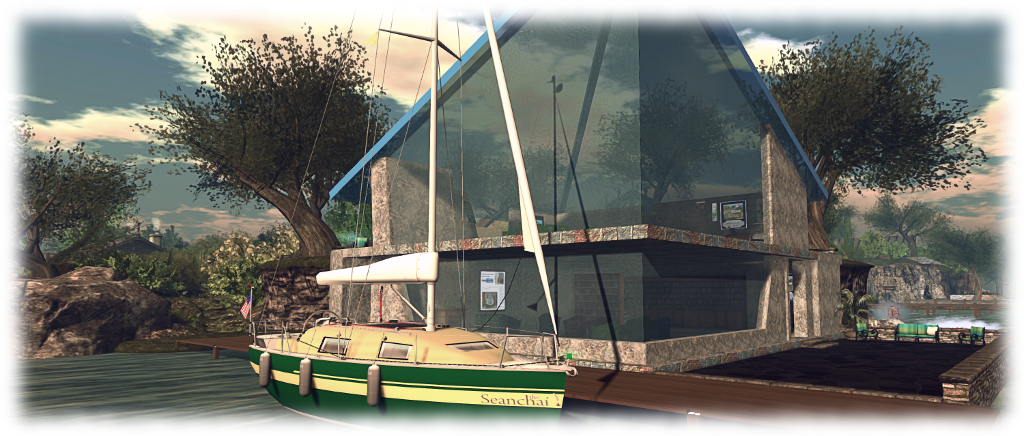
It’s time to kick-off another week of storytelling in Voice by the staff and volunteers at the Seanchai Library. As always, all times SLT, and events are held at the Library’s home at Holly Kai Park, unless otherwise indicated.
Monday, September 25th 19:00: A Wizard of Earthsea
Gyro Muggins reads Ursula K. Le Guin’s first Earthsea Cycle.
The boy is born on the island of Gont in the archipelago of Earthsea. This is a world infused with magic. Not everyone can control this magic, but those who know the right words and have a wizard soul can learn to utilize the power of the Earth to manipulate objects and events. The boy’s name is Duny; I can tell you that name because the name has no power over him. His true name is something he can only reveal to those he trusts absolutely beyond question.
I know his true name, but fair reader, I’m not sure yet that I can share it with you.
His aunt knows a few things, a handful of words, that can be used to bind things or call animals to her. Duny is particularly adept at calling falcons and other birds of prey. His agile mind soon surpasses what his aunt can teach him. He burns to know more. He is assigned to a mage, Ogion, who tries to teach him about the balance of magic with the Earth. There is always a cost for using magic. Understanding the levy for sorcery is the difference between being just impulsively talented and being wise about what you know.
(Commentary by Jeffrey Keeten.)
Tuesday, September 26th 19:00: Monsters of the Midwest
Join Kayden Oconnell for true tales of bigfoot, werewolves and other legendary creatures!
Wednesday, September 27th, 19:00 Callahan’s Crosstime Saloon
Corwyn Allen reads Spider Robinson’s 1999 anthology.
The titular saloon is a haven for lost souls; a place where the patrons come for one drink and a chance for a second – but only if they offer an unburdening toast at the fireplace. Mike Callahan, the owner, never judges but sometimes advises in as few words as possible.
The stories in the volume are:
“The Guy with the Eyes”
“The Time-Traveler”
“The Centipede’s Dilemma”
“Two Heads Are Better Than One”
“The Law of Conservation of Pain”
“Just Dessert”
“A Voice is Heard in Ramah…”
“Unnatural Causes”
“The Wonderful Conspiracy”
Also presented in Kitely (hop://grid.kitely.com:8002/Seanchai/108/609/1528).
Thursday, September 28th 19:00 Kiss Me Again, Stranger
Daphne du Maurier is perhaps best known for her period novel Jamaica Inn and her romance / thrillers My Cousin Rachel and Rebecca (the latter also being infamous for the claims of plagiarism made against – and not the only story by Du Maurier to face such claims). However, see also turned her hand to writing short stories in the horror genre as well, of which The Birds – immortalised by Hitchcock and also accompanied by claims of plagiarism is the most well-known.
With Kiss Me Again, Stranger, du Maurier sets out a tale of revenge framed by loneliness in what is a classic tale of a femme fatale, and which has itself enjoyed numerous short film and television adaptations.
London, England, not long after the end of the Second World War. A lonely car mechanic goes to see a film. At the theatre, he encounters an attractive usherette – and is immediately smitten; so much so that after the film has ended, he waits around outside the cinema for her to finish work, then follows onto the late-night bus, which they share with a man in a RAF uniform.
Paying a fare to the end of the bus route for both of them – he has no idea where she might get off – the young man sits beside her, secretly thrilled that she doesn’t seem surprised, nor does she reject his company. He even ventures to put an arm around her, which she appears to accept, telling him it’s not every day she gets a free ride – or free pillow, as she rests her head on his shoulder with the instructions that he’s to wake her “at the bottom of the hill, before we get to the cemetery.” He doesn’t, content to bask in her company, and they miss the cemetery. But she doesn’t mind, “Oh, there’ll be others,” she says. “I’m not particular.”
And thus is the young man drawn into her dark world…
With Shandon Loring (also presented in Kitely hop://grid.kitely.com:8002/Seanchai/108/609/1528).
Please check with the Seanchai Library’s blog for updates and for additions or changes to the week’s schedule.
The featured charity for August and September is Little Kids Rock, transforming lives by restoring, expanding, and innovating music education in schools.
NASA’s Mars Science Laboratory rover Curiosity has begun the steep ascent of an iron-oxide-bearing ridge that’s grabbed scientists’ attention since before the mission arrived on Mars in 2012.
“Vera Rubin Ridge”, previously referred to as “Hematite Ridge”, stands prominently on the north-western flank of Mount Sharp, resisting erosion better than the less-steep portions of the mountain below and above it.
“We’re on the climb now, driving up a route where we can access the layers we’ve studied from below,” said Abigail Fraeman, a Curiosity science-team member. As we skirted around the base of the ridge this summer, we had the opportunity to observe the large vertical exposure of rock layers that make up the bottom part of the ridge. But even though steep cliffs are great for exposing the stratifications, they’re not so good for driving up.”
The ascent to the top of the ridge will take the rover through a 65 metre (213 ft) change in elevation, which is being achieved through a series of drives which started in early September 2017, and which will cover a distance of around 470 metres (1542 ft).
Vera Rubin Ridge mosaic of 70 images captured by Curiosity’s Mastcam telephoto lens on August 13th, 2017. The layering of the ridge can clearly be seen. Credit: NASA/JPL / MSSS
The ridge is of particular interest to scientists not only for its erosion resistant composition, but also because the rock of the ridge exhibits fine layering, with extensive bright veins of varying widths cutting through the layers. Orbital spectrometer observations have revealed the iron-oxide mineral hematite shows up more strongly at the ridge top than elsewhere on lower “Mount Sharp”, including locations where Curiosity has already found the mineral. It is hoped that a detailed study of the ridge will reveal why it has been so resistant to erosion and whether this is related to the high concentrations of hematite in the rock. Answering these questions could further reveal information on past environmental conditions within Gale Crater.
“The team is excited to be exploring Vera Rubin Ridge, as this hematite ridge has been a go-to target for Curiosity ever since Gale Crater was selected as the landing site,” said Michael Meyer, lead scientist of NASA’s Mars Exploration Programme at the agency’s Washington headquarters.
A monochrome image of “Vera Rubin Ridge” captured using the imager on Curiosity’s ChemCam instrument shows sedimentary layers and fracture-filling mineral deposits. ChemCam’s telescopic Remote Micro-Imager took the 10 component images of this scene on July 3rd, 2017, from a distance of about 377 feet. Credit: NASA/JPL / CNES / CNRS / LANL / IRAP / IAS / LPGN
Curiosity Project Scientist Ashwin Vasavada of JPL added, “Using data from orbiters and our own approach imaging, the team has chosen places to pause for more extensive studies on the way up, such as where the rock layers show changes in appearance or composition. But the campaign plan will evolve as we examine the rocks in detail. As always, it’s a mix of planning and discovery.”
In the meantime, and in the saw-sawing of evidence concerning the past habitability of Mars, a team from the Los Alamos National Laboratory (LANL) has discovered evidence of boron on Mars, adding weight to the pro-life side of the argument.
A key building block of modern life is ribonucleic acid (RNA), which requires the sugar ribose. Like all sugars, ribose is unstable and quickly dissolves in presence of liquid, particularly water. However, when boron is dissolved in water it becomes borate, which acts as would act as a stabilising agent of ribose, keeping the sugar together long enough so that RNA can form.
“Borates are one possible bridge from simple organic molecules to RNA,” Patrick Gasda, the lead author of the LANL paper outlining the discovery. “Without RNA, you have no life. We detected borates in a crater on Mars that’s 3.8 billion years old, younger than the likely formation of life on Earth.”
An artist’s impression of how the lake in Gale Crater may once have looked. The central “island” is the impact peak and humped formation of “Mount Sharp”. Credit: Kevin M. Gill
The mineral was detected by Curiosity’s ChemCam instrument, a joint development by LANL the French space agency, the National Center of Space Studies (CNES). It was found in veins of calcium sulphate minerals located in the Gale Crater, indicating it was present in Mars’ groundwater and was preserved with other minerals when the water dissolved, leaving behind rich mineral veins.
Curiosity has already confirmed that Gale Crater was home to a series of lakes, and the LANL findings add weight to the potential these lakes could have had life in them at a time when it would have experienced temperatures ranging from 0 to 60 ° C (32 to 140 °F) and had a pH level that would have been neutral-to-alkaline.
OSIRIS-REx Swings by Earth
Just over a year ago, on September 8th, 2016, NASA’s Origins, Spectral Interpretation, Resource Identification, Security – Regolith Explorer (OSIRIS-REx) lifted-off from Space Launch Complex 41 at Cape Canaveral Air Force Station, at the start of a journey which will carry it a total of 7.2 billion kilometres (4.5 billion miles) to gather samples from the surface of an asteroid and return them to Earth for study (see my previous reports here and here).
On September 22nd, 2017, the spacecraft returned to the vicinity of Earth – albeit it briefly – to gain the gravity assisted speed boost it needs in order to complete its journey to the carbon rich asteroid Bennu, from which it will gather samples.
A graphic issued ahead of the OSIRIS-REx fly-be on Friday, September 22nd. Credit: NASA’s Goddard Space Flight Centre / University of Arizona
In making the flyby, the spacecraft came to within 17,000 km (11,000 mi) of Earth, approaching at a speed of around 30,400 km/h (19,000 mph) and passing over Australia and Antarctica, gaining a velocity boost of around 13,400 km/h (8,400 mph) as it accelerated back out into the solar system. The fly-by also curved the probe’s course onto an intercept trajectory with Bennu, which it will reach in October 2018. During the operation, OSIRIS-REx performed a science campaign, collecting images and data from Earth and the Moon, which also allowed the science team to check and calibrate the probe’s suite of science instruments.
Bennu is roughly 450 metres (1,614-ft) in diameter, and its solar orbit carries it across that of the Earth every six years. It is carbon rich, which is of significant interest to scientists because carbonaceous material is a key element in organic molecules necessary for life, as well as being representative of matter from before the formation of Earth. Organic molecules, such as amino acids, have previously been found in meteorite and comet samples, indicating that some ingredients necessary for life can be naturally synthesised in outer space.
On reaching Bennu, OSIRIS REx will “fly” alongside the asteroid for some 12 months, surveying and studying it and imaging points of interest as possible candidates for a daring “touch and go” sample gathering mission, when it will collect between 60 and 2000 grams (2–70 ounces) of material. If all goes well, the probe will depart Bennu in March 2021, arriving back at Earth in September 2023, when the sample will be parachuted down for scientists to study.
A secondary reason for visiting Bennu is that, like many Near-Earth Asteroids (NEAs) there is a slim chance it might strike our planet towards the end of the 22nd Century. An analysis of the thermal absorption and emissions of the asteroid will allow scientists to better predict its future orbits and the real potential for such a collision, and could help determine the actual risk of other NEAs striking Earth.
The following notes are taken from the Sansar Product Meetings held on Friday, September 22nd. These meetings are held every Friday at 9:30am PDT and 4:00pm PDT, and are open to all. There is no set agenda (currently), and the meetings are a mix of voice and text, and the official meeting notes are published in the week following each pair of meetings. Venues change on a weekly basis, and are announced in the Meet-up Announcements. The September 22nd meeting took place at the Zen Garden by Sansar Studios.
Bjørn Laurin attended both meetings to talk about the upcoming September / October release, and the next couple of releases beyond that. As such, the discussions were lengthy, so I’ve attempted to bullet-point key aspects of the major topics below, and have included a number of audio extracts of Bjørn’s comments.
Again, for ease of reference, some of the audio extracts comprise comments made at different points in the conversations, which I’ve attempted to bring together to offer a cohesive flow of information. There is ambient background noise in the audio, as there is currently no way of disabling this in the Sansar client. Similarly, any sounds of background typing is due to others in the meeting leaving their microphone open while not speaking.
Discord Channel
The official Sansar Discord channel launched on Thursday, September 21st. 2017. The channel is designed to act as an extension to the Sansar user community, allowing them chat with one another, make friends, plan meet-ups in real-time, exchange ideas, etc. Discord works on the web, a desktop app, and a mobile app, allowing users to stay connected wherever they are.
The Sansar Discord FAQ provides full details on the channel. Joining is a case of following this link and the instructions provided. Those who do not already have a Discord account will have to create one as a part of the process.
Sansar Store Focus Group Meetings
There will be two sessions focusing on discussions and feedback on the Sansar Store in week #39. Guidelines on intent and scope of the meetings and their location(s), will be published on the Sansar blog ahead of the first meeting. However, the dates / times are:
Monday, September 25th, 15:00-16:00 PDT.
Wednesday, September 27th, 14:00-15:00 PDT.
Upcoming Releases Overview
The Lab is referring to the next release as the “Discovery release”, of which highlights include:
Easier discovery of experiences in the Atlas
Branded stores on the Sansar Store
The ability for users in Desktop mode to be able to interact with objects in an experience (picking things, up, throwing them, etc.).
Currently, this release is scheduled for deployment on Thursday, September 28th, 2017, depending on final bug fixes / QA.
Bjørn also indicated that fashion and avatar customisation has risen closer to the top of the pile of upcoming features following the Discovery release. He specifically notes work on hair together with skin shaders for the hair and avatar skin; the upcoming fashion / clothing support releases, and coming options for experience owners to be able to monetise their experiences (e.g. ticketed access, etc.).
Desktop Mode Object Interaction
In the Discovery release.
Will allow those running Sansar on the desktop to have a similar level of interaction with in-world objects as those using VR. Desktop user will be able to pick up objects, “hold” them, throw them, drop them.
Objects around an avatar with interaction will highlight on a mouse-click, allowing the user to select which one they want to pick up.
Initially will not include animations: clicking on an object will cause it to float over the avatar’s hand. However, future releases will support “holding” objects (and eventually “picking up” objects see more on animations below).
There is some debate within the Sansar team in giving creators an explicit means of differentiating between users in VR mode and users in Desktop mode, or in allowing the platform to handle it internally.
Games designers see the ability to differentiate as “critical” to allow better design of control options, and which can be used by players in either mode, and Bjørn leans more towards this approach.
Atlas Improvements
The Discovery release includes a search option in the client version of the Atlas and a new Featured tab for featured experiences.
Future improvements for the Atlas will include a Favourites / Bookmarks tab, an Events tab and the ability to sort listed experiences.
Store Branding
Will be part of the Discovery release.
Comprises the ability to add a masthead logo to creator’s items. Details of masthead sizes available on the Discord channel.
People gather at the Zen Garden for the Friday, September 22nd meet-up
Beyond The Discovery Release
Avatar Identification in Desktop Mode
Possibly appearing in the October / November release.
This will most likely offer the same capabilities as VR mode currently has: click on an avatar and see their name, offer friendship, mute them.
Fashion and Clothing
For the most part, fashion and clothing will be handled as a single release rather than a series of iterative releases over time adding essential capabilities.
The exception to this will be handling clothing layers which will be handled in two parts: separation of the current clothing bakes from the avatar and then the rest of the capabilities.
The separation of the bakes will see clothing initially defined as either a single, complete layer (e.g. socks, underwear, pants / skirt, blouse / shirt, jacket all-in-one), or possibly as a “top” layer (e.g. undershirt, shirt, jacket) and a “bottom” layer (e.g pants, underwear, socks, skirt).
Further division of individual clothing layers will come in the future, but is seen as a more complicated task.
Clothing will naturally fold, flow and fall like real clothing and cloth from the initial release.
The Sansar Store will also be updated with the “main” fashion update is released to more fully support clothing.
Bjørn’s hope for the “main” fashion release is December 2017.
Due to what is involved with support for fashion / clothing, there may be a requirement for creators to sign NDAs – Jenn will be reaching out to creators about this in due course.
Clothing Physics
Clothing physics will be part of the initial release.
It’s currently not clear whether cloth physics will have to be assigned prior to upload, or if it is something done from within Sansar (such as by right-clicking on an item in Edit mode and selecting a “make cloth” option).
Bjørn indicated that the process will not be complex but there will be two specific routes to achieve different sets of results for clothing.
There is vagueness around how things will work due to contractual obligations, but some may be familiar with the tools the Lab are using to making clothing in Sansar work.
Avatar Updates
The back-end avatar rigging will be changing over the next “one or two months”.
These changes will not be visible to the casual user, but the changes will facilitate clothing design and will allow designers to create their own clothing.
One consequence of this is that all current outfits will break – however Bjørn indicated that all broken outfits will be replaced.
Future avatar updates will include the ability to change the avatar shape – more body fat, less body fat, etc. However, these will not be in the Discovery release.
As part of the work on hair (noted towards the top of this article), it will be possible to blend hair styles with the face, and things like masks or facial tattoos with hair and facial features, so they all work naturally together, and masks / tattoos respond to facial movements.
Aside I: the individual working on the avatar design spent ten years on developing the characters in the Halo game series.
Linden Lab has issued an important notice for international users who have a credit card filed with the company for the payment of services.
The blog post, issued on Friday, September 22nd, reads in full:
Due to some unexpected changes with our International Billing system, some Residents outside the United States with a Credit Card on file may have difficulty with their current payment method as of September 30, 2017.
In order to avoid any service disruption, we encourage all Residents outside of the United States to please take a moment to log into your account and re-enter your existing Credit Card information. Doing so now will prevent any disruption in in-world and Marketplace purchases, as well as recurring monthly billing for Premium Accounts, Private Regions and monthly Mainland maintenance. If you have difficulty with your payment method after September 30, 2017, updating your payment information will resolve the issue.
We apologise for this inconvenience and appreciate your patience as we continue to upgrade our billing systems in order to best service our Residents around the world. If you have any questions regarding this notice, please visit https://support.secondlife.com to contact our Support teams.
To re-enter your credit card details, go to your account dashboard at secondlife.com, click on Account (top left) and then on Billing Information on the list of options that opens. This will display your billing information summary (sample image below).
Make a note of the services the card is Used For on the right, then Remove your card details (option on the left) and then click Add A Credit Card (circled). This will open the form for you to enter your card details. Make sure to click Add Card to add the card to the system.
When your card has been recorded, you can check the details under Payment Method, then review the services the card is Used For. Should you need to change any of the latter, click on the Change option (circled under Used For on the right) to display a pop-up of services charged to the card and check / uncheck as required.
Updated, September 25th: As indicated to me by Grumpity Linden, the cause for the Wolfpack and Maintenance RCs to be withdrawn as noted in this article (and which was as a result of this issue), has now been resolved and the two updated versions of these viewers are once again available. As a result, the links to their release notes and download options have been restored.
The majority of the notes in this update are taken from the TPV Developer meeting held on Friday, September 22nd 2017. The video of that meeting is embedded at the end of this update, my thanks as always to North for recording and providing it. Timestamps in the text below will open the video in a separate window at the relevant point for those wishing to listen to the discussions.
Server Deployments Week #38 – Recap
There was no deployment / restart on the Main (SLS) channel on Tuesday, September 18th, leaving that channel running on 17#17.09.01.508236.
On Wednesday, September 19th, the RC channels were updated as follows:
BlueSteel and LeTigre received a new server maintenance package, 17#17.09.14.508549, comprising improvements to address some problems that could degrade simulator performance in rare cases.
Magnum received a new server maintenance package, 17#17.09.14.508533, containing a fix for BUG-100505 “llGetEnv (“agent_limit”) is returning an empty string in Magnum, LeTigre and Blue Steel regions.”
SL Viewers
Alex Ivy 64-Bit
[0:54 and 6:00] The Alex Ivy 64-bit viewer is due an update, possibly in the early part of week #39 (commencing Monday, September 25th). This may not have all the fixes required for the viewer to get promoted to de facto release status. Before this happens, the Lab wants to tackle the problem with pipeline stalls in this viewer, and are working on an experimental branch of the viewer to try to resolve the issue. This branch will be made available as a test viewer to those who have reported the issue and can reliably repro it. Depending on the outcome of this testing, a decision will be made on folding it into the RC branch for the viewer.
The wiki instructions for the viewer should now be updated to the 64-bit build requirements, nd Oz indicates that a new 64-bit Havok library should follow the release of the viewer.
Voice Viewer
[1:33,2:13, and 34:02-37:14] There will be a new Voice SDK arriving for the Voice RC viewer in the near future, which will include an updated SDK that includes a fix for some long-standing problems. There are still some problems to be fixed, so it is unlikely this viewer will be promoted until the new SDK has spent time in RC and the remaining major issues have been resolved.
This viewer already fixes the high number of failures to connect to the Voice service when logging-in; however, there is an issue where manually killing the Voice process will not restart (as it used to), and so Voice won’t work. The Lab would like to fix this so the process does restart the process, but this is not seen as a critical issue to be resolved before the viewer is promoted.
The new SDK does not alter the Voice protocols, but is not compatible with previous versions, requiring the supporting updates in the viewer to work. This means the new SDK cannot work with older viewer versions, and older SDKs cannot be used with viewers incorporating the code updates to support this new SDK.
Maintenance and Wolfpack RCs
[2:04 and 4:15] The meeting references updates to the Maintenance RC viewer (to 5.0.8.329115) and the Wolfpack RC (to 5.0.8.39128). While both updates were available at the time of the meeting and shortly thereafter, the Alternate Viewers wiki page now references the previous RC releases for both (5.0.8.329065 and 5.0.8.328990 respectively). It is not clear whether this is an error with the wiki page, or if the updated RCs have been withdrawn (both still appear on the viewer release notes list). Resolved.
Snapshot Viewer
[5:14] There may be a new updated to the 360 snapshot viewer in the next week to two weeks. Work has also started on providing better support for using 360-degree images in Second Life Place Pages (see here and here for more on Place Pages).
Pipeline Status
Keeping the above in mind, the current viewer pipeline comprises:
Current Release version 5.0.7.328060, dated August 9th, promoted August 23rd – formerly the Maintenance RC
Release channel cohorts:
Maintenance RC viewer, version 5.0.8.329065, dated September 18th.
Wolfpack RC viewer,version 5.0.8.328990, dated September 12th – this viewer is functionally identical to the release viewer, but includes additional back-end logging “to help catch some squirrelly issues”
Alex Ivy 64-bit viewer, version 5.1.0.508209, dated September 5th
Voice RC viewer, version 5.0.8.328552, dated September 1st
Obsolete platform viewer version 3.7.28.300847, dated May 8, 2015 – provided for users on Windows XP and OS X versions below 10.7.
New Viewer Splash / Log-in Screen
[7:12-7:42] As noted in my week #36 TPV meeting notes, Phronimos Linden is updating the viewer splash screen which will see a different look and feel to the screen, including how information is displayed (such as making grid status info more prominent), and will see updates to some of the widgets providing information in the splash screen. This work is now with the QA team, and information on the updates will be available for TPVs soon.
Windows Viewer Installation Warning
[7:47-8:48] The Lab’s code-signing key used to verify the viewer with Windows (notably Windows 10) has expired. The Lab have a new key, but for an interim period, it means users installing the Windows version of the official viewer may find Windows SmartScreen reports the viewer as unverified.
You can read more here, on via my own blog post, which includes steps on clearing the warning and installing the viewer.
Server Version Updates and Move to the Cloud
[12:13-12:53] A number of server version updates are advancing. these don’t always have user-visible changes, but they are nevertheless important to Second Life. Among other things, they are part of the preparatory work for moving SL capabilities to the cloud (see my week #36 TPV notes for more on this).
[15:08-19:06] There is no time line for moving things to the cloud, simply because the Lab does not know at this point how long it will take. There are some significant changes which must be made to both the way things are built and the way they are run, and there need to be assorted updates to various components that go into building and running SL services.
Some SL services are already being tested in the cloud, and some are performing well – such as the process for determining if a user requires a viewer update. Others have been tested and revealed problems which must be addressed if they are to be run from the cloud – or should be addressed even when not running in the cloud.
It is unlikely the Lab will be providing specifics on services which have moved to the cloud / are being tested, and which are still based within their data centre until things reach a point where simulators are running in the cloud, simply because where many SL services run makes absolutely no difference to the user experience, as long as they are running. Moving and testing simulators in the cloud is likely to be one of the last things to be tackled, simply because of the complexities involved.
The first goal is to get everything working pretty much “as is” from the cloud. Only after this has been done, will work start on leveraging the benefits of having everything in the cloud be explored and exploited.
[19:06-21:49] This could include giving – and to use Oz’s words, the option of having their regions hosted in specific geographical locations. So, for example, the various communities located in South America could have their regions all hosted in South America, potentially improving response times between viewer and server. However, whether this will in fact be possible is dependent on the Lab reaching that point at which they can start leveraging the benefits of the cloud.
Obviously there are trade-offs in this kind of shift, should it occur; relocating a simulator to better serve a community may not improve things for others access the region on that simulator. However, in potentially supplying the option, the Lab is providing land owners with a choice of what they would like to do.
[21:56-22:38] If nothing else, this work should be a demonstration that the Lab really is continuing to invest in Second Life and its future. Were they seriously thinking of letting it go (i.e. in favour of Sansar), then none of this work – and the associated expenditure – would be taking place.
[29:26-31:16] There is a “fair amount” of back-end work that is being worked through, and the work is approaching the point of internal testing within the Lab. Once this has reached a suitable point, the server-side / simulator changes will be deployed (e.g. to Aditi) for wider testing, alongside of a project viewer to handled the client-side application of the capabilities.
Recent Grid Issues
[37:51-39:20] As most are aware, there have been some recent grid issues. While not the cause of these issues, but which has been a contributing factor to their duration, is some low-level code within the viewer which handles log-in retries far too aggressively. When this happens en masse (such as when there is a grid issue), it results in the log-in servers being swamped, adding to the woes for people trying to log-in.
A recent Maintenance update to the SL viewer addresses this issue (see my week #30 TPV update), and the request for TPVs to pick these code changes up was re-iterated at the meeting. In addition, the log-in servers have themselves been made more robust when facing large number of attempted / repeated log-in attempts.
Other Items
Estate Tool Ban List Improvements
[9:32-11:22] The Lab has resumed work on the region ban lists (layout / usability, etc), and the updates should be appearing soonTM. The specifics of what is being done will hopefully be available for the next TPV Developer meeting.
Premium Member Benefits
[13:13-14:53] There is apparently at least one Premium member benefit that will be appearing real soonTM which the Lab believe people will like, and some further ideas are being considered. Oz declined to comment on what any of these might be, citing it being more fun to find out when they are announced. He also indicated that appropriate and considered suggestions / ideas for benefits (e.g. not things that persist after a Premium subscription has been cancelled) are also welcome.
Group Notice Failures
[28:00-28:55] Still no work on group notices (on-line and off-line) sometimes not getting through for some people. It’s not on the “now / next” roadmap of things the Lab is / will be looking at. The focus on sever-side work is on dealing with instability issues which can cause crashes / offer exploits to griefers.
Asset HTTP Messaging and Asset HTTP Issues
[41:14] As noted in my week #36 TPV meeting update, the recent Asset HTTP updates are leading to the texture pipeline getting out of sync, and people experiencing texture load stalls. A JIRA for this has been filed (BUG-139123), and a possible fix has been submitted to the Lab by Sovereign Engineer.
[43:16] The Lab is also working on the texture caches in an attempt to make them faster and more effective.
I’ve known Maxwell Graf – incredibly enough – since 2007. We’re not actually in the same social groups within Second Life and rarely hang out, but Max is the kind of person you can instantly feel at home with. We can go without talking for several months, and then an impromptu IM picks things up almost where they were left last time around. I’ve also been honoured that Max has, on occasion passed his written thoughts on subjects related to content creation, Second Life, etc., to me for thoughts and feedback – even though I’m possibly the least qualified to comment on matters of content creation.
Max is perhaps best known for his period furniture and buildings
It is as a content creator that Max is perhaps best known in Second Life. His Rustica brand is renowned for quality furnishings, building kits and more, particularly for those with a lean towards Medieval or fantasy settings – although his products are applicable to more than just these two genres. In more recent years he’s branched into steampunk and fashion (with his Bitch and Bastard brands of female and male clothing and apparel – including some magnificent facial hair options for the discerning gentleman!). He is also a superb sculptor of land and maker of landscapes – as anyone who has visited the stunning and beautiful Rustica, home of his brand, will agree.
… However he offers far more for period setting, role-play, home and avatar. His “Ex Libris” range of books offers “titles” of great benefit to SLers (we have them at home) and can be bought as a set or as part of an entire library displayed within beautiful modular cabinets
Nor has Max content with offering his creativity to just Second Life. He has one of the first into Blue Mars and also quickly active in Cloud Party. More recently, he’s been working in Sansar, building a five experience “chapters”, including some familiar names – LagNmoor, Rustica, and Neptune’s Revenge – those willing to dip their toes into Linden Lab’s latest venture can visit and enjoy (just follow the clues!).
Throughout all of this, Max has been a friend to many; honest, supportive, outgoing, and true. So when he puts out a plea on Plurk concerning a personal situation, those who know him rally round with re-Plurks, Tweets and blog posts (and my apologies to Max and Lyric for being a little tardy with this blog post, I haven’t been paying attention to social media of late – and my thanks to both Saffia Widdershins and Ciaran Laval for the indirect nudges on the matter).
The Rustica Maison de Maille at Rustica – see inside the store for a petite version
Max isn’t asking for donations or any kind of direct financial support via the real world. What he is asking is for people to buy something for their in-world enjoyment from his store. It doesn’t matter how big or small, how much or how little; in fact, as he says himself, if there is something you desperately want, but cannot honestly afford it, contact him, and he’ll try to sort something out with you.
As we’re currently re-building and replacing elements of Holly Kai Park to ensure all of the landscaping elements, buildings, accessories, etc., are held by a single account, we took the opportunity to zap to Rustica and pick up a set of Max’s PipeWork Electric Lamps, which are now installed in the snug lounge and around the dance floor at Caitinara Bar to add some lighting ambience with a unique look.
We added the Rustica PipeWorks Electric Lamps set to the snug at Caitinara as an ideal option for projected lighting, using the table lamps (foreground, left and on the tables) and wall sconces (over the bar) . Some have also been used around the dance floor and gallery seating area.
So please, do take the opportunity to help a talented creator and friend. Hop over to Rustica in-world or on the Marketplace and offer support by buying an item or two. I can guarantee you won’t be disappointed with the quality of anything you purchase from Rustica / Max.
 The boy is born on the island of Gont in the archipelago of Earthsea. This is a world infused with magic. Not everyone can control this magic, but those who know the right words and have a wizard soul can learn to utilize the power of the Earth to manipulate objects and events. The boy’s name is Duny; I can tell you that name because the name has no power over him. His true name is something he can only reveal to those he trusts absolutely beyond question.
 The titular saloon is a haven for lost souls; a place where the patrons come for one drink and a chance for a second – but only if they offer an unburdening toast at the fireplace. Mike Callahan, the owner, never judges but sometimes advises in as few words as possible.
 Daphne du Maurier is perhaps best known for her period novel Jamaica Inn and her romance / thrillers My Cousin Rachel and Rebecca (the latter also being infamous for the claims of plagiarism made against – and not the only story by Du Maurier to face such claims). However, see also turned her hand to writing short stories in the horror genre as well, of which The Birds – immortalised by Hitchcock and also accompanied by claims of plagiarism is the most well-known.




 Inara Pey: Living in a Modemworld