Space Update: Planet Nine, “signalling” stars and a quick round-up

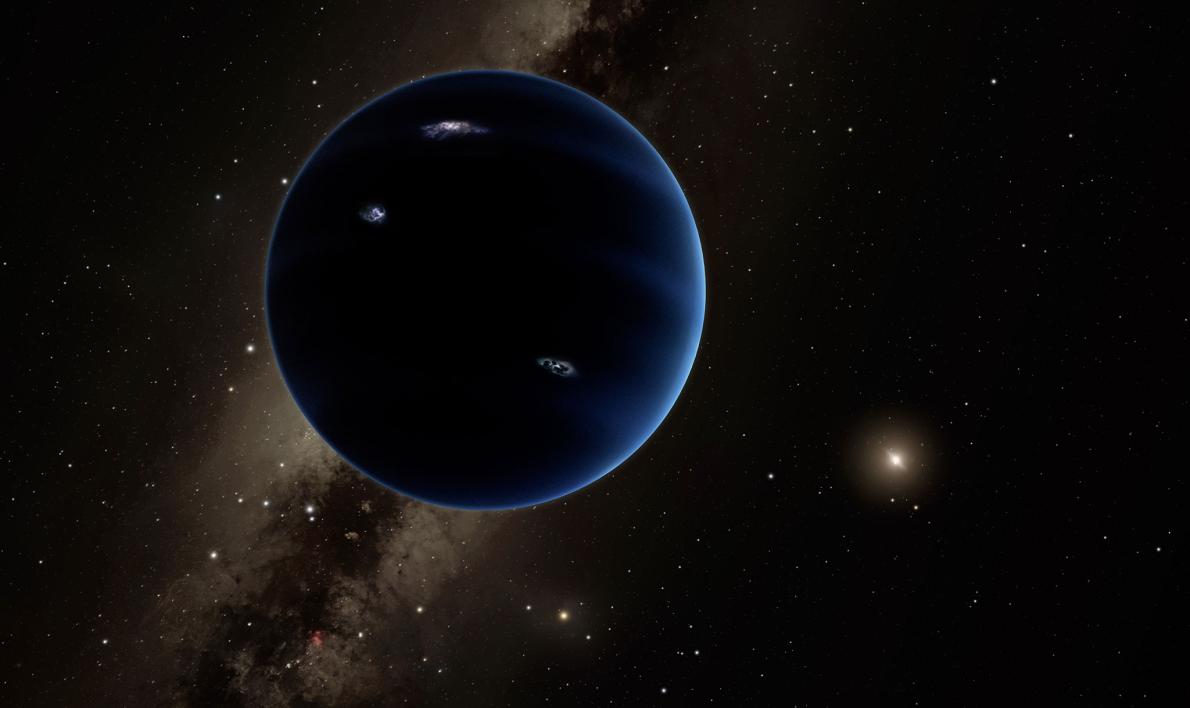
Planet Nine, if it exists,could equal Neptune in size, and orbits the Sun 200 times further away than Earth. Credit: Caltech / R. Hurt
Planet Nine, if it exists,could equal Neptune in size, and orbit the Sun 200 times further away than Earth. Credit: Caltech / R. Hurt

In January and February 2016, I wrote about Planet Nine (or Planet X, George, Jehoshaphat, or Planet of the Apes, depending  your preference), the Neptune-sized world believed to be orbiting the sun on the very edge of the solar system in a highly eccentric orbit. Since then, the search for this mysterious world has continued, and while it has yet to be located, evidence that it exists has been mounting. Not only that, but astronomers now believe it might explain why the solar system is “tipped”.

The Hunt started after Mike Brown, a leading planetary astronomer at the California Institute of Technology (Caltech), and his colleague Konstantin Batygin developed a computer model which showed that the very eccentric orbits of six Trans-Neptunian Objects (TNOs) located in what is called the scattered disk,  a sparsely populated region of space between 30 100 AU from the sun, overlapping with the Kuiper belt, could have been due to the influence of a massive, distant planet. At the time, they noted that if the model was correct, other TNOs would likely  occupy equally distinct orbits.

A planet averaging about 10 times as massive as Earth, called Planet Nine could explain the paths of six distant objects in the solar system with mysterious orbits
A planet averaging about 10 times as massive as Earth, called Planet Nine could explain the paths of six distant objects in the solar system with mysterious orbits. Credit: Caltech / R Hurt

At the joint European Planetary Science Congress (EPSC) and American Astronomical Society’s Division for Planetary Sciences (DPS) in October, it was revealed more TNOs fitting the model have been discovered over the past several months. Two of them,  2013 FT28 and 2014 SR349, precisely fit the same type of orbit seen the original six objects used by Brown and Batygin model. Five more have been found in orbits which are effective perpendicular to Planet Nine’s believed orbit around the Sun, something predicted by the computer model.

All of this is helping to narrow down Planet Nine’s potential orbit around the Sun, and the arc of that orbit where it might be found. So much so that Batygin, Brown have teamed with original proponents for Planet Nine Chad Trujillo and Scott Sheppard to use the 8-metre Subaru Telescope atop Mauna Kea in Hawaii to carry out a  search of the night sky. Sheppard and Trujillo are also using two telescopes in Chile to search the possible sweep of the planet through the southern hemisphere’s night sky. And they are not alone.

The Brown / Batygin model for Planet Nine indicated the planet would cause some TNOs to ine in orbits perpendicular to the planet's own eccentric orbit around the Sun - and five such object have now been discovered (shown in teal, with the original TNOs possibly influenced shown in magenta. Credit: Caltech
The Brown / Batygin model for Planet Nine indicated the planet would cause some TNOs to lie in orbits perpendicular to the planet’s own eccentric orbit around the Sun – and five such object have now been discovered (shown in teal, with the original TNOs possibly influenced shown in magenta. Credit: Caltech

Also at the planetary conference, graduate student Elizabeth Bailey, using Brown and Batygin’s data presented a paper proposing how the odd tilt to the solar system’s major planets relative to the Sun might be due to Planet Nine.

With the exceptional of Mercury, all the major planets in the solar system orbit along a plane tilted by about six degrees from the Sun’s equator. This suggests either the Sun was somehow tipped on its axis in the past, or the planets have been pulled from their original alignment along the Sun’s equatorial plane. Of these two ideas, the preferred option has been for exotic interactions between the early Sun’s magnetic field and the primordial disk of gas surrounding it, inclining the latter, which then formed the planets. However, Bailey’s simulations suggest that a large body occupying Planet Nine’s predicted orbit could have had sufficient influence on the Sun over some 4 billion years to have slowly tipped it over by six degrees. Bailey’s hypothesis was supported by a  Brazilian team of astronomers, who used a different analytical method while working independently from her, and reached the same conclusion.

As it might be: estimates concerning Planet Nine's possible size, mass, etc., should it exist. Credit: Space.com / Karl Tate
As it might be: estimates concerning Planet Nine’s possible size, mass, etc., should it exist. Credit: Space.com / Karl Tate

Even so, some remain sceptical that the mysterious world exists. “I give it about a 1% chance of turning out to be real,” says astronomer JJ Kavelaars, of the Dominion Astrophysical Observatory in Victoria, Canada. Interestingly, his fellow researcher and collaborator Cory Shankman,  has created models with the exact orbits of the original six TNOs used by Brown and Batygin, and found that a massive planet would not maintain their tell-tale clustering for long periods.

Thus, the search for the solar system’s mysterious Planet Nine, continues.

ETs Phone Home?

Are aliens sending signals using their own stars? That’s what might be happening, according to astrophysicists Ermanno Borra and Eric Trottier, from Laval University in Quebec; although they admit it’s only one possible explanation for what they appear to have discovered.

It was in 2012 that Borra predicted intelligent aliens might use the light from their own stars to signal their existence to the cosmos. Using data from the Sloan Digital Sky Survey, Borra and Trottier analysed the spectra of 2.5 million stars to see if this might be the case – and found 234  which seem to be broadcasting a signal of the kind predicted by Borra.

The “signals” are pulses in the stars’ light, separated by a constant time interval. What’s more, all 234 stars are predominantly in the F2 to K1 spectral range, which is the small range of stars centred on the spectrum of our own life-supporting Sun, and thus the broad group of stars thought might support life on planets orbiting them.

The Sloan Digital Sky Survey telescope, New Mexico. Credit: SDSS / Fermilab Visual Media Services / NASA

However, as Borra and Trottier note in their paper – which has yet to be comprehensively peer-reviewed – the pulses could be the result of natural factors such as rotational transitions in molecules or the Fourier transform of spectral lines. It might even be due to rapid pulsations in the stars themselves. Nevertheless Borra and Trottier have tended to dismiss rotational transitions on the grounds that such behaviour isn’t common to these types of star. They also think it unlikely a Fourier transform is responsible.

Instead, they lead towards either the “signals”  being an artefact produced by data reduction on the part of the Sloan instrument, or the work of ET, with a slight emphasis towards the ET side of their thinking.  Others, having read their paper, are far more sceptical.

“It seems unlikely that 234 separate alien societies would be sending out such similar signals more or less simultaneously” Seth Shostak, a senior astronomer at the SETI (Search for Extraterrestrial Intelligence) Institute in Mountain View, California said. “It would be like expecting us to send the same signals as the Abyssinians — it doesn’t make a whole lot of sense.” Instead, Shostak leans towards the data reduction explanation; as does Occam’s Razor.

But a further possible explanation has been suggested: that the signals are due to highly peculiar chemical compositions in a small fraction of galactic halo stars which has  never been previously encountered. While not as exotic as aliens using their stars as signalling devices, should this prove to be the case, it would still be a remarkable new discovery.

Continue reading “Space Update: Planet Nine, “signalling” stars and a quick round-up”

Celebrate Halloween at The Great Boo! in Second Life

Holly Kai Park - The Great Boo! Sunday, October 30th
Holly Kai Park – The Great Boo! Sunday, October 30th

It’s that time of year when ghosts and ghouls arise, when demons and vampires and more walk abroad; it’s a time for spooky stories and terrifying tales to be told by moonlight or in darkened rooms. And if you’re someone who enjoys spine-tingling yarns, we have just the thing for you at Holly Kai Park – The Great Boo!

Join us on Sunday, October 30th from 1:00pm SLT, as Seanchai Library presents an afternoon of Halloween stories live in voice to mark the opening of Holly Kai Park’s Storyteller’s Circle.

poster-2Our demonic deliverers of twisted tales and devilish dialogue will be:

  • 1:00pm – Dubhna Rhiadra
  • 1:20pm – VT Torvalar
  • 1:40pm – Boudicca Amat
  • 2:00pm – Bryn Taleweaver
  • 2:20pm – Hana Hoo
  • 2:40pm – Trolley Trollop
  • 3:00pm – Crap Mariner
  • 3:20pm – Kayden Oconnell
  • 3:40pm – Caledonia Skytower

The circle has been specially dressed for the occasion – the camp fire is lit, the torches blaze brightly to ward off the spirits. But the mist roils and rolls, the wolves howl and owls hoot, and great cobwebs fill the gaps between the trees as the spirits walk abroad! Just set your viewer to midnight (or let Firestorm set the atmosphere for you!), and step into our ghostly world!

The gates will be open throughout the afternoon – so feel free to join us as time permits – although we hope you’ll be with us throughout! after all, what could be a better complement to your Spooky Sunday plans?

And if you feel like coming in costume, there are spaces aplenty for ghouls, ghosts, monsters, demons and all, oh my!

SLurl Details

Stories that go Boo! and more in Second Life

It’s time to kick-off a week of story-telling in voice, brought to our virtual lives by the staff and volunteers at the Seanchai Library. As always, all times SLT, and events are held at the Library’s Second Life home at Bradley University, unless otherwise indicated.

Sunday, October 30th 13:00 The Great Boo!

the-great-boo-posterIt’s that time of year when ghosts and ghouls arise, when demons and vampires and more walk abroad; it’s a time for spooky stories and terrifying tales to be told by moonlight or in darkened rooms. And if you’re someone who enjoys spine-tingling yarns, Seanchai Library has just the thing for you at Holly Kai Park – The Great Boo! – an afternoon of Halloween stories live in voice to mark the opening of Holly Kai Park’s Storyteller’s Circle.

  • 1:00pm – Dubhna Rhiadra
  • 1:20pm – VT Torvalar
  • 1:40pm – Boudicca Amat
  • 2:00pm – Bryn Taleweaver
  • 2:20pm – Hana Hoo
  • 2:40pm – Trolley Trollop
  • 3:00pm – Crap Mariner
  • 3:20pm – Kayden Oconnell
  • 3:40pm – Caledonia Skytower.

Monday October 31st

19:00: The War Hound and the World’s Pain (Von Bek #1)

von-bekGyro Muggins opens the covers of Michael Moorcock’s 1982 supernatural novel.

Europe, the 17th century: nations are ravaged by the Thirty Years’ War, driven by religion and engulfing most of the Great Powers. Weary of the fighting, disillusioned, faithless and cynical, Ulrich von Bek, the War Hound, deserts his troops and travels through a Germany ruined by the war and religious persecution.

Coming to a strange forest, he finds within it a castle which appears to have escaped the war. He decides to seek shelter within its walls – only to find this is no ordinary castle. The lord within it is none other than Satan himself.

Von Bek discovers he has been allowed into the castle so that Satan might seek his help. In return for his soul, the Devil asks him to seek out the Cure for the World’s Pain, so that Satan might use it as proof to God that he wishes to be reconciled with heaven.

The hosts of Hell, however, aren’t that keen on the idea of reconciliation…

21:00: Live From a Haunted House

A Halloween special with Shandon Loring

Tuesday November 1st, 19:00: The Day of the Dead

With Trolley Trollop and Caledonia Skytower.

Wednesday November 2nd, 19:00: All Souls Day

With Shandon Loring.

Thursday, November 3rd

19:00 Unnatural Creatures

unnatural creaturesUnnatural Creatures is a collection of short stories about the fantastical things that exist only in our minds—collected and introduced by beloved New York Times bestselling author Neil Gaiman.

The sixteen stories gathered by Gaiman, winner of the Hugo and Nebula Awards, range from the whimsical to the terrifying. The magical creatures range from werewolves to sunbirds to beings never before classified. E. Nesbit, Diana Wynne Jones, Gahan Wilson, and other literary luminaries contribute to the anthology.

Join Shandon Loring as he brings some of these stories to life.

21:00 Seanchai Late Night

With Finn Zeddmore.


Please check with the Seanchai Library SL’s blog for updates and for additions or changes to the week’s schedule.

The featured charity for September-October is Alex’s Lemonade Stand Foundation (ALSF), a childhood cancer foundation dedicated to raising funds for research into new treatments and cures for all children battling cancer.

Additional Links

The haunting beauty of Everwinter in Second Life

Everwinter; Inara Pey, October 2016, on Flickr Everwinter – click any image for full size

I make no secret of being a fan of Lauren Bentham’s region designs. I’ve covered several of them in these pages; they are always beautifully conceived and wonderfully executed – even when the theme might be a little on the dark side – making them a joy to visit and explore.

Take Everwinter. It is a dark design, and might easily be taken to be in keeping with the time of year. However, its roots go far deeper than Halloween or any “traditional” apocalyptic setting. As Lauren notes in her introduction to the region, Everwinter takes its inspiration from a place in the physical world, and centre of a very specific event.

Everwinter; Inara Pey, October 2016, on Flickr Everwinter

Located in northern Ukraine, close to the border with the Republic of Belarus in 1970, Pripyat City was the ninth nuclear city (a kind of closed city) dedicated to supporting the Soviet Union’s burgeoning nuclear power industry. By early 1986, its population was over 49,000 – but by the end of April that year,  it lay a ghost town. It has remained that way ever since; and while most of us might not know its name first-hand, few of us are unfamiliar with the name that brought about Pripyat’s desertion: Chernobyl.

Pripyat’s sole purpose was to house all those involved in running and maintaining the Chernobyl nuclear plant, giving those workers and their families all the necessities of life: housing, shops, schools, public amenities including a public swimming pool and an amusement park. But when a systems test at the power station went disastrously wrong, the entire city was evacuated on the afternoon of April 27th, 1986, leaving the great Ferris wheel of its amusement park as one of the most enduring photographic images of the aftermath of the Chernobyl accident.

Everwinter; Inara Pey, October 2016, on Flickr Everwinter

It is the amusement park which forms the centre of Lauren’s build at Everwinter – but as she points out, this is not intended to be a recreation of either Pripyat park, or a reflection of the Chernobyl disaster itself, although she provide some starting statistics about both in her introductory notes, and they make sobering reading.

From all of this, you can probably guess expect, Everwinter is an atmospheric build; one which should be visited with local sounds enabled. By doing so, arriving visitors can hear the actual evacuation message just as it was broadcast that chilling afternoon in April 27th, 1986.

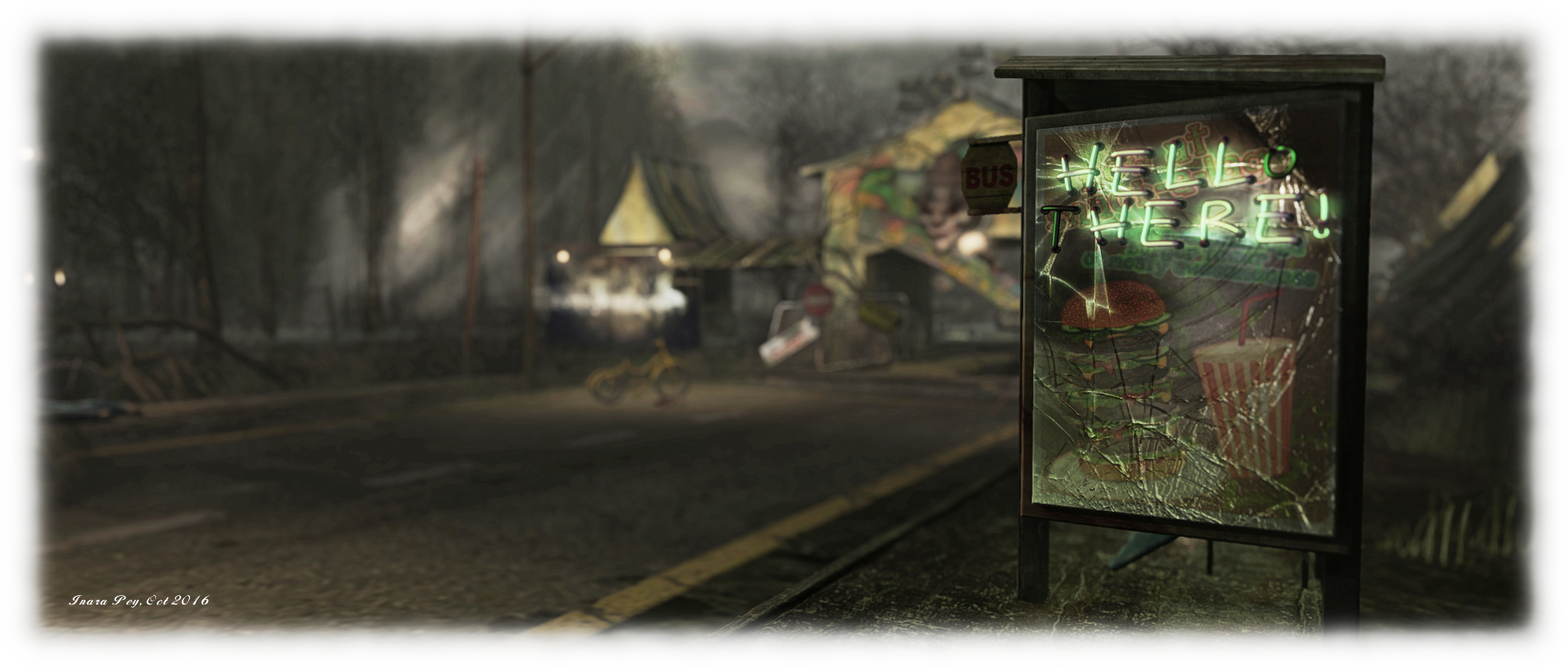
A ruined, broken road leads away from the landing point, neon signs  – in English, a further demonstration that Everwinter is not intended to be a historical recreation of Pripyat – glow faintly, competing with a lowering Sun which lights the old amusement park in the distance. Along this cracked road, tumbleweeds roll in the wind, vehicles lie rusting and broken, and locals stand, heads encased in gas masks.

Everwinter; Inara Pey, October 2016, on Flickr Everwinter

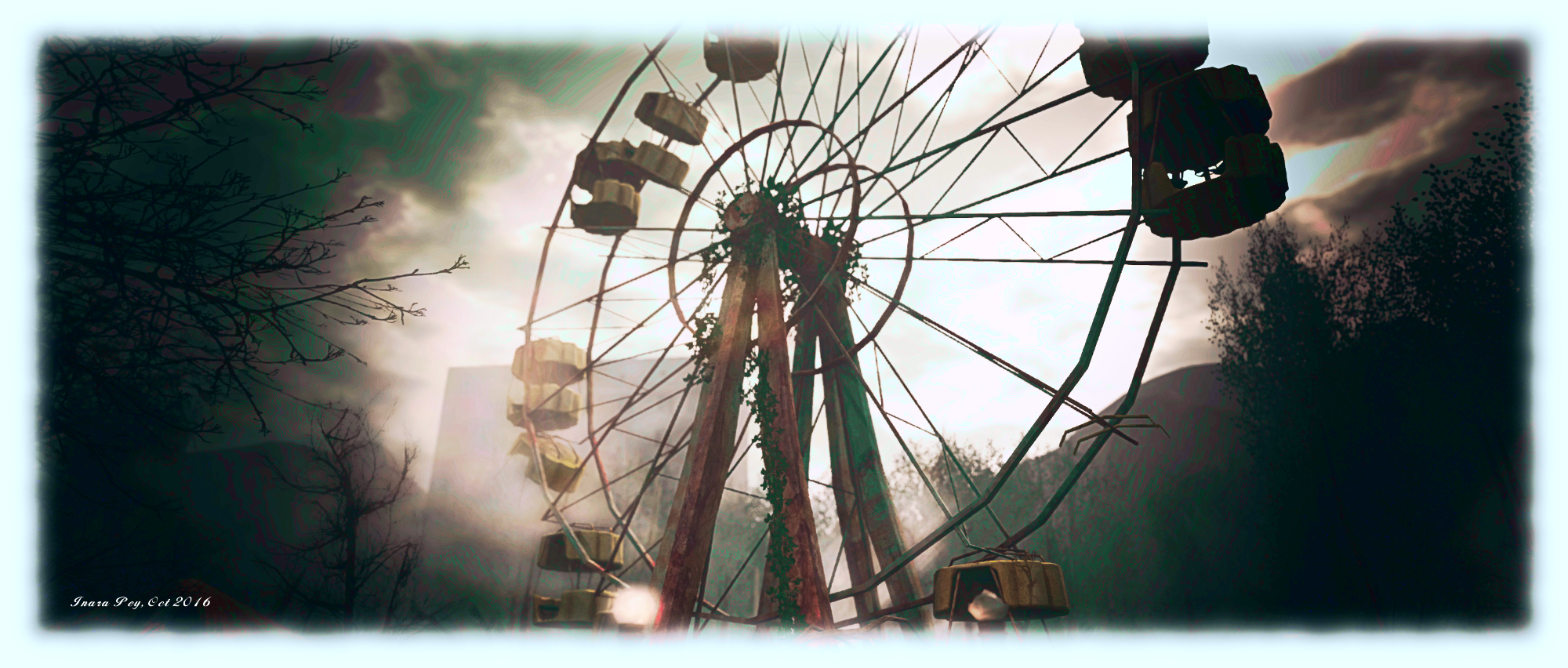
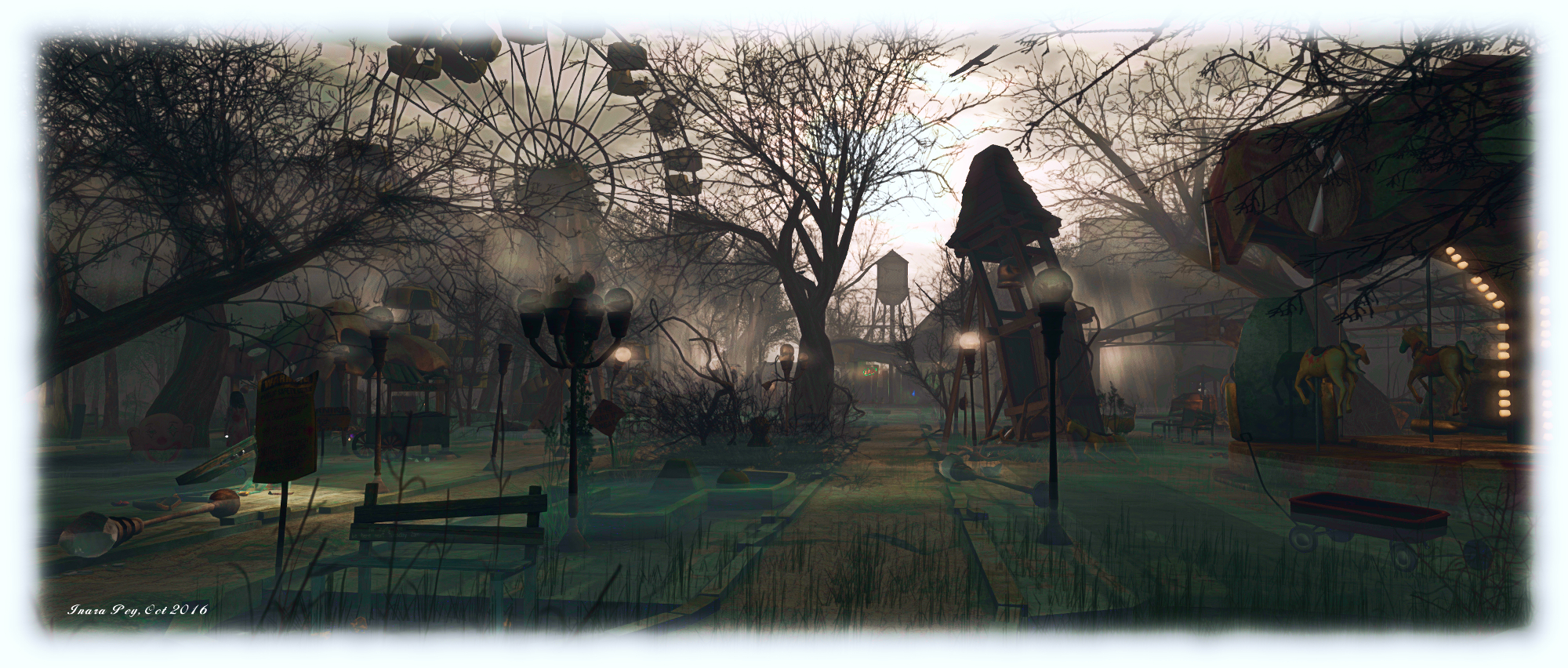
The amusement park stands deserted, the Ferris wheel rising into a cloudy sky, its cars broken and arms rusting, caught in flickers of lightning. Mist – or what appears to be mist – drifts across the ground beneath and wraps itself around trees and the remains of the park. But is it really mist? Look again and none the flickers of pigment within it, like tiny particles suspending in the air – a symbol, perhaps of the deadly nuclear poisons which sparkles and shifted through the air over the city in the wake of Chernobyl’s meltdown.

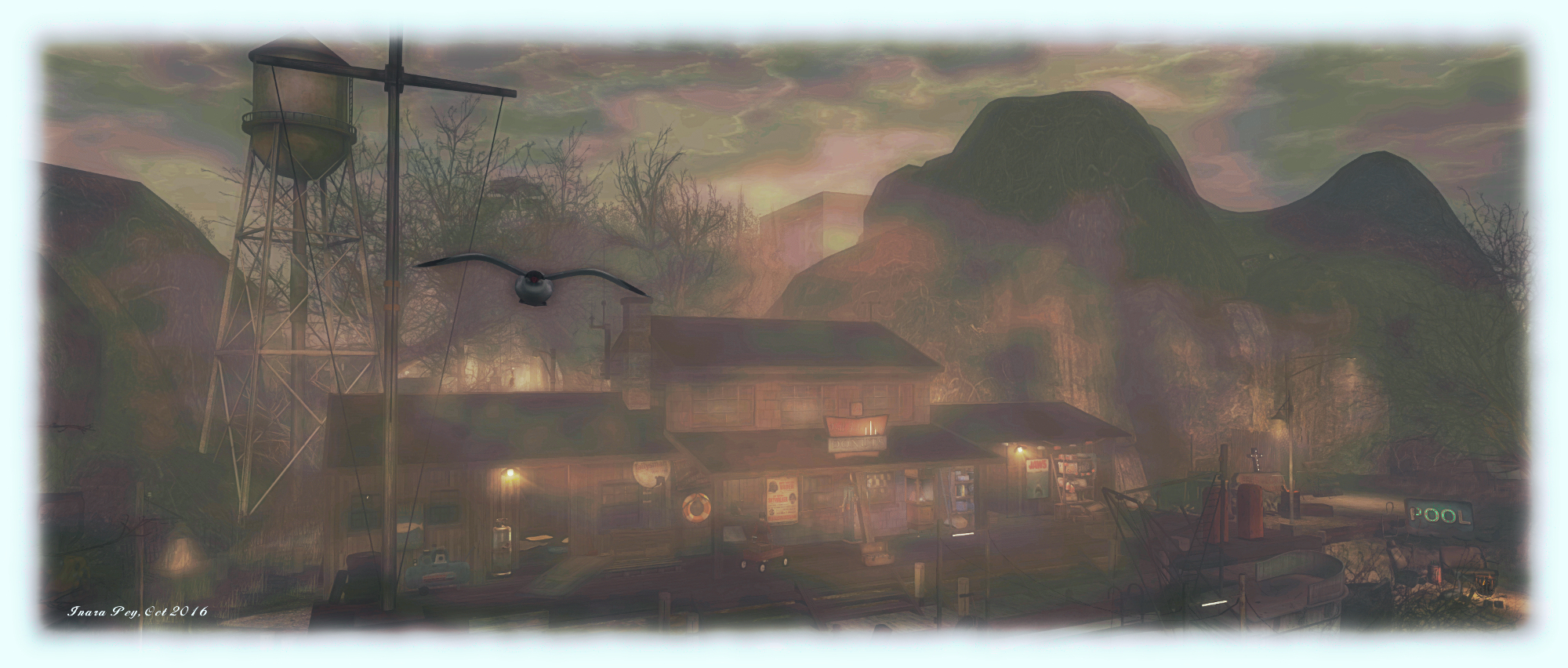
Dark, with the shells of concrete apartment buildings blurring with rugged hills to form the region’s edge, broken only by the route to a small area of coastline, Everwinter is a foreboding place. The home of dangerous mists and even stranger, haunting clowns and creatures. Yet one nevertheless photogenic and encouraging exploration. A masterpiece of design; the ideal destination for those seeking an engaging and very different kind of haunting visit.

SLurl Details

Opening November’s Art at the Park in Second Life

Art at the Park, November 2016

The November 2016 Art at the Park exhibition opens at Holly Kai Park on October 29th, 2016 and runs through until November 27th.

For this exhibition, we are both pleased and privileged to be featuring the work of five more talented artists, who between them offer a rich diversity of art and styles. They are: Sheba Blitz, Maxi Daviau, Skinnynilla, Terrygold and Sorcha Tyles.

The exhibition will formally open on Saturday, October 29th at 12:00 noon SLT, with a live performance by Winston Ackland, making his first appearance at the park, with music streamed from 1:00pm onwards. Formal attire is requested for the opening.

We look forward to welcoming you to Holly Kai Park and our November exhibition, and hope you’ll join us for the opening event on Saturday, October 29th!

About the Artists

Sheba Blitz

Sheba Blitz
Sheba Blitz

Sheba Blitz is a SL and RL artist who exclusively paints Mandalas, and her who have captivated me since I first encountered it at Kayly Iali’s Gallery 24.

Mandalas are ancient and mystical symbols of the universe. And represent the way of the “peaceful path”. Classically in the form of a circle (the Cosmos) enclosing a square (Earthbound matter).

Sheba’s Mandalas generally contain what is called a quarternity or a multiple of four. This squaring of the circle is a common archetypal image of wholeness and order. Mandalas are perceived as sacred spaces and remind the viewer of the immanence of sanctity in the universe and its potential to themselves. Used for meditation, contemplation, healing and pure visual pleasure.

Sheba was born and lives in Australia; she has studied, explored and accumulated many Art Diplomas from different art processes over the years but always returns to her love of geometrical hand painted mandala designs in mixed media. As someone who loves mandala art, I’m elated she agreed to join us at Holly Kai Park.

Maxi Daviau and Skinnynilla

Second Life Partners Maxi Daviau and Skinnynilla are both superb second Life photographers and regions designers. The Mill, their homestead region is a delight to visit, and their Flickr streams completely absorbing.

Maxi Daviau and Skinnynilla

“I have always loved and been amazed at the creativity in this virtual world. Exploring and taking pictures has always been my main hobby in Second Life,” Maxi says of her in-world time. “I love to see what all the residents create here,” Skinnynilla – show also goes by the sobriquet Shakespeare – adds.

Between them, they produce stunning landscape images that capture the very soul of the regions they visit, as well as producing incredible and intimate avatar studies. It is an absolute delight to have them exhibiting side by side at Holly Kai park.

Terrygold

terrygold
Terrygold

“I do not like to say I am an artist,” says Terrygold of her work. “In my spare time I make photos in which at time, a quick idea – like a flash – is a starting point. I develop the idea, and the trip begins.”

It’s a disarming statement, made in all genuine modesty, by a true talent within Second Life. Terry’s work, which I’ve covered on numerous occasions in my own blog, is never anything less than utterly captivating in form, style and presentation.

Rich in narrative, unique in approach, Terry’s work is attractive, and I am genuinely thrilled to see her work on display at Holly Kai Park.

Sorcha Tyles

Sorcha Tyles
Sorcha Tyles

I confess – much to my shame – to not having encountered Sorcha’s work until Skinnynilla pointed me in the direction of her Flickr stream.

I’m glad he did.

There is a deep, personal richness to Sorcha’s work which is almost overwhelming. She regards SL photography as perhaps her biggest addiction in Second Life, and looking at her work, one can not only see why, but also catch a glimpse of Sorcha herself. Her images gracefully combine landscapes with personal studies, producing a range of art that is bewitching in its breadth and intimate in its depth.

My thanks to skinny for introducing us, and to Sorcha for being a part of Art at the Park.

Our Opening Event Musician

winston-ackland
Winston Ackland

Winston Ackland is making his first appearance at Holly Kai Park. An accomplished physical world musician, who in-world provides smiles and tapping feet with his clever original works and quirky adaptations of obscure covers. Somehow, it all makes sense as audiences relax in a comfortable atmosphere and enjoy innovative songs crafted from a blend of rock, blues, bossa nova, jazz and lounge.

In 2008, Winston’s physical and virtual lives merged when his cover of Lithium hit the big screen in 20th Century Fox Films, Marley and Me. In 2012 his cover of Psycho Killer was featured in Oliver Stone’s Savages.

Stories at the Park

In addition, this exhibition will feature a special Stories at the Park event on Saturday, November 20th from 3:00pm. Presented by Seanchai Library, Stories at the Park features readings of 100-word short stories and poems of up to 100 words, inspired by the art on display at the park, and written by some of Second Life’s top writers. The event is open for anyone who enjoys writing, and details of how to take part can be found on our Stories at the Park guidelines. Note that you do not have to read your own work if you prefer not to use Voice: Seanchai Library staff would be happy to read it for you.

SLurl Details

Project Bento User Group update 32 with audio

Project Bento – extending the SL avatar skeleton

The following notes and audio were taken from the weekly Bento User Group meeting, held on Thursday, October 27th at 13:00 SLT at the the Hippotropolis Campfire Circle. and chaired by Vir Linden. For details on the meeting agenda, please refer to the Bento User Group wiki page.

Note that this update is not intended to offer a full transcript of the meeting, nor does it present the discussion points in chronological order. Rather, it represents the core points of discussion, grouped together by subject matter were relevant / possible, whilst maintaining the overall context of the meeting.

General Project Status

Work continues on Bento bug fixes. As a result of the Bento code being available in a pre-release version of Firestorm, the number of reported issues with legacy content have increased (see BUG-40672). There are two issue in particular the Lab have been looking at:

  • The previously reported issues of some mesh content having latent “bad” joint positions which were previously overlooked by the viewer, but which are now taken into account under Bento, leading to avatar deformation (see my update #30 for more on this)
  • An issue related to the eye joints now being scaled by the eye size slider, which can result in existing mesh eyes appearing to bug out of avatar’s heads when viewed in the Bento viewer. The easiest way to fix this is to reset the eye slider to the default 50 value.
Eye sizing issue: as Bento allows mesh eyes to be affected by the eye size slider, they can suddenly appear to resize when seen on the that viewer (r), compared to how they appear on a non-Bento viewer (l)

Outside of these problems – which are still being looked at (see below), there is at least one bug (initially noted with Haste Coy products and also reported on BUG-40672), which should have a fix in the next Bento RC update, and a crash issue which also should be fixed in the next update.

If anyone is encountering issues with existing content when using the Bento viewer, they should report their problems via the JIRA (BUG-40672) so the Lab can look at things.

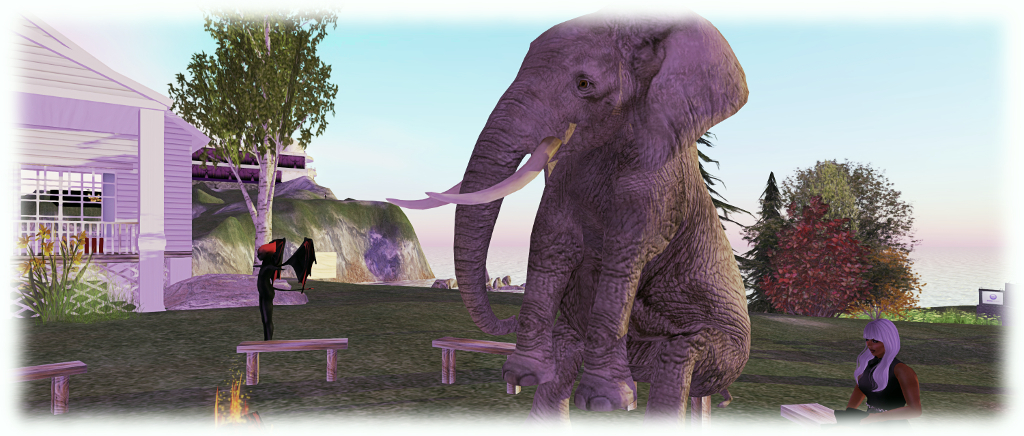
Benches: because even an elephant needs the occasional sit down. Medhue Simoni's stunning Bento mesh elephant
Benches: because even an elephant needs the occasional sit down. Medhue Simoni’s stunning Bento elephant avatar

Legacy Content Deformation Issue

There has still been no decision on how to handle the “werewolf deformation” issue, which now extends to about three creators, and may extend beyond werewolf models. There have been suggestions on forking rendering behaviour by something like upload date, so that if an item was uploaded prior to date X, then it is handled as “non-Bento”; if uploaded after date X, it is handled with Bento in mind.

A problem here is setting an arbitrary date may not actually solve anything. Bento has been around for over a year, with content creators working on it for the last several months at least, during which time other creators have been creating / updating and uploading non-Bento content. So, determining which is which by date likely won’t work.

That said, if there is a large amount of legacy content impacted by the viewer change, it still might be preferable to set a date and have Bento content creators re-upload their work to be on the “right side” of that date, rather than trying to get legacy content creators to re-upload. This is because some creators may not already be around and / or some may have used mesh creation kits which don’t have the necessary .DAE file for them to modify.

A further complication here is that any impact of the viewer behaviour change may simply be negated by creators of older avatar models updating to Bento models, to which their customers subsequently update.

Other Items

No Modify Shapes

The eye issue mentioned above once again raised concerns around users employing shapes that do not have modify permissions. Such shapes prevent the use of the appearance sliders, so even apparently “easy fix” issues, such as adjusting the eye size slider, may not be applicable.

This particular issue sparked a lengthy conversation about using the (currently non-obvious in the official viewer) XML shape exporter coupled with additional code to more easily export a shape’s XML file, which could then be re-imported with a check box to ensure the default 50 setting for things like the eye size sliders.

One problem here, as Vir pointed out is that users who are unaware of unfamiliar with using the shape sliders likely aren’t going to be enamoured with the idea of exporting an appearance XML file, creating a shape and then importing the appearance XML data against that shape, even though some TPVs have, with the Lab’s approval, sought to make this easier.

There is also the problem that creators may object to users being given the ability to export / import shape data, as it effectively bypasses the permissions system, allowing anyone to take shape data and use it as they please. However, given there is already a TPV methodology available, to assist with shape data import which has been given the nod by the Lab,  Vir will take the matter back to the office for further discussion.

The more direct solution might be for creators to indicate that Bento avatar meshes require the use of a modifiable shape (either supplied with the mesh or which the user can create and edit).

The Skeleton

Vir highlighted the fact that while different terms are used, there are technically three types of joints in the avatar skeleton: bones, the “standard joints” for rigging to; collision volumes, as used by things like fitted mesh; and attachment points,  which have most of the properties of joints, hence why some creators started rigging and animating to them, even though this was never an intended use.

Next Meeting

The next Bento meeting will likely be Thursday, November 10th, 2016, as November 3rd clashes with the Lab’s monthly internal meeting.

Additional Links