Firestorm have announced that as from Thursday, January 7th, Firestorm viewer 4.7.1 is to be blocked from accessing Second Life, and those using 4.7.1 are being encouraged to update to a more recent version (or revert to 4.6.9 for the time being if using Windows XP or Mac OS X 10.6) ahead of the block coming into force.
The move is in keeping with Firestorm’s commitment to Linden Lab to only have 3 versions of their viewer (allowing for specific issues which might otherwise come us, as has been the case for Mac users, who have had to face a series of (apparently) Cocoa related issues impacting their ability to use viewers incorporating these updates) active at any given time.
As noted in the announcement, this means that only Firestorm 4.6.9 will remain available for those still using Windows XP or versions of OS X older than 10.7, and this will be blocked some time after the next release of Firestom, which currently looks to be set for some time in February.
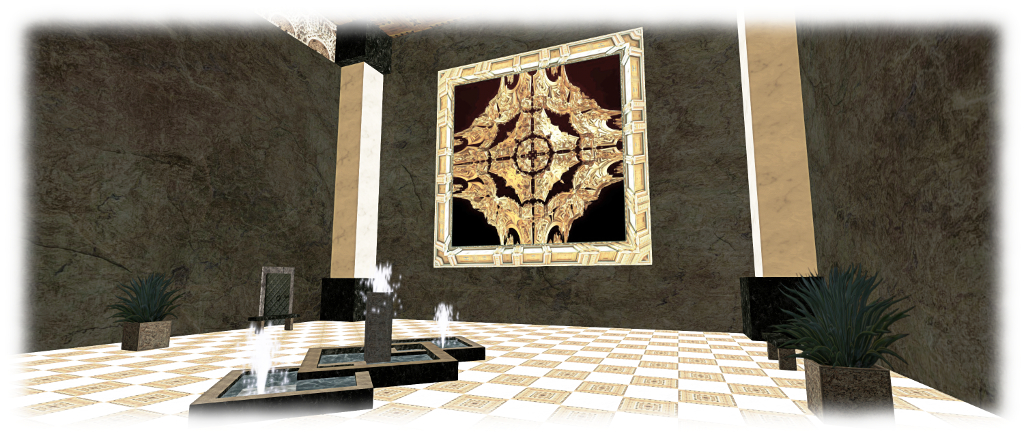
Heritage is the over-arching title of two immersive installations created by Gem Preiz. The first, Vestiges, opens On Thursday, January 7th, with the second, Wrecks commencing on Monday, March 7th 2016.
“Heritage is the theme of the two exhibitions,” Gem explains of the pieces. “The heritage passed to us by our predecessors, and the one we shall bequeath to our descendants in the endless fight of life against Time.”
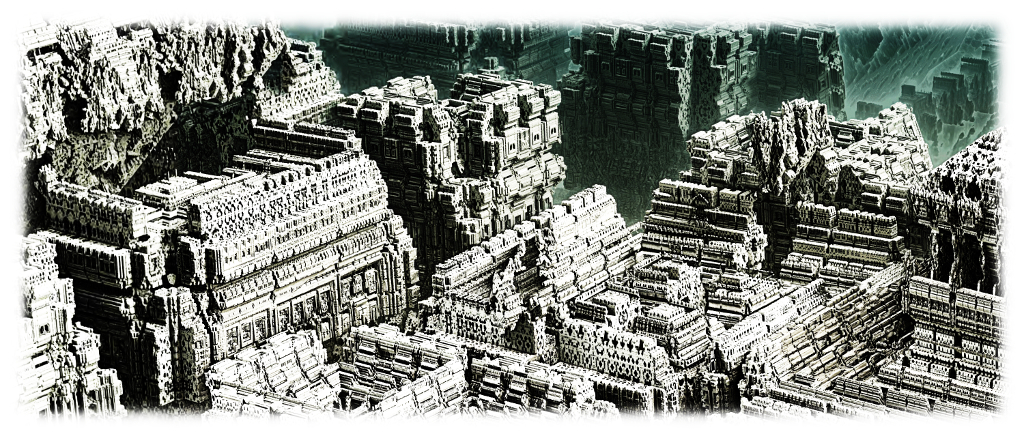
Vestiges evokes the first of these aspects: the heritage passed down to us by others; a journey through the past, visiting the ancient places and secrets of long-past civilisations – but are they the civilisations which gave rise to us, or are we perhaps archaeologists travelling through space and time, witnessing the past of worlds and those who inhabited them, the examination of their past causing us to reflect upon what we might leave for those who follow us?
This is a huge installation, eighteen rooms in total, through which the visitor travels as if on a quest. Those who are familiar with Gem’s fractal art will know he can produce huge and beautifully complex pieces, rich in detail and grandeur, and the rooms the visitor travels through are intended to enhance the feeling of being immersed within the scenes they present.
The arrival point offers notes on the installation, presenting a wealth of background material as well as providing guidelines on how to both best experience your time spent exploring them, and how best to set your viewer.
Heritage: Vestiges – Gem Preiz
A teleport system (which will only be available to the public once the installation has opened to the public on January 7th) then carries visitors to the first room, and the start of their journey. Do make sure you enable the music stream here to enjoy the compilation of music Gem has created specifically for the installation.
From here you journey comprises alternating between witnessing the exteriors of vast citadels and then visiting “hidden” chambers within them, each with its own treasure to be found. The way forward is variously indicated by rocks on the ground marking a path, or pillars between which a footpath is set, or arches under which you must travel. Guidance is given in chat, and invisiprims help to ensure yo stay on the right track, gently nudging you in the right direction and lifting you to the phantom passages between rooms (use CTRL-ALT-T to see them if you find this easier).
Some of the citadels have a certain familiarity about them; there is s distinctly Egyptian feel to the second, for example, while another suggested to me an echo of the ancient orient. Whether these citadels represent our own distant past or that of another civilisation entirely is for you to decide. For while all we see is somewhat familiar, so to is it so very alien; And thus the installation – and the images within – toy gently with our sense of perspective, causing us to stop, examine, and ponder.
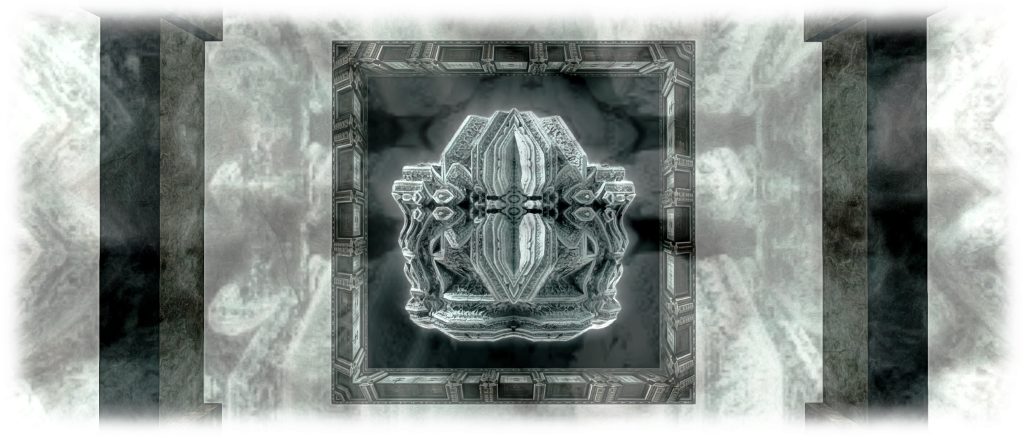
The intricacy of Gem’s fractal art is always a marvel to behold, and this installation is a veritable tour de force of his work, where the extent to which he has used fractals may not always be immediately apparent, and so considered study of both citadels and chamber images is required. The former are of such a huge scale that only careful camming can really bring out their beauty, allowing our impressions about what they are and represent to flow freely as we move across them. Similarly, it is only through considered study of the images within the chamber we can fully appreciate the extent to which Gem has used fractals in their construction.
If I’m totally honest, such is the scale and presentation of some elements, that it can, on repeated visits diminish their overall impact. But these instances are in the minority, and more than compensated for by the knowledge of what is to come. One thing I would recommend is that if you plan to make one more repeat visits (I found myself drawn back a number of times to specific rooms and scenes), they try to do so in the company of a friend who hasn’t previously visited Heritage; sharing in their reaction experience of seeing these cityscapes and images for the first time can be as involving as any first solo visit.
As noted earlier, Heritage opens to the public on Thursday, January 7th.
The Oculus CR-1 – now available to pre-order (image: Oculus VR)
Following a pre-announcement on Tuesday, January 5th, Oculus VR have confirmed that the Oculus Rift headset is now available for pre-order (for Windows users) for shipment to the following countries: Australia, Belgium, Canada, Denmark, Finland, France, Germany, Japan, Iceland, Ireland, Italy, Netherlands, New Zealand, Norway, Poland, Spain, Sweden, Taiwan, United Kingdom, United States.
The price for the headset and accessories is a nominal US $599 (€699 in Europe and £499 in the UK), although as the announcement notes, this is exclusive of tax and shipping costs, and the price may vary for non-USD purchases.
Oculus VR indicate that pre-ordered set will start shipping on March 28th, 2016, and limited stocks will be available to retailers later in April 2016. However, Engadget report even the March 28th ship date may have slipped due to the initial volume of orders already received by Oculus VR, and that some outside of the US may have had problems in placing orders.
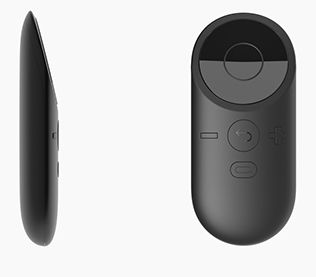
The Oculus Remote is “designed to make it simple and intuitive to navigate VR experiences” (image: Oculus VR)
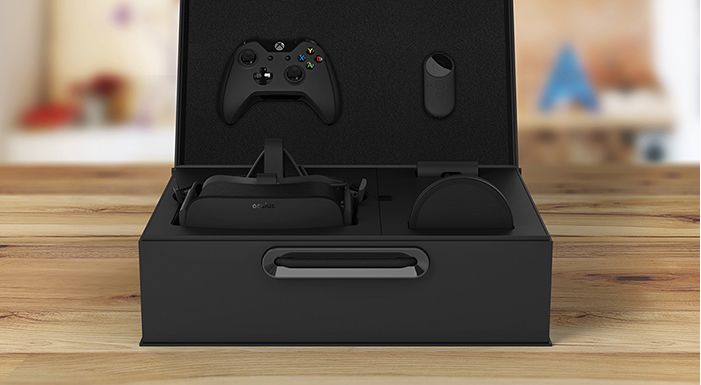
The complete package comprises the Rift headset with built-in headphones and microphone, sensor, and an Xbox One controller and the Oculus Remote.
Those pre-ordering also secure the opportunity to pre-order the Oculus Touch hand controllers when they become available later in 2016 (the release of the latter was pushed back to the second half of 2016 to allow further time for development / testing).
Also included in the package is a copy of Playful’sLucky’s Tale, a platform game which has enjoyed much exposure and positive response as a part of Oculus Rift demonstrations, and also EVE: Valkyrie.
Those pre-ordering are reminded that a fairly hefty PC is required to obtain a suitable Rift experience, with the specifications listed as : NVIDIA GTX 970 / AMD R9 290 equivalent or greater GPU;, an Intel i5-4590 equivalent CPU or greater; at least 8Gb of RAM; compatible HDMI 1.3 video output; 3 free USB 3 ports (and 1 USB 2 port) and Windows 7 + SP1 or greater. Oculus also report that PCs supplied by manufacturers meeting this specification will start to ship with an “Oculus Ready” logo, and the company will be making suitable PCs with headset available for pre-order in February (presumably in the US only) at a starting price of US $1499.
A compatibility tool is available for download to help determine if your PC is “Oculus ready” and those wishing to pre-order can do so through the Oculus Shop.
The compatibility tool will tell you if your PC is ready for the best Oculus Rift experience
There has already been some excitement following the announcement by those SL users who are interested in the Lab’s upcoming virtual worlds platform, “Project Sansar”, as this is being built very much with the Rift in mind (although use of a Rift headset with “Sansar” is not a requirement).
While the experience is acknowledged to be somewhat less-than-optimal, it’ll be interesting to see of the Oculus VR announcement spurs the Lab on update the Second Life Oculus Rift project viewer for those wishing to try the headset in Second Life. There have been promises that such an update is coming down the pipe, but until now it has likely been sitting at the back of the queue while the Lab pushes out updates and capabilities liable to be more widely appreciated by SL users.
Oculus CR-1 with sensor, Oculus Remote and Xbox wireless controller (image: Oculus VR)
As noted above, Engadget report that the initial response to the pre-order announcement has been positive. There is undoubtedly a lot of interest in HMDs from gamers around the world, and most likely from the curious and those with specific uses for the headset. However, it’ll be interesting to see how things go over the coming year. Whichever way you look at it, the Oculus Rift CR-1 and its nearest rival, the HTC / Valve Vive represent fairly hefty investments, and many might prefer to wait and see how the market develops in terms of newer, more compact headsets, lower prices, etc., before committing.
I confess to being in the latter category. To me, the potential of VR still lies down the road, and I’m more than happy to see how the hardware side of things shapes up, and what really develops in support of it in terms of practical applications which might appeal to me (games most certainly ain’t it). I also have to admit augmented reality holds far more fascination for me in terms of it potential for “every day” use than do most things so far imagined with VR.
The weekly scheduled server deployments will not resume until week #2 of 2016 (week commencing Monday, January 11th), when there should be a deployment to the three release candidate channels.
SL Viewer
The Maintenance RC viewer was updated on Tuesday, January 5th to version 4.0.1.309460. This sees MAINT-5760 “Favourites sort order reverts every session and no favourites display at the login screen for single name “Resident” accounts” removed from the resolved issues list.
The Quick Graphics RC viewer (graphics preset options and Avatar Complexity) updated to version 4.0.1.309320, also on Tuesday, January 5th. This sees the addition of two further fixes to the resolved issues list:
MAINT-5541 “[QuickGraphics] 0 complexity avatar renders as jelly”
MAINT-5567 “[QuickGraphics] A mesh attachment causes avatar to be jellybaby while Avatar complexity is set to No Limit”.
Login Failures – Friends List Updates
People have been experiencing log-in failures recently, which appear to be related to issues as the viewer loads / updates the Friends list as a part of the log-in process (see BUG-11032 and BUG-11127).
The log-in failure issue generates s generic error message
The problem is account-specific, and when I asked Oz and Simon Linden about the problem, and whether a more permanent resolution might be forthcoming, during the simulator User Group meeting on Tuesday, January 5th, Oz replied, “yes, we think we understand what’s up with that… fix is in the works”, although he declined to elaborate further.
In the meantime the advice remains as specified by Alexa Linden on BUG-11032: if you are unable to log in as a result of the problem, you will need to file a support ticket explaining the problem and noting it is a Friends List Login Failure. Support should then be able to fix your account.
Project Bento
There’s no major news on Project Bento beyond what I’ve already reported to date. However, given the project is now in a public beta, user group meetings associated with the project are now open to all as well.
Meetings will take place on Aditi at Mesh Sandbox 2 (note that is an Aditi, location, not the main grid) at 13:00 SLT every Thursday, with the first public meeting scheduled for Thursday, January 7th. In announcing the meetings, Oz Linden also requested those who have any available, to bring example content using the new avatar skeleton extensions along to the meetings (but do notes the region is rated General!).
In the meantime, Cathy Foil, one of the content creators involved in Bento has produced video explaining how the work was handled within the initial development group,
Aditi Password Changes
As I noted in my 2015 week #51 project updates report, there are changes coming in the way Aditi inventory syncs with Agni are handled, which will also affect Aditi password changes. These changes are still to be deployed, so in the meantime, anyone wishing to change their password on Aditi should do so via a support ticket.
Those wishing to attend the Project Bento meeting on Aditi and who have not logged into the beta grid for a while, many want to check that they can in advance of Thursday, January 7th, and if necessary file a support ticket requesting a password update, as noted above.
Object_Rezzer_Key
Object_Rezzer_Key is a new parameter which is to be added to llGetObjectDetails() early in the New Year. It will allow a rezzed object to find the key of its parent rezzer, then use llRegionSayTo() to chat back to that parent – see my 2015 Project updates: server and Project Bento report for more.
Commenting on this work at the Simulator User Group meeting, Simon said:
OBJECT_REZZER_KEY is in QA and the release process … if things go steady, it would see the beta grid later this week or next, and possibly RC in 2 weeks. That’s all tentative, of course. … OBJECT_TOTAL_INVENTORY_COUNT and OBJECT_PRIM_COUNT are in the next release (before that one).
Tom Boellstorff and his digital alter ego, Tom Bukowski (image: Steve Zylius / UCI)
There are probably few Second Life residents who keep an eye on blogs and the more well researched media reports on Second Life who are unaware of Fran Seranade’s story. Now 88 years old, Fran is a keen Second Life resident, who spends time in-world with her daughter and son, enjoying much of what the platform can offer: dancing, Tai Chi, swimming, horseback riding, walking, exploring. All far removed from the physical world, where she suffers from Parkinson’s Disease, which deeply affects her ability to do many of the things we take for granted: such as simply getting out of a chair and walking to the next room.
Fran Swenson (Fran Seranade in Second Life), seen with her avatar and friends in Second Life
It is now also the story used to introduce an article appearing in UCI News, the on-line newsletter of the University of California, Irvine, which explores the work of Tom Boellstorff, a professor of anthropology at the university.
InA (virtual) world without Parkinson’s, Heather Ashbach talks to Tom about his ongoing work with Fran and other Parkinson’s Disease sufferers using Second Life, which is now part of a US $276,900 National Science Foundation study that began in July 2015, and will run through until June 2018, examining how on-line environments affect social interaction and self-understanding as well as physical-world experiences of disability.
Tom’s work has also been more broadly covered through The Drax Files World Makers episode #31, which I covered here
Tom’s work as an anthropologist studying our digital interactions with ourselves and others has already given rise to two books, Coming of Age in Second Life: An Anthropologist Explores the Virtually Human,and Ethnography and Virtual Worlds: A Handbook of Method. With this study, he hopes to build on the knowledge he’s acquired over the last several yeas of study, and also learn which aspects of on-line social interaction are linked to specific disabilities and how differing platforms and devices are utilised.
“Billions of people now participate in on-line environments – social networking sites like Facebook, games, virtual worlds,” he notes in the article. “Since some early human first picked up a stick to use as a cane, persons with disabilities have been at the forefront of technology innovation, so it’s natural that they would be doing creative things in virtual worlds too.”
His examination of Parkinson’s and the effect Second Life has had on those suffering from it is not limited to Fran; the article specifically touches on the lives of Solas NaGealai, who founded the original Team Fox presence in Second Life (and whose story I covered in August 2014), and architect DB Bailey, and they are two among many Tom has talked to within Second Life.
Second Life has provided Solas NaGealai to continue her love of fashion and design, and provided her with the means to directly support MJFF through Team Fox SL.
Solas was diagnosed with a particular form of Parkinson’s Disease known as Young Onset Parkinson’s Disease (YOPD) – the same form of the disease which struck Michael J. Fox.
When first diagnosed, Solas was a full-time fashion designer. However, as the illness progressed, she was forced to leave that career behind. Fortunately, her discovery of Second Life allowed her a way to re-engage in her passion for design, and she founded her own fashion label at Blue Moon Enterprise.
Prior to his diagnosis, DB Bailey was a noted architect who, among other projects, collaborated on the design of Los Angeles’ Walt Disney Concert Hall. Since the disease has forced him to step back from that career, he’s been able to use Second Life as his creative outlet as an architect and artist.
Tom’s work, which has involved in-world and face-to-face interviews and studies, has also touched upon the possible physical benefits some of those with disabilities report as a result of their use of Second Life. In Fran’s case, for example, she his indicated an improvement in her sense of balance and co-ordination as a result of using the platform. This is something Tom has suggested might be down to what is called “mirror neurons“, with Fran’s brain responding positively to the visual stimulus she receives as a result of her in-world activities. However, examining such potential benefits does not form a part of the current study, primarily because Tom is not a medical doctor; but he is of the opinion that they are worth future examination.
The psychological and sociological benefits of using platforms like Second Life in matters of healthcare are clear, and have been the subject of many studies. With the promise of more immersive VR experiences and opportunities now on the horizon, a better understanding of how different platforms and mediums assist those with disabilities enjoy a richer, fuller life is liable to be of enormous benefit, and also offers an opportunity for broader public discussion on matters of disability and the use of technology.
As Tom himself notes in closing the interview with Heather Ashbach, “disability is a fascinating category of human experience because anyone can enter it at any moment – we’re all just a car accident away. And even if we avoid it, if we live long enough, age will present us with obstacles that limit our ability to function as we currently do. Studying how people adapt through the use of technology helps advance the public conversation on disability and digital technology.”
Altogether, an excellent read, and one thoroughly recommended.
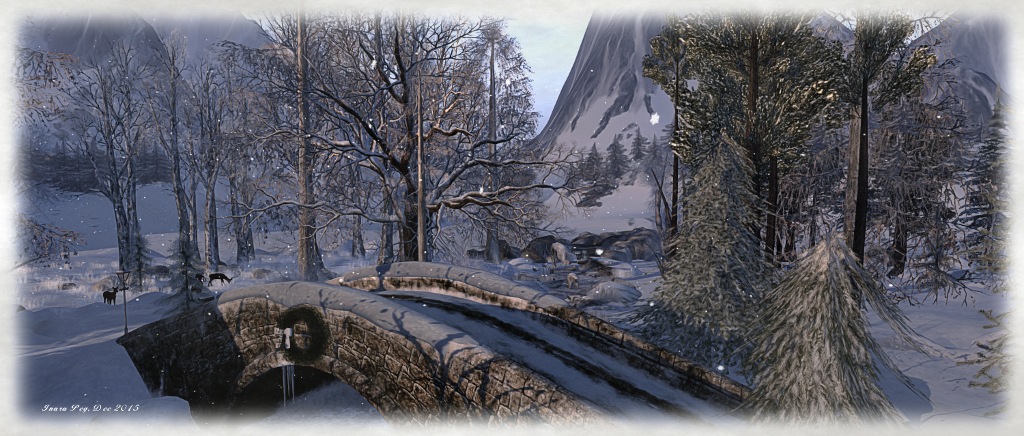
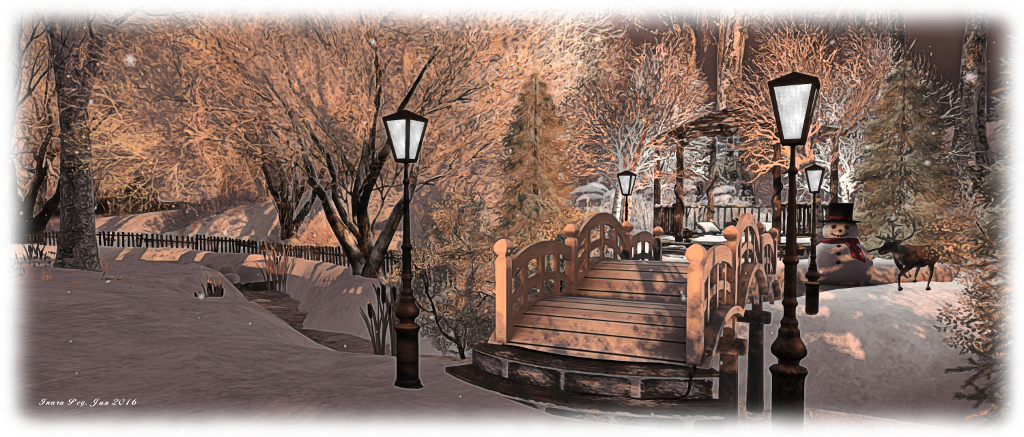
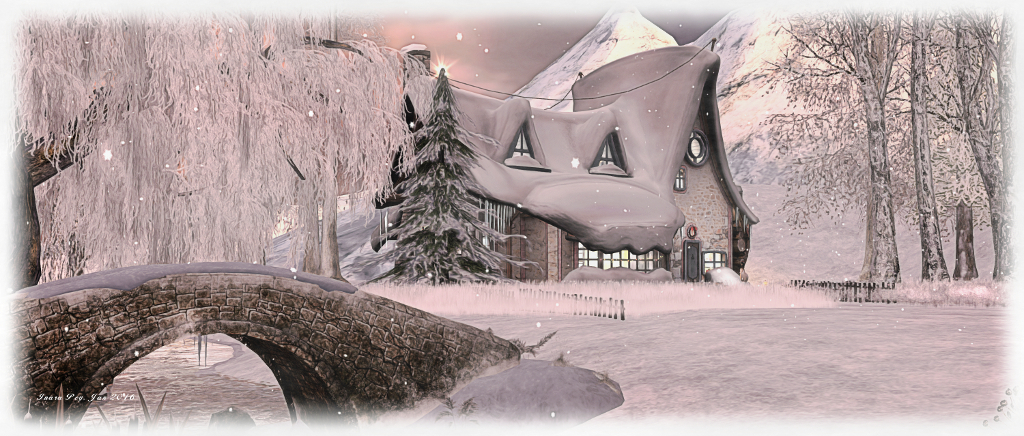
In December 2014, I visited artist Milly Sharple’s winter themed Let it Snow! on the Isles of Lyonesse, and I’m more than happy to say it is once more with us, the region again offering snow, fronted trees, wintry walks, opportunities for dancing and, of course, for photographs.
Those who visited Let it Snow! in 2014 will immediately be struck by the feeling of familiarity and homecoming; there is much here that echoes last year’s build – but there is also much that has changed, making a visit more than worthwhile. From the landing point towards the middle of the region, visitors are free to wander as they please as snow falls from a cloudy sky (courtesy of an all-encompassing dome) lit by a lowering sun, the landscape braced on two sides by tall hills.
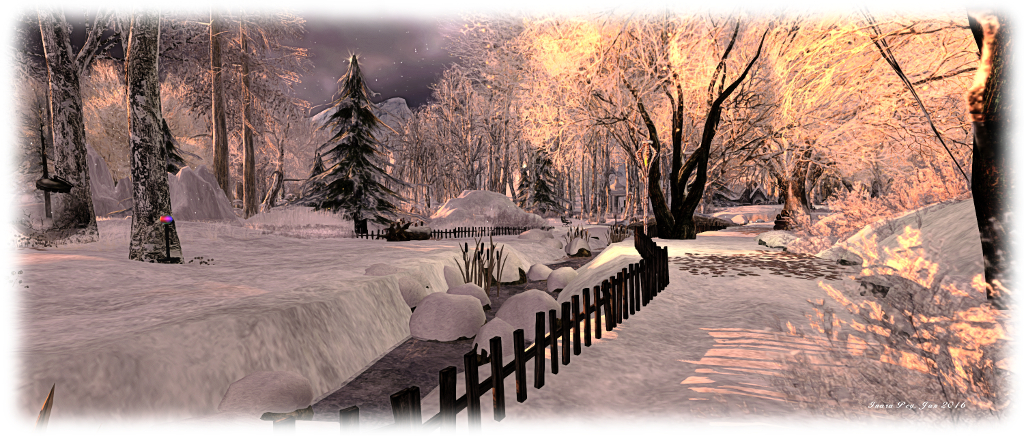
There are paths to be found, snow-covered but still visible, showing the way between the cottages and other buildings to be found within the isle, but for the most part routes are set by avenues between the trees which, in summer, would doubtless be greensward. Thus a walk through Let it Snow! is truly a journey of discovery; and there is much to be found, be it the cottages scattered far and wide, huddling under the lee of hills or sitting boldly atop them, or at the little brick-built Christmas Shop sitting across from a n open-fronted café, both offering rest and refreshment, or the many little places lovers and couples can snuggle in one another’s company, the chimes of a music box playing in the distance and birds chirping overhead.
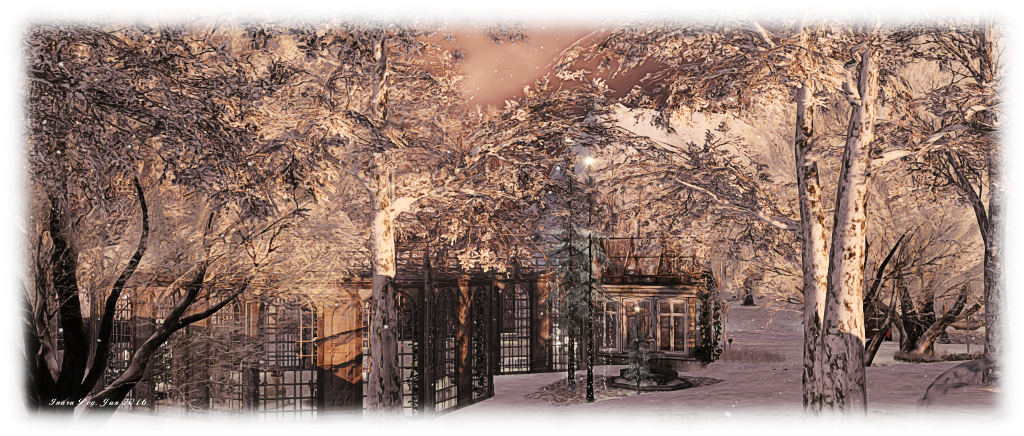
Everywhere you do wander, you will doubtless come across plenty of opportunities for outdoor dancing, while a great glass house offers a romantic setting if you want to be more formal when taking your partner by the hand. Those seeking a warm, quiet sit down indoors will find it in a couple of the cottages, with the LAQ cottage toward the south-east corner of the region, and not too far from the landing point, offering a particularly comfortable retreat.
Those with a keen eye will also doubtless spot little signs scattered around the landscape. Touching any of these will rez a sled you can ride on your own, or with a friend. Once seated on it, touch the menu to get yourself properly posed and then use *Move* to get yourself going (cursor / WASD thereafter).
In December 2014, I described Let it Snow as a delight. It still is – one that is beautifully photogenic, as you might expect. It’s also a place where descriptions are really superfluous; far better go along and enjoy. You’ll probably find Caitlyn and I lurking around as well 🙂 .
 Firestorm have announced that as from Thursday, January 7th, Firestorm viewer 4.7.1 is to be blocked from accessing Second Life, and those using 4.7.1 are being encouraged to update to a more recent version (or revert to 4.6.9 for the time being if using Windows XP or Mac OS X 10.6) ahead of the block coming into force.





 Inara Pey: Living in a Modemworld