High Fidelity: Stephen Wolfram and more on tracking

HF-logoOn Tuesday, December 29th, High Fidelity announced that Stephen Wolfram has become their latest advisor.

British-born Stephen Wolfram is best known  for his work in theoretical physics, mathematics and computer science. He  began research in applied quantum field theory and particle physics and publish scientific papers when just 15 years old. By the age of 23, he was studying at the School of Natural Sciences of the Institute for Advanced Study in Princeton, New Jersey, USA, where he  conducted research into cellular automata using computer simulations.

Stephen Wolfram via Quantified Self

When introducing Wolfram through the High Fidelity blog, Philip Rosedale notes this work had a profound impact on him, as did – later in life – Wolfram’s 2002 book, A New Kind of Science.

More recently, Wolfram has been responsible for WolframAlpha, an answer engine launched in 2009, and which is one of the systems used by both Microsoft’s Bing “decision engine” and also Apple’s Siri. In 2014, he launched the Wolfram Language as a new general multi-paradigm programming language.

In become an advisor to High Fidelity, Dr. Wolfram joins Peter Diamandis, the entrepreneur perhaps most well-known for the X-Prize Foundation, Dr. Adam Gazzaley, founder of the Gazzaley cognitive neuroscience research lab at the University of California, Tony Parisi, the co-creator of the VRML and X3D ISO standards for networked 3D graphics, and a 3D technology innovator, Professor Ken Perlin of the NYU Media Research Lab, and Professor Jeremy Bailenson, the director of Stanford University’s Virtual Human Interaction Lab.

In their October update published at the start of November, High Fidelity followed-up on the work they’ve been putting into various elements of tracking movement, including the use of BinaryVR for tracking facial movement and expressions. In particular, the company’s software allows users to create a their own virtual 3D face from 2D facial photos, allowing them to track their facial animations in real-time, transforming them onto the CG representation of their face.

Ryan balances one object atop another while Chris uses the gun he picked-up with a hand movement, then cocked it, to try and shoot the yellow object down
Ryan balances one object atop another while Chris uses the gun he picked-up with a hand movement, then cocked it, to try to shoot the yellow object down

Integration of the BinaryVR software allows High Fidelity to track users’ mouth movements through their HMDs, allowing their avatars to mimic these movements in-world, as Chris Collins demonstrates in the update video. The company has also been extending the work in full body tracking, as seen in my October coverage of their work, and this is also demonstrated in the video alongside of more in-world object manipulation by avatars, with Chris and Ryan building a tower of blocks and Chris then picking up a gun and shooting it down.

The hand manipulation isn’t precise at this point in time, as can be seen in the video, but this isn’t the point; it’s the fact that in-world objects can be so freely manipulated that is impressive. That said, it would be interesting to see how this translates to building: how do you accurately sized a basic voxel (a sort-of primitive for those of us in SL) shape to a precise length and width, for example, without recourse to the keyboard or potentially complicated overlays?

Maybe the answer to this last point is “stay tuned!”.

Vote for Windlight Magazine in the UK Blog Awards

UKBA-logoThe UK Blog Awards, sponsored by Odeon Cinemas, Debenhams department stores,  and Hills Balfour PR agency, was founded in 2014 “to recognise true viral style and creative excellence across a variety of 16 UK industries, as well as awarding 2 sub-categories: Best Storyteller and Most Innovative award.”

“For what may seem like a lifetime, company employees and private individuals have been found Blogging about opinions, facts and sharing good practice with viewers of the worldwide web since the early 1990s,” the organisers note. “So, here at UKBA we thought it was about time that individual Bloggers and companies received recognition for all your well-earned innovative opinions and content!”

Nominations for the 2015 UK Blog Awards were held over November / December 2015, and one of the blogs nominated for a possible award has been Second Life’s own Windlight Magazine, for which I’m privileged to be a Contributing Writer.

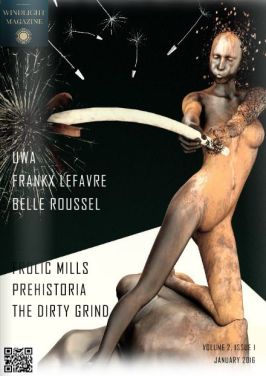
Windlight-Jan-16
Read the January 2016 edition of Windlight Magazine

Since its inception in July 2015, Windlight has become perhaps the premier arts magazine in Second Life, featuring a team of highly talented writers (and I’m not simply saying that because I do contribute!), and an outstanding editor / founder in the form of John (Johannes1977 Resident).

During the months following its inaugural issue, Windlight Magazine has provided superb coverage of the arts in Second Life, and has gradually encompassed broader elements of the platform – travel, fashion, etc.

At the same time, the Magazine has sought to promote the arts through the Windlight Fellowships, has supported notable charity activities, and has most recently stepped in to sponsor the UWA art gallery.

During this same period, the Windlight blog has become a go-to resource by which people can discover the arts in Second Life, learn how to improve their SL photography, find advice on art, photography and writing, read reviews of places to visit in-world, and more. As such, it is a worthy nominee for a UK Blog Award.

UKBABut it needs your help.

Public voting on blogs nominated for the 2015 Awards commenced on Monday, January 4th and will run through until the end of February. The top 10 most popular blog from the various categories in the nominations will then be shortlisted for judging by an adjudicating panel of experts, with the winners being announced at a special awards evening which will in London ion Friday, April 29th, 2016 (full details TBA).

To help ensure Windlight Magazine might be one of those finalists, please click on the image immediately above right, and place your vote.

Doing so might not only help Windlight Magazine reach the finals and possibly receive and award, but it will also help promote Second Life and Second Life arts to the rest of the world.

Additional Links

2015 viewer release summaries: week 53

Updates for the week ending Sunday, January 3rd

This summary is published every Monday, and is a list of SL viewer / client releases (official and TPV) made during the previous week. When reading it, please note:

  • It is based on my Current Viewer Releases Page, a list of all Second Life viewers and clients that are in popular use (and of which I am aware), and which are recognised as adhering to the TPV Policy. This page includes comprehensive links to download pages, blog notes, release notes, etc., as well as links to any / all reviews of specific viewers / clients made within this blog
  • By its nature, this summary presented here will always be in arrears, please refer to the Current Viewer Release Page for more up-to-date information.

Official LL Viewers

  • Current Release version: 4.0.0.309247, December 17th – no change
  • Release channel cohorts (See my notes on manually installing RC viewer versions if you wish to install any release candidate(s) yourself):
    • No updates
  • Project viewers:
    • No updates.

LL Viewer Resources

Third-party Viewers

V4-style

V1-style

  • Cool VL Viewer updated as follows: Stable version to 1.26.16.6 and Experimental branch to 1.26.17.4, both on January 2nd, 2016 (release notes).

Mobile / Other Clients

  • No updates.

Additional TPV Resources

Related Links

Space Sunday: cosmic lightsabers, monkeys to Mars and junk in orbit

There were many remarkable space images published throughout 2015. However, perhaps one of the most memorable came at the end of the year, and coincided  with the release of Disney’s Star Wars: The Force Awakens. Captured by the Hubble Space Telescope, the image was immediately dubbed by the media as the “cosmic lightsaber” due to the manner in which part of the image resembles the double-sided lightsaber used by Darth Maul in an earlier Star Wars film.

It shows a new-born star laying within a cloud of dust, which is shooting out two beams of light from its poles and which seem to cut through the surrounding material and space.

Two beams of light slice through space from the polar regions of a new-born star. Captured by the Hubble Space Telescope, the image was immediately dubbed "the cosmic lightsaber" (image: ESA / NASA / D. Padgett / T. Megeath / B. Reipurth) - click for full size
Two beams of light slice through space from the polar regions of a new-born star. Captured by the Hubble Space Telescope, the image was immediately dubbed “the cosmic lightsaber” (image: ESA / NASA / D. Padgett / T. Megeath / B. Reipurth) – click for full size

The beams are no optical illusion, but the result of material from the surrounding dust cloud falling into the star, only to erupt into supersonic jets of material ejected up through the star’s poles and into space. As the jets travel outwards, so they encounter other dust and material, and distinctive arced shock waves form within the “beams”, which gradually give rise to knotted clumps of material called Herbig-Haro (HH) objects, and are ubiquitous in star-forming regions, although they are relatively short-lived in astronomical terms.

Given the nature of the HH object seen by Hubble (officially designated HH24), it is thought that the star causing it is very young – just a few thousand years old. It lies in a “stellar nursery” some 1,350 light-years away “in” the constellation of Orion, and which has one of the highest concentrations of HH objects yet found in our galaxy.

Another view of the "stellar nursery" where stars are being formed, captured by Hubble. HH24 can be seen at the top left, with further HH objects just visible in the lower right. Both this image and the one above were captured in infrared, allowing Hubble to "look through" the intervening clouds of dust and "see" the jets
Another view of the “stellar nursery” where stars are being formed, captured by Hubble. HH24 can be seen at the top left, with further HH objects just visible in the lower right. Both this image and the one above were captured in infra-red, allowing Hubble to “look through” the intervening clouds of dust and “see” the jets

Monkeys to Mars?

There is a mounting effort to see humans set foot on Mars some time within the next 25 years; however, Russia is apparently set on getting “crew” to Mars by 2017, in the form of four macaque monkeys.

The simians have been selected on the basis of their cognitive and learning abilities, and have been undergoing 3 hours a day of training for a possible flight to Mars, with news of the proposal first reaching the public domain in October 2015. The training is has been taking place at the Institute of Biomedical Problems in Moscow, and initially comprised training the monkeys to operate a joystick system to “shoot” targets on a screen, as indicated by a cursor.  Successful “hits” saw the monkeys rewarded with a sip of juice.

This has been followed by training the monkeys to solve simple puzzles and mathematical problems. “What we are trying to do,”  Inessa Kozlovskaya, responsible for the team training the monkeys, “is to make them as intelligent as possible so we can use them to explore space beyond our orbit,”

The Russian plan is to send the monkeys on a six-month voyage to Mars, during which their heath and ability to function during a prolonged stay in zero gravity conditions will be assessed, together with their exposure to cosmic radiation. However, Russian officials have refused to indicate whether the mission will include a return trip to Earth.

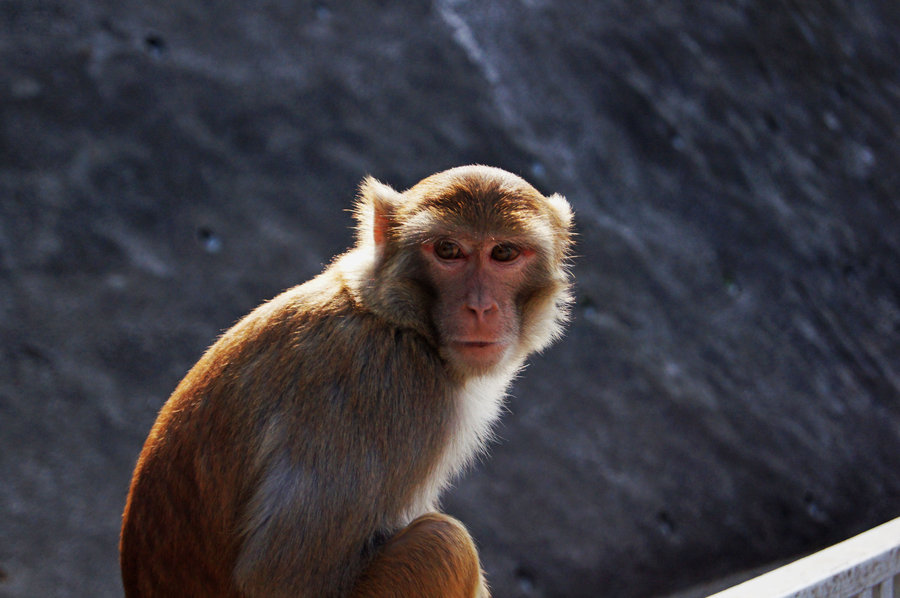
Rhesus macaques are one of the least endangered, most familiar of the "old world" monkeys, and are known for their intelligence and their social bonds (image: "carcoalfeather", deviant art)
Rhesus macaques are one of the least endangered, most familiar of the “old world” monkeys, and are known for their intelligence and their social bonds (image: “carcoalfeather”, deviant art)

Sending animals into space isn’t new. The very first animal to enter space was in fact a rhesus macaque called Albert. He flew a short-duration ballistic flight atop a US V2  in 1948, but died of suffocation mid-flight. His successors were no less fortunate. Alberts II, and IV were killed on impact when their capsule parachutes failed to deploy, and Albert III died when his V2 exploded on the edge of space.

Continue reading “Space Sunday: cosmic lightsabers, monkeys to Mars and junk in orbit”

A journey through Nightfall in Second Life

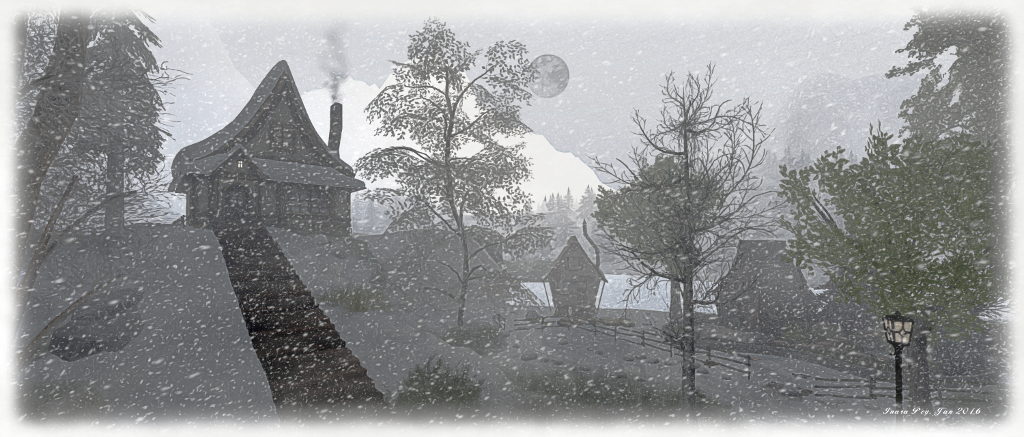
Nightfall; Inara Pey, January 2016, on Flickr Nightfall (Flickr) – click any image for full size

Nightfall, the homestead region held by Uni Looney (Unique Loon),  is a place Caitlyn took me to visit late 2015, but I didn’t get around to blogging about it at the time. As such, it seemed right that it should be one of the first places I re-visit and write about as we start the new year.

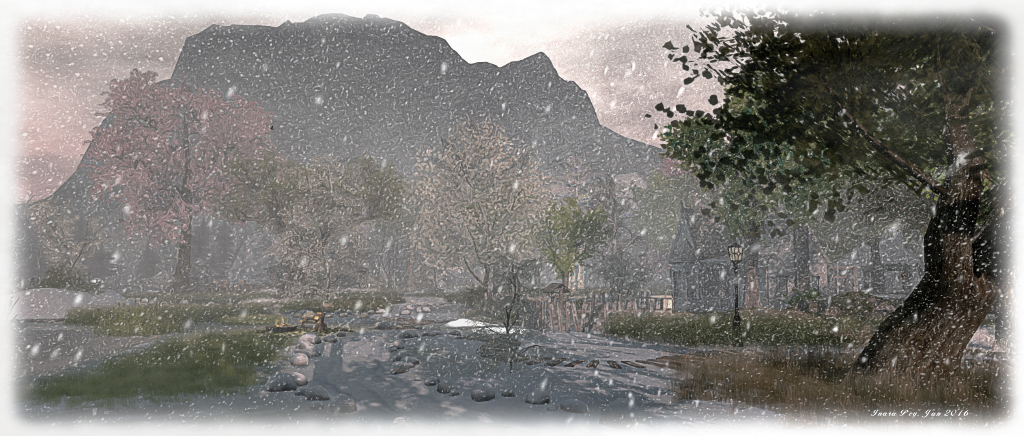
When visiting the region back then, it was in the grip of what might be considered an Indian summer; bright greens and autumnal golds were everywhere despite the month of October slowly advancing. With my most recent visit, however, that last dash of warmth had clearly departed, leaving the region firmly in winter’s tight grip.

Nightfall; Inara Pey, January 2016, on Flickr Nightfall (Flickr) – click any image for full size

The landing point in the south-west corner of the region provides access to the ruins of an old castle or fortification, rising from grass which is itself attempting to keep its head above the snow drifting down from above. Here the newly arrived can enjoy a spot of ice skating, while a turn to the north will lead the way through the ruins, past camp fires, seating areas, and a mouse on his own grand tour, to the north end of the region and the beach. Just mind the  sleeping brown bears and very much awake polar bears should you head in that direction!

The journey eastward requires you either take a cold dip in the frigid waters of the channel which divides the region, or you make your way across one of the three bridges spanning it – two of which look decidedly rickety, although they are in fact quite sound.

Nightfall; Inara Pey, January 2016, on Flickr Nightfall (Flickr) – click any image for full size

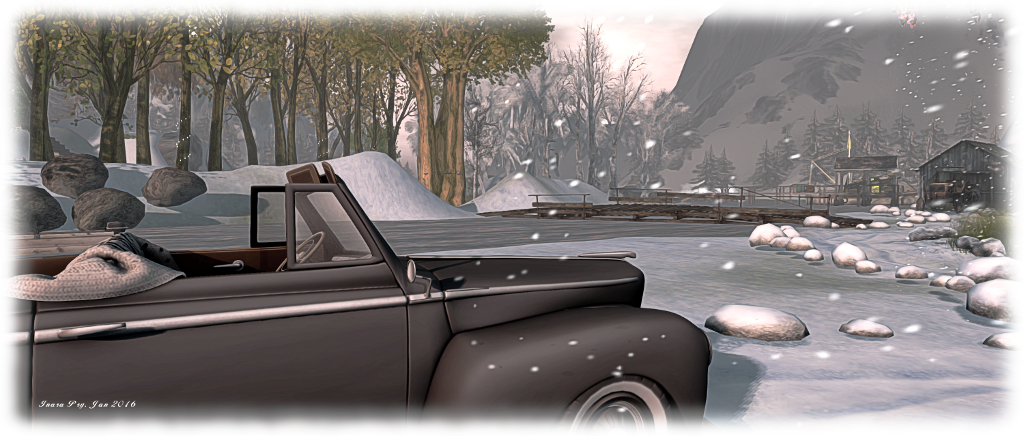
The weather on the east side of the region is somewhat colder; the snow falls in heavy sheets to cover roads and paths, ponds lie frozen, and the local livestock and horses all appear to be enduring the weather rather than appreciating it. A convertible sits just outside the falling snow, the owner brave enough to leave the top down; given the state of the weather, I’m not sure I’d be so confident!

A little cottage sits no far from the dividing water, offering shelter from the snow, and while the fireplace may be lacked, there is a bath for those needing to warm themselves up with a quick, hot dip. Beyond this, and reached via two smeller bridges arching over a little stream, three more cottages can be found. Two of these are somewhat whimsical in nature while the third,  sitting atop a low hill, offers a warm fire to please colds toes, hands and noses.

Nightfall; Inara Pey, January 2016, on Flickr Nightfall (Flickr) – click any image for full size

Nightfall is a gentle region, a place you can roam as you see fit, either following the paths and board walks, or simply setting out through the grass as the mood takes. As with many regions in SL, there is plenty of ambient sound available to add to the sense of immersion. For those who prefer, bicycles can be rezzed from the board walk near the beach on the north side of the island.

All told, a charming place to visit and explore.

SLurl Details

Stories and news from Seanchai Library

It’s time to kick-off  a new year of story-telling in voice, brought to our virtual lives by the staff and volunteers at the Seanchai Library, as we move from Christmas to New Year celebrations. As always, all times SLT, and events are held at the Library’s Second Life home at Bradley University, unless otherwise indicated.

Monday January 4th, 19:00: Nobody Bothers Gus

Gyro Muggins presents a 1955 short story by Algis Budrys, who also wrote under the pen names of Frank Mason, Alger Rome, John A. Sentry, William Scarff, and Paul Janvier.

An alienated “superman” with an innate ability to dampen curiosity (and be forgotten) is essentially invisible and therefore unable to participate in society.  With no “culture of his own,” he retires to anonymity in the country.

Tuesday January 5th 19:00: Epiphany

Trolley Trollop concludes reading Connie Willis’ Miracle and Other Christmas Stories.

Wednesday, January 6th 19:00: Waiting for Fido

Caledonia Skytower continues a journey through some of the writings of Mj McGalliard, bringing us Waiting for Fido, Stories Told in the Dark Book 1.

The stories to be related in the dark in this case are those nagging tales that won’t go away until you bring them to the light. Waiting for Fido is the story of a couple ready to retire and sail away, almost. There is still the nagging problem of what to do with the family pets…

Thursday, January 7th, 19:00

19:00: Time Travel Stories

With Shandon Loring – Also presented to be presented at Seanchai Kitely and Seanchai InWorldz. Check session post during the week for specific grid locations).

21:00: Seanchai Late Night

with Finn Zeddmore.

News From Seanchai

2016 will see Seanchai Library continue their Explore series, so brilliantly inaugurated in 2015 with Explore the Great Gatsby

There are exciting times ahead for Seanchai Library in 2016:

  • Some of the Library’s activities will be relocated to LEA 9, which has been granted to Seanchai for the winter and spring months. In particular, the ever popular Tea-time at Baker Street series featuring the stories of Sherlock Holmes will be relocating to a purpose-built set at LEA 9, together with one of the weekly book nights, in order to offer guests a 360-degree visual support for the stories being told
  • Seanchai will continue there Explore series in partnership with Tacoma Little Theatre (TLT). Building on the success of Explore the Great Gatsby, and with funding now confirmed, Seanchai will this year focus on the works of Anton Chekhov, in support of TLT’s  production of Christopher Durang’s Vania and Sonia and Masha and Spike. The new Explore will be established as a part of Seanchai’s presence in Kitely, and will feature at least one crossover performance between the physical and virtual worlds
  • Additionally, Seanchai Library is working with myself to develop an ongoing partnership which will encompass stories and poems written by Seanchai staff and volunteers focused of the art displayed at Holly Kai, and which will be presented in voice at Holly Kai Park as a part of work to bring the art of story telling the park through Stories at the Park.

I’ll be reporting on all of these projects by Seanchai Library as the year progresses.

—–

Please check with the Seanchai Library SL’s blog for updates and for additions or changes to the week’s schedule.

The featured charity for January / February is Heifer International, working with communities to end world hunger and poverty and to care for the Earth.

Additional Links