Updates for the week ending Sunday, September 18th
This summary is published every Monday, and is a list of SL viewer / client releases (official and TPV) made during the previous week. When reading it, please note:
It is based on my Current Viewer Releases Page, a list of all Second Life viewers and clients that are in popular use (and of which I am aware), and which are recognised as adhering to the TPV Policy. This page includes comprehensive links to download pages, blog notes, release notes, etc., as well as links to any / all reviews of specific viewers / clients made within this blog
By its nature, this summary presented here will always be in arrears, please refer to the Current Viewer Release Page for more up-to-date information.
Official LL Viewers
Current Release version: 4.0.8.319463 (dated dated September 9), promoted September 15 – formerly the Visual Outfits Browser RC viewer download page, release notes
Project Bento (avatar skeleton extensions) RC version 5.0.0.319688 released on September 14 (download and release notes)
VLC Media Plugin Viewer RC updated to version 4.1.1.319583 on September 13 – replaces the QuickTime media plugin for the Windows version of the viewer with one based on LibVLC (download and release notes)
Cool VL viewer Stable branch updated to version 1.26.18.24 and the Experimental branch updated to version 1.26.19.26, both on September 17th (release notes)
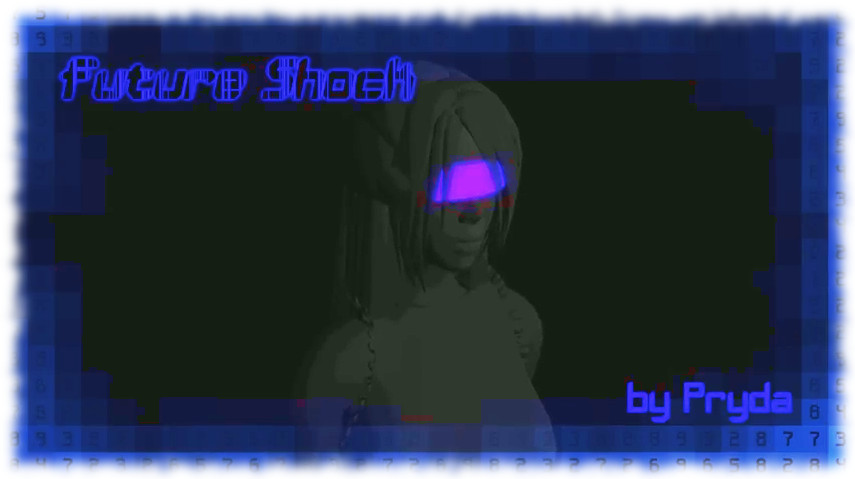
Future Shock is an ambitious and intriguing new Second Life Machinima series produced by Pryda Parx, the first episode of which was released on You Tube on September 16th, 2016.
“Future Shock is set in a dark future world where technology is designed to keep everyone safe and secure. At least that’s the way it is meant to be,” Pryda told me as we discussed the concept and the evolving series. “A place where technology dominates and where real life and virtual worlds intertwine.”
Unfolding over nine episodes, the story is told in something of a non-linear manner. Individual segments run to around 4 minutes each, unfolding part of the story, but as Pryda notes, “to get the most out of the audience will need to pause, rewind and revisit previous episodes; there are a lot of subtle connections between episodes which will not be apparent when first seen.”
Is technology helping us, or…?
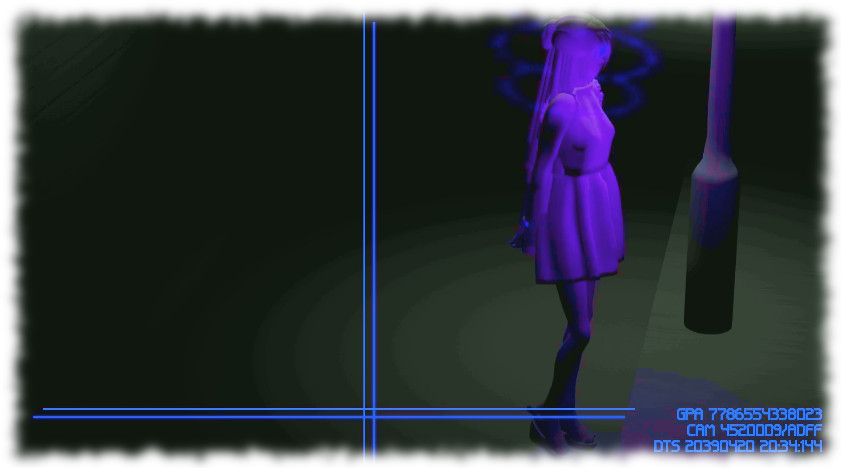
This is the case with the first segment, IP Credit, in which we are given a view of what appears to be both the real and the virtual as they intertwine. We know nothing of the character(s) we see or anything about the environment or what is going on. There is clue to the immediate events we see in the episode’s tag-line, but how the scene fits with the rest of the story arc is something we’re going to have to return to and consider later.
“I wanted to make something for the interactive YouTube generation,” Pryda says of the series. “Something to entertain, but also to provoke debate on technological and social trends and to explore what the future might actually hold.”
What lies within – and why?
A further striking element of the series is its presentation. Outside of the virtual realm, the world is predominantly monochrome: dark skies, dark pavements and floors, grey walls, grey people. Where colour is used, it tends to emphasise the presence of technology which, as we see as the scene unfolds, perhaps isn’t entirely benign. Dialogue is also minimal (and non-existent in the first segment, although the language can be strong when it does occur in later segments), a technique which further draws the audience into the unfolding story.
The first series has taken Pryda around a year to put together; work which unsurprisingly has required her involvement with a lot of tools – Blender for modelling, GIMP, Audacity for the distinctive audio, etc. The remaining segments will be released on YouTube at two-weekly intervals, with the last release occurring just before Christmas. There is also an introductory teaser, which can be seen here.
Nor does it end there. “There is a lot of background content and a coherent framework for world in which the story is set, ” Pryda told me. “Much of this background will play out over the two series following the first.”
So, if you’re on the look-out for a new and quite stylish sci-fi, which intertwines a number of themes in a unique style and approach, why not give Future Shock a go? The first segment is embedded below, and the series can be found on Pryda’s YouTube channel.
The moment of destruction: the SpaceX Falcon 9 explodes on Launch Complex 40 at Kennedy Space Centre, Florida
SpaceX Look to Resume Falcon Flights in November 2016
SpaceX President Gwynne Shotwell has indicated the company hopes to resume Falcon 9 launches from November 2016, despite the September 1st loss of the launch vehicle and its US $200 million Amos 6 Israeli-built communications satellite during the preparations for a full static fire test of the rocket’s main engines.
It’s an ambitious aim, given that the cause of the loss is still unknown – and until it is known, it is highly unlikely the Falcon 9 will be cleared for flight by the FAA. However, the comments might suggest company feel that the cause of the loss may not have been with the booster itself, but may have been triggered by an external event, in which case such a target might be possible.
Launch Complex 40, Canaveral Air Force Station, after the Loss of the Falcon 9 booster and payload on September 1st, 2016. Credit: Ken Kremer
The static fire test is a part of pre-launch preparations unique to SpaceX. Basically a full dress rehearsal of a launch, it includes fuelling the booster and briefly firing the main engines with the rocket locked-down on the pad. It was during fuelling operations, eight minutes before the rocket motors were to be fired, the that a series of explosion occurred, destroying the booster and its payload.
Video footage seems to suggest the point of origin for the explosions was outside of the vehicle, in what SpaceX has called a “fast fire”, which started at, or near, the liquid oxygen fuelling umbilical. As well as the complete loss of the vehicle, the explosions and fireball caused extensive damage to Space Launch Complex (SLC) 40 at Canaveral Air Force Station, which had been leased to SpaceX for Falcon 9 launches.
It is the second lost of a Falcon 9 rocket in 15 months. In June 2015, the vehicle carrying the Dragon CRS-7 cargo resupply vehicle to the International Space Station disintegrated a little over two minutes after lift-off, following the failure of an internal strut.
In order to resume launches and meet obligations, SpaceX are planning on pivoting Falcon 9 launches to Kennedy Space Centre’s Pad 39A until such time as SLC 40 can be repaired. SpaceX leased the pad – a part of the complex used to launch the Saturn IB, Saturn V and space shuttles – in 2014 in a 20-year deal. It is currently being refurbished at the company’s expense to launch crewed Dragon 2 flights to the International Space Station, and commercial missions using their new Falcon Heavy launcher. Currently, there is still much work to be completed at the launch complex – previously used to launch the space shuttle, and before that, the mighty Saturn V rocket, although SpaceX plan to have the work completed by November.
Launch Complex 39A at Kennedy Space Centre undergoing refurbishment by SpaceX in preparation for Falcon Heavy and crewed Falcon 9 launches. The Rotating Service Structure, seen on the left and used for space shuttle launches, is due for demolition
Whether or not the root cause of the September 1st accident will be known by then, and the Falcon 9 cleared for flight is a major unknown. The investigations into the June 2015 loss took six months to complete and – due to it being caused by a failure within the vehicle – the rocket had to undergo several engineering changes.
Blue Origin Announces the New Glenn Booster Family
Blue Origin, the company founded by Amazon founder Jeff Bezos, revealed its plans for a family of reusable boosters for both orbital and deep space launches. Called New Glenn, the vehicles are a significant step forward for the company.
The New Glenn family. Credit: Blue Origin
Although more widely known for their efforts in the sub-orbital space tourism field, with their New Shephard reusable system, Blue Origin has long indicated it has wider aspirations, whilst remaining somewhat tight-lipped about exactly what it is developing.
Like the smaller New Shephard sub-orbital launch vehicle, New Glenn is to comprise a reusable first stage – referred to as the “propulsion module” on New Shepard. The vehicle has been under development for about 4 years, and the plan is for the first launch to take place in 2020.
Seven metres (23ft) in diameter, the New Glenn first stage will be powered by seven of the company’s new BE-4 engines. These are the same engines United Launch Alliance have selected as the primary propulsion unit for their own upcoming new Vulcan launch vehicle, which will enter service in 2019 to replace the expensive Atlas V booster.
This core stage of the new Blue Origin rocket – which is named for John Glenn, the first American to orbit the Earth, just as New Shephard is named after Alan Shephard, the country’s first astronaut to fly in space – will be topped by either a second stage for launches to low-Earth orbit, or a combination of a second stage and third stage system capable of a broader range of launch options. In both variants, the second stage will be powered by a single BE-4 engine, while the third stage will be powered by an uprated version of the BE-3 engine, currently used by the New Shephard. Neither the second nor third stages will be recoverable. It is anticipated that New Glenn will be capable of lifting between 35 to 70 tonnes to low Earth orbit, placing it in the same class of launch vehicle as SpaceX’s Falcon Heavy – and thus competing directly with it.
When it enters service, the new booster will be launched from America’s Space Coast, from the historic Space Launch Complex 36 at Canaveral Air Force Station, which Blue Origin took over in September 2015 in a deal with the USAF’s 45th Space Wing.
New Glenn compared to other current launch vehicles. The two-stage variant will be 85 metres (270ft) tall, and the 3-stage variant 95m (313 ft) tall. Both will have a 7m (23 ft) diameter. Credit: Blue Origin
In its time, SLC 36 was was used to launch the Mariner missions, the first US interplanetary probes to visit over worlds, Pioneer 10 and Surveyor-1, the first US vehicle to soft-land on the Moon. It was largely demolished in 2010, leaving just a single pad. Blue Origin are expected to construct a rocket fabrication and assembly facility there, as well as a new launch complex. Currently, it is not clear how the first stage of the booster will be recovered, but the company have hinted at an automated at-sea landing in the style of SpaceX might be used.
China Launches Tiangong-2
On Thursday, September 15th, 2016, and as expected, China launched the Tiangong-2 (“Heavenly Palace 2”) orbital laboratory from their Jiuquan Satellite Launch Centre in Gansu Province, and on the edge of the Gobi Desert in northern China. The Long March 2F booster (and not a long March 7, as incorrectly reported in some space news outlets) lifted-off at 14:04 UTC, making for a night launch, local time.
The Long March 2F carrying the Tiangong-2 orbital laboratory, lifts-off from China’s Jiuquan Satellite Launch Centre in Gansu Province at 14:04 UTC on Thursday, September 15th
Tiangong-2 is the second phase of China’s goal to establish a permanently crewed space station in the early to mid 2020s. This work started in 2011 with the launch of the Tiangong-1 facility, which was briefly visited by two crews in 2012 and 2013. It will culminate in the on-orbit construction of a large space station, starting with the launch of the Tianhe (“Harmony of the Heavens”, and formerly Tiangong-3) space station core module in 2022.
an artist’s impression of Tiangong-2 (centre right) with the Tianzhou resupply vehicle docked (left), together with the Shenzhou-12 crew vehicle at the laboratory’s far docking port. Credit: CCTV
It is expected that at least two crews will visit the facility. The first 2-person crew will fly to the laboratory in October aboard Shenzhou-11. They will commence the first round of a fairly extensive science programme, remaining at the lab for around 30 days.
After this, the facility will be left dormant until April 2017, when a Long March 7 booster is due to deliver the Tianzhou (“Heavenly Ship”) uncrewed resupply vehicle to orbit. This craft will then perform an automated docking with Tiangong-2, providing it with additional fuel, water and other consumables and also use its engine to boost the laboratory into a higher orbit to await the arrival of the second crew.
The second crew, comprising 3 personnel, should fly to the facility in mid-2017 Shenzhou-12. They are expected to say for less than 30 days, but while there carry out a number of tasks connected to developing a full space station, including performing an EVA. Whether further crews will visit the station after this has yet to be determined.
A Billion Stars – A Map to Our Galactic Neighbourhood
The first one billion: a billion stars in our galaxy mapped by distance and brightest – with a few extra-galactic objects shown for good measure. Credit: ESA/Gaia/DPAC
The above image might not look like much, but it is the largest all-sky survey of celestial objects published to date, pinning down the precise position on the sky and the brightness of 1142 million stars in our galaxy.
It is the product of the European Space Agency’s (ESA) Gaia Project, which is approaching the mid-point in its 5-year mission. Launched in December 2013, and orbiting the L2 Lagrange point, Gaia commenced its mapping operation in July 2014 – and it will continue doing so through until 2017. This map, released by the European Space Agency on September 14th, covers the data gathered from July 2014 through to September 2015. A further map, which includes data through to August 2016, is currently in development.
An artist’s impression of the Gaia vehicle at the L2 position relative to the Earth and Sun
The intention is to create a precise three-dimensional map of astronomical objects throughout the Milky Way, mapping their motions, which reflect the origin and subsequent evolution of the galaxy. Spectrophotometric measurements by the craft will provide a detailed survey of all observed stars, characterising their luminosity, effective temperature, gravity and elemental composition. The data gathered will provide the basic observational data to tackle a wide range of important questions related to the origin, structure, and evolutionary history of our galaxy.
It is the second such survey to be undertaken. The first was ESA’s Hipparcos mission, almost two decades ago, which surveyed around 200 million stars. One aspect of the Gaia survey will be to compare its findings with those of Hipparcos, so it will hopefully be possible to start disentangling the effects of “parallax”, a small motion in the apparent position of a star caused by Earth’s yearly revolution around the Sun, and the “proper motion” of the star’s physical movement through the galaxy.
The Gaia map includes globular clusters without our own galaxy, and images of clusters and galaxies beyond our own. Credit: ESA/Gaia/DPAC
The Gaia map means it is now possible to measure the distances and motions of stars in about 400 clusters up to 4,800 light-years away, and includes 3194 variable stars, which rhythmically swell and shrink in size, leading to periodic brightness changes. Many of these are located in the Large Magellanic Cloud, one of our galactic neighbours, a region that was scanned repeatedly during the first month of observations, allowing accurate measurement of their changing brightness. During the first phase of the mission, Gaia also discovered its first supernova in another galaxy, and the science and engineering team had to overcome a “stray light” issue where fibres used in the vehicle’s sun shield protrude beyond the edges of the shield and into the field of view. In doing so, they reflect unwanted light, resulting a degradation in science performance when mapping the faintest of stars in Gaia‘s view.
The Birth of a Black Hole?
Black holes; the boogie-men of the cosmos. Deep wells of gravity so intense that not even light can directly escape after passing the event horizon. They are formed in one of two ways, during the death of super-massive stars.
In the first, the star gobbles up the last of its fusionable fuel, causing the core to suddenly and violently contract, in turn triggering a violent explosion – a supernova – completely shedding the star’s outer shell of mass, and leaving behind a super-dense neutron star. Generally only 10 or so kilometres across, this have a greater mass than our Sun. It is thought that if this mass is too great, the neutron star also collapses in on itself, forming a black hole. In the second, the star doesn’t go supernova, but experiences a “failed supernova” brightening for a very brief period as some matter is lost, but then continuing to collapse in on itself until a black hole is formed. In both cases, the star vanishes from the visible spectrum, leaving behind tell-tale signs in the infra-red and in x-rays.
The Large Binocular Telescope, one of three instruments so far used in gathering data on N6946-BH1. Credit: NASA
A team of astronomers now believe they have captured the birth of a black hole through this second process.
They were studying data relating to N6946-BH1, a red giant thought to be coming to the end of its life, when they noticed something odd. In 2009 the star, roughly 25 times bigger than our Sun and 20 million light years away, could be seen in the visible light wavelengths. By 2015, however, it had vanished, leaving only an infra-red afterglow. A subsequent check on Hubble Space Telescope data revealed the same: in 2007 the star was visible, in 2015, it wasn’t.
Intrigued, the team checked data on the star from the Palomar Transit Factory (PTF). This revealed that in 2009, N6946-BH1 blossomed briefly in luminosity, with a massive burst of neutrinos occurring at the same time – events both consistent with the star collapsing, but not going supernova. Add these to the infra-red tell-tale, and it would seem N6946-BH1 might have formed a black hole.
If so, it should now be a source of x-rays emitted in a particular spectrum as local matter fails into it. The team are now hoping that the Chandra X-ray Observatory in Earth orbit will be able to take a look at N6946-BH1 in the next two months or so to see if those x-rays can be detected. Should it be determined that N6946-BH1 has collapsed into a black Hole – even one now 20 million years old – studying it could help describe the beginning of the life cycle of a black hole, and better inform us on how black holes form, potentially why some super-massive stars form a neutron star rather than collapsing all the way to a black hole.
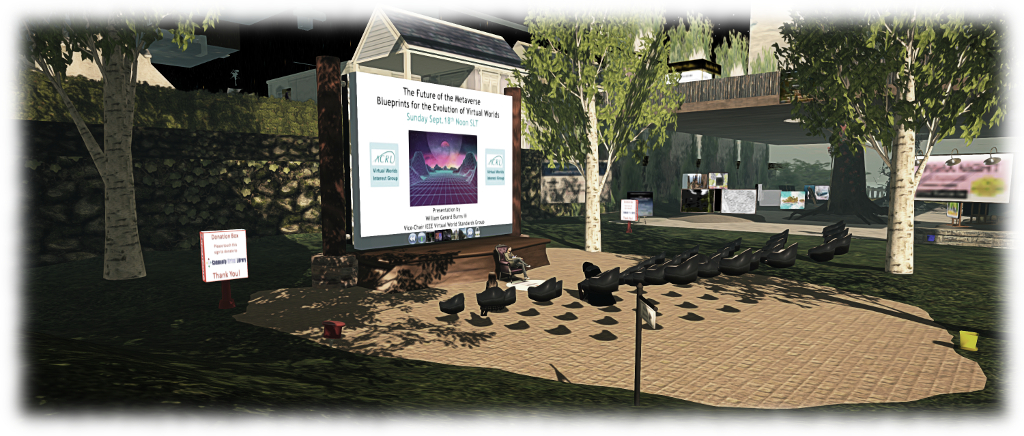
On Sunday, September 18th, Will Burns (Aeonix Aeon in-world), Vice-Chair IEEE Virtual World Standards Group, authority on virtual domains, author of the thought-provoking Andromeda Media Group blog, will be presenting The Future of the Metaverse: Blueprints for the Evolution of Virtual Worlds, a joint session with ALA Virtual Communities in Libraries, which will be held at the CVL Auditorium.
The presentation will provide an overview of the history of virtual worlds and phases of development, offering a definition for the “Metaverse” and a glimpse into the future of virtual worlds, and will include interoperability and other key elements of design. It will last for around an hour, and will be followed by a further hours for questions and answer and general discussion.
This will be an informative event, offering a unique perspective on virtual worlds and their future from a man who has been offering insights, observations and helping shape the metaverse since its inception.
Join librarians, educators, and anyone interested in virtual worlds and the future of immersive learning. The session is jointly sponsored with the ALA Virtual Communities in Libraries Member Initiative Group.
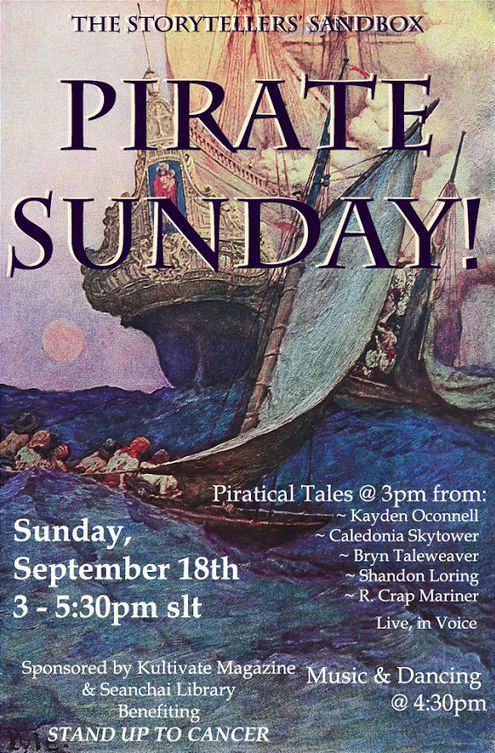
Every year, on September 19th, people around the world celebrate International Talk Like A Pirate Day. However, as it this year falls on a Monday, when a lot of people will be busy at work, Seanchai Library, in partnership with Kultivate Magazine, will be holding a special Pirate Sunday Storytellers Sandbox at Kultivate’s in-world HQ of Water Haven.
Running from 3:00pm SLT through until 5:30pm SLT, the event will comprise 90 minutes of storytelling live in voice, including:
Kayden O’Connell and Bryn Taleweaver reading selections from “Treasure Island” by Robert Louis Stevenson
Caledonia Skytower reading selections from “Women Pirates” by Anne Myers
Shandon Loring will read from Dead Men Tell No Tales a collection of stories from the Pirates of the Caribbean
R. Crap Mariner reading various pirate tales from his 100 Word Stories collection.
An hour of music from Anek Fuchs will follow from 4:30pm, with dancing at the “shipwreck cove”.
Guests are strongly encouraged to come dressed for the occasion, whether as brigands or wenches or whatever outfit they’ve got stashed away in Davy Jones’ Locker.
The entire celebration, from X-marks-the-Spot to Pieces-Of-Eight, will benefit Stand Up to Cancer (SU2C).
An international movement, originally founded in the United States, SU2C takes an innovative approach to ending cancer by focusing on forming “dream teams” of doctors and researchers who are directly involved in leading-edge cancer research and treatment, and then undertaking aggressive research programmes. 100% of all donations made through SU2C goes directly into funding cancer research and treatment and paying for these teams; none is lost to “administrative costs” or put aside for CEO or executive salaries, etc.
To mark the occasion, one half of Water Haven has been flooded and docks installed, and a flotilla of ships – privateers and men’o’war, and merchant ships – to come alongside, having skirted the dangers of ghost ships, wrecks and a waiting Kraken in the bay beyond!
And don’t forget that throughout the week, Seanchai Library will be presenting a range of stories in voice for our listening enjoyment, with all dominations and tips going to support Alex’s Lemonade Stand Foundation (ALSF), a childhood cancer foundation dedicated to raising funds for research into new treatments and cures for all children battling cancer. So, check out the schedule in brief below, and do be sure to visit the Seanchai Library website.
All events are at Seanchai Library headquarters at Bradley University, unless otherwise indicated in the descriptions.
Sunday, September 18th, 13:30: Tea Time at Baker Street – join Caledonia Skytower, John Morland and Kayden Oconnell as they continue to read from that most famous of tales from the pen of Arthur Conan Doyle: The Hound of the Baskervilles. Dramatised many times over the years on stage, film, radio and television, it’s a story told many times and in many ways. So what not settle into the lounge at 221B Baker Street, the University of Washington iSchool, and hear the chilling original?
Monday September 19th, 19:00: A Spectre is Haunting Texas – Gyro Muggins reads Fritz Leiber’s 1969 novel telling of a world in which Texas had secretly run the United States from 1845 through until the Third World War, after which the former state conquered the entire North American continent…
Tuesday September 20th, 19:00: The Old Country – Faerie Maven-Pralou concludes a reading of Mordecai Gerstein‘s 2005 novel of shape-shifting, magic, war, and discovery.
Wednesday September 21st, 19:00: A Monstrous Regiment of Women (Mary Russell #2) – return to 221B Baker Street at the University of Washington’s iSchool, for the latter-day adventures of Mr. Sherlock Holmes (retired) and his young orphaned protégé, Mary Russell, originally from the United States, as written by Laurie R. King.
Thursday, September 22nd:
19:00 Cutlass! Three Pirate Tales with a Twist with Shandon Loring (In Second Life and Kitely. Check Kitely event announcements for specific grid location)
21:00: Seanchai Late Night – late-night science fiction with Finn Zeddmore.
The Shire. For anyone who has entered the realms of J.R.R. Tolkien’s Middle Earth, that is a name synonymous with Hobbits, the house at Bag End, and the place from which Bilbo and Frodo Baggins each in turn left behind all they had ever known to set out on quests very different in nature, but ultimately part of the same history. It is also a place beautifully brought to life in Second Life by Chocolate Aftermath, working with region holder Imabean Algorythm (Ima Peccable).
I first visited The Shire, Second Life, in March of 2015, and was utterly delighted with all I saw; a beautiful blending of places for Little and Big Folk, complete with a touch of Elven mystery. I confess to not having made a return trip in nigh-on a year, so seeing it featured in the Destination Guide highlights for September 16th put me in the mind to renew my acquaintance with the region, see what has changed and – most importantly of all – introduce Caitlyn to Chocolate’s interpretation of this corner of Tolkien’s world.
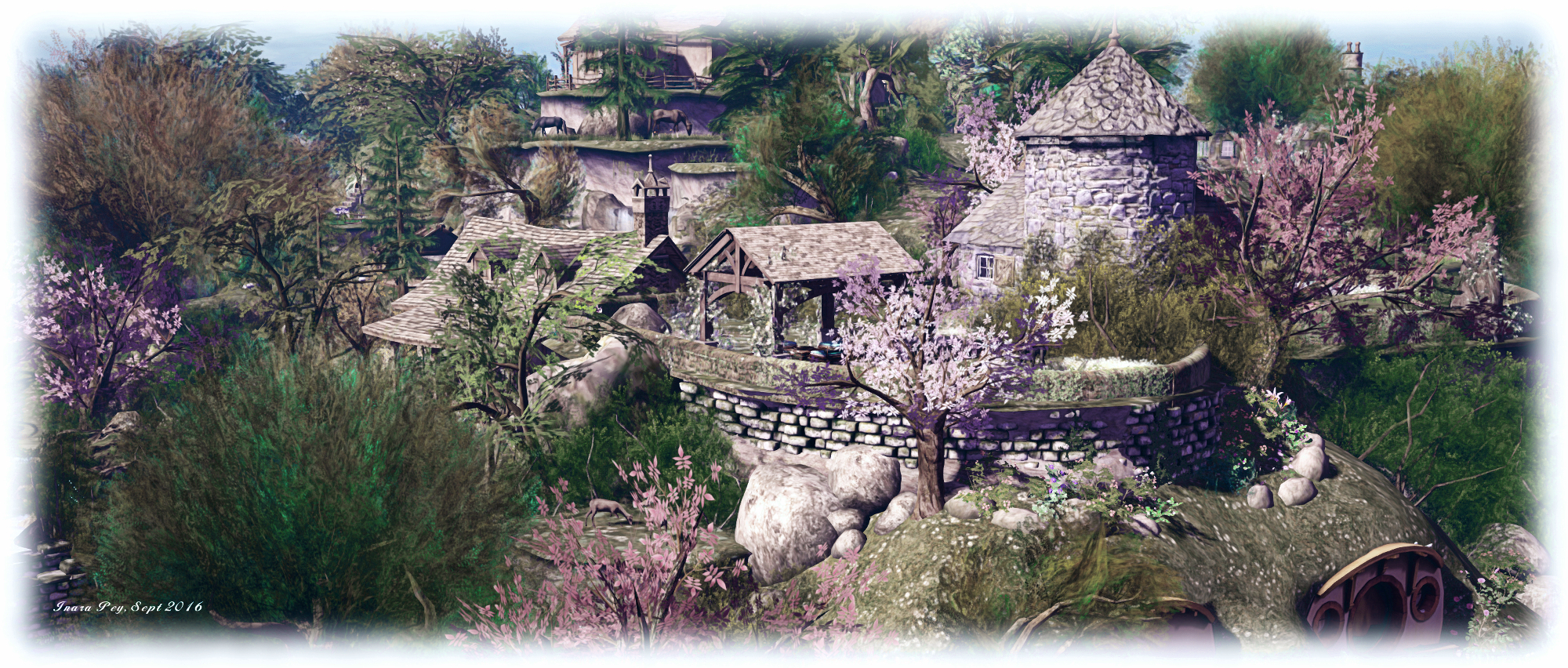
And I’m utterly delighted that while things have greatly changed since my last visit in (I think) August of 2015, all of the magic and delight of The Shire remain, offering a balanced mix of public spaces and private, for-rent residences. The latter comprise for the Little Folk, familiar double-fronted Hobbit Holes with large round front doors and little steps leading up their humped backs to “rooftop” seating areas; whilst for the Big Folk, more traditional slate-roofed cottages and farm houses are scattered across the region.
All of the hobbit holes and houses are placed within their own grounds and spaced across the region and both upon its hills and lowlands in such a way that tenants have a good feeling of privacy from one another, while the fences and walls surrounding their plots serve to steer casual visitors along the public paths and tracks without huge risk of unwanted intrusion by the polite Second Life Explorer.
Visits to the Shire begin towards the south-east corner of the region where Bilbo Baggins’ (eleventy-first?) birthday is being celebrated. I didn’t notice any of Gandalf’s fireworks awaiting their time to be lit, but I’m sure they are there 🙂 . The Shire “proper” lies on the other side of a narrow sliver of water across by a set of stepping-stones which – in a nod to wider aspects of Tolkien’s world, is watched over by an Entish tree spirit.
Once over the water, the path divides, and where you go is really down to where your feet carry you. As noted the homes spread across the region are private, so please do note the rental status at the gates / paths leading to them and respect the privacy of the tenants. The paths and tracks wind their way gently around and over the hills of the region, presenting plenty of opportunities for exploration and to sit down (Hobbits love a good natter, you know).
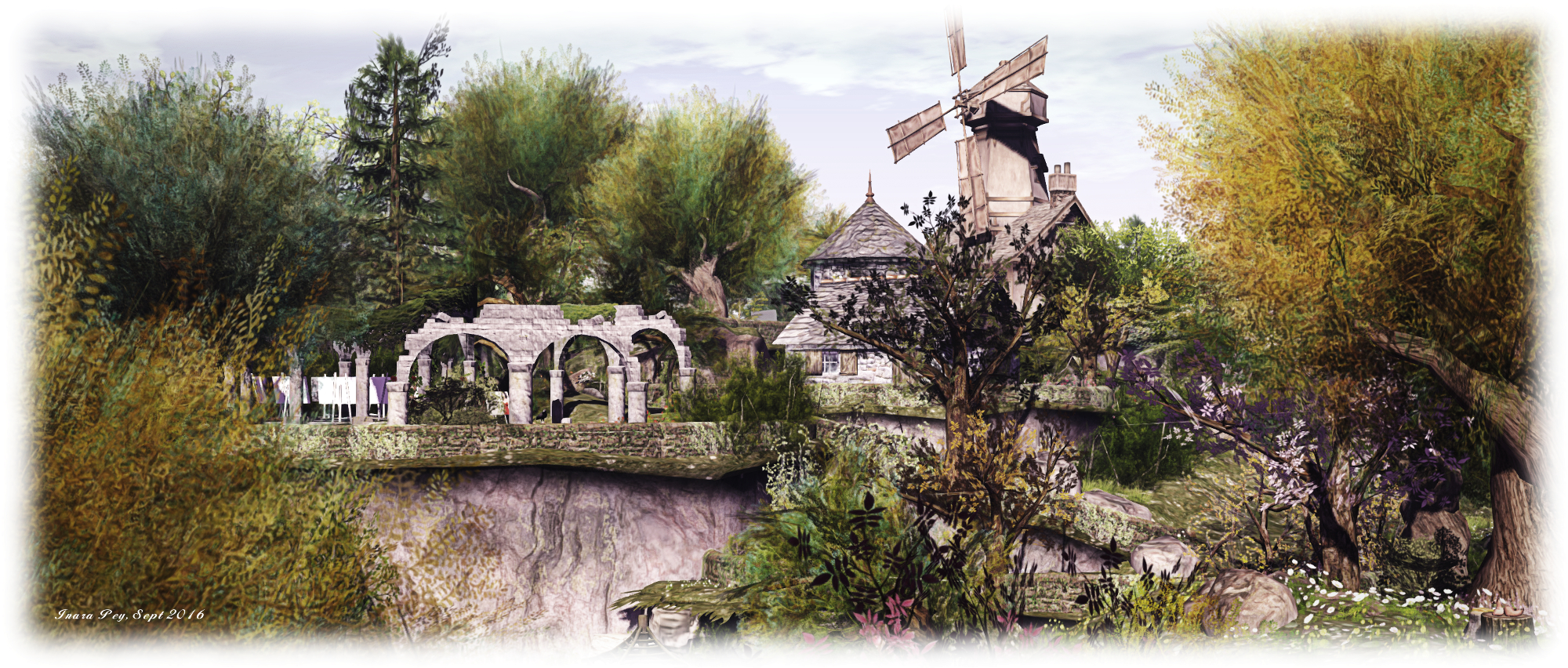
There are other hints of un-Hobbity things to be found as you explore this little corner of the Shire as well. There’s a touch of dwarvishness to be found under hill, and little touch or two of an elven influence up on the hill (one of which has the region’s open-air art gallery which currently features Jewell Wirefly’s images). There’s also a hint that trouble may have found its way to this part of The Shire – it’s not every day one comes across a watchtower with a rack of spears in the land of the Hobbits – has Saruman been up to mischief?
The Shire is, without a doubt, a joy to visit. Bird song fills the air and with all the hobbit holes, open windows and doors, it’s not hard to imagine the smell of baking and cooking being wafted gently on the breeze. Those interested in renting a hole or cottage can find information on cost and LI allowances on the rental boxes at the entrance to each plot. Those interested in photography will find plenty of opportunities, and those with a love of Tolkien will feel right at home!






 Inara Pey: Living in a Modemworld