Space Sunday: Jupiter and Juno

 Update, July 5th: The insertion burn on July 4th/5th was successful, and Juno is safely in its initial orbit around Jupiter. I’ll have an update on the mission in the next Space Sunday.

rAt 20:18 PDT on Monday, July 4th (03:18 UT, Tuesday, July 5th) a spacecraft called Juno will fire its UK-built Leros-1b engine to commence a 35-minute burn designed to allow the spacecraft  enter an initial orbit around the largest planet in the solar system, ready to begin a comprehensive science campaign.

As I write this, the craft is already inside the orbit of Callisto, the furthest of Jupiter’s four massive Galilean satellites,  which orbits the planet at a distance of roughly 1.88 million kilometres. During the early hours of July 4th, (PDT), the vehicle will cross the orbits of the remaining three Galilean satellites, Ganyemede, Europa and Io, prior to commencing its orbital insertion burn.

In the run-up to the burn, Juno will complete a series of manoeuvres designed to correctly orient itself to fire the Leros-1b, which will be the third of four planned uses of the engine in order to get the craft into its final science orbit. Two previous burns of the engine – which NASA regards as one of the most reliable deep space probe motors they can obtain – in 2012 ensured the craft was on the correct trajectory from this phase of the mission.

Getting into orbit around Jupiter isn’t particularly easy. The planet has a huge gravity well – 2.5 times greater than Earth’s. This means that an approaching spacecraft is effectively running “downhill” as it approaches the planet, accelerating all the way. In Juno’s case, this means that as the vehicle passes north-to-south around Jupiter for the first time, it will reach a velocity of nigh-on 250,000 kph (156,000 mph), making it one of the fastest human-made objects ever.
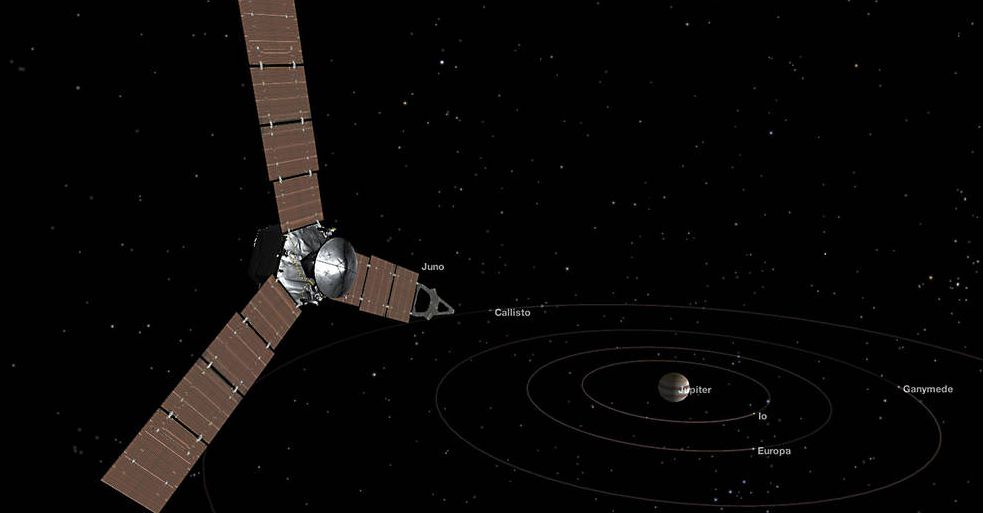
An Artist's impression of Juno approaching the Jovian system. Credit: NASA
An Artist’s impression of Juno approaching the Jovian system. Credit: NASA

Slowing the vehicle directly into a science orbit from these kinds of velocities would take an inordinate amount of fuel, so the July 4th manoeuvre isn’t intended to do this. Instead, it is designed to hold the vehicle’s peak accelerate at a point where although it will be thrown around Jupiter and back into space, it will be going “uphill” against Jupiter’s gravity well, decelerating all the time. So much so, that at around 8 million kilometres (5 million miles) away from Jupiter, and travelling at just 1,933 kph (1,208 mph), Juno will start to “fall back” towards Jupiter, once more accelerating under gravity, to loop around the planet a second time on August 27th, coming to within (4,200 km (2,600 mi) of Jupiter’s cloud tops, before looping back out into space.

On October 19th, Juno will complete the second of these highly elliptical orbits, coming to within 4,185 km (2,620 mi) of the Jovian cloud tops as it completes a final 22-minute burn of the Leros-1b motor. This will be sufficient for Jupiter’s gravity to swing  Juno into an elliptical 14-orbit around the planet, passing just 4,185 km from Jupiter at its closest approach before flying out to 3.2 million kilometres (2 million miles) at it’s furthest from the planet.

Juno's journey to Jupiter, with a flyby-of Earth in 2013
Juno’s journey to Jupiter, with a flyby-of Earth in 2013

The July 4th insertion burn is also significant in that it marks the end of a 5-year interplanetary journey for Juno, which has seen the vehicle cover a distance of 2.8 billion km (1.74 billion miles).

It’s a voyage which began on August 5th, 2011, atop a United Launch Alliance (ULA) Atlas V, launched from Cape Canaveral Air Force Station, Florida.

As powerful as it is, the Atlas isn’t powerful enough to send a payload like Juno directly to Jupiter. Instead, the craft flew out beyond the orbit of Mars before dropping back to Earth, passing us again in October 2013 and using Earth’s gravity to both accelerate and to slingshot itself into a Jupiter transfer orbit.

While, at 35 minutes, the engine burn for orbital insertion is a long time, the distance from Juno to Earth means that confirmation that the burn has started will not be received until 13 minutes after the manoeuvre has actually completed. That’s how long is takes for a radio signal to travel from the vehicle back to Earth (and obviously, for instructions to be passed from Earth to Juno.  Thus, the manoeuvre is carried out entirely automatically by the vehicle

Juno is not the first mission to Jupiter, but it is only the second orbital mission to the giant of the solar system.

The Jovian system was first briefly visited by Pioneer 10 in 1973, followed by Pioneer 11 a year later. Both of these were deep space missions (which are still continuing today), destined to continue outward through the solar system and into interstellar space beyond. They were followed by the Voyager 1 and Voyager 2 missions in January and July 1979 respectively, again en route for interstellar space by way of the outer solar system.

In 1992 the Ulysses solar mission used Jupiter as a “slingshot” to curve itself up into a polar orbit around the Sun. Then in 2000, the Cassini mission used Jupiter’s immense gravity to accelerate and “bend” itself towards Saturn, its intended destination. New Horizons similarly used Jupiter for a “gravity assist” push in 2007, while en route to Pluto / Charon and the Kuiper Belt beyond.

It was in 1995 that the first orbital mission reached Jupiter and its moons. The nuclear RTG-powered Galileo was intended to study Jupiter for just 24 months. However, it remained largely operational until late 2002 before the intense radiation fields around the planet took their final toll on the vehicle’s systems. Already blind, and with fuel supplies dwindling, Galileo was ordered to crash into the upper limits of Jupiter’s atmosphere in 2003, where it burned up.

In the eight years it operated around Jupiter, Galileo complete changed our perspective on the planet. Juno has a 20-month primary mission, and it is hoped its impact on our understanding of Jupiter will be greater than Galileo’s. However, it is unlikely the mission will be extended.

Unlike all of NASA’s previous missions beyond the orbit of Mars, which have used RTG power units, Juno is entirely solar-powered, making it the farthest solar-powered trip in the history of space exploration. However, the three 8.9 metre (29 ft) long, 2.7 metre (8.9 ft) wide solar panels are particularly vulnerable to the ravages of radiation around Jupiter, and it is anticipated that by February 2018, their performance will have degraded to a point where they can no longer generate the levels of electrical energy required to keep the craft functioning – if indeed, its science instruments and electronics haven’t also been damaged beyond use by radiation. This being the case, Juno will be commanded to fly into Jupiter’s upper atmosphere and burn up.

Juno's science instruments - click for full size. Credit: NASA / JPL
Juno’s science instruments – click for full size. Credit: NASA / JPL

Continue reading “Space Sunday: Jupiter and Juno”

Detectives, Trigger Warnings, odysseys and libraries

It’s time to kick-off a week of story-telling in voice, brought to our virtual lives by the staff and volunteers at the Seanchai Library. As always, all times SLT, and events are held at the Library’s Second Life home at Bradley University, unless otherwise indicated.

Sunday, July 3rd

13:30: Tea Time at Baker Street

Tea-time at Baker Street returns for the summer, featuring a new location – 221B Baker Street at the University of Washington in Second Life, and a return to  His Last Bow.

A 1917 anthology of previously published Sherlock Holmes stories by Sir Arthur Conan Doyle, the volume originally comprised seven stories published by The Strand Magazine between 1908 and 1917. However, later editions of the book saw an eighth story included, The Adventure of the Cardboard Box, originally published in 1892.

First appearing in print in 1908, The Adventure of Wisteria Lodge forms the first tale in the volume, and it is with this tale the Seanchai begins. It is in fact a two-part story, comprising The Singular Experience of Mr. John Scott Eccles and The Tiger of San Pedro.

In the first instalment, Mr. John Scott Eccles of Surrey, arrives at 221B Baker Street in an agitated state, wishing to discuss something of a “grotesque” nature with Holmes and Watson. However, no sooner has he arrived than so does Inspector Gregson of the Yard, accompanied by Inspector Baynes of the Surrey constabulary. They wish to question Eccles about a murder at a house in which he had spent the previous night.

Clearly shocked on hearing about the murder, Eccles proceeds to tell a tale which has all the hallmarks of intrigue and, possibly, passion: mysterious coded messages and possible secret trysts. Even the behaviour of the murdered man suggests to Holmes that he was attempting to use Eccles to establish an alibi prior to his death. But an alibi for what?

18:00: Magicland Storytime

Caledonia Skytower concludes the Magicland reading of Ollie’s Odyssey (see below for details).

Monday July 4th.

No session.

Tuesday July 5th, 19:00: Trigger Warning: Short Fictions and Disturbances

TriggerCorwyn Allen reads Neil Gaiman’s collection of short fiction intended to entertain and provoke. Within it, he looks behind the masks we wear and at the people we really are, using a rich mixture of genres and experiences on which to found his stories: horror, science fiction, fantasy, fable, poetry – even his own experiences using Twitter.

Within these tales, characters new and established are revealed. Black Dog, an original story for this volume returns to the world of America Gods, whilst elsewhere can be found stories featuring Sherlock Holmes and a story written for the 50th Anniversary of Doctor Who.

Neil Gaiman is a literary artist whose unique approach to fiction drives deeply into our imaginations, engaging and stirring us in mind, heart and soul.

Wednesday July 6th 19:00: Ollie’s Odyssey

OllieCaledonia Skytower reads William Joyce’s children’s tale about Oswald (or Ollie, or Oz), a stuffed rabbit and favourite of young Billy. Oz goes everywhere with Billy, until one day, he is accidentally left under a table during a wedding, and is kidnapped by the wicked Zozo.

An unwanted amusement park prize, Zozo hates all toys that are favourites; so much so that he doesn’t just want them lost – he wants them forgotten by everyone – and he has gathered other embittered toys to his cause.

Now Oz must work to not only rescue himself and get back to Billy, he must ensure all the other “lost” toys reach safety.

Thursday, July 7th 19:00: A Tale Of The Caxton Private Lending Library & Book Depository: Holmes on the Range

I confess to not having a clue how these two fit together, so bets hurry along to 221B Baker Street at the University of Washington in Second Life, so Shandon Loring can tall all!

(Also on Kitely – check in-world and Google+ for location specifics.)

—–

Please check with the Seanchai Library SL’s blog for updates and for additions or changes to the week’s schedule.

The featured charity for May / June is Habitat for Humanity, with a vision of a world where everyone has a decent place to live – a safe and clean place to call home.

Additional Links

Mac Kanashimi’s Snarl in Second Life

Snarl - Mac Kanashimi
Snarl – Mac Kanashimi

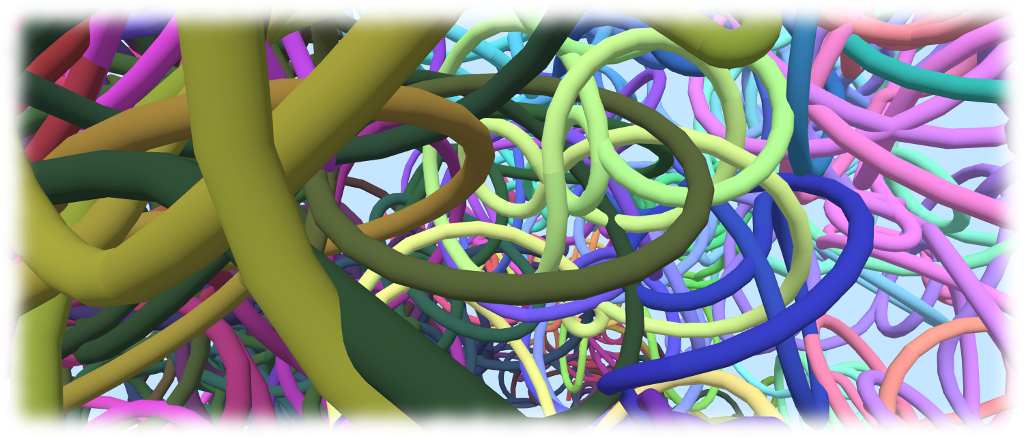
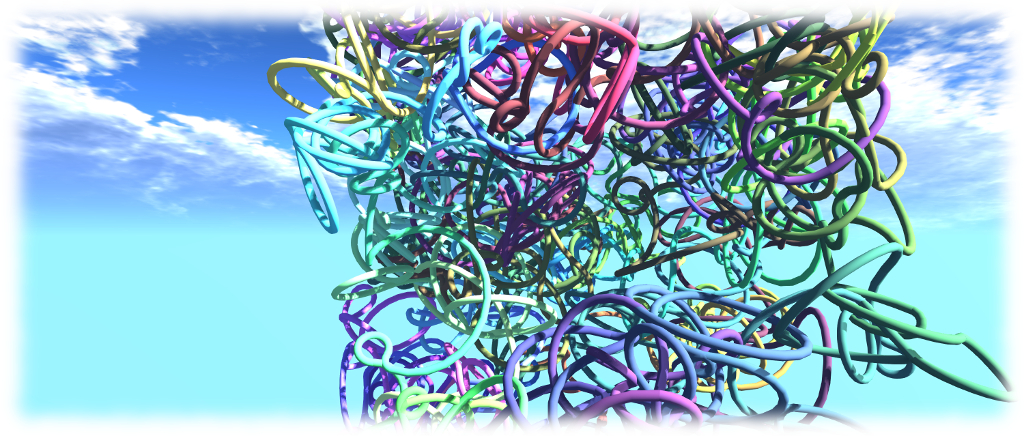
Snarl is the name of Mac Kanashimi’s latest art installation, and it really is one of those things that has to be seen in order to be appreciated; frankly, no photograph really does the build justice.

Known for his huge, fractal-based builds, several of which I’ve covered in this blog (see Climbing the Pinwheel (August 2014), The Geometry of Art (April 2014) Enter the Dragon Curves (February 2014)). However, for Snarl, he has opted for something far more organic in form: a huge vine-like tower of rings, curls, loops of fibre-like elements which rises more than 4,000 metres in to the sky above the region in which it sits.

Snarl - Mac Kanashimi
Snarl – Mac Kanashimi

The result is quite extraordinary, some 5,000 items, each with an LI of three, all of which utilise HSL (Hue, Saturation, Lightness) to RGB conversion.This has been set such that lightness has the slowest cycle of conversion, causing the tower  to go from light colours in the lower extremes through to darker colours at the top. Saturation then has a slightly faster cycle than lightness, leaving hue with the fastest cycle.

To appreciate it requires ramping-up draw distances as high as your system can comfortably handle – and this is really worthwhile doing. If you are fortunate enough to have a Space Navigator / joystick which allows you to flycam, I can thoroughly recommend ramping-up draw distance and then flying up the side of Snarl at a relatively slow pace. Watching the curls and twists slowing unfold / pop into view as distinct clumps and then slowly connect to one another, colour washing over them after then have appeared, really does bring home the organic nature of this build.

Snarl - Mac Kanashimi
Snarl – Mac Kanashimi

Do note that when you arrive at Snarl, which rebuilds itself tail-to-top once a day, you will do so at the top, and sans any platform on which to stand. This affords you with the novel (if initially disorienting) experience of falling through the installation, all of the segments of which are phantom, presenting you with a unique “inside” perspective on the build which is worth repeating by flying through it as you examine it.

Snarl is an extraordinary installation, which will remain open through until the end of 2016.

SLurl Details


SL Project updates 16 26: Server, viewer TPVD Meeting

It All Starts With A Smile; Inara Pey, June 2016, on Flickr It All Starts With A Smileblog post

Some of the notes in this update are taken from the TPV Developer meeting held on Friday, July 1st. The video of that meeting is embedded at the end of this update, and references to it are indicated through the use of time stamps in the paragraphs below (note that there were some extended pauses in the meeting where there was no discussion, hence some of the time gaps evident between time stamps, where given). My thanks as always to North for recording and providing it.

Server Deployments – Recap

  • On Tuesday, June 28th, the Main (SLS) channel received the same server maintenance package previously deployed to the RC channels, comprising  minor internal changes and Tool Tip/Constant text fixes.
  • On Wednesday, June 29th, all three RC channels received the same new server maintenance package, comprising the following fixes:
    • BUG-11836  Increase max animation size – animation files up to  250Kb can now be uploaded
    • BUG-6035 (non-public) LSL email registration (for receiving email from outside the region) can break without automatic recovery.

Deployments for Week #27

There will only be one deployment in week #27 (commencing Monday, July 4th), this will be to the Main (SLS) channel, promoting the current RC channel package, which due to Monday being a holiday in the United States, will take place on Wednesday, July 6th, rather than Tuesday, July, 5th.

SL Viewer

The Bento project viewer updated to version 5.0.0.317134, on Thursday June 30th. This update includes small tweaks to the avatar skeleton file, but no structural changes, and provides fixes for:

  • SL-426 missing string for left pec, right pec attachments
  • SL-398 issues with system eyelashes
  • MAINT-6380 vertical flicker with some mesh avatars.

Visual Outfits Browser Project Viewer

[03:22] The Visual Outfits Browser (VOB) project viewer updated to version 4.0.6.316422 on July 1st. This could be the last iteration of the viewer as a project release prior to it being promoted to a release candidate status, which might be as early as week #27, pending the outcome of fixes for a couple of issues.

Oculus Rift Project Viewer

[04:19] A new Windows build for the Oculus Rift project viewer, version 4.1.0.317313 was released on July 1st (reported as being with the Labs QA team during the TPV Developer meeting) – see my update article for more.

It is expected that over the fullness of time, this viewer will progress through project and RC releases and be merged into the main viewer. The Lab currently has no plans to maintain it as a separate viewer channel.

Note that this viewer is still specific to the Oculus Rift. Support for the HTC Vive in Second Life is something the Lab “would like to be able to do”, but this viewer does not expressly support the Vive as well. If and / or when the Lab might offer Vive support in SL, and how far that support might go (e.g. will it include support for using the Vive’s room sensors with SL) is an open question at this point is time.

Inventory Messaging Viewer Promotion

[00:28] It appears the inventory messaging viewer, version 4.0.6.315555, is “almost certain” to be promoted to de facto release status on Tuesday, July 5th.

This viewer eliminates deprecated and unused UDP inventory messaging mechanisms from the viewer, replacing them with the current AIS mechanisms. The promotion of this viewer to de facto release status marking the start of a countdown towards the removal of the corresponding back-end support for these old UDP operations, which will most likely take place some time in Q4 of 2016 (final dates TBD at this time).

When it happens, it means than any viewers still reliant on the UDP mechanisms for inventory operations – such as the Lab’s Obsolete Platforms viewer (version 3.7.28.300847) will no longer work.

Maintenance RC Viewer

[03:02] The Maintenance RC viewer, version 4.0.6.316883 at the time of writing, is also doing well in its cohort, and is expected to be promoted “not to far” behind the messaging viewer – so most likely around mid-July, unless anything happens, given the Lab generally likes to leave 2 weeks between viewer promotions.

Project VLC Media Plugin Viewer

[36:23] It is hoped this project viewer (currently version 4.0.6.316258, dated June 15th) should move to release candidate status in week #27. Again, this will be for Windows only, replacing the QuickTime media plugin for the Windows viewer with one based on LibVLC. The Mac viewer will be updated to use LibVLC when the 64-bit version is released.

There have been some issues with this viewer recognising .MOV files in comparison with playing files in a web browser or a VLC client (see BUG-20024), It is believed that this is due to be down to the number of different .MOV formats the VLC plug-in in the viewer can recognise (.MOV essentially has multiple flavours) when compared to other means to play these files.

[44:56] In general terms, the Lab plan to make further media handling improvements with the 64-bit versions of the viewer, unless something significant comes up with diverts resources.

There have also been some questions over licensing of media in .MOV format, commenting on this, Oz said:

[39::08] We  believe our viewer is not going to be violating any licensing terms, and you [TPV developers] will have to make your own judgements about what your viewers are and are not allowed to do. I’m afraid Linden Lab cannot be in the position of providing advice on that.

64-Bit

[15:42] Work is continuing on the 64-bit versions of the Windows and Mac viewers., with Oz again re-iterating that when ready, the Lab will provide the Windows viewer in 32-bit and 64-bit flavours and the Mac versions as 64-bit only (as do most TPVs who support 64-bit). Linux will also be provided as 64-bit only, although this isn’t a focus for the first release of the 64-bit versions, unless the Lab receive suitable Linux contributions to help them along.

Continue reading “SL Project updates 16 26: Server, viewer TPVD Meeting”

Second Life Oculus Rift viewer 4.1.0.317313

The Second Life Oculus Rift project viewer has been updated to support the Oculus CV-1

Update: July 8th: Linden Lab has suspended viewer support for the Oculus Rift. This article has been updated accordingly, notably with strikethroughs on links which are no longer valid.

Update July 5th: Rai Fargis has raised a JIRA – BUG-20130 – where specific issues with this viewer can be recorded for the direct attention of l,inden Lab. Many thanks to Rai for doing so, and to Ai Austin for poking me with the JIRA number. please also refer to my follow-up article on his project viewer

Update July 3rd: Those with Oculus HMDs are reporting significant issues with this update to the viewer via Twitter, the SL forums and YouTube, with some of the problems also being added as comments to the end of this article. Any specific, reproducible issues (allowing for the apparent quantity of problems being encountered) should be reported to the Lab via the LL JIRA, if possible. 

On Friday, July 1st, 2016, Linden Lab released the much-anticipated update to the Oculus Rift project viewer.

Version 4.1.0.317313 of the viewer is a Windows only build, for a very specific reason, as all VR followers should be aware, and as explained in the headline comments in the release notes:

The SDK from Oculus Rift does not support anything but Windows, so the other platforms are not supported for use with an Oculus Rift.

This update means the project viewer should now support both the Oculus DK 2.0 and the new consumer version of the headset, the CV-1. Note, however, that it is not intended to support the HTC Vive as well (see below).

In addition, the update brings the viewer up-to-date with all viewer releases through to the Lab’s current release code base, and so includes the plethora of updates over the last two years, up to and including Avatar Complexity and graphics presets.

As with the previous version of the viewer, the Oculus Rift setting panel can be accessed via Preferences > Move & View. There is also an Advanced HMD menu option in the viewer’s Advanced menu, but I’ve no idea what this does (I don’t have an Oculus Rift of my own), and a toolbar button is available for those wishing to toggle in / out of the viewer’s “Rift mode”,  which can also be done by pressing CTRL-SHIFT-D (note that using either of these options will generate an on-screen error message if a Rift headset is not connected to your PC).

Oculus Rift Set-up floater

The release notes for the viewer contain a set of tips designed to help optimise the viewer’s performance (unchanged from the previous release of the viewer), as well as listing the core key controls:

  • Enter HMD mode – CTRL + SHIFT + D
  • Align to look – Q
  • Center Mouse Pointer – Z
  • Action key – X
  • Camera Mode – M (Press multiple times to cycle through 3rd Person, HMD Mouse look, and 1st Person modes)
  • Hide UI – CTRL+SHIFT+U

Performance

As has been repeatedly indicated by the Lab (e.g. the June 2016 Meet the Lindens chat with Ebbe Altberg), the nature of Second Life, where much of the in-world content (including avatars) has not been optimised for delivery at very high frame rates, the viewer is unlikely to deliver optimal Oculus Rift performance (e.g. 75 fps at all times for the DK-2 and 90 fps for the CV-1).  It should, however, offer a “comfortable” level of performance sufficient enough for people to enjoy the immersive experience presented by the headset reasonably well.

Future Intent and Vive Support

Going forward, the Lab plans to progress Oculus support through project and RC status and integrate it into the release viewer. There are no plans to offer a specific “Oculus Rift flavour” version of the viewer that will be maintained alongside a “non-Oculus Rift” version.

Speaking at the TPV Developer meeting on Friday July 1st, Oz Linden indicated that providing support for the HTC Vive in Second Life is something the Lab “would like to be able to do”, but it is not something on the horizon at present. If and / or when the Lab might offer Vive support in SL, and how far that support might go (e.g. will it include support for using the Vive’s room sensors with SL) is an open question at this point is time.

Related Links

A walk through Legacy Ridge in Second Life

Legacy Ridge; Inara Pey, July 2016, on Flickr Legacy Ridge – click any image for full size

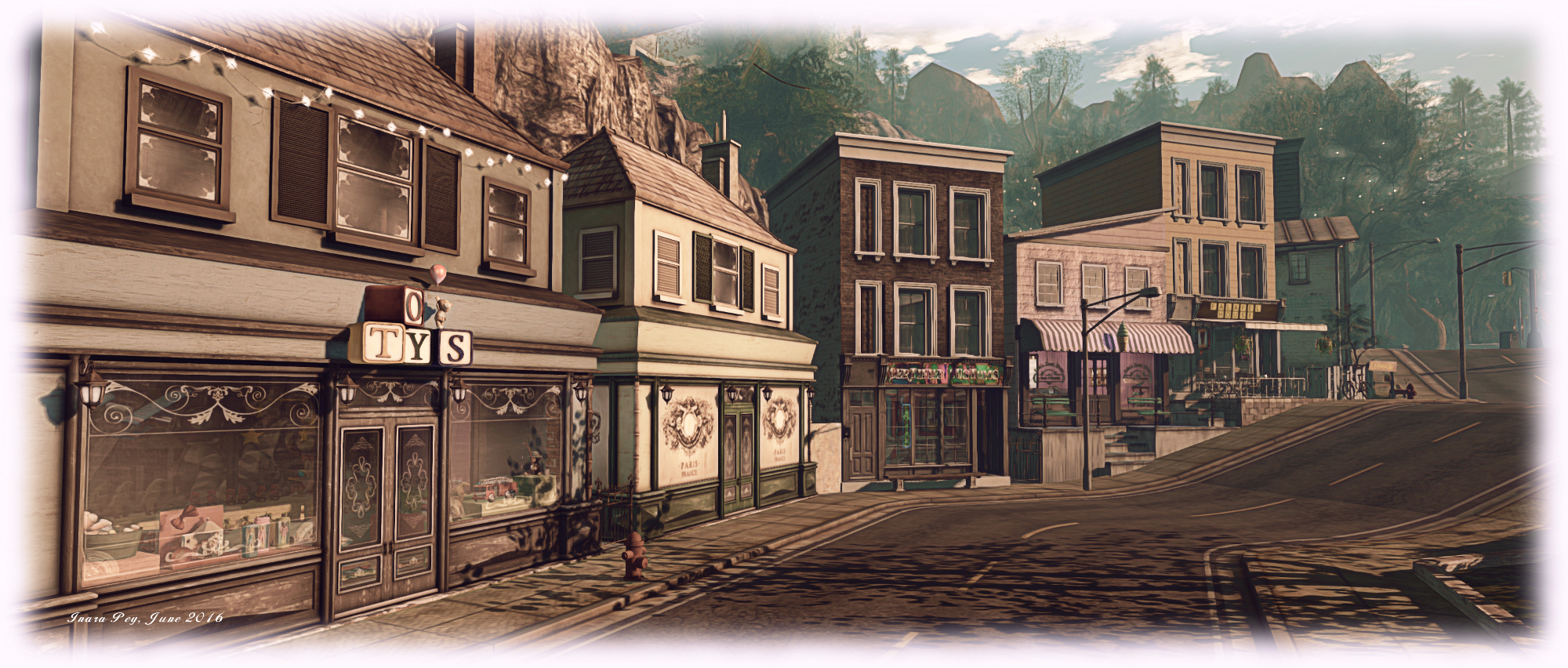
Legacy Ridge is described as a private residential community within Second Life, although it is open to public visits. A full region, the design is largely the work of Isa (Isa Messioptra) and Cipher (Ciphertazi Wandin), the talents behind Crestwick Island, a destination I last wrote about a little over a year ago, at the start of June 2015.

Given Isa and Ciph are involved in Legacy Ridge, you might expect it to be somewhat special in look and feel – and if you were to do so, you’d be absolutely right. This is a beautifully imagined and designed coastal hamlet, tucked into a fjord-like lnlet cutting deep between tall mountain peaks which hunch protectively around it as if sheltering it from the rest of the world.

Legacy Ridge; Inara Pey, July 2016, on Flickr Legacy Ridge

A visitor’s journey begins at the welcome centre, down near the north-facing waterfront. The latter is without the expected beach; instead the grassy land sit protected from the waters of the bay be a strong of boulders which sharply define the waterfront and give every impression of having been hauled down from the mountains and placed as they are for precisely this purpose. Behind them sits a tarmac parking lot and the 50’s style Lucy’s Diner.

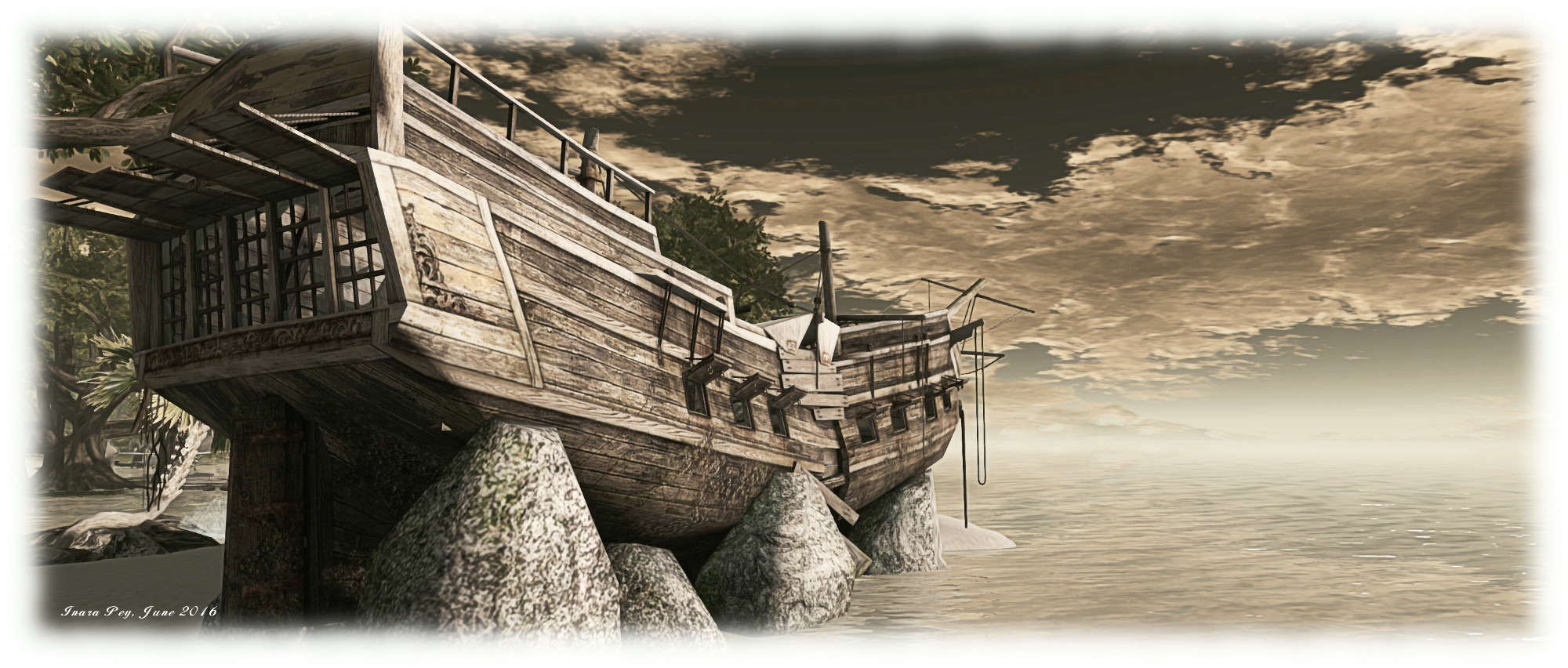
The road from the diner offers short run to the east, passing and ancient fishing boat which has been left well and truly high and dry, before petering out, a rough track completing the route to a small dock built out over the water. Southwards from the diner, the road climbs a short incline to reach a little row of shops sitting with their backs against a sheer cliff and looking out over a children’s playground to the bay beyond.

Legacy Ridge; Inara Pey, July 2016, on Flickr Legacy Ridge

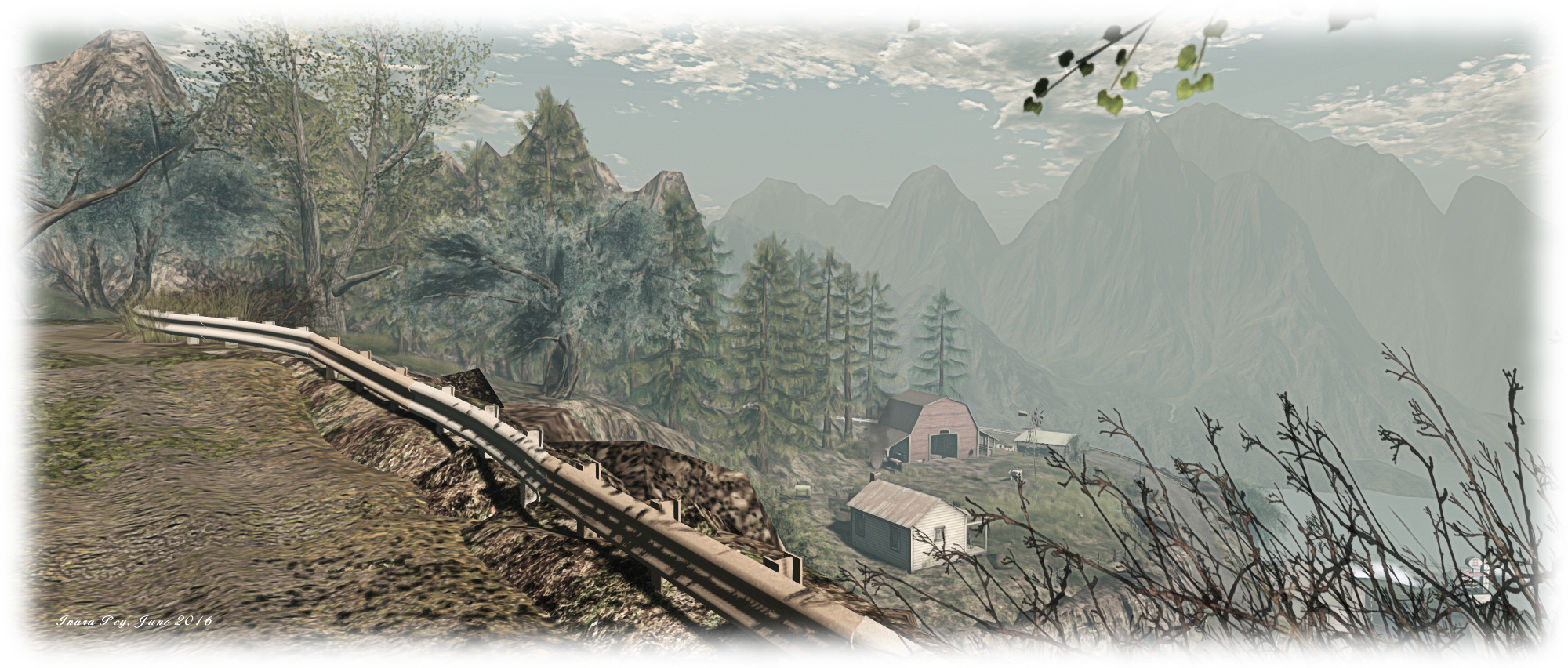
A junction marks the end of the shops, offering a choice of routes: continue eastward, and you’ll arrive at another parking lot, this one sitting before the local motel. Turn left, however, and the road will lead you onwards and upwards to a further junction. This is denoted by the abrupt end of the tarmac surface as it is crossed by an unpaved road pointing west and east. It’s entirely up to you which route you take from here, as both will lead you around the rest of the region, climbing ever higher in the process as you pass houses cosily nestled under hill and tree.

It is this aspect which gives Legacy Ridge a very unique look and feel. Walking (or cycling) up and around the tracks, there is a real impression of moving along an old coastal road, winding slowly away from the little hamlet below and to some new destination “inland”. To the west and north, the land falls away, offering views out over the water. To the east and south the land rises to a series of rounded peaks, and while these don’t blend seamlessly with the mountains of the sim surround, they do nevertheless give an immersive feeling of being the foothills to them, as they naturally hide the tall peaks from view as one winds passes directly below them.

Legacy Ridge; Inara Pey, July 2016, on Flickr Legacy Ridge

The majority of the houses up in the hills were empty at the time of my visit, but they are defined as being for private occupancy, therefore investigation is not recommended, as requested within the region rules. Other than this, Legacy Ridge is open to exploration and offers some excellent opportunities for photography, and is perfectly completed with a natural sound scape, so be sure to have local sounds enabled. Should you enjoy your visit, do please consider a donation towards the region’s upkeep.

SLurl Details