 “NASA did it again!” an elated Scott Bolton, Principal Investigator for the Juno mission to Jupiter, announced on the night of Monday July 4th / Tuesday July 5th. He was speaking shortly after the Juno space craft, having travelled 2.8 billion kilometres (1.7 billion miles), achieved an initial orbit around the largest planet in the solar system, becoming one of the fastest human made objects ever built.
“We are in orbit and now the fun begins, the science,” he added during the post-insertion press briefing. “We just did the hardest thing NASA’s ever done! That’s my claim. I am so happy … and proud of this team.”
Solar powered Juno successfully entered a polar elliptical orbit around Jupiter after completing a must-do 35-minute-long firing of the main engine known as Jupiter Orbital Insertion or JOI. The vehicle approached Jupiter over the planet’s north pole – an orbit which will afford some unique views of Jupiter and its system of rings and moons in the coming months.
Due to the time delay, some 48 minutes for a one-way signal, Juno completed the insertion burn entirely on autopilot and, for this initial pass through the planet’s radiation belts, with many of its more critical systems powered-down as a precaution and to preserve battery power – the manoeuvre meant Juno had to turn its solar panels away from the Sun, limiting its ability to generate electrical power for all of its systems.

As I reported last week, the do-or-die burn of the Leros-1b engine had to be carried out flawlessly if the spacecraft were to achieve and initial orbit around Jupiter. By the time it started at 20:18 PDT on Monday July 4th (04:18 UT, Tuesday July 5th), Juno had already accelerated to an incredible 250,000 kph (156,000 mph) relative to the planet, as a result of Jupiter’s massive gravity well, and the 35-minute engine burn was designed to reduce this huge speed by just 1,939 kph (1212 mph).
As tiny as this velocity change might sound, it meant the difference between Juno simply whipping around Jupiter to be thrown back out into deep space and being trapped in a 53.5 day orbit are the planet by that same enormous gravity well. In October 2016, a further 22-minute burn of the Leros-1b will reduce this orbital period to just 14 day, allowing the primary science mission to commence.

That mission is all about peering far beneath Jupiter’s banded clouds for the first time and investigating the planet’s deep interior with a suite of nine instruments. The hope is that Juno will probe the mysteries of Jupiter’s genesis and evolution, and by extension, how we came to be. Or, as Scott Bolton phrased it, “The deep interior of Jupiter is nearly unknown. That’s what we are trying to learn about. The origin of us.”
Life on Titan Without Water?
Further out in space and orbiting Saturn, is massive Titan, another of the solar system’s enigmas. Examined by the NASA Cassini space vehicle and (briefly) by the European Space Agency’s Huygens lander, Titan is fascinating for a number of reasons, including the fact it is the only natural satellite known to have a dense atmosphere rich in minerals and hydrocarbons.
Huygens revealed Titan has a very mixed surface environment, complete with hydrocarbon seas, lakes and tributary networks filled with liquid ethane, methane and dissolved nitrogen. This surface is also very young; while Titan has been around since very early in the solar system’s history – some 4 billion years – the surface environment is estimated to be somewhere between 100 million to 1 billion years old; suggesting geological processes have been and are at work.

All of this – particularly the thick atmosphere (which has a comparable density to that of Earth), the presence of hydrocarbon rich liquids (which also fall as rain) – has caused many astronomers and planetary scientists to speculate that Titan might have all the prebiotic conditions necessary to kick-start life. The only thing which has been seen as potentially mitigating this is the absence of surface water.
However, a team of scientists from Cornell University, New York, led by Dr. Martin Rahm, has proposed that condition on Titan are such that it might support life even without the presence of water.

Specifically, the team has been examining the role that hydrogen cyanide (HCN) might have on Titan. This is an organic chemical, which although poisonous to life today, is seen in some circles as a precursor to amino acids and nucleic acids, and thus a basic building block in the development of organic compounds which in turn might give rise to life.
In particular, hydrogen cyanide is the most abundant hydrogen-containing molecule in Titan’s atmosphere – although it is missing from the moon’s surface – and has some unique properties. It can, for example, react with itself or with other molecules to form long chains, or polymers. One such polymer is called polyimine, which is capable of absorbing light of many wavelengths and might therefore as as a catalyst for photochemically driven chemistry, some of which might be prebiotic in nature and which might in turn give rise to more complex organic reactions.
Polyimine has yet to be detected directly on Titan, so the research is still only at an initial phase, as the research team note. However,the work has been positively received. “This shows how the structures and functions that life needs can be created with molecules present on Titan and could work in liquid methane and ethane solutions,’ Chris McKay, one of NASA’s most respected planetary scientists said in response to the study. “Amino acids, DNA and water may not be the only biochemistry for life. Clearly experimental work to follow-up on these theoretical calculations is needed and then, of course, missions to Titan to see what is there.”
Unfortunately, follow-up research is liable to be restricted to arms’ length studies of Titan through the likes of the Hubble Space Telescope, the upcoming James Webb Space Telescope and direct Earth observations, as getting missions to Titan isn’t easy. Out current capabilities mean the vehicles destined for the further reaches of the solar system require suitable planetary lines-up so they can receive “gravity assists” to help speed them on their way (just like Juno had an assist from Earth, as I explained last week).
Curiously enough 2016 offered one such opportunity and, had it been funded by NASA, would have seen the launch of TiME, the Titan Mare Explorer. After a seven-year voyage, this would have splashed down in one of the largest lakes of Titan, Ligeia Mare, where it would have sought to determine the chemistry, depth and marine processes of Titan’s seas, as well as examining Titan’s atmosphere.

The next launch opportunity, coincidentally, occurs in 2023, and Spain’s Centro de Astrobiologia has developed a proposal to launch a similar mission to NASA’s TiME, but using a “paddle boat” floating laboratory called the Titan Lake In-situ Sampling Propelled Explorer (TALISE). This would also splash-down in Legia Mare, arriving in 2030, but rather than floating on the currents, would navigate the 420 km (260 mi) long lake, studying the chemistry of the lake while making for the coastal littorals, where it would also study the shoreline. TALISE has yet to receive funding from any space agency, but it is an intriguing concept.
The Big Bang Theory of the Martian Moons
One of the many mysteries of Mars is how the planet came to have its moons. There have been two competing theories over the years. The first is that Phobos and Deimos, are captured asteroids. The second is that both are the remnants of one or more collisions between Mars and other primordial bodies not long after the solar system formed.
Both theories have their pros and cons, but now a complex study carried out by a team of Belgian, French, and Japanese researchers has provided compelling evidence that both Phobos and Deimos are the last remnants of a massive collision between Mars and an object roughly one-third its size. This collision, which most likely took place when Mars was less than one billion yeas old resulted an a ring system of dust surrounded Mars, which over the next few thousand years coalesced into perhaps as many as ten small moons and possibly one comparatively large one.
Most of these orbited relatively close to the planet, where they each drawn down by gravity to break-up and collide with the planet until only Phobos and Deimos were left. the majority orbiting relatively close the planet (and interestingly enough, Phobos is now close enough to Mars that its own break-up, which will take tens of thousands of years, may have already commenced).
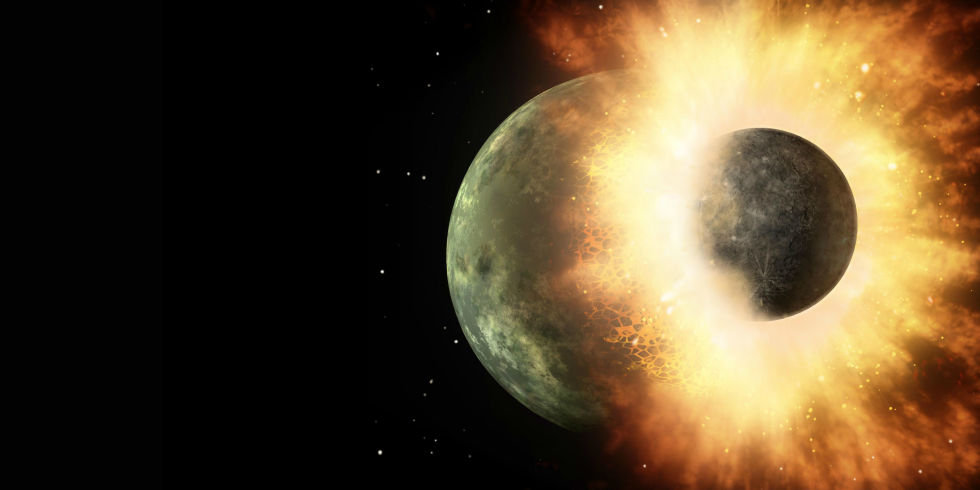
Corroboration for the research came, coincidentally, from an independent study recently published by the Laboratoire d’Astrophysique de Marseille (CNRS/Aix-Marseille Universite), which has all but ruled out the asteroid capture theory for the two little moons.
Essentially, the Marseille researchers used the light signatures emitted by Phobos and Deimos to show that unlike asteroids, the Martian moons are most likely composed almost entirely from very fine grains of dust – precisely the kind of dust found surrounding a planetary body which has collided with, and destroyed, another, smaller body.
The Martian Rovers

Meanwhile, on the surface of Mars, NASA’s rovers are encountering very different situations.
The solar-powered Opportunity rover, which is now into its 16th year of operations on Mars, has completed its latest science campaign exploring Marathon Valley, a gully on the rim of Endeavour crater. The rover has been studying the valley for almost a year, carrying our a range of science studies,
Now often overlooked in favour of its “big cousin”, the Mars Science Laboratory rover Curiosity, “Oppy” has completed more than a marathon in terms of the distance it has travelled over 16 years, a total of 42.85 km (26.63 mi). This is a remarkable achievement for a vehicle which had an original primary mission period of just 90 days – although it also demonstrates some of the limitations in relying on rover-based exploration. It also stands as testament to the power of the Martian dust devils, which have periodically passed over the rover, cleaning its solar arrays of accumulated dust and restoring power, allowing the rover to continue well beyond to most optimistic expectations for its operational life.
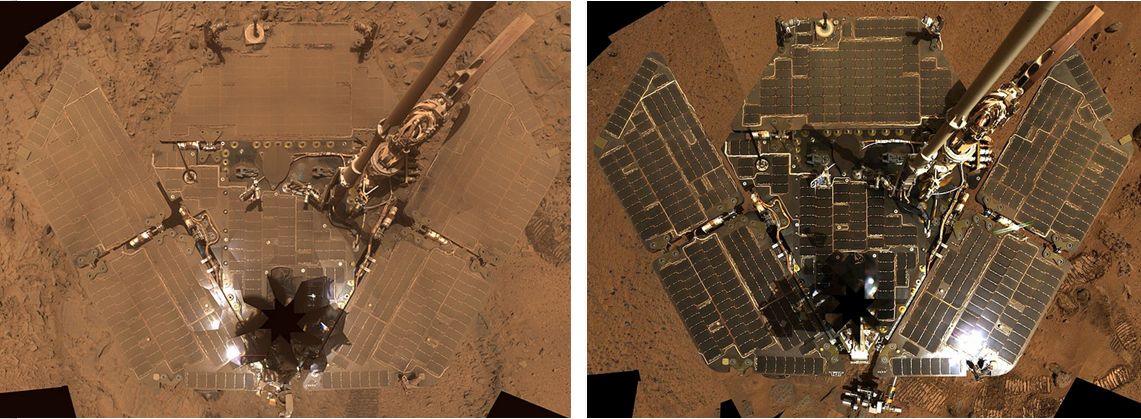
Which is not to say all is well with Opportunity; the vehicle is 16 years old, and it is showing signs of increasing age. Since December 2014, for example, the rover has been suffering from bouts of “amnesia” as a result of repeated failures to write telemetry data to its volatile memory. While these aren’t serious enough to halt the rover’s activities, they do act as a reminder that “Oppy” is becoming one of the grand old ladies of Mars.
Not that Opportunity is alone in having problems. On Saturday, July 2nd, the Mars Science Laboratory rover Curiosity unexpectedly withdrew into “safe” mode as a result of an unexpected mismatch between camera software and data-processing software in the main computer.
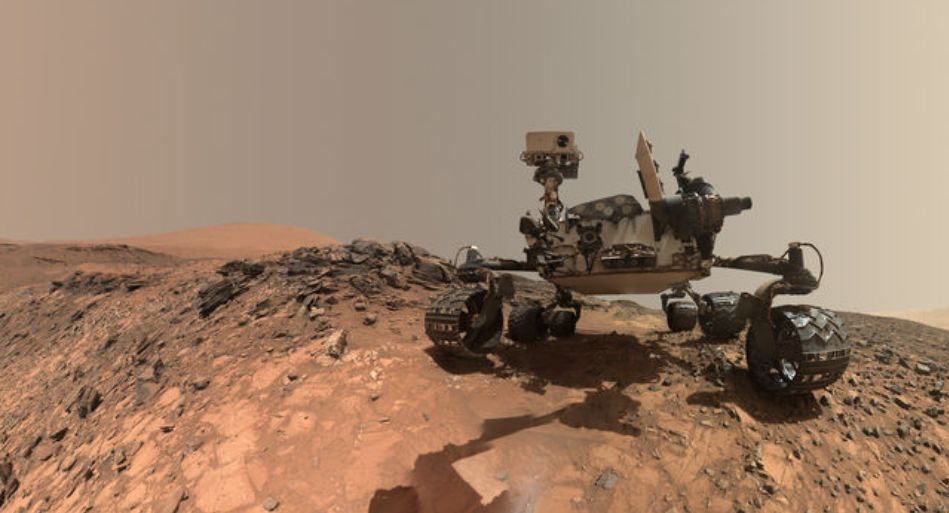
This is the fourth time the rover has switched to safe mode – which is designed to prevent the vehicle damaging either of its own-board computer systems – the other three occurring in 2013. It means the rover has ceased most activities outside of monitoring itself and maintaining prescribed sequence for communications with Earth, both of which include running a set of diagnostics across its systems and supplying the results to engineers on Earth so that further investigations and analysis can be carried out.
The situation is not considered to be a threat to the rover, and all three prior safe mode situations were resolved with Curiosity able to resume normal operations following support from Earth. As it is, the mission recently received a funding extension from NASA which will allow it to continue through until at least October 2018.

 Inara Pey: Living in a Modemworld