 Dawn, the NASA / ESA joint mission to explore two of the solar system’s three “protoplanets” located in the asteroid belt between the orbits of Mars and Jupiter, continues to intrigue scientists as it studies Ceres, the second of its primary targets.
As I reported in June 2015, Dawn is part of a broader effort to better understand the origins of the solar system and how the planets actually formed; all of which might give us greater understanding of how life arose here on Earth.
Launched in September 2007, Dawn arrived at Ceres in March 2015, after a 2.5 year transit flight from Vesta, its first destination, which it had been studying for 14 months following its arrival in July 2011. Because of their relative size – Ceres accounts for around one-third of the total mass of the asteroid belt – both of these airless, rocky bodies are regarded as dwarf planets, rather than “simple” asteroids. However, Ceres is proving to be quite the conundrum.
At the start of July, Dawn completed the first part of its high-altitude survey of Ceres and fired its low-thrust ion drive to start a series of gentle manoeuvres to reduce its orbit around from 4,400 kilometres (2,700 miles) to 1,450 kilometres (900 miles). It’s now hoped that from this lower orbit, the space craft will be able to discover more about some of Ceres’ more mysterious features.
One in particular has been the subject of much debate. It started when Dawn imaged a series of bright spots within the crater Occator as it made its initial loop around Ceres to enter orbit. Since that time, it has repeatedly images the bright spots, and their presence has also been confirmed by the Hubble Space Telescope.

Currently, it is believed the bright marks might either be salt deposits or water ice (the European Herschel Space Observatory had previously found evidence of water vapour on Ceres). However, while the science team aren’t leaning either way, their mission briefing on July 21st, leant some weight to the bright spots perhaps being water ice. This came in the form of an announcement that he 92 kilometre (57 mile) wide Occator has its own, very localised atmosphere focused around the bright areas.
The evidence for this comes from images of the crater taken from certain angles which reveal a thin haze covering around half of the cater, but not extending beyond its walls. Th thinking is that this haze is perhaps the result of the ice in the bright area – if they are ice – sublimating out.
However, if this is the case, it actually raises a further mystery: why the haze? Generally, such sublimation would lead to the resulting gases dissipating very quickly, without forming a haze. One hypothesis is that Ceres’ gravity, which is somewhat higher than might be expected for a body of its size) may be and influencing factor.
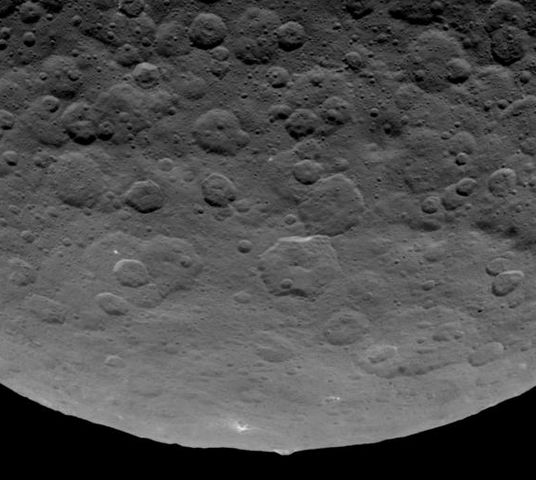
The bright spots aren’t the only curious feature on Ceres. Dawn has also spotted numerous long, linear features whose cause is unknown, as well as one big mountain that mission team members have dubbed “The Pyramid.” This massif, about 5 km (3 mi) in height, and around 30 km (19 mi) across at its base, is oddly flat-topped and has streaks of bright material on one of it flanks, as if something has been cascading down the slope. What this might indicate has planetary scientists scratching their heads at this point.
With all the mysteries thrown up by New Horizon’s recently flyby of Pluto, and Dawn’s discovery of mysterious features on Ceres, it really is becoming a case that the tiny worlds of our solar system are perhaps the most perplexing.
Three years ago, in August 2012, NASA’s Mars Science Laboratory rover, Curiosity, arrived in Gale Crater, Mars. Since that time, the rover has made some remarkable discoveries, as reported in this blog over the years.
To mark the anniversary of the landing, NASA has launched two new on-line tools designed to open the mysterious terrain of the Red Planet to anyone with an interest in planetary exploration.
Experience Curiosity allows users to journey along with the one-tonne rover on its Martian expeditions. The program simulates Mars in 3-D, using actual data returned by the rover and NASA’s Mars Reconnaissance Orbiter (MRO). It also uses a game-ready rover model based entirely on real mechanisms.

User are able to drive the rover, examine it, call up data on key components, witness the driving view from different cameras on the rover, and operated the robot arm. Activities are a little basic, but as this appears to be a part of NASA’s Eyes On project, capabilities may grow over time.
Mars Trek is a much more expansive tool – one which is actually being used in the planning for the Mars 2020 rover mission. It features interactive maps, which include the ability to overlay a range of data sets generated from instruments aboard spacecraft orbiting Mars, and analysis tools for measuring surface features. Standard keyboard gaming controls are used to manoeuvre the user across Mars’ surface, and topographic data can be exported to 3D printers to allow the printing of physical models of surface features.
The map view and be manipulated in 2D or 3D, data on various surface missions is provided, compete with the ability to zoom into the surface locations for these missions, making for a visually impressive model.
Continue reading “Space Sunday: active Ceres, open Mars, and shooting stars”







 Inara Pey: Living in a Modemworld