Examining Firestorm’s landing pages for Second Life

MadPea and Firestorm: working in collaboration to enhance the experience those new to Second life have with the platformUpdate #3, January 9th, 2016:  The testimonials on the landing pages have now been updated with genuine comments and images from Second Life users.

Update #2: I’ve further been informed that the testimonials are intended to the express the sentiments of SL users and are based upon feedback. expressed by SL users. Similarly, the images are in fact stock Internet images. A footnote to the effect that “The consumers above are not actual consumers of the advertised product.” has now been added to each of the landing pages.

Update #1: I’ve been informed by various third parties that the testimonials on the landing pages may not in fact be genuine. I’ve therefore revised this post until I hear further on this matter.

On Monday, December 28th, Friestorm announced the arrival of their Gateway landing pages, and asked Firestom users for their assistance in helping to spread the word about Second Life.

The Landing pages are an integral part of the Firestorm Gateway, which itself forms a part of the upcoming trail Gateways Programme I previewed back in September, and which hopefully will be officially announced as up and running by the Lab in the near future.

In all, six landing pages have been produced, each one of which is intended to showcase a specific aspect of using Second Life, and encourage those new to Second Life to sign-up and log in to the platform. To help with this, Firestorm is asking SL users to share those pages they feel their non-SL friends and contacts would find to be of the most interest and thus sign-up.  The six pages have the following topic descriptions:

While one might quibble over the subject titles (role-play and exploring might seem to exhibit a high degree of cross-over, for example), the pages themselves offer a crisp, clean approach to present Second Life, including endorsements from (and photos of) actual SL users.

Each of the pages includes a series of sign-up buttons which carry those interested to the initial phase of sign-up: creating an account – providing a user name, etc.

The sign-up form
The sign-up form using the Lab’s API

It’s probably worth pointing out here, and before the conspiracy theorists reach for their tin-foil hats,  that this sign-up process uses an API supplied by Linden Lab. This means that, just like all third-party TPVs, none of the gateways in the programme – Firestorm or anyone else – is storing or accessing the sign-up information a new user provides. The information is strictly between the user and the Lab. The only part of the sign-up information which can be accessed is the e-mail address: and that only for as long as it takes for an automated welcoming e-mail to be sent.

Providing the fields are correctly filled-out  – error messages will be displayed at the foot of the input fields, although you may have to use the vertical slider to bring them into view thanks to the API – clicking Get Started will move you on to the next page, intended to step the user through downloading, installing and launching the viewer.

The Firestorm instructions page

To me, this page presents some issues which perhaps need to be dealt with if it is to be as effective as might be hoped – I’ll come back to this a little later.

One thing established SL users are bound to note is that nowhere is there any opportunity for the new user to select an avatar.

This isn’t an oversight on the part of the Firestorm team – it is a result of having to use the “old” user sign-up API, which doesn’t have any hooks into the Avatar Picker seen on the Lab’s own sign-up pages.  Thus, the first opportunity new users get to picker the gender of their avatar is after they have logged-in – and even then, they only initially get either the male or female default Character Test avatars which (a long while ago) replaced the infamous “Ruth”.

As the gateway has to use the "old" SL registration API, users do not get to select the gender of their avatar until after they log-in (left), and are then defaulted to either the female or male Character Test avatar
As the gateway has to use the “old” SL registration API, users do not get to select the gender of their avatar until after they log-in (left), and are then defaulted to either the female or male Character Test avatar (click to enlarge, if required)

Obviously, this is far from ideal. First impressions count, and many people seeing their avatar for the first time and comparing it to the glossy images on the landing pages could end up feeling a tad bit aggrieved or disappointed and might even simply log off.

This issue has already been raised with the Lab, so hopefully, something can be done about it,  either by providing the updated API with the avatar picker to those involved in the gateway programme, or by the Lab finding the means to present new users coming into SL via these gateways with at least one of the new “Classic” avatars instead of the Character Test versions.

Once they have selected their gender and have seen their avatar appear, the new user will find they’re starting at the start of the Firestorm’s orientation island, where they can start learning to use the viewer, before progressing on to finding out more about Second life in general through the various activities and events operating within the Firestorm gateway regions.

Given that new users are confronted with the Character Test avatars on first logging in (and allowing for the fact this will hopefully be changing), I did find myself wondering if a short lesson couldn’t be provided showing the new user how to access the Avatar Picker and quickly create an alternative look, just to reassure them that avatars in SL really don’t all look like they first see themselves.

The Firestorm Gateway incorporates their viewer orientation island and includes social areas for users
Once new users have progressed through the Firestorm landing / sign-up pages and have installed the viewer and logged-in with it, they’ll be delivered to the orientation island in the Firestorm gateway regions

Continue reading “Examining Firestorm’s landing pages for Second Life”
2015 viewer release summaries: week 52

Updates for the week ending Sunday, December 27th

This summary is published every Monday, and is a list of SL viewer / client releases (official and TPV) made during the previous week. When reading it, please note:

  • It is based on my Current Viewer Releases Page, a list of all Second Life viewers and clients that are in popular use (and of which I am aware), and which are recognised as adhering to the TPV Policy. This page includes comprehensive links to download pages, blog notes, release notes, etc., as well as links to any / all reviews of specific viewers / clients made within this blog
  • By its nature, this summary presented here will always be in arrears, please refer to the Current Viewer Release Page for more up-to-date information.

Official LL Viewers

  • Current Release version: 4.0.0.309247, December 17th – no change
  • Release channel cohorts (See my notes on manually installing RC viewer versions if you wish to install any release candidate(s) yourself):
    • No updates
  • Project viewers:
    • No updates.

LL Viewer Resources

Third-party Viewers

V4-style

  • No updates.

V1-style

  • Cool VL Viewer updated as follows: Stable version to 1.26.16.5 and Experimental branch to 1.26.17.3, both on December 26th (release notes).

Mobile / Other Clients

  • No updates.

Additional TPV Resources

Related Links

Winter at The Trace Too in Second Life

The Trace too; Inara Pey, December 2015, on Flickr The Trace Too (Flickr) – click any image for full size

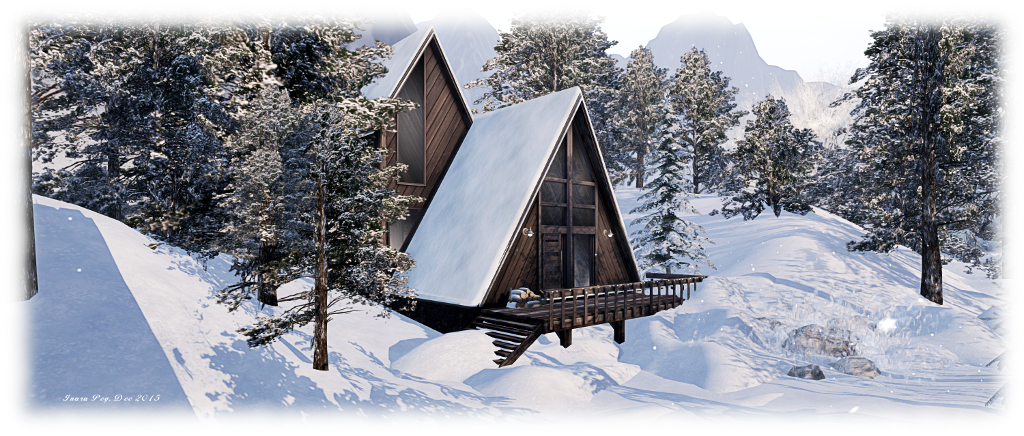
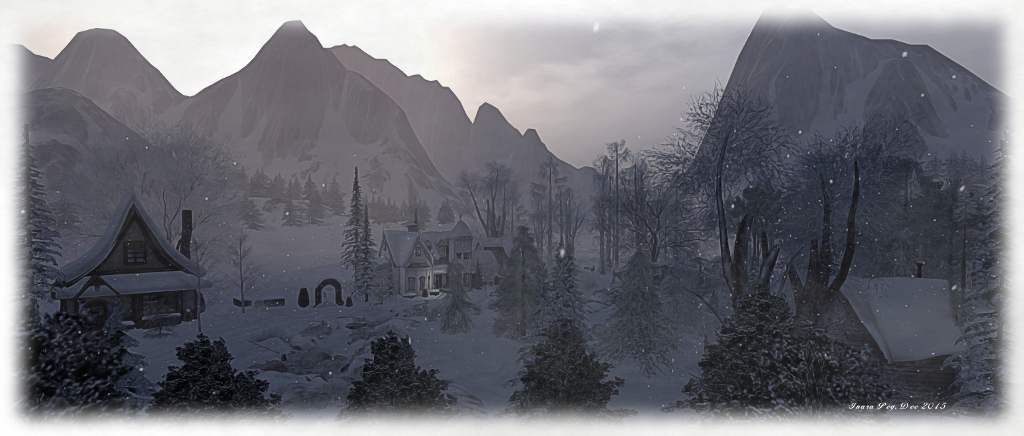
Seasons change at The Trace Too – it’s one of the elements which keep Kylie Jaxxon’s homestead region so fresh and appealing, causing many of us to return there again and again through the year. This Christmas / New Year season is no different, and visitors dropping into the homestead region will find it snuggled under a blanket of snow, the surrounding mountains a salt and pepper mix of snowy folds and exposed rock.

While the rural look and feel to the region which came with the autumn season remains, the landscape and buildings scattered across it have changed somewhat. The landing point offers a choice of snowy paths to follow; which you take is entirely up to you. Closest to the landing point sits a row of cottages and houses, a short distance from the local church.

The Trace too; Inara Pey, December 2015, on Flickr The Trace Too (Flickr)

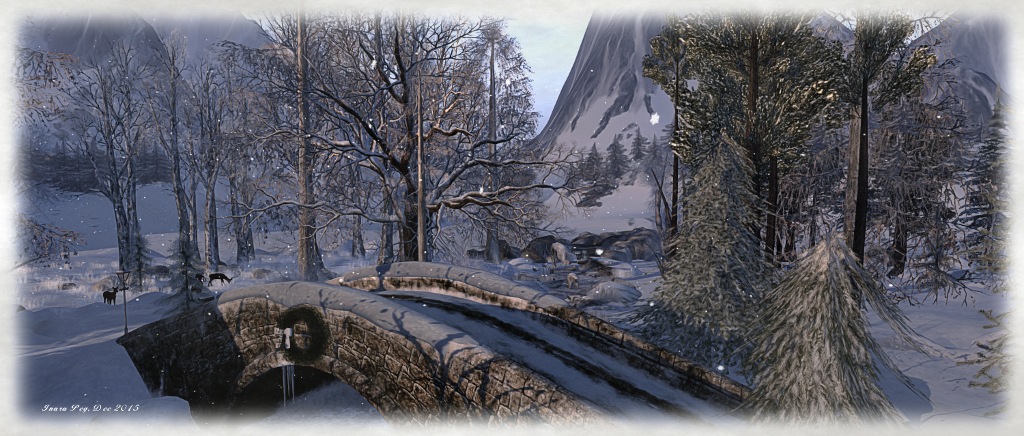
The houses lead the way to a stone bridge, deer foraging in the woods nearby as the path arches over the stonework of the bridge, crossing a frozen stream to turn back eastwards, taking the visitor to a beautiful appointed wood framed house. Further to the north sits a frozen lake with a little chalet on the shore, while to the north-east sits a cosy little group of shops offering more shelter from the cold.

Everywhere the show lies crisp and deep – if not necessarily even, having drifted into mounds here and there as more falls from a sky tinged with grey cloud. The snow has piled high on rooftops as well, and hugs an A-frame house in its grasp, making a particularly picturesque setting among the fir trees to the east of the region.

The Trace too; Inara Pey, December 2015, on Flickr The Trace Too (Flickr)

Kylie always makes great use of space within her region designs, and this winter offering is no exception. Houses, shops and cabins are positioned so that one can enjoy a good walk whilst exploring and gain the impression the region is bigger than expected. Options to simply sit and enjoy the landscape can also be found scattered around.

For those looking for a wintry location to enjoy that’s not crowded-out with bits and bobs, or who want to grab some more scenic and seasonal photographs, The Trace Too is a perfect destination.

The Trace too; Inara Pey, December 2015, on Flickr The Trace Too (Flickr)

SLurl Details

Space Sunday: bringing a rocket home; uncovering Ceres

A second from touchdown: the Falcon 9 first stage booster, with landing legs deployed, about to make a successful landing at "Landing Zone 1", Cape Canaveral Air Force Station, having been launched from the space facility 10 minutes earlier as a part of a flight to deploy 11 Orbcomm telecommunications satellites
A second from touchdown: the Falcon 9 first stage booster, with landing legs deployed, about to make a successful landing at “Landing Zone 1”, Cape Canaveral Air Force Station, having been launched from the space facility 10 minutes earlier as a part of a flight to deploy 11 Orbcomm telecommunications satellites

On Monday, December 21st, the private space launch company SpaceX achieved a remarkable first in the annals of space flight: they successfully launched a payload carrying rocket into orbit, and then returned its first stage to a safe landing back on Earth, close to its original launch point.

The Falcon 9 rocket, in its first launch since June 2015 when a fuel tank failure lead to the vehicle’s destruction together with the Dragon resupply vehicle it was lifting to the International Space Station, was lifting a total of 11 communications satellites into orbit on behalf of Orbcomm.

The booster lifted-off from Florida’s Cape Canaveral Air Force Station at 20:29 EST on Monday, December 21st (01:29 UTC, Tuesday December 22nd).  At 2 minutes 27 seconds into the flight, having pushed the vehicle through the densest part of the atmosphere, the first stage engines shut down, and shortly afterwards, the first and second stages separated, allowing the latter’s Merlin engine to ignite.

As the second stage continued to accelerate up to deployment orbit, the first stage coasted upwards before using cold gas thrusters to effectively “flip” the booster around so it could use the first in a series of “boostback burns” of its main engines to slow itself down as well as pushing it back towards Cape Canaveral.

With this completed, the booster used the cold gas thrusters to again flip itself over so it would be descending engines first towards the ground, performing two further “boostback burns” to control its descent before making a final engine burn during the last few dozen metres of the descent and deploying its 4 landing legs and steering vanes for a successful touch down some 10 minutes after lift-off, which was captured by cameras on the ground and aboard an observing helicopter.

The SpaceX success came less than a month after Blue Origin, the private space company founded by Amazon billionaire Jeff Bezos, also landed the initial stage of their New Shephard launch system following a test launch. However, the latter is not intended to achieve orbital velocities at present, and so the booster stage – referred to as the “propulsion module” by Blue Origin – was not travelling nearly as fast as the Falcon 9 first stage, nor did it have to perform the complex “boostback” manoeuvres.

In the meantime, the second stage continued upwards, successfully deploying the Orbcomm satellites into LEO – low Earth orbit, at around 630 kilometres (just under 400 miles) altitude. With this part of the mission completed, the second stage booster also re-ignited its main engine, allowing it to achieve a geostationary transfer orbit and coast phase.

This was as important as the first stage landing because, while existing Falcon 9 rockets are capable of placing large payloads into geosynchronous equatorial orbit, some 36,000 km (22,000 miles) above the surface of the Earth, it has required the first stage of the rocket to do much more of the work, leaving it with insufficient fuel reserves to attempt a return to Earth and landing. The uprated second stage, tested as a part of this flight, alleviates the first stage of some of the booster phase work, allowing it to retain the fuel it needs to make a successful return to Earth.

The overall hope with the upgraded Falcon 9 and the new landing facilities at Cape Canaveral, is that they will allow SpaceX to lower launch costs to the benefit of customers, and allow them to make more efficient use of their boosters rather than just tossing them away into the Atlantic or Pacific after a single use.

However, even with this first successful landing, the company still has some significant hurdles to clear. One of these will be demonstrating it can refurbish used first stages at a fast enough pace to be able to maintain a launch cadence high enough to be attractive to commercial operators looking for launch opportunities, rather than risking them look to those companies able to offer a faster launch rate.

Nevertheless, SpaceX’s achievement is clear, and after the disappointments in trying to recover the Falcon 9 first stage at sea (initially seen as a “safer” option due to the negligible risk of civilian injuries if anything went wrong when compared to  returning a rocket to Earth near populated areas), deserves every congratulation.

Dawn over Ceres

Dawn mission patch (NASA / JPL)

Dawn, the NASA / ESA joint mission currently mapping Ceres, one of the solar system’s three “protoplanets” located in the asteroid belt between the orbits of Mars and Jupiter, reached its lowest planned orbital altitude in early December, ready to start the final phase of its mission.

The new orbit, just 385 km (230 miles) above Ceres mains the craft can image the surface at a resolution of 35 metres (120 feet) per pixel.

Of particular interest to the science team has been determining the mysterious bright patches seen within the crater Occator during Dawn’s approach to Ceres and during its higher mapping orbits. While perhaps the largest found, the bright spots in Occator are not alone – around 130 bright spots have been located, almost all of them within Ceres’ craters, and analysis now shows that the material  seems to be consistent with salts, such as sulfates, with silicate materials also very likely present.

A false-colour representation Occator Crater on Ceres reveals the short wavelength of the bright deposits in the crater, pointing to them being salts. Occator measures about 90 km (60 miles) across

Continue reading “Space Sunday: bringing a rocket home; uncovering Ceres”

Cica’s Roots in Second Life

Roots - Cica Ghost
Roots – Cica Ghost

Sunday, December 27th saw the opening of Cica Ghost’s latest installation Roots. Like all of her installations, it is a beautifully fascinating piece; one which clearly draws on some of her earlier pieces, offering a new interpretation of them while at the same time presenting something that is both captivating and tinged with a soulfulness that is quite moving.

The clearest inspiration for the installation is Cica’s marvellous Little Village from March 2014. The little houses, clinging to their little hills, paths running around and between them, are all here; but something is very different. The gay colours have faded, the paths are in places broken, frameless windows stare sightless across a darkening landscape, while doorways sit slack-jawed  without doors,

Roots - Cica Ghost
Roots – Cica Ghost

Cica tells us, “The people have gone… the village remains, and time and nature now live here …” and so it is. Roots rise up from the ground and spring from gaunt trees, passing through empty windows to rise through roofs, while trees sprout new growth where once chimneys puffs the comforting smoke from fireplaces, and the fences alongside the paths broken and bent.

Sitting under s sombre sky, the little village slowly surrenders itself to nature, quietly decaying and fading. Even the bright flowers have been mostly replaced by poppies, the flower so often associated with sacrifice and death. However, this shouldn’t be taken to mean all is dark and foreboding here.

Roots - Cica Ghost
Roots – Cica Ghost

There is a melancholy beauty within Roots which has to be seen to be appreciated. There is something also Burton-esque in its construction that tugs at the heart; walking through the village, it is hard not to be captivated and enthralled. And when you do, you’ll come across other touches echoing Cica’s earlier works. A face peeking around the window of one house hints at Strings, while a strong echo of Dreamers can be found in the form of sculpted heads; a suggestion that what we are seeing is but a dream, or simply decorative pieces left with the rest of the village?

Should you wish, you can also take the air, balloons float, hover, drift and bob their way around the village, and you can hop a ride on them. Whether you float via balloon, walk (or do both), do be sure to have the audio stream on as well; the music does much to complement the installation, helping to enhance one’s feelings and response to the build.

Roots - Cica Ghost
Roots – Cica Ghost

I make no secret of my admiration for Cica’s work; her imagery, her use of motifs, her presentation and the joy she brings to her art always captivates me. At the same time, she can often challenge our thinking or our perceptions as she tells a story through her work.

Roots is another wonderful piece, and one not to be missed. It’s also one I made sure I made time to film, having missed the opportunity with Prison and Strings.

SLurl Details

  • Roots (Rated: Moderate)

Seeing out the year with Seanchai Library in Second Life

It’s time to kick-off another short  week of story-telling in voice, brought to our virtual lives by the staff and volunteers at the Seanchai Library, as we move from Christmas to New Year celebrations. As always, all times SLT, and events are held at the Library’s Second Life home at Bradley University, unless otherwise indicated.

Sunday, December 27th, 18:00: All Good Gifts

A new original story by Caledonia at Magicland Park.

Monday December 28th, 19:00: Science Fiction Adventures

With Gyro Muggins.

Tuesday December 29th 19:00: Epiphany

MiracleTrolley Trollop continues to read from Connie Willis’ miracle and Other Christmas Stories, bringing us Epiphany, the final tale in the book.

A Christian minister has an epiphany about the Second Coming of Christ, which leads him onto a journey of his own.

He is accompanied by an atheist and a retired English teacher; an unlikely trio of wise men who walk snow-covered streets, following their own signs and wonders, and gaining insights into their faith (or lack of it) along the way in a moving tale which discusses faith without ever proselytising.

Wednesday, December 30th 19:00: The Following Shoes Are a Gift from the Pope

In a special 75-minutes session, Caledonia Skytower reads from M.J. McGalliard’s collection of short stories rife with absurd (though not “blasphemous”) humour related to saints, and some of the more circuitous doings of the Catholic Church.

—–

Please check with the Seanchai Library SL’s blog for updates and for additions or changes to the week’s schedule.

The featured charity for October – December is Reach Out and Read, one of the most highly rated literacy charities in the USA which reaches 4.4 million children annually and distributes 1.6 million books.

Additional Links