 NASA and the Applied Physics Laboratory (APL) at John Hopkins University kept their promise a little earlier than expected.
With the resumption of image and data transmissions from New Horizons, at the start of September, they had indicated that Fridays would henceforth, and for the course of the next 12 months, be known as Pluto Friday, the day on which the latest raw images from the mission to that distant tiny world and its companions would be released.
However, the first set of images came a little sooner than advertised: on Thursday, September 10th, and they continue to show two tiny worlds which continue to astound and have planetary scientists rethinking much about their understanding of dwarf planets.
“Pluto is showing us a diversity of landforms and complexity of process that rival anything we’ve seen in the solar system,” New Horizons’ principal investigator Alan Stern, from the Southwest Research Institute in Colorado, said in a statement. “If an artist had painted this Pluto before our flyby, I probably would have called it over the top — but that’s what is actually there.”
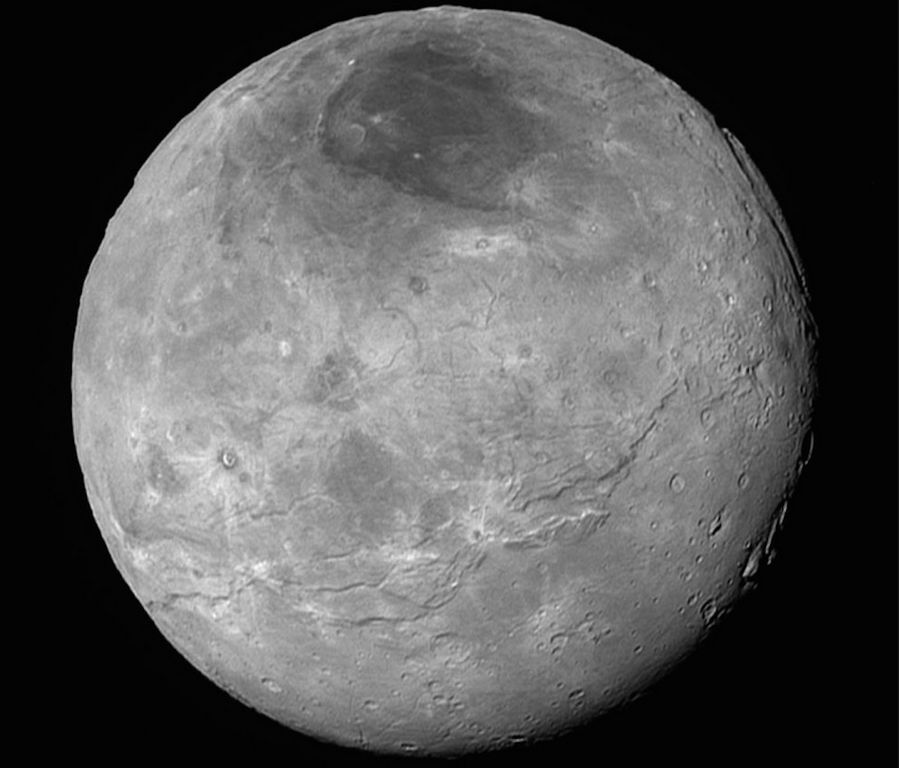
The images render details as small as 400 metres / 440 yards per pixel on the surface of Pluto, and reveal features that have scientists agog with excitement; so much so that at a NASA press conference, the images were summarised thus, “it’s complicated!”
In them, we can see a rich complexity of features: nitrogen ice flows which have apparently oozed (and might still be slowly oozing) out of mountain ranges and across broad plains; mountain ranges which are themselves reminiscent of chaotic regions on Mars and Jupiter’s Europa; complex valley systems which might have been carved by the action of material flowing across the planet; and even – perhaps most curiously of all – what seem to be wind-blown fields of dunes.

What is also particularly striking about these images of Pluto is the way that they reveal some of the oldest (geologically speaking) regions yet seen on the planet sitting right alongside what are the youngest locations on the planet, adding further emphasis to the idea that Pluto has been, and might still be, an active world.
But what about those dunes mentioned above? If they are indeed what the images released on September 10th suggest, Pluto has once again served up a surprise.
“Seeing dunes on Pluto, if that is what they are would be completely wild!” William McKinnon from the mission’s Geology, Geophysics and Imaging (GGI) team, said, “because Pluto’s atmosphere today is so thin. So either Pluto had a thicker atmosphere in the past, or some process we haven’t figured out is at work. It’s a head-scratcher!”

More is also being discovered about Pluto’s atmosphere, which is also proving to be a lot more complex than had originally been thought, having many more layers within its thin haze than had been thought. However, these layers of haze have allowed the science team to glimpse surface features which might otherwise have remained unseen as sunlight caught by the haze over the terminator – the divide between the day and night sides of the planet – cast a soft glow over part of Pluto’s night side. When enhanced through careful processing, this glow could be used to reveal what lay below.
“This bonus twilight view is a wonderful gift that Pluto has handed to us,” said John Spencer, another member of the GGI team. “Now we can study geology in terrain that we never expected to see.”

The images given here are all black and white because the main imaging camera on New Horizons, LORRI, is only capable of taking black-and-white images, the best means to reveal surface details. However, the Ralph instrument on New Horizons can capture data relating to the colour of surface features, which can be combined with the LORRI pictures to produce colour images once the data has been properly processed. So hopefully, colour images should appear in due course.
The Waters of Mars
There have been two intriguing announcements about Mars in the course of the past weeks. In the most recent, a team of researchers led by Alexis P. Rodriguez of the Planetary Science Institute, offers a new hypothesis on how the flood plains imaged on Mars may have formed, while the second may offer something of a corroboration.
It has tended to be thought that the huge, low-lying flood plains seen across Mars formed as a result of the near-simultaneous release of water from a global water table on the Red Planet around 3.2 billion years ago.
However, Rodriguez and his team suggest that in fact, the flood plains have their origins some 450 million years earlier than that, and arose from a series of very localised geologic events. They propose that as the lowland oceans of Mars went into decline, together with their many tributary river networks as the atmosphere thinned and cooled, water retreated into the sediments locked within valleys and canyon systems, where it froze out.

Then, around 3.2 billion years ago, localised subsurface activity within the planet caused lava to heat some of these sediments from below, melting the trapped water within them, giving rise to sudden and violent flooding to create the features we see from orbit today.
“Our investigation suggests that early Mars sedimentation could have buried and trapped enormous volumes of surface water, perhaps triggering the transition into the frozen world that Mars has been during most of its history,” Rodriguez said.
If correct, the study suggests a number of things. firstly, it lends weight to an idea put forward in a recent study into the disappearance of Mars’ ancient atmosphere (see my report last week), that Mars may have in fact been a lot colder than previously thought when many of its water-related features were formed. Secondly, it suggests that if life arose on Mars, and “followed the water” underground, then the material exposed by these vast floods may hold evidence of environments which may once have been suitable to sustain microbial life. Thirdly, it lends weight to the oft-stated idea that their may be vast frozen “lakes” beneath the surface of Mars.
“Because the process of deposition, freezing, heating and eruption were regional, there may be vast reservoirs of water ice that are still trapped beneath the Martian surface along the boundaries of its ancient northern ocean as well as within the subsurface of other regions of the planet where contemporaneous seas and lakes formed,” Rodriguez stated.
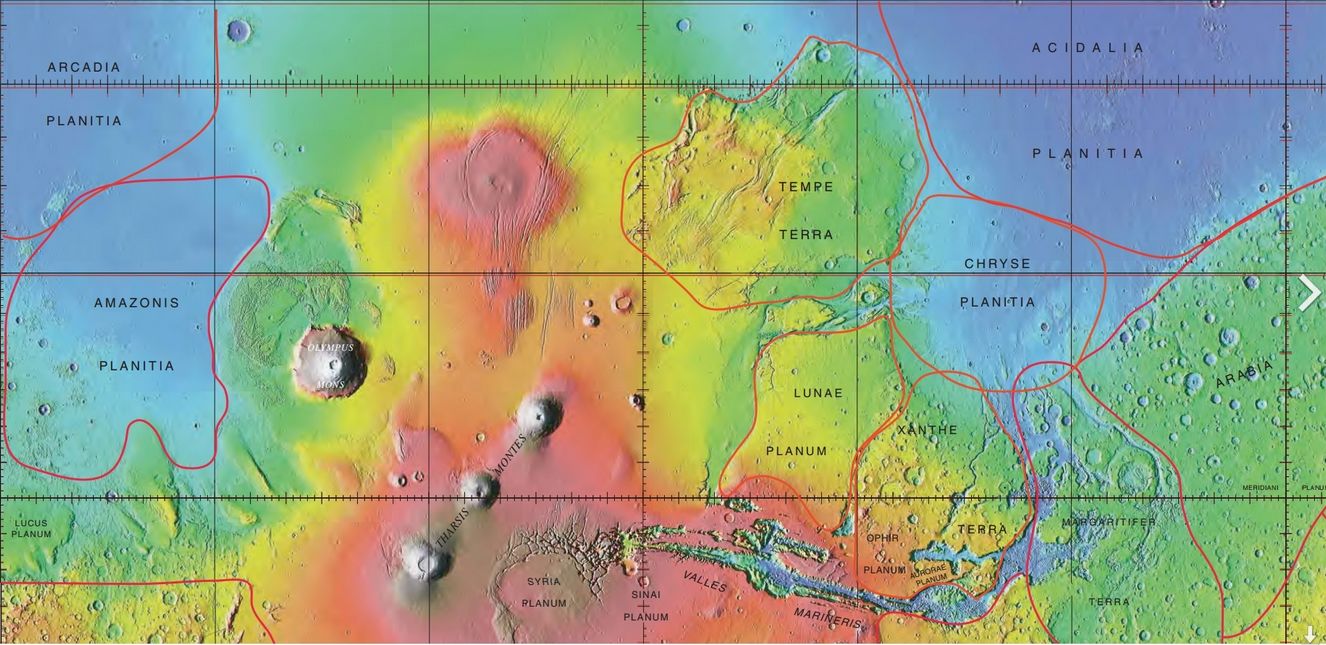
This third point – that there may be large frozen slabs of water ice under the surface of Mars – had already had some degree of corroboration. Slightly ahead of the Rodriguez team publishing their findings, a group of researchers from the University of Arizona issued the results of their investigations into a series of very unique craters found in the low-lying Arcadia Planitia, region of Mars, lying between the equator and the north pole.
These craters – around 187 were identified and studied – are all small in size, around 350-430 metres (1,000-1400 ft) across and have an unusual “terraced” cross-section, rather than the more usual “bowl” shape found in impact craters of a similar size. These “stepped” pattern to their shape suggests they are made up of different layers of material – ice, dirt, rock – rather than being of the more uniform composition.
It is believed that when the impact which created them occurred, these different layers offered different degrees of resistance to the impact shock wave, leading to their stepped shape. In this, they are almost unique across the entire surface of Mars, suggesting something equally unique may lie below them.
As a result, the team investigating the craters used images from the High Resolution Imaging Science Experiment (HiRISE) camera aboard NASA’s Mars Reconnaissance Orbiter (MRO) to construct 3D models of some of the craters, allowing them to estimate the thickness of the different terrace layers in the craters. This information in turn allowed them to calibrate the Shallow Radar, or SHARAD, instrument on MRO to measure the layers and determine their composition.

The results revealed a slab of ice averaging around 40 metres (130 ft) thick, lying beneath the surface of the plain, and extending over a huge area and as far down as the 38-degree line of latitude.
Quite how the slab formed isn’t clear, but one theory is that the ice may be the result of periods of snowfall at some point in Mars’ past. Currently, the research team are continuing their investigations into the region in the hope of determining the most likely explanation for the ice, and how it has remained preserved for so long.
NASA PI Runs Kickstarter for Education and Outreach
A long tradition with NASA space missions is that historically, they have always been able to include the cost of EPO – Education and Public Outreach – within their budgets, allowing them to directly promote their activities through the experts directly involved with the mission.
However, a 2013 US federal policy change designed to consolidate U.S. education spending within the Department of Education, means that NASA’s Science Mission Directorate, which handles all of the agency’s unmanned space missions, is now only allowed to spend a very small part of its $5 billion a year budget – around $40 million – on EPO activities. And this isn’t enough to fund all of the Directorate’s outreach activities.
The first major casualty of this policy change was OSIRIS-REx, an asteroid sample-return mission slated for launch in September 2016, which had all EPO funding removed in 2013. However, the mission’s Principal investigator,Dante Lauretta, has come up with a novel way to try to fund the mission’s STEM activities directly – through the crowdfunding portal Kickstarter.
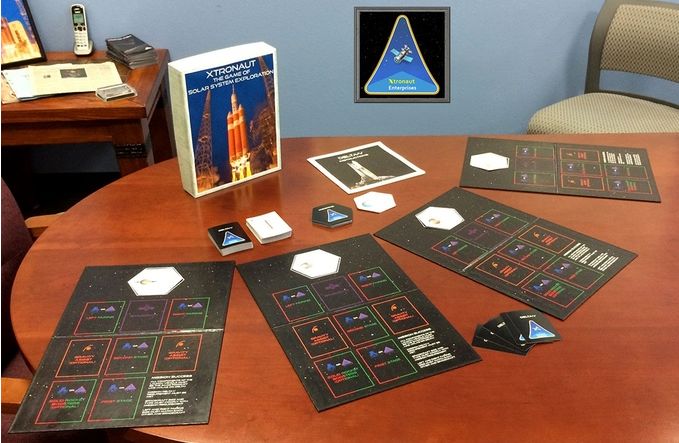
He’s hoping to raise some US $15,000 (with stretch goals up to US $75,000) in support of EPO activities related to the mission he can undertake directly, and quite outside of NASA’s remit. In addition, the Kickstarter itself is also serving to raise awareness of and interest in the exploration and understanding on the the solar system by offering backers copies of a unique card game called Xtronaut.
The game can be played by up to 4 people, aged 7 years and up. In it, they develop their own space missions to explore the solar system, working in competition with one another whilst also facing many of the technical, physical and political challenges which have to be faced when developing, managing and operating actual space missions.

To create the game, Lauretta teamed with space entrepreneur Michael Lyon, one of those behind the tourist flights to the International Space Station, and enlisted the financial support of asteroid mining company Planetary Resources. Together with Lyon, Lauretta has created Xtronaut Enterprises, which acts as a portal for the the game and also for the company’s STEM and related outreach, while also providing outreach information on solar system exploration in general.
Those backing the kickstarter can obtain one or more copies of the game, various expansion packs and other items, depending on their pledge level – with those pledging at the highest levels having the opportunity to join Professor Lauretta at a special Florida VIP beach party to witness the launch on OSRIS-REx in September 2016.
Having launched on Saturday, September 12th, at the time of writing the Kickstarter had already raised US $4,000.

 Inara Pey: Living in a Modemworld