Art in a park – and it’s me (at least in part)!

Art In The Garden - Kirsten Smith
Art In The Garden – Kirsten Smith

OK… time for full disclosure. The following is a mini-review of a place I previewed earlier in the month, and which is now open to the public. I have a vested interest in re-visiting and covering it, as it features some of my work, in what amounts to my first gallery-style display with art for sale.

At the start of November, I wrote about the redevelopment of Holly Kai Park, a public space on the region of Holly Kai, to the north of Blake Sea. As I noted at the time, the new and expanded park offers a lot of amenities to visitors: one hour quayside rezzing time (so you can leave your boat safely moored while exploring), a beach area, parkland, trails to wander, an events space, and places to sit and rest.

Art In The Garden - Kirsten Smith - Marga
Art In The Garden – Marga

The Park is also the home for a new gallery space – Art In The Garden, and I’ve had the honour of being invited to participate in the inaugural exhibition, which had yet to go on display when I first visited the park to write my preview about it0.

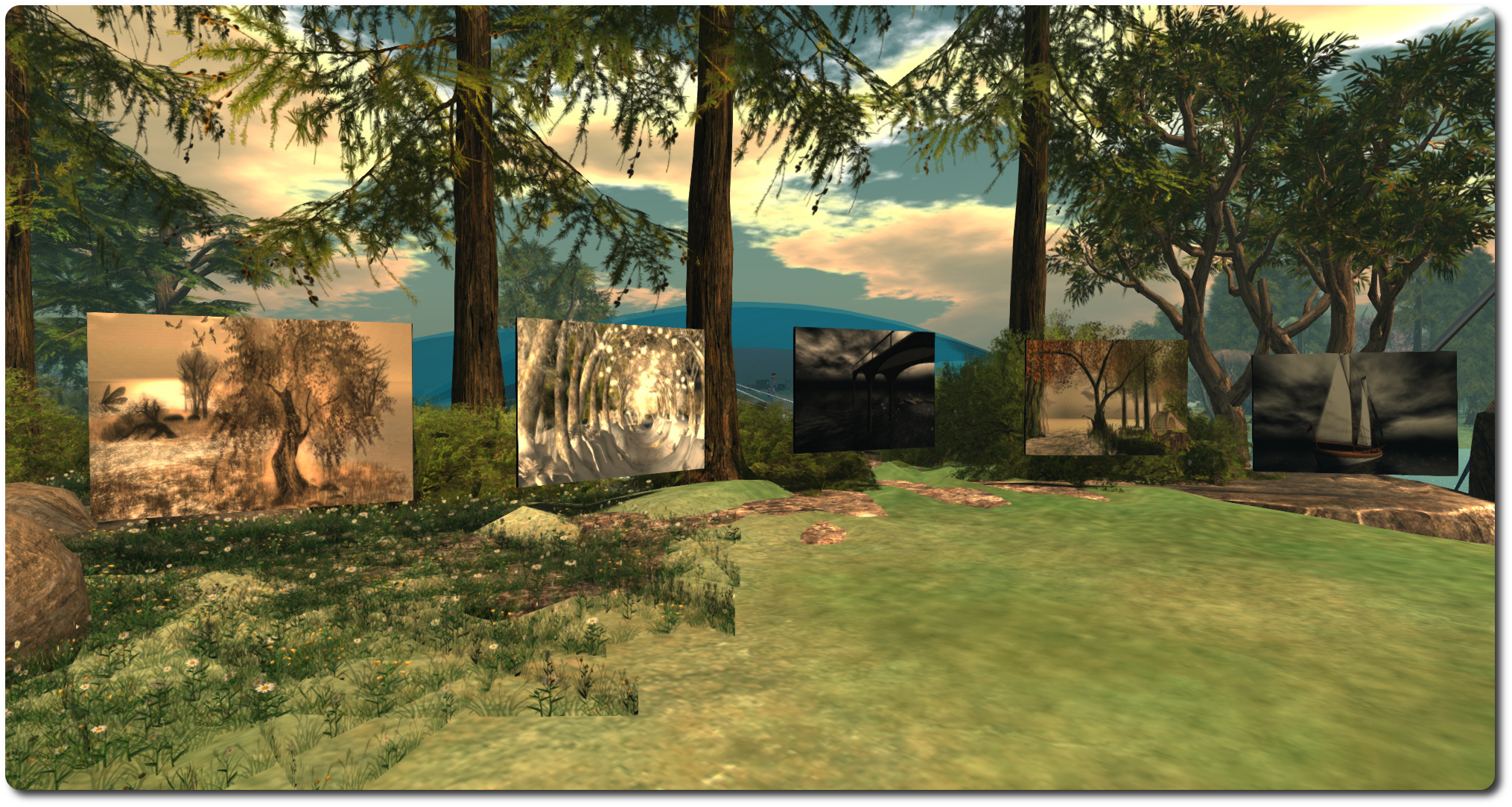
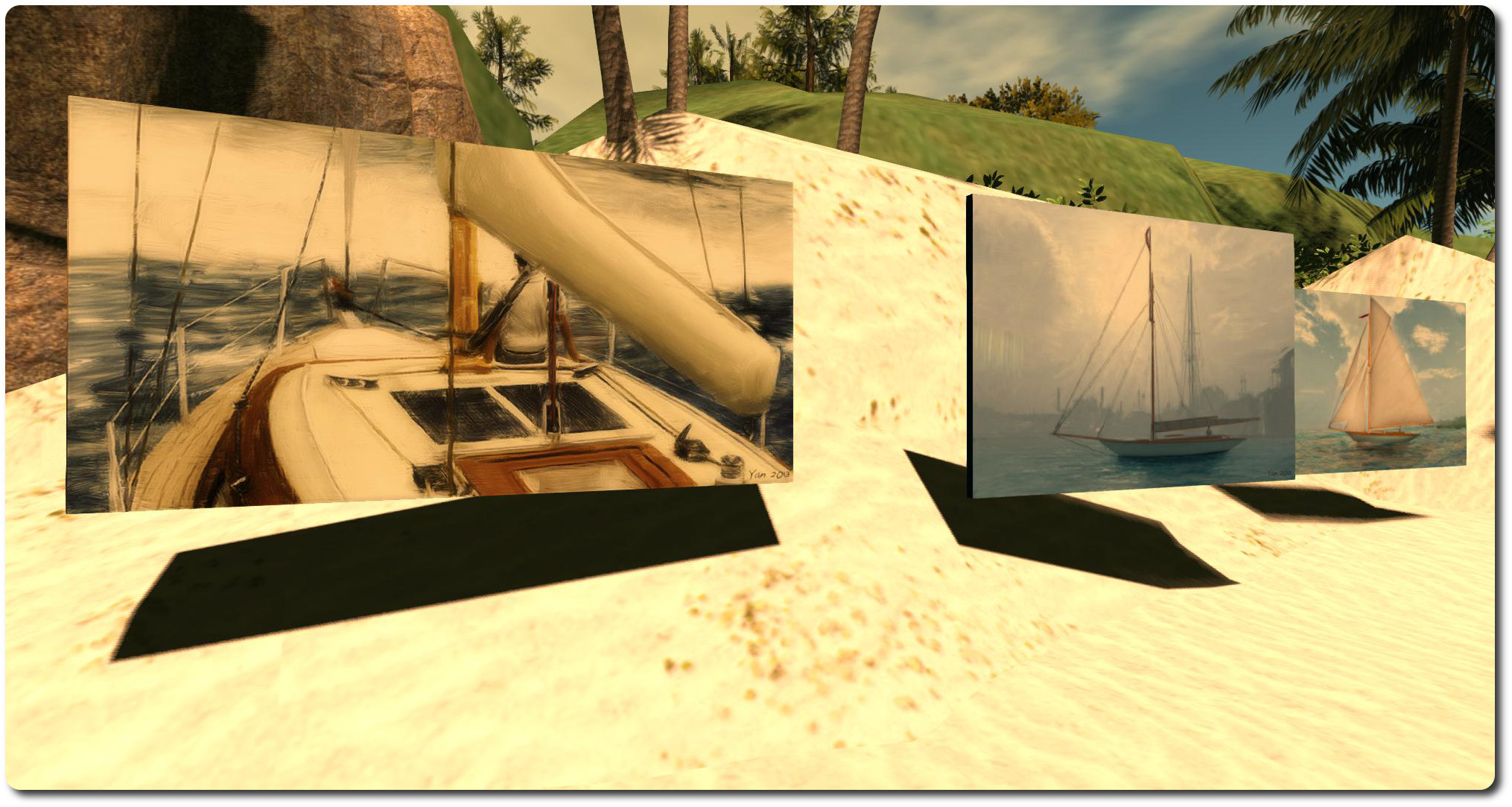
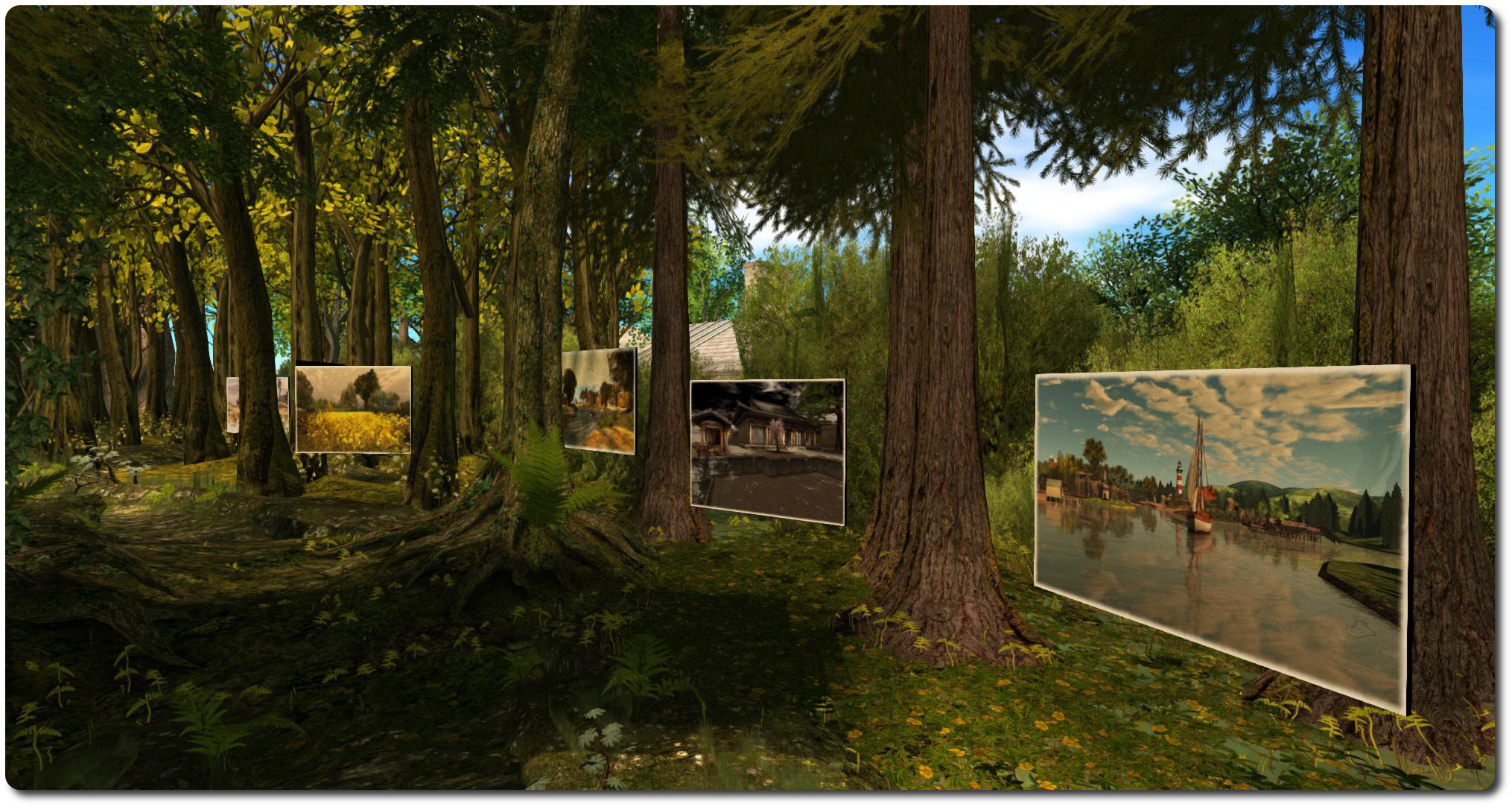
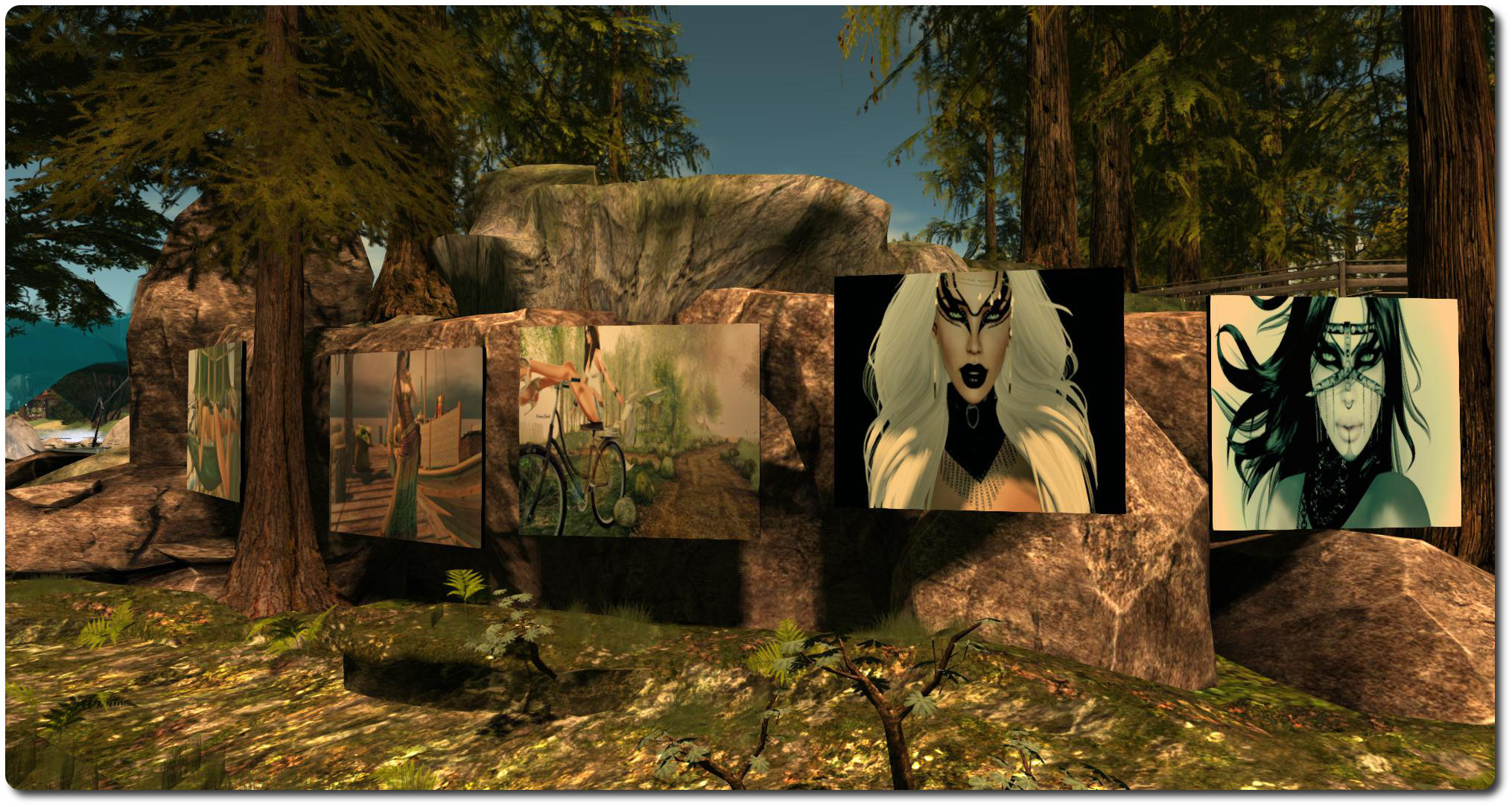
Artwork by Yany O’Real, Kirsten Smith, Em Larsson, Elvira Kytori, Marga, Mirabelle Sweetwater, RickerR, Io Bechir, Carelyna, Madi Fray, and Bambi Foxdale is on display throughout the park, together with efforts by yours truly. Taken together, it offers variety of themes and styles, ranging from photography through painting to pen-and-ink, featuring landscapes, portraits, wildlife, and a touch of abstract.

Art In The Garden - Yany O'Real
Art In The Garden – Yany O’Real

Pieces are displayed so that they encourage visitors to explore the park, following the various paths and trails, with each artist being displayed in a specific location, almost like individual display spaces within a gallery. While all of the art can be seen whether you start from either the west or east side moorings, I’d recommend starting on the east side of the park (if there is space to moor there, should you come by boat), and then follow the route as indicated on the maps there.

If you’re looking for art for your home, all of the pieces on display are available for sale, and I believe all are modify, and so can be resized, offering flexibility of placement. There is also an Art In The Garden group, with free enrolment, you can join to keep abreast of events and activities related to the gallery.

Art In The Garden - Yep, and yours truly ...
Art In The Garden – Yep, and yours truly …

If you’re looking for a new gallery to enjoy, Art In The Park may well offer you exactly what you’re seeking, complete with the opportunity to meet with friends, chill out under the park awnings and even, should you have one available, rezz a boat and take a trip around the local islands.

I admit to feeling very privileged at being included in the gallery’s first exhibition, the pieces on display from the other artists are of an amazing standard (and I’ve quite fallen for Yany O’Real’s sea and sailing paintings). My efforts aside, a great place to visit.

Related Links


Stories from childhood, tales of kidnapping and adventure, and legends from the sea

It’s time to kick-off another week of fabulous story-telling in voice, brought to Second Life and Kitely by the staff and volunteers at the Seanchai Library.

As always, all times SLT / PDT, and unless otherwise stated, events will be held on the Seanchai Library’s home on Imagination Island, or at their Kitely Homeworld.

Sunday November 16th

Having solved the mystery of The Hound of the Baskervilles, Holmes and Watson are taking a well-earned end-of-year break to recharge their mental faculties and (hopefully) enjoy some festive faire. They’ll be returning to Seanchai Library in the New Year, doubtless with a tale yet to be heard within the Library’s hallowed walls.

Monday November 17th, 19:00: Witches, Magic and Other Strange Things

Gyro Muggins returns with new tales to tell.

Tuesday November 18th,19:00: The Thanksgiving Visitor

Capote1First published in 1967 in McCalls magazine, and then printed in book form the following year by Random House, The Thanksgiving Dinner is a further tale by Truman Capote focusing on a young boy called Buddy.

It forms one of three semi-autobiographical short stories written by Capote focused on Buddy, and which also feature Buddy’s older cousin, “Sook”, his best friend, said to be based on Capote’s older cousin, Nanny Rumbley Faulk. As such, it sits between A Christmas Memory (originally published in 1956) and One Christmas, (originally published in 1982).

All three stories in the series received a mix critical response when they first appeared, with one member of his own family stating, after reading a Thanksgiving Dinner,  that Capote had “invented” a trouble childhood, although he and Buddy share much in common – both suffered their parent’s divorce, both were sent to Alabama to be raised by relatives. Others have accused Captoe of “romanticising” his past. Nevertheless as works of fiction, they offer a trio of intriguing tales, with The Thanksgiving Dinner carrying a particular message on the the subject of harassment and revenge. Read by Faerie Maven-Pralou.

Wednesday November 19th, 19:00: Kidnapped

KidnappedCaledonia Skytower continues reading from one of Robert Louis Stevenson’s most well-known works. First published in serial form in the magazine Young Folks
between May and July 1886, Kidnapped is perhaps best summarised by simply giving the story its original full title:

Kidnapped: Being Memoirs of the Adventures of David Balfour in the Year 1751: How he was Kidnapped and Cast away; his Sufferings in a Desert Isle; his Journey in the Wild Highlands; his acquaintance with Alan Breck Stewart and other notorious Highland Jacobites; with all that he Suffered at the hands of his Uncle, Ebenezer Balfour of Shaws, falsely so-called: Written by Himself and now set forth by Robert Louis Stevenson

When first published, due in part to its title, the book was at first thought to have been autobiographical, and David Balfour a real person. This impression was added to by the fact that several of the characters – including the Alan Breck Stewart mentioned in the title – were real people, while a part of the story involves matters related to the very real Appin Murder, which followed the Jacobite Rising of 1745. The novel has also drawn strong comparisons with the true-life story of James Annesley, which also influenced Sir Walter Scott in writing his Guy Mannering.

Thursday November 20th

09:00 The Last Mermaid

Shandon Loring resumes reading from Shana Abé’s novel containing three haunting and seductive loves stories which reach beyond time, featuring one of the more romantic legends of the sea – mermaids -, with all three stories connected by a locket as they span the ages.

mermaid“531 AD: The tiny island of Kell is said to be enchanted, inhabited by an extraordinary creature who comforts shipwrecked sailors passing into the next world. Prince Aedan of the Isles believes in no such nonsense—until he awakens on Kell itself and meets the sensuous siren who rescued him from the sea.

“1721: Ronan MacMhuirich, Earl of Kell, is the target of an unlikely assassin: Leila, a mysterious woman from an exotic land. But his irresistibly beautiful would-be slayer is in just as much danger as Ronan when she falls for this man with a magic of his own.

“2004: What do you do when you inherit a Scottish island you never knew existed—and find yourself pursued by a handsome stranger who wants to buy it from you? That’s what happens to Ruri Kell when she accepts Iain MacInnes’s invitation to visit her birthright, and listens to a proposition as sinfully tempting as everything else about him.

21:00 Seanchai Late Night

With Finn Zeddmore.

Saturday November 22nd, Seanchai Kitely

09:00 Tales from the Sea

I believe that Shandon Loring will be returning to Seanchai Kitely with further tales from the sea and featuring mermaids – check back with the Seanchai blog for details in the week!

10:00: Beat to Quarters

beat-to-quartersCaledonia Skytower continues reading this tale from C.S. Forester’s Hornblower series.

June 1808, somewhere west of Nicaragua, Captain Horatio Hornblower commands the 36-gun HMS Lydia, sailing under unusual orders from the Admiralty: to ally His Majesty’s Navy with an insane Spanish landowner against the Spanish colonial government and find a water route across the Central American isthmus.

Nor is that all; Hornblower also has orders to locate the Natividad, a Spanish 50-gun ship of the line and either “take, sink or destroy” her. His orders make it perfectly clear that the Admiralty will not accept any failure in the mission, informing Hornblower that a court-martial awaits him should he be unsuccessful.

For Hornblower, the orders are tough enough; but matters are barely improved when, with his wife far away in England, he finds himself distracted by the presence aboard ship of Lady Barbara Wellesley, a passenger he is obliged to allow onto the Lydia at Panama.


Again, please note both of these sessions are at Seanchai’s Kitely homeworld, as indicated in the title link, above.

—–

Please check with the Seanchai Library SL’s blog for updates and for additions or changes to the week’s schedule. The featured charity for November – December is Heifer International, which is working with communities to end world hunger and poverty and to care for the Earth.

Related Links
Imagination’s golden autumn

Autumn [Imagination], Intouchable; Inara Pey, November 2014, on FlickrAutumn [Imagination], Intouchable (Flickr)

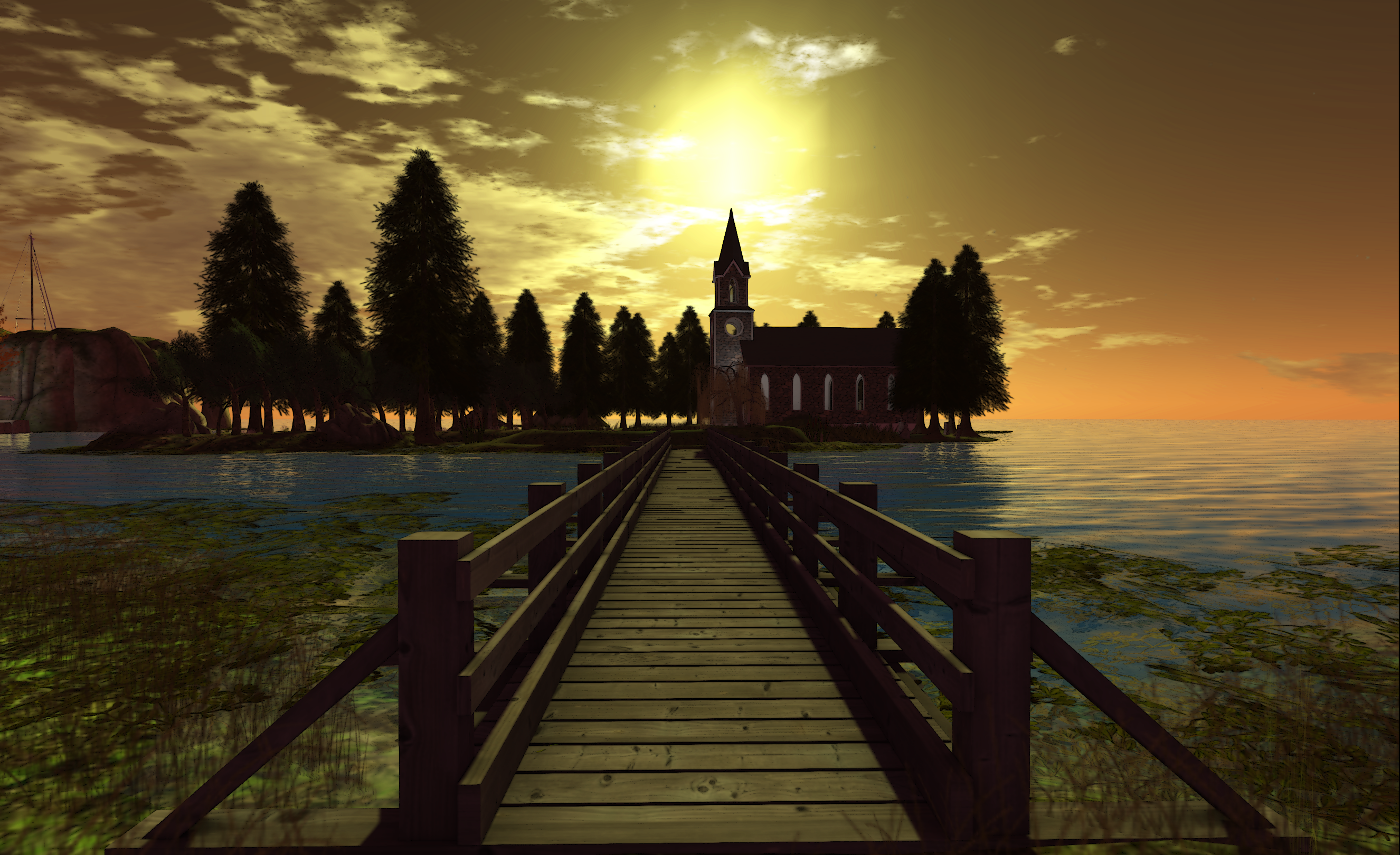
A year ago, I was drawn to ARNICAR India’s beautiful region, Imagination. Back then I described it as “a perfect haven for those wanting to escape the trials of the world or who are looking for a place to soothe their tired minds. Predominantly water, the region has a number of small islands scattered across it and, in one case, floating over it.”

Now called Autumn [Imagination]  and having been relocated to Intouchable, the region offers an autumn-themed design which sees a subtle shift in presentation whilst retaining all of the beauty and tranquillity I discovered there in 2013, with much that remains familiar within the changes made.

Autumn [Imagination], Intouchable; Inara Pey, November 2014, on FlickrAutumn [Imagination], Intouchable (Flickr)

Water still forms the predominant feature, hence one reason for my continued attraction, and if anything is far more prevalent. The landmark will deliver you close to the middle of Imagination, where a familiar large fob watch sits with a broken face and gears hanging out of one side of the case, a reminder that while here, time holds little importance. Three tree-lined paths form a Y around the landing point, presenting the visitor with a choice on their arrival. Which one you take – if any – matters not; all three will lead to discovery and delight as you explore.

Walking beneath the golden arches of each is worth the time, as each path has its own character and contains small motifs from earlier designs for the region, giving those who have visited before a pleasant feeling of familiarity and comfort. Keep your eyes peeled as you walk, as there are some wonderful little touches and details that are oh-so-easy to otherwise miss.

Autumn [Imagination], Intouchable; Inara Pey, November 2014, on FlickrAutumn [Imagination], Intouchable (Flickr)

A small island lies a short distance through the ankle-deep water from the paths. Here children play, Wendys and Lost Boys in the long grass, their laughter sprinkling the air as the chase one another or fly kites. Nestled against the rocks of the island is a tented boat – perhaps their home; certainly a place for visitors to sit and forget their worries.

Another island floats serenely at the end of one of the paths, the waters of the open sea washing against the rocks of a breakwater beneath it. You’ll have to fly up to the little house atop the island (or at least I didn’t find a teleport). If you do you’ll discover a lovely collection of bonsai trees and more places to sit and snuggle, or to dance. Platforms scattered around the island – on the water and in the trees – offer similar retreats from the worries of life, or places to share with friends.

Autumn [Imagination], Intouchable; Inara Pey, November 2014, on FlickrAutumn [Imagination], Intouchable (Flickr)

For those who prefer not to walk, rideable horses wander through the region, simply right-click on one to mount it and you can set off on your wanderings. One thing I would recommend is that you try keeping to ARNICAR’s chosen windlight for the design (seen in all the images here); the dark skies, rippled by the odd wave of cloud and with the sun dipping towards the horizon perfectly complements the rippled waters below whilst also brighting the golden colours of the trees to the fore.

The description for Autumn [Imagination] is a quote from George Bernard Shaw: Imagination is the beginning of creation. You imagine what you desire, you will what you imagine and at last you create what you will. It’s perfectly apt for this place, imagination brought it into being, and it is turn stirs the imagination as you explore.

Autumn [Imagination], Intouchable; Inara Pey, November 2014, on FlickrAutumn [Imagination], Intouchable (Flickr)

Do keep an eye out for the hippos! 🙂

Related Links

The little lander that could – and did

Rosetta,
Rosetta,Philae and, behind them, comet 67P/Churyumov–Gerasimenko seen in an artist’s impression of the mission

It’s been a hectic 48 hours. On Wednesday, November 12th, after 10 years in space, travelling aboard its parent vehicle, Rosetta, the little lander Philae touched down on the surface of comet 67P/C-G/Churyumov–Gerasimenko (67P/C-G). It was the climax of an amazing space mission spanning two decades – and yet was to be just the beginning. Packed with instruments, it was hoped that Philae would immediately commence around 60 hours of intense scientific investigation, prior to its batteries discharging, causing it to switch to a solar-powered battery system.

Unfortunately, things haven’t quite worked out that way. As I’ve previously reported, the is very little in the way of gravity on the comet, so in order for Philae to avoid bouncing off of it when landing, several things had to happen the moment it touched the comet’s surface. As it turned out, two of these things didn’t happen, with the result that the lander did bounce – twice.

Where Philae may be (ESA image via BBC News) – Rosetta has yet to positively locate the lander beyond a rough estimate based on communications and signals received from the CONSERT instrument on the lander

The first time it rose to around 1 kilometre above the comet before descending once more in a bounce lasting and hour and fifty minutes, the second time it bounced for just seven minutes. Even so, both of these bounces meant the lander eventually came to rest about a kilometre away from its intended landing zone. What’s worse, rather than touching down in an area where it would received around 6-7 hours of sunlight a “day” as the comet tumbles through space, it arrived in an area where it was only receiving around 80-90 minutes of sunlight – meaning that it would be almost impossible to charge the solar-powered battery system.

As noted above, the mission was designed so that most of the core science could be carried out in the first 60 hours of the mission, just in case something like this occurred. Even so, in order to prolong the life of the vehicle, it would have been nice to move it into a greater area of sunlight. A means of doing this had also been built-in to Philae: the three landing legs can be flexed, allowing it to “hop”. But as images were returned to Earth by the Lander, it became apparent that one of the legs is not in contact with the ground, making such a hop problematic. After discussion, it was decided not to attempt to move the lander, but focus on trying to achieve the planned science objectives.

In this image released by ESA, a model of the Philae lander has been superimposed on images of the vehicle's shadowy surroundings as captured by the panoramic cameras mounted around the lander (image: Image: Sipa USA/Rex)
In this image released by ESA, a model of the Philae lander has been superimposed on images of the vehicle’s shadowy surroundings as captured by the panoramic cameras mounted around the lander (image: Image: Sipa USA/Rex)

As it turned out, the initial contact between the lander and the comet confused several of Philae’s instruments into “thinking” it had in fact landed, causing them to activate. These included the ROMAP magnetic field analyser, the MUPUS thermal mapper, the CONSERT radio sounding experiment and the SESAME sensors in the landing gear. Data received from these instruments, arriving on Earth some 30 minutes after initial contact with the comet, and the information which followed, help alert mission staff that something had gone wrong, and enabled them to subsequently piece together the events that occurred during the landing sequence, while the instruments continued to gather data and transmit it back to Earth via Rosetta.

On Friday, November 14th, the decision was taken to activate Philae’s sample-gathering drill, officially referred to as SD2. This had been postponed from the previous day, as the drill uses a lot of power. However, obtaining and analysing samples from inside the comet is a central part of the mission, the decision was made to push ahead with drilling operations.

Continue reading “The little lander that could – and did”

The chaotic balance of a cosmos

Chaos, Kosmos
Chaos, Kosmos, LEA21

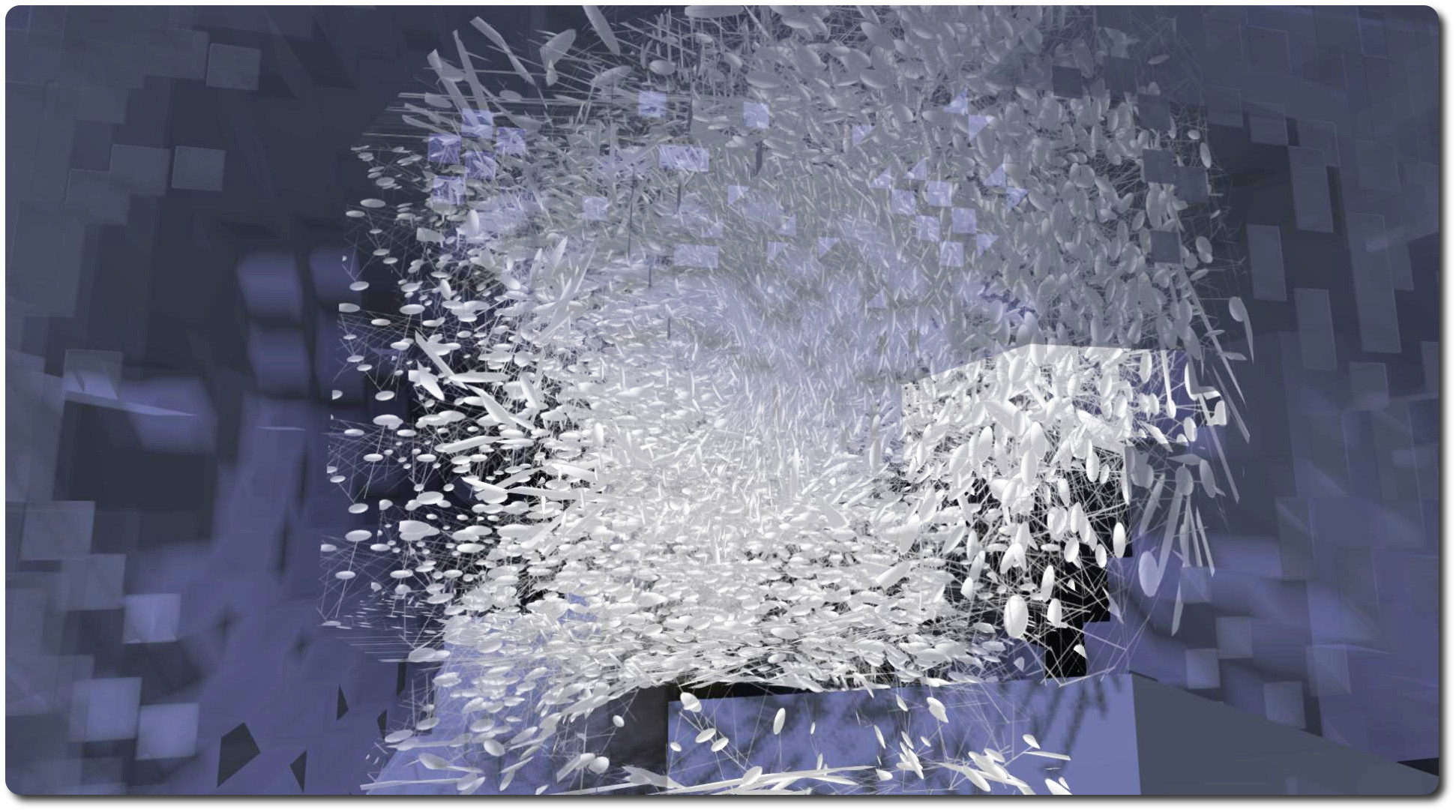
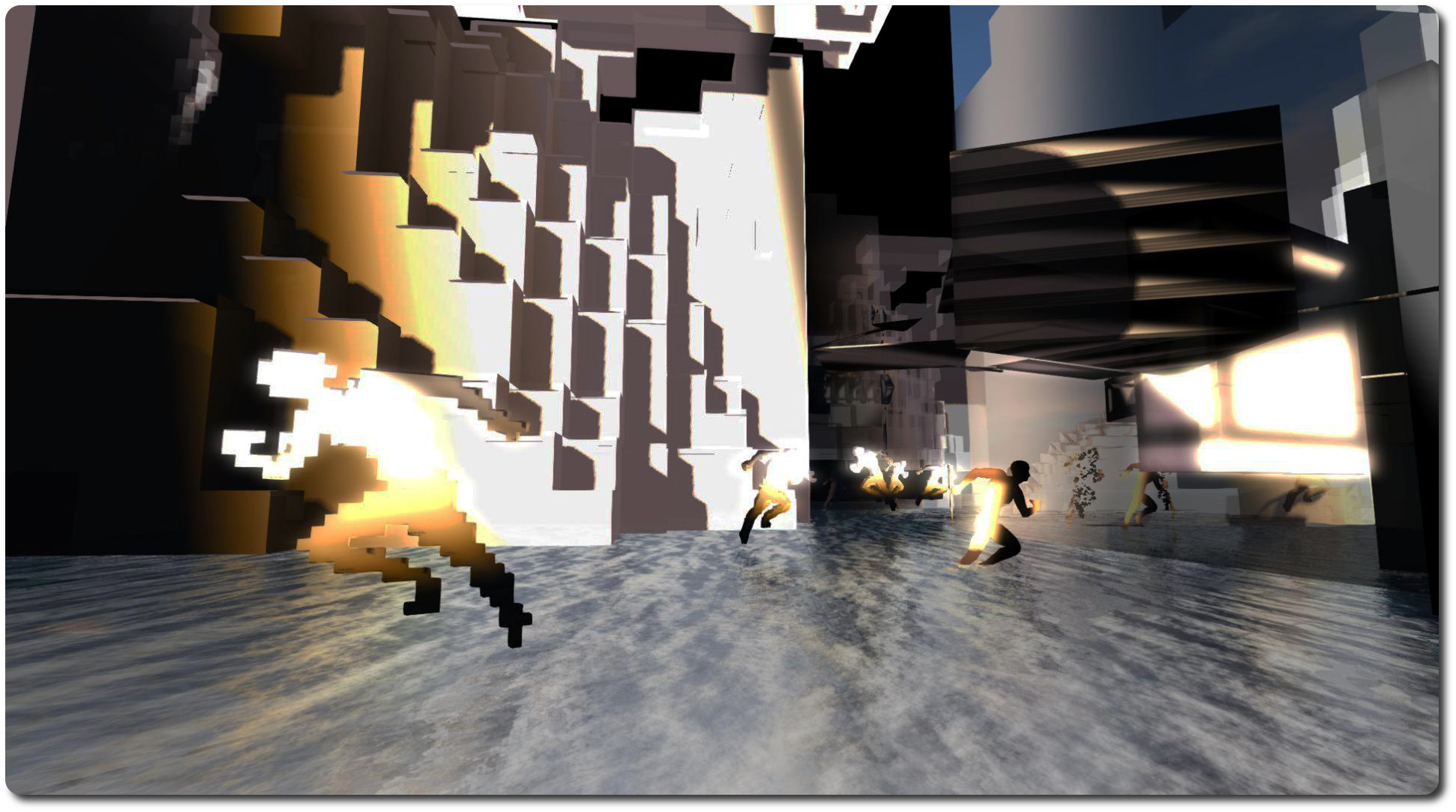
Chaos, Kosmos, now open at LEA21, is Giovanna Cerise’s latest full region installation. It offers a fascinating environment intended to reflect the idea of the relationship between the cosmos and chaos as seen through the lens of ancient Greek cosmology; the one (the cosmos) having arisen from the other (chaos), and which itself is still reflective of its origins, prompting generations of thinkers, philosophers and scientists to understand its structure and order, and impose upon it an order of their own.

This is an incredibly intricate – and at first glance, no pun intended, chaotic – installation. Structures exists on multiple levels, each comprising a mix of solid-looking and semi-transparent prims. All appear haphazard in design and placement – but all have an underlining organised structure, arising from the use of algorithms in their creation. Flowcharts representing these algorithms lie under, around and on the structures, further suggesting the orderliness of their form and design in contrast to their undisciplined appearance.

Chaos, Kosmos
Chaos, Kosmos, LEA21

Givanna describes this relationship thus, “the beautiful, good and rational order of the world, which always comes from a messy background. The Chaos is not definitely passed by the construction of an intelligible world and of the shapes, but it still continues to be as the foundation on which also the Kosmos stand.”

It’s a very visual representation of a complex concept  – one which, I have to say, works very well. So much so that I’d suggest that more than one visit will be required to understand all of the subtle complexities in the design, and that in doing so, the visitor is liable to have their perceptions challenged and challenged again – just as the cosmos has persistently challenged us to re-evaluate our thinking about it.

Chaos, Kosmos
Chaos, Kosmos, LEA21

Order from disorder – or at least the unformed – also arises in art, through all its many mediums, as Giovanna notes, “It could be understood as a creative act of the artist who derives a sense and an aesthetic and meaningful order from the formless matter.” Again, this is strongly reflected in the nature and style of this installation as a whole, and also in much subtler aspects of the work. One element of the piece, for example, features a design representative of a human hand on which neumes appear, a clear reference to music, reminding us of the link between music and mathematics, here forming almost tonal algorithms which echo the foundations of the installation itself.

The best way to observe the piece as the artist intended is to set your windlight to sunset or midnight, although other lighting works well with many of the structures; then use the teleport system (indicated by the compasses) to move around the elements of the build in the order Giovanna desired. Once you have completed an initial circuit, I’d recommend spending a little time flying and observing for yourself, as there is a lot to seen beyond the preset teleport destinations.

Chaos, Kosmos
Chaos, Kosmos. LEA21

All told, an intriguing installation – one which will open to the public through until the end of December 2014 as a part of the current round of the LEA’s Artist In Residence programme.

Related Links

SL project updates 46/2: viewer updates, miscellaneous news

Collins Land; Inara Pey, September 2013, on Flickr, on FlickrCollins Land, September 2013 (Flickr) – blog post

The following notes are drawn from the Server Beta user group meeting held on Thursday, November 13th, the transcript for which can be found here.

Server Deployments Week 46 – Recap

As always, please refer to the server deployment thread in the forums for the latest information and updates.

  • There was no deployment to the Main (SLS) channel on Tuesday, November 11th.
  • On Wednesday, November 12th, all three RC channels received the same server maintenance package, which comprises “minor improvements” to help configure the texture and mesh CDN, by allowing the Lab to reconfigure the CDN URL if they need to, with the intention of the of making it a more dynamic host name in the future.

SL Viewer

Snowstorm RC Viewer

A new Snowstorm contributions RC viewer arrived on Thursday, November 13th. Version 3.7.21.296724 promotes the viewer from project status, and brings with it the following contributed updates:

  • OPEN-215 kCGLRPTextureMemory is a deprecated function as of Mac OS X 10.7, replace with kCGLRPTextureMemoryMegabytes
  • OPEN-268 FFLOAD_XML missing on linux and darwin, FFSAVE_XML missing on darwin
  • STORM-2053 applicationShouldTerminate function returns NSApplicationDeligateReply when it should return NSApplicationTerminateReply
  • STORM-2056 Projector reflections do not respect the environment intensity parameter
  • STORM-2067 Glossy Projectors
  • STORM-2069 Delete key doesn’t delete first character of marked text on OSX
  • STORM-2070 Sticky modifier keys after OS window comes up on OSX
  • STORM-2071 Unwanted InputWindow comes up when typing Japanese on OSX
  • STORM-2072 Bad behavior of Input Window
  • STORM-2078 Editing an objects rotation with the rotation rings often causes the object to jump to position <0,0,0> on the region and rotation changes to <0,0,0>
  • STORM-2080 Dresses purporting to be Fitted Mesh stretch to 0,0,0
  • STORM-2081 Second Life 3.7.18 (295539) Oct 16 2014 08:19:54 (Second Life Release) crashes every time upon viewer Quit under OS X Yosemite 10.10

Attachment Fix and Maintenance RC Updates

The current RC viewers – the Attachment fix RC viewer and the Maintenance RC viewer both updated on Wednesday, November 12th as a result of the Benchmark viewer promotion to release status. The updates were as follows:

  • Attachment Fix RC viewer updated to version 3.7.21.296729. This viewer adds some fixes to previously released changes in the way joint offsets in rigged meshes are handled & fixes some issues found with adding and removing attachments after the recent AISv3 deploy, and improves the status information shown in inventory for attached objects
  • Maintenance RC viewer updated to version 3.7.21.296734. This viewer offers a broad range of fixes for voice, privacy, rendering, texture animation, avatar distortion, inventory management, sounds, Mouselook in Mac, multiple UI fixes in script editor, Pay flow, chat, stats floater, edit menu, etc.

Release Viewer VFS Failure Issue

It’s still not clear how widespread the VFS failure issue on the current release viewer extends (see part 1 of this week’s update, and BUG-7776).  As noted in the first part of this report, I’ve managed to resolve such problems by manually deleted the viewer cache, and this worked for me in this case. Whirly Fizzle posted the same advice to the bug report, but at least one person has indicated it didn’t resolve the issue for them.

“Fast Pipe” Viewer

Monty Linden is working on further viewer-side updates to address reported problems being experienced in region rezzing times (such as reported in BUG-7698). There’s an initial release of the viewer available to those who can self-compile, and Whirly Fizzle reports that the fixes appear to work, commenting that, “Fast-pipe with pipelining enabled def works better for me on CDN regions. The long texture loading stalls have pretty much stopped.” There’s no date as to when this viewer will publicly appear as an RC or project viewer.

Other Items

Viewer Stats Ping Sim Data

There have been a few question in both meetings and in the forums about what the Ping Sim data in the viewer’s statistics bar actually represents. According to the wiki page:

Ping Sim: How long it takes data to go from your computer to the region you’re currently in. This is largely dependent on your connection to the Internet. If Ping Sim is high but Ping User is not, the server might be having problems.

However, this doesn’t paint a complete picture, as there can be a noticeable difference in the ping sim value given in the statistics bar of the viewer compared to pinging a simulator host directly. Responding to a question during the Server Beta meeting, Maestro Linden said:

As I recall, the ping number is your actual network round trip, measured by the UDP connection to the sim, *plus* some other time, like the time required to render the frame… So if you’re only getting 10FPS, that’s an automatic +100ms on top of the actual network round trip time… That ping time may also include the sim’s frame time (22.2ms if running at 45fps).

Answering a similar question through the forums in October, Oz Linden offered further clarification:

Looking at the code (I had not had occasion to look at this before), the Ping Sim measure appears to be based on a separate Ping message (our own message type transmitted over UDP, not ICMP). Those messages are mixed in periodically with the other UDP messages that are more or less constantly flowing between the viewer and the simulator. Because it’s the application that is turning that message around rather than a low-level part of the network stack, the fact that it is consistently higher than ICMP ping to the same host isn’t surprising. 

[ICMP, or Internet Control Message Protocol is the protocol generally used by ping operations.]

A couple of upshots of this is that if there is packet loss as a result of packet loss with increase ping rates as seen in the viewer, while no actual increase is occurring in the network connection itself, while increasing traffic within in region will cause higher ping rates within the viewer, simply because of the resultant UDP packet queuing in the server (hence a possible reason for BUG-7797, where the ping increase is seen as causing an increase in “lag”, rather than being indicative of an increase traffic load occurring). As such, Maestro commented that the viewer’s ping data is, “probably a more useful measure of latency than network ping.”