Important note: The SL Go service is to be shut down on April 30th, 2015. For more information, please read this report.
As I (among others) reported on Tuesday, October 14th, OnLive released a version of their SL Go service for the iPad.
At the time of the release, there was an unexpected rotation issue which meant that the screen orientation was locked in one horizontal orientation – if you flipped the iPad around, the screen would appear upside down, although the input areas might actually flip with the screen but still be displayed as if they were upside down.
This was a particular nuisance for people using a bluetooth keyboard or docking station with their iPad, as it meant the viewer would be displayed upside down when docked with either.
On Friday, October 24th, Dennis Harper from OnLive dropped me a note to inform me that this rotation issue has now been corrected, The app should update for those who already have it, and the fix is now a part of all downloads obtained via the Apple iTunes store.
The new Dev Kit version of castAR (image via Engadget)
I’ve been following the work of Technical Illusions, the creators of the castAR projected augmented reality headset with a VR capability, for some time now, although things have been quiet on the news front for a while. However, that’s starting to change.
The first item of news is that the company in the process of moving its operations from Seattle, Washington, to Mountain View, California.
David Henkel-Wallace – castAR’s recently appointed CEO (image: Technical Illusions)
The move is being overseen by the company’s new CEO, David Henkel-Wallace, who joined the company in June 2014. The move is in part to try to drive-up the company’s ability to hire hardware talent – they’ve found it hard to get hardware specialists in Seattle, where software rules the roost. It also puts them in the middle of “Nerdvana” – as Co-founder Jeri Ellsworth puts it, which could do much to raise their visibility in terms of inward investment opportunities.
As it is, the company numbers around a dozen full-time employees, including Henkel-Wallace, founders Ellsworth and Rick Johnson and CFO Paul Denton. Both Denton and Henkel-Wallace have considerable experience in building-up start-ups. There’s also Toby the cat, also listed as co-founder, and fulfilling the role of Senior Cat, with responsibilities for eating, sleeping, purring and lap-sitting.
The other major news for the company is that a year after their Kickstarter campaign, their initial developer kits are now ready, and will soon be shipping to those people who pre-ordered kit through the campaign. The new headsets have also been on show to the likes of Engadget and Venture Beat’s Gamesbeat, where Ellsworth talked to Dean Takahashi.
Ellsworth is the first to admit the new headsets are still some way short of a production-ready version, but they’ve still come a long way from even the 2nd prototype versions seen just seven months ago.
castAR – from pre-prototype (top) in early 2014 to the developer version of the headset (bottom), October 2014 (images via Engadget)
The revised developer headset weighs-in at some 140 grams, and the company is aiming to get this down to around 80 grams in the production version. Included in that are two 120 Hz cameras with 135 degrees tracking, and 1,000 Hz gyro. The optics, now supplied by a Japanese company, deliver a resolution of 2,560-by-720, with every pixel addressable and capable of being resolved at a distances of between half a metre and 2 metres when using the retro-reflective system.
The headset is admittedly still nerdy-looking, resembling a pair of heavily framed sunglasses with a bulky silver mounting for the LEDs and cameras on top. However, Technical Illusions state that they opted to make the headset somewhat on the big / clunky side, as they weren’t sure how well all the tech would fit into it. They’re now confident that the package can be shrunk down to something which not only meets their target weight, but which is also more pleasing to the eye and closer to their conceptual look for production versions.
As well as the headset, the other major components of the system – the interactive wand, the retro-reflective surface and the VR clip-on – have all been refined and improved. Work is still ongoing with the wand, which allows a user to manipulate virtual items projected by the headset onto the retro-reflective surface with “sub-millimetre accuracy”. Kits, when shipped, will also include Technical Illusions’s own game, mARbles, designed to demonstrate the gameplay capability of the system to developers.
mARbles is a “Marble Madness”-style game which can be played individually or by two r more players. It is shipping with the castAR dev kits (image: Technical Illusions)
So what is the market for the castAR? Ellsworth believes that games “will be king for a while”, and admits to looking forward to seeing flight simulators that use the castAR projection system, although she also notes other potential uses when talking to GamesBeat’s Takahashi.
A lot of people are going to get excited about tabletop collaborative experiences, where multiple people sit around a table and work in the same physical space. All the game characters are in the same space. We have a lot of companies approaching us that want to use it for visualization – architecture, things like that, where you can sit around and table and work in the same space.
Nor do users necessarily need to be in the same physical space, in order to engage with one another, as the company has demonstrated in a number of its videos.
In terms of practical applications, Technical Illusions have been working with medical experts to see how the castAR system might be used alongside MRI scans, the castAR system being use to build 3D holograms of scanned patients which can be examined by doctors and / or surgeons, helping them to build a more complete understanding of the patient’s condition.
The conceptualised castAR production headset and VR clip-on system (image: Technical Illusions)
How successful castAR is likely to be is hard to judge; the world is awash with excitement over VR that all things AR have been largely sidelined. Even the involvement of Google (and others) in Magic Wand hasn’t really done much to change that.
castAR is also somewhat different to other AR systems seen so far, potentially making it an oddball in the eyes of some media, although its potential to enter into the VR sphere through the VR clip-on may serve to generate wider interest. How big a footprint castAR might actually make in the VR world is hard to judge; a key here might be in whether it can be made compatible with games being specifically developed for Rift-type hardware.
So far, the company has managed to achieve a lot while remaining relatively low-profile. Their emphasis for the foreseeable future is on building relationship with developers and getting content integrated into the system as the hardware itself continues to mature towards the desired consumer format.
Even so, if the company is to make its mark, it is liable to need the support of investors – and the move to Mountain View is, as noted by Technical Illusions themselves, perhaps as much about that as putting them more readily at the hub of available expertise. As such, it’ll be interesting to see where the move leads.
On Tuesday, October 21st, the Main channel was updated with the server maintenance release previously deployed to the LeTigre and Magnum RCs in week 42. This update includes a crash fix and improves the delivery pipeline for abuse reports
On Wednesday, October 22nd, the release candidate channels were updated as follows:
BlueSteel and Snack will remain on the CDN project, and were updated with the same server maintenance package being deployed to the Main channel
LeTigre and Magnum were both updated to the CDN for texture and mesh fetching.
Upcoming Deployments
There is a further server maintenance package being prepared for deployment. however, it is still undergoing testing, and it is not clear whether it will be ready for deployment on Wednesday.
CDN and the Future of Snack
With the CDN now supporting texture and mesh fetching across all of the primary RC channels, there is a chance it may be promoted to the Main channel in week 4, particularly given that, outside of CDN support, all the server channels are now in parity. However, the Lab is making no commitments to this, and is taking a “wait and see” approach on what may happen. In particular, the Ops team will be monitoring performance over the weekend, when SL usage is expected to be at its busiest since the RC-wide deployment of CDN support, to see how things hold up.
As it stands, there are an estimated 130 regions on the Snack RC. As these all came from the Main channel, they will likely be switched back to that channel once it has CDN support, and Snack will again be dissolved until it is once again required.
Group Chat
With the most recent changes to the back-end servers, Simon Linden is continuing to poke at the code to see what can be improved. He’s now looking at the code that routes the messages – where it goes to find where group members are on the grid in order to be able to deliver messages to them, with the aim of trying to improve things there.
At the moment, if you move between regions which active in a group chat, the first message to be sent to you after you move will be sent to the region where you were and generate a failure message which has to go back to the chat service, which they has to relocate you and then attempt a further delivery. It is hoped that this can be improved, and there was a brief test following the Server Beta User Group meeting on Thursday, October 23rd to this end, just to see how the code is performing.
It has been suggested that the Lab should bypass the region hosts altogether when handling group chat, and attempt to route it directly from the chat servers to the viewer. However, this would likely require some serious re-engineering; more to the point, it could introduce security vulnerabilities.
Other Items
Aditi L$ Balance
A question was asked on how account L$ balances are updated on Aditi. Maestro replied that account balances are checked nightly (SLT), and any falling below L$ 10K (because someone has been uploading mesh models for testing / viewing prior to paying to upload them on Agni, for example), they are automatically increased by L$5K. However, if someone resets their account password (which triggers a reset on Aditi), their L$ balance will change to match their L$ balance on Agni, although again, if this is below L$10K it should be topped-up but L$ 5K overnight.
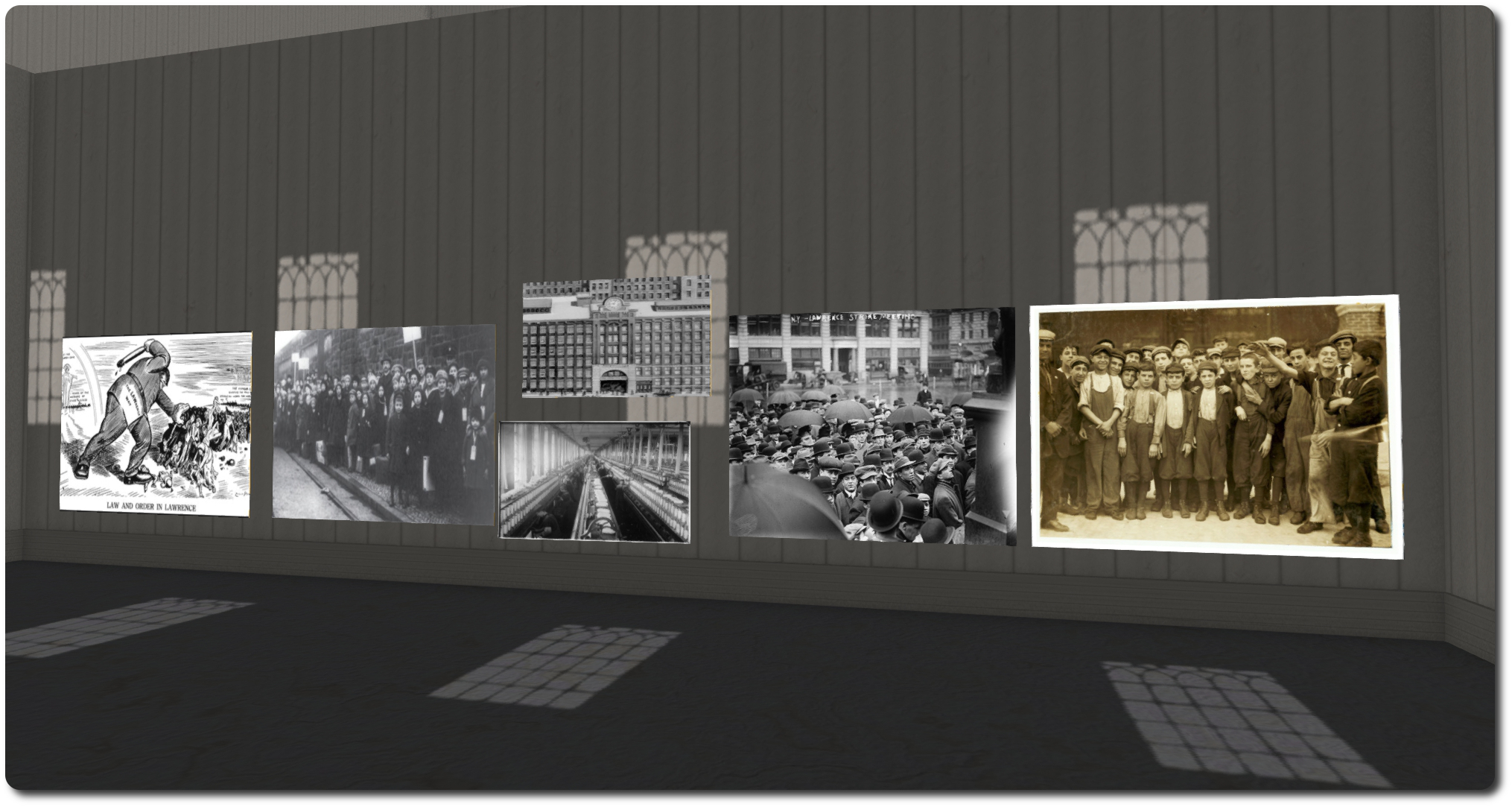
Bread and Roses, located at LEA13, is an interactive, educational installation commemorating the 1912 Lawrence Textile Strike, and which is open now through until the end of December 2014.
The strike, which commenced on January 1st, 1912, was prompted by textile mill owners in the town of Lawrence, Massachusetts, arbitrarily cutting workers pay after a new law reduced the working week from 56 hours to 52. The cut, amounting to around 30 cents, equated to the loss of around three loaves of bread for the already hard-pressed working families in the town (hence one of the strike’s other names: “The Three Loaves Strike”).
To put this in perspective, the staple diet of mill workers and their families in Lawrence was bread and molasses. Meat was a luxury few could afford. What’s more, the conditions were so harsh that the mortality rate for children was 50% by age six, and that 36 out of every 100 mill workers, male or female, were dead by the age of 25. Families were crammed into poorly maintained tenement blocks; thus the pay cut was, to say the least, cruelly severe.
With its largely immigrant population (some 51 different nationalities), the work force in Lawrence had been deemed by more conservative trade unions to be too ethnically divided to be properly organised. However, under the guidance of the Industrial Workers of the World (IWW), representatives of which had been active in the town ahead of the imposition of the pay-cut, the strike grew within a week to encompass some 20,000 workers and ran through a harsh winter prior to both sides reaching agreement.
The strike particularly came to the attention of the United States as a whole (and the rest of the world) after local police attempted to prevent IWW from sending 100 children from striking families in Lawrence to Philadelphia to stay with the families of supporters of the strike until it had reached a conclusion. Arriving at the railway station, the police drew their batons and began clubbing mothers and children alike, in full view of the press, resulting in Congressional hearings being called.
In the end, the mill owners acceded to the demands of the strike organisers. Pay was raised, working conditions were improved – but it was in the end something of a pyrrhic victory. The IWW refused to enter into written agreements, allowing the mill owners to slowly but surely take back the concessions made, whilst also removing union representatives from their workforce.
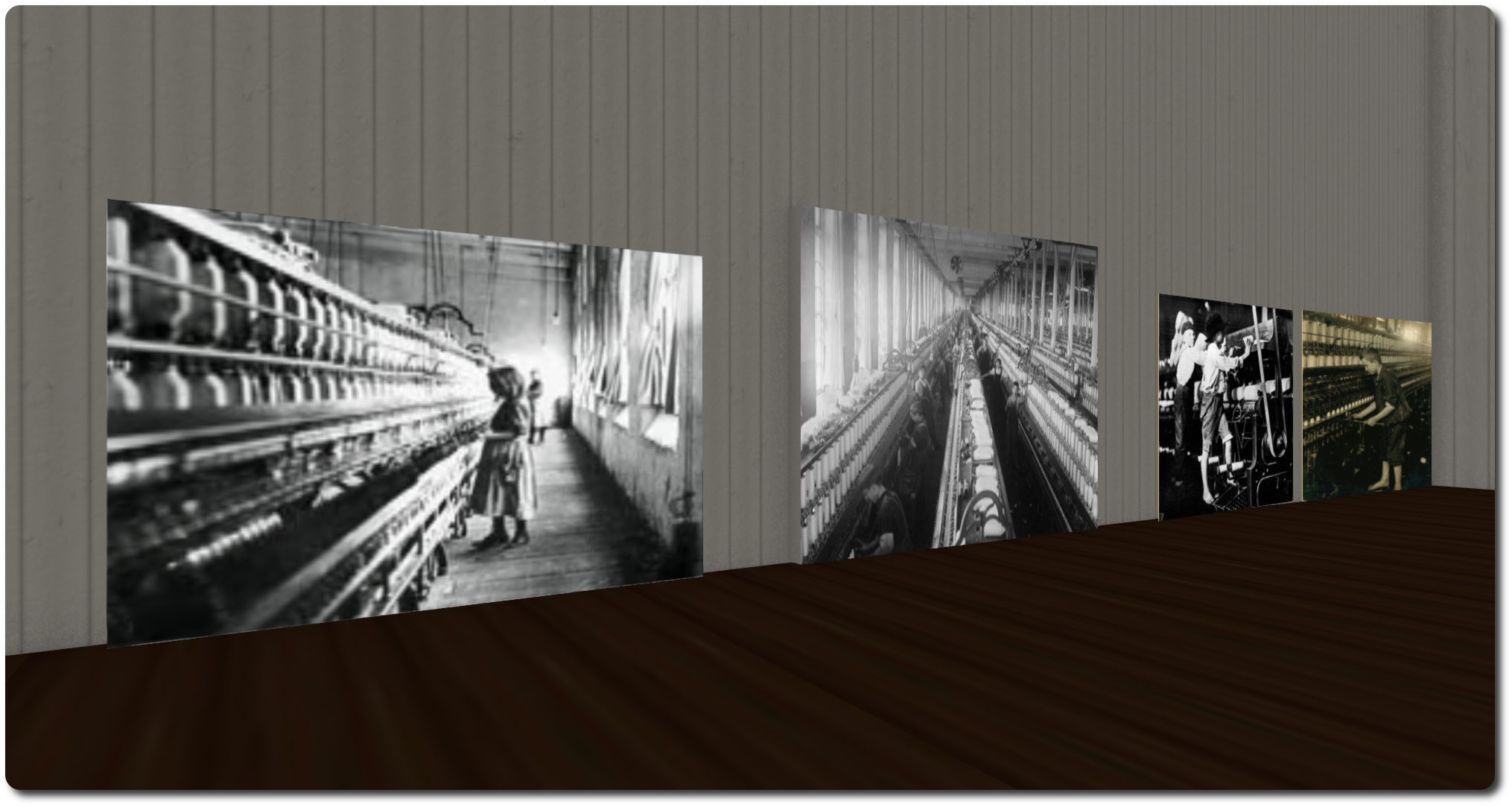
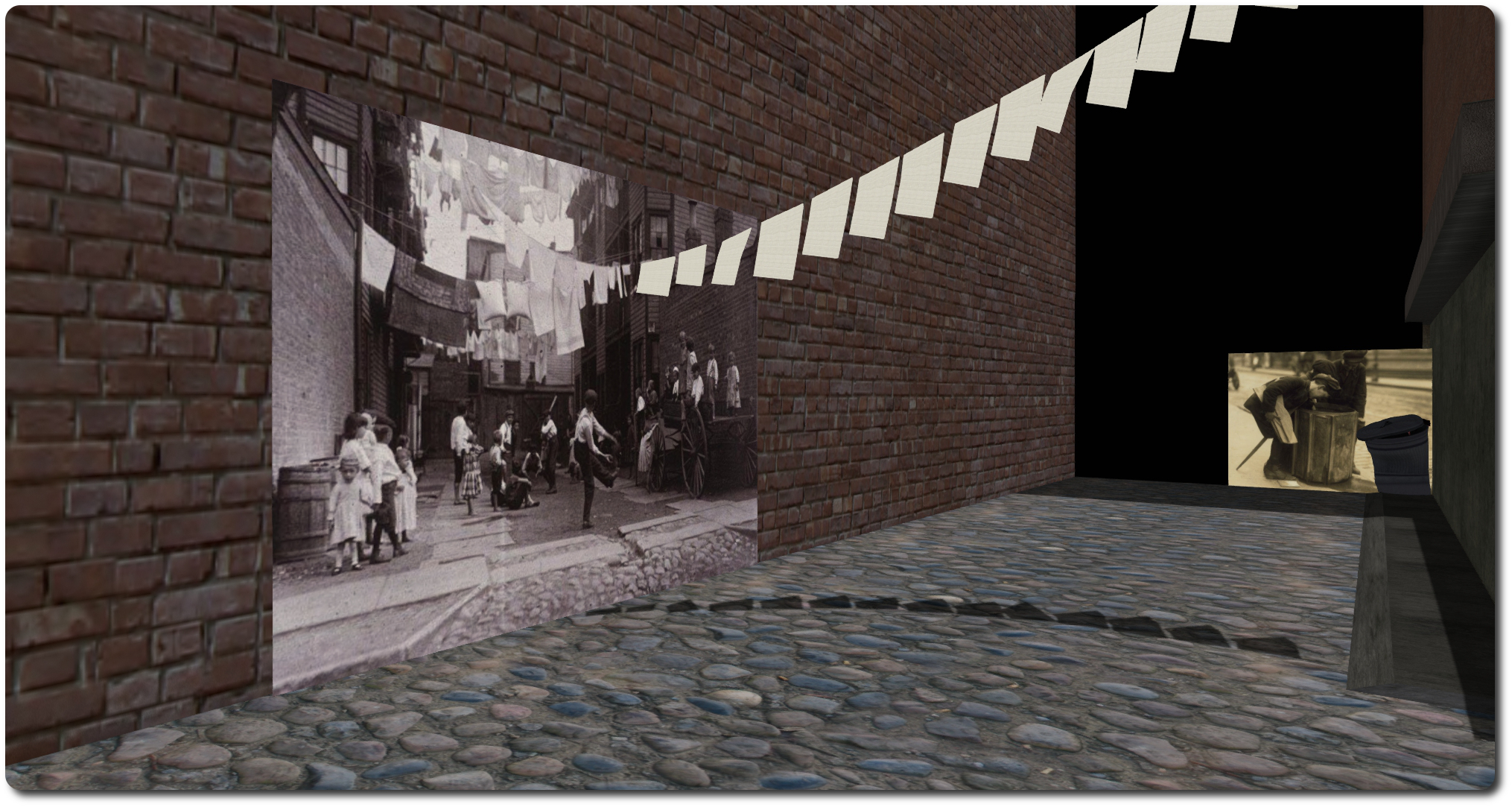
The installation at LEA13 is the brainchild of Canadian-born Dr. Sharon Collingwood (aka Ellie Brewster in SL), a Professor in the Women’s Studies department at The Ohio State University, Columbus, Ohio. It’s an interactive piece, aimed a school students, and offers plenty to do. A tour through the set takes students through a mill where images provide visual and text-based information on the strike, while large blue buttons provide additional information or questions to be answered by students. In addition, there are media elements and links to external web resources.
As well as examining the strike, the installation also offers some social commentary as well; not just in the strong contrast between the houses and attitudes of the well-to-do mill owners and the frightful conditions endured by the workers – but also in the often entirely blinkered viewpoints of movements which marked the times. The latter is perhaps most clearly demonstrated in the house occupied by the (white, middle-class) suffragettes, citing the strike as an example of the “power” embodied within women, whilst ignoring the black scullery maid in the kitchen…
An exploration of the installation will reveal it to be seemingly incomplete. There are empty rooms, etc. This is intentional, as it is hoped that students will add to the exhibit throughout its duration. In addition, students can assume one of four identities prior to explore the exhibit and, for the benefit of those who may not be familiar with using Second Life, there is a brief set of tutorial items offering basic instructions on finding one’s way around the viewer.
All told an interesting glimpse into history, and a useful educational tool. Those wishing to use the classroom facilities within the exhibit should contact Ellie Brewster in-world.
And the title of the piece? “Bread and Roses” was another name by which the strike came to be known, after being incorrectly linked to the strike by author Upton Sinclair. The origins of the phrase in fact seem to lie with labour union leader, Rose Schneiderman, who was not directly involved in matter in Lawrence, but who stated during a speech that, “The worker must have bread, but she must have roses, too.” This in turn inspired James Oppenheim to write a poem of the same name, which in turn became a song strongly associated with labour movements and the concepts of fair wages and dignified working and living conditions.
Bread and Roses: Joan Baez and her sister, Mimi Farina, who founded “Bread and Roses”, a nonprofit co-operative organisation, designed to bring free music and entertainment to institutions: jails, hospitals, juvenile facilities, nursing homes, and prisons.
You’ll believe a whale can fly – or that’s Magic Leap’s hope (among more practical things)
Augmented Reality took a shot in the arm this week with the new that Google is at the forefront of some US$542 million investment in technology company Magic Leap. What’s more, not only is the coming putting the money forward directly, rather than through their investment arm, Google Ventures (which has previously put money into things like Philip Rosedale’s High Fidelity, alongside of investment house True Ventures), but two senior executives from Google will be joining the Magic Leap board. These are Sundar Pichai, Android and Chrome leader, and Don Harrison, Google’s corporate development vice-president.
The funding round comes on top of an initial round of investment in February 2014, which drew some US$50 million to the company.
But who or what is Magic Leap? According to the company’s website, it is essentially an augmented reality system which uses a “Dynamic Digitized Lightfield Signal”, although they note we can call it “Digital Lightfield™”, capable of merging realistic computer graphics with everything the user sees in the real world. This appears to be something of a merging of both VR and AR (with the emphasis on the latter), to create an immersive whole. The system doesn’t use the Oculus Rift, but apparently uses a headset system possibly akin to, say, the castAR system or perhaps Google Glass; the latter of which might explain Google’s interest – or it might not.
However, no-one knows precisely what Magic Leap is or how it works, because there haven’t been any public demonstrations of the system, nor have any images of the hardware been released. And while trendy terms like “Digital Lightfield™” are used on the equally trendy website, there is little to tell what is going on.
So far all that has been released are a series of pretty stunning images and videos – witness the video above, or the images top and centre in this article. However, that’s not so say the company don’t have something to get investors excited.
“It was incredibly natural and almost jarring — you’re in the room, and there’s a dragon flying around, it’s jaw-dropping and I couldn’t get the smile off of my face,” Thomas Tull, CEO of Legendary Entertainment (aka Legendary Pictures) told the Wall Street Journal. Images, projected into the wearer’s eyes, can even be made to appear to pass in front of or behind real-world objects. Tull was so impressed by what he saw, he not only had Legendary Pictures to invest in Magic Leap, he also made a personal investment as well.
Nor are Legendary Pictures and Google alone. Other investors in the funding round include Qualcomm, Kleiner Perkins, Andreessen Horowitz, Vulcan Capital, Obvious Ventures and Caufield & Byers. Qualcomm’s executive chairman, Paul Jacobs, is also joining Magic Leap’s board, and will sit alongside Google’s Don Harrison and an observer.
Another Magic Leap promotional image: a yellow submarine apparently floats down a street the Magic Leap wearer is walking along
Such a broad spread of investment potential speaks to the vision held by Magic Leap’s CEO, Rony Abovitz, who wants the company to become “a creative hub for gamers, game designers, writers, coders, musicians, filmmakers, and artists.”
The potential for something like Magic Leap in films is clear; imagine sitting down in a movie theatre, donning a pair of glasses perhaps not too dissimilar to the current 3D glasses provided at theatres, and then seeing a film where events can become a shared experience as they extend into the audience…
That may well be why co-founder of Weta Workshop, the SFx company behind the visual effects for Peter Jackson’s Lord of the Rings and The Hobbit trilogies (among others), Richard Taylor, was also drawn to the project. He participated in the first round of funding for Magic Leap, and now sits on the company’s board of directors.
Weta Workshop co-founder Richard Taylor: Magic Leap investor and board member (image via Stuff)
“What Rony and the Magic Leap team have created is nothing short of remarkable and will forever change the way we interact with images and information,” Taylor said at the time of his investment.
“The wearable technology they have developed is revolutionary in its ability to create amazingly immersive and fantastical experiences. This goal alone would be a Herculean endeavor for any development group, but the fact that the Magic Leap team is driven by the mantra of also delivering devices that complement human physiology is extraordinary,”
Bing Gordon, a partner at Kleiner Perkins Caufield & Byers, and a former executive at EA Games sees a huge the potential for Magic Leap. Commenting on how the system is better coordinated with how the human eye and brain process images, making the computer graphics feel, and move, more naturally, he told the New York Times that Magic Leap could help drive augmented reality to outstrip mobile devices in terms of popularity in its possible range of uses.
It would seem that Google is looking more broadly at the potential of the technology as well, rather than button-holing it for any particular use or in combination with any particular product (Glass itself has been somewhat low-key this year, and was all but absent at the corporation’s Google i/o in July). Many commentators believe that Google’s investment, coming as it does from the company, rather than its investment arm, is a strategic move, with Google willing to see how the Magic Leap technology matures. Abovitz has gone a little further on matters, stating that Glass and Magic Leap use different approaches and will not be merged.
Rony Abovitz (in the space suit) and friends appearing at TEDx Sarasota in December 2012 – still generating a “Wut?” response in many people today
Abovitz himself cuts something of an unusual figure – as anyone who witnesses his appearance at the TEDx Sarasota’s inaugural conference is liable to agree. The Magic Leap website is equally somewhat offbeat, indicating that the Magic Leap team comprises (among others) “rocket scientists”, “software ninjas”, “computing hobbits”, and “psychedelic physicists”. however, it might not be wise to underestimate him. Abovitz also founded MAKO Surgical, producing surgical robotic arm assistance platforms, a company he took from start-up in 2004 to being named, in 2011, the fastest growing technology company on Deloitte’s Technology Fast 500.. In 2013, he orchestrated the sale of MAKO to Stryker Medical in a US$1.65 billion deal.
“Magic Leap is going beyond the current perception of mobile computing, augmented reality and virtual reality,” Abovitz said in a company statement following the funding round. “We are transcending all three, and will revolutionize the way people communicate, purchase, learn, share and play.”
During my wanderings through the SL10B Community Celebration regions in June 2013, I came across Evan Moonshine’s Lepidoptera Museum. It was both a lovely build, and the subject matter within it fascinating; my only regret being that the cards describing all of the lepidoptera on display were to small to the read, and the subjects were themselves a little on the small side to be fully appreciated.
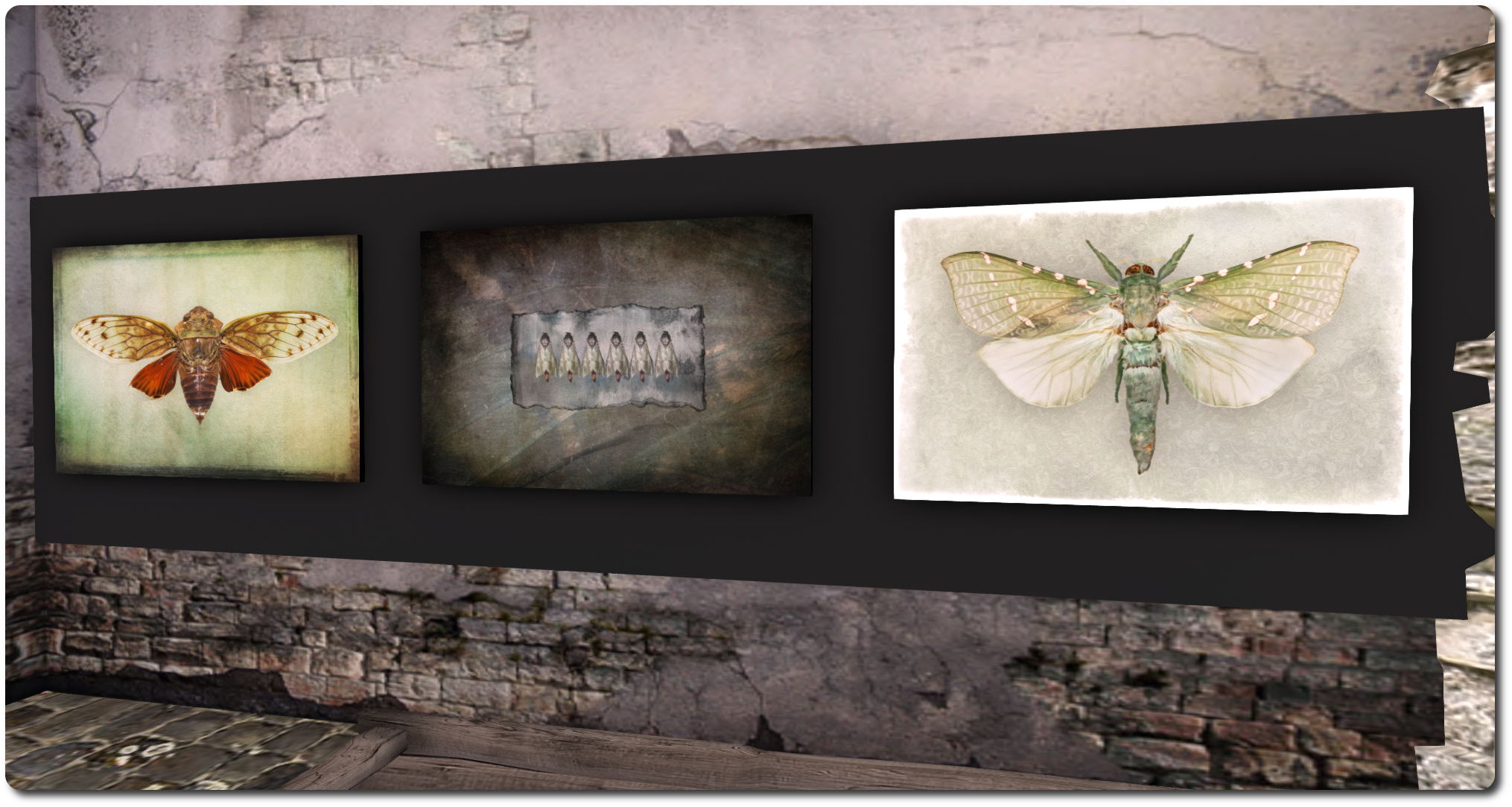
Now, in an exhibit at the Ode’s Arts & Culture Community running through until November 15th, 2014, DecemberGrey has brought some of her own images of lepidoptera and beetles to Seceond Life, combining them with some of her fabulous waterscapes of well-known SL regions. Called Waterscapes & Flying Things, it adds up to a fascinating display of artistic talent well deserving of a visit.
The images of moths and beetles occupy the ground floor of the OACC’s converted watermill gallery. At first glance, these might appear to be reproductions of drawings of the subject matter painstakingly created in the physical world by some 19th century botanist. Not so. These are images painstakingly created by the artist as a result of getting unexpectedly sidetracked at university, as DecemberGrey explains:
While in my second year of a BSc in botany (some fair while ago), I looked into the microscope on the lab bench while the lecturer was talking about angiosperm reproduction…. And from that point on, was captivated by the world seen only through a magnifying lens. I forgot the lecture, became lost. Today, all I remember is the brilliance that captivated me. It changed my life.
…My macro work started manually, my fingers moving the focus ring on the camera – millimetre by millimetre – to create a number of images of the same body which would then be compiled into a single image. Now it is a process somewhat automated. Technology is impressive, and allows an entirely different method of working. It gives me time to dabble in color and light. And to imagine. To transform. To create.
The results are simply amazing, with each of her subjects beautifully presented (and all of them available for purchase).
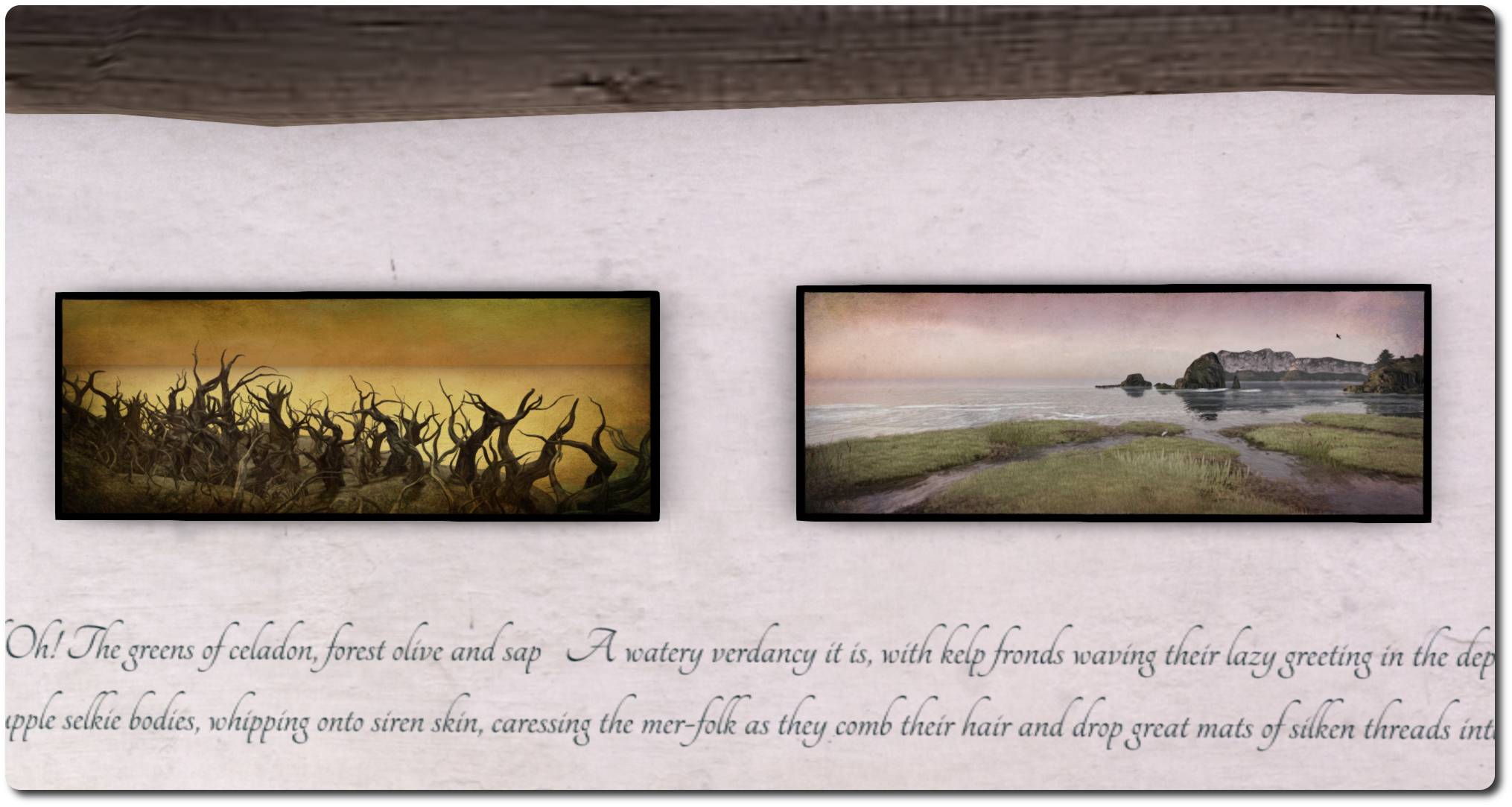
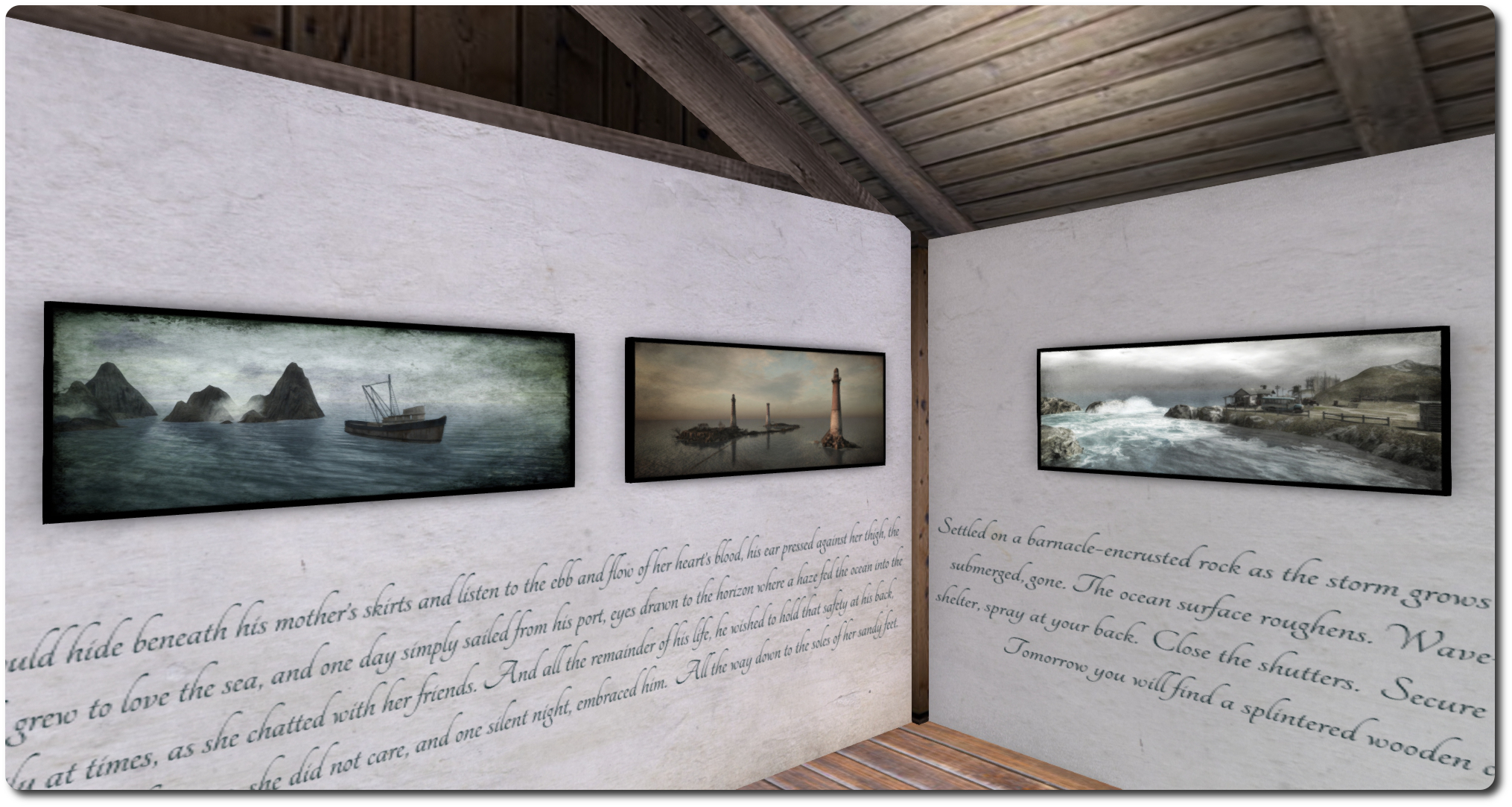
For DecemberGrey’s waterscapes, climb the stairs all the way up to the mill’s attic, where you’ll find them displayed perfectly on the whitewashed walls.
Featuring famous locations such as Roche, Hazardous, The Colder Water, Nagare and Frisland, and arts locations such as Imagin@rium and Immersiva, these pictures are as beautifully composed as the real-life images on the ground floor; in fact I’d say without a shadow of a doubt that they are among the finest images I’ve seen captured from within SL. To call them exquisite would not be over-emphasising them at all.
 Important note: The SL Go service is to be shut down on April 30th, 2015. For more information, please read this report.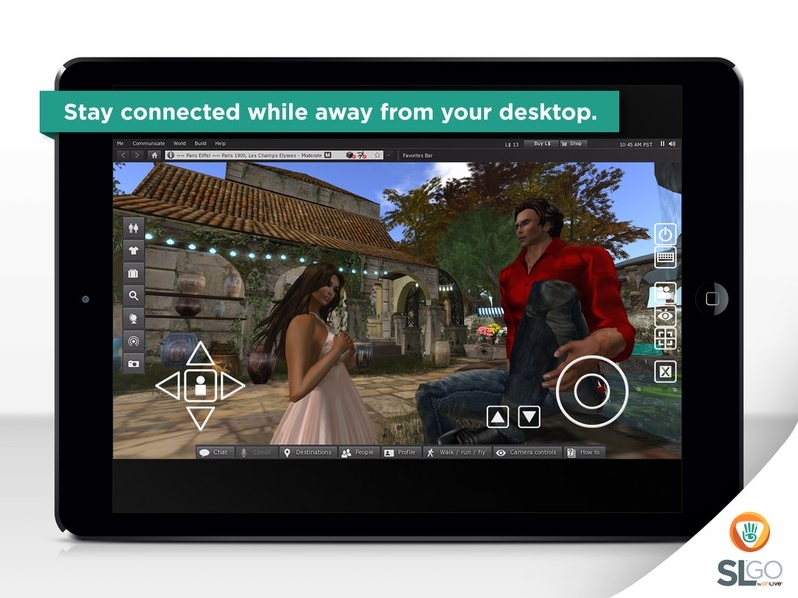







 Inara Pey: Living in a Modemworld