Andrew Linden departing the Lab

Andrew Linden: Departing the Lab

He’s been one of the longest-serving members of the Lab’s team, and actually out-lasted Philip Rosedale for time put in with the company, but after more than eleven years with Linden Lab, Andrew Linden is saying “farewell”.

He broke the news during his regular appearance at the Tuesday Simulator User Group meeting on December 17th, saying, “This is going to be my last User Group meeting as a Linden: I’ve decided to leave LL and pursue other things. I’ve really enjoyed these User Group meetings, which is why I’ve been showing up all these years.”

He confirmed that he will be joining Rosedale at the latter’s latest venture, High Fidelity, saying, “”I’m going to join Philip and his new project. Not because I don’t love SL or am not excited about what LL is working on, but because I’m ready for a change, and I really like working with Philip.”

Andrew’s final day with the Lab will be on Thursday December 19th, after which he’ll be off to join the High Fidelity team.

As a long-serving member of the Lab’s staff, he will be sorely missed. Over the years he’s been exceptionally popular among residents, and he has worked on many of the Lab’s server-side and other projects. Most recently, he has been instrumental in overhauling the platform’s interest list, massively improving the way in which in-world scenes and managed and loaded between the servers and the viewer, and which has also seen an overhaul of the viewer’s object caching capabilities (which are currently available through a release candidate viewer), all of which has significantly improved scene loading and rendering. This work was recently featured in a video narrated by Torley Linden.


The video demonstrating the interest list work: the last large-scale undertaking Andrew worked on

Also of late, Andrew has worked on a number of anti-griefing measures within the platform, and has currently project has involved LSL updates to enable the uniform scaling of objects and linksets (such as uniformly increasing or decreasing a linksets size by a factor of 2). This work should be appearing in an RC release in the New Year.
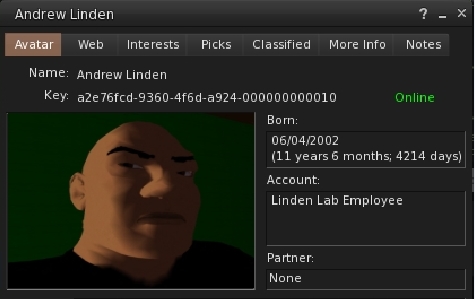
Andrew's profile: testimony to his time at the Lab
Andrew’s profile: testimony to his time at the Lab

In the time I’ve been attending the Simulator User Group meeting (formerly the Server/Sim/Scripting group), Andrew has always been polite, inquisitive and helpful to all, and demonstrated a willingness to readily delve into issues and see what he can find and / or put right. In response to the direct enquiries I’ve put to him in the past, he’s always been more than helpful in his replies, willing to provide concise explanations and offer additional information and guidance.

The news of his departure was met with a mix of sadness and best wishes from those at the meeting. For my part, I’d like to again extend my thanks to Andrew for his input to, and work on Second Life over the years, for his support of the Simulator User Group and to wish him all the best for the future.
Fisicofollia: a futurist’s landscape reimagined

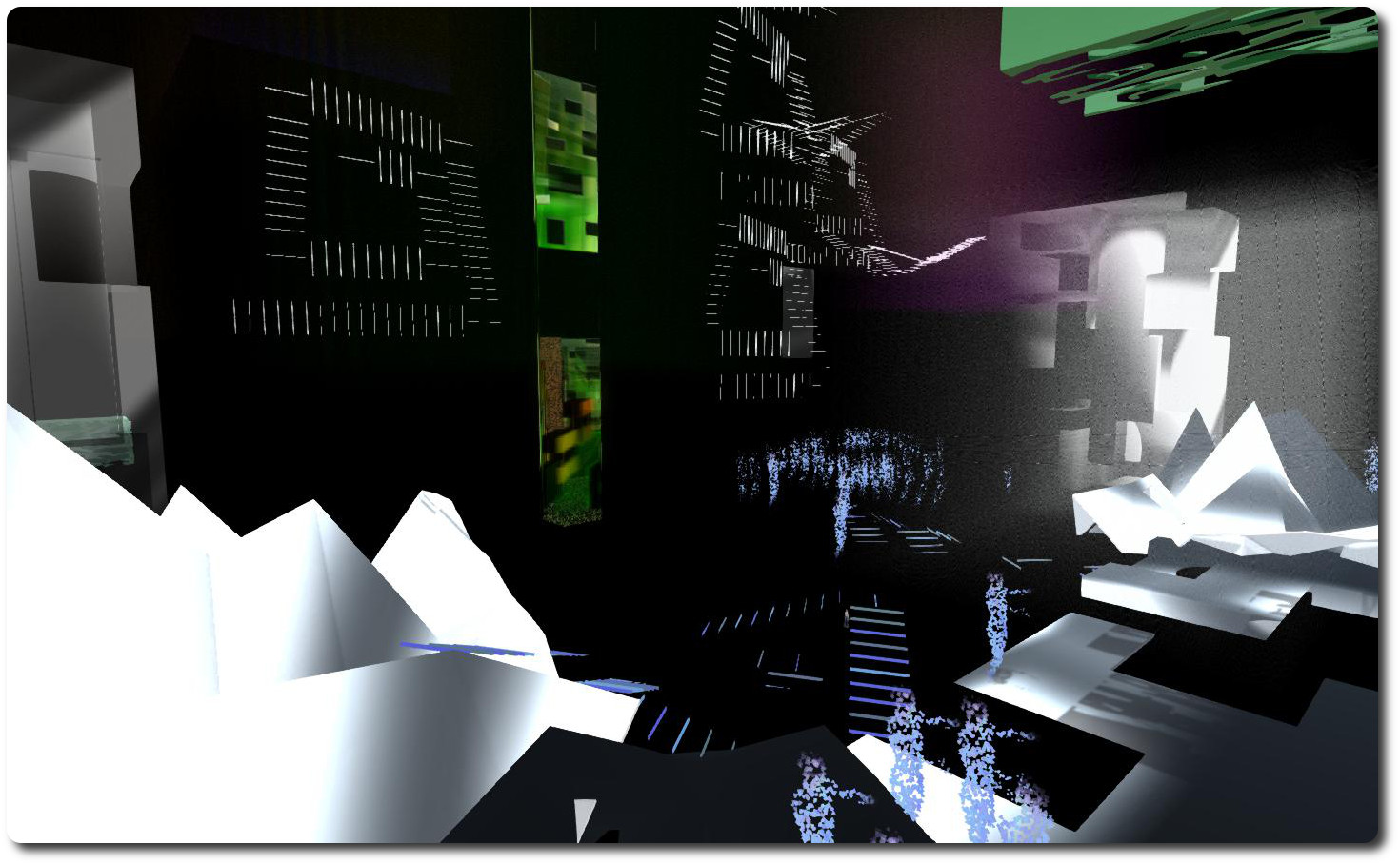
Giovanna Cerise’s latest installation, Fisicofollia, opened at LEA6 on Monday December 16th as part of the LEA’s Full Sim Art Series.

Fisicofollia takes as its springboard the Futurist movement,  and particularly the works of Filippo Tommaso Marinetti, Fortunato Depero, Giacomo Balla, and Enrico Prampolini.

Marinetti effectively founded the movement following the publication of The Founding and Manifesto of Futurism (1909), in which he declared,  “Art, in fact, can be nothing but violence, cruelty, and injustice.” Violence became one of the themes emphasised and glorified by the movement, alongside others such as speed, technology, and youth, together with objects such as the industrial city, the car and the aeroplane; indeed, almost anything that represented the technological triumph of humanity over nature.

FF-9_001
Fisicofollia – LEA6 until December 31st, 2013

Futurist were slow to develop a distinctive style in the early years, initially basing their works on Divisionism, the breaking light and colour down into a field of stippled dots and stripes, before adopting Cubism as they looked to find a more individual means of expression through their works.

In terms of paintings, many of the works by Futurists exhibited strong lines and often imbued a sense of velocity through a blurring of lines and form. These aspects are somewhat reflected in elements of this installation. One section in particular uses colour and blurring to great effect. Elsewhere, there is a more free-form interpretation of the movement’s works, which embraced not only paintings, but sculpture, architecture, fabrics and fashion.

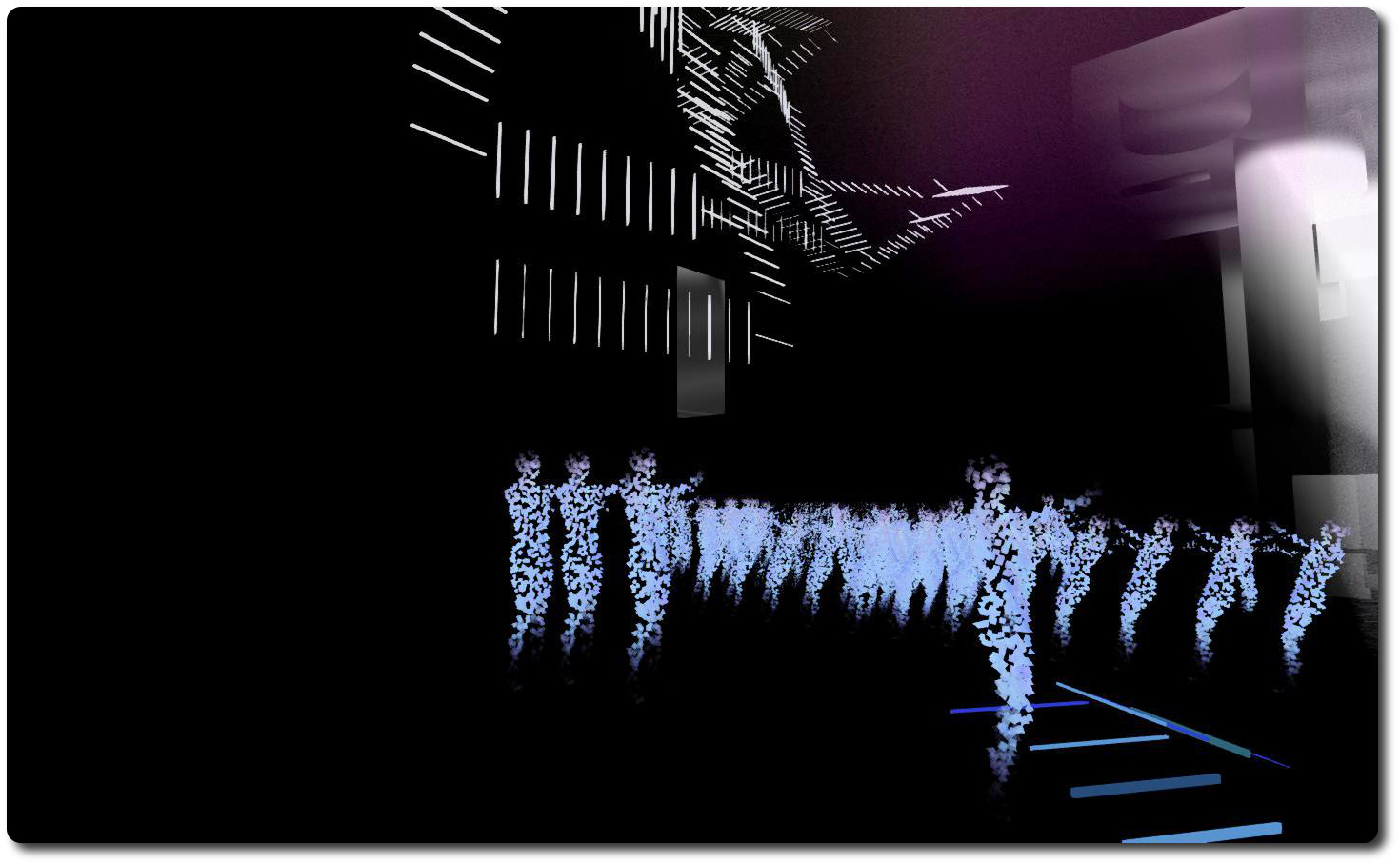
Throughout the main part of the build is the figure of a man, constructed from blue-shaded pyramids or tetrahedrons. Of varying sizes, it appears to be leaning back, arms raised horizontally, and is found in various sizes and numbers across the installation. Many of these figures are regimented into lines, some even into ordered into ranks. The latter are especially evocative of the movement’s militaristic leanings, their ordered rows, identical poses and colours suggestive of soldiers on parade. Draw in close to these figures, and they seem to mix and merge into a stippling effect, again perhaps again echoing the influence Divisionism had on the Futurists.

FF-4_001
Fisicofollia – LEA6

Geometry is used to great effect throughout the piece. One section of the installation appears to be draped in mist; approach it, however, and one discovers the mist is in fact a series of closely spaced, translucent grids, forming a moiré pattern which breaks-up  the landscape and which shifts and changes as one’s eye (and camera) moves.

Patterns are also formed through the use of multiple parallel lines, spaced and placed to give the impression of stairways. Higher-up, in what is very much as three-dimensional design, these come together, Escher-like, to form eternal stairways leading nowhere, presenting a place where, to use Giovanna’s words, “lines, planes, shapes and colours combine, alluding to an invention related to childhood and madness.”

FF-3_001
Fisicofollia – LEA6

Along with the visual elements of the piece is an accompanying sound scape, and it is recommended that the visitor has sounds enabled when visiting in order to benefit from the auditory elements present in the installation.

As well as describing Fisicofollia as a free-form interpretation of the Futurist movement’s approach to art, Giovanna also refers to the piece as:

A multi-dimensional performance space, in which light and shadow, colour and movement are the protagonists. The scene expands to create a multiplicity of perspectives in a continuous emotional tension … The visitor can interact with the environment simply going through it, resulting in different visual impressions.

FF-10_001
Fisicofollia – LEA6

Fisicofollia is open through until the end of December 2013.

Related Links

2014: Step into the garden of good and evil with the Basilique Performing Arts Company

Paradise LostI recently wrote about of Romeo + Juliet, a unique re-imagining of Shakespeare’s tale of love, loss and tragedy, performed by the Basilique Performing Arts Company, and which features an inspired mix of  renaissance-inspired sets, 1940s costumes, and contemporary music.

While that production is set to continue until around mid-February, and is a must-see for anyone who hasn’t yet taken the opportunity to do so, the Company has now announced its next major – and equally ambitious –  undertaking.

In Spring 2014, the Basilique Performing Arts Company will be premiering Paradise Lost: The story of Adam and Eve’s original sin, choreographed and set to the fourteen movements of Mozart’s Requiem Mass in D minor.

Based on Milton’s epic blank verse poem, the production has been conceived and developed by the creative team of Canary Beck and Harvey Crabsticks. Each performance will run for some 60 minutes and comprise three Acts: The Creation, The Fall and The Expulsion. Through each, we will follow Satan, as he builds Hell, God as he creates the Garden of Eden, the Tree of Knowledge, Adam … and Eve; witness Satan’s beguiling of Eve, watch as she and Adam wilfully lust for one another in the face of God’s anger, only to be banished from the Garden of Eden; then finally, watch all that came after: the battle between  the forces of Good and Evil, and Adam and Eve’s lives after Eden. All have been specially choreographed, and each act will comprise a number movements from Mozart’s Requiem.

This promises to be a most amazing production, as demonstrated in the preview trailer – best watched full screen and in HD, if possible.

Paradise lost: The Story of Adam and Eve’s Original Sin will be staged at the Basilique Playhouse. All performances will be free, and the schedule will be announced in due course, and reported in these pages.

So get set for what is likely to be one of the highlights of the Second Life cultural calendar in 2014!

Fitted Mesh: “last call” for issues; release candidate “after the holiday”

secondlifeThe Lab’s Fitted Mesh project viewer has been out for a month, and has seen some good feedback from those who have been trying it out.

Already one update to the viewer has been released, correcting a number of problems, and the Lab has been working with content creators and users who have been providing feedback through the FITMESH project reporting on the JIRA.

However, Lab is keen to start progressing the project in the New Year, and so a “last call” for issues has gone out.

“If you’ve been seeing any issues with the current fitted mesh project implementation, or anything that needs to be added/changed, please make sure that the issues are filed by now, or as soon as possible,” Nyx Linden said at the Content Creation User Group meeting on Monday 16th December.

For those who missed the original announcement, Fitted Mesh is a means by which mesh garments are rigged to the collision bones of the avatar skeleton, allowing them the be resized as the avatar’s shape is changed using the Edit Shape sliders. In essence, it is the same approach as has been seen within Second Life and variously referred to as the “RedPoly method” or “Liquid Mesh”.

The technique uses both the existing bones in the SL avatar and an additional set of bones in order to work, and you can read more on it in my original preview article, if you’re not already familiar with the approach.

Oz Linden, also at the meeting, underscored the “last call”, saying, “To emphasise what Nyx said earlier … get your comments and issues in on Fitted Mesh ASAP so that we can do a release candidate after the holiday break.”

Quite when that release candidate will appear is unclear; there is a lot going on at the Lab, and several projects are likely to be vying for room in the release channel (although some will hopefully go to project viewer status first and give the rest some elbow room).

However, if you have been looking at the current Fitted Mesh viewer and wish to have input to the project, now is very much the time to do so. Similarly, if it is something which has been on your “to do” list, now is the time to move it to the top, or risking seeing your chance ot have input to the project, and influence on the Lab, vanish.

Related Links

Viewer release summaries 2013: week 50

This summary is published every Monday and is a list of SL viewer / client releases (official and TPV) made during the previous week. When reading it, please note:

  • It is based on my Viewer Round-up Page, a list of  all Second Life viewers and clients that are in popular use (and of which I am aware) and which are recognised as adhering to the TPV Policy
  • By its nature, this summary will always be in arrears
  • The Viewer Round-up Page is updated as soon as I’m aware of any releases / changes to viewers & clients, and should be referred to for more up-to-date information
  • The Viewer Round-up Page also includes comprehensive links to download pages, blog notes, release notes, etc., as well as links to any / all reviews of specific viewers / clients made within this blog.

Updates for the week ending: December 15th, 2013

Official LL Viewers

  • Current Release version updated on December 10 to 3.6.12.284506 (dated December 4)  – formerly the NameUpdater RC (download page, release notes)
  • Release channel cohorts (See my notes on manually installing RC viewer versions if you wish to install any release candidate(s) yourself):
    • “Project Interesting” RC updated on December 12 to version 3.6.13.284757 – more viewer-side control of which objects are loaded in memory at any given time; more aggressive scene caching; faster scene load when visiting a region never previously visited; expanded performance metrics (download and release notes)
    • Google Breakpad RC updated on December 13 to version 3.6.13.284710 – contains an update to Google Breakpad and restructures the crash reporting mechanism to support out of process crash reporting; no functional changes to the viewer (download and release notes)
  • Project viewers:
    • No updates

LL Viewer Resources

Third-party Viewers

V3-style

  • Kokua updates on December 12th to version 3.6.12.30743 – core updates: parity with LL 3.11 and 3.12 codebase; tweaks and updates from the Kokua team  – release notes

V1-style

  • Cool VL updated on December 7th to:
    • Stable version: 1.26.10.4
    • Experimental version: 1.26.11.4
    • Legacy version: 1.26.8.41
    • Release notes (all) In general: GPU tables additions, assorted bug fixes and optimisations; Experimental branch: port of further fixes from viewer-interesting and from Fitted Mesh project.

Additional TPV Resources

Related Links

Firestorm meeting and Q&A December 14th: video and transcript

firestorm-logoOn Saturday December 14th 2013, the Firestorm team hosted another informal question-and-answer session. While the meeting was recorded, the Firestorm team are aware that many of their users have hearing difficulties, and / or prefer to read text. It is because of this that this transcript has been provided.

When reading it, please remember:

  • This is not a word-for-word transcript of the entire meeting. While all quotes given are as they are spoken in the video, to assist in readability and maintain the flow of conversation, not all asides, jokes, interruptions, etc., have been included in the text presented here
  • If there are any sizeable gaps in comments from a speaker which resulted from asides, repetition, questions to others etc,, these are indicated by the use of “…”
  • Timestamps are provided as guidance should anyone wish to hear the comments in full from any speaker on the video
  • Questions /comments were made in chat while speakers were talking. This inevitably meant that replies to questions would lag well behind when they were originally asked. To provide context between questions and answers, questions in the transcript are given (in italics) at the point at which each is addressed by a member of the Firestorm team, either in voice or via chat.

Please note: This transcript is provided for informational purposes only. As such, questions on technical issues relating to Firestorm and  / or project-specific questions cannot be answered here unless one of the Firestorm team drops by.

The TL;DR Summary

The numbers in braces are timestamps which refer to the section of this transcript where more details can be read, and to the section of the video recording where the relevant comments can be heard.

Main Discussion:

  • The next release: will most likely be a stabilisation of the code currently in 4.5.1 rather than introducing major updates, although this is still to be determined. LL have a lot coming down the pipe, which Jessica was hoping would be ready for inclusion in the next release, but that is looking unlikely unless something significant happens to change things [0:00:25-0:02:48]
  • Response to the beta has been good, around 120,000 downloads, of which around 6,000 are for the Windows 64-bit version. A number of people have subsequently reverted back to the 4.4.2 release due to issues. There are significant issues with voice, Mac users have encountered issues arising from Cococa (Mac and Voice issues covered later as well).[0:02:48-0:06:03]
  • Reference is often made to “Linden Bugs”. This does not necessarily mean they are the Lab’s fault; it simply means that the SL viewer has the same issues [0:06:03-0:06:53]
  • Firestorm releases are currently roughly four months apart. Ideally this should be two months, which is a target, but needs to be balanced with the risk of overwhelming the support volunteers (who need to both learn and support new releases). Therefore, it might mean a compromise of a release every quarter [0:06:53-0:09:40]
  • Voice issues: Vivox problem, LL have it as well. Firestorm have a series of videos demonstrating the problem. If a user on FS 4.5.1 beta has the issue, the recommendation is to revert to the 4.4.2 release [0:09:53-0:10:46]
  • The FS Windows 64-bit has been well received and feedback has been positive. Most people are reporting imporved stability rather than improved performance compared to the 32-bit version [0:11:10-0:12:56]
  • Oculus Rift is coming to Second Life [0:13:10-0:15:27]
  • Leap Motion is coming to Second Life – and the Firestorm Team have taken a lead in the integration work with the viewer [0:15:27-0:22:49]
  • Firestorm 4.5.1 beta and Firestorm release numbering explained [0:23:02-0:26:35]
  • Why Firestorm block versions and why Phoenix isn’t currently blocked [0:52:02-0:58:41; 1::0036-1:02:56]
  • Firestorm Q&As qill be monthly from January, alternating between 08:00 SLT and 16:00 SLT month-by–month [1:12:03]

Q&A Session:

  • Would it be an option to have different branches for people to download …? – includes discussion on why FS does not have nightly builds and on joining the FS beta testers [0:27:56-0:37:32]
  • Can we hope for more tattoo layers? [0:37:35-0:39:19] – reply includes reference to Linden Lab User Group meetings, the forums in which such questions can be asked
  • Will the new version [of Firestorm] be in 64-bit, and is Fitted Mesh coming? [0:40:00-0:47:40]
  • Why is IM and local chat so laggy in the beta version of Firestorm? (Mac build) – known issue, with both Firestorm (FIRE-12172) and LL JIRAs raised against it [0:47:40-0:49:47]
  • Why will music streaming not work on 4.4.2 with the new Mac OS upgrade? – Mac OS X 10.9 Mavericks issue reported under FIRE-10630 There is also a list of Cocoa bugs specific to the Mac build [0:49:47-0:52:02]
  • Dealing with inventory “jump” issues and bug regressions [0:52:02-1:00:36]
  • Are older versions of Firestorm also blocked from OpenSim when they are blocked from SL? – any version prior to 4.4.2 will unfortunately be blocked from OpenSim when blocked from SL. All versions of FS from 4.4.2 onwards can be individually blocked from grids [1:02:56-1:04:13]
  • Has the FS team ever considered working on a mobile Firestorm product? – includes the FS April Fools from 2013, and accessing Firestorm remotely [1:04:16-1:10:17]
  • Has the FS team considered “drawing a line” on how far they’re veer from the LL codebase (e.g. additional feature input, etc.), in order to improve the release cycle and lessen the maintenance overheads? [1:13:20-1:21:01]
  • What drives the FS team to do what they do? [1:21:40]

Continue reading “Firestorm meeting and Q&A December 14th: video and transcript”