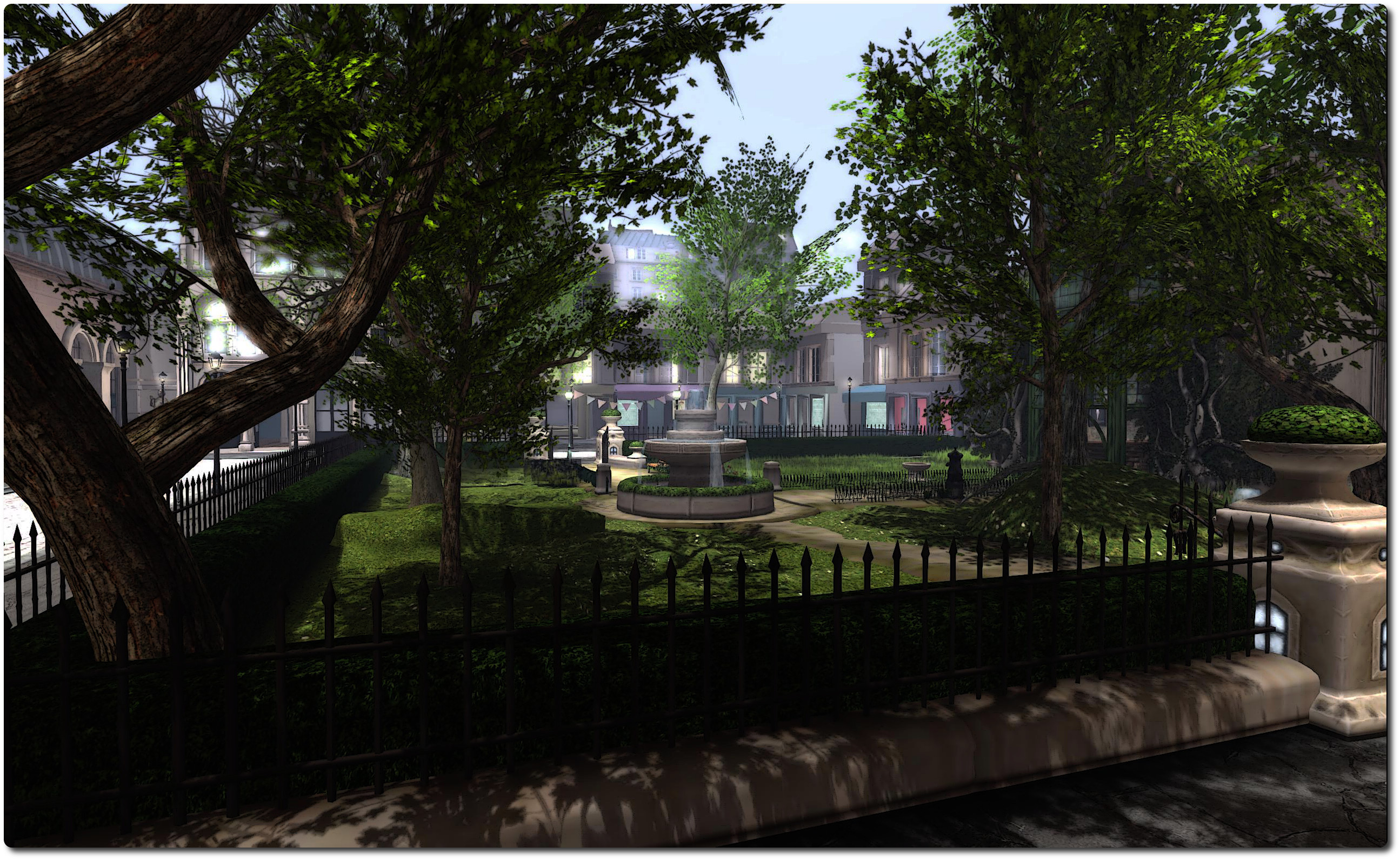
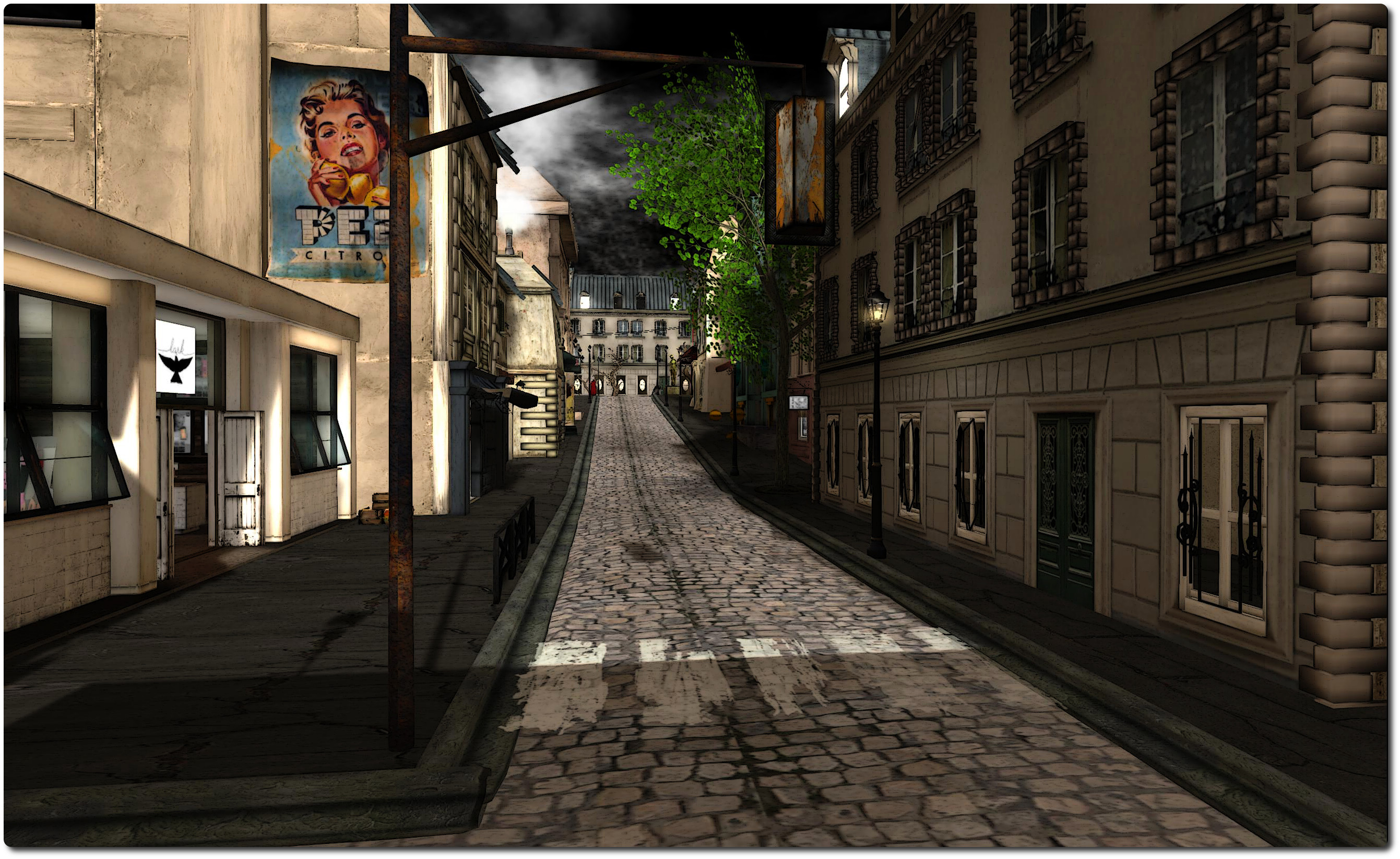
Walking down the
Cobbled street
Jeans & T-shirt
And silk black flats
Upon my feet
With the sunshine
On my shoulders
And the smell of pastries
In the air
Watching people
Passing by
Til the day
Has turned to night
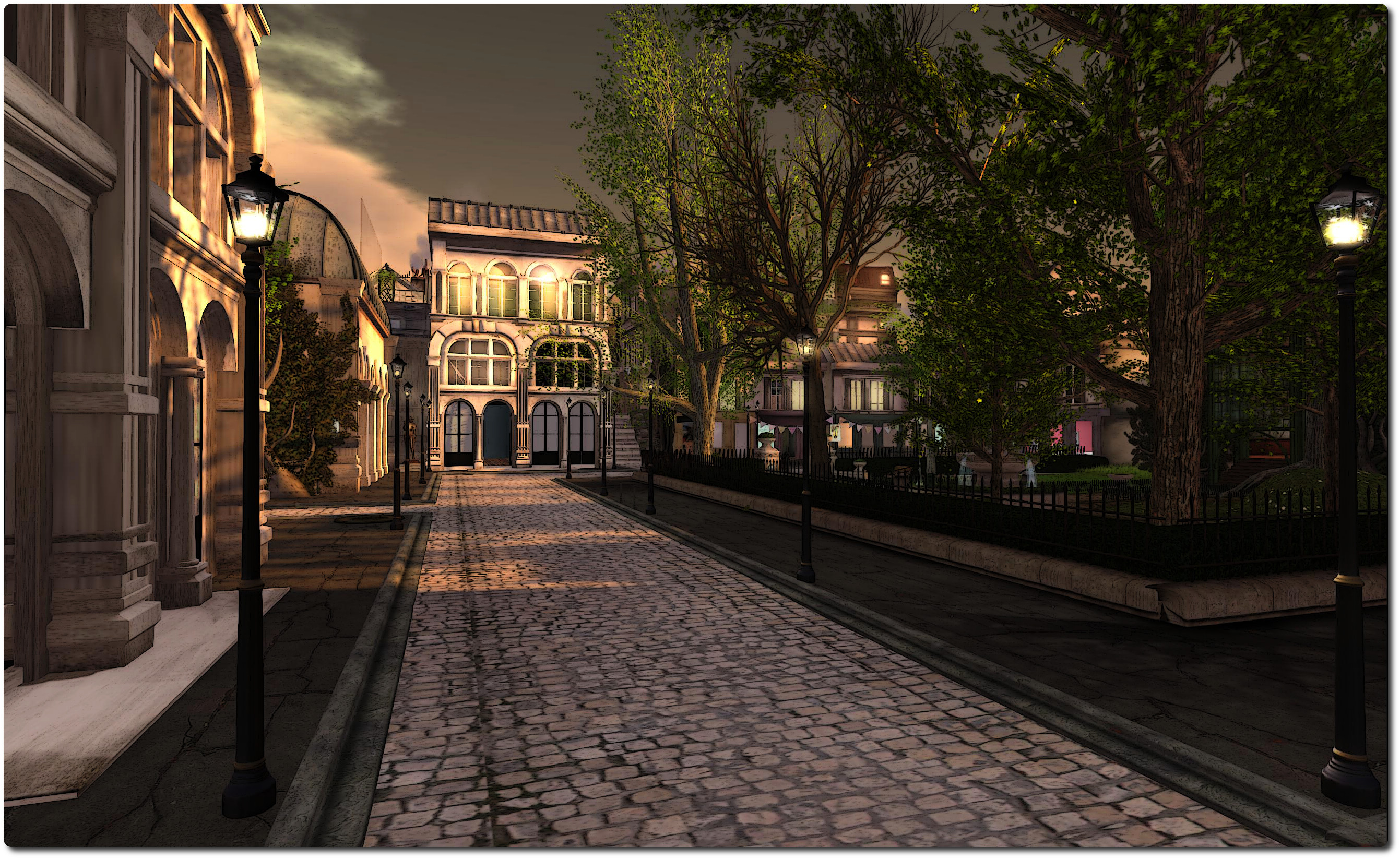
The cobbled street
Now paved in
Silver light
With the light from lamp posts
Tall as trees
Reflecting on the surface
Of the river Seine
Walking neath
Blue velvet skies
On my way to
Buy some pink champagne
I’ll return then
To my balcony
In the hotel
Named after George the fifth
And there I’ll sit and watch the stars
I’ll dream my life away
And send a wish into the void
To a far off shooting star
That one day
Life will bring me back
To this heaven
To the city that stole my heart
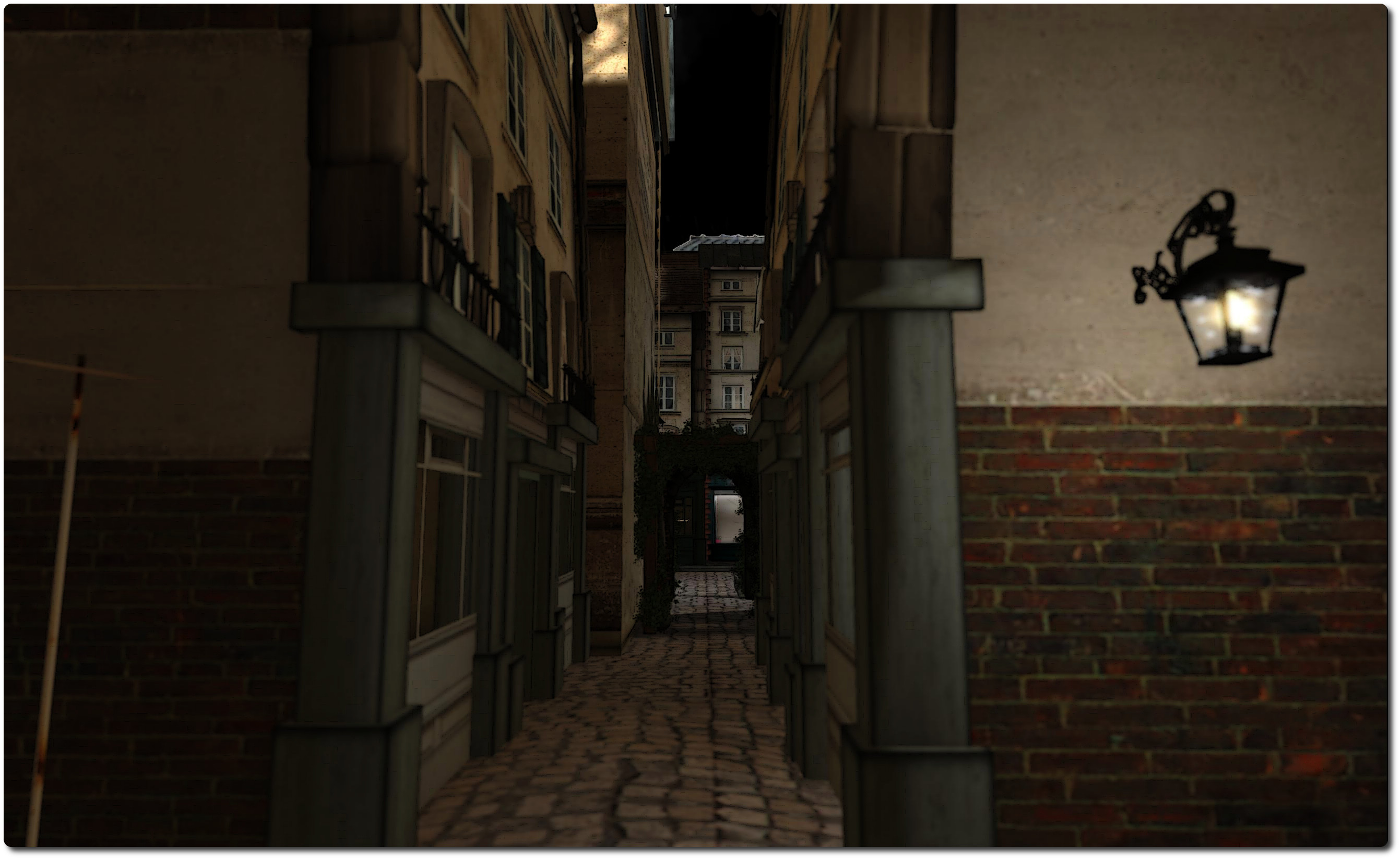
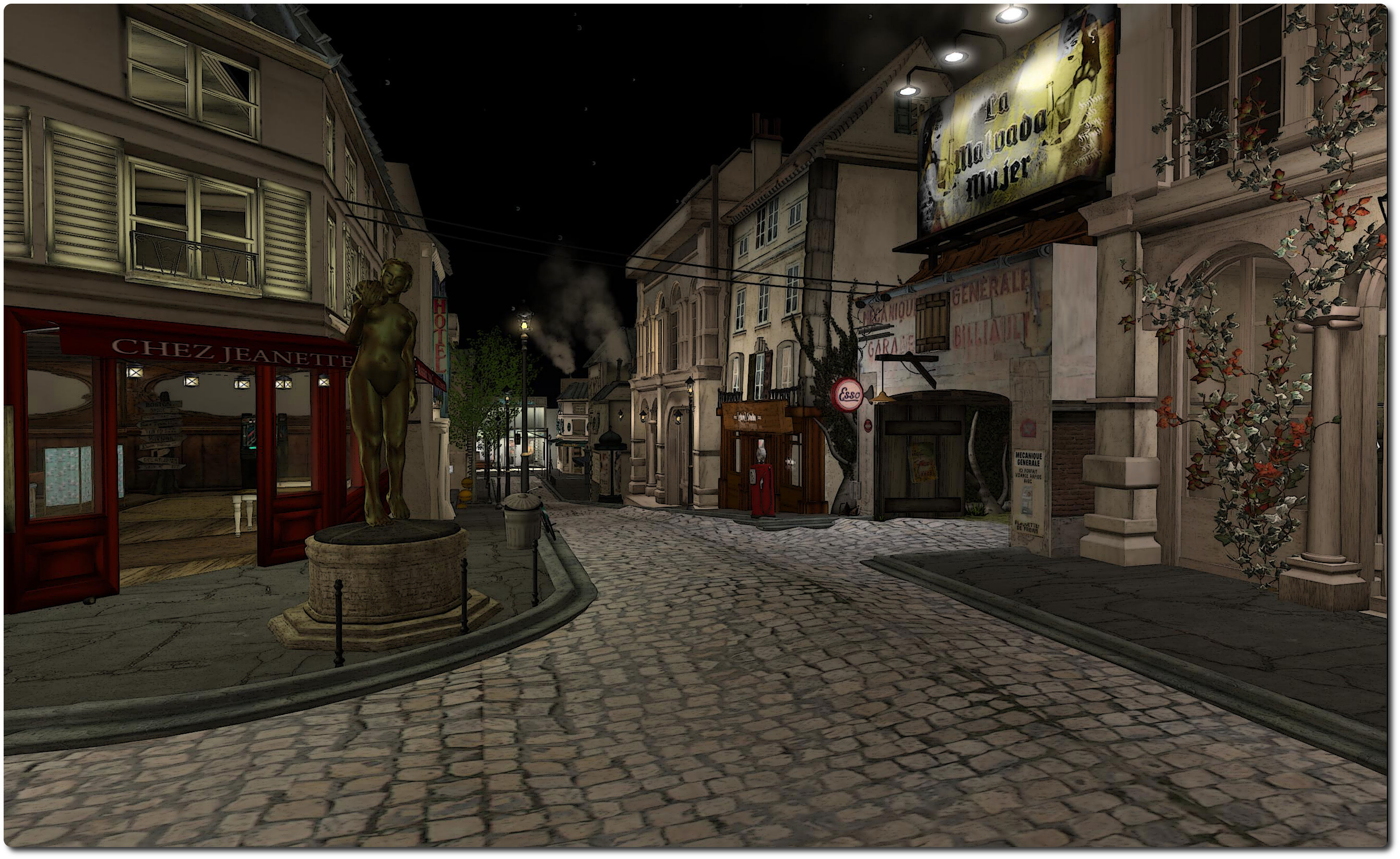
“Paris” by Natasha Wright. Images from Cupcake (Rated: Moderate)
No, this isn’t a return to coverage of Wars of the Worlds in SL. November marks the start of the next round of missions to Mars, with two new orbiters about to depart Earth as a part of our efforts to better understand the Red Planet and its atmosphere. Meanwhile, and despite a lack of headline news, NASA’s Mars Science Laboratory (MSL) continues its own explorations of the Red Planet, as does its little cousin Opportunity, half a world away.
Driving Forward
During the last week of October, the MSL rover Curiosity chalked up another achievement making its first pair of back-to-back autonomous drives using its on-board capabilities rather than relying on assistance from Earth.
I’ve covered the benefits of Curiosity’s ability to “self navigate” and how it works in previous MSL reports. However, up until now the system has only been used after the rover has initially traversed a course carefully plotted by the drive team on Earth using images taken by the rover and from overhead passes of the Mars Reconnaissance Orbiter (MRO).
This was the case with the rover’s drive on Sunday 27th October, when it completed an autonomous drive after a plotted drive. However, on Monday 28th October Curiosity immediately resumed its autonomous drive without any input from Earth, heading for the next waypoint along the route which will eventually bring it into the lower slopes of “Mount Sharp”.
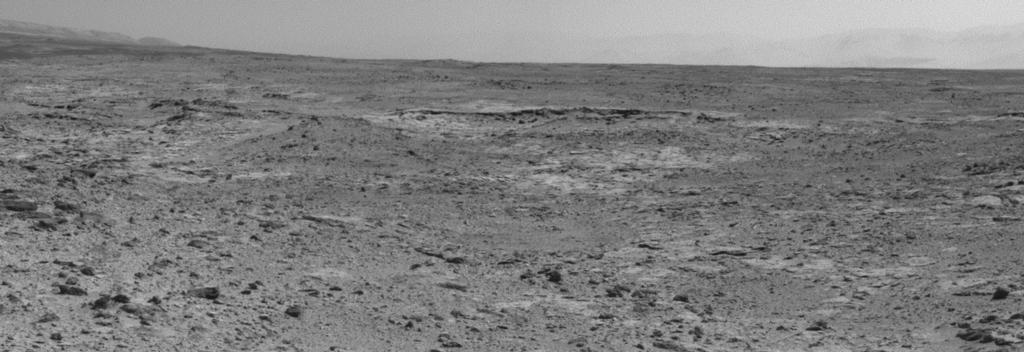
Next stop “Cooperstown”, the raised outcrop in the centre of this image from Curiosity’s Navcams, captured at the end of the rover’s back-to-back autonomous drives on October 28th, 2013 (Sol 437).
This waypoint, dubbed “Cooperstown”, is a rocky outcrop which had been identified as a candidate for examination by the rover in MRO images of the route to “Mount Sharp”. It is anticipated that Curiosity will spend no more than a day examining the outcrop, which is liable to be done predominantly using the instruments mounted on the turret at the end of the rover’s robot arm.
“What interests us about this site is an intriguing outcrop of layered material visible in the orbital images,” said Kevin Lewis of Princeton University and a participating scientist for the mission responsible for planning the “Cooperstown” activities. “We want to see how the local layered outcrop at ‘Cooperstown’ may help us relate the geology of ‘Yellowknife Bay’ to the geology of ‘Mount Sharp’.”
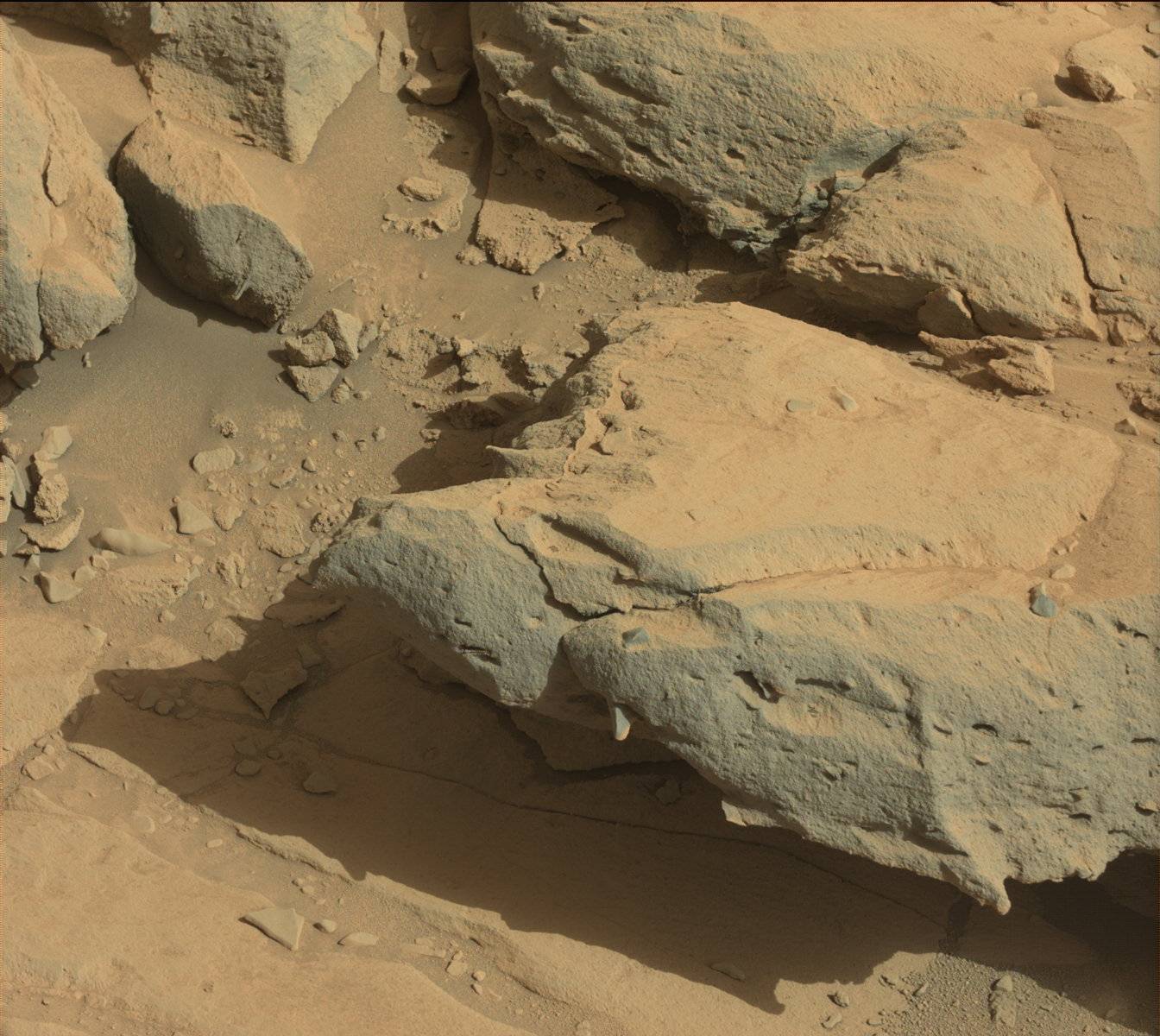
A high-resolution raw image of part of the “Cooperstown” outcrop captured using Curiosity’s Mastcam on Sol 440 (November 1st, 2013)
“Yellowknife Bay” is an area of Gale Crater which, alongside that of “Glenelg”, the rover spent some 6-months examining various rock formations and gathering samples for analysis.
The planned duration of the “Cooperstown” stop is in marked contrast to the rover’s last waypoint stop, and coupled with the testing of back-to-back autonomous drives, is aimed at accelerating Curiosity’s progress towards the desired destination of “Mount Sharp”. So far, the rover has traversed around one-third of the 8.6 kilometres (5.3 miles) separating the “Yellowknife Bay” area, which it left in July 2013, from the entry point to the lower slopes of “Mount Sharp”.
The ability for the rover to safely store data necessary for it to resume self-navigation in its onboard memory is also vital for future planning for Curiosity’s progress over the upcoming holidays, when it is hoped that multi-day operations for the rover can be planned and uploaded, allowing the rover to continue in a range of activities, including driving, rather than necessarily spending the entire holiday periods parked-up and performing static science.
The next key activity for the rover is the uploading of the third new version of the on-board software. Such uploads are periodically needed in order to both prepare the rover for upcoming aspects of the mission and to improve its capabilities. This next update will see improvements in the information the rover is able to store overnight for the purposes of autonomous driving, updates to the software controlling the robot arm which should further increase the ability to use the arm when the rover is parked on a slope – something which is likely to be needed once Curiosity starts exploring “Mount Sharp”.
“The number 3 is in nature, in our culture and in ourselves. Is the Trinity exposed in its multiple meanings present in religion, science and philosophy, in the division of time into Past, Present and Future, in the Three Powers, in You, Me and that which unites us or disjoint us and in the Id, Ego and Superego of Freud? – Noke Yuitza
A new installation by Giovanna Cerise and featuring pieces by Alpha Auer, Ataro Asbrink, Betty Tureaud, Daco Monday, La Baroque, Noke Yuitza, Paola Milla, Pol Jarvinen and Taralyn Gravois opens on Sunday November 3rd at LEA17.
Give the numbers! is a collaborative exploration of numbers and their meaning, be it practical, philosophical, mystical, factual or fantastical, and their influences on us.
Paola Mills
Given that numbers are central to our lives in so many different ways, the idea of representing them, their many and varied meanings, influences and uses is a fascinating concept, and in Give the numbers! it is one which is intriguingly presented. The main part of the installation is floating in the air as series of platforms interlinked by a teleport system, and presented in a series of two-dimensional frames above which they sit.
The way the various numbers from 0 through 8 are presented and interpreted is highly individual, leading to an absorbing piece which deserved a reasonable amount of time and effort in exploring. Some of the pieces offer interactive elements as well, so keep an eye out for these. When I made my preview visit, elements were still under construction, so there are probably newer aspects to be explored and enjoyed and which I missed when looking around.
5555555 55555 555 – Alpha Auer
When you have finished exploring the sky platforms, do take a trip down to ground level, where you’ll find Giovanna’s Arthimos, a fascinating geometric build which, in the words of the artist, offers, “Fascination and illusion in balance between rationality and irrationality.”
Here the numerical influences are again clear through the use of the various shapes and lines, but there is something else at work here; pan around the build and elements which might initially appear to work together seem to come into conflict; the rational becomes irrational. Even the nature of numbers changes, thanks to the placing of a series of dice around the build, reminding us of how numbers are often linked with chance, and chance, while irrational, often forms the basis of our supposedly rational ability to make decisions.
Arthimos – Giovanna Cerise
There is little guidance on preferred lighting settings, but I do recommend something around Midnight is perhaps the best way to appreciate the pieces, together with a relatively low draw distance to bring each element individually to the fore (with the exception of Arithmos, where a draw distance sufficient to let you see the entire region is recommended). The images here were captured using JAXBlackContrast from Jackson Redstar, with cloud cover set to zero and S/M and Ambient Sun / Moon settings tweaked a little via the colour picker sliders.
Give the numbers! will run through until the end of December 2013.
It’s time to kick-off another week of fabulous story-telling in Voice, brought to Second Life by the staff and volunteers at the Seanchai Library SL.
As always, all times SLT, and unless otherwise stated, events will be held on the Seanchai Library’s home on Imagination Island.
Sunday November 3rd, 13:30: Tea Time at Baker Street
Sherlock Holmes (l, standing) and, Dr. Watson receive two distinguished guests in “The Adventure of the Second Stain”, Sidney Paget / Strand Magazine, 1904
Caledonia Skytower and Corwyn Allen read The Adventure of the Second Stain, from The Return of Sherlock Holmes.
Holmes and Watson received two very distinguished guests, who between them have a serious problem of some considerable import and delicacy.
None other than the Prime Minister, Lord Bellinger and the Secretary of State for European Affairs, Trelawney Hope, inform Holmes that a document has been stolen from Hope’s dispatch box, apparently while the latter was at Secretary of State’s home. The document, a letter from a foreign potentate, could result in very dire consequences – even war – if delivered to the wrongs hands.
Both the Prime Minister and Hope impress upon Holmes that such is the nature of the document that no-one in Hope’s household, not even his wife, knew of its presence prior to the letter vanishing when Hope himself was out of the house for a number of hours.
Taking the case, Holmes decides to call upon a number of spies who may have a vested interest in obtaining the letter on behalf of their governments, only to find one of them has been murdered. Deciding that this could not be mere coincidence, he finds the mystery deepening when Hope’s wife, Lady Hilda Trelawney Hope, arrives at his home, demanding to know the contents of the document, whilst also begging Holmes to tell her husband nothing of her visit…
Monday November 4th, 19:00: Science Fiction: The Planets Series
With Gyro Muggins.
Tuesday November 5th, 19:00: Treasure it the Heart of the Tanglewood
Faerie Maven-Pralou restarts her reading of Meredith Ann Pierce’s 2001 novel for young adults, which was unfortunately interrupted in August.
Hannah lives by the fearsome Tanglewood with a few talkative companion animals. She doesn’t age, and she has no memory of anything but this life of isolation. Once a month she plucks the flowers that grow from her head, a painful process in which “each yank made her whole scalp ache”, and brews them into a tea for the wizard who lives deep in the woods.
When Hannah falls in love with one of the many knights who seek the treasure of the book’s title, she starts to question the wizard’s motives, finding he has turned the knight into a fox.
Escaping the wizard’s manipulative grasp, Hannah sets out to find a cure for the knight, an adventure in which she discovers her own identity and the repercussions of some of her actions while under the control of the wizard.
Wednesday November 6th, 19:00: Fortunately, the Milk
“This is quite possibly the most exciting adventure ever to be written about milk since Tolstoy’s epic novel War and Milk. Also it has aliens, pirates, dinosaurs and wumpires in it (but not the handsome, misunderstood kind), also a never-adequately-explained-bowl-of-piranhas, not to mention a Volcano God.”
– Neil Gaiman.
What do you do when your wife is away on a business trip, you pop down to the corner shop to get a pint of milk for the kids’ breakfast, get caught in conversation and eventually return home to the accusing stares of your two children delivered across milk-less bowls of cereal? Do you admit that yes, in fact you had been gossiping, or do you opt for the safer way out and offer-up the most outlandish tale?
Guess which course of action this particular father took?
Join Caledonia Skytower as she reads Neil Gaiman’s delightful tale in the art of trolling the kids.
Thursday October 17th
16:00: A Leprechaun´s Tale
With Dubhna Rhiadra.
19:00: Weirder than Weird
If you love quirky and dark short stories but have become discouraged over the lack of originality these days then this book will renew your faith! “Weirder Than Weird” is full of dark and creepy tales as well as a few oddballs that Rod Sterling would probably feel right at home with. With Shandon Loring.
21:00: Seanchai Late Night
—–
Please check with the Seanchai Library SL’s blog for updates and for additions or changes to the week’s schedule.
The following summary is taken from the TPV Developer meeting held on Friday November 1st. A video, courtesy of North, can be found at the end of this report. The numbers in braces after each heading (where given) denote the time stamp at which the topic can be listened-to in the video.
General Viewer News
As noted in part 2 of this week’s report, there are currently two release candidates in the LL viewer release channel, the GPU Table RC, which contains updates to the viewer’s GPU table but no functional changes, and another Maintenance RC, which includes finer access control for estate/parcel owners; CHUI: toggle expanding Conversations by clicking on icon + more.
It is expected the Google Breakpad RC will be returning to the RC channel in week 45 (see below).
Several of the remaining anticipated viewer RCs / project viewers, again as previously reported, held-up as a result of issues uncovered in QA and / or bugs being re-introduced into them. These include:
The Group Ban List viewer: work here, which involves server and viewer changes, is held-up as a result of QA testing revealing some issues which Baker Linden is addressing (as per part 2 of this report)
The interest list viewer, which recently saw the issue of objects failing to render without a relog return to the code after having been fixed, and which still has one or two other issues to be fixed, although Oz Linden feels those working on it are homing in on solutions
The HTTP viewer updates, which were for a time awaiting QA resources (see below for a further update).
AIS v3
[02:29-07:07]
Nyx Linden, Tiny RobotTM, in the Halloween spirit
The Lab is keen to start progressing this work towards a release. As with Server-side Appearance, they’re looking to TPVs to help with various aspects of testing. To this end, a request has been passed to TPVs that they indicate to the Lab when they have merged the code into experimental versions of their viewers so that a pile-on test can be arranged in order to put the updates through their paces.
There is no specific date for when this will take place, and commenting on the project in general, Nyx Linden said:
Now is a good time to start your merges, I’ve just pushed an updated to Sunshine external, so you guys should have our latest and greatest … But again, this is not formally QA’d, we’ve been testing things as we’ve been going on, but it is not ready for release yet. But now is a good time to start doing test merges and getting side branches up-to-date with that.
The latest code includes a fix to viewer-side behaviour. On logging-in to Second Life, the server sends a list of the things it believed an avatar was wearing, although the message only had room for one wearable of each type (e.g. undershirt, shirt, jacket, etc.), and so it may or may not be up-to-date with the Current Outfit folder.
While the current release versions of the viewer ignore the contents of the message, they do still wait on the message for timing (thus slowing down avatar processing). With the new code, the timing pause is being done away with, so that the viewer should be able to start resolving the avatar from the Current Outfit Folder whether or not the message has been received. There is a slight side-issue with this change that may affect some avatars under limited circumstances, but a fix for this issue is due to be made available to TPVs before the code even reaches any experimental versions of their viewers.
Viewer Crash Reporting
[09:00-14:50 and 26:03-31:15]
There is an issue with the viewer crash reporting which means that a lot of crashes are being incorrectly reported as viewer “freezes”. This is something the Lab is aware of and is working to address. The problem lies with a number of the mechanisms used to determine various types of crashes are not working, with the result that the associated crashes are being misreported as the viewer freezing.
As well as addressing this issue, the Lab has also been working in other areas related to Google Breakpad and crash reporting, including:
Simplifying and cleaning-up the creation and interpretation of the marker files used to generate crash rate numbers
Re locating these files much earlier in the viewer initialisation and log-out processes so that crashes which occur during the viewer’s initialisation or termination can also be captured
Addressing those crash reports which are generated, but lack associated stack dumps or mini-dumps and ensure that in the future that do have the required information, thus allowing the Lab to fill-in more of the blanks and ensure even more meaningful data is gathered as a result of crashes.
TPV Developer meeting, Friday November 1st
It will be a while before this work is ready for inclusion in viewers; one reason for this is because the improvements to Google Breakpad require continual rounds of user testing as changes are made (hence why the Google Breakpad RC appearing and vanishing and reappearing in the viewer release channel). However, once the code is ready for release, it should provide for more accurate crash reporting across all viewers. As the work comes to fruition, it should allow for more accurate identification of a range of crash situation and assist with the work in trying to eliminate them.
I think everyone expected to see a man emerge–possibly something a little unlike us terrestrial men, but in all essentials a man. I know I did. But, looking, I presently saw something stirring within the shadow: greyish billowy movements, one above another, and then two luminous disks–like eyes. Then something resembling a little grey snake, about the thickness of a walking stick, coiled up out of the writhing middle, and wriggled in the air towards me–and then another.
“The Cylinder Opens”, Chapter 4 of H.G. Wells’ War of the Worlds
October 30th 1938, and across the airwaves originating from New York City, comes the familiar announcement to thousands of radios within receiving range: Mercury Theatre on the Air is once more live and broadcasting. But this was to be no ordinary presentation by the company co-founded and led by the rising young genius, Orson Welles.
Orson Welles
War of the Worlds has gone down in history as one of the most famous radio broadcasts ever made. Transplanting the story of a Martian invasion from 19th century rural England to the east coast of America in the 1930s, the Mercury Theatre on the Air gave a dramatisation that was – by some at least – taken all too literally as it reached out across the airwaves (although it appears much of the upset linked to the show actually occurred in the days after the broadcast, rather than at the time).
The confusion that did occur during the broadcast was most likely the result of Welles’ own clever structuring of the show, which was presented as a series of eye-witness accounts being reported-on “live” from a number of locations in upstate New York and in the city itself, and which saw the first “breaking news” announcement timed to coincide to the period when many listeners would re-tune their radios to CBS after listening to a popular show on a rival station.
On Friday November 1st, and with special permission of the estate of Howard Koch, one of the two co-writers of the original script, the Avatar Repertory Theatre (ART) staged a performance of Welles’ War of Worlds to mark the 75th anniversary of the original broadcast.
The production, which had first been performed in Second Life in 2011 by Seanchai Library and friends, brought several of that production’s cast back to the stage, together with new faces and voices from the ARTs team, all of whom once again filled the original stage set.
War of the Worlds, Avatar Repertory Theatre
The set for the production was simplicity itself; eight members of the cast standing in the windows of what appears to be a broken and shattered building, perhaps a shop-front in one of the towns the Martians passed through en route to New York or which might even be the ruined remnants of one of that city’s towering skyscrapers. The wall behind the actors changed as the production progressed, displaying various backgrounds which helped enhance the story and offer visua cues as the settings for the unfolding tale changed.
Kayden Oconnell as Professor Richard Pierson
Reprising the role of Professor Pierson, Kayden Oconnell stood a little forward of the main set, framed by an empty doorway.
Given Pierson, the pivotal character in the piece, had been played by Welles himself back in 1938 and already regarded as an actor, director and producer of some considerable renown, any adaption of the radio play needs a lead who can fill Welles’ shoes with confidence. Kayden Oconnell is just such an actor. In reprising the role, he brought with him the same gravitas, tone and authority he presented to audiences in 2011.
Alongside of him, the rest of the cast, often performing more than one role, also presented the material with authority and skill, so much so that if you closed your eyes, it was easy to imagine yourself back in a war-jittery America, listening to the most chilling “news” being broadcast on a dark, early winter’s night.
But the production wasn’t all words; great care had been taken to add both aural and visual effects, as with the original broadcast. Thundergas Menges provided the sound effects and music, the latter of which did much to recreated the feel of the original broadcast through the inclusion of pieces Welles had used to represent the various bands playing during the “regular broadcasts” from CBS which his “news bulletins” would periodically interrupt at the start of the piece.
The visuals with the piece were once again a treat, and added another famous ingredient to the mix. As the Martians started on their attempted conquest of the Earth, a huge fighting machine taken from Jeff Wayne’s more recent but equally famous adaptation of H.G. Wells’ novel, reared up over the audience, heat-ray menacing and ready to fire.
“They were inside the hoods of machines they’d made. Massive metal things on legs … giant machines that walked…”
I thoroughly enjoyed War of the Worlds when first presented in-world in this format back in 2011, and found myself equally enthralled this time around. In both cases, the cast presented a piece that offered us a window into the past and those chilly October nights when the fear of war was once again on the minds of many people, while at the same time presenting us with an aural and visual treat we could enjoy simply as a re-telling of one of science-fiction’s all-time great stories.
My only regret is really that this was only a single performance; it’s a piece I’d happily sit through again, and would, were it possible, encourage everyone to go see and enjoy.
Bravo to all involved!
The heat-ray strikes!
War of the Worlds was staged at the Avatar Repertory Theatre’s New Theatre. It was directed by Caledonia Skytower and featured the voice talents of Corwyn Allen, MadameThespian Underhill, Ada Radius, Avajean Westland, Sodovan Torak, Em Jannings, Thundergass Menges, and Caledonia Skytower, with Kayden Oconnell as Professor Richard Pierson.



 Inara Pey: Living in a Modemworld