SL10BCC: The last and next ten: celebrating a decade of Second Life

SL10B-CC_WordPress

While it may seem hard to believe, 2013 marks ten years since Second Life first opened its doors fully to the public. While SL has been around a little longer than a decade when you take into account the closed beta programme of 2002/03 and, even before that, Linden World, 2013 is nevertheless an important milestone in the platform’s history.

That’s why the organisers of this year’s Community Celebration have chosen to celebration SL’s “tenth birthday” with the theme Looking forward, looking back.

But what does that mean? Well, as mentioned above, SL has been around a long time. Some of those who were there right back at the start – as long ago as 2002 – are still here. People like Dr. Fran Babcock, who is already recalling those very early days, when Second Life was just 16 regions, and taking a look at them as they appear today. Many more of us will no doubt recall 2003 or the magical boom period of 2006 / 07, when Second Life was the media darling of the world.


Looking back: the birth of Second Life – Linden World – with video footage by Andrew Linden, who is still with the Lab today

And that’s what Looking back is all about: looking back over our involvement in Second Life and celebrating what it was that drew us here and what has, over the months and years, kept us engaged in-world since taking those first few hesitant avatar steps. Whether we’ve been involved with the platform for six months or six years, it is an opportunity to celebrate our time with Second Life: what we enjoy in-world, the communities and clubs we’re a part of, the things we love to do in-world and how Second Life has been a part of our lives as it has grown from a mrer 50-or-so regions in June 2003 to the digital world it has become today. Ten years is also a long time for
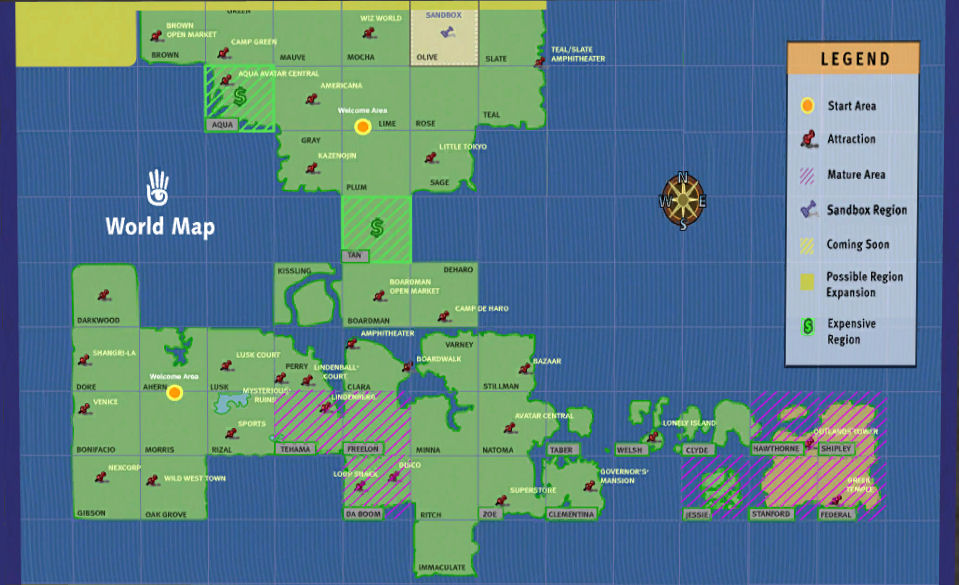
Second Life as it appeared on opening the doors to the public in June 2003

The Community Celebration theme is designed to be a launchpad for ideas and opportunities in which we can all express how we personally regard Second Life and what it means to us, and the hope it that it will lead to many fascinating builds and displays which reflect our memories of times past and our enjoyment with, and enthusiasm for, the platform.

At the same time, the looking forward part of the theme give all of us, no matter how long we’ve been involved in the platform the chance to consider what Second Life might grow into or give rise to in the course of the next ten years. Right now, we’ve only scratched the surface of what immersive 2D worlds might bring by way of entertainment and practical use.

Just what will Second Life look like in 2023? What might it have given rise to a decade from now? Will it be purely immersive, or will it be augmentive – or a mix of the two? How might immersive 3D works better entertain us and how will 3D environments augment our everyday lives at home and  / or at work? Let your imagination run free and bring your vision of the future of SL and virtual worlds to SL10B, and let us see where you think we’re headed in the years to come.


Bruce Branit’s moving glimpse of a possible immersive 3D world of the future (2009).

Applications for Exhibitor space on the Community Celebration regions will open on April 15th. So why not use the time between now and then to mull over ideas and seek inspiration – perhaps by visiting some of the earliest locations and builds in-world or for peeking into the future of Second Life and virtual worlds – and then apply to be a part of SL’s tenth anniversary?

Related Links

Dipping back into dio

dio-logoUpdate, February 19th, 2014: dio was discontinued by Linden Lab on February 19th, 2014. Links to the dio website, etc, have therefore been removed from this article.

dio, Linden Lab’s browser-based “social experience” reaches two months of age this week. Whether this will be accompanied by any updates remains to be seen. So far, there appears to have been only one significant update to the application, which appeared at the end of February, a month after the original launch. As I’ve not really commented on dio for a while, I thought I’d take time out and have a poke at some of the updated features.

The Updates

“Live Chat” / Comments

When browsing dio Places, perhaps the most obvious update is that Comments have now been expanded to include Places as well a rooms. I’ve previously been critical of the idea that dio presents “persistent live chat” when in fact the “chat” element is more of a basic message board service, limited by the fact it only applies to rooms – so any conversations which might occur in real-time can ge abruptly interrupted as one person shifts to another room without warning.

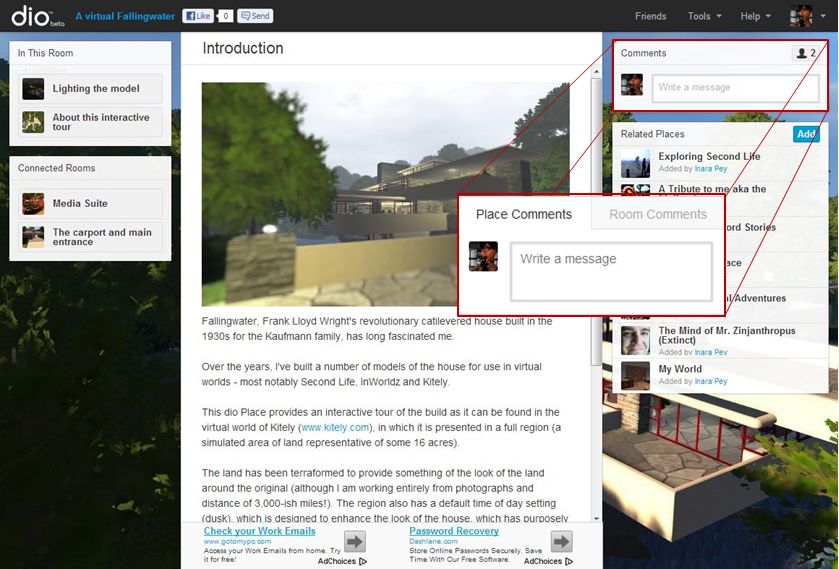
The dio product team have addressed this by adding a new tab to the Comments panel. Entitled “Place”, it does exactly what it says on the label – allows comments to be made about a Place, rather than a room, and to be accessible from any room visited within the Place.

The old dio Comments panel (main picture) and the new, tabbed approach for commenting on rooms and Places (inset)

New Editing Buttons

The updates also bring a set of new on-screen editing buttons what are immediately available at the top of a page on creating a room. These provide easy insertion / creation of:

  • Photos
  • Videos
  • Inventory objects
  • Exits to other rooms

All of these work on the same principles as the initial release of dio, although the editing screens for the options have been revised somewhat (see below).

The new buttons options displayed at the top of each room when in edit mode, allowing object, etc., to be added directly to the room.

Additionally, a new option is provided – that of Text, which opens a simple text editor which can be used to generate simple blog-style entries for a room. Currently, there is no means of formatting text, so how useful this option might be remains to be seen. Once created, text objects appear in the In This Room panel along with all other types of object. Text objects can also been assigned Actions as well, which offers interesting options with their use; for example, in an adventure game Place, a text object could be set as a map with both explanatory text (or perhaps a riddle as to what it means), which can be taken by others. They then have the choice of both looking at the map and reading the associated explanation / riddle.

Continue reading “Dipping back into dio”

Inside Firestorm at Virtual Ability Inc

Virtual AbilityOn Thursday March 28th, Virtual Ability Inc will be hosting a presentation by Ed Merryman and Lette Ponnier about the Firestorm viewer and project.

Entitled Overview of the Firestorm Viewer and Project, the presentation will take place in both voice and text, and will commence at 11:00 SLT at the Blue Orchid Cabana, Virtual Ability Island.

The promotional material for the presentation reads:

Learn about what makes the Firestorm Viewer and the project on the whole unique. We’ll discuss some of its most popular features and customizability options and cover how to find help and more information from our large and active support team and its resources.

The Presenters

Ed Merryman – Voice

Ed Merryman joined SL in September 2007. He is the Firestorm Support Team manager, and has led the team since the Firestorm Project was established in September 2010.  

Ed Merryman and Lette Ponnier - talking about Firestorm at Virtual Ability Island on Thursday March 28th, commencing at 11:00 SLT
Ed Merryman and Lette Ponnier – talking about Firestorm at Virtual Ability Island on Thursday March 28th, commencing at 11:00 SLT

Lette Ponnier – Text

Lette Ponnier has been involved in Second Life since early 2008. A keen member of SL’s small, but thriving, open chat trivia community, Lette has been an integral part of the Firestorm team since February 2011 where she head-up the English Language Support team. She also specialises in providing help to Firestorm Mac users.

As well as providing support to Firestorm users, both Lette and Ed are active teachers for the team, and present weekly classes about the viewer which are open to anyone to attend, no matter what level of experience they have with the Firestorm viewer.

So, if you’re curious as to why Firestorm is so popular among Second Life’s users, and / or about trying the viewer out for yourself, why not make a note to drop into Virtual Ability Island on Thursday March 28th?

Related Links

With thanks to Virtual Ability Inc.

Getting back to work and an Opportunity for comparisons

CuriosityThe Mars Science Laboratory rover Curiosity resumed full science operations on March 23rd, with the delivery of a second portion of cuttings to the Sample Analysis at Mars (SAM) instruments inside the rover. Earlier, on March 21st, Curiosity resumed continuous environmental monitoring of the “Yellowknife Bay” area of Gale Crater.

Full-scale operations with the rover had been halted following the discovery of a computer glitch in the primary computer system the so-called “A-side” computer, which prompted mission controllers to order the rover to switch to the redundant “B-side” computer.

Since then, engineers and scientists on Earth have been working to both recover the “A-side” computer while simultaneously working to transfer all relevant data and command sets to the “B-side” computer and run Curiosity through a series of tests in order to ensure the “B-side” computer can increasingly take over day-to-day operations on the rover.

The “A-side” problem was traced to the unit’s memory module which acts as the “table of contents” for accessing the computer’s memory, preventing data and instructions from being accessed and causing the computer to enter into an “endless loop”. The computer has now been fully recovered and is available as a back-up once more, should it be required.

Recovery to the “B-side” computer was drawn-out due to the need for the computer to “understand” various aspects of the rover’s condition, including the placement of the robot arm, so that it could correctly take-on command and control. This involved a series of tests carried out early in March. More recently, engineers had to confirm the “engineering camera” sets, were functioning correctly.

In all, Curiosity uses some seventeen camera systems. Of these, 12 are paired sets of “engineering cameras” comprising the black-and-white Navigation Cameras (Navcams) mounted on the rover’s mast, the black-and-white front Hazard Avoidance Cameras (Hazcams) mounted at the front of the rover’s body, and the rear black-and-white Hazcams. Of these cameras, three pairs (of Navcams and front/rear Hazcams) are hard-wired to the “A-side” computer, and three pairs are hard-wired to the “B-side” computer.

The last time the “B-side” engineering cameras had been used was in April 2012, when the Mars Science Laboratory was still en route to Mars (the “B-side” computer was used to “look after” the rover and its ancilliary systems during the long flight from Earth to Mars). As the rover was switched-over to the “A-side” computer shortly after arrival on the surface of Mars, the “B-side” cameras had never been actively used on the planet, and thus needed to be run through a similar set of commissioning tests and check-outs which marked Curiosity’s initial activities back in August 2012.

Looking at Curiosity’s left-front and left-centre wheels and tread marks, using the left Navcam on the rover’s mast, which is hard-wired directly to the “B-side” computer. Captured on March 22nd, 2013, or Sol 223 of the mission, this image marks the first time the “B-side” engineering cameras have been used in more than six months – and the first time they have been used by the rover on the surface of Mars. For reference, the wheels are 50 cm (20 in) in diameter.

Bringing the “B-side” computer up to a point where it could take over all on-board operations  was further delayed when it also suffered a glitch on March 16th which, although relatively minor in scope, caused engineers on Earth to order Curiosity back into a “safe mode” of operations while the glitch was investigated, diagnosed and corrected.

Continue reading “Getting back to work and an Opportunity for comparisons”

SL projects update week 13 (1): server, AO capabilities, HTTP, group ban list

Server Deployments – week 13

On Tuesday March 26th, the SLS (Main) channel received the maintenance package previously deployed to BlueSteel and LeTigre in week 12, which includes a fix for a crash mode  – release notes.

Some issues have been reported on following the Main channel deployment. Regions have been slow to come back up, and several which have had issues with groups and display names failing to show, teleport errors, etc. However, at the current moment in time, these issues do not appear to be widespread.

On Wednesday March 27th, the RC channels should receive the following deployment packages:

  • BlueSteel and LeTigre: a new maintenance package, which includes:
  • Magnum: should receive the same update as the Main channel (i.e. the package deployed in week 12 to BlueSteeel and LeTigre), otherwise retaining the updates and fixes deployed to it in week 12 – release notes.

As usual, there is a forum discussion thread for comments / feedback on the deployments.

That the region crossing fix for BUG-1814 is not been deployed to the rest of the grid in week 13 is liable to cause some consternation.

New AO Capabilities

The new AO capabilities, due for deployment on BlueSteel and Magnum. I provided an overview for the new capabilities in week 12, and the Lab have now provided a set of wiki pages on the calls and permissions:

Ban List – and More

As recently reported, Baker Linden has started working on an update to the code for managing groups which will allow group owners / moderators to ban users who create problems (e.g. those who spam groups, people who are persistently abusive in group chat, etc.).

The work is being undertaken in response to JIRA VWR-29337, and is likely to prove very popular once available.Currently, Baker is working on the development documentation and plan for the work, and has been giving further thought on what the capability will be able to do. Speaking at the TPV Developer meeting on March 22nd, he gave a little more insight into how the capability might progress:

  • A possible format for how the Group Ban option might appear in the viewer, as visualised by Alyssalillian McMinnar
    A possible format for how the Group Ban option might appear in the viewer, as visualised by Alyssalillian McMinnar. LL have an internal design for the UI elements, but this is not something Baker is currently focused on

    The initial release will at least allow group owners and moderators to ban people, a will display the names of banned individuals and the date on which they were banned (presumably to owners / moderators only)

  • It may include a capability to specify why a person has been banned, even if this is initially a case of selecting from a pre-defined list of reasons
  • A future option may be to include a time ban option (although this is potentially more useful in banning people from accessing a region / parcel)
  • An initial design for the viewer-side Group floater has been developed internally by LL, but Baker isn’t so concerned with how the options will be presented through the viewer until after he had defined how the code will work
  • Baker is not planning on adding any on the ban capabilities for group to the existing ban capabilities for regions / parcels, nor will any of the new group ban capabilities be shared with region / parcel ban capabilities, due to the complexities involved.

At the same time as working on the group ban list, Baker has also opted to correct other long-standing issues:

  • The ability to search for people using their user name properly (i.e. no period in between first and last names)
  • A fix for the disallowing of leading spaces on display names.

These fixes will also likely roll-out the same time as the first phase of the group ban list function, once Baker is able to start coding and testing the latter.

HTTP Project

On Friday March 22nd, Monty reported that the Aditi testing had been subject to a couple of non-related hiccups (due to inventory issues), but otherwise the regions were stable and whole one significant bug within the code had been found – severe enough to take down some Apache web servers when HTTP-In was being tested, and which has now hopefully been fixed.

Load testing on Aditi has been a little light, but obviously, more practical load testing will occur when the capabilities reach a Release Candidate channel and things start to get fine-tuned.

Mainland Griefing

The subject of Mainland griefing was discussed at the Simulator User Group meeting on the 26th March. There has been a noticeable rise in object griefing and spamming recently, particularly by the so-called “goonsquad”. Several options for better means of combating the problem were raised, including JIRA SCR-19 (“Script function to return objects”) for the return of griefer objects where users do not have access to estate / region tools for return objects, and possible throttling of llDialog (SVC-8080) to try to overcome the use of dialogue spamming prims.

The Lab will obviously not be drawn into discussions on their own plans for combating griefing, but Andrew Linden took a series of notes on problems which are being encountered, while Simon indicated that the Lab is looking at some options which may help with issues.

Related Links

HTTP updates: the what, why, who

Update March 27th: Commenting on the open-source development mailing list, Monty Linden states: “It looks like Beta (Aditi test regions) will be wrapped up shortly. If you’ve wanted to try these out but haven’t yet, now would be a good time to jump in there.” 

Linden Lab is in the process of making a number of improvements to Second Life which should benefit both the platform and users. Once deployed, some of these updates will be clearly visible as they gain widespread use in-world, such as the upcoming materials processing capabilities. Others will be perhaps more noticeable because they require a viewer update – as is the case with server-side baking, rather than being obviously visible in everyday use. Some will have more of a “background” impact, rather than anything which is clearly visible in-world (although they may make their presence felt for the more keen-eyed).

Monty Linden
Monty Linden

Among the latter category of changes are the HTTP updates currently being tested on Aditi and which will soon be popping-up on a Release Candidate channel. This work is being spearheaded by Monty Linden, and has been under development as a part of the Shining Project initiative kicked-off by Linden Lab in 2012.

Several of my SL projects update reports have covered Monty’s work, and will continue to do so in the future. The aim of this article is to bring the various threads together in a single post, in order to provide a  broad overview of what it all means without getting caught-up in the technical minutiae.

Communications between the viewer and the SL servers are subject to many vagaries. Network issues can occur locally (i.e. with a user’s own network), or at the ISP level, for example, long before they actually involve the SL servers. There is little LL – or the support team for whatever viewer is used to connection to SL  – can do in these instances.

However, network issues aside, there is much work that can be done to improve viewer / server communications and make connectivity between the two more robust – and this is the focus of Monty’s work. Some of this has to do with gradually switching aspects of the service away from the older UDP services within SL to HTTP-based services, and some of it has to do with improving the existing HTTP services employed by SL and making them both more robust and (hopefully) a little easier on older models of routers.

Initial Work

As mentioned above, Monty’s work is encapsulated within the Shining Project, and is being carried out in a number of phases. The first phase of this work was actually completed during the second half of 2012, and focused on improving the HTTP texture fetch mechanism both server-side and within the viewer by which textures are obtained for rendering. This work started to go into widespread use around  November 2012, when the viewer code was made available and Linden Lab announced the new capability thus:

A new scheme for performing HTTP operations is introduced with this release. It is intended to reduce crashes and stalls while performing HTTP operations and generally enable performance and reliability improvements in the future. In this release, it is being used by the viewer’s texture retrieval code. Our expectation is that it will provide consistent and predictable downloading of textures.

The initial HTTP updates being driven by Monty Linden started to appear in around November 2012
The initial HTTP updates being driven by Monty Linden started to appear in around November 2012, with improvements to the texture fetching code in both the viewer and on the server end of things

Following the release of the viewer code, many reported they were seeing significant improvements in texture downloads, and a resultant improvement in texture rendering.

As a part of this initial work, Monty also started examining connectivity between the server and the viewer (number of actual connections opened, etc), and found that it can cause significant hardships for older classes of router, many of which incorporate a firmware-controlled “lock-out” which can be triggered when too many connections are opened when using HTTP, and so can cause users issues (hence the recommendation which some support teams give to disable HTTP textures within the viewer if connection issues are being experienced).

Second Phase

At the start of 2013, Monty commenced work on the second phase of the project, which is currently focused on the server-side of things (that is, there are currently no viewer-side code changes). In particular he is looking at further improving texture and mesh asset-fetching from the server and at implementing HTTP persistent / keepalive connections capabilities, which should enhance the overall robustness of such communications (some of which may hopefully see some connectivity improvements for those people using older model routers, as noted above).

Continue reading “HTTP updates: the what, why, who”
