Things have been relatively quiet viewer-wise with only two updates to the official viewer branches. The development viewer rolled to 3.4.4.267614 December 4th, while on December 5th, the beta viewer rolled to 3.4.3.267755. The latter included a good crop of updates, including a number of graphics and GPU support related changes, and the long-await snapshot tiling fix.
The MAINT-628 fix in action: an image taken with the latest beta viewer running in deferred mode and at a resolution of 3500×2154 pixels, well above the 1400×900 of my monitor – and no tiling! There are limits to how well the fix works at ultra-high resolutions, as noted in the JIRA comments included in my report on the release.
Server Deployments
Following-on from last week’s RC deployment issues, there was no main channel deployment on Tuesday December 4th, although a number of regions were restarted during the course of the day.
Wednesday December 5th saw the same maintenance release rolled to all three RC channels. This comprised the release originally aimed at Magum in week 48 and which included all bugs fixes for the problems which required the roll-back on Thursday 29th November. Initial statistics for this update during the brief time it was available last week showed a clear improvement in stability, and this seems to have continued with this week’s release, although there has been one major issue come to light and is under investigation.
This relates to IM messages sent by scripted objects failing to trigger e-mails to the object’s owner if they are off-line. The problem appears to be related to the use of llInstantMessage(llGetOwner(), and appears to affect regions on all three RC channels, but not every case where llInstantMessage(llGetOwner() is used appears to be affected.
Currently, it is thought that a fix will be available for deployment during week 50, and should reach the RC channels om Wednesday December 11th.
Details of the week’s RC release can be found in the release notes and in the forum discussion thread (including some discussion on the current scripted object / e-mail issue).
Back in July 2012, I indicated that Runitai Linden had a long-awaited fix for the “tiling” issues affecting high-resolution snapshots for some people.
The issue was initially reported in JIRA MAINT-628 at the end of 2010, and has impacted viewer releases since then, becoming the subject to intense investigation by users and LL alike. The problem has tended to make itself known when taking images at a higher resolution than that of your monitor, resulting in lines breaking-up the captured image in a tiling effect.
In July Runitai commented on the JIRA thus:
Runitai Linden added a comment – 18/Jul/12 1:57 PM
Fixed in viewer-cat
Fix was to use a large render target for snapshots that are larger than the window, but only when lighting and shadows is enabled. Screen space effects will still show seams when lighting and shadows is disabled.
If the graphics card is unable to allocate a single render target large enough for the high res snapshot, the old method of tiling is still used. On my GTX 580, I could take artifact-free snapshots up to 3500 pixels wide, but could not allocate a full set of render targets at 4000 pixels wide, so the old method is used.
Changes involve an invasive set of changes to LLRenderTarget, so QA should be careful to check various shadow modes, ambient occlusion, depth of field, and anti-aliasing with lighting and shadows enabled. Running with Debug GL enabled will likely cause a crash now when taking high-res snapshots (expected and acceptable behaviour), since the driver reports “out of memory” when trying to allocate a large render target. When Debug GL is not enabled, the viewer handles this error condition gracefully and continues to function.
Sadly, in the interim, things went slightly pear-shaped with LL’s viewer code, with major bugs appearing in the beta code branch which brought updates to a juddering halt which they were sorted out. Those reading my weekly project news updates will be aware of the issues, which were finally sorted out last month. However, in the interim, a LOT of high-priority work has backed-up, with the result that MAINT-628 appeared to be in a holding pattern with a lot of other work, waiting for the high-priority stuff to clear. When I asked Oz Linden about the situation, he could only say that the JIRA looked likely to be out “pretty soon” – which suggested a potential wait of a few more weeks.
However, for those using the SL viewer – the wait is over!
Beta viewer 3.4.3.267755 was released on December 5th, 2012, and the release notes contain a small but significant entry:
I’ve just been playing with the release, having long suffered from the tiling issue when trying to capture images at almost anything over my screen resolution of 1440×900 and the results are superb. The following two images were captured at the same image resolution (3500×2154). The top was captured using the current SL release viewer, and the lower image with the new beta viewer. The results are clear – but click to enlarge each, if required. Note the tiling line across the sky in the first image and the lack of any such line in the second.
The problem again: an image captured on my PC at 3500×2154 resolution, using the release SL viewer, 7th December. Note the tile line in the sky (click to enlarge)Roughly the same image shot using the new beta viewer at the same resolution – no tiling line (click to enlarge)
So, for those who have been afflicted by the tiling bug, the wait is almost over. You can either grab the beta viewer and start snapping in high res, or wait for the fix to arrive in your favourite viewer – the wait shouldn’t be that long now, hopefully!
Earlier this week I reported on and reviewed a new Virtual Landmark (VLM) system designed to provide and alternative to traditional landmarks. Created by Darrius Gothly, the Virtual Landmarks for Virtual Worlds system is designed to provide a comprehensive means of ensure landmarks and web links to in-world locations never need to expire.
Now Darrius, has taken the system a step further forward, and make the maintenance and update of VLMs even easier through the use of the VLM Location Beacon.
The VLM Location Beacon logo
The VLM location beacon is a single-prim object which can be linked to a VLM. Once rezzed and configured (using the VLMurl for the required location), the Location Beacon will become invisible and phantom and will continuously monitor for any changes that need to be posted to the VLMVW Database.
This means that if you need to move your store or a teleport location within a store or exhibit, etc., simply move the Location Beacon associated with the location (either physically if moving it within the same region, or by taking it back to your inventory and then re-rezzing it at your new location), and the VLMVW database will be automatically updated with the details of the new location.
Location Beacons which are in use will also periodically check the VLMVW database to ensure their “parent” VLM record is still active. If either the location referred by the Beacon has been removed from the VLM / VLMVW database (remembering that one VLM record can store up to eight in-world locations) ro the VLM itself has been deleted, the Beacon will self-delete, sending you IM to inform you it has done so in the process.
The VLM location Beacon now forms a standard part of all VLM packages offered by DGP4SL through the SL Marketplace. Anyone who has purchased package should receive an update from DGP4SL which includes the Location Beacon.
Rebeca Bashly is hailed as one of most successful artists in the Linden Endowment for the Arts Full Sim arts series. She deserves to be. A little over a year ago, in October 2011, she presented a stunning, immersive interpretation of Dante’s Inferno as the initial piece in the 2011/2012 Full Sim Arts series.
Now, in December 2012, she is back with a piece which is equally evocative.
Rebeca describes The Tower as being “symbolic of restrictive areas, of closed minds, of self limitations and the like, as in kids fables.” It is a marvellous piece, not only because she established the entire installation in less than 24 hours, but because the scenes it presents are so emotive powerful.
It is a piece which needs no intermediary descriptions or explanations; it speaks loudly and clearly for itself. Simply use the orchid floating on the water to commence your journey, climb the stairs and look for further orchids as you pass through each level.
Everything is a testament to the artist’s vision and skill. The imagery is perfectly balanced by the ambience of the setting. It is also a tour de force demonstration of the visual power of immersive environments as a medium for art and expression.
The Tower is open through until the end of the month. Don’t miss it.
Since we first ventured into space, there have been a number of images returned to us with show both the beauty and the fragility of the place we call home – the Earth, with perhaps two of the most iconic being Earthrise and The Blue Marble.
Earthrise was taken by William Anders aboard Apollo 8 on December 24th, 1968 as he, mission Commander Frank Borman and colleague Jim Lovell became the first men to travel around the Moon and back to Earth. While there has been some dispute over the years as to who took the image, Borman and Lovell both having grabbed the camera on which the original was taken to capture shots of their own, it remains perhaps one of the most famous images of modern history.
1990 – “Earthrise” (click to enlarge)
In 1972 came The Blue Marble, an image captured from Apollo 17 on December 17th, 1972 from a distance of 45,000 kilometres (28,000 miles). While the term has been subsequently applied by NASA to a wide range of images of Earth returned from orbiting satellites, the original Apollo 17 photograph remains the most famous.
1972: The Blue Marble (click to enlarge)
On December 6th, 2012, NASA released three composite high-definition pictures of images captured by the Suomi NPP meteorological satellite using its VIIRS (Visible Infrared Imaging Radiometer Suite) instrument. Part of a series of images captured by the satellite which reveal the Earth at night in stunning detail, the three images are “whole Earth” pictures showing views from over Africa, the Americas and Australia and Asia.
All three are amazing views of the planet, but I have to confess that of them all, it is the picture showing Africa and Europe which is for me the most stunning. Not because I’m from the UK, which can just be seen in the image, but because the picture says so much about our place on Earth. Just look at the lights of our cities spread across Europe, and the seemingly tiny sprinkling of lights around Africa.
2012: The Black Marble (click to enlarge) – via the BBC
All of these images deserve to become as iconic as Earthrise, The Blue Marble and other famous images such as 1990’s Pale Blue Dot, taken from a distance of 6 billion kilometres (3.7 billion miles) by the Voyager 1 spacecraft revealing the Earth as a tiny pinpoint of reflected sunlight hanging in space.
Together, all of these images remind us that in all the vastness of space, we only have one place to call home. It belongs to us all, and we’re all responsible for it. Let’s make sure we take care of it.
Is it really a year since I last wrote about logging-in to Second Life for the first time as Inara Pey? Wow. Back then I covered the arrival of my fifth rezday with something of a retrospective on SL itself. The times certainly have been interesting.
I’m not about to delve into another retrospective as with last year – you can follow the link above or wait for my Review of the Year. What I will say that this year, while it has been very uppy-downy for me at times (don’t worry, I’m not going to delve into that either! Suffice it to say there are a couple of people out there – and they known who they are – to whom I’ll always be indebted for their time and shoulders), has also been something of a renewal of SL discovery for me.
Given all the doom and gloom which swirl around SL, one can never underestimate the value of getting out and about and simply exploring. While there may well be clouds gathering on the horizon, it is still not too late for the storm to be averted – and in the meantime, there is still so very much to see and enjoy – as I hope my “Destination” articles in this blog have shown over the course of the last couple of years.
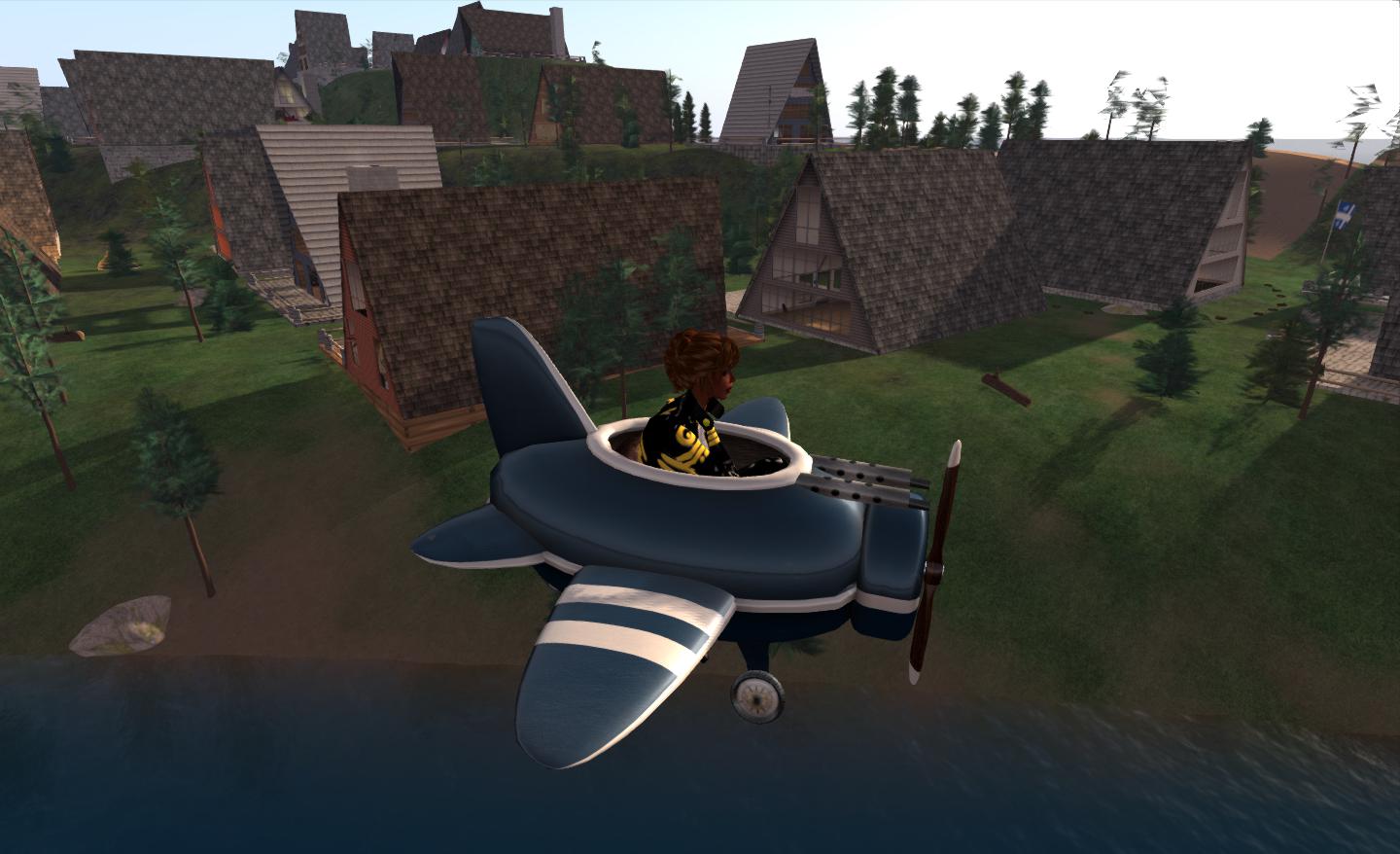
This year has also seen me start into a couple of new pastimes in Second Life – flying and sailing. I get an enormous pleasure out of the two, for very different reasons. Flying, at least in the right aeroplane, can be an enormous amount of fun. I’m totally in love with my Terra Stingray (which also doubles at times as a very good boat), and more recently my Warbug has brought an entirely new meaning to the word “fun”.
Warbug Patrol: keeping the skies over Linden Homes free from…errr….
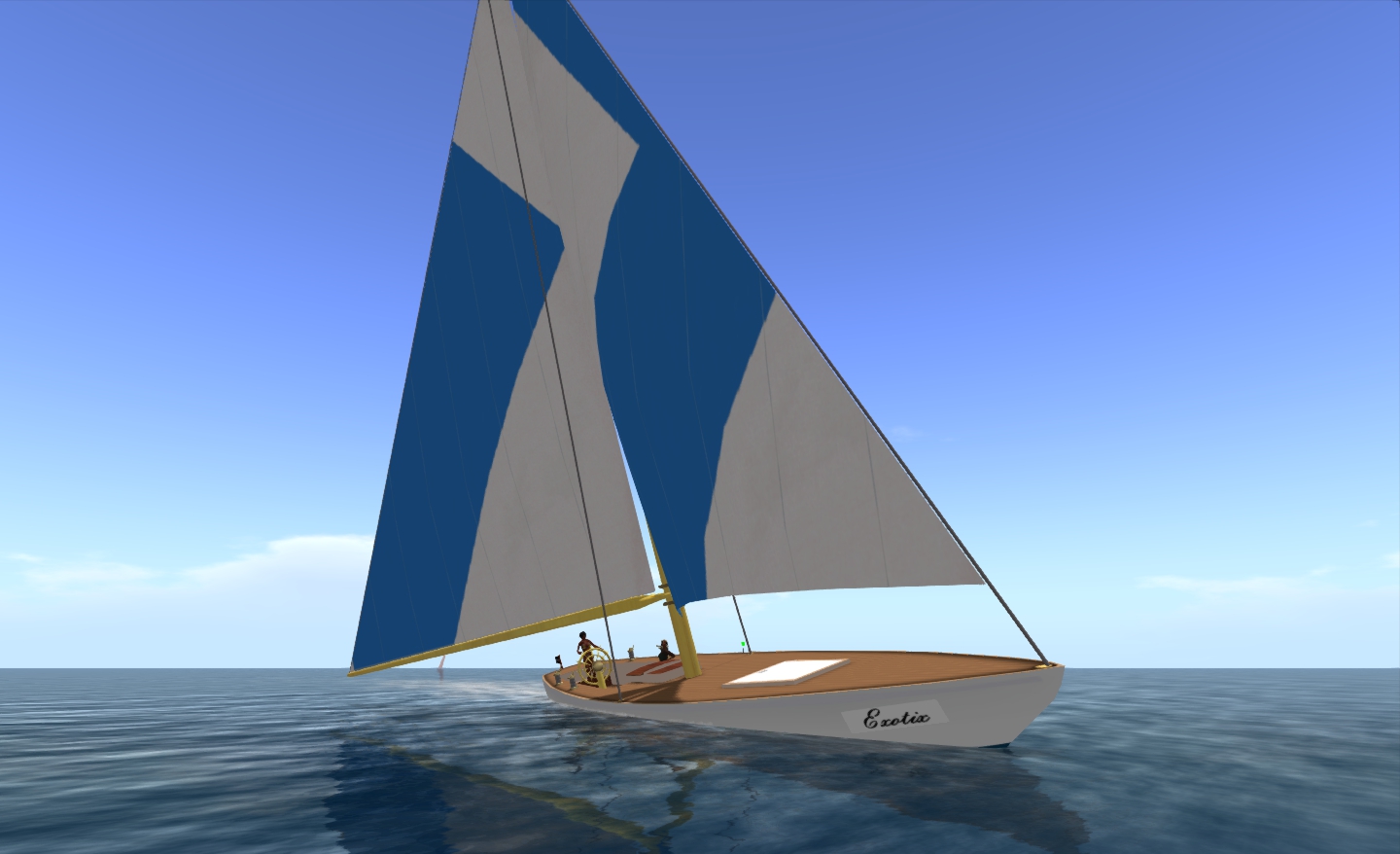
Sailing is an altogether different pleasure; one more easily shared with friends in easy conversation, broad sails overhead a fresh winds from behind under warm skies. Whether I’m out in the middle of Blake Sea or hugging the coastline around one of the continents or navigating my way to a destination like Second Norway, just being out on the water – like its real-life equivalent – is strangely liberating. I don’t care if I don’t have the biggest, fastest, best-looking or easily operated boat in the world, I’m having enormous fun out on the open seas…
Sailing: an SL pastime I’ve really come to enjoy…
All-in-all it’s been a great SL year for me; one capped-off by having friends old and new with whom I can share it, both in-world and through these pages. And while I don’t want to particularly seem to be plugging it, the fact that so many people appear to enjoy reading this blog (wrats, um w-a-r-t-s and all :)) does genuinely touch me.
I’ve no idea what the next twelve months will bring; Second Life is officially ten years old in 2013, so I can’t help but feel whatever it is won’t be a closing of the doors, and I still feel that while they may not be working on anything big and sexy, LL are still plugging away, somewhat hamfistedly at times it’s true, trying to improve SL on a technical level, improve our in-world lives and give us more toys to play with.
All things considered, it’s been a great year; perhaps my only disappointment is that Linden Lab don’t seem to be in the mood to celebrate with me. While others get their rezdays marked with a Linden Cake, I see nary a crumb :(. Ah well. Maybe next year. To the rest of you out there, however, whether near or far, thank you for your friendship, your support and your encouragement.


 Earlier this week I reported on and reviewed a new








 Inara Pey: Living in a Modemworld