The “Rocknest” sand dune was originally selected as a possible “cleaning agent” which could be used to “scrub” the interior surfaces of the CHIMRA sample pre-processing system mounted on the rover’s robot arm. The required a material which was both of fine particulate matter and somewhat hard in nature, and the surface crust of the “Rocknest” dune provided the latter, while the very fine granular nature of the underlying material offered the former, leading to three scoops of soil being used to “scrub” the CHIMRA system under high-speed vibration, prior to samples being passed to the rover’s on-board systems for detailed analysis.
The initial analysis of the samples revealed concentrations of water and sulfur and chlorine-containing substances, among a range of other ingredients to be contained within the soil samples, results which are interesting in a numbers of ways – but none of them relating to the discovery of organics.
“We have no definitive detection of Martian organics at this point,” Paul Mahaffy, Principal Investigator for SAM stated on the initial findings, “But we will keep looking in the diverse environments of Gale Crater.”
Curiosity has used almost all of its science payload to examine the sand over the last several weeks, revealing it to have much in common with other regions of Mars explored by rover and lander. The Alpha Particle X-ray Spectrometer (APXS) and Mars Hand Lens Imager (MAHLI) camera, each mounted on the turret at the end of the rover’s robot arm, have confirmed “Rocknest” has chemical-element composition and textural appearance similar to sites visited by earlier NASA Mars rovers Sojourner (part of the 1997 Pathfinder mission), Spirit and Opportunity.

The Chemistry and Minerology (CheMin) instrument initially revealed that the soil composition at “Rocknest” is about 50% common volcanic minerals and 50% non-crystalline materials such as glass. SAM added further information to the initial CheMin analysis of two samples, identifying ingredients present in much lower concentrations and on the ratios of isotopes within the soil. The latter aspect of the analysis important as isotopes are different forms of the same chemical element, and measuring them can provide clues about environmental changes.
That SAM detected water in the samples does not mean the drift was wet; water molecules bound to grains of sand or dust are not unusual, even on Mars. However, the amount of water detected has been higher than anticipated – possibly reflective of the fact that Curiosity has already discovered extensive evidence for free-flowing water to perhaps once have been present within Gale Crater.
SAM also tentatively identified the oxygen and chlorine compound perchlorate with soil samples. The latter is a reactive chemical which has previously been found in arctic Martian soil by NASA’s Phoenix Lander. Reactions with other chemicals heated in SAM formed chlorinated methane compounds – what are referred to as “one-carbon organics” – which were detected by the instrument, and which may have been responsible in part for NASA caution in publishing results of the SAM analysis until further tests had been undertaken. It is now thought that while the chlorine in the compounds is of Martian origin, the carbon detected is actually of Earth origin, and a last remnant of contaminants within the CHIMRA system carried to Mars by the mission.
While no evidence for organics of purely Martian origin have been found, this does not mean the search is over. Curiosity has only been on Mars for four months, and has a long way to go. What “Rocknest” has revealed is that the rover and its science suite continue to function well beyond expectations, which can only be to the good of the mission, as John Grotzinger observed. “We used almost every part of our science payload examining this drift,” he said. “The synergies of the instruments and richness of the data sets give us great promise for using them at the mission’s main science destination on Mount Sharp.”
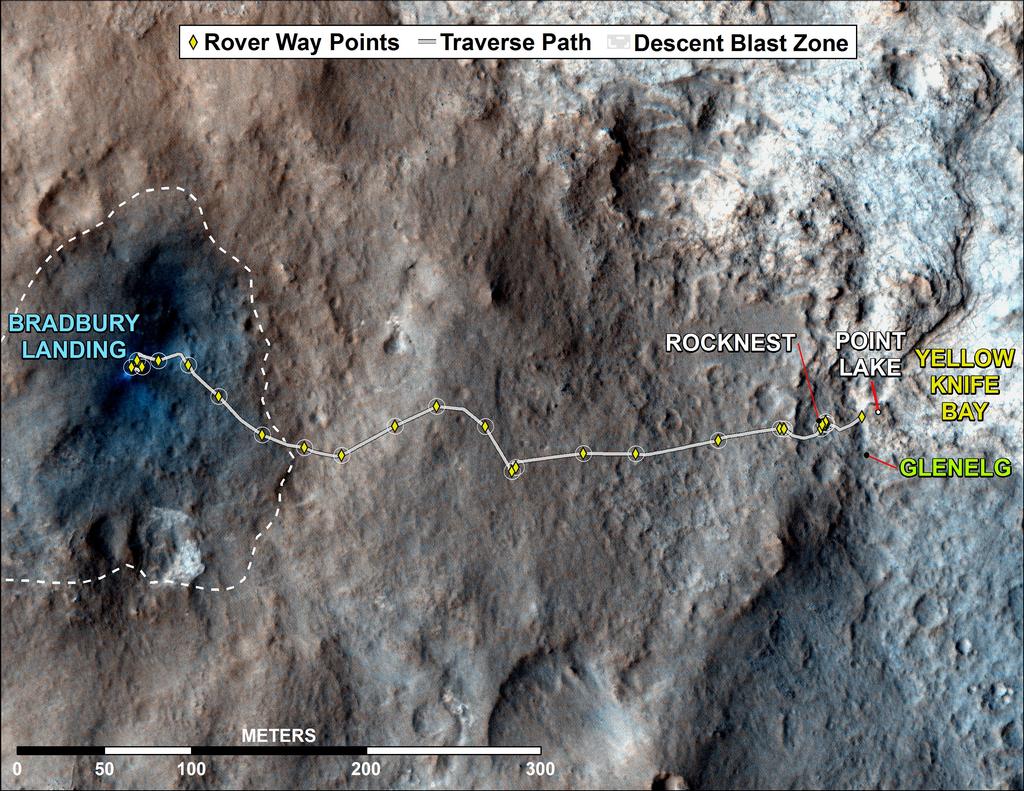
Curiosity is currently located at a point overlooking a depression dubbed “Point Lake”. Original plans had been for the rover to travel to a region called “Glenelg” which has been shown from orbital images to be the meeting point for three types of terrain. However, a site slightly further to the east, dubbed “Yellowknife Bay” may now be the rover’s next destination, where the on-board drill system will be deployed and used for the first time.
Looking to the Future
On Tuesday 4th November 2012, NASA reaffirmed its commitment to an ongoing Mars exploration programme aimed at landing humans on the planet if not in 2030, then certainly within the 2030s, by announcing Curiosity will likely be joined on Mars by a “sister” rover, forming a further part in a very aggressive push towards Mars.
The future rover will be largely based of the MSL mission architecture, including the “skycrane” landing system and a rover broadly similar to Curiosity but with a substantially different mission payload. The mission will constitute a vital component of a broad portfolio of Mars exploration missions in development for the coming decade, all of which are aimed directly towards launching a human mission to Mars in the future.
The portfolio itself, if all missions are approved by the US government will comprise the MER and MSL rovers already operating on Mars, together with Mars Odyssey and the Mars Reconnaissance Orbiter already operating above Mars, the Mars Atmosphere and Volatile EvolutioN (MAVEN) orbiter due to launch at the end of 2013, which is designed to study the Martian upper atmosphere, the planned 2016 InSight mission to examine Mars’ interior composition and the new, as yet unnamed 2020 rover mission.

Nor are NASA alone in their efforts. Following a recent agreement reached with the Russian space agency, it now seems likely European Space Agency’s (ESA) ExoMars missions – initially put in jeopardy after NASA withdrew from providing suitable launch vehicles for the missions – will now take place. These comprise a 2016 orbiter vehicle which will join the hugely successful European Mars Express mission in Mars orbit and provide (among other things) a substantial boost to Mars/Earth telecommunications, and a long-planned rover mission, also dubbed ExoMars. If all goes according to plan these should be joined at some point in the 2020’s by ESA’s ambitious Mars Sample Return (MSR) mission, which will see samples gathered from the surface of Mars returned to Earth for detailed analysis.
In the meantime, Curiosity’s mission has only really just begun. The initial results from its preliminary studies of Mars have, in every way, been “one for the history books”. Here’s to many more over the next two plus years!
All images reproduced courtesy of NASA unless otherwise stated

 Inara Pey: Living in a Modemworld