“Lights, cameras, action!”

Update, April 12th: The Machinima Open Studio Project has moved to a new, permanent location at LEA7 and has been extensively updated, which I’ve also reviewed.

If you ever dreamed of being a movie mogul, the time is now. The Machinima Open Studio Project (MOSP) at LEA20 offers a wide variety of locales and sets built with filming in mind.  Nine structures dot the countryside with more to come. Peaceful Valley sits in the shadow of tall mountains, should you keep the region Windlight setting, while the cottages and outdoor locations along Beach Walk are definitely a sun lover’s paradise.

So reads the promotional material for the Machinima Open Studio Project (MOSP), which formally opened on October 1st. A part of the Full Sim Art series operated by the Linden Endowment for the Arts, MOSP is curated by Artist-in-Residence Chic Aeon, and is located on and above LEA 20, where it provides a wide range of facilities and options for machinima makers and photographers alike. The facility will be open through until the end of February 2013.
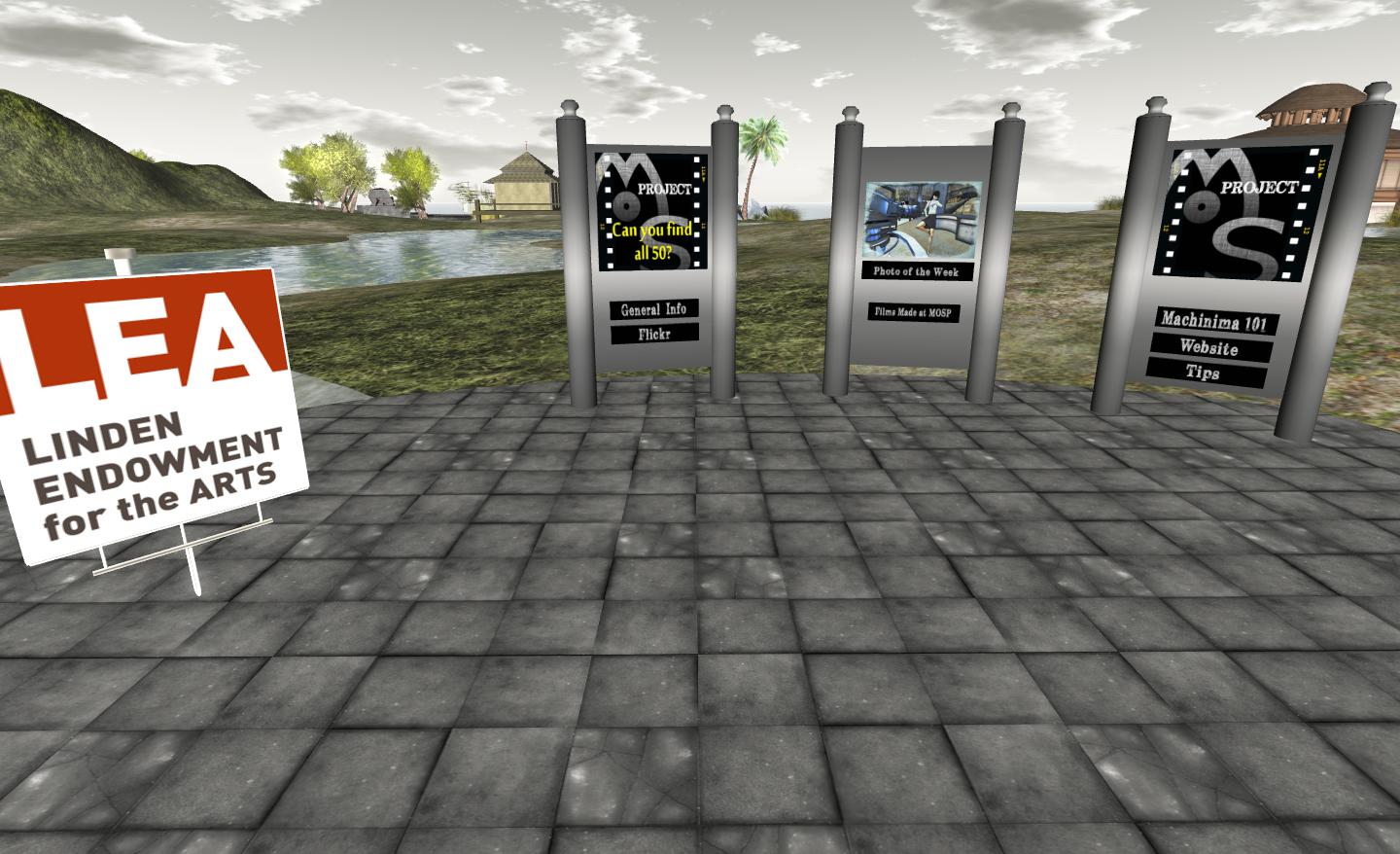
Part of the MOSP Welcome Area

Visitors to the facility are advised to start at the Welcome Area. This is a simple, open-air platform with a series of information boards which provide quick and clean access to essential information about MOSP and its facilities. One of these also supplies you with a teleport HUD, and I strongly recommend you grab a copy and use it in order to see everything on offer – there is a lot to see.

Around the Welcome Area are a number of the pre-built sets. There are simple, open affairs which offer scope for the machinima maker and photographer alike, either using the established windlight presets or custom set-ups. All of the ground-level sets use the same landscaping and design, allowing several or all of them to be used in productions / photo shoots.
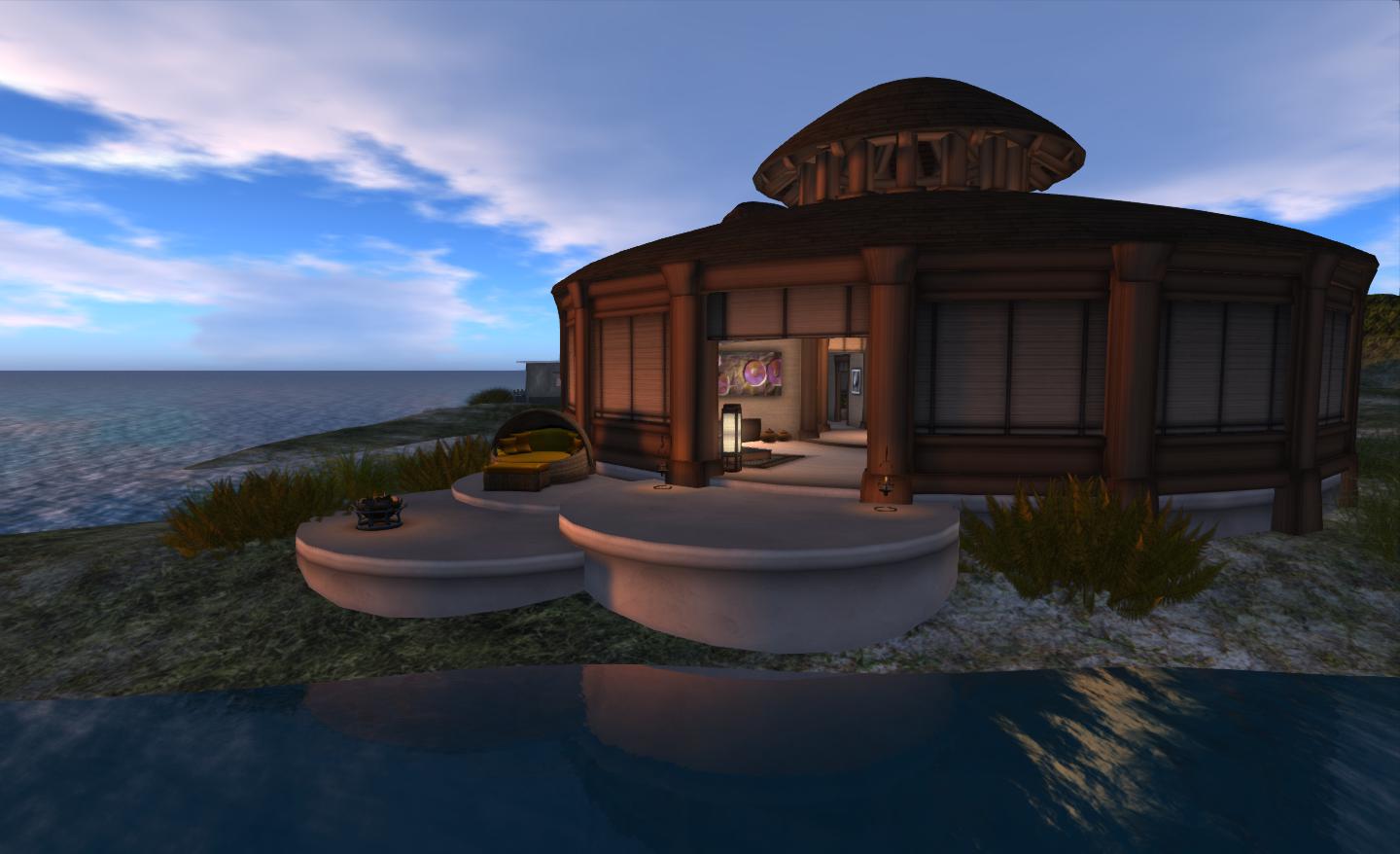
One of the ground-level outdoor sets

Above ground is a further range of individual themed sets – subway, New Orleans, ruins, gypsy camp, park and Shadowlands – each with its own possibilities for filming and photo-shoots, either on its own or, again, in unison with some of the other sets.
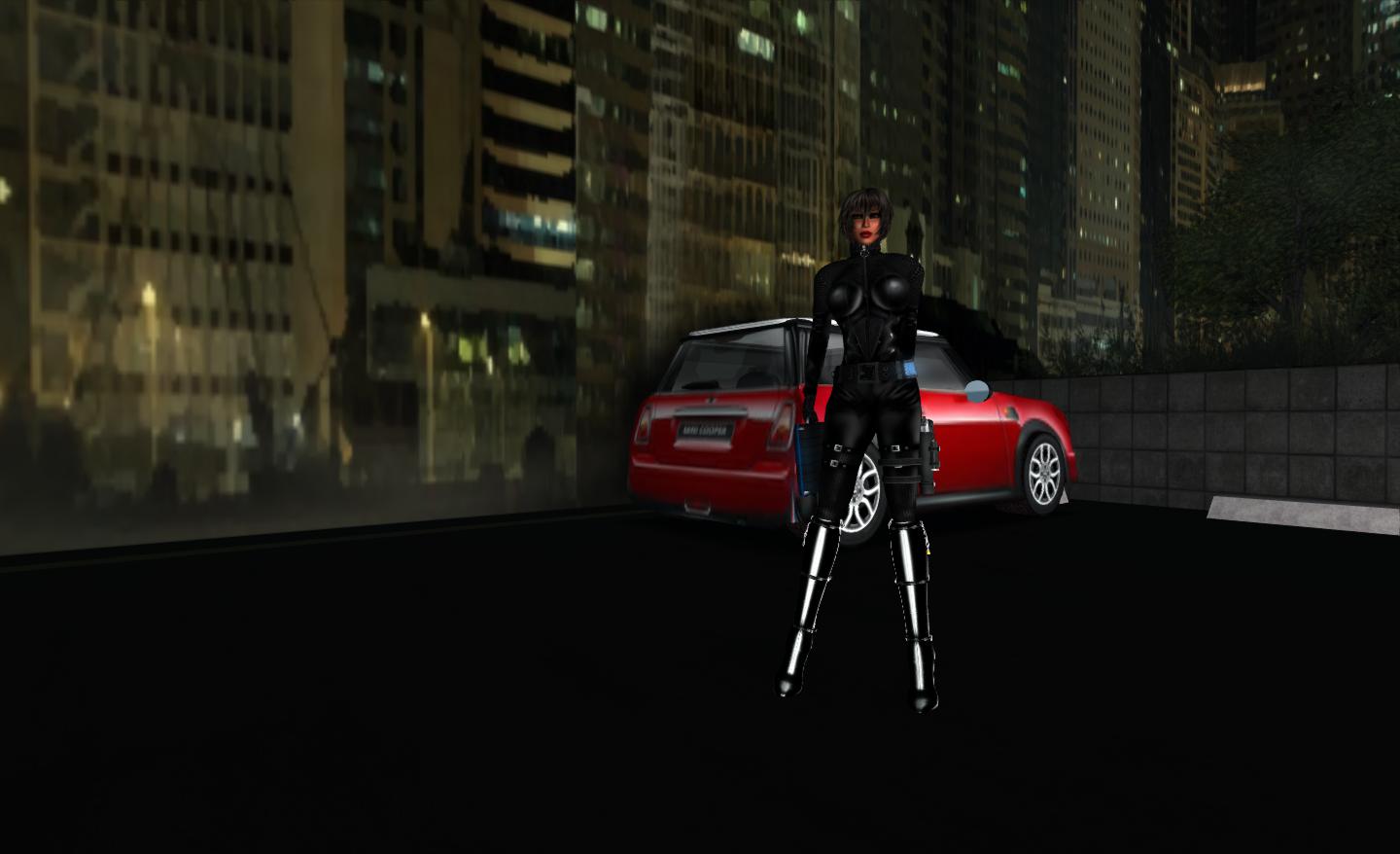
“I knew the only reason Calhogie picked the time and place was not only because he didn’t want to have anyone see him taking possession of the case, but because he wanted somewhere quiet to tie-up loose ends. So I let Mr. Redemption hitch a ride on my thigh as insurance…” – on one of the MOSP sets

There are also four sound stages available for interior shooting. The layouts are very studio like, with each containing a number of related sets, allowing scenes to be quickly and easily filmed, ready for assembly into a completed show or film.

One of the soundstages with pre-built sets

Finally, there is the Corporate Office, space that lends itself to a huge range of uses – chat show studio, teaching environment, news studio, meeting place, all presented in a professional and well laid-out environment in the heart of a “city” sky scene.
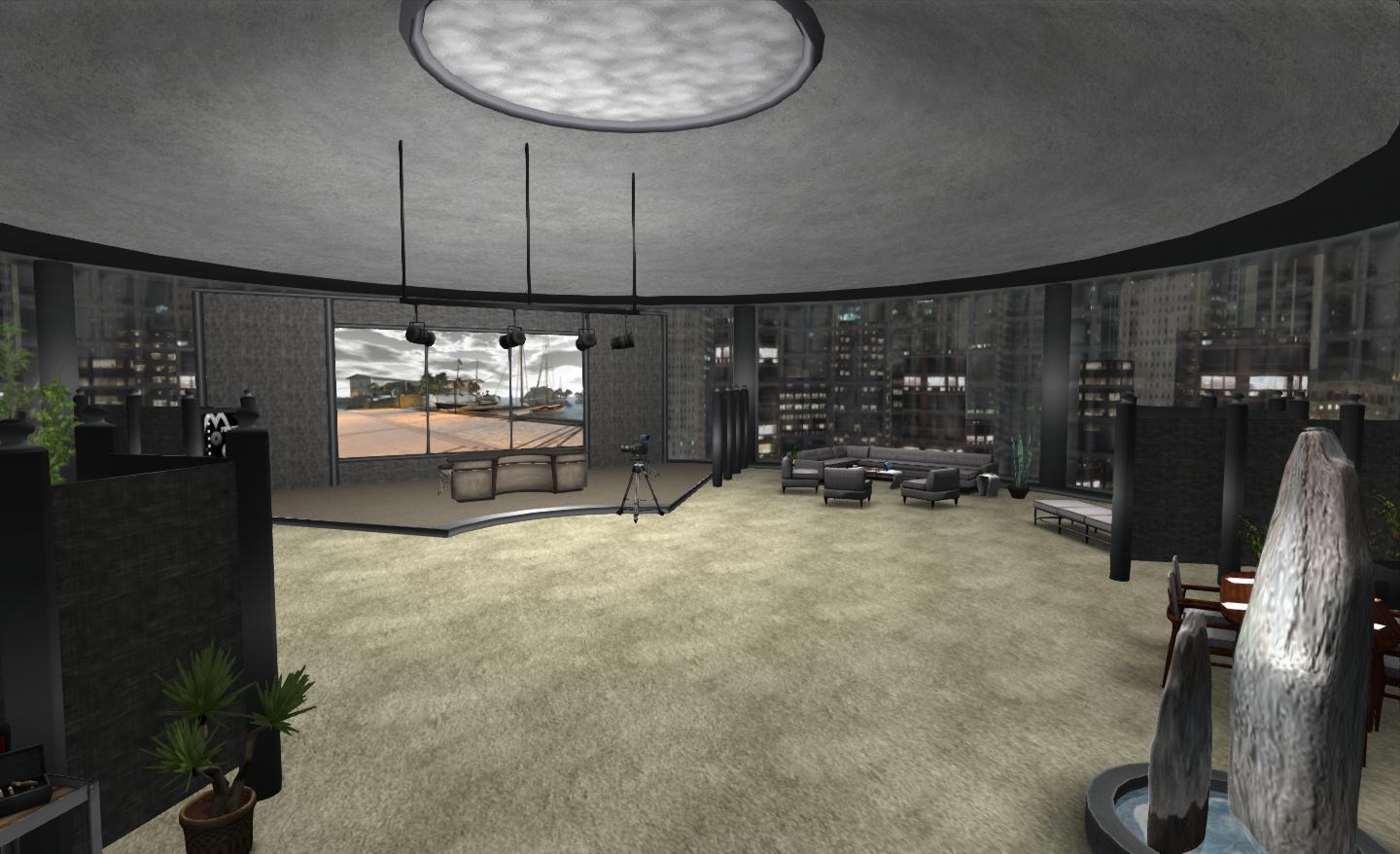
The Corporate Office space

Everything at MOSP has been put together with care and attention; the soundstages and specialised sets, together with the Corporate Office are well above ground level to get the maximum advantage from increased frame rates. One the ground, the sets are spread well apart, allowing for plenty of camera movement. Further, Chic has brought together some excellent supporting material,  including notes on getting started in machinima making, a dedicated website for the project, a Flickr group for those using MOSP for photography and promotional boards for films made in whole or in part in the region.
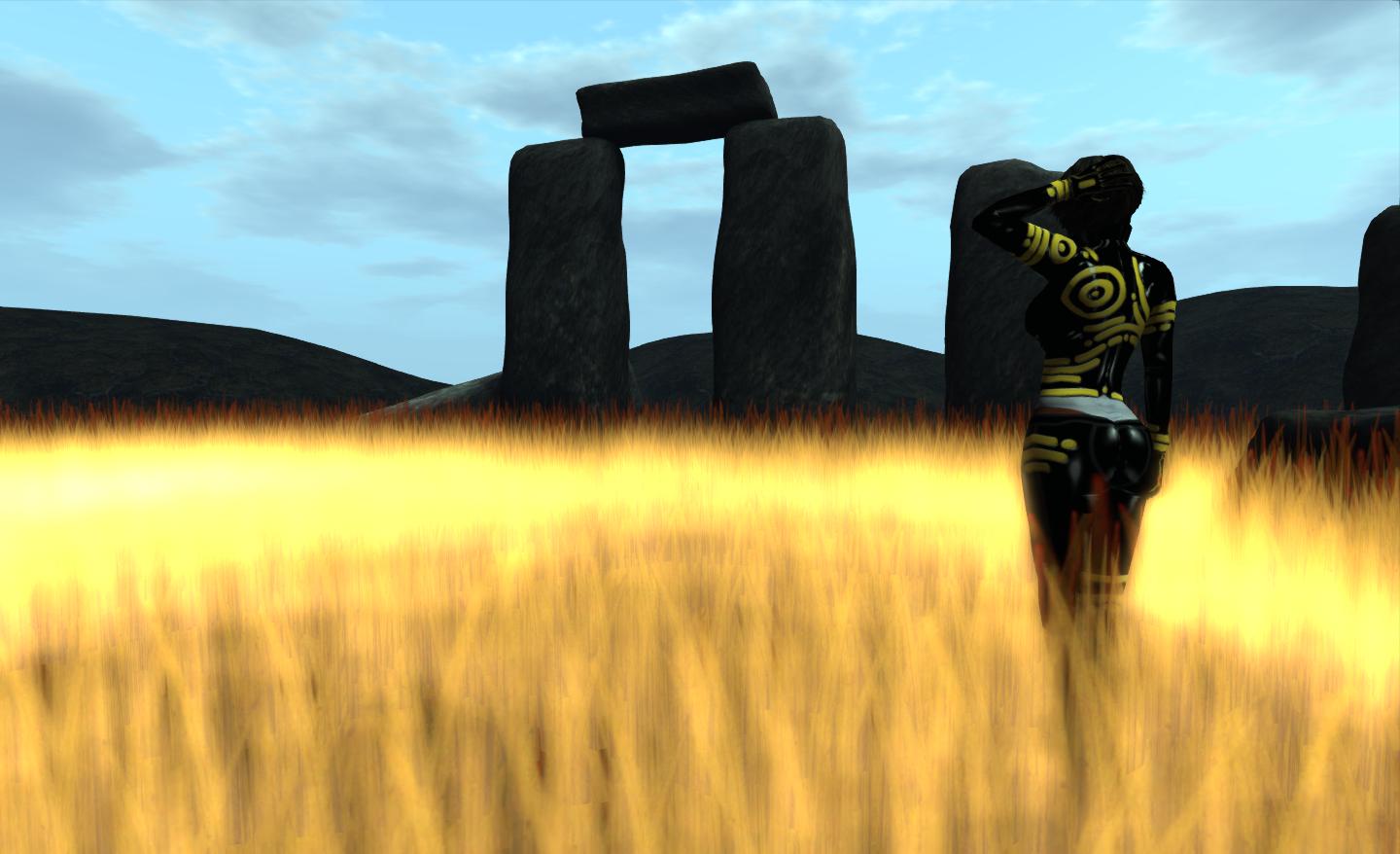
Standing in the sun-dried grass and looking at the stones, only one thing ran through my mind was, “We’re not in Kansas any more…” – on the “ruins” set at MOSP.

The soundstages and themed sets, together with the Corporate Office are well above ground level to get the maximum advantage from increased frame rates. One the ground, the sets are well space to allow for plenty of camera movement. Given the close proximity of the LEA regions, it is advisable to keep draw distance down. This not only (again) helps improve frame rates when filming – to also means there is less risk of accidentally capturing a pice of the neighbouring region when filming / shooting. There a lots of clear extras on the ground sets as well, which can be used to great effect with the right ambient windlight / lighting – I particularly love the train track, which can be made to look as if it is disappearing into the distance.

If you’re into machinima, want to make a start or need a number of pre-made locations for a photo shoot, MOSP is definitely worth a good look. And if you’re curious, there’s also the Explorer Hunt, with up to 50 gifts for the keen-eyed!

“Calhogie was gone and I knew the Feds would be coming after me. Rikhard’s had done a bang-up job ensuring that. But I had the case, and I figured what was inside could keep me pretty comfortable even on the run. For now, it was just a long walk back done the track, but I still had Mr. Redemption on my thigh, ready to keep me company on the way….” – making use of the rail track section at MOSP

Related Links

Video courtesy of Chic Aeon

Firestorm: SL, MOSES, OpenSim and the future

firestorm-logoLogging-on to SL today, I notice from the Firestorm MOTD that Jessica Lyon brings word on Firestorm and what is going on with SL’s most stable and most popular viewer – and the viewer of choice for many OpenSim grids.

The team has been hard at work on the viewer while LL have been busy sorting out stability and crash issues on their own beta. As Jessica comment in her blog post, one of the reasons Firestorm is on a long release cycle is that until now, she has preferred to see the viewer go out with significant updates which users will want to have / see (both new capabilities and bug fixes), rather than pushing out much smaller, more incremental releases which might get on people’s nerves the their frequency. The next release will be no different in that regard, with a range of further fixes and well as a host of new features, including William Weaver’s marvellous Phototools, which I simply adore. William (Paperworks Resident in SL) has been working closely with Firestorm developer Ansariel Hiller to get the tools integrated into Firestorm. I’ve been able to use the integrated version ahead of the release, and love the work both Ansariel and William have put in on this.

Phototools, fully integrated into Firestorm in the next release, allows stunning images to be produced from within the viewer without necessarily relying on external processing through PhotoShop, etc. (image courtesy of William Weaver)

However, in the future, it seems things will be changing, as Jessica states:

We plan to make that updating process easier for you by setting up seamless behind-the-scenes updates you will hardly even notice, allowing us to provide more frequent updates and even hotfixes to improve your experience faster!

This sounds like the team will be implementing an automatic update process similar to that used by LL to update the official viewer. It will be interesting to see how this is implemented and how people respond to it. While it is likely most people won’t mind  / will welcome the move, some may prefer to keep the option turned off (if possible) so they can track what changes are being made to their viewer installation.

MOSES: collaboration with Firestorm

An intriguing part – for me at least – of Jessica’s news is that the team are liable to be working with Doug Maxwell and his MOSES team.

This is interesting for me as I covered MOSES last year in an article in this blog, and also covered a major upgrade to the platform after meeting Doug at a presentation he gave on the project. He’s looking to enhance OpenSim security for the MOSES grid, and it appears he’ll be working with the Firestorm team on security aspects affecting the viewer, which will in turn be fed back into the OpenSim community.

In terms of direct OpenSim support, Jessica has this to say:

While Second Life still remains the primary focus of our development efforts, we have begun working towards bringing Firestorm Viewer into better compatibility with the OpenSim Platform. It is important to point out where the extent of that effort ends, though. We are making Firestorm work better on the “base” OpenSim Platform, but we cannot fix problems that arise on specific OpenSim grids because of changes those particular grids have made to their OpenSim code. For those issues to be fixed, we will rely on those grids to provide us code contributions to address those issues.

This is a pragmatic and sensible approach and typifies the considered manner in which Jessica approaches projects.

To help support the OpenSim effort, Firestom had two regions on OSgrid donated to them for their use, one of which has been outfitted to serve as Firestorm’s OSgrid headquarters and which has been named, somewhat appropriately, Firestorm Island. Directions for visiting it can be found in Jessica’s post.

All-in-all, an interesting update.

Nouveau steampunk with a rural seasoning

I first visited Steelhead, albeit very briefly, earlier this year when I was poking my nose into mazes around Second Life and dropped in on the Southwest Gate Hedge Maze of Nevermoor. I had a quick look around at the time and added Steelhead to my list of places to review for my series on SL destinations – something I finally managed to do over the past few days.

Steelhead is described as “an American Victorian Steampunk Community in the Second Life Nestled in the Coastal Pacific Northwest”. It’s a group of seven regions, which bring together commercial, residential and role-play elements in a themed community focused steampunk and which bring together an eclectic and fascinating range of themes.

Steelhead Port Harbour

There are a number of teleport points through the community, so rather than scatter them across this article, I’ll list them at the end.

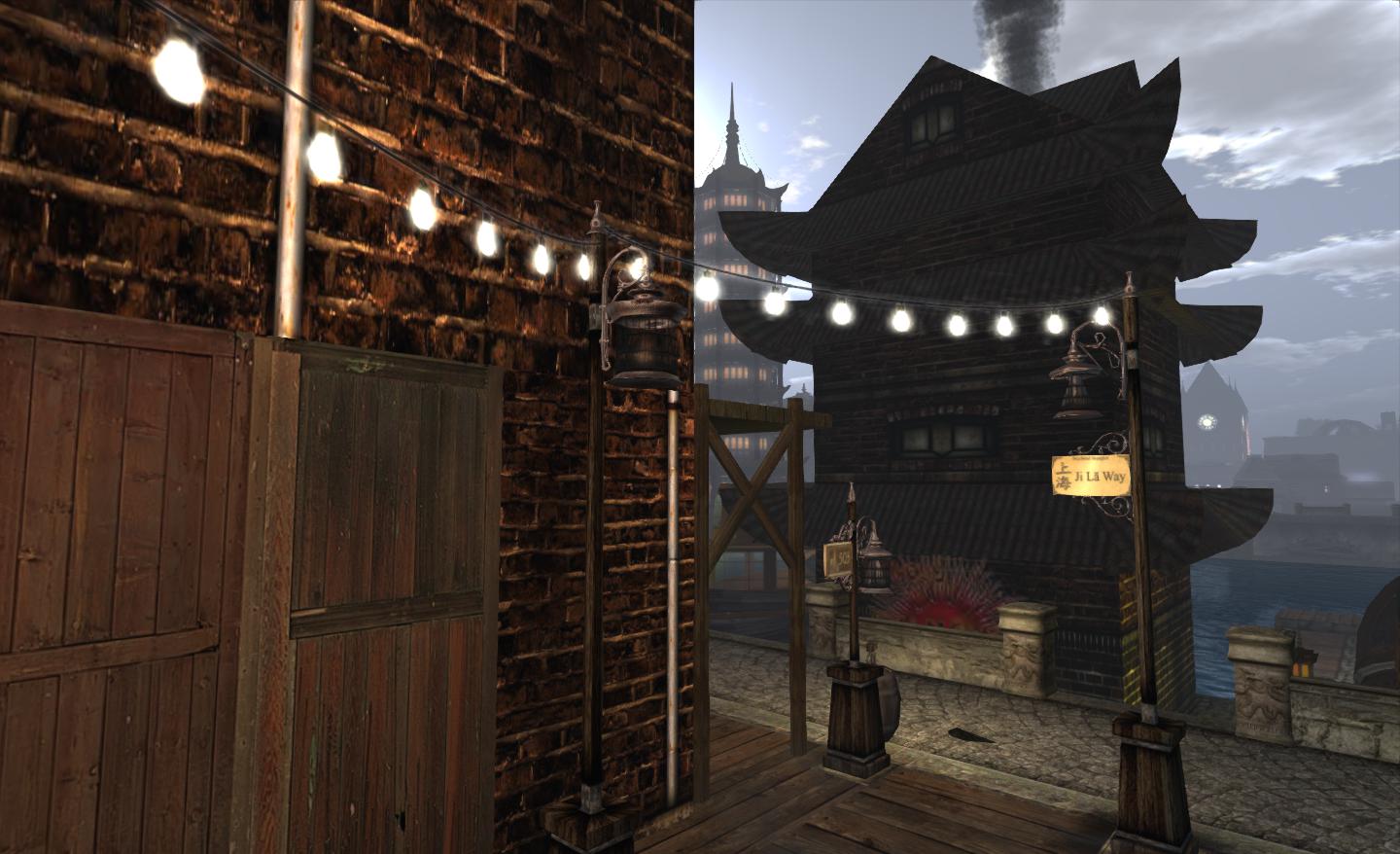
Steelhead itself is the commercial centre for the community. here you’ll find the train station, stores and wide streets and the town hall, wherein a weekly meeting of residents is held to discuss community matters. To the west of this is Steelhead Shanghai, a fascinating “Sino-steampunk” region which brought to mind photos I’ve seen of the Hong Kong harbour front circa the 1920s (although Hong Kong admittedly never had dirigible junks sitting on the waterfront).

Steelhead Shanghai

Steelhead Harborside is mostly residential, and offers a nice walk along footpaths bordered by houses which keep to the theme of the community, and across bridges over canal-like waterways which give the place a very homely and attractive feel. To the north sits Steelhead Nevermoor, which brings a touch of mystery and magic to the estate (and which I most enjoy exploring at night). It is also where you can find the maze mentioned at the top of this article.

Steelhead Nevermoor

Continue reading “Nouveau steampunk with a rural seasoning”

SL projects update week 42 / 1

Server Updates

The main channel deployment took place as planned on Tuesday 16th October. As previously indicated, this was the code deployed to the BlueSteel RC channel in week 41 (essentially an improved database query that should help with the back-end system load).

Of the Release Candidate channels, these are due to be updated on Wednesday 17th October as follows:

  • Magnum – will not receive an update, but will continue to run with the code deployed in week 41, probably in the same configuration
  • BlueSteel – will get code that’s almost the same as the main channel, with some OS-level configuration changes that shouldn’t be visible to anyone
  • LeTigre – will be getting a minor update to the Havok library which is mostly about getting our servers to build under Visual Studio 2010 on Windows and autobuild on Linux.

The LeTigre update will use “slightly newer” versions of the Havok libraries, so concerns were raised at the Server  / Sim meeting on Tuesday 16th October as to whether this may lead to a resumption of the problem with mesh vehicles being unable to travel between regions running different versions of Havok.Andrew Linden confirmed this might well be the case for mesh vehicles moving between LeTigre regions and other regions following the deployment.

To help reduce issues with situations like this arise, it was suggested that areas such as the Blake Sea regions are either removed from the RC channels, or placed on the same channel. While this would not solve the problem grid-wide, it would reduce the impact somewhat for people using mesh vehicles in these regions. A query was put to the LL deployment team on this by Andrew Linden, and they  agreed to try to make the Blake Sea regions more homogenous by ensuring they are all on the same channel.

SL Viewer

A further stability test build for the beta viewer was made on Friday October 12th, and reached the download page on Tuesday 16th (3.4.1.265898release notes) after being cleared by QA. This should be the last stability test release and should see the OK for code merges to resume. Merges and release priorities are still being looked at, and speaking at the Open Dev meeting on Monday 15th October, Oz indicated that there are “a few open source contributions in the pipeline that are in the mix”, as well as the anticipated LL merges such as the Steam code, Monty Linden’s HTTP library updates, Baker Linden’s Group Services project code, Apple OSX Mountain Lion support (including gatekeeper compatibility), etc.

Kelly Linden reports fixing SVC-7870 (Edit Linked Parts isn’t returning creator/owner), but given the current backlog, it may be a while before this makes it through to a beta  / release viewer.

Avatar Baking

The aim of this work (Project Sunshine) is to improve issues around avatar baking and to eliminate bake fail issues. It will primarily focus on moving the emphasis for the baking process from the viewer to a new Texture Compositing server. The viewer will retain some elements involved in avatar baking – the actual baking of the avatar shape (i.e. shape values and IDs) will still take place on the viewer side, for example.

As of Monday 15th October, no major news. Commenting at the Content Creation / Mesh Import meeting, Nyx Linden said, “Still plugging along at it :). It’s a complex project with many moving pieces, we’ll let you know when there are updates, and I will definitely be asking for beta testers here when we’re ready for feedback”.

Interest Lists and Object Caching

The focus of this project is to optimise the data being sent to the viewer, information already cached on the viewer and the manner in which that data is used in order to ensure it is used more efficiently so that things rez both faster and in a more orderly manner than is currently the case.

Interest lists and object rezzing: ironing-out the bugs, wherever they are

Andrew Linden continues to iron-out the bugs in the interests lists project, including one in the main viewer codebase wherein after crossing a region boundary the connection to the region you were just in will get reset after about 60 seconds. This is impacting the interest lists work and requires resolving, so Andrew is currently focused on trying to sort it out. A problem has also been reported with objects rezzing in the test regions on Aditi (e.g. Ahern) when moving through them in a vehicle, and will be looked into.

Pathfinding

A question was raised at the Content Creation / Mesh Import meeting on the 15th October as to why a 1-prim pathfinding character  has a land impact of 15. The reason for this is due to the increase physics load on the character. As previously covered, while this may seem harsh, it actually means that characters with a much higher prim count will also have a land impact of 15 (for example, a 30-prim character will still only have a land impact of 15), unless other factors (such as streaming cost) come into effect.

There are a couple of other issues with pathfinding characters which are being (or are about to be) looking at:

  • A bug whereby copies of single-prim characters only have a land impact of one (not 15). This problem is being addressed under PATHBUG-194.
  • A problem wherebypathfinding characters suddenly appear to “fly away” when adjusting your camera position, almost as if they are suffering from lag, and then reappearing there they should actually be (I gather this tends to happen when looking at a pathfinding character, which is following a set path then turning the camera away and then back again). Andrew Linden believes the problem is related to interest list updates, and will be looking into it.

Mesh

The patch to enhance the mesh uploader when dealing with rigged mesh items was discussed at the Content Creation Mesh Import group meeting on October 15th, with Nyx expressing interest in the idea, and agreeing with a suggestion that the patch needs to be formally submitted to LL’s bit bucket repo applied to a cloned version of the development viewer, supported by a JIRA outlining the patch and with a link to the repro.

Mesh uploda enhancement: suggested that it is submitted as a patch to LL

SH-3055 is a bug relating to mesh uploads which has been around for a while, but which appears to be affecting more people of late. With it, mesh uploads fail without any error message or warning on clicking CALCULATE or UPLOAD on the mesh upload floater. The issue is hard to track down (or even reproduce) as it doesn’t occur with any consistency. Either the upload works, or it simply sits as if waiting for something – whether it is waiting for data to be returned by the server, or whether it is receiving information and failing to action upon it.

Darien Caldwell and Nicky Dasmijn have been working with a debug viewer in an attempt to pin the problem down, but so far without success. One school of thought they are pursuing is that it is a problem with the viewer’s cURL wrapper (which is also thought to have been responsible for the recent crash issues being experienced in the beta viewer). The thinking behind this is that the problem appeared to come about with the introduction of a multi-threaded cURL in v3.2.5 of the viewer – with 3.2.4 having exhibited no major issues with uploading.Nyx Linden has stated he’ll take the problem to the team work on cURL to see if they can identify anything.

Materials Processing

No further updates. When talking to Geenz Spad and Oz Linden on Tuesday 16th October, Geenz could only say, “There’s not much to really report on materials for the time being unfortunately, but when there is something I’ll be more than happy to tell everyone.” Oz then added, “We’ll do more than tell you – we’ll give you something to play with :-)”.

Network Pile-on Test Update

Commenting on the thread for the pile-on test, Oskar Linden said: “All of the tests passed and the code will be going to RC next week. Thank you all for your help!”

With thanks to Baz deSantis for information on the Sim / server Group meeting.

Rod Humble hints at more virtual worlds in LL’s future

On October 14th, and thanks to Lelani Carver, I commented on an article in VentureBeat’s Gamebeat in which Rod Humble discusses LL’s new products and mentions Second Life (see Rod Humble talks-up new products, creativity and Second Life).

In my piece, I included a quote from him which appeared in the article:

“We are still investing in 3D virtual worlds,” he said. “But shared creative spaces is what we do. There is an opportunity to embrace the new way of developing things. A lot of this could be done inside Second Life. But you get more creativity in the hands of more people by building on new platforms”

Rod Humble: “Yes, the plural is deliberate”

At the time I was writing, Humble’s initial wording caught my eye: “We are still investing in 3D virtual worlds” (note the plural). I thought it an odd turn of phrase; why not simply, “We are still investing in Second Life”? In the end, I dismissed the various thoughts floating around my head and assumed the quote was either misinterpreted by the interviewer or that Humble was simply using a broad term by which to define Second Life without using the name itself.

However, it would appear the quote was accurate and intentional. Dropping a comment after my article (which you can read in full here), Rod himself had this to say on the matter:

My comment about also investing in virtual worlds is correct. As you know I don’t like to detail things until we are close to something actionable, but we absolutely are investing in the large virtual world space which I think will make Second Life users, business owners and developers very happy…. but its a ways off :).

In replying to my response to his comment, he went on to add:

Welcome! Yes the plural is deliberate :)

Now this is undoubtedly going to open the doors to speculation (why on Earth do you think I’m pushing this article front-and-centre 🙂 ). For my part, I find the comment “I think will make Second Life users, business owners and developers very happy….” possibly telling. After all, business owners and developers are by definition Second Life users – so why distinguish them somewhat apart from “Second Life users”?

Also of interest is the use of the phrase “the large virtual world space”, which is also open to a lot of speculation.

As Rod points out, it is going to be some while before anything further can officially be said. However, it is obviously fair to say that he wouldn’t have gone even this far without having a reasonable level of confidence that whatever is in the pipeline is going to come to pass.

So what do you think? Do you think he’s referring to the “SL 2.0” some have been writing about / wishing for? Is it “SL+” – perhaps with additional features such as larger regions? A whole new generation of virtual world solutions, perhaps cloud-based? Or something else entirely?

And if you decide to reply, please remember what else Rod said in his original comment: “Our commitment to Second Life remains key and central to our company.”

Related Links

A spoonful of sand, a question over plastic and an unexpected finding

Not long after I Pressed my last MSL update, Curiosity went ahead and collected its first scoop of Martian sand.

The operation took place over the course of several hours on October 7th (Sol 61), gathered a scoopful of sand and powdery material from the sand ridge the rover had been examining at a location mission managers have dubbed “Rocknest”.

The operation was the first phase in a process which is designed to “clean” the Collection and Handling for In-Situ Martian Rock Analysis (CHIMRA) device mounted on the turret at the end of Curiosity’s robot arm (and which includes the scoop itself). The cleaning process is required to ensure that no contaminants from Earth remain in CHIMRA’s chambers so they do not adversely affect analysis when samples eventually reach the on-board SAM and CheMin instruments.

A Hazcam’s view: Curiosity scoops its first load of Martian surface material

The entire process was carefully monitored using several of Curiosity’s camera systems in order to confirm progress and to make sure everything was operating as expected. This made the gathering of the first scoop of material a protracted affair, with the Hazcams at the front of the rover being used to monitor progress from a low angle and both the Navcam and Mastcam systems imaging progress and results. Once the sample has been gathered, the turret was vibrated gently to level the material in the scoop and shake-off any excess.

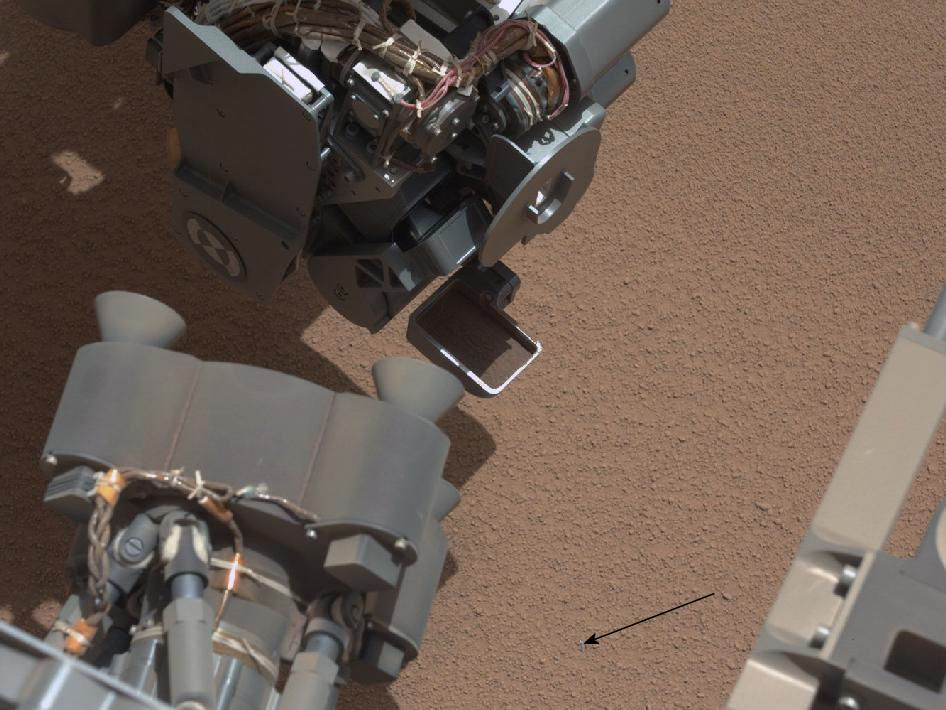
A Mastcam image of the scoop filled with material and (arrowed) the FOD – Foreign Object Debris – which halted scoop operations. For scale purposes, the scoop is 7 cm (2.8 inches) long, and 4.5 cm (1.8 inches) wide

It was an image from the Mastcam which brought a halt to operations, when a small, bright object was spotted. Believing the object might be something from the rover, mission managers decided to suspend the scoop operations and use the Remote Micro-Imager of the Chemistry and Camera (ChemCam) instrument to study the object in an attempt to ascertain what it might be.

Continue reading “A spoonful of sand, a question over plastic and an unexpected finding”