During this phase of the mission, the Mastcam cameras were not used, as mission plans called for Sol 2 to be used for final calibration testing of the system, using the images on the rear section of the rover. Therefore, Mastcam will return its debut images of Mars on Sol 3, which should include a 360-degree colour panoramic sweep of Gale Crater.
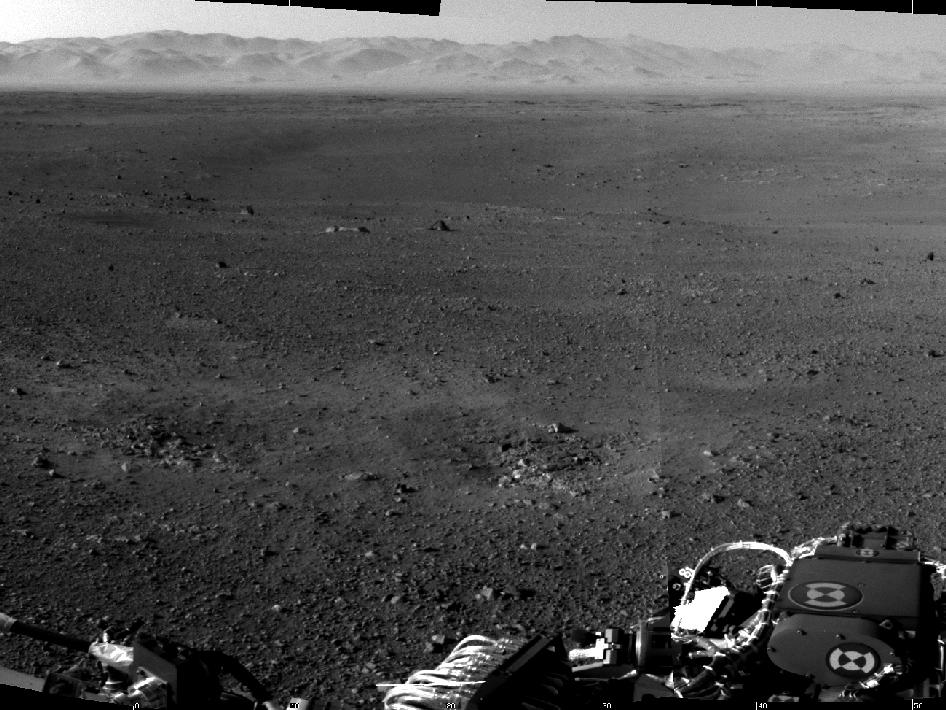
Images from the rover are returned in two forms. Following capture, they are compressed as thumbnails for near-immediate transmission to Earth (in case anything untoward happens to the rover). The higher-resolution images then follow as a part of later transmissions. The thumbnails, in their raw state, can be found on the MSL website, and provide a great “first look” at what the rover is doing.
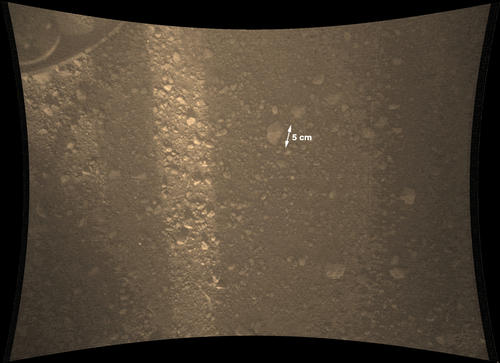
Sol 2 also saw JPL release a post-landing image returned by the MARDI – the Mars Descent Imager – showing the ground immediately beneath the rover. MARDI sits some 70cm (30in) above the ground, and the image is slightly out-of-focus (hence the slight blurring in the image below). It was captured shortly after the rover had soft-landed on Mars and represents the 1,008th image taken by MARDI during the rover’s descent.
Rover and Systems Status
By the end of Sol 2, mission managers were able to confirm that the rover had deployed all masts and antennae successfully. However, the REMS (Remote Environmental Monitoring Station) – effectively Curiosity’s weather station – did exhibit some issues, but engineers now believe they understand the problem and are confident the issue will be resolved with at update planned for Sol 4.
There is also a slight issue with the HGA, in that due to the orientation of the rover on the ground, the line-of-sight between the HGA and Earth is partially occluded by the rover’s low-gain communications mast as the Earth sets over the Martian horizon. While this is not a major problem, tests will be carried out to determine exactly how much this does impact communications so that adjustments to the data transfer window can be made.
The RTG power system for the rover is operating at a better-than-expected power rate – 115 watts compared to the anticipated 105 watts. The rover’s thermal levels are also higher than predicted, which me be the result of the environmental conditions in Gale Crater are better than had been predicted (this is something REMS will be able to investigate from Sol 4 onwards).
Both of these potentially mean that the rover is in a far healthier position for dealing with the environment than had been predicted, and this could offer benefits for the mission: higher power output means the rover can potentially operate for longer into the day prior to switching power requirements over to the heating systems as night-time approaches and temperatures plummet. Similarly, it also means that the rover will potentially have to use less energy to warm up things like the drive actuators in the wheels in the mornings in order to get the rover moving.
Planning Sol 3
Anticipated highlights for sol 3 include:
- The start of a major 4-sol period of flight software transition. This will see a major uplink of software from Earth to the rover on the morning of Sol 3, which will be transitioned into the rover’s system between Sols 5 through 9
- A full 360-degree panorama using the colour Mastcam system
- Tests on the HGA to determine exactly how much the occulsion of the Earth by the low gain antenna is affecting signal strength
Curiosity in SL
A resident-built model of Curiosity has been supplied to JPL, and is no display at JPL’s Explorer Island in Second Life. The model is being displayed with a series of images from the real rover itself, which appear to be undergoing periodic update.
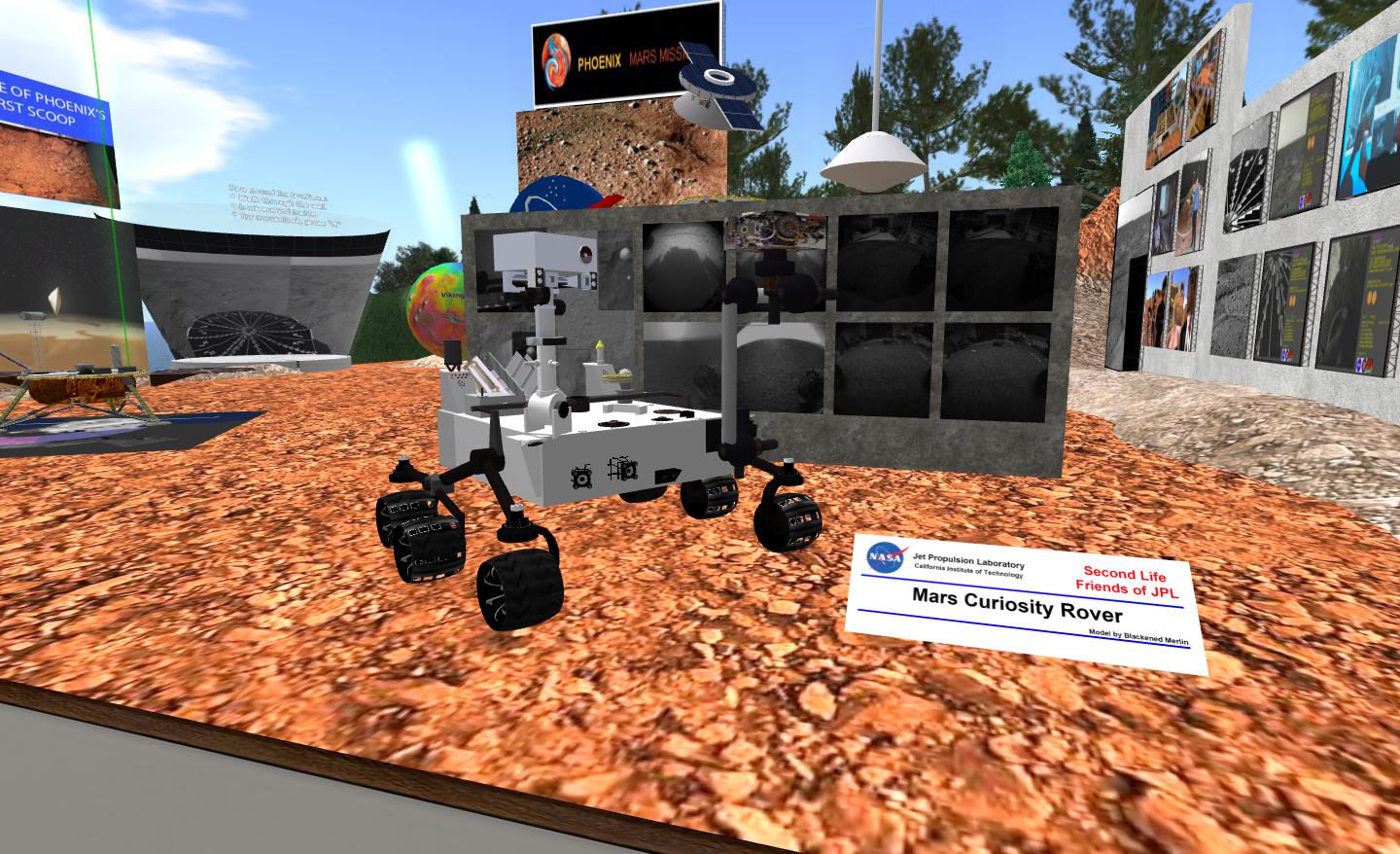
Explorer Island itself provides an overview of several JPL missions, although it is apparent that the region is perhaps not being updated as perhaps it might, nor does it appear to be making use of capabilities such as media on a prim, which is something of a shame. Nevertheless, if you wish to see Curiosity “first hand” and find out something about the MER rovers and Mars Phoenix (2008 lander, now defunct), it might be worth a visit.
Mission Trivia
On manned space missions, such as the ISS and on former shuttle missions, it has been a tradition to start each new day for the crew with music transmitted to them by mission control on Earth. On Sol 2, Mars Science Laboratory mission control followed this tradition, “waking up” Curiosity to the sound of The Beatles’ Good Morning, Good Morning.
Related Links
- MSL Science Corner (JPL)
- MSL website (JPL)
- MSL website (NASA)
- NASA TV schedule (for mission briefings)
- NASA YouTube channel (featuring MSL updates and briefings)
- MSL on Wikipedia (now extensively updated)
- Follow Curiosity on Twitter
- Mission updates on this blog
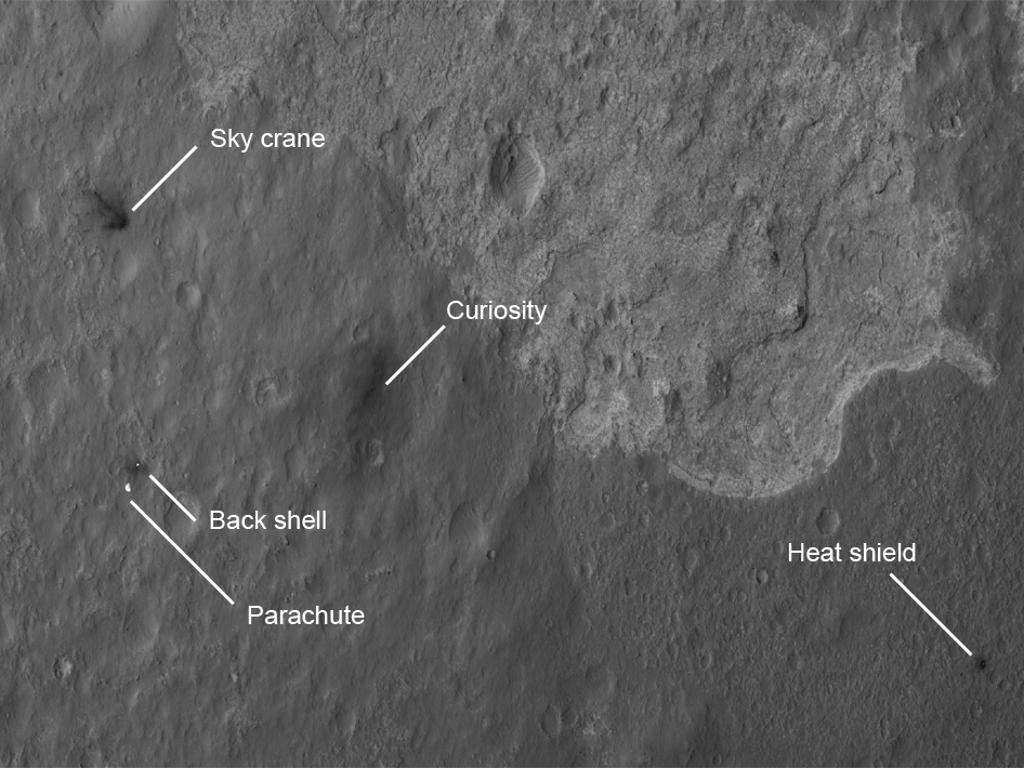
All images courtesy of NASA JPL.

 Inara Pey: Living in a Modemworld
I guess I should have read this post first. I’ll bet young boys see stuff like this and wanna get in there and fiddle with it. So, I’ll answer my own question. I suppose teenage boys get the difference. As for girls, I’m not sure how I’d have felt about it. I mean, someone telling me we’ve landed a rover on Mars, I think I’d say, duh. hehe. I mean, if I was a teen again.
LikeLike
I am so happy I happened upon this blog. Ty for taking the time to put it all together!
LikeLike
Thank you, and you’re very welcome :).
LikeLike