SpotON3D: Losing patience around patents

There has been much to-do around SpotON3D’s plugin to present the Viewer through a browser / Facebook page.  Specifically, the furore has been around SpotON3D’s revelation that they have filed a patent application for the technology. A lot of this furore has been on the matter of prior art existing around the concept of a web browser plugin (the inDuality product is frequently pointed to), and the fact that others in the OpenSim environment have been working towards similar capabilities. Another cause for upset has been the perception that SpotON3D are using the fact that they have filed for a patent on the technology as an anti-competitive roadblock to discourage others from working on the same idea out fear of facing financial penalty should the SpotON3D patent in fact be granted at some point in the future.

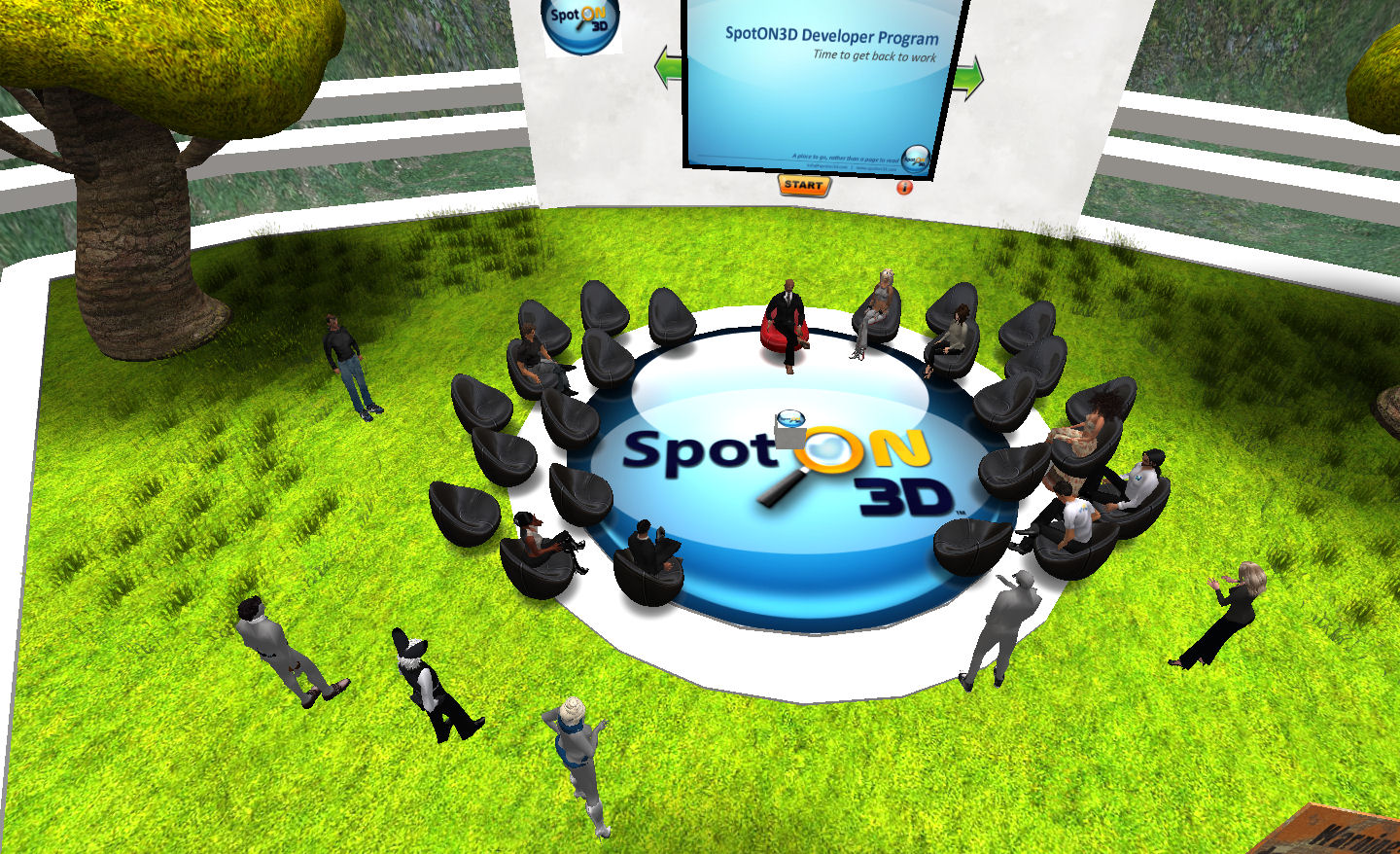
SpotON3D have twice made efforts to directly address concerns in these matters through face-to-face group meetings. The first of these was held on their own grid, and was not a roaring success due to a number of reasons. The second attempt was held last night at their Content Creator’s Expo being held in Second Life. Hosted by Tessa Kinney-Johnson, SpotON3D’s COO and Stevan Lieberman, SpotON3D’s CEO, this also wasn’t an inspiring success.

A major reason for this was the seeming unwillingness for those at SpotON3D to actually engage with others on specifics (i.e. what area(s) of technology they are patenting), repeatedly deferring such discussions until the patent is published. Instead, they would only go so far as to circle around what the patent may not be, and the patent process itself. I say “may not” here, because the answers Stevan Lieberman gave last night were vague because as he himself put, it, “I don’t fully understand all of the technology”.

While this may well be true, it also came across to some as evasiveness: SpotON3D called the meeting, have seen the questions that have been asked repeatedly in public forums (which they’ve previously refused to answer), and so should have been somewhat better prepared to deal with this kind of question a little more openly.
Obviously, there are reasons for SpotON3D not to go into specifics – just as any company filing a patent application would avoid discussing precise details, simply because doing so would tip-off “the competition” and lead to complications through the patent process etc. However, while this attitude may well appear to be right and proper from a legal perspective (Lieberman is himself an intellectual property attorney), it tends to demonstrate a lack of understanding of the environment in which his company is working. This was exacerbated by his refusal, as the conversation broadened, to indicate two further patent applications SpotON3D is in the process of filing.

In many respects, what we have here is both a failure to communicate – and in fairness, this is not just SpotON3D’s fault, although they do carry the brunt of responsibility and they’ve managed to turn this entire situation into something of a PR disaster as a result. I could go on at length as to why, but Maria Korolov has been me to the punch in expressing why this is so, and her comments are an excellent read on the matter.

Simply put, SpotON3D are doing themselves no favours – not so much by filing this (and other patents), although some may well differ within me in this opinion – but in the manner in which they are both interacting with, and reacting to, the OpenSim community as a whole. In this regard, were I to point out just one aspect of the advice Maria gives to SpotON3D to help alleviate matters, it would be this:

Give something back to the community. Now.

Much of the damage SpotON3D have done to themselves stems from the fact that they appear to constantly come up with reasons not to give back to the community they claim to be a part of. Yes, they have plans to do so “next year”, but that simply isn’t enough. They need to be seen to be contributing now, and moving away from what appears to be repeatedly citing reasons why they cannot.

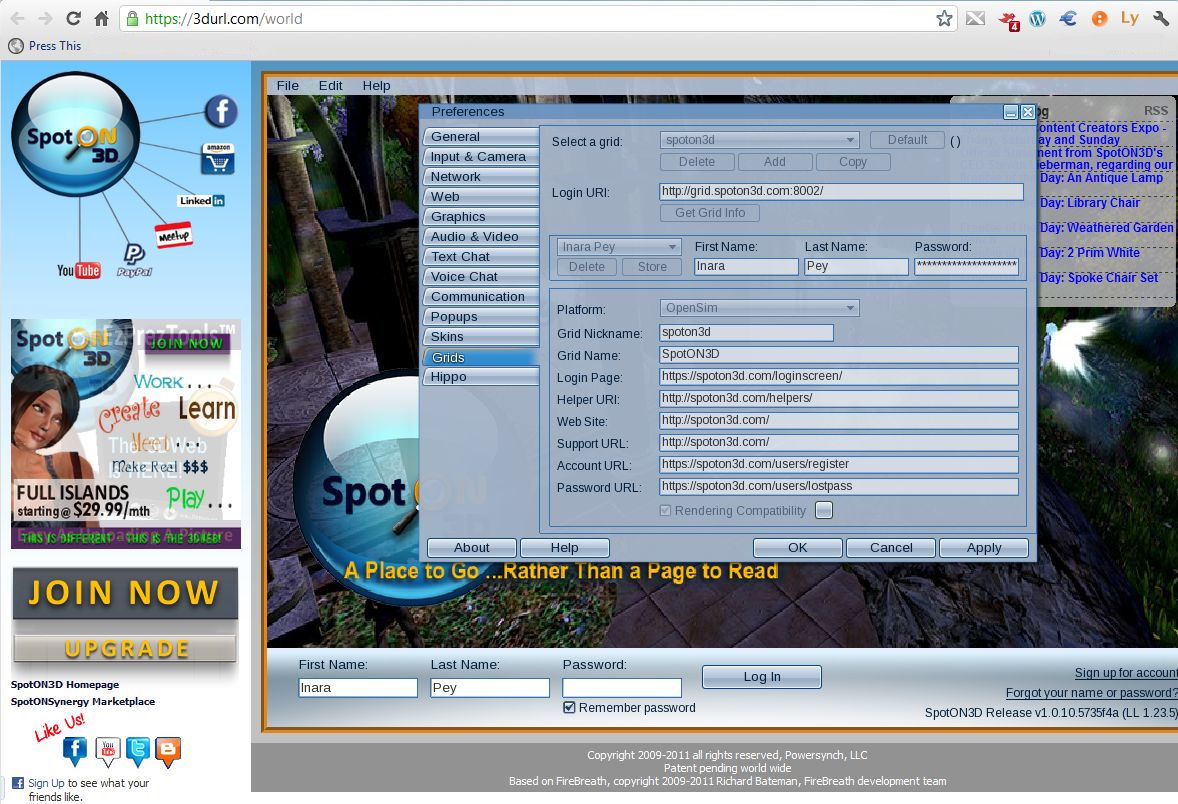
In this, SpotON3D further haven’t helped generate a feeling that they are working openly with the rest of the community as they’ve recently taken steps to lock-down the plugin so that the Viewer no longer supports the ability to access other grids when displayed through the plugin. Whatever the reasons for doing so, it doesn’t really measure=up to SpotON3D’s claims of openness towards the greater community.
Beyond this, the company needs to offer more of an olive branch if they want to be be seen as being genuine in their efforts to broker greater understanding and cooperation. This may sound unfair to those at SpotON3D, who may well feel as if they have attempted to reach out on at least two occasions, only to receive a rap across the knuckles, and had to face-up to placard-wavers and the like. But the move really has to come from them, and demonstrate they themselves are willing to bring something to the table that can be discussed.

And with the greatest of respect to Tessa and Stevan, they need to ensure that whoever does this is a) fully briefed on all aspects of the technology and the kind of questions they are liable to face – and be prepared to provide answers; and b) is able to engage with people positively and with both openness and empathy.

Further Reading

Four reasons why I’m excited about SL again

I’m feeling excited about SL again. It’s a novel experience after the last two or so years of feeling like I’m frequently shaking my head or burying my face in my hands so often.

It really started when Rod Humble started to make his presence felt. One could not help but feel that here is a man who – even if he claims he doesn’t understand Second Life – actually groks the potential of the platform on many levels. Since January, we’ve seen substantial progress on numerous fronts. True, it hasn’t always been quite what we wanted, or perhaps as far as we’ve wanted – but the positive results are undeniable in a number of areas. There may still be an almighty pile of things still sitting in the To Do box at the Lab, but no-one can hand-on-heart deny considerable effort has been put into trying to directly address matters of usability on a number of fronts, and to examine issues around user engagement and retention.

SLCC saw a round of talks and panels of Linden Lab staff that did much to reinforce the feeling that the Lab is back on the right track. What particularly excites me, are three things that have, I think, the potential to radically transform SL, and one that looks like it’s going to get some overdue focus. Namely:

  • Mesh
  • Gaming mechanics
  • Non-player characters (NPCs)
  • Prims

If we’re honest, the first iteration of mesh is already here; the capability is rolling-out across the Main grid, the code to support it within the Viewer is now at Beta and is available in at least one third-party Viewer with others set to follow, and mesh creations are slowly beginning to appear.

Mesh: opportunities

True, what we’re getting in the first release may not be what everyone wants, and there has been much angst on the technical side about the capability to produce SL-efficient mesh objects. It’s also fair to stay that it may not initially be as well-suited to some areas of content creation as it is to others. However, Linden Lab are aware of many of the issues (real and perceived) and are working towards trying to resolve those that they can over time. As Charlar Linden himself said at SLCC 2011, there will at some point be at least one “non-trivially sized” set of improvements to mesh to follow-up the initial roll-out.

But the fact is, doubts and angst aside, mesh can be transformative within Second Life on many levels beyond “traditional” content creation, for example:

  • It potentially offers new and previously unseen opportunities for creative collaboration as sim owners, groups and even businesses work with 3D artists to generate totally new and unique experiences within Second Life
  • It potentially takes the opportunities for practical prototyping to new levels, and well beyond anything that can be achieved with prims, something that might open the doors to other forms of collaborative efforts in both education and business
  • It can clearly bring an entirely new dimension to art within SL, be it static, mobile or through the lens of a camera; offering new ways for artists to express themselves visually both in-world and elsewhere.
Using gaming mechanics

Gaming mechanics also opens the door to many new possibilities, depending upon how they are implemented. At SLCC 2011, Gez and Esbee Linden gave a demonstration of the kind of thing LL staff have being playing with in order to better understand the mechanics of creation and the capabilities and limitations of SL, and how game-like mechanics might be used to enhance the SL experience. Even in a “rough” form, the results shine a light on a lot of potential, as Gez himself commented at the convention:

Second Life itself is not a game.  However, you can make some great games inside of Second Life, and you can use game mechanics, and game tutorials, and game systems to help people become more engaged and comfortable in Second Life.”

It’s amazing to think of the opportunities that the considered implementation of game-like tools, mechanics and controls could bring to Second Life. Just consider role-play quests (as a single example) wherein there’s no need to don a HUD or faff with notecards – everything can be done immersively on-screen, via simple prompts or icons and using intuitive controls such as point-and-click and / or point-and-drag.

NPCs: New opportunities

Non-player characters (NPCs) offer a similar means for new an immersive interaction within a virtual world that potentially goes beyond the use of bots / scripted agents, as they could run without being attached to logged-in accounts. Little wonder, then that UK-based Daden Ltd., has been working on just such a capability for OpenSim, as Maria Korolov reported in Hypergrid Business this week.

NPCs can be applied to a wide range of uses within SL. Here’s just two:

  • Within training simulations, where they can add depth of experience for trainees and perhaps be programmed to react a number of different ways as a result of interactions with trainees, making training simulations a lot more dynamic
  • Within role-play environments, where they could be used to provide help and guidance to players, or present threats that need to be dealt with and so on, adding to the immersive experience in ways that again go beyond the use of account-based bots. And that’s just scratching the surface of opportunity.

Combined with the use of gaming mechanics, NPCs stand to give Second Life a new dimension in terms of the way people can engage with various offerings within SL, as well as providing those seeking to provide immersive experiences with a raft of new tools and opportunities.

NPC coding and Mesh…new opportunities for pets?

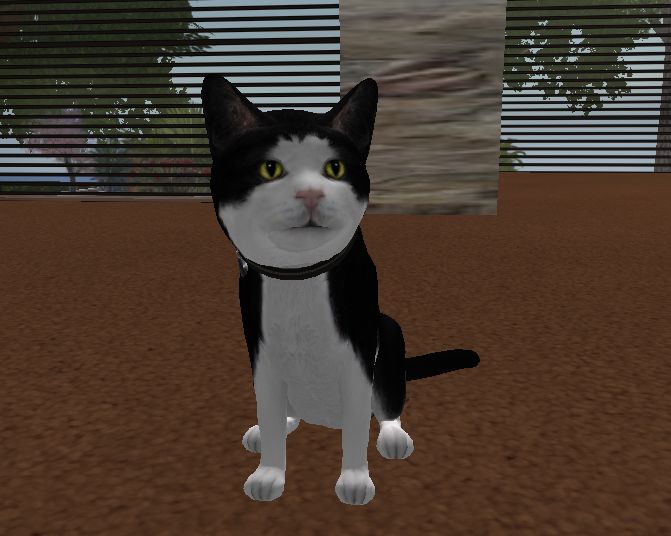
Even in more mundane settings, NPC capabilities could be used to create, say, the “next generation” of pets beyond the likes of Stitch on the left here; able to both interact and react to avatars and their environment beyond the current limitations seen in pets at present.

Finally, there is the humble prim. Even if you’re not enamoured with any of the above, there is no need to worry, as it seems new life is to be breathed into the prim – and possibly the tools we have to manipulate it.

Not only is the new 64m upper size limit coming into effect with the release of mesh, but it seems that prims are to become central to a “directed experience” in the future aimed encouraging people coming into SL to engage in the process of content creation and the collaborative opportunities offered by in-world building. From the way Durian described it, this “direct experience” will be one of a number that the Lab is considering as ways of further user engagement with Second Life, and having a focus on prims and in-world creation is perfectly aligned with Rodvik’s view that Second Life is a shared creative space.

That prims should get additional attention is only right and proper – they may not be perfect, but they offer a lot of opportunities for those without deep-seated artistic and technical skills (i.e. me), to get a lot of fun and enjoyment out of SL. In this respect, it was very pleasing to see members of the LL product team engaging so much with the tools themselves in an effort to better understand them and – perhaps – start looking at ways and means to improve them down the road.

So, yes, I’m feeling pretty positive about Second Life and the future. The road ahead may be a little bumpy, and not everything is going to happen at once, or – again – necessarily as some of us might like it to happen; but the promise is there – and the Lindens themselves seem as determined as the rest of us to make it real.

SLCC: Destination Guide – highlights

Speaker

  • Brett Atwood (Brett Linden), Managing Editor, Linden Lab
  • Contact e-mail: editor@lindenlab.com

Focus

The Destination Guide – what it is, how it works, how to be a part of it. Note this is not intended to be a full transcripts Brett’s presentation.

  • The Editorial Team at Linden Lab comprises Brett (four years at the Lab), Gabrielle Linden (relative newcomer) and the inimitable and beloved Torley Linden
    • The team collaborates in helping and supporting Linden Lab initiatives and the community in getting news and information out about venues, events, etc.
    • Specifically focused on the Destination Guide, but also do support for messaging and the secondlife.com website,  producing the Lab’s own promotional videos and touches on the blog and social networking
    • Showcase (click to enlarge)

      Highlighted the various promotional opportunities for users, not all of which are the remit of the Editorial Team, but which include the Destination Guide, Events Calendar, Classifieds, SL Groups, my.secondlife.com, the SL YouTube channel, blogs, forum and social networks

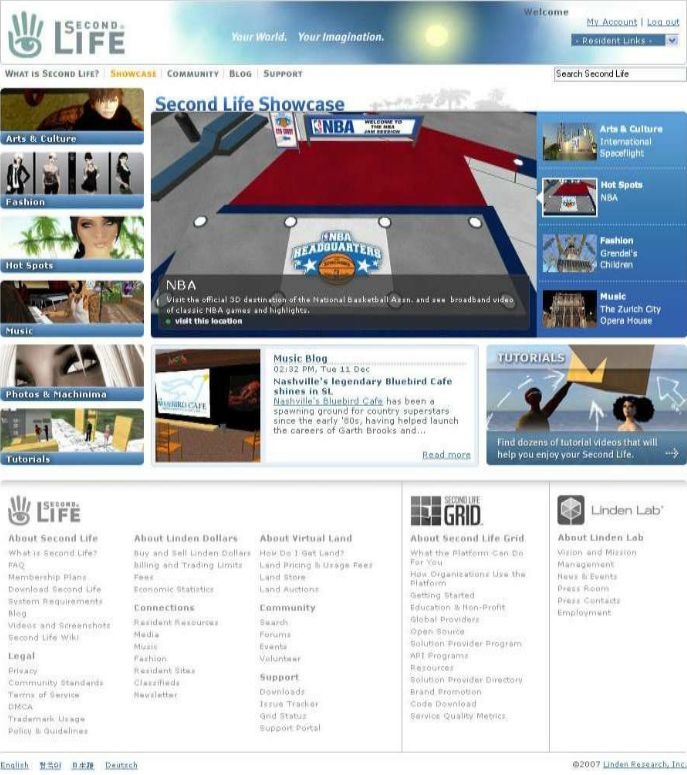
    • Reviewed the origins of the Destination Guide in terms of the old Showcase feature (right), which itself arose from the 2006 machinima of the making of Suzanne Vega’s guitar (see below)
      • Video seen as a demonstration of the power of SL, which LL should be doing more to promote
      • Showcase performed two functions: providing a means for users to find things to do & places to visit, and also offered LL the means to showcase SL activities simply and quickly to the web at large
      • The showcase feed and data is still available for viewing at http://secondlife.com/app/showcase, while the new Search is also available directly on the web at Search.secondlife.com

  • One of the aims of the Editorial Team is to have new destinations highlighted in the Guide daily, including looking at real-world current affairs (used the example of the Middle East situation as an example, when related destinations in-world were refreshed and highlighted)
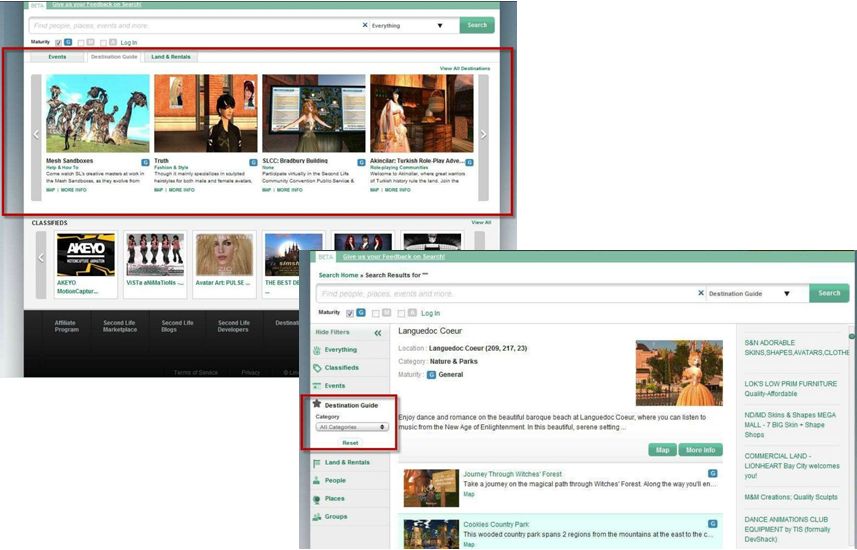
  • Destination Guide comprises one master feed of data, which can be broken down and used – third-party use included – to provide multiple channels of delivery:
    • Secondlife.com
    • Viewer 2 log-in screen
    • Inside the SL Viewer, both Basic and Advanced modes
    • TPVs
    • Maps.secondlife.com links
    • Widgets and RSS feeds
  • A significant portion of the Destination Guide audience comes directly from the web – seen as potential new users, and thought is given to how LL can inspire / tell a story in order to get people to sign-up (something that has been a focus of mine in the recent past)
  • LL aware of the mixed viewers from users on the inclusion of the Facebook “like” button on web pages Destination Guide. LL do not view the button as being about Facebook integration; rather it is seen as a means for peer-to-peer promotion outside of SL of venues as people opt to “like” entries
  • Alongside Facebook, indicated that the Guide could be integrated with new Profiles at my.secondlife.com “but that’s something we want to hear from you about”
  • As a part of the channel delivery concept for the Destination Guide, it is now available via the Viewer 2 Search, where it can be presented in multiple ways
One feed – multiple channels
  •  A “hot” icon (flames) indicating how popular a location is in terms of avatar presence has been added to destination listings
    • No flame = not many visiting; deep red flame  = very popular
    • Coded so that very busy sims are not over-prioritised in the listing to help throttle the number of visitors
  • Destination Guide central to the Basic Viewer mode to encourage people to explore & recognise the experiences available in SL, and where it uses a “newcomer friendly” channel
  • Destination Guide seen as a means of supporting high-impact events (such as SLCC), through the creation of limited-time categories within the Guide that contain relevant information (locations, etc.)
  • Create Ad Widget

    For those with entries in the Destination Guide there is a Create Ad Widget – this allows the code and image for the entry to be displayed and edited or taken for embedding to a website or blog elsewhere

  • The Destination Guide within the Viewer 2 log-in screen is “version 1” and will be subject to revision, with feeds a mix of editorially-managed and automated
    • The What’s Hot section operates so that id a sim exceeds 40 avatars, the entry “goes away”
    • The idea is to connect people quickly through the log-in process
    • LL want feedback from users on this approach
  • Venues, etc., can get on to the Destination Guide in a number of ways:
    • Via user recommendation using the on-line Destination Guide form
    • E-mailing the Team at editor@lindenlab.com
    • Being involved in the official blogs
    • The team also actively monitor user’s blogs, social media (Twitter, Facebook, my.secondlife.com, etc.), YouTube, etc., in order to identify what is catching attention
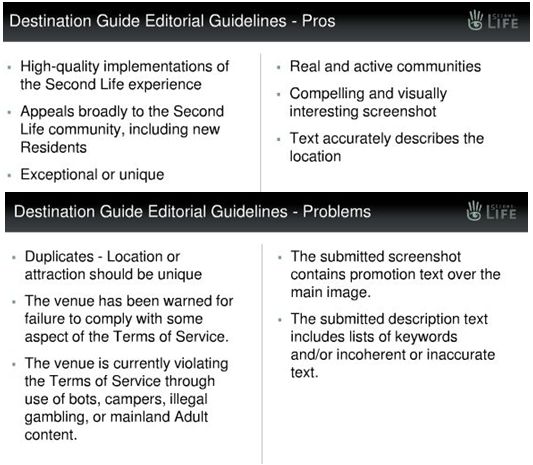
  • There are pros and problems to getting noticed and addressed (below)
Destination guide – getting noticed pros and problems – remember, Destination Guide is not a classified ads page!
  •  The Team monitor Destination Guide both on the web and its in-Viewer use to see which categories are popular month-by-month
  • The Destination Guide is a non-paid, editorially-moderated tool and should not be confused with classified ads
  • In addition to the Destination Guide, the Editorial Team are engaged on promoting SL machinima via the SL YouTube channel and into locations such as the website log-in page, as machinima recognised as a valuable tool for SL promotion in turn (something else I wrote about some time back)

Further information


SpotON3D to host content creator’s workshop – in SL

This weekend will see SpotON3D, who have been the source of much controversy around patent issues of late are holding a 3-day exposition this weekend at their sim in Second Life.

The aim of the weekend is to enable people to: “Learn more about our products and services, on how to expand your business to SpotON3D, the SpotON3D Developer Program and much more!”

Schedule of Events

The weekend’s programme is as follows (all times SLT):

FRIDAY – August 19th, 2011

  • 11:00: CCEXPO INTRODUCTION with Tessa Harrington
  • 12:00: SpotON3D’s GEEKSPEAK: Ask the SpotON3D TechTeam Your Questions
  • 13:00: Developer Discussion Group with Philippe Pascal
  • 14:00: Concurrency: Should the number of users be your sole reason for expanding?
  • 15:00: Scotty Bevill of Bevill Edge®
  • 16:00: Music
  • 17:00: SpotON3D ‘s Patent Pending Plug-in: Is it a threat or a benefit?

SATURDAY – August 20th, 2011

  • 11:00: CCEXPO INTRODUCTION by Tessa Harrington:
  • 12:00: Reserved
  • 13:00: Amleth McCallen performing
  • 14:00: Vardasilver Spearsong about RP
  • 15:00: SpotON3D Office Hours
  • 16:00: Sunny Salamander, SpotON3D Chief Developer, Business Tools : HOTSWAP
  • 17:00: AgileBill Firehawk/ AgileBill Krebs – http://www.agiledimensions.com

SUNDAY – August 21th, 2011

  • 11:00: CCEXPO INTRODUCTION by Tessa Harrington
  • 12:00: SpotON3D Chief Developer – Business Tools :: BoostCLOUD Severs
  • 13:00: Lesley Scope aka Light Sequent :: Cybergogy for a 3D Educational
  • 14:00: Maxmillion Kleene performing
  • 15:00: Phoenix DaVinci – What I like to create: HotSwap Scenes?
  • 16:00: GridWrap – Hosted by Tessa Harrington & Wildfire/Raine Morgwain, Guest Sandy Adams.
  • 17:00: Wildfire Morgwain – Virtual Entertainment- The Next Great Cinematic Frontier?

Patent Discussions

Most interestingly, SpotON3D have decided to open part of the event to discussions around their move to patent the wrapper they’ve developed to present the Viewer thro popular web browsers. This is scheduled for Friday at 17:00 SLT.

In all, SpotON3D has filed five patents for technology linked to their Virtual World offering, although it is the wrapper patent that has so far gained the widest coverage, and it is this that appears to be the focus of the discussion planned for Friday.

The company have already attempted to hold one discussion around their actions, but this didn’t go very well, as Maria Korolov reported at the time. Whether this attempt is any more or less successful is open to question; but at least it is leaning a little more towards “neutral ground”. The last meeting was boycotted for a number of reasons – one being it was held on SpotON3D’s own grid. Given this meeting is still going to be held on SpotON3D’s own region (SLurl) in SL, it remains to be seen as to whether it is regarded as “neutral” enough. The other aspect of the discussion is, of course, just how open the SpotON3D folks are prepared to be in relation to their patents; on the strength of their last meeting, some observers might be prone to say, “not very”.

For more information on the expo, see:

(With thanks to Maria Korolov)

Home improvements…again

Yep, I’ve re-worked my home…again. I can’t go six months without doing something. This time I’ve retained the basic sky platform, but with some differences, and have added a new house.

The last time I played with things, I had no idea what I really wanted to do. This time it was easy: I wanted to get rid of the clutter and go for something clean and more suited to my in-world time. It’s great having things like a swimming pool and jacuzzi in-world, especially when they’re impractical in real life – but unless they’re used, they simply become fluff. Well, to me at least.

There were things in the old build I wanted to keep – the gazebo, which receives a lot of use, especially when friends visit or I’m parked in-world, writing or working out-world; the planters and trees – although I wanted to improve on them and the greenery in general. I also knew which house design I wanted to use as well.

So away I went, and here are the results.

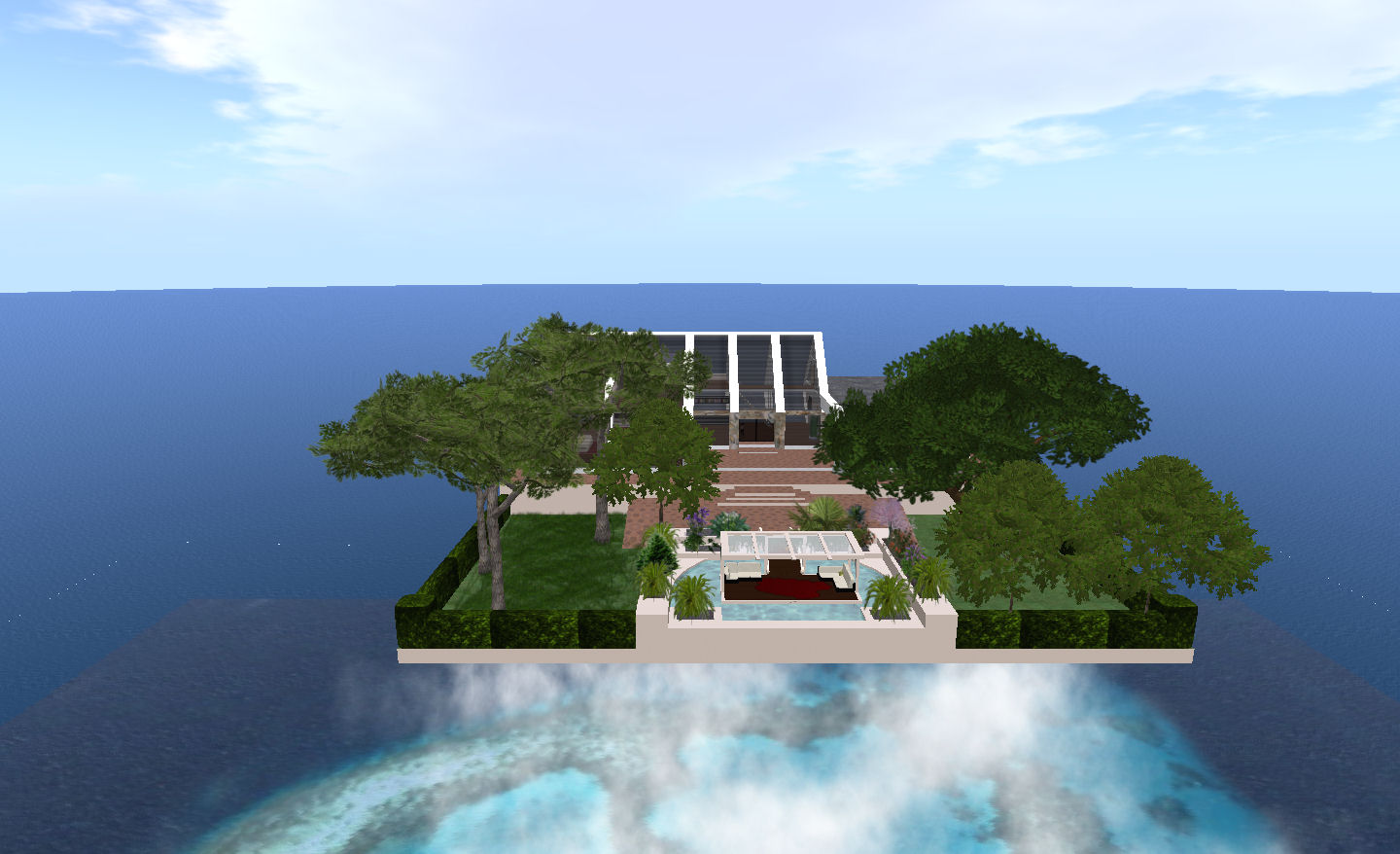
An aerial view

The gazebo, as mentioned, remains, but the pool area that was to the left as you look at the picture has gone, as has the dance stage to the right, leaving me with two lawn / grass areas and room to plant some impressive new trees. The walls / rails around the platform have also gone, replaced by sculpted hedgerows.

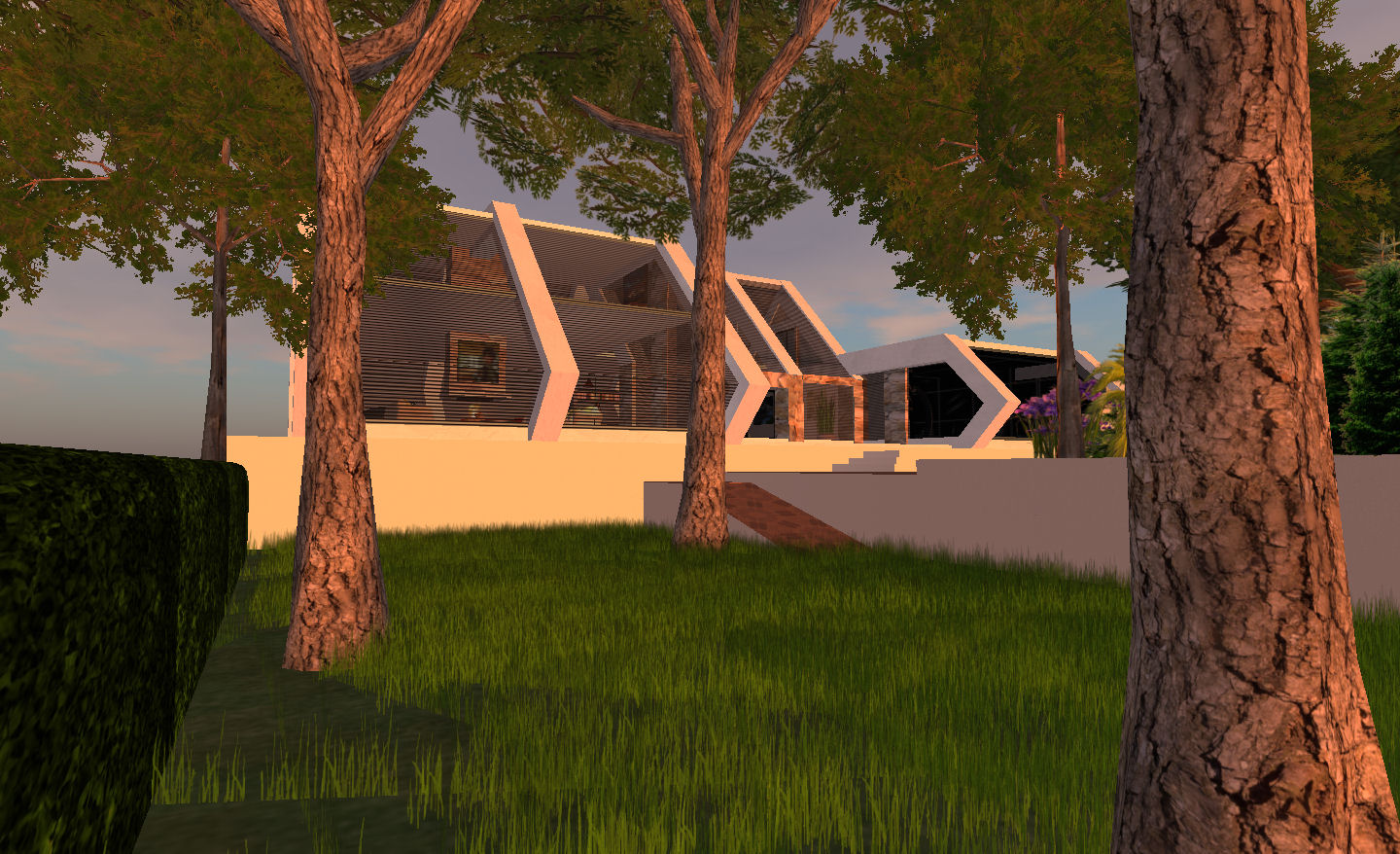
Through the trees

The house itself is a variation on my Canaveral 2 design, which I recently re-worked using the new prim size limit of 64m. I’ve wanted to use it for a while, if I’m honest, as I really like the look and lines.

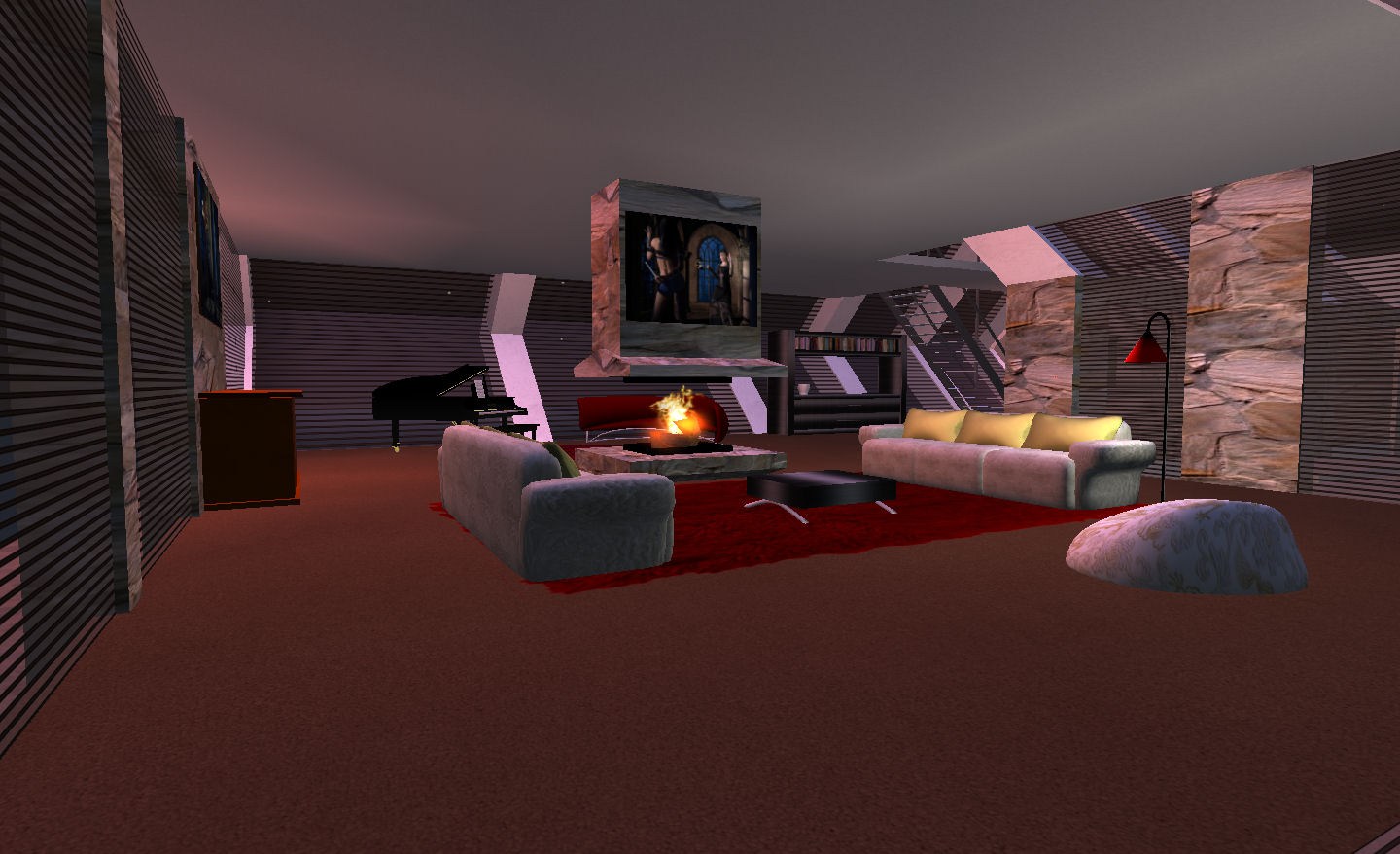
The lounge (click to enlarge)

The lounge hasn’t changed in terms of furnishings, but the house design has meant I can bring my piano back into the lounge area, rather than having it out in the hall; I missed having it as a focal-point for visits.

As per usual, I’ve opted for scripted lights (‘cos I’m lousy with textures), and as the photo shows, have hopefully got something warm and inviting in terms of tone around the fireplace and the indirect lighting.

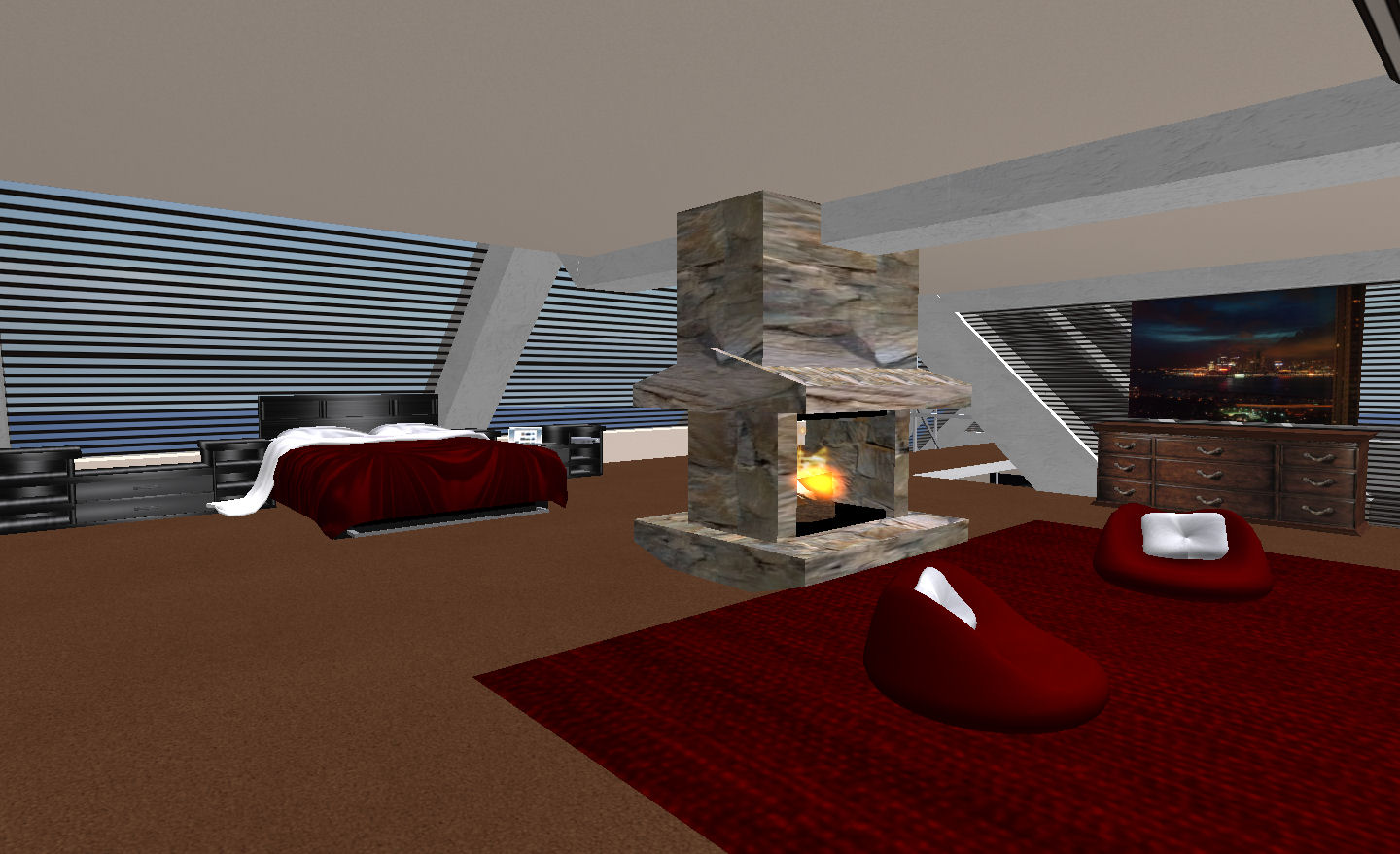
Bedroom

The bedroom is above the living room, and reached by a stairway and suspended landing I’m rather pleased with. Again, I kept to a central fireplace, as with the lounge, as this nicely divides the room in two as well as giving it something of a focal-point & extra picture-hanging space when I need it!

I didn’t bother with making the windows tintable – haven’t for a while now; being up in the sky, it’s not like I’m overlooked, and hopefully Firestorm will soon be able to access the new land privacy options should I ever need to go that far.

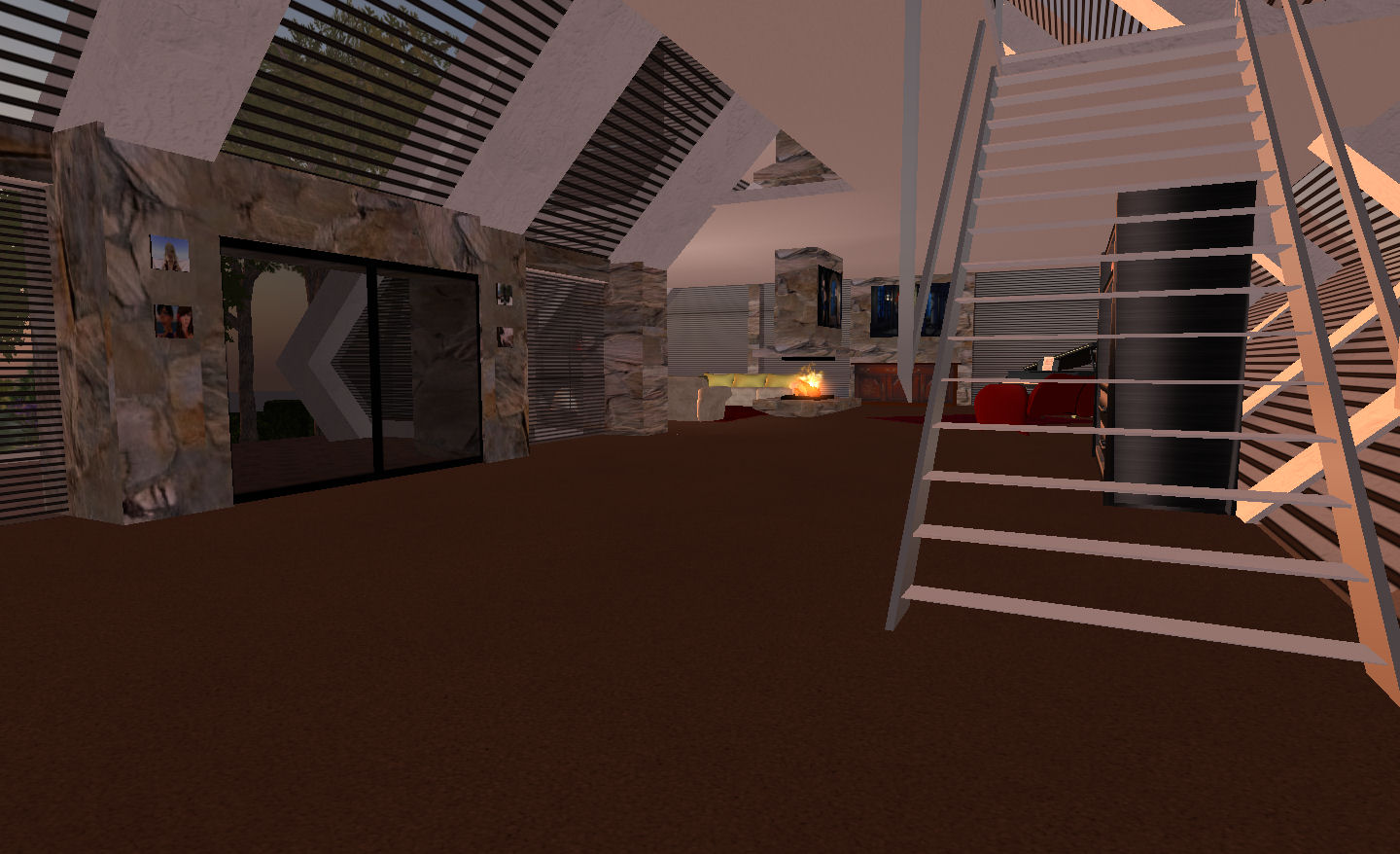
Entrance hall at dusk

All-in-all I’m pretty happy with the way the place has worked out; it still sprawls a littleon account of the scale, and I’m seriously considering taking up a suggestion from a friend and re-scaling this and some of my commercial builds to suit more “real life” avatar heights now things like Penny Patton’s camera adjustments and other ideas for a more immersive experience at catching on. Certainly, this house feels overly large given I have been using one of Penny’s camera positions for about six months now (even though I’m technically over 6ft tall in-world!). I guess time will tell on and further changes. For now, I think I’ll just enjoy the new house :).

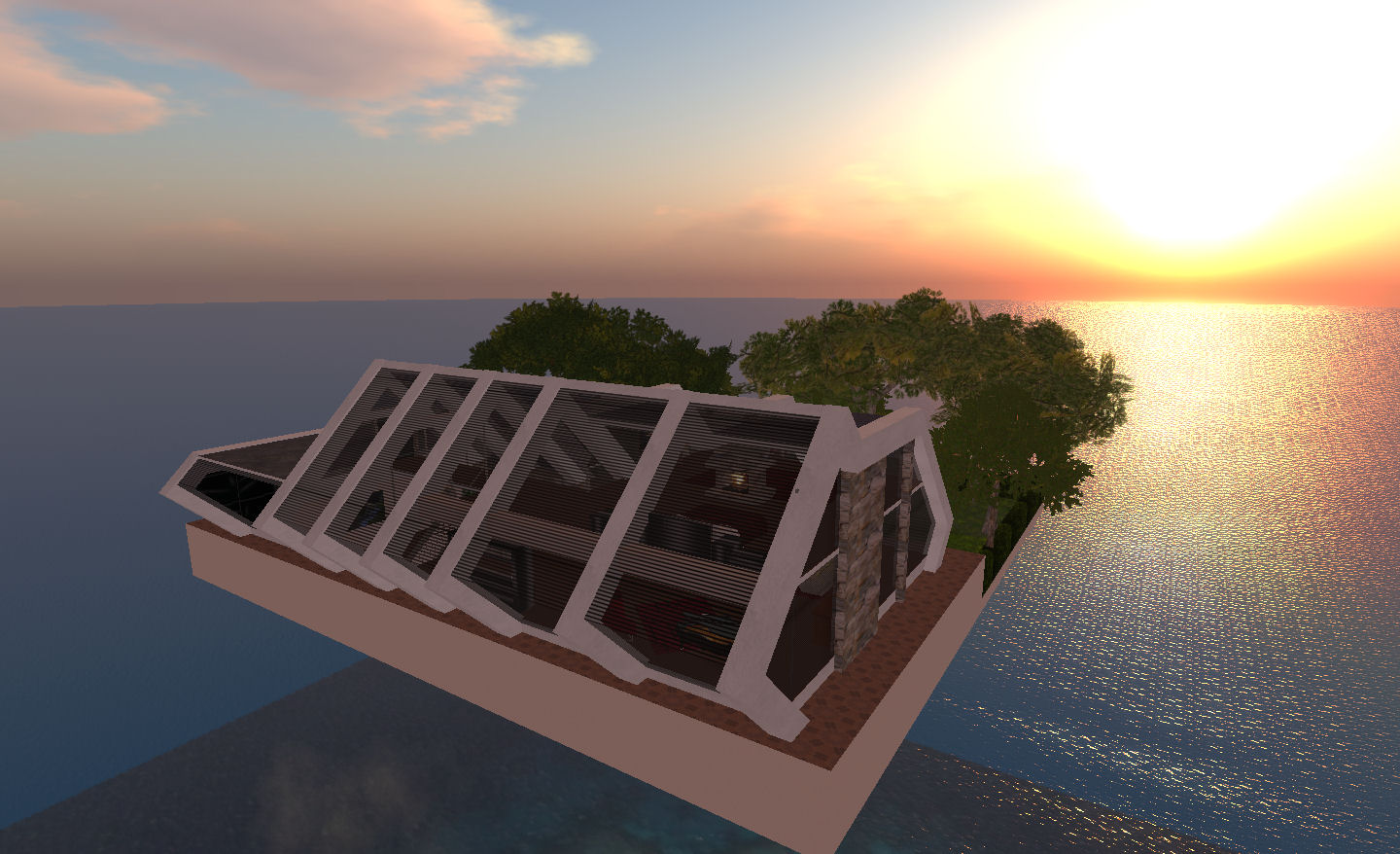
The new house at sunset
Another view from the lawn

SLCC: The Future of SL – Highlights

On Sunday 14th August, as a part of SLCC 2011, members of Linden Lab gave a presentation “The Future of Second Life” as a part of four keynote addresses at the convention.

The panel itself comprised John Laurence (Durian Linden), who has only recently joined Linden Lab, but has worked previously with both Rod Humble and Jeff Peterson (Bagman Linden); Sarah Kuehnle (Esbee Linden), who recently made a popular return to Linden Lab (and who brought a prim with her to the presentation!); and Michael Gesner (Gez Linden).

After introductions, Esbee recapped on some of LL’s recent user-facing activities over the last six months, including:

  • The arrival of new avatar selections as a part of the sign-up process, stating more are to be added
  • The new log-in screen for Viewer 2 (/3), which will be further iterated in the future
  • The new Search, described as being faster and with better relevance

She also made mention of the Basic mode of the Viewer, the new region & estate settings, dynamic shadows & deferred rendering … and mesh.

Learning Experience

The core of the presentation revolved around demonstrating a new game developed within Second Life by Lab employees as a learning experience because, Durian Linden explained:

“As Rod was a newbie and certainly I was new to Second Life as well, one of the first things we wanted to do was to make something in the world…We wanted to try and challenge ourselves as Lindens, to use our toolset to make an experience…basically for new users to be able to have fun using the Basic Viewer without a lot of the advanced functions and with just a very simple style of UI.

“So we gave ourselves about two weeks to pull this together, working with a team of in-world builders. We wanted to see really first-hand what the limitations are and then how we can try to overcome those limitations.”

The Linden-developed game…

The game uses the Basic Viewer’s point-and-click approach (although it may be re-visited to make use of click-and-drag as well) to guide an avatar through a setting, collecting and placing various objects, which avoiding hazards and traps. It is specifically designed to see what can be achieved within Second Life while avoiding the need to have to navigate inventory or gain familiarity with both the concept and use of things like HUDs – or indeed without having to rely on on-screen pop-ups or delivered notecards for assistance.

Using point-and-click to achieve goals

During the process of building the game, the team encountered a number of problems not found in “traditional” game development: their monsters would chase them through the sim while they were building, and guns sitting on build platforms overhead waiting to be placed within the game would also open fire on those below!

Gez viewed the development and construction of the experience as being valuable to understanding the power of Second Life as well as some of the limitations and issues. He also, later in the presentation, emphasised that the game is not intended to replace the new user experience – or even be released in its current state; it is a prototype for learning within Linden Lab. However, he did acknowledge the wider potential value such an approach may have for users:

“I do think that there is some value in creating an experience which is simpler, it’s more guided, it gives you prompts, it gives you almost quests or achievements, things that tell you what you need to do next to learn how to use Second Life, but I will completely agree with the fact that Second Life itself is not a game.  However, you can make some great games inside of Second Life, and you can use game mechanics, and game tutorials, and game systems to help people become more engaged and comfortable in Second Life.”

Some have angry birds. The Lindens have angry boxes!

Product Team

Following the presentation, Durian expended on the role of the product team, stating things had been broadly divided into two main areas:

  • Usability, designed to answer such questions as is SL the kind of product a reasonably-intelligent person can come along and start to use; can they operate an avatar or the camera, can they use the basic functions in order to meet others, have fun, etc. As a part of addressing this the team have been, and are, looking at:
    • Avatar rezzing time and rezzing priorities (i.e. giving avatars a higher rezzing priority)
    • Improved access to the Viewer’s avatar customisation tools
    • Basic / advanced Viewer integration to bring together tools from both and ease the transition for new users from the basic tools to the more advanced tools (interestingly, as a part of this, the team are looking at the issue of what to do with the Sidebar in terms of improving / changing it)
    • Developing Direct Delivery from the Marketplace (due to go live in a couple of months)
    • Improving overall inventory management, especially for making inventory easier to understand from a new user perspective
  • Engagement, defined as answering the question of how do people find the things they want to do & how can LL provide better tools to content creators, both of which are aimed at keeping users engaged with SL. As parts of this element he pointed to:
    • The new Viewer 2 log-in screen with the destination guide options
    • Mesh as a means of encouraging new content and content developers
    • Prims themselves, as a “directed experience” and means of getting people engaged with building within Second Life and the collaborative aspects of content creation, both  for pleasure and for profit
    • Scripted non-player characters that can be used to populate areas and enhance the experience of visiting such areas

As the focal point for all development, working with the rest of Linden Lab, the product team has divided itself into specific Subject Matter Experts in order to fully understand various aspects of SL use:

  • Durian – art
  • Gez – gaming and breedables
  • Esbee – role-play
  • Charlar Linden- Adult
  • Geo Linden – Education
  • Nya Linden – Music
  •  Cassandra Linden – Fashion

These roles will not replace the normal community relations channels, but will accept input from the user community.  Hamlet Au suggests means of contacting the team.