Euorpa’s icy, mineral-stained surface as imaged by NASA’s Galileo mission – see below (credit: NASA / JPL)
On Monday, September 26th, after some teasing beforehand, NASA provided an update on the venting of water by Jupiter’s icy moon, Europa.
As I noted in my last Space Sunday report, Europa is covered by shell of water ice, much of it discoloured by mineral deposits and by deep cracks, beneath which it is believed to have a liquid water ocean about 100 km (62.5 miles) deep. The ocean is believed to be made possible by tidal flexing enacted by the massive gravity of Jupiter as well as from the other large Galilean moons. This generates heat within Europa, and this heat stops the water from freezing solid.
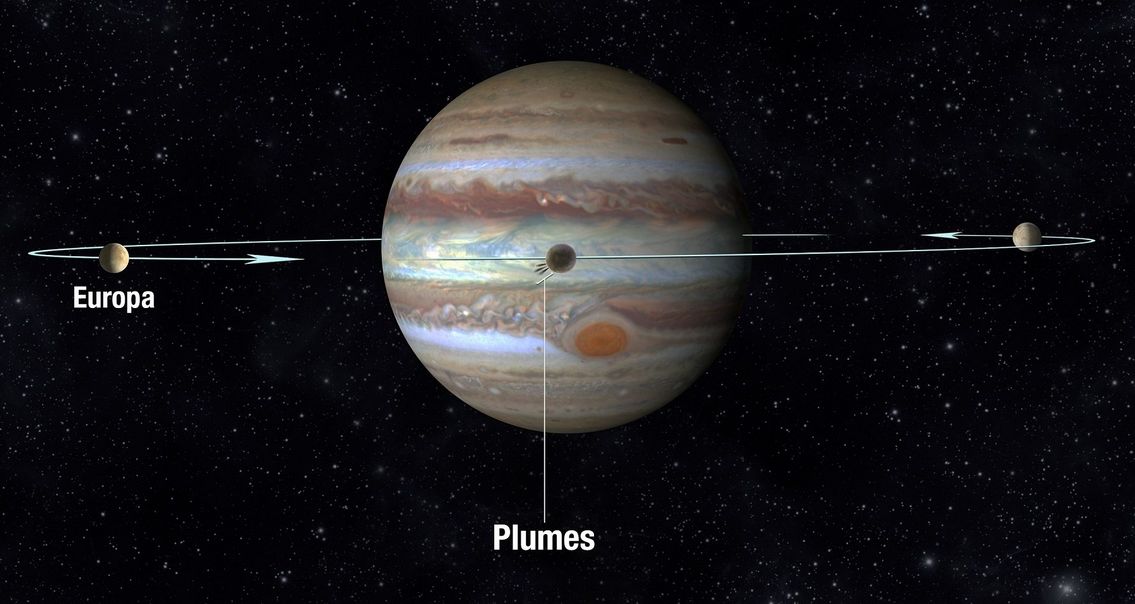
In 2012, The Hubble Space Telescope (HST) captured what appeared to be a huge plume of water erupting some 200 kilometres (125 mi) above the surface of Europa, using its Space Telescope Imaging Spectrograph (STIS) instrument. The update offered on September 26th provided information on further plumes, strengthening the case of water existing under the ice crust of Europa in the process – a crust which may be far thinner than thought.
Europa transit illustration. Europa orbits Jupiter every 3 and a half days, and on every orbit it passes in front of Jupiter, raising the possibility of plumes being seen as silhouettes absorbing the background light of Jupiter. Credit: A. Field (Space Telescope Science Institute)
Over a 15-month period, astronomers used Hubble’s STIS to observe Jupiter and Europa in the ultra-violet spectrum. During that time, Europa occulted (passed in front) of Jupiter on 10 separate occasions. The observations were an attempt to examine a possible extended atmosphere around the moon, which is slightly smaller than our own. However, on three of the passes, astronomers witnessed what appeared to be plumes of water erupting from the surface – and in pretty much the same location as seen in 2012. Analysis of the plumes revealed they were made up of hydrogen and oxygen consistent with water vapour being broken apart by Jupiter’s radiation in a process known as radiolysis.
The plumes are not constant, but rather flare up intermittently, possibly as a result of the surface ice on Europa flexing in response to the same gravitational influences that are keeping the ocean beneath the ice from freezing out. This suggests that the icy crust is, at least around the region where the plumes are occurring, thinner than had been thought. This is important, because it could mean that any automated mission sent to Europa could have a fair chance of cutting its way through the ice to deploy a submersible vehicle which could then search for any evidence of life in Europa’s salty ocean – which contains between two and three times as much water as all of Earth’s oceans combined.
The Gentle Crunch: Rosetta Mission Ends
The European Space Agency’s Rosetta spacecraft said farewell on Friday, September 30th, bringing the 12-year mission that bears its name to a close.
Launched in 2004, Rosetta was a daring attempt to rendezvous with a short-period comet, 67P/Churyumov-Gerasimenko, then orbit it and study it as it swept through the inner solar system and around the sun on its (roughly) 6-year obit. The aim was to give us unique insight into cometary behaviour and – more directly – to study one of these tiny lumps of mineral and chemical rich rock “left over” from the solar system’s formation, and thus gain greater understanding as to how things came to be, and perhaps how life itself might have begun.
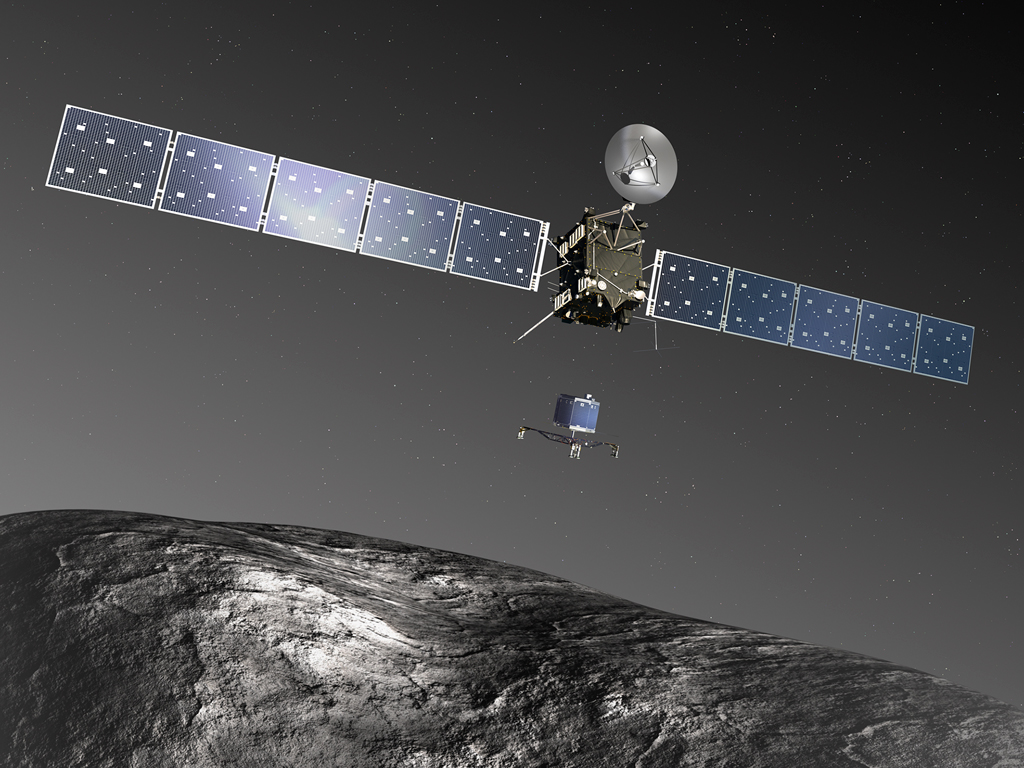
Rosetta, Europe’s mission to unlock the secrets of the early solar system through the study of comet 67P-C/G, and the Philae comet lander (image: European Space Agency)
Rosetta travelled almost 8 billion km (5 billion miles), including three flybys of Earth and one of Mars, and two asteroid encounters, before finally arriving at 67P/C-G in August 2014. In November of that year, The Philae lander was deployed in the hope of studying the comet from the surface and gathering samples of its material for analysis. Unfortunately, Philae’s anchoring mechanism failed, sending the little lander bouncing across the comet, until it came to rest in a location where it was receiving insufficient sunlight to recharge its batteries. Nevertheless, in the time it did have before its batteries were almost depleted, the washing machine sized lander some 80%+ of its science goals.
Meanwhile, Rosetta studied the comet in the long fall towards the Sun, and carried out an extensive mission of study, analysis and image capture, much of which has completely altered thinking around comets like 67P/C-G. For example, the mission discovered that water within the comet has a different ‘flavour’ to that of Earth’s oceans, suggesting that the impact of such comets with primordial Earth played far less of a role in helping start Earth’s oceans than had been thought.
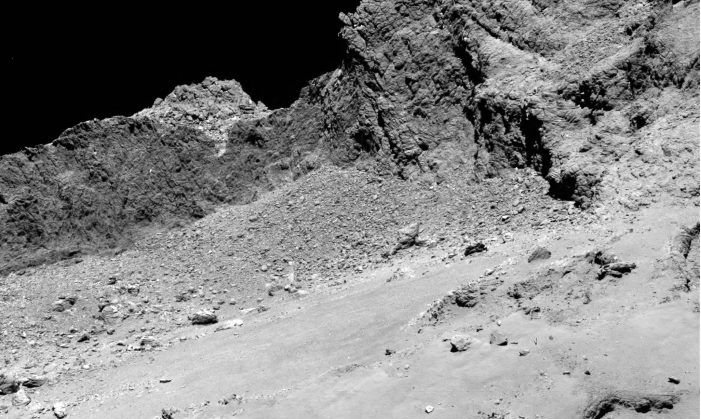
The final descent: Rosetta’s OSIRIS narrow-angle camera captured this image of Comet 67P/C-G from an altitude of about 16 km above the surface, as the spacecraft commenced its final descent on September 29th, 2016. Craggy hills about 614 metres wide rise from a surface smothered in dust redeposited on the comet’s surface after being outgassed during its active phase. Credit: ESA/Rosetta/MPS for OSIRIS Team MPS/UPD/LAM/IAA/SSO/INTA/UPM/DASP/IDA.
As the comet became more active during its approach to the Sun, Rosetta found complex organic molecules – amino acid glycine, which is commonly found in proteins, and phosphorus, a key component of DNA and cell membranes – were present in the dust vented by 67P/C-G, reinforcing the idea that the basic building blocks for life may have been delivered to Earth from an early bombardment of such rocks. The mission also confirmed that the comet’s odd shape – two potato-like lobes of different sizes joined at a narrow waist – was the result of a very slow-speed collision very early in the comet’s 4.5 billion-year age.
In all the spacecraft operated in the harsh environment of the comet for 786 days, made a number of dramatic flybys close to its surface, survived several unexpected outgassings, and made two full recoveries for potentially serious “safe mode” situations. However, all things must inevitably come to an end, and with its manoeuvring propellants almost exhausted, on September 29th, Rosetta set course for a gentle crash landing on 67P/C-G.
The moment of destruction: the SpaceX Falcon 9 explodes on Launch Complex 40 at Kennedy Space Centre, Florida
SpaceX Look to Resume Falcon Flights in November 2016
SpaceX President Gwynne Shotwell has indicated the company hopes to resume Falcon 9 launches from November 2016, despite the September 1st loss of the launch vehicle and its US $200 million Amos 6 Israeli-built communications satellite during the preparations for a full static fire test of the rocket’s main engines.
It’s an ambitious aim, given that the cause of the loss is still unknown – and until it is known, it is highly unlikely the Falcon 9 will be cleared for flight by the FAA. However, the comments might suggest company feel that the cause of the loss may not have been with the booster itself, but may have been triggered by an external event, in which case such a target might be possible.
Launch Complex 40, Canaveral Air Force Station, after the Loss of the Falcon 9 booster and payload on September 1st, 2016. Credit: Ken Kremer
The static fire test is a part of pre-launch preparations unique to SpaceX. Basically a full dress rehearsal of a launch, it includes fuelling the booster and briefly firing the main engines with the rocket locked-down on the pad. It was during fuelling operations, eight minutes before the rocket motors were to be fired, the that a series of explosion occurred, destroying the booster and its payload.
Video footage seems to suggest the point of origin for the explosions was outside of the vehicle, in what SpaceX has called a “fast fire”, which started at, or near, the liquid oxygen fuelling umbilical. As well as the complete loss of the vehicle, the explosions and fireball caused extensive damage to Space Launch Complex (SLC) 40 at Canaveral Air Force Station, which had been leased to SpaceX for Falcon 9 launches.
It is the second lost of a Falcon 9 rocket in 15 months. In June 2015, the vehicle carrying the Dragon CRS-7 cargo resupply vehicle to the International Space Station disintegrated a little over two minutes after lift-off, following the failure of an internal strut.
In order to resume launches and meet obligations, SpaceX are planning on pivoting Falcon 9 launches to Kennedy Space Centre’s Pad 39A until such time as SLC 40 can be repaired. SpaceX leased the pad – a part of the complex used to launch the Saturn IB, Saturn V and space shuttles – in 2014 in a 20-year deal. It is currently being refurbished at the company’s expense to launch crewed Dragon 2 flights to the International Space Station, and commercial missions using their new Falcon Heavy launcher. Currently, there is still much work to be completed at the launch complex – previously used to launch the space shuttle, and before that, the mighty Saturn V rocket, although SpaceX plan to have the work completed by November.
Launch Complex 39A at Kennedy Space Centre undergoing refurbishment by SpaceX in preparation for Falcon Heavy and crewed Falcon 9 launches. The Rotating Service Structure, seen on the left and used for space shuttle launches, is due for demolition
Whether or not the root cause of the September 1st accident will be known by then, and the Falcon 9 cleared for flight is a major unknown. The investigations into the June 2015 loss took six months to complete and – due to it being caused by a failure within the vehicle – the rocket had to undergo several engineering changes.
Blue Origin Announces the New Glenn Booster Family
Blue Origin, the company founded by Amazon founder Jeff Bezos, revealed its plans for a family of reusable boosters for both orbital and deep space launches. Called New Glenn, the vehicles are a significant step forward for the company.
The New Glenn family. Credit: Blue Origin
Although more widely known for their efforts in the sub-orbital space tourism field, with their New Shephard reusable system, Blue Origin has long indicated it has wider aspirations, whilst remaining somewhat tight-lipped about exactly what it is developing.
Like the smaller New Shephard sub-orbital launch vehicle, New Glenn is to comprise a reusable first stage – referred to as the “propulsion module” on New Shepard. The vehicle has been under development for about 4 years, and the plan is for the first launch to take place in 2020.
Seven metres (23ft) in diameter, the New Glenn first stage will be powered by seven of the company’s new BE-4 engines. These are the same engines United Launch Alliance have selected as the primary propulsion unit for their own upcoming new Vulcan launch vehicle, which will enter service in 2019 to replace the expensive Atlas V booster.
This core stage of the new Blue Origin rocket – which is named for John Glenn, the first American to orbit the Earth, just as New Shephard is named after Alan Shephard, the country’s first astronaut to fly in space – will be topped by either a second stage for launches to low-Earth orbit, or a combination of a second stage and third stage system capable of a broader range of launch options. In both variants, the second stage will be powered by a single BE-4 engine, while the third stage will be powered by an uprated version of the BE-3 engine, currently used by the New Shephard. Neither the second nor third stages will be recoverable. It is anticipated that New Glenn will be capable of lifting between 35 to 70 tonnes to low Earth orbit, placing it in the same class of launch vehicle as SpaceX’s Falcon Heavy – and thus competing directly with it.
When it enters service, the new booster will be launched from America’s Space Coast, from the historic Space Launch Complex 36 at Canaveral Air Force Station, which Blue Origin took over in September 2015 in a deal with the USAF’s 45th Space Wing.
New Glenn compared to other current launch vehicles. The two-stage variant will be 85 metres (270ft) tall, and the 3-stage variant 95m (313 ft) tall. Both will have a 7m (23 ft) diameter. Credit: Blue Origin
In its time, SLC 36 was was used to launch the Mariner missions, the first US interplanetary probes to visit over worlds, Pioneer 10 and Surveyor-1, the first US vehicle to soft-land on the Moon. It was largely demolished in 2010, leaving just a single pad. Blue Origin are expected to construct a rocket fabrication and assembly facility there, as well as a new launch complex. Currently, it is not clear how the first stage of the booster will be recovered, but the company have hinted at an automated at-sea landing in the style of SpaceX might be used.
China Launches Tiangong-2
On Thursday, September 15th, 2016, and as expected, China launched the Tiangong-2 (“Heavenly Palace 2”) orbital laboratory from their Jiuquan Satellite Launch Centre in Gansu Province, and on the edge of the Gobi Desert in northern China. The Long March 2F booster (and not a long March 7, as incorrectly reported in some space news outlets) lifted-off at 14:04 UTC, making for a night launch, local time.
The Long March 2F carrying the Tiangong-2 orbital laboratory, lifts-off from China’s Jiuquan Satellite Launch Centre in Gansu Province at 14:04 UTC on Thursday, September 15th
Tiangong-2 is the second phase of China’s goal to establish a permanently crewed space station in the early to mid 2020s. This work started in 2011 with the launch of the Tiangong-1 facility, which was briefly visited by two crews in 2012 and 2013. It will culminate in the on-orbit construction of a large space station, starting with the launch of the Tianhe (“Harmony of the Heavens”, and formerly Tiangong-3) space station core module in 2022.
an artist’s impression of Tiangong-2 (centre right) with the Tianzhou resupply vehicle docked (left), together with the Shenzhou-12 crew vehicle at the laboratory’s far docking port. Credit: CCTV
It is expected that at least two crews will visit the facility. The first 2-person crew will fly to the laboratory in October aboard Shenzhou-11. They will commence the first round of a fairly extensive science programme, remaining at the lab for around 30 days.
After this, the facility will be left dormant until April 2017, when a Long March 7 booster is due to deliver the Tianzhou (“Heavenly Ship”) uncrewed resupply vehicle to orbit. This craft will then perform an automated docking with Tiangong-2, providing it with additional fuel, water and other consumables and also use its engine to boost the laboratory into a higher orbit to await the arrival of the second crew.
The second crew, comprising 3 personnel, should fly to the facility in mid-2017 Shenzhou-12. They are expected to say for less than 30 days, but while there carry out a number of tasks connected to developing a full space station, including performing an EVA. Whether further crews will visit the station after this has yet to be determined.
A Billion Stars – A Map to Our Galactic Neighbourhood
The first one billion: a billion stars in our galaxy mapped by distance and brightest – with a few extra-galactic objects shown for good measure. Credit: ESA/Gaia/DPAC
The above image might not look like much, but it is the largest all-sky survey of celestial objects published to date, pinning down the precise position on the sky and the brightness of 1142 million stars in our galaxy.
It is the product of the European Space Agency’s (ESA) Gaia Project, which is approaching the mid-point in its 5-year mission. Launched in December 2013, and orbiting the L2 Lagrange point, Gaia commenced its mapping operation in July 2014 – and it will continue doing so through until 2017. This map, released by the European Space Agency on September 14th, covers the data gathered from July 2014 through to September 2015. A further map, which includes data through to August 2016, is currently in development.
An artist’s impression of the Gaia vehicle at the L2 position relative to the Earth and Sun
The intention is to create a precise three-dimensional map of astronomical objects throughout the Milky Way, mapping their motions, which reflect the origin and subsequent evolution of the galaxy. Spectrophotometric measurements by the craft will provide a detailed survey of all observed stars, characterising their luminosity, effective temperature, gravity and elemental composition. The data gathered will provide the basic observational data to tackle a wide range of important questions related to the origin, structure, and evolutionary history of our galaxy.
It is the second such survey to be undertaken. The first was ESA’s Hipparcos mission, almost two decades ago, which surveyed around 200 million stars. One aspect of the Gaia survey will be to compare its findings with those of Hipparcos, so it will hopefully be possible to start disentangling the effects of “parallax”, a small motion in the apparent position of a star caused by Earth’s yearly revolution around the Sun, and the “proper motion” of the star’s physical movement through the galaxy.
The Gaia map includes globular clusters without our own galaxy, and images of clusters and galaxies beyond our own. Credit: ESA/Gaia/DPAC
The Gaia map means it is now possible to measure the distances and motions of stars in about 400 clusters up to 4,800 light-years away, and includes 3194 variable stars, which rhythmically swell and shrink in size, leading to periodic brightness changes. Many of these are located in the Large Magellanic Cloud, one of our galactic neighbours, a region that was scanned repeatedly during the first month of observations, allowing accurate measurement of their changing brightness. During the first phase of the mission, Gaia also discovered its first supernova in another galaxy, and the science and engineering team had to overcome a “stray light” issue where fibres used in the vehicle’s sun shield protrude beyond the edges of the shield and into the field of view. In doing so, they reflect unwanted light, resulting a degradation in science performance when mapping the faintest of stars in Gaia‘s view.
The Birth of a Black Hole?
Black holes; the boogie-men of the cosmos. Deep wells of gravity so intense that not even light can directly escape after passing the event horizon. They are formed in one of two ways, during the death of super-massive stars.
In the first, the star gobbles up the last of its fusionable fuel, causing the core to suddenly and violently contract, in turn triggering a violent explosion – a supernova – completely shedding the star’s outer shell of mass, and leaving behind a super-dense neutron star. Generally only 10 or so kilometres across, this have a greater mass than our Sun. It is thought that if this mass is too great, the neutron star also collapses in on itself, forming a black hole. In the second, the star doesn’t go supernova, but experiences a “failed supernova” brightening for a very brief period as some matter is lost, but then continuing to collapse in on itself until a black hole is formed. In both cases, the star vanishes from the visible spectrum, leaving behind tell-tale signs in the infra-red and in x-rays.
The Large Binocular Telescope, one of three instruments so far used in gathering data on N6946-BH1. Credit: NASA
A team of astronomers now believe they have captured the birth of a black hole through this second process.
They were studying data relating to N6946-BH1, a red giant thought to be coming to the end of its life, when they noticed something odd. In 2009 the star, roughly 25 times bigger than our Sun and 20 million light years away, could be seen in the visible light wavelengths. By 2015, however, it had vanished, leaving only an infra-red afterglow. A subsequent check on Hubble Space Telescope data revealed the same: in 2007 the star was visible, in 2015, it wasn’t.
Intrigued, the team checked data on the star from the Palomar Transit Factory (PTF). This revealed that in 2009, N6946-BH1 blossomed briefly in luminosity, with a massive burst of neutrinos occurring at the same time – events both consistent with the star collapsing, but not going supernova. Add these to the infra-red tell-tale, and it would seem N6946-BH1 might have formed a black hole.
If so, it should now be a source of x-rays emitted in a particular spectrum as local matter fails into it. The team are now hoping that the Chandra X-ray Observatory in Earth orbit will be able to take a look at N6946-BH1 in the next two months or so to see if those x-rays can be detected. Should it be determined that N6946-BH1 has collapsed into a black Hole – even one now 20 million years old – studying it could help describe the beginning of the life cycle of a black hole, and better inform us on how black holes form, potentially why some super-massive stars form a neutron star rather than collapsing all the way to a black hole.
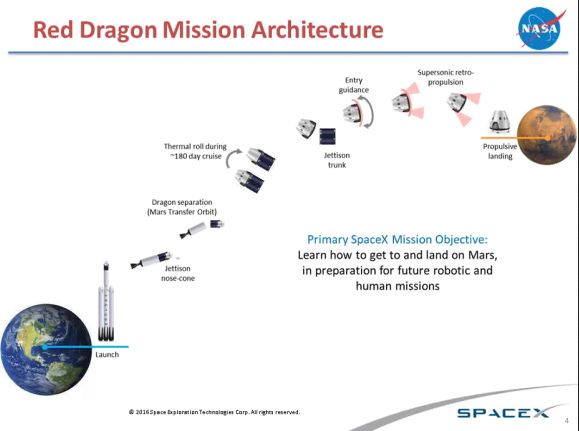
SpaceX’s plan to start down the road to their first human mission to Mars with their 2018 automated mission to the Red Planet – which NASA suggests will cost the company around US $320 million
NASA has indicated that the SpaceX Red Dragon mission to Mars, which the company plans to carry out in 2018, will likely cost around US $320 million for SpaceX to mount, ad NASA itself will spend around US $32 million over four years in indirect support of the mission.
The Red Dragon mission, first announced in April 2016, will be financed entirely by SpaceX; NASA’s costs will be related to providing technical and logistical support – such as using its Deep Space Tracking Network for communications with the vehicle.
If all goes according to plan, the Red Dragon mission could be launched as early as May 2018. It is the crucial first step along the road towards the company’s ambitions to land a human crew on Mars by the end of the 2020s. If successful, it could potentially be followed by at least three further uncrewed Red Dragon flights in 2020/22, prior to the company commencing work on building-up matériel on Mars in preparation for a crewed mission.
A SpaceX / NASA infographic outlining the 2018 mission. Credit: NASA / SpaceX
Red Dragon is the name of an uncrewed variant of the SpaceX Dragon 2 vehicle, which will enter service in 2018 ferrying astronauts to / from the International Space Station. Intrinsic to the mission is the plan to conduct a propulsive landing on Mars using the craft’s SuperDraco Descent Landing capability. This is vital on two counts.
For SpaceX, a crewed variant of the Red Dragon will likely be the Mars descent / ascent vehicle during a human mission to the planet. So understanding how it operates in the Martian atmosphere is a vital part of preparing to land a crew on the planet. NASA is similarly interested in learning how well retropropulsion works in slowing a vehicle to subsonic speeds in the Martian atmosphere, as it now looks likely they will use the same approach for their human missions to Mars, which may occur in the 2030s. Gaining the data from the SpaceX missions means that NASA doesn’t have to fly its own proof-of-concept missions all the way to Mars.
A Dragon 2 text article test-fires its eight SuperDraco engines during a hover test in 2014
Whether or not Red Dragon will fly in 2018 is still a matter of debate. SpaceX has some significant commitments and obligations on which to focus: commercial Falcon launches, resupply missions to the ISS, the start of crewed flights to the ISS, introducing the Falcon 9 into its flight operations, etc. These all tend to suggest that the development of the Red Dragon capsule, which will require some significant modifications when compared to the Dragon 2, will be subject to the company’s existing commitments taking priority over it.
In the meantime, the company plans to release more information on the overall Mars strategy, up to and including their human mission, in September.
Jupiter’s Great Red Spot: Atmospheric Heating for a Giant
As the Juno space vehicle reached the farthest point from Jupiter in its first orbit around the gas giant and begins a 23-day “fall” back towards the planet, scientists on Earth may have unlocked the secret of why Jupiter’s upper atmosphere is so warm.
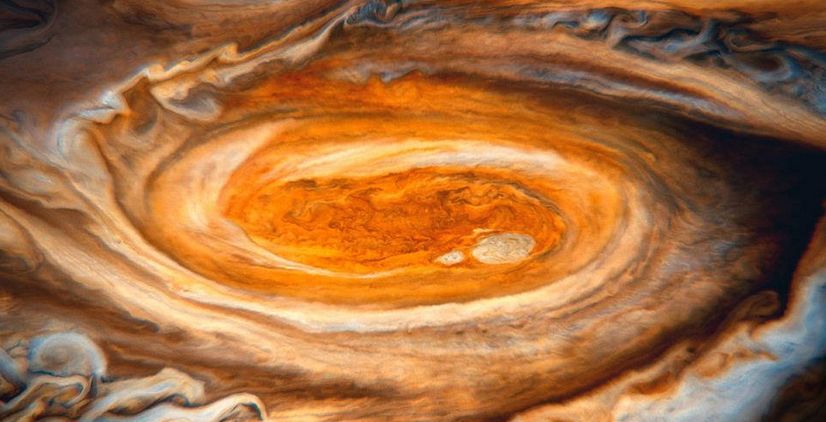
The Eye of Jupiter: a CGI recreation of the Great Red Spot based on observations from the Voyager spacecraft and Hubble Space Telescope, and as used in the television series Cosmos: A Spacetime Odyssey. Credit: 21st Century Fox.
Here on Earth, the atmosphere is heated by the Sun. However, despite being five times further from the Sun than Earth, the upper reaches of the Jovian atmosphere share similar average temperatures to our own when they should in fact be a lot colder. Many theories have been put forward as to why this is the case, but now a team from Boston University, Massachusetts, believe they’ve found the answer: the heating of Jupiter’s upper atmosphere is the combined result of the Great Red Spot (GRS) and Jupiter’s aurorae.
The Great Red Spot is one of the marvels of our solar system. Discovered within years of Galileo’s introduction of telescopic astronomy in the 17th Century, it is a swirling pattern of red-coloured gases thought to be a hurricane-like storm raging down through the centuries in the Jovian atmosphere. Roughly 3 Earth diameters across, its winds take six days to complete one spin around its centre, driven in part by Jupiter’s own high-speed spinning about its own axis, completing one revolution every ten hours.
A composite image: The Apollo 11 Saturn V on LC 39A during a countdown demonstration test on July 11th, 1969, and the Apollo 11 crew (l to r): Commander Neil Armstrong; CSM Pilot Michael Collins and LEM Pilot Edwin “Buzz” Aldrin. Credit: NASA (both)
July 20th marked two anniversaries, the first manned landing on the Moon (July 20th, 1969) by Apollo 11, and the first American automated soft-landing on Mars with Viking Lander 1 (July 20th, 1976). As such, I’m starting this Space Sunday with a short look at both events.
Apollo Lunar Module (LEM) Eagle arrived on the surface of the Moon at 20:18:04 UTC on July 20th, 1969 after being launched atop a Saturn V rocket along with Neil Armstrong, Michael Collins and Edwin “Buzz” Aldrin from the Kennedy Space Centre Launch Complex 39A at 13:32:00 UTC on July 16th, 1969. It was the culmination of John F. Kennedy’s vision to re-assert America’s industrial and technological leadership in the world.
This composite of images from NASA’s Lunar Reconnaissance Orbiter (LRO) mission, released in 2014 highlight elements of the Apollo 11 landing site on the Moon – notably the descent section of the LEM and some of the science equipment – watch the video
The land was dramatic in every sense of the word. On separation from the Command Module, the LEM immediately experienced issues communicating directly with Earth, then there were the infamous 1202 master alarm which triggered the LEM’s landing computer to re-boot itself, followed by a 1201 alarm. Then there was the discovery that, fair from being smooth and flat, the main landing site was boulder strewn, forcing Armstrong to fly the LEM to the limits of its available descent fuel in order to find a suitable landing area.
Armstrong finally set foot on the Moon on July 21st at 02:56:15 UTC, after he and Aldrin (the LEM Pilot) had been given the opportunity to rest. Aldrin followed Armstrong down the ladder 20 minutes later, and together they spent about 2.5 hours on the surface, collecting 21.5 kg (47.5 lbs) of lunar material for return to Earth. Their total time on the Moon was short – just under 22 hours – but Aldrin and Armstrong between them, seen in fuzzy black-and-white television footage and (later) crisp photos, forever changed humanity’s perception of the Moon and its place in the cosmos.
To Mark the 47th anniversary of the landing, which also saw Collins remain in orbit piloting the Command and Service Module (CSM), The National Air and Space Museum in Washington, DC has produced a 3D tour (with other goodies) of the Apollo Command Module Columbia, as seen from the pilot’s (Collin’s) seat. This can be run in most browsers and offers a first-hand tour of the vehicle.
For those who prefer a visual record, NASA issued a restored film of the entire Apollo 11 EVA on YouTube in 2014. Or you can re-live the entire mission in just 100 seconds, courtesy of Spacecraft Films, which I’ve embedded below.
Apollo 11 was the first of six missions to the Moon (Apollo 13 being famously aborted after a critical failure within the Service Module whilst en route to the Moon), which concluded on December 19th, 1972, when Apollo 17 splashed down in the South Pacific Ocean, the only Apollo mission to fly a fully qualified geologist to the Moon (Harrison Schmitt).
In the 44 years since the end of the Apollo lunar project, human spaceflight has been confined to low-Earth orbit and will not move beyond it until the 2020s (with the uncrewed Exploration Mission 1 serving as the preliminary flight for that move in 2018). As such, it is all too easy to dwell on the political motivations which led to the programme, rather than on the phenomenal achievement Apollo actually was. Today’s plans for moving beyond LEO once more, and for sending Humans to Mars, may seem long overdue but they nevertheless build on the foundations laid down by Apollo.
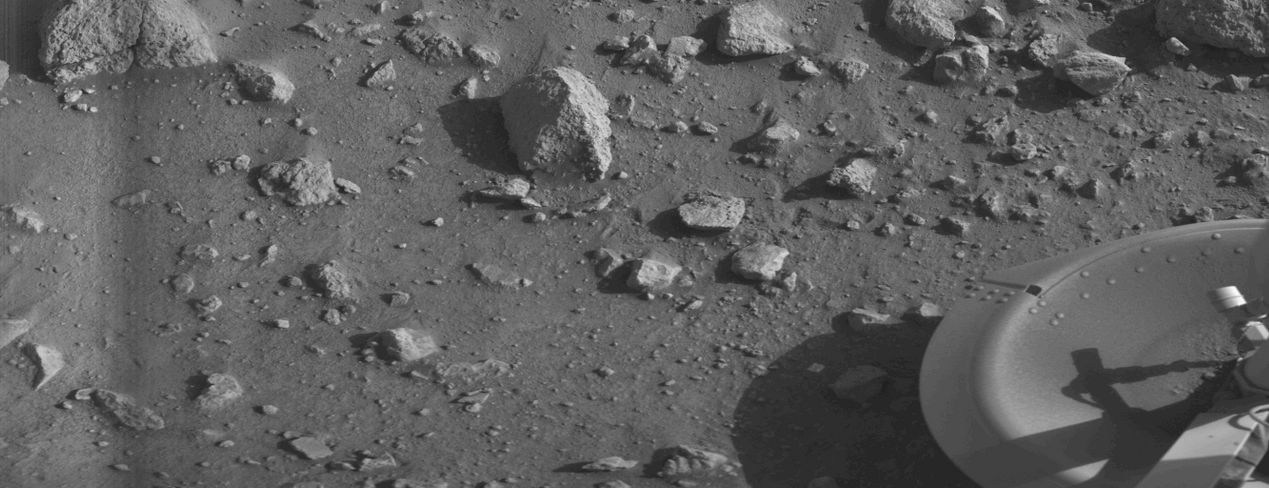
The first “clean” image of the surface of Mars returned by Viking 1 on July 20th, 1976. Credit: NASA / public domain
Viking Lander 1 arrived on the surface of Mars seven years to the date after Apollo 11 arrived on the Moon – although that hadn’t been the original intent. 1976 saw the United States celebrating its bicentennial, and it had originally been intended that the Lander would touch-down on the Red Planet on July 4th of that year.
However, after arriving in orbit on June 19th, 1976, the Viking orbiter craft used its imagining systems to survey the proposed landing site, which had been “scouted” from orbit by the Mariner 9 mission – the first vehicle to orbit Mars – in 1971 / 72. Unfortunately, the Viking orbiter’s much more capable cameras revealed the primary landing site to be far rougher than had been believed, leading to a decision not to land there, but to survey the back-up sites prior to committing to a landing on July 20th, and thus to instead celebrate Apollo 11’s triumph instead of America’s Independence Day.
Given the state of play of planetary exploration at the time, Viking was a massively impressive mission: two orbiter vehicles launched back-to-back, carrying two lander vehicles in turn carrying an impressive set of 5 experiments intended to seek signs of life on Mars. At the time, no-one actually knew the density of the Martian upper atmosphere or the load-bearing strength of the Martian surface or what they might actually find on the surface. There were genuine fears that the latter might be all dust, and the lander could simply dig itself a hole when firing its retro-rockets at the final point of landing and then fall into it, or if it did arrive safely, whether it might sink into the Martian dust; hence why the first image to be returned by the lander following touchdown prominently featured one of its own landing pads (above).
Mars as seen from 80 million km (50 million mi): a Hubble Space Telescope image of Mars captured during opposition on May 12th, 2016. Coincidentally, the Arabia Terra, one of the subjects in the report below, is the dark area in the centre of the image, together with Xanthe Terra. Cryse Planitia (Plain of Gold) is in the lower part of the light-coloured circular area dipping into the dark mass of Arabia and Xanthe Terra. North is to the top of the image, south to the bottom. Credit: NASA / ESA
It has long been believed that Mars once had oceans which covered most of the northern hemisphere lowlands about 3.4 billion years ago. Radar mapping from orbit has revealed layers of water-borne sediment similar to those found on Earth’s ocean floors, sitting on top of a layer of volcanic rock. In addition, there is strong evidence for an ancient shoreline and coastal areas around the rim of the ocean. The problem is, the evidence for the coastal areas is far from complete, leading to one of Mars’ many mysteries: if the lowlands were once home to a vast ocean, where did the shoreline go?
Alexis Rodriguez of the Planetary Science Institute in Tucson Arizona believes a study she and her colleagues have been carrying out may hold the key: sections of the Martian coastline may have been washed away as a result of massive tsunamis. And when I say huge – I mean waves towering some 120 metres (400ft) into the air.
The northern hemisphere of Mars when it was once home to an world-circling ocean, 3.4 billion years ago
The time of the Martian ocean coincides when the end of the period known as the Late Heavy Bombardment, when the planets of the inner solar system were subject to a disproportionately large number of asteroid impacts. Rodriguez and her colleagues have suggested that two particularly large meteoroids smashed into the northern hemisphere during this period, driving the tsunamis and reshaping the ancient shoreline.
The focus of the study is a region on Mars where the Arabia Terra upland region meets the lower-lying Chryse Planitia, and which should form a part of the ancient shoreline. Within it, Rodriguez and her team have identified two separate geological formations which may have been created by two separate tsunami events.
This set of images show the region where Arabia Terra flows down to Chryse Planitia. In figure A, the red line denotes the original ancient shoreline of the region. The grey area below and to the left of it denotes depositions believed to be the result of the first tsunami, together with outflow channels carved by the receding flood (blue arrows). The black line indicates the much younger shoreline of the region at the time of the second impact, which saw the formation of icy lobes in the region, and the embaying of features by slurry and material deposit by the receding waters. Images B and C focus on the coastal areas of deposition and embayment. Image created by Esri’s ArcGIS® 10.3 software
The older of the two looks every bit like a coastal region struck by a huge wave which deposited boulders over 10 metres across. As the water then receded back into the ocean, it cut large backwash channels through its debris and boulder field, depositing large amounts of surface material back into the ocean. Then, several million years later, the second impact took place.
This later event came at a time when Mars was effectively entering an ice age, and caused not so much massive tidal waves, but huge ice slurries which spread across the landscape, much of it freezing out, forming lobes of ice. The material which did make it back into the ocean also “embayed” older features there, partially burying them in the slurry.
Radar imaging has revealed subsurface large lobes of icy deposits along the outwash plains and channels in the Arabia Teraa / Chryse Planitia abutment, indicative of the study’s suggestion that some of the material deposited after the second tsunami event froze out before it could flow back to the ancient sea
The study isn’t conclusive, but does offer up some strong supporting evidence. Rodriguez and her team are the first to admit more research is required before the tsunami hypothesis might be confirmed or refuted. They are now examining other areas where the ancient coastline is “missing” to see if they exhibit similar evidence for tsunami events.
For the second time in less than a month, SpaceX has landed the first stage of a Falcon 9 rocket on a platform at sea, bringing the total of successful landings the company has so far achieved to three.
The landing came at 05:30 GMT on the morning of Friday, May 6th, just nine minutes after the rocket had lifted-off from Cape Canaveral Air Force Station in Florida on a successful mission to carry the Japanese communications satellite JCSAT-14 to orbit.
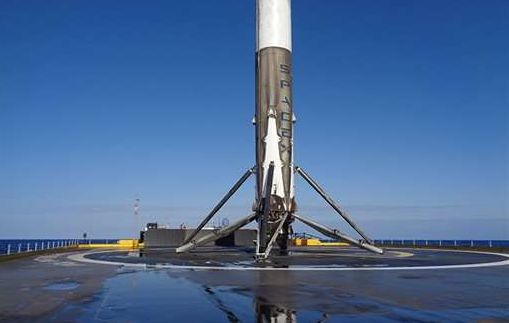
Following separation, the first stage of the Falcon 9 1a rocket performed a series of flight manoeuvres referred to as “boost back”, which culminated in the first stage making a successful touch-down on the deck of the drone ship Of Course I Still Love You, the same craft used to recover the first stage of the Falcon 9 rocket to lift the CRS-8 resupply mission to a safe rendezvous with the International Space Station in April.
The recovery of the booster stage was actually an unexpected event – SpaceX had believed that the nature of the mission would more than likely result in a failure to achieve a successful landing.
“Given this mission’s GTO [Geostationary Transfer Orbit) destination, the first stage will be subject to extreme velocities and re-entry heating, making a successful landing unlikely,” SpaceX representatives stated ahead of the launch.
The Falcon 9 1a first stage secured on the deck of Of Course I Still Love You, following the successful May 6th landing. Credit: SpaceX
Ideally, the company would like to bring all of its boosters back to a touch-down on land, as was the case with their first successful landing in December 2015. However, some mission profiles mean that the Falcon 9 cannot carry sufficient fuel reserves to complete a set of “boost back” manoeuvres that would be enough for it to make landfall, so some landings at sea are inevitable if SpaceX is to get anywhere close to recovering the majority of its launchers.
Nevertheless, with three successful landings under its belt, and three first stage rockets requiring refurbishment in order to be able to fly again, SPaceX boss Elon Musk jokingly conceded, in a Tweet made after the landing, “May need to increase size of rocket storage hangar!”
The “Boiling” Waters of Mars
An international team from France, the UK and the USA have produced the strongest evidence yet that the distinctive recurring slope lineae (RSL) features seen on the slopes of Martian craters are produced by liquid water. And not just any water; the study suggests the water is “boiling”.
RSLs have been the subject of intense debate and discussion since 2011; in essence, they are ridges and rills which appear on the slopes of hills and craters, notably in the equatorial regions of Mars during the summertime. The significance here being that on Earth, identical features are always the result of free-flowing water. As the “recurring” in the title suggests, the Martian RSLs appear to be active – frequently renewing themselves on a seasonal basis, with new RSLs sometimes also appearing at the same time.
Two images showing the flank of the same crater, revealing what appear to be active RSL, periodically renewed during the Martian summer. Credit: NASA/JPL
However, the low pressure of Mars’ atmosphere means that water cannot survive long on the surface unprotected: it will either freeze or sublimate. So the idea of it surviving long enough to create trails in the sides of craters had many scientists scratching their heads. Then, in 2015, a NASA study put forward evidence RSLs might actually be the result of water containing a strong suspension of mineral salts – magnesium perchlorate, magnesium chlorate and sodium perchlorate. Such minerals could be sufficient enough to prevent water exposed to the surface environment on Mars either immediately freezing or sublimating.
Building on this idea, the French-led international team used blocks of water ice containing the same minerals and placed them on the slope of a simulated Martian crater housed inside a special Mars Chamber at the Open University in the UK. When the pressure in the chamber was reduced to the ambient surface pressure on Mars and the temperature adjusted to a typical Martian summer’s day, the team found the ice would melt, producing a liquid mix which effectively “boiled” filtering into the sand and moving down-slope. As it did so. the resultant vapour “blasted” sand grains upwards, creating ridges which would collapse onto themselves when they became too steep, forming channels almost identical in form to Martian RSLs.








 Inara Pey: Living in a Modemworld