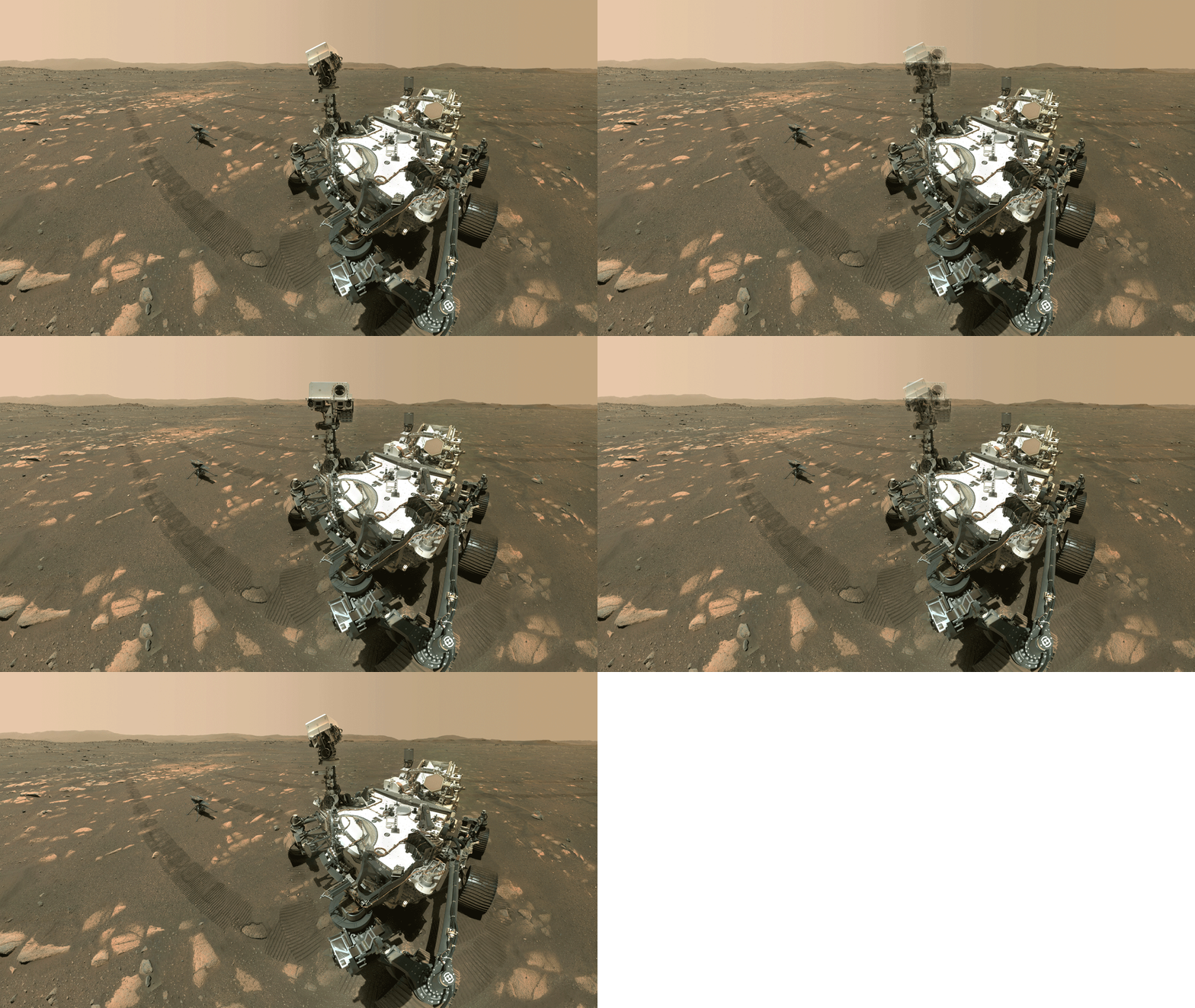
Mars 2020 mission Sol 46 (April 6th), 2021, a series of 62 images captured using the WATSON imager on the robot arm of the Perseverance rover were used to create this “selfie” of the rover “looking” at the camera, then back at the Ingenuity helicopter sitting on the ground some 4 metres away. Credit: NASA/JPL
NASA has delayed the first flight of the Ingenuity helicopter on Mars after the vehicle detected an issue during one of its pre-flight tests.
For the past week, the agency has been preparing the little helicopter drone, part of the Mars 2020 mission, for the first of a series of 5 pre-planned test flights within Jezero Crater. It had been hoped the flight could take place on Sunday April 11th / Monday April 12th, 2021 (depending on where you are in the world); however it will now not take place until Wednesday, April 14th at the earliest.
After being dropped on the surface of Jezero Crater by the Mars 2020 Perseverance rover (see my previous space Sunday report), Ingenuity successfully recharged its batteries using solar energy and survived its first night alone on Mars without incident. This was a major milestone for the project, as there were fears that if the batteries couldn’t be fully charged and generate sufficient heat, the extreme cold of the Martian night could freeze the vehicle’s electronics, and even crack the batteries themselves.
Since that first night, the helicopter has shown it can keep itself warm and the flight team has spent the week conducting a range of pre-flight checks, including unlocking Ingenuity’s pair of contra-rotating propellers and then testing them under power and at low speeds, then speeding up to higher speeds, including an attempt to reach the 2400 rpm required for take-off.
Part of testing Ingenuity included taking a low-resolution image via its downward-looking camera system while it was still sitting under the rover. April 3th, 2021 / Sol 42. Credit NASA/JPLAll of these tests were completed successfully, with the exception of the final full-speed test attempted on Friday, April 9th. This aborted during the phase when the command programme on Ingenuity was supposed to switch from “pre-flight” to “flight” mode, as will be required ahead of the actual flights. However, a guardian “watchdog” timer designed to oversee the correct execution of command sequences expired before the switch-over occurred, prompting Ingenuity to safely shut-down its motor and await further instructions from Earth.
Following a full evaluation of telemetry received following the curtailed test, the flight team were confident that no actual damage had occurred to the helicopter, stating the full spin-up test of the rotors would be postponed and the flight itself delayed until April 14th. They also indicated that assuming the first flight was completed without incident, the second flight will take place on Sunday, April 18th.
The rotor tests took place once Perseverance was well clear of the helicopter – the rover is gradually making its way to the look-out point where it will record Ingenuity’s flights. However, before it did so, engineers took the opportunity to use the WATSON (Wide Angle Topographic Sensor for Operations and eNgineering) camera on the rover’s robot arm to capture a series of 62 images that were stitched together to produce a picture of Perseverance apparently “looking” back at the helicopter using its mast cam imaging systems, and which can be seen at the top of this article.
Another image Perseverance took that recently caused excitement was one that appeared to show a “rainbow” arcing across the dusty Martian sky. Captured on April 4th (Sol 43), the image spread quickly across social media, as did the “rainbow” explanation.
Captured on April 4th (Sol 43), this image via the rear-facing Hazcam system on Perseverance caused excitement in the media, being described as a “rainbow”. However, it wasn’t any such thing, as NASA was forced to explain. Credit: NASA/JPL
The only problem being, rainbows are impossible on Mars, as NASA quickly stepped in to note through social media:
Many have asked: Is that a rainbow on Mars? No. Rainbows aren’t possible here. Rainbows are created by light reflected off of round water droplets, but there isn’t enough water here to condense, and it’s too cold for liquid water in the atmosphere.
Rather, the “rainbow” was the result of lens flare – light being scattered by the lens of the Hazcam (HAZard avoidance CAMera) that captured the image, to strike the imaging sensor in multiple places like an arc of machine-gun bullets. Such effects are prevented on the front-facing Hazcams (the ones most frequently used by the rover, as they are equipped with sunshades; however, similar shades were deemed superfluous on the rear-facing Hazcams, and so lens flares like this are actually quite common should the system be in use and the Sun happens to be in the right position.
Released on March 5th, 2021, this image was captured on February 22nd, 2021 (Sol 4), using the Mastcam-Z system on NASA’s Perseverance rover. It shows a raised section of outflow delta sediments approximately 2.3 km west of “Octavia E. Butler Landing”, where the rover touched down. It was likely formed by material carried into the crater by flowing water that gradually settled as the flow of water met the calmer waters of the crater lake. The remnant is approximately 25-30m high and some 200m across at its base, as indicated by the horizontal scale. Beyond it can be seen the crater wall forming the backdrop to the image. Credit: NASA/JPL
NASA’s Mars 2020 Perseverance rover has spent a further week prepping itself to commence full-time operations on Mars, while also clocking up a distance of 90+ metres while further exercising its driving skills. The mission has also started honouring the Navajo people and their language.
Prior to the mission launching, the science team divided the anding site in Jezeo Crater into a grid with each cell covering an area of 1.5 square kilometres and after a US national park exhibiting similar geology. The plan was to compile a list of names inspired by each cell’s national park that could be used to name features observed by Perseverance. However, as the rover landed in the cell named for Arizona’s Canyon de Chelly National Monument (Tséyi’ in Navajo), in the heart of the Navajo Nation, the mission team reached out to the Navajo Nation through team member Aaron Yazzie, himself a Navajo (or Diné), to seek their permission and collaboration in naming new features on Mars.
Navajo Nation President Jonathan Nez, Vice President Myron Lizer enthusiastically agreed to the idea and worked with advisers to make an initial list of 50 words in the Navajo language that could be used by the rover’s team in dubbing surface features imaged by the rover.
The partnership that [we have] built with NASA will help to revitalize our Navajo language. We hope that having our language used in the Perseverance mission will inspire more of our young Navajo people to understand the importance and the significance of learning our language. Our words were used to help win World War II, and now we are helping to navigate and learn more about the planet Mars.
Navajo Nation President Jonathan Nez
“Máaz” (Navajo for “Mars”) is currently the first target for scientific study by Perseverance. Credit: NASA/JPL
These names have already started to be used, and more are being added to the list. There is, however a complication: the accent marks used in the English alphabet to convey the unique intonation of the Navajo language cannot be read by the computer languages Perseverance uses. So instead, the science team is working with the Navajo to produce unaccented phonetic representations of the names which the rover can interpret.
The first of the Navajo names to be used is “Máaz” (the Navajo word for Mars – or “Maaz” to the rover). It has been applied to the first target for study by the rover, a large, flat rock the rover is due the commence studying soon. A second rock, dubbed “Yeehgo” (Yéigo in Navajo) has been used as a test subject for the rover’s SuperCam.
“Yeehgo” some 3.1m from the rover was used as a test subject for the SuperCam imager system and lasers on March 10th (Sol 16), during the rover’s driving operations. This images so the image contrasts from Navcam imagers (main picture) to Mastcam-Z (lower right) and Supercam mosaic of 2 images.Credit: NASA/JPL
Developed jointly by the Los Alamos National Laboratory (LANL) in New Mexico and a consortium of French research laboratories under the auspices of French space agency CNES, SuperCam is an instrument suite that can provide imaging, chemical composition analysis, and mineralogy in rocks and regolith from a distance. It comprises two lasers that can “zap” rocks and other features multiple times per second while using it imaging system and four spectrometers to analyse the vapour and dust given off by the laser strikes to determine the composition of the material struck and potentially identify bio-signatures and assess the past habitability of the rock.
“Yeehgo” was used as a means of testing the resolution of the Remote Micro-Imager (RMI) on the SuperCam system, with the rover’s high-resolution Mastcam and Navcam systems (both of which are mounted on the rover’s mast just below the SuperCam) also capturing images for context. The rock was also a target for the laser systems, which the on-board microphones picked up as they fired, the lasers sounding like a fast swinging Newton’s Cradle (sorry, no “pew-pew!” from Mars).
Since departing “Octavia E. Butler Landing” the rover has been scouting locations of interest, in particular looking for an area when it might safely drop off the Ingenuity drone helicopter. The latter is intended to complete its test flights in the first 30-60 days of the mission in order to free-up the rover so it can drive much further afield and get on with its primary science mission in earnest.
Along the way, Perseverance paused to take in objects such as the rocks mentioned above, and to perform checks of its underside using the imaging systems on its robot arm, checking on the ejection of the “belly pan” covering the underside caching system that will deposit samples of rock and material for collection by a future sample-return mission.
I’ll have more on the Mars 2020 mission over the coming weeks.
Left: March 12th (Sol 18), the imaging system on the rover’s robot arm is used to check the underneath of the vehicle ahead of the release of the belly pan (outlined) covering the sample caching system. The four forward cameras of the Hazcam system can be seen at the top of the picture. Right: March 13th (Sol 19), a view from the rover’s rear Hazcam system images the belly pan on the ground as the rover resumes its drive. Credit: NASA/JPL
Two seconds from disaster: an inverted starship prototype SN9 about to impact the landing pad at Boca Chica, February 2nd,2021. Directly below the vehicle and on the horizon is the angled base of the Super Heavy launch platform (under construction). Centred on the ground is the Starhopper test vehicle with the SN7.2 test tank to the right. Image credit: Cosmic Perspective
On Tuesday, February 2nd, and after Federal Aviation Authority (FAA) related delays, SpaceX starship prototype SN9 took to the skies over southern Texas in the second high altitude flight test for the starship programme.
The flight itself, to some 10 km altitude, followed by a skydive descent to around the 2 km altitude mark, was remarkably successfully – as was the case with the first high-altitude flight (to 12 km on that occasion) seen with starship prototype SN8 in December 2020 (see: Space Sunday: the flight of SN8 and a round-up). However, and also like the SN8 flight, things went off-kilter during the final element of the flight, resulting in a complete loss of the vehicle.
Lift-off: SN9 rises from its launch platform with SN10 beyond it. he angle of this shot makes the two vehicles appear closer than they were in reality; SN10 was in fact well clear of its sister. Image credit: LabPadre
As I’ve previously noted, the route of staship prototype SN9 from fabrication high bay to launch stand had been remarkably fast compared to that of SN8, leading to speculation that the anticipated second flight test could occur in January. However, while the vehicle remained on the launch stand going through numerous pre-flight tests, including numerous Raptor engine re-start tests (which actually saw two of the motors swapped-out), things appeared stalled before that final step of an actual flight.
This now appears to be down to the fact that the FAA weren’t entirely happy with SpaceX over the flight of SN8, which effectively went ahead without proper approval. In short, SpaceX applied for a waiver against the licence the FAA had granted for starship flight testing which would have allowed the company to exceed “maximum public risk as allowed by federal safety regulations”.
At the time, the waiver was denied – but the SN8 launch went ahead, violating the required safety limits, and whilst no-one was injured in the crash of SN8, the FAA correctly ordered a full investigation into the flight and also the safety culture and management oversight of SpaceX operations. Those investigations not only took time to complete, but also afterwards required FAA review and make modifications to the licence granted to SpaceX to carry out starship prototype flights.
Boca Chica from space: captured by a SkySat satellite approximately 568 km above the Earth, this image shows the SpaceX Boca Chica launch facility with the two Starship prototypes on their launch stands, the SN7.2 tank test unit, the Super Heavy booster launch stand under construction, and other elements such as the fuel farm, and Highway 4 running from the coast (r) back to the SpaceX construction and fabrication facilities (off to the left of the image). Image credit: Planet Labs
If a licensee violates the terms of their launch license, they did so knowing that an uninvolved member of the public could have been hurt or killed. That is not exaggeration. They took a calculated risk with your life and property … If the FAA does not enforce their launch licenses, it will damage the long-term viability of the launch industry and damage their credibility with Congress. It is possible that the industry could suffer significant regulatory burdens enforced by Congress to ensure safety.
– Former deputy chief of staff and senior FAA adviser Jared Zambrano-Stout,
commenting on SpaceX launching SN8 without the request licence waiver
The required licence modifications were not completed until February 1st, the day on which SpaceX initially attempted to launch SN9, and their lack of their availability may have been the reason that attempt was scrubbed, resulting in the February 2nd attempt.
Coverage of the test flight started very early on the morning (local time) on February 2nd, with SpaceX providing multiple camera points around the launch stand and on the vehicle, as well as via drones flying overhead In addition, spaceflight enthusiast such as NASASpaceflight.com also provided coverage from multiple points around the Boca Chica, Texas, site, including video recorded by Mary “BocaChicaGirl”, who provides a daily 24/7 feed of activity at the site.
The vehicle, with prototype SN10 occupying a second launch stand nearby, lifted-off at 20:25:15 UTC, following a 25 minutes delay due a range safety violation – one of the circumstances of concern to the FAA. However, the ascent itself was flawless, with the vehicle rapidly climbing to altitude over the next four minutes, two of the Raptors shutting down as it did so to reduce the dynamic stresses on the vehicle in light of it being only partially fuelled and to ensure it didn’t overshoot the planned apogee for the flight.
Flip over: at 10 km altitude, the one operational Raptor motor gimbals its thrust as the leeward midships RCS thruster fires, tipping SN9 over to start its 2-minute skydive back to the ground. Image credit: SpaceX
This came at 20:29:15 UTC, with the vehicle entering a brief hover using its one firing motor, as fuel supplies were switched from the main tanks to the smaller “header” tanks that would be used to power the engines during landing manoeuvres. At this point, the remaining motor shut down as the reaction control system (RCS) thrusters fired, gently pushing the vehicle over from vertical and into its skydive position, where the fore and aft aerodynamic surfaces could be used to stabilise the vehicle during descent.
This phase of the descent lasted just over 2 minutes, with the order given to re-start two of the Raptor engines given at 20:31:35 UTC. These engines should have then gimballed and used their thrust, together with the forward RCS thrusters to return the vehicle to a vertical pose before one of the motors again shut down and the second slowed the vehicle into a propulsive, tail-first landing.
From below: a camera on the ground dramatically captures the moment one of the Raptor engines on SN9 re-starts as RCS systems fire to help maintain stability. Image credit: SpaceX
Both of these motors fire a split second apart, and footage of the rear of the vehicle suggests that the first may have suffered a mis-fire before starting correctly. However, the second motor appears to have suffered a catastrophic failure on re-start, possibly involving a turbopump failure: as it ignited, debris could clearly be seen being blown clear of the vehicle.
With only one operational main engine, SN9 was unable to stop its change in flight profile and remain upright. Instead, it continued to rotate and become inverted just before it struck the landing pad in what SpaceX refer to as “an energetic, rapid unscheduled disassembly” (that’s “exploded on impact” for the rest of us).
No official word on the failure has been given – obviously, SpaceX will need time for a thorough investigation, and will likely have the FAA watching closely. It is also not clear if the material coming away from the vehicle is actually parts of the engine, or sections of the engine skirt blown clear of the vehicle. As some are still to be drifting down to the ground fairly close to SN10 on its launch stand, it is possible they are from the vehicle’s skin.
A wider image of the inverted SN9 prototype just before impact, with the Super Heavy launch stand, SN7.2 tank and Starhopper prototype overlapping one another, and the SN10 prototype to the right. Note the debris (arrowed) drifting down behind the vehicle. Image credit: NasaSpaceflight.com
SpaceX SN5 rises from its launch stand at the SpaceX Boca Chica, Texas, centre. Credit: SpaceX
SpaceX once again heads this week’s column after the Starship SN5 prototype became the first of the units to successfully make a “hop” into the air and back again, travelling some 150 metres up and several tens of metres sideways to navigate its way from launch platform to landing pad.
The flight of the “flying spray can” – the nickname derived from the vehicle’s cylindrical form topped by the nozzle-like 23 tonne ballast mass – only lasted around a minute once the Raptor engine fired, but the hop represented a huge leap forward for SpaceX in their development of the Starship vehicle.
As I noted in July, SN5’s unusual shape is due to it only comprising the section of the vehicle containing its fuel tanks, single raptor engine and landing legs. It lacks any upper sections (replacing by the ballast block) and the aerodynamic surfaces that will give Starship a lifting body capability during atmospheric operations. These will all be present in future prototypes, But for SN5, they are not currently required, as its initial flight(s) are purely about testing Starship’s ability to make a vertical descent and landing.
A starship cutaway showing the fuel tanks and engine bay (outlined in red) that form the prototype vehicle SN5, and the upper cargo / habitation space and aerodynamic surfaces that are not included on the current prototype. Credit: WAI (with additional annotation)
The successful test flight took place on Tuesday, August 4th – an attempt on Sunday, August 2nd was cancelled due to unfavourable weather in the Boca Chica, Texas, area. Engine ignition came at 23:57 UTC (18:57 local time), the prototype rising vertically, but canted at a slight angle. This was due to the initial prototypes being designed to operate with three Raptor motors, by SN5 is currently only fitting with one, offset from the vehicle’s vertical centreline, so the vehicle is canted (with the ad of the top ballast block) to compensate for the offset thrust from the motor, with small reaction control system (RCS) jets near the base and top of the vehicle occasionally firing to help maintain a stable flight angle.
As the craft rose, the Raptor motor was also gimballed (moved around like you move a joystick on a game controller, a common practice for rocket motors to allow them to use directed thrust to adjust a flight trajectory), vectoring its thrust so it could translate across to the landing pad for a successful landing.
Prototype nose cones being fabricated at Boca Chica. Credit: NASASpaceflight.com / BocaChicaGal
SpaceX released a video afterwards the flight showing the highlights. In it, SN5 can be seen lifting off, trailing a plume of vented cooling gas, the RCS jets visible as they fire to help maintain stability. The footage also clearly shows the Raptor’s offset exhaust plume moving as the motor in vectored, as well as the craft maintaining a brief hover at the apex of its flight before descending sideways and down towards the landing pad.
Cameras at the base of the vehicle show the landing legs being deployed, as well as a small, non-hazardous fire on the Raptor motor, likely the result of dust blown into the engine space at lift-off that subsequently ignited. This “inside” camera and one on the SN5 hull then captured the moment of landing and engine shut down.
Prototypes SN6, 7, and 8 are in development, and some of these will fly with the aforementioned forward / upper sections and flight surfaces in loftier (literally) and more complex flight tests. Currently, it not clear how many more flights SN5 will make. However, Musk has already indicated he would like to have Starship use a more “Falcon Like” set of landing legs to provide broader support when landing on uneven planetary surfaces, so SN5 might by used to test new landing leg configurations alongside testing of other prototypes.
A Starship / Super Heavy pairing lifts-off from a dedicated launch facility in this still from an animated video produced by SpaceX for the September 28th, 2019 update. Credit: SpaceX
On the occasion of the eleventh anniversary of SpaceX achieving orbit for the first time with their Falcon 1 rocket on September 28th, 2008, CEO Elon Musk presented an update on the company’s progress developing its massive Super Heavy booster and interplanetary class vehicle, Starship.
It has been some 12 months since the last update on the development of the two vehicles – the last update really being overshadowed by the announcement SpaceX planned to fly a Japanese billionaire and his entourage around the Moon and back (see Moon trips, Mr Spock’s “home” and roving an asteroid for more), and the programme has moved on significantly since then, as indicated by the fact that the 2019 update took place at the SpaceX facilities in Boca Chica and against the backdrop of the first of the Starship prototype vehicle.
Starship Mk1 under construction at the SpaceX facilities near Boca Chica, Texas. Credit: unknown
Since its first public unveiling in 2016, the Starship / Super Heavy combination has been through a number of iterations and name changes. However, it is fair to say that things have now settled down on the design front, and what was presented at Boca Chica is liable to remain largely unchanged, assuming everything proceeds as SpaceX hopes.
In this, the flight capable prototype Starship at Boca Chica is the first in a series of such vehicles. A second is under construction at the SpaceX facilities in Cocoa, Florida, and three more are planned, one of which will be used to make the first orbital flight within the next 6 months, and Musk suggesting another could be used in a crewed orbital flight within the next 12 months – which sounds exceptionally ambitious. Construction of the two initial Starship prototypes has not exactly been secret: both have been literally assembled in the open. So even ahead of the September 28th event, some were already developing renderings of the new Starship design compared to the last known iteration.
A rendering by Kimi Talvitie comparing the 2018 design for Starship (l) with the prototype (r). The rendering of the 2019 prototype was based on direct feedback from Elon Musk
The new design sees some significant changes in Starship – notably with the fins, canards and landing legs. The 2018 variant was marked by three large fins, two of which would be actuated (hinged for up / down motion relative to the hull) for atmospheric flight, with all three fins containing the vehicle’s landing legs. At the time of that design, I commented that this approach appeared risky: a heavy landing on the Moon or Mars might conceivably damage one of the actuated fins, affecting the vehicle’s ability to undertake atmospheric flight on its return to Earth.
With the new design, the fins are reduced to two and reshaped, both of which are actuated to hinge “up” and “down”. In addition, the landing system is now independent of the fins, removing the greater part of the risk of damaging them on landing. The number of landing legs is also increased to six. At the forward end of the vehicle, the canards are enlarged and hinged in a similar manner to the fins.
Starship’s basic specification. Note the “dry” mass of 85 tonnes is incorrectly stated in the slide: it is expected the production version of Starship will mass around 120 tonnes (the prototype masses around 200 tonnes. Credit: SpaceX
The remaining aspects of the design are more-or-less unchanged as far as the body of the ship is concerned: it will be some 50 metres (162.5ft) in length and have a diameter of 9m (29ft). The forward end of the vehicle will be given over to crew and passengers or cargo (or a mix of the two), although Musk now estimates the vehicle will – with the aid of the Super Heavy booster – be lifting up to 150 tonnes to low Earth orbit – an increase of roughly a third – and return up to 50 tonnes to Earth.
To help achieve this, the motor system has been slight revised. While six engines will still be used, three will now be optimised for vacuum thrust, ideal for orbital flight and pushing the vehicle out to the Moon or Mars, and the remaining three optimised for sea level thrust and capable of being gimballed for use during a descent through an atmosphere and landing.
Starship’s motor arrangement: three central Raptor engines optimised for sea level thrust and capable of gimballing and three outer vacuum optimised motors with fixed, large diameter exhaust bells for maximum efficiency. The “boxes” visible in the rendering are potentially additional cargo bins. Credit: SpaceX
During the presentation, Musk explained the rationale behind the use of 301 cold rolled stainless steel in the design, noting a number of reasons. Firstly, the cold rolling process results in a stronger, light finished product, and this becomes even stronger when exposed to the very low temperatures of cryogenic fuels. Thus, Starship and Super Heavy in theory have a structural strength equitable to that of carbon composites – but at a much lower overall mass.
Secondly, the cold rolled steel has very high melt temperatures, reducing the amount of direct heat shielding required, again reducing the vehicle’s overall mass. It is also both highly corrosion-resistant and easy to work with. This means that basic repairs to a vehicle on the surface of the Moon or Mars could be effected, or even that a Starship could even be dismantled and the steel from the hull re-purposed. Finally, there’s the fact that all these advantages are gained in a product costing around 2% that of an equivalent mass of carbon composite.
Starship Mk 1 filmed during the September 28th livestream event. Credit: SpaceX
In terms of heat shielding, the “windward” side of Starship (the side facing the fictional heat of entry into an atmosphere) will be coated with lightweight ceramic tiles. Somewhat similar in nature to those used within the space shuttle, they will be of a hardier material and less prone to damage. The re-entry profile was also discussed, with Musk comparing Starship to a sky diver.
To explain: the vehicle will approach the atmosphere at a relatively high 60-degree incidence, using the heat generated by contact with the upper atmosphere to slow its velocity from Mach 25 to a point where, once within the denser atmosphere, the vehicle is literally falling more-or-less horizontally. The fins and canards can then be used to maintain the vehicles orientation in a similar manner to that of a sky diver using his arms and legs. in addition, the lift generated by fins and canards will further help slow its descent until, roughly 2 km above the ground, the vehicle will rotate to a vertical position and use the three gimballed Raptor motors to make a propulsive, tail-first landing.
SpaceX plan to offer Starship in support of lunar operations – but the company’s goal is to establish a permanent human presence on Mars. Credit: SpaceX
Starship Mk 1 is equipped with the same sea level optimised Raptor motors as intended for the production vehicles. SpaceX hope to see it make at least one flight before the end of the year – although the company has yet to secure a permit from the US Federal Aviation Authority to commence flights. This first attempt will be to an altitude of around 20 km (12.5 mi) before a descent and landing. If successful, the test programme involving the various prototype vehicles will unfold from there.
Dude, why’s my car in orbit? Musk’s cherry-red Tesla photographed from its payload mounting on the Falcon Heavy upper stage. Credit: SpaceX
On Tuesday, February 6th, SpaceX launched one of the world’s most powerful launch vehicles – in fact, currently, the most powerful launcher in operation since NASA’s massive Saturn V rocket by a factor of 2 in terms of lift capability.
I’m of course talking about the Falcon Heavy, which after years of development and launch delays, finally took the to skies at 15:45 EST (20:45 UTC) on the 6th, after upper altitude wind shear delayed the launch from its planned 13:30 EST lift-off time – which would have been at the start of the four-hour launch window required to send its payload on a trans-Mars injection heliocentric orbit.
Three cores, 27 Merlin engines, 5 million pounds of thrust. A remarkable shot of the lower part of the Falcon Heavy at lift-off, captured by Ryan Chylinski. Credit: R. Chylinski / SpaceFlight Insider
The run-up to the launch was handled fairly conservatively by SpaceX: Falcon Heavy is a complex system – effectively three individual Falcon 9 rockets which have to operate in unison. So much might go wrong that even Elon Musk was stating he’d be happy if the vehicle was lost after it had cleared the launch pad. This was not a joke: in September 2016, a pre-flight test of a Falcon 9 lead to the loss of the vehicle, its payload and massive damage to its Cape Canaveral launch pad, putting a dent in SpaceX’s launch capabilities at the time. A similar event at Kennedy Space Centre’s pad 39-A, the only launch facility capable of handling the Falcon Heavy, would be a massive setback for the company’s 2018 aspirations.
However, and as we all know, the launch proved to be flawless. All 27 engines fired as required, generating the same thrust as 18 747 running all their engines at full throttle, and the vehicle took to the air. Two minutes later, the “stack” reached the point of “max-Q”, the point at which aerodynamic stress on a vehicle in atmospheric flight is maximised (symbolised in a formula as “q” – hence “max Q”). At this point, were the rocket’s engines to continue to run at full thrust, the combined stresses could literally shake the vehicle apart; so instead the motors are throttled back, easing the strain on the vehicle, prior to them returning to full thrust as “max-Q” has passed.
The Falcon Heavy flight path. Credit: SpaceX
After passing through “max-Q”, the vehicle completed perhaps the most spectacular part of its flight. Their job done, the two outer Falcon 9 stages shut down their engines and separated from the core rocket. Then then re-lit their engines to boost them vertically to where both could perform a back-flip and then return for a landing at Cape Canaveral Air Force Station, just south of Kennedy Space Centre. So perfect was this aerial ballet that the two boosters landed almost simultaneously.
The central first stage should have also made a return to Earth after separating from the upper stage, landing aboard one of the company’s two autonomous spaceport drone ship (ASDS) – necessary because the stage had flown too far and too high to make a return to dry land. This was the only point of failure for the flight. Unfortunately, it over-burnt its propellants, leaving it without enough fuel to land on the floating platform. Instead, it slammed into the sea at an estimated 480 km/h (300 mph), some 100 metres (300ft) from the ASDS – the only notable failure in the launch.
Two from one: the moment at which two Falcon 9 cores are about to touch-down at Cape Canaveral Air Force Station following the February 6th, 2018 launch of Falcon Heavy. Credit: SpaceX
The second stage, however, performed perfectly, the payload fairings jettisoned, and the world got its first look at a car in space: Musk’s own Tesla Roadster, complete with a spacesuited mannequin (“Starman”) at the wheel, Don’t Panic – a reference to The Hitch Hiker’s Guide to the Galaxy – displayed on the dashboard. During the ascent, he was apparently listening to David Bowie’s Space Oddity played on the car’s stereo.
Right now, “Starman” and the car are en-route to a point out just beyond the orbit of Mars. It is is on a heliocentric (Sun-centred) orbit, travelling between 147 million and 260 million km (91.3 million and 161.5 million mi) from the Sun, and passing across both the orbits of Mars and Earth in the process – but without actually coming close to either. It will continue in this orbit for millions of years. Continue reading “Space Sunday: rocket power and space stations”→